King Charles and Queen Camilla went to church in Australia last Sunday. They attended a regular service held at St Thomas’ North Sydney.
Kanishka Raffel, who is the Anglican Archbishop of Sydney, preached a sermon for all, whether they were Kings or kids, monarchs, musicians or mechanics.
What might an Archbishop preach about in the presence of the monarch? Of all the subject matter in the world, both large and small, what message is worth pressing home?
Kanishka spoke on Acts 8:26-40. Long before the Gospel ever reached the shores of England, and Europe, the good news of Jesus Christ came to an Ethiopian man who then took God’s message home with him.
‘The Good News of Jesus’. I can’t think of a better message for everyone to hear.
The media is having a field day over a story that erupted at a graduation ceremony yesterday for the Australian Catholic University (ACU).
Former Union chief, Joe de Bruyn, was awarded an honorary doctorate and delivered a speech to the newly graduating students. What followed led to 90% of students, staff, and family members walking out in disgust.
I know very little about de Bruyn and I’m not making a judgment about where his heart is, but his speech may well go down in the annals of ‘how not to present a Christian viewpoint’ (if indeed this can be classified as Christian).
In his 15-minute address (which ACU heads knew about in advance), de Bruyn offered a critique of all that is evil in Australian society. He hit at 3 subjects in particular: abortion, IVF, and same-sex marriage.
Unpopular opinion: it is possible to agree with the substance of his concerns (or agree in part) and also think de Bruyn’s speech is counterproductive and even unChristian.
First of all, I believe abortion is a terrible practice for society to accept. Taking the lives of the unborn isn’t a sign of cultural maturity and success; quite the opposite. Second, I accept Jesus’ understanding of marriage, and how marriage is between one man and one woman, intended for life. Third, I disagree with de Bruyn’s cancellation of IVF. IVF, like so many technological developments, presents us with ethical dilemmas that require much wisdom. For instance, a Christian couple may proceed with IVF along with agreed conditions, thus using the technology but with a much narrower moral parameter than what is set by law. More importantly, framing all these issues without the Gospel of Jesus Christ, will in fact distort each one and therefore misrepresent how we ought to speak of these issues in both church and society.
Second, why do I suggest that the speech was unwarranted and unhelpful?
There are 3 key components that work together and de Bruyn failed in 2 ½ of these:
i. What he said…
ii. How he said it…
iii. The occasion in which he said it…
Let’s start with the occasion. This was a graduation ceremony at a university, albeit a Catholic one. Being Catholic, I imagine this provides more latitude for Christian language and ideas to be present than if it was a secular institution. Even with this, is a graduation service the appropriate time to list all the evils in Australia and to vent all one’s personal axes and anxes onto the students and their families? I would be stunned if such a speech was delivered at a Christian theological college, let alone a mainstream university.
Second, I’m reminded of how often the Bible tells us that how we speak is as crucial as what we speak.
Proverbs 15:1 says, “A gentle answer turns away wrath, but a harsh word stirs up anger.”
The Apostle Peter exhorts,
“But in your hearts revere Christ as Lord. Always be prepared to give an answer to everyone who asks you to give the reason for the hope that you have. But do this with gentleness and respect” (1 Peter 3:15)
Paul writes,
Therefore, as God’s chosen people, holy and dearly loved, clothe yourselves with compassion, kindness, humility, gentleness and patience. (Colossians 3:12)
Speech that is void of love is like a cymbal repeatedly clashing in your ears; it’s jarring and we do your hearing no favours. As the Apostle says,
“If I speak in the tongues of men or of angels, but do not have love, I am only a resounding gong or a clanging cymbal” (1 Corinthians 13:1)
Of course, truth can and often does offend, even when spoken with the gentleness, patience, and kindness of Christ. Look at how society responded to Jesus when he taught and showed the grace of God! Nonetheless, this doesn’t legitimise aggression or slander and a host of accompaniments that betray the Christian message. It may also be worth pointing out that when anger is expressed by God, Jesus, or the Apostles, it is often aimed at religious people for their hypocrisy and their failure to live out the faith they claim to have.
Why I am writing about Joe de Byun’s ACU speech? A reason for making a comment is because this address is symptomatic of a theme that is becoming far too common and accepted today in ‘Christian’ circles. It’s as though angry words mean faithful words. No, it doesn’t. Yesterday’s incident is all the more bewildering given that he was invited to speak, knowing his track record, and with some knowledge of what he was planning to say.
Too often we are seeing angry Christians throw around words in the public space as though they are faithfully representing Jesus. Don’t get me wrong, anger has a place, but it shouldn’t be a regular go-to in public discourse. Are we trying to win applause from vocal supporters or are we trying to persuade people of a Gospel vision for life?
Hundreds of people walked away, a few staunch supporters remained, while others sat uncomfortably and embarrassed and required to continue with their duties. Did anyone leave with a better understanding of the Christian Gospel or of a life-affirming view of God?
Thankfully there were other words spoken at yesterday’s ACU Graduation. These words aren’t being reported in the newspapers but they were shared and how much more befitting,
“As you take you next step, remember our mission.
First, Act in truth and love. These words are from Paul’s letter to the Ephesians. Paul was writing to a community of Christians struggling with persecution and division. The love Paul talked about here doesn’t translate perfectly into English. He wasn’t talking about romantic love or the love between friends. He certainly was not talking about an emotion or anything sentimental. Paul was talking about a decision – an act of will – to live in ways that serve, and meet the needs of other people, especially when doing so is hard, and costly.
Second, Pursue knowledge. Knowledge founded in truth, and communicated with grace and compassion. We see every day the ugliness of discourse as it exists on social media. I encourage you to make the decision to mediate the knowledge you gained through your study at ACU by acting with gentleness and kindness.
Third, remember that all people are valuable. As you grow in confidence in your professional lives, don’t forget what it was to be unsure, vulnerable or unpopular.
Finally work for the Common Good. My hope for you is that your professional lives promote the wellbeing of the peoples you encounter in your communities and in the wider world.
… I’d entreat you though to remember that the real test before you as you enter the next stage of your lives as teachers, knowledge professionals, pastoral workers and business leaders is how you work for the good of others when you get no thanks or acknowledgement, when those ‘others’ are very different from you, when they challenge your patience, when they are hurtful and when your differences seem irreconcilable. As an institution inspired by its Christian ethos our mission would have us love the unlovable and reconcile the irreconcilable.
Commit to this as you step through life and I am sure you will leave your piece of the world transformed for the better.
Once again, my congratulations to you all and I wish you the very best in all you aspire to achieve”
Last week, I enjoyed Xiao Long Bao with the family in a restaurant just behind Bourke Street in Melbourne City. On our way back to the car, we walked past two billboards casting their messages onto the famous Swanston and Flinders Street intersection.
The first billboard was hilarious; it advertised Melbourne’s Fringe Festival by emulating Paris’ Olympic Opening Ceremony with a Last Supper mock-up. Melbourne’s creatives apparently have the comedic and artistic flair of the inside of a vacuum: ‘Let stupidity repeat itself’! (no I’m not offended, except by the boorishness).
The second billboard stands outside St Paul’s Cathedral. This gothic lookalike sits on the busiest intersection in Melbourne’s CBD. It is a favourite spot for news reporters, city workers, protesters, and more. In every direction a tram is clicketing with passengers heading to the MCG or to theatre shows and the symphony.
With this kind of amazing frontage, which is probably unbeatable anywhere else in all of Melbourne, what message would you like to convey to the 100,000s people who pass by every day? Your Church has an opportunity to say something interesting, provocative, or encouraging to Melbournians on their way to work and home at the end of the day, what button should we press?
I’m not a climate sceptic, so don’t dump that label on me, but is it really the best message we can send to the city? St Paul’s isn’t alone in this. In fact, it has become the norm for churches to talk about and be known for social concerns. This isn’t new. The term ‘wowsers’ entered the Aussie vernacular because of Christian concerns over alcohol and related social problems. Of course, Churches since the earliest days have cared for the vulnerable. Praise God!
At the same time, Churches understood and prioritised Gospel proclamation, making disciples of Christ and growing churches. Today it sometimes feels that this task is either getting lost, or in too many cases, is no longer believed to be necessary
In other words, we are losing the vertical priority of the Gospel in favour of the horizontal. By vertical, I’m referring to the Bible’s idea that God is above all in holiness, authority and glory, and that sin is foremost a rejection of God’s rules and purposes. The primary issue facing people today is that we are separated from God on account of sin and are sitting under his rightful judgment. Hence, the greatest need we have is God’s forgiveness and reconciliation that is freely given through Jesus Christ.
By horizontal, I’m talking about relationships between people, hence social issues and creation care.
This shift from evangelism to social action didn’t happen overnight, but it has become a huge problem and one we need to talk about. The reasons for preferring the horizontal over the vertical are fairly obvious. Social issues are more tangible than talk about heaven. We can see family discord and poverty. We can hear about the terrible plight brought on by gambling and alcohol. We are regularly reminded of environmental issues facing the globe. The horizontal appears more pressing because in one sense it’s more obvious than talking about the wrath of God and needing God’s mercy and the cross of Jesus.
Social concerns are also more agreeable to the broader community. The city loves churches that provide foodbanks, clothing, and shelter. It’s a win!
People from all walks of life appreciate when churches do the heavy lifting for social needs. Such activities and messages are way less offensive than the bits of Christianity that involve preaching and talking about sin and hell and the cross and resurrection. Promoting the horizontal is palatable whereas focusing on the vertical is vulgar.
It’s not that the horizontal is unimportant. Loving our neighbours belongs to loving God. I think both the Mosaic Law and Jesus were pretty clear: we are not loving God if we are not loving our neighbours. There is something odd if we think that preaching a sermon is suffice and that somehow it’s okay to neglect my neighbour’s broken fence or ignore a child’s cries for help. The resurrection of Christ proves that the whole person matters. But let’s not fool ourselves into thinking we are faithful to God’s mission if we are not prioritising the proclamation of the Gospel to make disciples of Christ and grow his church. Indeed, we’re not fully loving people if we’re not speaking the Gospel into their lives. Don’t buy into delusional hubris that thinks we hit a 6 when the media praises a diocesan decision or the local council gives you another grant.
We don’t choose between the vertical and horizontal. Did Jesus? No. But neither did He allow pressing issues to hijack his mission in the world,
“Let us go somewhere else—to the nearby villages—so I can preach there also. That is why I have come.” (Mark 1:38)
“Now my soul is troubled, and what shall I say? ‘Father, save me from this hour’? No, it was for this very reason I came to this hour. Father, glorify your name!” (John 12:27-28)
In fact, by minimising the Gospel priority of the vertical, we distort the horizontal and the mission becomes less effective. It’s the Melbourne mirage; let’s do what the community wants so that we become more ‘successful’. We think we’re kicking goals. To state the obvious, why would people join your church or become a follower of Jesus if our offerings are little more than a cheap version of what the Government can give us?
Read statements from Archbishops and scan agendas for denominational meetings. Listen to Easter and Christmas sermons, what’s the message? How often does your Church talk about and encourage evangelism? How much of your church’s budget is given to spreading the Gospel and starting churches? When your denomination meets annually, is preaching Christ and calling people to repentance and saving faith in Jesus Christ on the top of the agenda? Does it even appear?
The recent Lausanne gathering in Seoul, South Korea is a case in point. I was invited to attend but due to other commitments was unable. This gathering of 5000 Christian sisters and brothers from around the world to discuss and pray about world evangelisation must have been an incredible experience. The privilege of listening to and learning from brothers and sisters from every corner of the earth would be a joy of a lifetime, a foretaste of heaven.
Each Lausanne Conference produces a paper to reflect, articulate, and explore the nature of reaching the nations with the gospel. For some time there have been some concerns, or at least questions raised, that evangelism and verbal proclamation of the gospel seem to be losing its central place amidst other important issues facing the world today.
There is much to commend in the Seoul Statement. I love the section calling on Christians to holiness. The Seoul Statement includes sections on technology and on human sexuality and gender. There is much to praise God for in these statements. The affirmation of biblical anthropology is a key issue in the 21st Century, where rejecting the Bible’s teaching about men and women leads to a rejection of the Gospel. These things are all really helpful and important. However…
Ed Stetzer is among notable voices who are, however, expressing mild concern that the vertical is being lost. Lost is perhaps too strong a word, but Gospel proclamation seems smaller because of the way horizontal issues are being framed and focused upon. He writes,
“Lausanne: The Need to Prioritize Evangelism…in a time of aggressive religious pluralism (when evangelism receives such significant pushback), evangelism (“declaring”) needs greater focus, particularly in a time of evangelistic decline….“The full name of the Lausanne Movement is the Lausanne Committee on World Evangelization. A stronger statement on the priority of evangelism would help the Seoul Statement. These statements will influence a generation, far more than the congress itself, so let’s make it stronger and not leave #L4Congress without the world knowing that we know mission drift happens—and is already happening in many places in evangelicalism. Let’s help an entire generation know that we are deeply committed to holding evangelism central to the mission.”
I share Ed’s concerns.
Again, Christians shouldn’t choose between the vertical and horizontal. This is not an either/or situation, but neither is it quite a both/and situation. There is an ontological and time priority to the vertical (preaching the gospel and making disciples). Think of it this way, when an oncologist diagnoses a patient, they will treat and care for presenting symptoms and tackle secondary causes, but they will also delve into the root cause. Sin is foremost against God. The Christian mission is about articulating the Gospel of what God has accomplished for us in Christ through his death and resurrection, which brings Divine forgiveness and reconciles us to the living God. This subsequently reconciles us to one another. This incredible coming together in peaceful relations then results in drawing further praise to God (cf Ephesians 2).
The problem is, that too many churches are either giving up on evangelism or no longer see evangelism as essential or it’s getting lost in the myriad of needs. I recall a missions seminar I attended in my denomination where the speaker focused solely on social action. When he was asked about evangelism, it was simply not on his radar.
When has evangelism ever been cool? When has explaining sin and salvation ever been popular on the community charts? When has evangelism ever been easy? And yet without evangelism, churches decline, Christians lose hope, and people go to hell.
Melbournians can be forgiven for thinking that our problems are primarily horizontal ones and God appears little more than in the shadows. Indeed, some churches explain away the vertical dimensions of sin with such Bultmann-like force that we are left wondering whether God is little more than a sociological or psychological category to justify human longings. Stripping God of his Divine power and denuding the Gospel of its vertical imperative is the ultimate humansplaining.
As Tom Holland recently suggested to Christians, “*Keep Christianity Weird… Don’t accommodate to the ideological mainstream, instead major on the supernatural…”
To be clear, I am not suggesting that St Paul’s Cathedral isn’t doing or not believing in evangelism, but their messaging is symptomatic of a disappearing Gospel confidence to provoke people in the best of ways, and to comfort them in eternal ways. The irony is, while the St Paul’s billboard communicates a positive image to one part of society, it’s saying something radically different for those who disagree with zero carbon. And will anyone who agrees with the billboard’s message be warmed to Christianity and think, you know what, I need to get with God? The message wasn’t necessarily wrong, but it’s not the church’s mission.
At the previous Lausanne meeting, held in South Africa, John Piper put it like this, “We care about all suffering now, especially eternal suffering”.
If your Church or denomination has a problem with that statement, then your church or denomination has a problem
Last week’s ministry conference in Melbourne was an encouraging and stimulating day. Many thanks to David Starling and Dani Treweek for serving us well. Each of the talks and the QandA session are now available for listening to on youtube.
Congratulations to Dr Dani Treweek on winning Australia’s Christian Book of the Year, for her outstanding work in, The Meaning of Singleness: Retrieving on eschatological vision for the contemporary church.
Dr Dani Treweek and Dr David Starling will be speaking at this special ministry leaders’ day at Mentone Baptist Church on September 6th.
In an age that is increasingly confused about sex and gender, what are we meant to think? What is a Gospel way to think through these important issues?
Click on the link or QR Code for further information and to book tickets for what will be an encouraging and equipping day.
The Paris Olympic Games began with the humanist anthem, ‘Imagine’ and closed with another, ’My Way’.
This notion of a world where humanity climbs to the top of the Eiffel Tower (or Babel!) and no longer relies on God, is as common in France as the baguette. Indeed, the French Enlightenment has profoundly influenced how we look at the world today: secular humanism.
Whereas Imagine empties the world of ultimate meaning, design and hope, My Way is the crooner’s funeral dirge.
‘And now, the end is near
And so I face the final curtain
My friends, I’ll say it clear
I’ll state my case of which I’m certain
I’ve lived a life that’s full
I traveled each and every highway
But more, much more than this
I did it my way’.
French singer, Yseult, performed ‘My Way’ with gusto and fireworks, but the song is delusional. ‘My Way’ is a self-justifying way of looking back over life and saying, ‘yep, I screwed up, but at least I did it my way!’
Don’t misunderstand, I’m not an Olympic critic. I enjoy the Olympics as much as any diehard sporting fan. And watching the Green and Gold outdo the Red, Blue and White is kinda ‘slay’.
There was, however, a hubris weaving throughout the Games that tarnished the gold, silver, and bronze. The alkaline isn’t achievement and success, it’s Rousseau’s imagining that set the Olympic message from start to finish: secular humanism.
The humanist project is appealing for it hooks onto every aspiration for personal freedom and success. The dream is then set within the possibility of imagining no hell and heaven, and no religion too. It’s very French. It’s thumbing our noses at the establishment (whoever they may be), and a finger salute toward religion. Ironically, and as the Olympics have shown, secular humanism is as religious and worshipful as the Temple of Artemis and any local Mosque or Church across Paris.
Like the moon glistening over the Seine at midnight, the Olympic message is romantic… until you jump into the river. It is a myopic vision in these 3 ways.
The Backdrop
The backdrop to the Olympic Games is Venezuela, Myanmar, Gaza, Ukraine, and Bangladesh. Political and social unrest is found in English cities and Australian streets. Geopolitical tensions are so high that political leaders are not asking if there will be a global war, but when?
‘My Way’ just isn’t believable. Doesn’t the message feel somewhat empty when we look outside the Parisian bubble?
Tony Estanguet, President of the Organising Committee, presented this stirring offering at the Opening Ceremony,
“Tonight you have reminded us how beautiful humanity is when we come together.
And when you return to the Olympic Village, you will be sending a message of hope to the whole world: that there is a place where people of every nationality, every culture and every religion can live together. You’ll be reminding us: it is possible.
For the next 16 days, you will be the best version of humanity.
You’ll remind us that the emotions of sport form a universal language that we all share.”
There is a smidgen of truth and goodness here. It feels kinda right. But then we see that the words are canvassed by imagining a world without God, and without ultimate justice and hope. It’s up to us and we can do it!
What’s the answer Mr Olympics? Sport unites?
I wonder how this resonates for those who can’t return home because of war or persecution?
The Backhand Swipe
The Olympic message also serves up a backhanded spin toward all those parts of the world who don’t buy into this self-human deification.
I guarantee there are more than 3 athletes uncomfortable with the Imagine My Way vision of life, and more than 4 viewers. The message is a backhanded slap in the face to many people in the 2/3s world who don’t buy into humanism. Today, much of the world is turning to the gospel of Jesus Christ and is looking at the West with weird fascination as they see celebratory pride in the midst of decline. It’s Camus’ Myth of Sisyphus. Except, Sisyphus is no longer pushing the boulder uphill it’s fast chasing him down the hill and yet strangely Sisyphus is shouting, ‘Look at me, I’m free!’
There is an arrogance attached to the humanist project. It relies on hubris because humility requires depending on a source and foundation that is other. The ‘My Way’ syndrome can’t afford to accept the human condition and it relies on the notion that we won’t repeat the mistakes from the past. And yet we do. Secular humanism has become a lame duck that employs all the boisterous noise of an Olympic triumph; mesmerising and leaving behind a truckload of debt.
A Modern Heresy
A third way the Olympics is short-sighted is its failure to understand how secular humanism functions as a Christian heresy. It’s not a Monet original, it’s a third-rate copy.
Tom Holland, Glen Scrivener and others have effectively shown that the air we breathe in our culture is oxygenated by Christianity. The Olympics doesn’t derive notions of equality from thin air! Even our anti or post Christian beliefs are immersed in the teaching and person of Jesus Christ.
As Christopher Watkin notes,
‘The most interesting migration of all concerns the secular itself. Claiming to have chased religion from its home, the secular has moved in and kept all the furniture. The secular is built on the assumption that there are two domains— the religious and the secular—and that one can grow as the other shrinks. As Tom Holland points out, this is a thoroughly and deeply religious idea, reaching back to Augustine’s notion of two cities. When secularism arrived on the scene it “came trailing incense clouds of meaning that were irrevocably and venerably Christian,” and the very idea of secularism witnesses not to Christianity’s decline but “to its seemingly infinite capacity for evolution.’
While trying to keep her love child in a backroom closet, secular humanism is courting a new friend from the depths of pagan Europe.
From Bacchus the Smurf crashing the Last Supper at the Opening Ceremony, to the ‘Hymn of Apollo’ that was set to music for the Closing Ceremony, neo-paganism is trending again,
‘I will remember, nor could I forget, far-shooting Apollo,
whom gods tremble before as in Zeus’s abode he is striding—
then as he comes up close to the place they are sitting, they leap up,
all of them, out of their seats, as he stretches his glittering bow back.’
Let’s leave aside the irony of thinking that it’s cool and inclusive to sing a hymn to fictitious gods, yet honouring the God who gives us breath and strength is anathema! The repeated dipping into neo-paganism is more than acknowledging the Olympics’ story of origin, it’s looking into the murky Seine and needing to explain the world and provide a moral compass should Christianity be taken to the guillotine. It’s an impossible task of course, because without Christianity, all our best values lose their mooring.
Tom Holland exposes this forced marriage between Humanism and neo-paganism. He points out how the ancient gods of Greece and Rome, “cared nothing for the poor,” and “to think otherwise was ‘airhead talk”.
It’s Christianity that changed everything and yet we want to sing ‘Imagine’ and ‘My Way’. It is Christianity that transformed the way we view the poor and the excluded. It is Christianity that gave rise to feminism’s first revolution in those early centuries AD. It is Christianity that altered the way society looks upon the young and the vulnerable. Any hints of moral goodness flowing through secular humanism has its roots in the very thing it wants to dismantle: Christianity.
Because of this, perhaps ‘My Way’ was a fitting end to the Paris Olympic Games. The Olympic flame was snuffed out, its dying embers a sign of where ‘Imagine’ becomes reality.
Another Way
There were glimpses of a better way sneaking through the Olympics. There was Nicola Olyslagers at the Village, accompanying athletes from across the world on the piano in song and praise to God. There was the Fijian contingent in one voice proclaiming Jesus. Again, there was Nicola Olyslagers who chose to glorify God in her sport,
“My worship may not be singing, it’s in my feet jumping over a bar”.
There is America’s gold medallist, Sydney Mclaughlin Levrone,
‘What I have in Christ is far greater than what I have or don’t have in life…he has prepared me for a moment such as this. That I may use the gifts he has given me to point all the attention back to him”.
Hubris or humility?
Self-seeking or God-glorifying?
As the athletes flooded into the Stade de France for the final time, the music pumped out, ‘no time for losers’. Athletes swayed with arms raised to the heavens and shouting out, ‘no time for losers’. Should we mention the 90%+ of the world’s Olympians who failed to medal in any event? And what of thousands more who failed to make an Olympic team?
Secular humanism is a temporary fix for the strong and successful. Christianity is the gospel for losers. The message of Jesus Christ is for those who have failed and lost and grossly miscalculated. This is the true Gospel of liberty and equality and fraternity because the onus and hope lays with God and because this salvation is by grace. This message is about the God who came down and drew all the world’s evils and suffering and went to the cross.
As Jesus puts it (I’m mulling over these words before preaching this week)
‘I have come that they may have life, and have it to the full.’
How?
‘“I am the good shepherd; I know my sheep and my sheep know me—just as the Father knows me and I know the Father—and I lay down my life for the sheep.’
I do enjoy French quirkiness and the absurd. It is often playful and sometimes provocative. And sometimes it is attention-seeking and puerile.
I loved much of the innovation and freshness that the French gave the opening ceremony of the Olympic Games. The interplay between art and athletes, and the sitz im leben of the city instead of stadium was pretty cool.
During the Opening Ceremony, there were many highlights, and of course, there was controversy. There was the mass reenactment of Marie Antoinette’s beheading with geysers of blood reaching the skies. If blood lust didn’t do it for you, another scene was depicted, and unsurprisingly it was most controversial, consciously so. although as myopic and unoriginal as a school kid’s impression of Monet’s water lilies.
I’m still unsure how Leonardo Da Vinci’s The Last Supper relates to the Olympics. Let’s leave aside that the painting is Italian, not French. The French do however enjoy the question and leave us without the answer. In this Olympic staged drama, the French have, as artists previously mimed, revised this Biblical scene where Jesus teaches his disciples over the Passover meal, on the night before his crucifixion. The French Jesus isn’t a male. Of course, let’s turn Jesus into an obese woman with a halo hovering over her head. The disciples can’t be men either. No, let’s have men in drag and a child and a splash of androgyny.
More than a few people are angered by or upset by this depiction of Jesus and his disciples. I don’t like it either. Mocking Jesus is kinda stupid and unoriginal. It’s a pale copy of the original setting where the crowds, Pharisees, and soldiers mocked Jesus every step to and on the cross.
Bear with me, but this reminded of the sermon that I’ve prepped for church tomorrow. W e are looking at that most famous and intriguing saying of Jesus,
“the truth will set us free”
Without giving too much away ,there is a line in my notes where I explore contemporary understandings of freedom and at one point, already with the French in mind, I say this,
‘When it comes to art, in painting, music and film, it does is pushes into the absurd or obscene, because freedom requires difference, new and fresh.”
The French have just provided a classic example! In this sense, the artistic directors for the Opening Ceremony are doing little more than conforming to the overdone narrative that is now basic to university education, social commentary and Parliamentary halls.
France is famous for revolutionary undertones; it’s part of the kindergarten curriculum: how to protest and exhibit violence 101. For example, French Protestant Christians were nearly wiped out in the 16th and 17th centuries, and Christianity has been a tiny minority ever since. In a way, Christianity is an easy target for the French (and yes, for Aussies too). Although, if the organisers had thought for more than a French moment, they’d have realised that more many African and Asian and South American Olympians, Jesus isn’t a parody or obtuse figure of derision; he is worthy of more honour and glory than all Olympic gold combined. Maybe they aren’t so concerned about social and international tolerance!
If the French were really daring, they would imagine an Islamic scene and the prophet Mohammed But of course, we know how that would quickly turn into real bloodshed (by the way, I think that would be a really dumb idea for all kinds of reasons: not least, because it’s not a way to love our Muslim friends).
So why depict Jesus and his disciples in feminine and trans robes? Is it a call to equality or sexual expression? Is the city of love trying to deconstruct the patriarchy? Like many things French, who knows! One thing on display however is this return to paganism that is popping up in Western cultures. The Olympic Games have their origins in paganism and as recent Olympic Games have intimated, we are returning to these superstitious waters.
This dramatic display turns the Last Supper into a hyper-sexualised trans orgy with Greek mythological overtones (hence Bacchus the smurf turning up).
I suspect this is not the intention, but there is in this boorish parody of The Last Supper, something that at least opens a question to what Jesus was showing that night.
The revolution planned by God before all eternity and carried out by his Son involved the shedding of blood, as the Passover meal vividly showed. The bloodshed didn’t involve chopping off the heads of his enemies, but dying in their place for their salvation.
If we are looking for the absurd and obscene, the beautiful and original, the cross of Jesus Christ to which the Last Supper prepares, is as French as it gets. It is the efficacious symbol for the peoples of the world. Not for the glory of sport, but where God’s good news draws people from everywhere corner in freedom and truth and love and grace. And yes, this will include people whom we find unlikable and uncomfortable or just different from us. That’s true originality: the cross speaks volumes about the foolishness of freedom searching without God and of staggering Divine love for these very people. As those who don’t fit gaze upon the crucified and risen Christ, there is not an emptiness or sterile religion, but a holy and loving God who forgives and frees. Stick that in your baguette and enjoy it!
Update Jul 29.
Olympic organisers have apologised. They confirm that the scene was depicting the Last Supper, infused with Greek paganism (Bacchus the blue smurf). It was a conscience artistic and moral judgment to sexualise and trans the Last Supper and with pagan elements added into the mix.
The apology sounds like the unrepentant juvenile caught stealing on CC TV, but I can afford to accept the apology.
One wonders what the closing ceremony will include!
This year I’ve received 2 phone calls at the church office this year from young women reaching out to local churches and offering to help us engage with young people and help them navigate life and follow God. I suspect there have been more, but we didn’t answer the phone.
On both occasions, the callers were young women who were incredibly polite and gracious. Straight away, their smoothness raised questions in my mind and their offer to look after or help out the young people at church was certainly strange. Their spiel very quickly turned to Bible study groups that they offer which will apparently save a generation from all the pitfalls of today’s society.
Maybe I’m suspicious by nature, but something didn’t sound right, so I asked what organisation they represent. Their tone changed immediately and became nervous and defensive. It’s like they were reading off a script and didn’t know how to handle the question. On both occasions, the callers weren’t keen to share the name of their organisation. Alarm! In addition, I asked them for a website that provides information about who they are and what they’re about. After trying to avoid an answer, one of the women gave me a website (which turned out to contain zero information). Another alarm was triggered.
It was fairly clear that they were representing a religious cult or sect of some sort; the only question was, which one. Eventually, they gave me their name, Zion Christian Mission Centre’. I hadn’t come across that name before, so I asked the Elders at my church and the pieces came together. The ‘Zion Christian Mission Centre’ or ‘Zion Church’ is a front name for the Korean cult, ‘Shincheonji Church of Jesus’.
I knew about this group because they have been targeting university students across the country for several years. In particular, they are effective at taking vulnerable international students who are wanting to learn about Christianity. Christian university groups have given specific warnings about this cult.
Trying to extract students from the ‘Shincheonji Church of Jesus’, is no easy task. Sadly, they are also manipulating people in the general community and targeting churches as well. One friend of mine has watched someone they know swallowed up by the Zion Church, like seeing a friend swept away by a flood and not wanting to be rescued. It’s really sad and dangerous.
The Herald Sun published today an article warning about Shincheonji Church of Jesus and how they’re weaving their way onto the Australian Catholic University campuses. Well done HS.
The ABC published an exposé back in 2021 which is worth reading.
Another AI attempt to depict a cult. Instead, think t-shirts and jeans in a lounge room
There is no point mucking around with this; cults are dangerous. Cults have existed across cultures and societies since ancient times, and despite the bad rap they receive, cults are alive and active today. I ask AI to give me an image of a ‘cult’. The first showed a ‘colt’ outside a barn. On the outside a cult may appear friendly and furry, but inside they are quite something else!
Some cults, because of their success and size, are no longer considered such, and we find they are recategorised and morph from cult to ‘sect’ or even a Christian denomination, even though they are not such. It’s part of the difficulty of defining such things.
Cults (and much like religion) latch onto human vulnerabilities and hopes. They offer community. They promise hope, security, or that thing which are affections are wanting to be met. We shouldn’t be surprised by such groups. Jesus warns that errant and self-seeking groups will come about to confuse and steal and destroy people’s lives.
On the surface, they may appear Christian-like and caring. Who doesn’t want to find a caring community? And studying the Bible is a great thing to do. How can we discern between a cult and a genuine Christian Church?
Their teaching doesn’t reflect the Bible doctrine (which is affirmed and articulated in historic Christian creeds and confessions), but they add to or subtract from orthodoxy. For example, they might deny the full and eternal Divinity of Jesus Christ. They often have a leader who gives prophetic words that contradict Biblical teaching about God or heaven/hell or spirituality.
In the case of the ‘Zion Church’, it started with a man in South Korea named Lee Man-hee. He claims to be a last-day prophet and even Messiah-like figure. Apparently, the book of Revelation is written in code and only a special prophet like Lee Man-hee is able to discern its meaning. To be saved and have heaven you must be a member of Shincheonji Church of Jesus and abide by the teachings of Lee Man-hee.
Second, despite the warmth and acceptance you receive at first, the more engaged you become, the deeper the tentacles of control become. Do they recommend you leave home and join a shared house with their members? Do they urge you to cut ties with your family? Do they claim to be the only true church?
Third, they offer false promises. Like a tongue that’s been sliding in gallons of castor oil, cult are slippery and we offer your promises and deals that they are unable to deliver and is not theirs to make.
Of course, a religious group (even a Church) might have one or more of these elements but when all three are present, the language of ‘cult’ is not amiss. While cults in the West traditionally take on a Christian favour, they do exist in other cultural and religious settings.
Cults are like gangs; once you’re hooked into the mob it is very difficult to separate yourself. They are secretive, controlling, and legalistic. There are hidden truths that tantalise and can only be revealed as you commit more of yourself and ascend the leadership structure. Soon enough, you find that more of life becomes controlled by the group leader, and rather than hearing a grace-filled message (which is the Christian Gospel), it is a spirituality of laws and rigorous requirements that determine spiritual health and success.
Over the years I’ve dealt with people from all kinds of places, and so I have experience in asking questions and discerning real from fake. When I took those phone calls, I might have smelled a rat in the first 30 seconds (or wolf), but I couldn’t name which one straight away. Even then, sometimes a fraud is sophisticated and convincing and sway pastors. We can all be taken in by a good story.
Beware of ‘Zion Christian Mission Centre’ and whatever other names they might go by. Here is some advice:
Should you receive a random message or call, or walk up at uni or knock on the front door by a stranger, ask questions.
What is the name of your organisation?
Tell me your website and socials so I can look for myself.
Don’t agree to anything on the spot.
Don’t hand over personal details.
When unsure, ask a mature friend to see what they think.
If you’re part of a church or Christian group on campus, go to one of the leaders and ask for them for wisdom.
Warnings:
If a so-called Christian group is unable to or reluctant to provide basic information about their name, website, what they believe.
They offer to meet with you 1-1 to read the Bible intensely and with high commitment.
They misdirect when you question them and what they teach.
They use guilt to control you and draw you in further.
They distance themselves from mainstream churches, thinking they alone are right and true
Does their teaching contradict key Christian beliefs and practices?
Do they require a ‘special leader’ to rightly interpret the Bible?
Finally, if you do find yourself entangled in a cult, there is hope and there is a way to be freed. Don’t feel shame, ask for help.
Look no further, astrology is coming to a news channel near you. Channel 7 has announced that their nightly news will have a new and regular segment on the stars to inform viewers on what Sagittarius and Capricorn are up to today.
Channel 7s entertainment reporter, Peter Ford, explains that the decision is motivated by shrinking audiences on commercial television,
“the EPs of the news services in Melbourne and Sydney are under a lot more pressure than in Perth, because the competition is much, much tighter. So this is a response to that.”
He also admits that Natasha Weber is a real believer in horoscopes,
“She’s deadset serious about it all.”
What a juxtaposition, following the daily meteorological report will be a report on the stars. It’s science versus superstition. Horoscopes now equals journalism!
This shift is less surprising than we might think. Sure, it feels like desperation, but I reckon the Seven News boss Anthony De Ceglie knows something, and that is, belief in alternate spiritualities is on the rise in Australia.
In one sense, this isn’t new, but it has been suppressed by the weight of hubristic rationalism and the ride taken by the new atheists.
When we remove God from the picture, we must find an alternative to create meaning and fill life. The new atheists put up an effort for 20 years, but their ‘godless’ alternative leans either toward a moral and spiritual vacuum or a gladiatorial arena where power wins and the weak are trodden. A world without God is brittle; no wonder issues of identity and self worth are paralysing a young generation.
The Gospel Coalition have reported how in the United States, astrology and horoscopes are finding popularity primarily among millennials. It’s not sceptical Generation X or the latter-day baby boomers, but teenagers and young 20-somethings who are grasping for meaning and hope.
Why is this the case? Hard-core materialism doesn’t work. Millennials are smart enough to see through that crusty materials don’t satisfy and they have been sufficiently indoctrinated to assume organised religions, especially Christianity, can’t be trusted. So where we do go? Like swings and roundabouts, let’s revisit pagan Europe and source wisdom from the gods of Greece and Babylon. Let’s turn our gaze again to the stars as though they offer droplets of guidance and words of hope.
For all the talk about science, human beings are a suspicious lot. For all our reasoning and cognitive faculties, our society is replacing empiricism with emotion, and truth with neo-paganism. Part of the reason is the emptiness offered by secular humanism and the new atheism. Another reason is a biblical one: God has wired us for eternity.
‘He has also set eternity in the human heart’ (Ecclesiastes 3:11)
We are made to worship. At our core, human beings are worshippers, seeking Divine purpose and design.
Don’t misunderstand, the Bible isn’t anti-science. Far from it; it is the biblical worldview that can gave rise to much modern science and intellectual growth. I’m simply affirming the BIble’s thesis, that the default setting in our heads and hearts knows there is a God and spiritual realities that govern and interact, subject and even save.
For example, the former juggernaut of the new atheists, Ayaan Hirsi Ali, is now a professing Christian and follower of Jesus! She speaks of her mental agony and former belief that ‘she can do all things by self’ but with ‘humility’, she has experienced a ‘spiritual awakening…my life has changed, it’s been transformed’.
Ali has found that the alternative to crippling unbelief isn’t to believe in anything and everything but to grasp a concrete hope in a real God.
It seems that Channel 7 news will be following the weather by reporting a very human imprint on celestial gaze. But it’s not news and it’s certainly not journalism. It’s old fashion suspicion and gaslighting.
Will I fall in love?
Should I buy that house?
How can I find meaning?
Does life have real purpose?
Don’t worship the stars. Worship the God who made the stars.
Psalm 8 puts it like this,
“Lord, our Lord, how majestic is your name in all the earth!
You have set your glory in the heavens.
Through the praise of children and infants you have established a stronghold against your enemies, to silence the foe and the avenger.
When I consider your heavens, the work of your fingers, the moon and the stars, which you have set in place,
what is mankind that you are mindful of them, human beings that you care for them?”
Last year at church, a woman was baptised after becoming a Christian. For many years she immersed herself in alternate spiritualities, what we often call ‘new age’. While her attention didn’t lay with horoscopes, she tapped into almost everything else. This is some of what she had to say,
“My New Age practices were strengthening as I became focused on positivity and not allowing negative energy to flow into my life. I’m not going to lie, it was exhausting. Having routines and rituals, having crystals, stones, special essential oils, cleansing spaces, clearing your mind and meditating. The New Age practises which are supposed to be to clear your mind so you can just ‘be’ involved doing the exact opposite. They involve work, concentration, work and more work on your part and if you get it wrong, you’re the one to blame.”
Then she read the Bible and in those words, she met Jesus and like an exploding star, she found peace, for God had found her. She continued,
“After becoming a Christian it’s been amazing to see how God has opened my eyes to so many things. From that moment onwards my life was different. God had given me new eyes. Everything I once saw in the New Age and believed to be good I realised had come from darkness. I also had a sudden awareness of my sin, things I had done and how I had fallen from God.
Since becoming a Christian I wake every day with a sense of peace. Peace about why we are here on earth, our purpose, which of course is to glorify God. There isn’t a day that goes by where I don’t thank God for sending Jesus to die for my sins. For those of you who see me here, I often hide in the back, primarily because even now, 3 years on I still get so emotional and teary singing in church about God’s grace and the grace he has shown in saving me. I often think people must look and think ‘who is that crazy girl crying at the back’.
Since becoming a Christian, going to church and attending growth groups here at Mentone I have been blown away by the impact God has had in my life. The first and biggest change is the sense of peace I have in my heart. Whilst there are the obvious happy and sad events that take place in life… put those aside and I now live in a place of contentment. There is absolutely nothing anyone could give me or take away from me to take that. No money, no person, no material object can bring me and more joy or peace. I already have all the peace I need inside me from Jesus. He is my peace.”
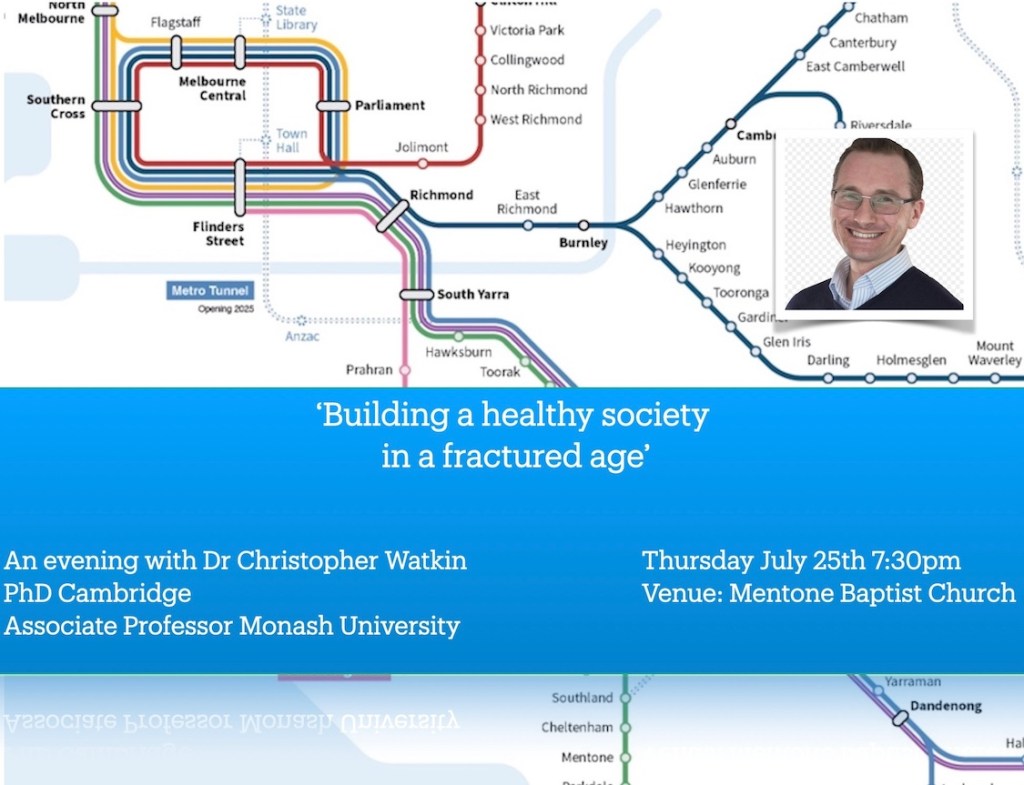
On July 25th at Mentone Baptist Church, Dr Christopher Watkin will be addressing one of the key social issues facing Australia in the 2020s:
‘How can we build a healthy society in a fractured age?’
Australia is wrestling with important issues surrounding religious and social freedoms and responsibilities. Dr Watkin will help us navigate a way forward.
In 2021, Chris addressed political and community leaders in Parliament House, Canberra, outlining a positive vision for civil society. It’s a great opportunity for Melbournians to engage with ideas that can shape tomorrow.
Dr Christopher Watkin is the ARC Future Fellow at Monash University. He is the author of the award-winning book, ‘Biblical Critical Theory’ and numerous other volumes including, ‘Difficult Atheism’.




 MurrayCampbell.net