The hardest Sunday of the year for organising church is the first Sunday following Christmas Day. As it happens, this year the Sunday falls only one day after Christmas, Boxing Day.
Boxing day in Melbourne is huge. For Melbourne Boxing Day means cricket at the MCG and shopping sales at Chadstone and eating lots of delicious post-Christmas food. I love all those things and later on our family will be participating in each of those activities today. But as Melbourne awakes from its Christmas slumber and drinks enough coffee to get the body going, something else is happening around Melbourne today. Gathering in small groups across hundreds of locations there is something taking place that is of even greater significance and will do more to accomplish the direction of 2022 than everything else Melbournians will be doing and enjoying this Boxing Day.
For most of us at Mentone Baptist, holidays have started and the majority of our congregation are already away interstate visiting family whom we have not been able to see for almost 2 years; that’s important. Others at Mentone have returned for church, only 24 hours since we last met.
Despite meeting in smaller numbers than usual (and yet counting many thousands across Melbourne), men and women are praising God and remembering God’s good news about his son and we are committing to God in prayer the year that has been and the year that is about to start.
Such praise, we are told in the Bible is like a pleasing aroma to God and which reaches heaven and is accepted by him. The voracious sounds of the MCG cricket crowd today is nothing compared to the praises of God‘s people.
And the prayers we pray to our Father in heaven may be of such consequence that lives will be changed and the very fabric of society can move. After all, God heard the pleas of his people in the Old Testament and answered them by sending the saviour of the world. The kaleidoscope of history is pitted with God answering prayer and fulfilling all his promises. There is nothing in all the world, no event, no pandemic, no government that can outbid or outlast what God will accomplish through his Son.
To the many and the few who are this morning meeting as church, be encouraged. We are probably feeling tired this morning and we’re looking forward to Melbourne’s Boxing Day allures (as am I). Also be encouraged, that as you meet for those precious minutes as a church today, this praise and prayer is of infinite worth and pleases God. And we can trust that God will use these petitions to accomplish his purposes in 2022.
What is Christmas about? What does Jesus have to do with Christmas? How relevant today is the story of Jesus’ birth? Here’s a brief explanation via a short acrostic.
C
Christ came into the world: Christ means God’s anointed ruler. He is given authority by God to reign over a Kingdom that will never end, and he rules with justice and righteousness. He can always be counted on for doing what is right and good.
H
Holy Spirit: Mary’s pregnancy was miraculous. While the circumstances of Jesus’ birth demonstrate his humanity, other particulars observe how this child is also God the Son. There are unique features surrounding Jesus which point to God’s special involvement. “His mother Mary was pledged to be married to Joseph, but before they came together, she was found to be pregnant through the Holy Spirit” (Matthew 1:18).
R
Redeemer: God’s Son came into the world on a rescue mission. Jesus wasn’t born because everything is okay, but because everything is not okay. And yet God loves us despite our multitude of failings and sins. That’s an idea worth thinking about it! “You are to give him the name Jesus, because he will save his people from their sins.” (Matthew 1:21)
I
Incarnation: God didn’t ignore the human condition. Jesus didn’t pretend to be a person. The one who enjoyed eternal communion with the Father took on human flesh. “The Word became flesh and made his dwelling among us. We have seen his glory, the glory of the one and only Son, who came from the Father, full of grace and truth” (John 1:14).
It is because Jesus is God that he has the character necessary and power required to overcome sin and death. It is because Jesus is man, he could serve as our substitute and saviour. Today, this same Jesus lives embodied in his resurrection body, acting as our mediator in heaven and guaranteeing our resurrection from the dead. It is not putting it too lightly when the Bible says that Jesus is the hope of the world.
S
Scripture: The events of Jesus’ birth are more than history. They were promised by God in the Scriptures (Bible) over many centuries. Christ’s coming into the world was the long awaited event God’s people yearned to see.
T
Travel: Jesus’ journey didn’t begin or end with the manger in Bethlehem. Jesus didn’t remain a forever baby, stuck inside Christmas cards or in portraits hanging in art galleries. Christmas is necessary preparation for Easter. The Son journeyed from heaven to earth, from Bethlehem to Nazareth, then to Jerusalem and the cross, the tomb and to life, ascension and heaven.
M
Manger: Jesus was born in the most humble of circumstances. His first bed was an animal’s feeding trough. God doesn’t ignore the baseline, the poor or suffering. When he entered the world, he identified with those who have little.
“Who, being in very nature God,
did not consider equality with God something to be used to his own advantage;
Adoration: The angels praised God, the Shepherds worshipped the infant, and the Magi brought him precious gifts. This same Jesus is deserving of all honour and glory because of who he is and because of what he has accomplished for us. It’s right to sing songs about and to this Jesus, and it is proper for us to live all of life for him. Who else died for sin? Who else can forgive sins? Who else can gift us eternal life?
S
Shepherds. Among the first to hear the good news of Jesus’ birth were ordinary people, even social outcasts. This reminds us how God’s good news isn’t for society’s elite but for those without a voice. Christianity is not a gospel validating self-sufficiency but revealing human anx and God’s efficacy. To quote Jesus, ‘I’ve not come for the healthy but for the sick’.
If these facts about Jesus’ birth intrigue you, perhaps you’d like to open a Bible and read the Bible for yourself. Might I suggest starting in Luke’s Gospel, as it jumps straight into the story of Jesus, including the famous Christmas narrative. You may also like to visit a church over Christmas or in the new year. If you live around Mentone or Cheltenham (or in the Bayside area of Melbourne), you’re very welcome to visit us at Mentone Baptist Church.
Victoria is not the only jurisdiction in the world to introduce laws prohibiting conversion practices. While Victoria’s The Change or Suppression (Conversion) Practices Prohibition Act remains the most extreme, both in the breadth of what is banned and in the criminal sanctions that are threatened, other Australian State and several countries have or are in the process of banning elements of Christian practice and belief.
The United Kingdom is introducing legislation to ban so-called conversion practices. More than 2500 pastors have signed a letter to the Government, explaining their position,
“It should not be a criminal offence for us to instruct our children that God made them male and female, in his image, and has reserved sex for the marriage of one man and one woman. Yet this seems to be the likely outcome of the proposed legislation,” they write.
“We therefore very much hope (and pray) that these proposals will be dropped in their current form. We have no desire to become criminals and place a high value on submitting to and supporting our government.
“Yet we think it important you are aware that if it were to come about that the loving, compassionate exercise of orthodox Christian ministry, including the teaching of the Christian understanding of sex and marriage, is effectively made a criminal offence, we would with deep sadness continue to do our duty to God in this matter.”
These are not words of bigotry. These are not malevolent attitudes toward fellow human beings who don’t identify with their biological sex or as heterosexual. These are reasonable convictions accompanied by love of neighbour. Indeed, the views articulated in the letter remain normal and orthodox in Christian churches around the world today (including Melbourne). The classical view of sex and marriage was even broadly held in civil society until just a few short years ago. But of course, the socio-political landscape has changed dramatically and it will continue to do so.
No doubt there are many faithful pastors who haven’t signed the letter. While others are weighing up the right course of action. I cannot of course speak for many who have signed. Among the signatories though are friends of mine. Indeed, some signatories are same-sex attracted. These are men and women who love God and are convinced by God’s good Gospel about his Son.
They are not malicious troublemakers or intolerant social miscreants. These are thoughtful people who are convinced by the teaching of Scripture, the very same Scriptures from which our society gleans the belief that all men and women are equal and that all life has value.
Perhaps I should clarify for those who are reading and are unsure about Christian motives behind objecting to these laws;. Christians seek good laws to govern society. Christians desire good for all citizens, and not just for those who agree with us. But introducing bad legislation for the sake of keeping up with today’s cultural controllers isn’t beneficial for anyone. Where people are mistreated on account of their gender and sexuality, we all call it out. The problem with these laws however isn’t just that they are an affront to religious freedom, but that they will also harm the very people the laws are designed to protect.
I’m sure there are more than a few Church leaders in the United Kingdom who are happily following Demas and have no issue with this Governmental intrusion and oversight. But that kind of fallacious living is myopic in the extreme. For those who choose Christ and care for their congregations by teaching the full counsel of God, Christian ministry will become more difficult in the United Kingdom as it is here in Victoria, Australia. There may be short term pain and trouble (and let’s not pretend, this pain and trouble will impact lives in significant ways), but to those who persist in faithfulness, there is eternal gain.
I am encouraged by the stand these Christian ministers are taking. No doubt, the decision to sign their names wasn’t done lightly. It takes courage to take this kind of public stand, knowing that signing your name may well cause attention and trouble for you and knowing it may indeed lead to accusations and slander, and even criminal charges.
To my brothers and sisters in the United Kingdom, may you be encouraged and strengthened. As Paul writes to Timothy, “For the Spirit God gave us does not make us timid, but gives us power, love and self-discipline. So do not be ashamed of the testimony about our Lord or of me his prisoner. Rather, join with me in suffering for the gospel, by the power of God.”
Governments and societies are important but they are not infallible. Sometimes popular ethics makes huge mistakes. Remember, Jesus found himself on the wrong side of popular opinion and on the wrong side of the courts. The Apostle Paul often found himself on the wrong side of the dominant culture, whether it was Jerusalem or Ephesus or Philadelphia. Christianity has often played this unwanted role in the last 2,000 years of history. It’s just that our cultural moment is unusual. In parts of the world like Australia and the UK we have reaped the rich gains of the Christian message, but we are now slowly turning our backs in pursuit of a life without God.
During one of the many occasions when Paul was imprisoned he wrote a letter to a young Timothy and encouraged him not to give up. Paul didn’t suggest altering the message, he didn’t argue for cultural domination or appropriation, nor did he resort to embittered speech toward those who had him put away. Paul did confront judges and legal counsel when he thought it wise, but he could not betray the God who saved him nor the people around him. After all, he had experienced Divine mercy, he who self-identified as the worst of sinners. How could he not seek good for others too?
From his prison cell, Paul wrote a letter to encourage Timothy. He said to Timothy, join me in being enthralled by what lays in store,
“In the presence of God and of Christ Jesus, who will judge the living and the dead, and in view of his appearing and his kingdom, I give you this charge: 2 Preach the word; be prepared in season and out of season; correct, rebuke and encourage—with great patience and careful instruction. 3 For the time will come when people will not put up with sound doctrine. Instead, to suit their own desires, they will gather around them a great number of teachers to say what their itching ears want to hear. 4 They will turn their ears away from the truth and turn aside to myths. 5 But you, keep your head in all situations, endure hardship, do the work of an evangelist, discharge all the duties of your ministry.
6 For I am already being poured out like a drink offering, and the time for my departure is near. 7 I have fought the good fight, I have finished the race, I have kept the faith. 8 Now there is in store for me the crown of righteousness, which the Lord, the righteous Judge, will award to me on that day—and not only to me, but also to all who have longed for his appearing.”
Let us not give up trusting and obeying God. Let us not give up loving others.
A devastating tragedy struck the Tasmanian town of Devonport yesterday. On what should have been a fun filled celebration for Grade 6 children who were finishing their final day of primary school, became the worst of nightmares. Children were playing on a jumping castle when a sudden gust of wind swept it high into the air, before plummeting 10m to the earth. Five children have died and another four remain in critical condition.
One dares not speak a word, for what can one say? Even as a parent with 3 children, what words can I utter? One cannot understand what these families are going through unless one has already experienced such loss ourselves. How do we make sense of the senseless? The death of any child is beyond words, but five lost to such circumstances? The reporter on the news last night added the note that this accident has happened so close to Christmas.
I don’t think the proximity to Christmas makes this awfulness any more harrowing than it already is. But perhaps there is something in the Christmas story that touches and empathises with the inexplicable.
Soon after Jesus’ birth, a tragic incident occurred in Bethlehem, and it forms part of the Christmas story. It is part of the original Christmas although we don’t often read it. And fair enough, it was a terrible event that involved the deaths of many little children.
“A voice is heard in Ramah,
weeping and great mourning,
Rachel weeping for her children
and refusing to be comforted,
because they are no more.”
There are words in Scripture that speak the word of unspeakable grief in losing a child. The circumstances and time and place are different but they nonetheless echo the human heart. Indeed, those words from the prophet Jeremiah are all poignant and jarring for the loss of those little ones in Bethlehem following the birth of another child, the Christ.
This Son of God, whose name is Jesus, would one day preach a sermon which today echoes through the generations and still pierces light and life into the darkness. In the address, Jesus spoke these words,
“Blessed are those who mourn, for they will be comforted.”
He is willing to comfort those who cannot be comforted.
On another occasion, in Jesus’ inaugural public address, he chose for his Bible text, verses from the book of Isaiah,
“the people living in darkness
have seen a great light;
on those living in the land of the shadow of death
a light has dawned.”
What an astonishing announcement, the darkness will not win. The shadow of death is long and thick, but its hold will not last forever. For you see, this same Jesus doesn’t only offer comfort, he has walked the path none of us wishes to undergo and yet will do so one day. He accepted the cross and descended to the dead so that he might punch through the darkness and bring the light of life that can never be dimmed.
We may struggle and grasp to find words to express our sorrow for these families in Devonport today, and that’s ok. For what can one say? Sometimes all one can do is sit and quietly grieve.
The one thing I can say to my fellow Aussies as we look on is this: the message of Christmas has a word to offer in every situation, even the darkest grief and unknown. Strip away Christmas from all the presents and food and decorations, and we uncover in the biblical story a God who hates death. He is appalled by it. He opposes it. His only Son experienced the harrowing of that darkness, for us, that one day death may be defeated forever and all who call on him will know his resurrection power.
We cannot answer the ‘why’ of much that happens in life. The unfathomable can sit like an incurable pain. The Jesus of Christmas tells us there is one who knows and we can go to him, not because we can explain everything, but because he has already taken that journey through death and he has broken through to life again.
As I watched one of my boys play a cricket match over the weekend, I chatted with one of the dads for much of the time. As we talked about how our kids are growing up and the challenges they face in the big mean world of Melbourne, the conversation turned to the topic of forgiveness. This cricketing aficionado said to me with a tone of sadness, we live in a time where people no longer know how to forgive.
I agreed. One of the key ingredients for human living is forgiveness, and it’s now lost. Our societal impulse is no longer to forgive (let alone understand the other). In today’s Australia, the first to throw the stone is the victor, regardless of whether the offence is real or just perceived. Anger is the mood of today. Controlling the story line and asserting individual rights is the power play at work.
It is interesting to observe that as our self-appointed cultural adjudicators assess the merits of Christianity and move from defining her teaching as half-baked to harmful, we should not be surprised to see our society also shifting away from forgiveness.
Expressive individualism is god and politics, education, and social media are the priesthood. People and society exist to serve my interests, rather than I have a duty to love my neighbour as myself. But what good is a power play like this if we lose our soul in the process? In ditching the message of Jesus Christ, we are not gaining, we are losing. If you don’t believe me, spend a few moments on Twitter today.
I’m not suggesting that only Christians know how to forgive (and yes, some Christians need to relearn this basic good), but I am saying that it is because of this Christian message our world learned how to forgive. As we turn away we leave behind key ingredients that keep society together.
There is a distinctive element in this Jesus framed understanding of forgiveness, one that is inescapably powerful in its goodness. Forgiveness isn’t something we practice because of self interest (although forgiveness brings benefits to the person doing the forgiving in important ways). Forgiveness isn’t a decision we bring to the table when we believe the offender is deserving of those words, ‘I forgive you.’ The very nature of forgiveness is that the offending party has wronged you and shouldn’t expect a semblance of peace making.
Forgiveness is acting in mercy toward an individual in light of their transgressions toward you. In what is one of the greatest words ever spoken, on the cross Jesus sees those responsible for his public execution and prays, “Jesus said, “Father, forgive them, for they do not know what they are doing.”
All this is to preface a word of grace and forgiveness that was spoken recently by a young woman at the funeral of her father. It is a word she shared about what she now wants for the man who murdered her dad.
Police Officer Richard Houston, of Mesquite, Texas, was killed in the line of duty by 37-year-old Jaime Jaramillo during a domestic disturbance.
At Mr Houston’s funeral, she said,
“I remember having conversations with my dad about him losing friends and officers in the line of duty.
I have heard all the stories you can think of, but I’ve always had such a hard time with how the suspect is dealt with.
Not that I didn’t think there should be justice served, but my heart always ached for those who don’t know Jesus—their actions being a reflection of that.
I was always told that I would feel differently if it happened to me. But as it’s happened to my own father, I think I still feel the same.
There has been anger, sadness, grief, and confusion. And part of me wishes I could despise the man who did this to my father.
But I can’t get any part of my heart to hate him.
All that I can find is myself hoping and praying for this man to truly know Jesus.
I thought this might change if the man continued to live, but when I heard the news that he was in stable condition, part of me was relieved.
My prayer is that someday down the road, I get to spend some time with the man who shot my father—not to scream at him, not to yell at him, not to scold him—simply to tell him about Jesus.”
Do you find in her intent something hideous or something beautiful? Are we repelled by her attitude or intrigued?
The enacting and receiving of forgiveness is fast becoming a social memory. We all know how important it is, but the identity games that control social media and politics is creeping into our homes and every aspect of living. And it’s not only forgiveness that is being lost, we are also losing our grip on patience and gentleness and kindness; all virtues that are necessary for maintaining healthy relationships and a civil society.
So long as we’re the one holding the stone or the dislike button, and everyone’s retweeting our version of justice, we can get by for a while. However, sooner or later we are the ones needing forgiveness. Indeed, one day the toll will toll for thee!
Jesus once taught his disciples to pray this,
“And forgive us our debts, as we also have forgiven our debtors.
And lead us not into temptation, but deliver us from the evil one.’
For if you forgive other people when they sin against you, your heavenly Father will also forgive you. But if you do not forgive others their sins, your Father will not forgive your sins.”
Is this Jesus so dangerous that a young woman finds in Him the power to want good for her father’s killer? Even that she might one day be able to tell him about Jesus? No one is ignoring the fact of the heinous crime or pretending justice should not be acquired. Just as we cannot live in a world without justice, we cannot live without forgiveness and neither will we survive for long without knowing the One who purchased for us Divine forgiveness.
May I suggest, don’t listen to our cultural overloads, avoid getting swept up by the tides of rage and intolerance that’s drowning our souls and dividing our society. Instead, let’s reconsider the powerful story of the Christ whose forgiveness so reconfigures the human heart, that we can be moved to desire good for those so undeserving. If we restart our own story with the definitive story of forgiveness, I can guarantee it will move our lives forward in ways that will surprise and surpass everything else.
John, one of Jesus’ disciples put it this way,
“This is the message we have heard from him and declare to you: God is light; in him there is no darkness at all. 6 If we claim to have fellowship with him and yet walk in the darkness, we lie and do not live out the truth. 7 But if we walk in the light, as he is in the light, we have fellowship with one another, and the blood of Jesus, his Son, purifies us from all sin.
8 If we claim to be without sin, we deceive ourselves and the truth is not in us. 9 If we confess our sins, he is faithful and just and will forgive us our sins and purify us from all unrighteousness. 10 If we claim we have not sinned, we make him out to be a liar and his word is not in us.”
I’ve written about The Change or Suppression (Conversion) Practices Prohibition Act numerous times given the extraordinary nature of this Government intrusion into the lives of religious Victorians. In this post, I want to inform people of one further way these laws will encroach on religious and civil freedoms and commonsense.
The laws will come into effect in February 2022. Churches are supportive of some measures contained in these laws, but the Act goes well beyond what is reasonable or right.
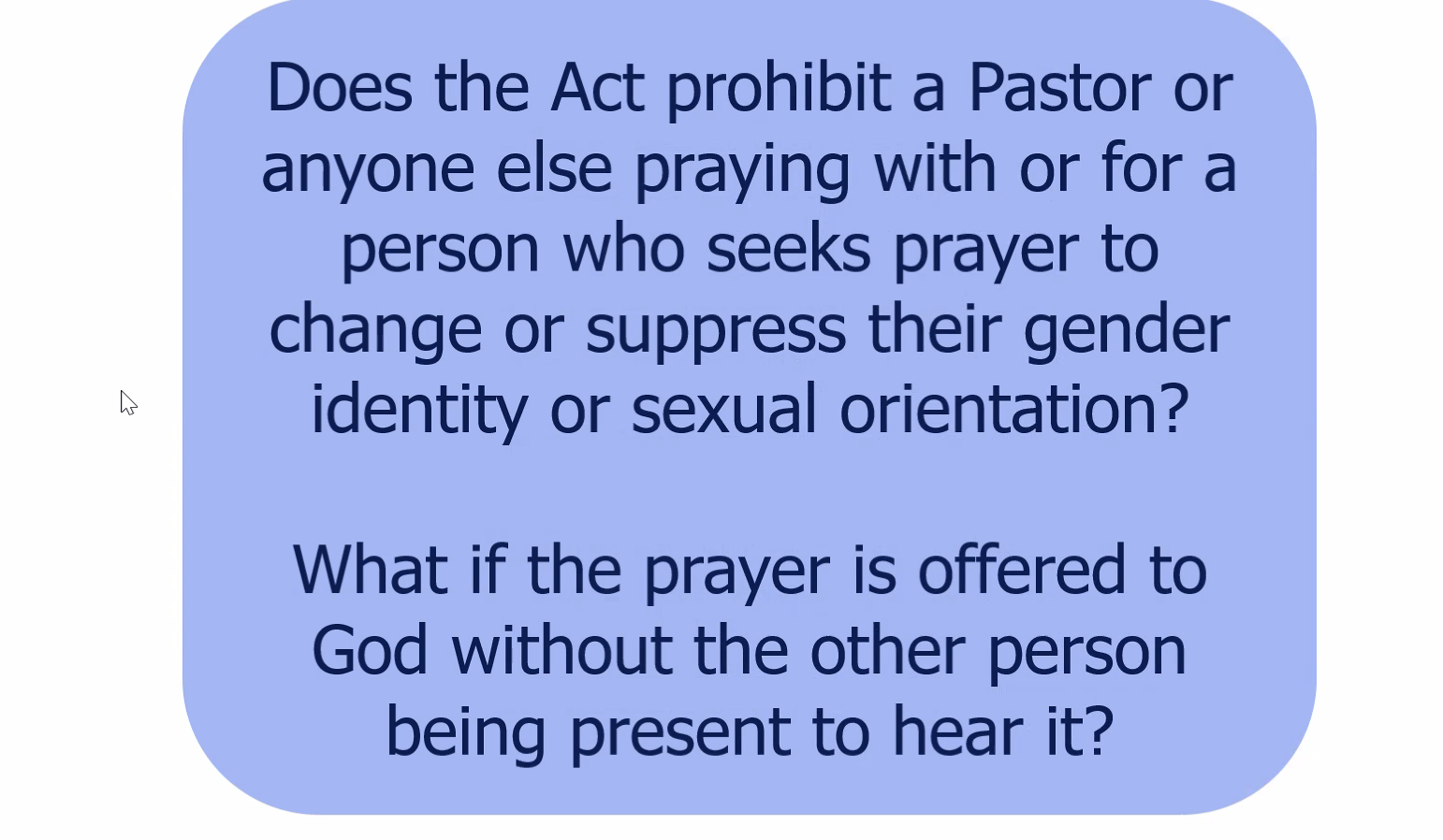
Among the more extraordinary measures found in the Act is banning people from having conversations with individuals about sexuality and gender, and prohibiting praying with them in line with a Christian view of sexuality (even with their express consent).
Slide is from a VEOHRC forum
The new laws may well extend even beyond consensual prayer. In a letter sent to church leaders from my own denomination we read,
“There is some uncertainty about the application of the Act to praying for or with people regarding their sexual orientation or gender identity. The Act specifically includes “a prayer based practice, a deliverance practice or an exorcism” in the unlawful practices, even if the person seeks or consents to such prayer. However, the VEOHRC has advised that it is a “grey area” if the person is not present when they are being prayed for. It may be unlawful if the person is aware of such prayer, in that this would be understood to be directed at them with the intention of change or suppression.”
Private prayers are considered a ‘grey area’ by the VEOHRC (Victoria Equal Opportunity Human Rights Commission). If that doesn’t make your eyes pop out of your head and roll down the hallway, what will?
For example, a believer prays for a friend, it’s just them and God. Or perhaps 2 or 3 friends pray together, as Christians do all the time, and they bring a request to God about another friend for whom they are concerned. This prayer, even if the person never knows about it, is potentially a breaking of the law. And depending on how police treat the crime, it could potentially lead to a term of imprisonment. More likely, the guilty prayers will be investigated by a civil tribunal and have their lives turned upside down and be forced to attend a reeducation camp where they must learn how to pray and believe in line with the religious views acceptable to the government.
Part of the problem with the VEOHRC coming out with what they call a ‘grey area’ is that it likely means a test case. Some poor woman or man will have their life dragged through the mud, legal system and courts, to see if a vexatious complaint can push the limits of the law.
What business is it of the Government to interfere with my prayers to God, or the prayers offered by anyone?
For those who are not already convinced, can we not see the massive overreach and the insanity that a Christian’s personal prayers are treated as a violation of State law?
What is it about prayer that the Government is so concerned about? Are they worried that God might answer prayer? As a Christian, I follow the Bible’s exhortation to regularly pray for our Governments, regardless of who is in power. I pray they might have wisdom and discernment, to act rightly, fairly, and mercifully.
What is it about prayer that is so egregious? The answer is, activists are not content to ban what were a few rare and abhorrent practices. The intention is to delete any belief and practice that does not fully embrace their own worldview.
One group behind the laws explained,
“A similarly insidious development in conservative religious communities is the ‘welcoming but not affirming’ pastoral posture.”
Ro Allen (the VEOHRC Commissioner) said in an interview,
“The proposed law is quite clear in countering any teaching that says that homosexual sex is wrong, so this may well be part of their education”
I thank God that Jesus welcomes us while not affirming every attitude and behaviour I might have. The very crux of Christianity is that God mercifully welcomes those who contravene his good design in many different ways. I will say again, for those who haven’t read before, the Gospel aim isn’t to change a person’s orientation but it is that they might live a godly life (the distinction is important). There are many same sex attracted Christians who uphold and want to live in light of the Bible’s sexual ethic. The very nature of Christianity is that it welcomes and includes everyone who doesn’t belong by nature and choice. That’s good news worth thinking about.
But understanding the very notion of sin and conversion, transgression and forgiveness cuts against what some groups will tolerate in our society. They are not prepared to live in a civil society where a plurality of thought is encouraged or permissible. Banning certain behaviours isn’t sufficient; the aim is to change and control what we believe and even think. Yes, even our prayers.
Orwell’s 1984 has been done to death in recent years. The next latest 1984 analogy is getting rather tiresome and predictable, but sometimes Mr Orwell had a knack of looking into the hearts of men and seeing something disturbing,
The aim of the Party in 1984 was power and they would orchestrate mind games in order to gain control over even the thoughts of the citizens,
“The thought police would get him just the same. He had committed–would have committed, even if he had never set pen to paper–the essential crime that contained all others in itself. Thoughtcrime, they called it. Thoughtcrime was not a thing that could be concealed forever. You might dodge successfully for a while, even for years, but sooner or later they were bound to get you.”
There is one who understands the mind and who hears our prayers, and it is beyond the purview of any Government.
“Search me, God, and know my heart; test me and know my anxious thoughts.” (Psalm 139:23)
“For the word of God is alive and active. Sharper than any double-edged sword, it penetrates even to dividing soul and spirit, joints and marrow; it judges the thoughts and attitudes of the heart.”(Hebrews 4:12)
Let God judge our prayers and our minds. And perhaps with time, reasonable minds will appreciate the misstep taken by the Victorian Government and seek to amend this set of laws.
The idea that God has new things to say and that the Holy Spirit speaks to people outside of Scripture is a common understanding among some religious circles. The ‘Holy Spirit said to me’ has become a popular belief, particularly among Pentecostal and progressive Christians. Stories of the Spirit speaking offer powerful testimonies, albeit ones that cannot be verified. The claim is often used to justify ideas and decisions we want to make. After all, how can we say ‘no’ to an idea if the Spirit has spoken?! This is, however, a misleading and yes, even dangerous notion. This view of the Spirit and God’s speech in fact ignores the Spirit’s own testimony through Scripture. It’s of no wonder that it often leads to all manner of pastoral issues.
When we have a dodgy doctrine of the Bible we shouldn’t be surprised if we take a wrong turn on all kinds of theological and ethical issues.
Before I turn to the Bible I want to clarify a few potential pushbacks.
What I’m not saying
I’m not suggesting that we only listen to Scripture and that other voices are unimportant. It is an act of love and respect that we listen to and understand the culture around us. We value people by appreciating the questions and fears and longings they feel and express. It’s for this reason, that people matter, that it’s vital Christians don’t go around playing God and claiming authoritative words from God.
Let me also preface, I am not pretending that the culture we live in doesn’t influence how we read the Bible. The conversation however is not a dialectical one where we come to the truth by listening to both the Bible and the voices of today. Rather the Holy Spirit sanctifies God‘s people so that we understand and embrace more of what God has spoken. His word will increasingly draw us into conformity with His Son and not with the standards of our cultural moment.
I am not denying the active work of God’s Spirit in the lives of God’s people. The Spirit illumines God’s words so that we may understand, believe, and obey them. The Spirit ministers to our hearts and affects joy, peace, love, and perseverance. The Spirit unites us to Christ and with each other. However, the Spirit does not speak new words or words that contradict Holy Scripture.
The suggestion that God’s Spirit is revealing new truths beyond the Bible cuts against the grain of what we learn about the Spirit’s role in revealing God and his plan of salvation. John 14-17 is one of the Bible’s most important sections for giving us a doctrine of Scripture. In these chapters, Jesus teaches his disciples extensively about the work of the Holy Spirit. Please note the following:
The Holy Spirit is sent from the Father and the Son (14:26; 15:26–27; 16:7).
He is the Spirit of truth (14:17; 15:26-27). Already in John’s Gospel the truth has been defined as Jesus (14:6) and the Father’s words are defined as truth (17:7). As the Spirit of truth his representation of God and God’s purposes are true. He does not lie.
The Holy Spirit has a speaking role. He is, however, not a free agent doing and saying whatever he pleases, but as the One sent from the Father and the Son his mission is tied to theirs (16:13–15). Jesus makes this very clear to his disciples.
The content of the Holy Spirit’s speech is Jesus: ‘the Holy Spirit will teach you everything, and remind you of all that I have said to you’ (14:26); ‘the Spirit of truth…will testify about me’ (15:27).
Most scholars agree that in 14:26 and 16:13–15 Jesus is addressing his apostles, rather than the Church at large. After all, when Jesus says, the ‘Holy Spirit…will remind you of all that I have said to you’, this must be addressed to the apostles who were with Jesus during his earthly ministry.
Thus, Jesus is not saying that the Spirit will teach us new things, he is teaching his apostles that the Holy Spirit will help them remember, understand and apply Jesus’ teachings. In other words, the Holy Spirit is pointing back to Jesus. On three occasions John shows his readers this divine’ remembering in action (2:22; 7:39 12:16).
6. The Spirit’s words to the disciples become what we know as the apostolic message, the New Testament Scriptures. In John 17:6–19 Jesus prays for his disciples, that as men who had been sanctified by the truth, and as Jesus had been sent by the Father, so Jesus sends his disciples into the world. This prayer is immediately followed up by a prayer for all future believers, those ‘who will believe in me through their message’ (17:20). To summarise: God’s revelation comes from the Father and from the Son, it is mediated by the Spirit, to the apostles, about the Son, who in turn are sent into the world. There is no hint that the Holy Spirit will speak words beyond the apostles or in addition to the full revelation of God in Christ.
In my view, this is game, set and match. Jesus’ teaching on the Spirit and Scripture in John 14-17 gives clarity as to the how, what, and why of the Spirit’s teaching.
One of the corollaries accompanying the view that the Spirit speaks new words today is the belief that the Bible isn’t sufficient. But is this the way Jesus and the Apostles describe the Bible? Let’s explore,
Jesus consistently taught that the entire Old Testament (for the New Testament had not yet been written) ought to be considered as the words of God, and accordingly trusted and obeyed.
For example, in the Sermon on the Mount, Jesus establishes his Scriptural hermeneutic, saying,
“Do not think that I have come to abolish the Law or the Prophets; I have not come to abolish them but to fulfil them. For truly I tell you, until heaven and earth disappear, not the smallest letter, not the least stroke of a pen, will by any means disappear from the Law until everything is accomplished.” (Matt 5:17-18)
This statement is important for at least these two reasons: First, Jesus explicates one of the chief purposes of the Old Testament Scriptures. “Law and Prophets” is shorthand for the entire Old Testament (from Genesis to Malachi), and with clarity, he explains their ultimate design, which is to prepare for and point people to himself. Jesus is not dismissing the fact that there is much to learn about God, the world, and ourselves through reading the Old Testament. In its pages, God reveals his character and Being, his justice and mercy, his righteousness and kindness, his power and his gentleness. We uncover human nature, spoken of without our masks and artificial moral colouring: people are presented in all their glory, worth, and depravity. In addition, historians, anthropologists, and linguists gain knowledge about the ancient world through reading this most unique of texts. Jesus, however, announces that the Old Testament is a word of promise, a divine plan that was awaiting fulfilment, and with his coming, the plan was being realised.
Second, not only is all Scripture full of divine purpose, it is also authoritative. Jesus states that every letter and brushstroke is considered true, important and abiding. The smallest letter in the Hebrew alphabet is yod, a tiny inverted comma-like flick of the pen. The least stroke of a pen is more difficult to identify with precision, although scholars have suggested several plausible candidates, including the letter waw, an ornamental stroke known as a “crown”, or even a hendiadys. Jesus’ point is nonetheless clear; not even the tiniest drops of ink on the page will be erased from Scripture but will remain until everything is accomplished.
Those listening to Jesus are left with no doubt that he has the highest regard for all the Scriptures, as the very words of God and words that remain authoritative. These words are to be interpreted in light of Christ but still hold continuing relevance and jurisdiction.
In summary, the Old Testament is true and purposeful, not losing its significance but finding fulfilment in the person and work of Jesus Christ. This is important for all kinds of contemporary issues surrounding racism, sexuality and gender.
Lest one thinks Matthew 5:17-18 is an isolated statement and we don’t need to take it that seriously, following his death and resurrection, Jesus once again explained the gravity of those events to his disciples by opening the Scriptures, again proving the link between the Old Testament promises and himself.
“He said to them, “This is what I told you while I was still with you: Everything must be fulfilled that is written about me in the Law of Moses, the Prophets and the Psalms.”
Then he opened their minds so they could understand the Scriptures. He told them, “This is what is written: The Messiah will suffer and rise from the dead on the third day, and repentance for the forgiveness of sins will be preached in his name to all nations, beginning at Jerusalem. You are witnesses of these things.” (Luke 24:44-48)
Jesus not only connects the Old Testament with himself but also the New Testament. This is unsurprising in many ways, given that the life of Jesus dominates the Gospels of Matthew, Mark, Luke, and John, and the remaining 23 books expound on the living reality and meaning of Jesus’ life, death, and resurrection. Jesus himself possibly never wrote a word with ink and papyri, and yet the authors of the New Testament were not independent biographers and theologians. They wrote not only about but under the direction of the Word become flesh.
Throughout the remainder of the New Testament, it is clear that the Apostles did not veer from Jesus’ view of the Old Testament Scriptures, and their own writings confirm Jesus’ foretelling of the work of the Holy Spirit who would enable them to retell God’s final revelation who is Jesus Christ.
For example, the Apostle Paul insists of Scripture,
“But as for you, continue in what you have learned and have become convinced of, because you know those from whom you learned it, 15 and how from infancy you have known the Holy Scriptures, which are able to make you wise for salvation through faith in Christ Jesus. 16 All Scripture is God-breathed and is useful for teaching, rebuking, correcting and training in righteousness, 17 so that the servant of God may be thoroughly equipped for every good work”. (2 Timothy 3:14-17)
The words of Scripture come from the breath of God. The relationship between God and the Bible is akin to one’s mouth and breath. Every word was expired from the mouth of God, and every word is useful. None is to be erased or excused, but all are useful for life and doctrine.
This Pauline paragraph also points to the way Scripture is authoritative and relevant for future generations of Christians, specifically in this case, Timothy. Words that were then centuries old remain useful to second-generation Christians. In other words, the Scriptures continue to hold their truth, crossing generations and cultures, nations and languages.
Hebrews ch3 provides us with a really clear example of the relationship between Scripture, the Holy Spirit’s voice, and today.
“So, as the Holy Spirit says:
“Today, if you hear his voice,
8 do not harden your hearts as you did in the rebellion, during the time of testing in the wilderness,
9where your ancestors tested and tried me, though for forty years they saw what I did.
10 That is why I was angry with that generation; I said, ‘Their hearts are always going astray, and they have not known my ways.’
11 So I declared on oath in my anger, ‘They shall never enter my rest.’ ”
12 See to it, brothers and sisters, that none of you has a sinful, unbelieving heart that turns away from the living God.”
The author of Hebrews confirms that the Holy Spirit speaks and he chooses a present active verb to suggest the continuing relevance of this speech. And notice the words the Holy Spirit speaks: Psalm 95. And notice the warning of the Spirit’s words which are Psalm 95, don’t harden your hearts to his words.
In his excellent book, ‘Hearing God’s words, Peter Adam, quoting Calvin, says,
“For Calvin, ‘Scripture is the school of the Holy Spirit’. Moses, for example, ‘wrote his five books, not onlyunder the guidance of the Holy Spirit, but as if God himself had suggested them out of his own mouth’. The words of Scripture do not come from the pleasure of men ‘but are dictated by the Holy Spirit’. Amos ‘possessed the discerning of the Holy Spirit’ and Ezekiel ‘only spoke from the mouth of God, as the organ of the ‘Spirit’.
“God not only caused the Scriptures to be written originally, but also sends the Spirit to bring those same words deep into the hearts of believers.” (Adam)
“For by a kind of mutual bond the Lord has joined together the certainty of his Word and of his Spirit so that the perfect religion of the Word may abide in our minds when the Spirit, who causes us to contemplate God’s face, shines.” (Calvin)
Wrongful claims about the Holy Spirit are unnecessary, misleading, and dangerous
The view that the Holy Spirit is speaking new words today cannot be sustained in light of the Spirit given word that is the Bible. What it does do is create a host of problems.
It undermines people‘s confidence in the Bible
It subjectivises the way God speaks.
It collapses revelation into illumination.
It inevitably suggests the Holy Spirit is a contrarian who gives contradictory words to different groups of believers. Which words are true? Which words are we to listen to?
It is often used to justify ethics and decisions that are clearly contrary to what God does say in his word.
God hasn’t given us a dodgy word that needs supplementation or revision. The issue isn’t that we need ‘new’ words from God, but that we often don’t press close to God in his sufficient word: reading, trusting and obeying.
Is God in a habit of having to correct himself? Is God a contradictory God? Are we to believe that the Holy Spirit is communicating new ideas that reject parts of the Bible?
Heterodox ideas throughout history have often come about because people have either added to or subtracted from God‘s Word. It’s the serpent on repeat, did God really say? It’s like building your case for or against vaccines based on the personal opinions of vociferous social media voices rather than medical experts. And sometimes, churches have adopted the letter of the word but lost the heart of what God is saying, and in doing so they cause many to stumble.
If we want to know what God thinks, open the Bible and read it; not plucking verses out of their context but reading it as we ought, in context, understanding genre, recognising that all Scripture is preparing for and fulfilled by and is about Jesus Christ.
A classic example of this arose during Jesus’ ministry. The Pharisees of Jesus’ day had adopted a revisionist view of marriage and one day approached Jesus with the aim of entrapping him by their new understandings. Jesus’ response wasn’t to reinvent human sexuality and the nature of marriage. Instead, Jesus pointed people back to the Scriptures and affirmed God’s purpose in marriage. Not only that, Jesus defined (in accordance with Scripture) that any sexual relations outside marriage between a man and a woman are considered porneia.
The wonder of God’s word is that it doesn’t leave us with pronouncements of judgment for all the ways we reject and break his good word. God’s Gospel word is that he loves to forgive and reconcile. This isn’t because righteousness becomes unimportant or fluid. Rather, the Scriptures show us that the God of absolute goodness and holiness is also the God of extreme mercy. This is where we find true inclusion and acceptance; God is not excusing or endorsing human attitudes and behaviour, but in Christ God forgives and restores us no matter who we are and what we have done. We don’t need to find new words to add to this final one.
Some of this material is taken from an essay and a lecture that I gave some years ago
I admit it. I’m a bit of a fan of Christmas movies. It doesn’t fall as low Hallmark, but put on a classic Christmas show I’ll make the popcorn. As a kid and now with children of my own I love sitting down and watching the snowfall and a Christmas tune and trying to take in the smell of pine and fir trees through the tv screen.
Home Alone, the Grinch, and A Christmas Carol are perennial favourites in our house. Even a Harry Potter Christmas scene is enough to take me in.
At this time of year, everyone is churning out new seasonal Christmas movies. Among the most anticipated Christmas movies for 2021 is ‘A boy called Christmas’. The movie features a lineup of British actors including Maggie Smith, Jim Broadbent and Toby Jones.
I haven’t seen the movie yet, but the trailer certainly caught my attention. First of all, ‘A boy called Christmas’ has all the hallmarks of another half-decent, fun viewing, film for families. It has the right amount of snow and pretty lights and elves and Christmas jargon to draw us into the story being told.
But if the movie is anything like the messaging that’s promoted in the trailer, ‘A boy called Christmas’ deserves an eye roll the size of Hollywood.
Covered with enough sugar dusted on top to make it all sweet, the story projects a couple of myths about Christmas.
Before I dare follow the well-trodden path of the Grinch and criticise anything connected with Christmas, let’s keep in mind that this new version of the origins of Christmas is fantasy and fiction; the producers and writers aren’t pretending otherwise. Nevertheless, ‘A boy called Christmas’, reinforces (as truth) two myths that are perpetually bouncing around our culture today.
First of all, Maggie Smith’s character makes a claim as she tells a group of children the story of Christmas,
“Long ago nobody knew about Christmas. It started with a boy called Nicholas.”
Ummm….no. There was once a man named Nicholas. He lived in the 4th Century AD and served as a Christian Bishop in the city of Myra (located in what is today, Turkey). But Christmas didn’t start with him, nor was it about him. In fact, one can pretty much guarantee that Nicholas would be appalled by any suggestion that he invented Christmas.
The event that we know as Christmas today certainly started with a boy, but his name wasn’t Nicholas; it was Jesus.
It’s worthwhile separating the day on the calendar called Christmas and the original event it is honouring. By Christmas, I’m not referring to the public holiday or to December 25th, but to the event that changed the world and which the world has sought fit to mark with a celebration every year in December. In fact, while Christians have always believed and held onto the birth of Jesus as a crucial step in God’s plan of redemption, no one celebrated a day called Christmas for hundreds of years.
I realise the name kind of gives it away, but in case we’re unsure, Christmas has something to do with Christ. Indeed, it has everything to do with the Christ. Christ of course is the Greek noun for the Hebrew name, Messiah. It’s a title that denotes ruler and anointed King. Christ is God’s promised ruler who will receive a Kingdom that will never end, fade, or perish.
“The woman said, “I know that Messiah” (called Christ) “is coming. When he comes, he will explain everything to us.”
Then Jesus declared, “I, the one speaking to you—I am he.” (John 4:25—26)
“Everyone who believes that Jesus is the Christ is born of God, and everyone who loves the father loves his child as well.” (1 John 5:1)
This first faux pas from ‘A boy called Christmas’ is forgivable, in the same way, Narnia and Dr Seuss aren’t given to us as history or sacred writ, but please make sure our kids realise this is the case. It is this next line from the movie trailer (which presumably features as a motif) that is nothing short of inane. A young Nicholas is given this advice,
‘Things only exist if you really believe in them!’
What a stupid thing to say! Does gravity only work when we believe it exists? Is Mount Everest only real because it has been seen and climbed? Do I cease to exist because most people on the planet have never heard my name or seen my face?
The advice, as insipid as it is, is however true to form. The movie is mimicking the way we are now trained to think and make choices and choose beliefs today. In Western culture, truth is no longer truth. Truth is your truth. Truth is the set of ideas that you preference and want to hold onto for meaning and guidance in life. One of the startling consequences of this is that we now live in a post-science age. For example, biology no longer determines reality, what matters is how you feel inside. Whether the issue is vaccines or climate change or a host of important issues, the scientific task is often considered little more than an instrument used to promote various socio-political agendas.
In a similar fashion, history has succumbed to revisionist keyboards, where events are rewritten and retouched according to a priori commitments to identify politics and other prevalent social preferences.
Here’s my advice, don’t learn theology from Netflix. Don’t use Hollywood as a history book or as a manual for learning about God, or pretty much anything for that matter. I guess this advice is kind of obvious, and many of us not only agree but respond with a rather dull ‘duh’. However, perhaps we underestimate the extent to which movies and tv shows influence the way we think about issues and the way these mediums inform our understanding of history and world events.
Movies are successful, not only because of their entertainment value, but because of the ways they both mirror the culture and change the culture. Hollywood, Netflix and Stan each echo the clarion call from our academic institutions and leading social activists. They are today’s poets and preachers, both teaching and enticing us to adopt new ways of thinking and living. Movies are designed to recalibrate attitudes and even to normalise ideas that are not yet embraced by our neighbours.
The real story of Christmas exceeds Netflix’s best attempts. It is more powerful and stunning and dangerous and wonderful than the best of fantasy writers, except the Biblical story is true.
The birth of Jesus is not a fact of history because I choose to believe. I believe because the events are historical and because they speak of wonders that are too good to ignore.
The Bible (yes, that ancient book which is supposedly unreliable and bad for your health), says some pretty startling things about belief and what is true and the great existential dilemmas.
The Bible authors insist on recording history with accuracy. The Bible writers also provided an explanation for the meaning of these events. Historians do not doubt the birth of Jesus Christ, and historians do not deny that the Bible is the earliest and most reliable source for retelling the circumstances of His birth, and life, death, and resurrection. Of course, some of the details are astonishing, for example, the presence of angels and the virgin birth. But this is the point, amidst seemingly ordinary history, such as the birth of a child, there was something extraordinary taking place.
In 2014 (note: this was said before the pandemic), historian Dr John Dickson went on the front foot to expose the view that real historians doubt the historicity of Jesus’s birth. He said,
controversial enough to get media attention. They have just enough doctors, or doctors in training, among them to establish a kind of “plausible deniability.” But anyone who dips into the thousands of secular monographs and journal articles on the historical Jesus will quickly discover that mythicists are regarded by 99.9% of the scholarly community as complete “outliers,” the fringe of the fringe. And when mainstream scholars attempt to call their bluff, the mythicists, just like the anti-vaccinationists, cry “Conspiracy!”
Christianity isn’t true because we choose to believe. We believe in this Jesus Christ because he is proven true and we trust him with all life because he is demonstrably good and efficacious.
So yes, I’m looking forward to watching ‘A boy called Christmas’, but kids please don’t get your theology from Hollywood. Parents, it’s okay to let your children enjoy these Christmas movies, but take a moment and explain to them that these are fun but untrue stories, and the real story is better than any fiction.
I thank God that the advice given to Nicholas isn’t true. Think about it, what a burden to carry if truth and reality were dependent on my understanding and adherence. I thank God truth doesn’t come from within. Thank God truth doesn’t depend on me believing it to be so.
Christmas didn’t not with some boy named Nicholas, but with God sending his one and only son into the world. He didn’t hide away in a toy factory. He didn’t hand out bicycles, lego, dolls, X-boxes, and puppy dogs wrapped in colourful paper. He laid down his life for us. As the book of Romans testifies about the Christ,
“You see, at just the right time, when we were still powerless, Christ died for the ungodly. Very rarely will anyone die for a righteous person, though for a good person someone might possibly dare to die. But God demonstrates his own love for us in this: While we were still sinners, Christ died for us.”
The incarnation (that is, God the Son becoming human) is inescapable. The imprint of Jesus coming not only remains at Christmas but is all around us today. As we follow this Jesus we gain the greatest gift that no Christmas tree can hold or no toy factory manufacture: Peace with God, the forgiveness of sin, and eternal life.
For those interested, here is a copy of a letter that I have sent to several Victorian MPs in the last few weeks. Note, the actual letter varies slightly depending on the recipient. I’ve also made one change here in light of Victoria reaching the target of 90% fully vaccinated today.
Dear…..
I am writing to express concern about the rules governing who can attend religious worship services in Victoria.
Throughout the pandemic, almost all churches have closely followed the health directives and we continue to do so. Like other religious leaders, I am persuaded by medical professionals that the vaccines are overwhelmingly safe and efficacious, and I have encouraged others to follow this advice. This public stance has come at some cost to me personally.
I am grateful for the availability of the vaccines. My entire family is fully vaccinated, including our 3 children. In my church, we anticipate that the overwhelming majority of members will be vaccinated, indeed at a higher percentage than the Victorian population. I am also heartened by the fact that over 93% of Victorians have already received at least the first dose of a vaccine.
While our State needed to increase vaccination rates, certain restrictions on Churches were understandable. However, in light of the new targets, it is no longer reasonable for unvaccinated Victorians to be separated in Church.
On September 19th, Premier Daniel Andrews announced Victoria’s Roadmap. This document stated that once Victoria reaches 80% of 12+ fully vaccinated, all settings will “align with National Plan to transition Australia’s National COVID-19 Response”. It was expected that when Victoria reached this target, any Victorians who remained unvaccinated would return to normal worship services alongside those who are fully vaccinated. We are now in a much better position than was anticipated. This is encouraging news. It, therefore, makes no sense to further exclude from worship services those who remain unvaccinated. Fully vaccinated people have no need to fear those who are unvaccinated.
I acknowledge that the Government has made provision for churches to hold services for people with unknown vaccination status. For a few short weeks, this is possible, but it is not a long term solution. First, a church is one community and it is wrong and harmful to divide it, especially after almost 2 years of lockdowns and hard restrictions. Second, Churches have a responsibility to welcome and minister to all kinds of people including the vulnerable. And it is among this demographic that we find many who are unvaccinated. Third, churches are largely run by volunteers. Forcing churches to organise additional services is not sustainable for an already exhausted community.
For almost two years Churches have chosen to comply with Victoria’s health directives because we have believed that they were reasonable, fair, and temporary. However, to separate church attendees further is neither, reasonable, fair or temporary.
I note that Churches in NSW have returned to normal worship services (as of October 24th) and so there is no division between those vaccinated and those with unknown vaccination status. If NSW can implement this positive step safely and equitably, surely Victoria can do so as well.
Apart from the health issues, this pandemic has created significant social tensions and has brought harm to the mental and spiritual well-being of countless Victorians. It is now time for our State to heal and move on. I am therefore requesting that the vaccination status mandate be removed from churches now that we have reached the target of 90%.
Your advocacy for local religious communities will be much appreciated.
Unfortunately, during the course of the year, some letters have been sent to MPs by some religious quarters containing misinformation, negative messaging toward vaccinations, and a tone lacking any semblance of grace. In contrast, the approach that has proven constructive (ie leading to favourable arrangements for NSW Churches, and even the Victorian Government giving some special consideration to Church) is one where church leaders have advocated responsibly and positively with consideration of society’s overall wellbeing.







 MurrayCampbell.net