My latest piece, ‘Proverbs for Preaching’ is available to read and engage with over at my new substack.
Enjoy and don’t forget to subscribe or follow if you like. Just click on the graphic below
My latest piece, ‘Proverbs for Preaching’ is available to read and engage with over at my new substack.
Enjoy and don’t forget to subscribe or follow if you like. Just click on the graphic below
King Charles and Queen Camilla went to church in Australia last Sunday. They attended a regular service held at St Thomas’ North Sydney.
Kanishka Raffel, who is the Anglican Archbishop of Sydney, preached a sermon for all, whether they were Kings or kids, monarchs, musicians or mechanics.
What might an Archbishop preach about in the presence of the monarch? Of all the subject matter in the world, both large and small, what message is worth pressing home?
Kanishka spoke on Acts 8:26-40. Long before the Gospel ever reached the shores of England, and Europe, the good news of Jesus Christ came to an Ethiopian man who then took God’s message home with him.
‘The Good News of Jesus’. I can’t think of a better message for everyone to hear.
Sloganeering can sound like a clarion call or like cringe. This self-absorbed need for redefining, refreshing and relevance has captured the attention of many strands of Christian thought and Church growth networks. It may sound new, fresh and revitalising, but there is rarely anything new under the sun. While Churches diagnose the issues with as much concurrence as a circus of entrepreneurs, evangelists and the local university student union, and while answers are equally disparate, there is a semblance of agreement that in Australia our churches have taken some missteps, while others have leapt over the precipice and into the void.
We’ve had several visitors to church recently who are struck by the fact as a church we read the Bible and preach through the Bible, and we pray. Apparently ,many Melbourne churches don’t see the need to do this. My question for Melbourne churches is this, what are you doing? Who are you listening to? What are you teaching?
As a Church, we’re currently preaching through 1 and 2 Chronicles. After 18 years at Mentone Baptist Church, we were yet to explore this 2 volume work. I decided that 2023 is the year to do so. As I read, prepared, and preached I noticed that one of the recurring themes in Chronicles is this topic of reformation. While aspects of reform are to fore in many of the sermons, we gave it special attention for 2 weeks as we examined the life and times of one of the key reformers in Judah’s history, King Jehoshaphat.
Other than King Solomon, more chapters are dedicated to Jehoshaphat’s reign than any other King in 2 Chronicles. That fact alone caused me to take a good look at his rule and the events that took place under him.
Jehoshaphat was a reformer. There are principles and lessons about his reforms that are useful as we consider what it means to reform the church today. As you’ll see, these characteristics are not unique to Jehoshaphat, these features are found consistently throughout the Bible and yet they find vivid expression in this Old Testament period.

The word ‘reform’ is used in politics and economics and law and education. When reform is announced, it means there’s something wrong, the system is broken or out of date and needs reforming. It requires fixing or renewing.
Reform is famously used to describe one of the great Christian movements of history to which we owe so much today, the Reformation: with Martin Luther, John Calvin, Thomas Cranmer, and best of all, the Baptists! What happened is that throughout the 16th Century, Christians living in different cities and speaking different languages were convicted by God’s word that some of the official teachings and morals of Rome were in error and out of step with the Bible. Across Europe, people went back to the Bible, ad fontes, and God began to reform and renew thinking, theology, education, civics, ethics and more. The Bible again changed the world.
This notion of reform didn’t however first appear in 16th Century Europe. We find reforms taking place in the Bible, and the reign of Jehoshaphat is one such example.
Jehoshaphat is among many Kings of Israel and Judah who understood that each new generation need reforming. While he doesn’t initiate his reforms as quickly as someone like Hezekiah, he nonetheless commits to returning Judah to God’s covenantal promises. This is set in stark contrast to his northern contemporary, King Ahab, who flew the flag of progress and change.
17:3 The Lord was with Jehoshaphat because he followed the ways of his father David before him. He did not consult the Baals 4 but sought the God of his father and followed his commands rather than the practices of Israel. 5 The Lord established the kingdom under his control; and all Judah brought gifts to Jehoshaphat, so that he had great wealth and honor. 6 His heart was devoted to the ways of the Lord; furthermore, he removed the high places and the Asherah poles from Judah.
Jehoshaphat might be King but he understands God is God and his role under God is to serve and obey him. So begins the process of removing errant practices and ideas and returning the people to God’s revealed will in his word.
Reform isn’t about maintaining dead religion or resisting the future or pining for the glory days of film noir or art deco. The Chronicler explains reformation is about devotion to God and a heart for His people. We read how Jehoshaphat’s heart was devoted to God’s commands. There is no distinction for Jehoshaphat between seeking God with his heart and following God’s words. Heart and mind, attitude and action, belong together and move in unison when we love God. We don’t choose between loving God and obeying the Bible. We don’t choose to be a heart Christian or a mind Christian.
In loving God, Jehoshaphat leads Judah in reformation in these important ways:
Jehoshaphat’s reforms include an aspect of the negative, saying no to false worship and removing practices and objects that distorted or altogether replaced the true worship of God. His reforms are also positive, sending out teachers and judges who will bring the people back to God’s words and cause them to live under the covenant.
7 In the third year of his reign he sent his officials … 9 They taught throughout Judah, taking with them the Book of the Law of the Lord; they went around to all the towns of Judah and taught the people. (17:7,9)
5 He appointed judges in the land, in each of the fortified cities of Judah. 6 He told them, “Consider carefully what you do, because you are not judging for mere mortals but for the Lord, who is with you whenever you give a verdict. 7 Now let the fear of the Lord be on you. Judge carefully, for with the Lord our God there is no injustice or partiality or bribery.” (19:5-7)
Jehoshaphat leads the people not forward and away from God, but forward with God by going back to the word. He is a word-centred leader which is evidenced by him sending out teachers to all the cities and towns of Judah, men who took the Scriptures with them and taught the people.
One of the myths embedded in some missiology and church planting manuals is that to reach people today we need to find new ways and innovations. If I collected $10 for every time I hear talks and blogs and books advocating fresh, relevant and powerful ideas for churches, I’d soon be in a position to buy the Vatican!
Of course, not everything new in the world and not every innovation is bad and wrong; that would be silly. Mission and Church have a language. I don’t simply mean linguistic and verbal language, but there are communicative signs and symbols in the way we do music and the way we organise church meeting places and the way we connect the gospel with people’s lives and cultural moments. But attached to many plans and dreams for the future, is a hubris and misstep that believes reaching people for Christ today requires new methods and new messages.
New is superior. New is more interesting. New is more authentic.
Of course, this vibe runs deep through many facets of our culture: think art, music, movies, and even ethics. Ethics today is like experimental art. In places like Melbourne, what’s noticed and praised are new expressions and new definitions for those big questions of life, ‘who am I’ and ‘what’s life about’. He old old story lacks gravitas, it doesn’t sell tickets, or so we assume.
This thinking is of course myopic. Plenty of new ideas are also disturbing and dangerous. Think of the subject of the movie Oppenheimer: the atomic bomb!
In fact, ecclesial commitment to innovation often creates new problems rather than fixing old ones. The consumer bent model of church that provides a cinematic experience or the moshe pit frenzy, the slick preaching that feels like a Netflix special, or the stripped back lounge church where we don’t preach or sing or do Bible because that creates awkward conversation.
Neither am I not arguing for traditionalism or conservatism. We don’t need to clean out the organ pipes and take classes to understand thee and thou. The tie is not more faithful than the t-shirt, or jeans over the dress. It’s not that one hour on Sunday is holier than 2, or a 50-minute exposition more faithful than 20. Within God’s given shape for church, there is great flexibility and freedom. And yet Jehoshaphat understood that faith has particular content and contour which shapes all of life.
The shape and trajectory of the local church is far less glamorous and sounds way less cool and exciting and all the other adjectives we use to appeal to our congregation’s hearts, time and money. And yet, it is far more substantial.
In the case of Jehoshaphat, his reforms produce something far more interesting and engaging and serious than what had previously captured Judah’s attention. In what we might consider rather mundane detail, in commissioning teachers to go to the towns and people with an open Bible, this King was shepherding the people wisely and lovingly.
Going back to the Bible isn’t a static process or a regressive move. Accepting all those profound ideas about the Trinity and atonement and the incarnation are treasures to wonder and share, not hide away in the too-hard drawer. The Bible’s teaching about sin and salvation, men and women, sex and gender, are to be embraced with thankfulness, not written out of the church. The Bible itself gives us directives as to how to read, understand and interpret the Scriptures. We don’t dismiss any verse or chapter as untrue or irrelevant, but we read appreciating its significance in that salvific moment and in the trajectory of salvation history, which of course finds climax in the person and work of Christ.
Big dreams and vision setting is fine, and even inspiring, so long as it’s driven by the biblical view of the gospel and grounded and shaped by God’s words in the Bible. The Bible is, after all, God’s loving word for the church. And yet how often is Scripture little more than background noise in our plans and moves and ideas and implementations.
Relevance is a mean master and pursuing it is often a sign that we’ve already lost our way. Many of the Kings of Israel and Judah had that attitude and found prophets to proffer that kind of message. Jehoshaphat doesn’t try to change or update God’s words with the latest trends coming out of Philistia and Ninevah. Instead, he raises up teachers who call the people back to God’s word.
This word is, as Psalm 19 declares, perfect. One can’t improve a Mozart Piano Concerto. One doesn’t add fresh brushstrokes onto a Rothko canvas. Some things are perfect and complete.
Jehoshaphat isn’t alone in grasping the need to reform a generation by going back to the word. Jesus holds the Scriptures in the highest regard and he was at pains to explain that not one dot or stroke will disappear.
As we read the Apostles’ letters, they stress how Christian leaders and church congregations alike must not manipulate the text. We must not change the text or try to reinvent the Scriptures, but faithfully pass them on from one generation to the next.
It’s what Paul says to Timothy.
And the things you have heard me say in the presence of many witnesses entrust to reliable people who will also be qualified to teach others. (2 Timothy 2:2)
Timothy is to pass on to the next generation of teachers the same body of teaching given to him from the Apostle who in turn received it from Jesus.
Paul elaborates on his point later on,
But as for you, continue in what you have learned and have become convinced of, because you know those from whom you learned it, 15 and how from infancy you have known the Holy Scriptures, which are able to make you wise for salvation through faith in Christ Jesus. 16 All Scripture is God-breathed and is useful for teaching, rebuking, correcting and training in righteousness, 17 so that the servant of God may be thoroughly equipped for every good work.
2 Preach the word; be prepared in season and out of season; correct, rebuke and encourage—with great patience and careful instruction.
In this age of expressive individualism and disconnection and disappointment, in this age of social media and AI, viruses and geopolitical tremors, God has already shown churches the way. The way forward for our churches is to keep going back to the Bible. That means our gatherings need lots of Bible: reading the Bible out loud in Church and preaching from and through the Bible, and ensuring our songs and prayers are soaked in Scripture. It means our small groups spend time in the word. It means discipleship is more than sharing life and coffee but is teaching them to obey everything Jesus commanded the Apostles (Jesus did say this in the Great Commission). It means structuring our churches and ministries by the word and making sure our mission ventures are about explaining and exhorting the gospel word.
That’s not irrelevance or dullness, it’s captivating. I don’t know what your favourite song is but whatever it is I suspect you have listened to that song 100s of times and you still love it and enjoy listening and singing along.
When Australian and English cricketers were interviewed during the recent Ashes series, they spoke about their love for the game. These cricketers have played hundreds of games and every week they practice in the nets for hours, hitting ball after ball after ball. These world-class athletes share how they are always trying to improve their game. There’s always something new that they can learn about cricket: a shot or ball position they can improve. The game is still the same game and rules and aims remain the same, but this doesn’t diminish their love of cricket.
The Bible is so big and deep and rich, that we do not need to alter it or go searching for a new word. By going back to the Bible and believing God, we’re not drinking out-of-date milk gone sour, this is life-giving, drink and food. This word is new every day.
Jehoshaphat’s reforms produce some rather interesting responses
Jehoshaphat’s reforms and his renewed focus on God’s words were noticed by surrounding nations, and it caused them to take interest and even to fear the Lord.
Only twice in all of Chronicles do we find this phrase, the fear of the Lord fell on the nations. Both occasions happen during Jehoshaphat’s reign.
The first instance is ch17, early in his reign.
9 They taught throughout Judah, taking with them the Book of the Law of the Lord; they went around to all the towns of Judah and taught the people.
10 The fear of the Lord fell on all the kingdoms of the lands surrounding Judah, so that they did not go to war against Jehoshaphat.
I understand that this might feel counterintuitive. To be relevant don’t we need to embrace all the new trends and fads? The reforming church isn’t chasing relevance or neither are we stuck in the mud with rude and angry characters who bemoan everything that is happening in society.
A church in the word will stand out: different, surprising, disagreeable and yet also appealing, objectionable but yet good.
As Tom Holland famously called out English bishops,
‘“I see no point in bishops or preachers or Christian evangelists just recycling the kind of stuff you can get from any kind of soft left liberal because everyone is giving that…if they’ve got views on original sin I would be very interested to hear that”.’
There lies the lie. For Churches to have a future in Australia don’t we need to adapt and change our colours and contours, even our doctrine? The reign of Jehoshaphat says otherwise.
One of the famous incidents during Jehoshaphat’s reign involves what is described as a foolish and even sinful alliance with King Ahab of Israel. There are important lessons to learn about the nature of Christian unity and when it is wise to partner with others and when it is not, but I want to observe the one thing Jehoshaphat does faithfully here: he distinguishes between false words from God and the true word.
“But Jehoshaphat asked, “Is there no longer a prophet of the Lord here whom we can inquire of?
Ahab has 400 prophets who in unison present what Ahab wants to hear. Their word is popular and soothing, it suggests an air of authenticity and persuasiveness, after all, it’s 400 to 1! Their message plays into Ahab’s a priori commitments and desires. However, as Micaiah spells out, behind these prophets is a lying spirit.
“So now the Lord has put a deceiving spirit in the mouths of these prophets of yours. The Lord has decreed disaster for you.”
Some of our ideas have good intentions but the timing is wrong or they are poorly executed. Sometimes our dreams for mission and church are noble but unwise. There are also messages, sermons and words offered that have demonic origins. Watch out for those sophist explanations of why the atonement isn’t the atonement or why the resurrection of Christ is spiritual but not physical or the appeals to new spirit insights as to why God’s sexual ethics has changed.
Paul argues similarly,
“The Spirit clearly says that in later times some will abandon the faith and follow deceiving spirits and things taught by demons. 2 Such teachings come through hypocritical liars, whose consciences have been seared as with a hot iron. 3 They forbid people to marry and order them to abstain from certain foods, which God created to be received with thanksgiving by those who believe and who know the truth.” (1 Timothy 4:1-4)
Reform isn’t moving away from the Bible and searching for new truths or new words from the Spirit. That’s the kind of attitude that gets Churches into trouble in the first place. In the case of Ahab and his prophets, the word of the Lord was proven true and the prophets false, but only when it was too late.
Micaiah declared, “If you ever return safely, the Lord has not spoken through me.” Then he added, “Mark my words, all you people!” (v.27)
In other words, you’ll know when it happens! You’ll learn God’s words are true when it’s too late. There is a reason why liberal denominations tend to sink faster and their buildings serve as tombs for spiritual corpses. They promise the gospel of the world and as Jesus says, take it and forfeit your soul.
Jehoshaphat’s reforms made positive impact on those outside Judah, but inside we are told God’s people didn’t want to change.
The end of Jehoshaphat’s life and reign is recorded with these words, 32 He followed the ways of his father Asa and did not stray from them; he did what was right in the eyes of the Lord. 33 The high places, however, were not removed, and the people still had not set their hearts on the God of their ancestors. (20:31-33)
By the end of his life, Jehoshaphat’s reforms were incomplete. At times he compromised and he was inconsistent. After 20 years of teaching and instructing the people, the people still had not set their heart on God.
The Chronicler doesn’t suggest that Jehoshaphat’s reforms were an error of judgment or built on false assumptions about God and the Bible. Rather, this illustrates the nature of human hearts. There is a warning here, that we can sit under the Bible for years and all that does is bring judgement on yourself because we will not take this gracious word to heart.
It also serves to remind us how normal Christian ministry, that is, ministry of prayer and word, is most often slow and arduous. We thank God when we see lives changed and we grieve when people’s hearts remain unchanged or indifferent. This doesn’t mean God’s method is no longer working. It’s the reality of the human condition. Keep praying and keep teaching.
The famous Reformation of Luther and Calvin made profound changes from which we continue to eat the fruit today: both in our churches and even our secular society. Among the myriad of writers and thinkers and activists, there were some hairy moments, saints behaved like sinners, and whacky enthusiasts and bullish thugs all did their bit to try and manoeuvre reform down all kinds of dangerous roads. Where the true church is, there is always someone with a false passport lurking nearby.
I recently learned that Martin Luther King’s famous ‘I have a dream speech’ didn’t convert anyone that day or in the days that followed. Today, it’s known as one of the greatest speeches of the 20th Century, but at the time, some of his closest advisors thought that it wasn’t very helpful. They read the manuscript and urged him to leave out those parts which with time proved to be the most memorable. Historian Dominic Sandbrook describes the speech as a slow burner. With time this speech on the steps of the Washington Monument became a hallmark of the civil rights movement.
Paul famously shows us that the word of the cross is foolishness to those who are perishing. The Gospel is stupid, silly, immoral, untrue, irrational, we’ve all heard the objections. And yet the same word is the power of God and the wisdom of God that brings salvation to all who believe. Reforming any church or organisation, even our own hearts, can be painful and cause anger, frustration and more. And yet God’s mission and method is as true and good today as it was in Germany 1517 and Carthage in 410, in London 1854 and Shanghai in 2019.
Do you love the church? Do you love the Gospel? Do you long to see God’s Kingdom growing around Australia?
There is wisdom in Jehoshaphat’s example. The Gospel is engaging and enthralling. The Bible is stunning and shocking. A reforming Church is Spirit-filled, word-centred and life-giving, joyful and sober-minded, intentional and creative, firm in belief and gracious and kind toward those who yet do not believe.
The future for churches in Australia doesn’t lay in coveting ourselves with the latest cacophony of trend words and theories, but in pressing ever closer to Christ and letting his word shape our message and method.
The question isn’t whether churches need changing, but are we being changed and sanctified by the word? If we’re not, then we will be as useful to the Kingdom of God as Ahab’s prophets. If we are, then we can trust God will accomplish his saving purposes and see Jesus keep his promise, “I will build my church”.
You may be familiar with this famous saying, “Pride goes before destruction, a haughty spirit before a fall”. It comes from the Bible, Proverbs 16:18.
We have mixed feelings about pride in Australia. On the one hand, we like to run over any tall poppy with the lawnmower. And yet pride is splashed across Instagram and Facebook pages all the time: pride in achievement and success, pride in people, pride about identity. Pride has become an idea or slogan to embrace and celebrate.
We have a discombobulated relationship with pride.
To quote Pride and Prejudice,
“[Mr. Darcy’s] pride,” said Miss Lucas, “does not offend me so much as pride often does, because there is an excuse for it. One cannot wonder that so very fine a young man, with family, fortune, every thing in his favor, should think highly of himself. If I may so express it, he has a right to be proud.”
“That is very true,” replied Elizabeth, “and I could easily forgive his pride, if he had not mortified mine.”
I think Australians are selective about the pride we denounce and the pride we embrace.

As a Church last Sunday we looked at the reign of King Uzziah from 2 Chronicles 26. In the account, the theme of power and pride rears its ugly head in devastating form.
Uzziah comes to the throne at the age of 16 and he starts well. While most teenage boys are gaming and playing cricket and using their testosterone for all manner of quick fulfilment pursuits, Uzziah was ruling a nation. He begins well,
4 He did what was right in the eyes of the Lord, just as his father Amaziah had done. 5 He sought God during the days of Zechariah, who instructed him in the fear of God. As long as he sought the Lord, God gave him success.
Uzziah rebuilds military towers and rebuilds towns. He organises and leads the army well. He brings people together. He led the army in battle against the Philistines, verse 7, ‘and the Lord helped him’. It’s not difficult to imagine the excitement surrounding this positive beginning. Uzziah is doing what pleases God and he’s looking after the people and protecting them. He oversees State run building projects that run on time and to budget.
Then it goes horribly wrong. Verse 16 spells out the downward progression,
But after Uzziah became powerful, his pride led to his downfall.
Power – pride – downfall.
While power is usually spoken in negative and abusive ways today, power isn’t inherently bad or wrong. God is all-powerful. By his powerful word, God created the universe and he made you. By his powerful word God exercises justice and administers mercy. In this strength, he stops nations and cares for the hungry. God also gives people strength – physical, mental, and spiritual strength.
Power can achieve much good and also much sin. In the hands of sinful people, which is all of us, power and strength is a present temptation. We have the creative ability to twist and misuse power in all kinds of ways.
Power doesn’t inevitably lead to pride but when it swims in the bathtub of humanity, it’s like putting an egg in boiling water for 6 minutes; the outcome is pretty likely.
1. Pride grows in all kinds of soil
We mustn’t think of pride in a one-dimensional way. Pride can grow in all kinds of soil: in success, in power, in failure, in suffering. Pride is adaptable and fits snuggly in all different sizes.
Pride is having that concern for yourself and your reputation over and above God and his glory and the good of others. Pride is a belief that I am better or that I deserve better.
Pride includes but isn’t limited to boasting and feeling big about yourself.
John Piper is right when he observes,
Boasting is the response of pride to success.
Self-pity is the response of pride to suffering.
Boasting says, “I deserve admiration because I have achieved so much.”
Self-pity says, “I deserve admiration because I have suffered so much.”
Boasting is the voice of pride in the heart of the strong.
Self-pity is the voice of pride in the heart of the weak.
2. Pride redefines reality, defining identity and worth against other people.
In Uzziah’s case, his pride is fed by power. He came to believe that power justifies freedom to live on one’s own terms. Uzziah comes to believe that power is a road to autonomy and freedom for defining life’s norms. He no longer felt the necessity to follow God’s laws. He had the liberty to take licence. He thought, I can even enter the Temple ignore the law and relate to God as I decide.
This pride exhibits itself in a shameful act in God’s Temple.
16 But after Uzziah became powerful, his pride led to his downfall. He was unfaithful to the Lord his God, and entered the temple of the Lord to burn incense on the altar of incense.
Of course, the reality is Uzziah was never independent. All the good he achieved only came about because of God’s help. As verse 5 reminds us, “As long as he sought the Lord, God gave him success” The Lord blessed his endeavours. The Lord was his helper. Not only that, the people he serves are God’s people. And this is God’s Temple and yet Uzziah’s self-confidence persuades him to strut about on his terms.
It’s here that I think it’s worth seeing how the story plays out and in doing so displays the stupid stubbornness of pride and its ability to destroy.
3. Pride doesn’t listen to wise counsel
We read that a large delegation of priests warn Uzziah and urge him to stop his behaviour,
17 Azariah the priest with eighty other courageous priests of the Lord followed him in. 18 They confronted King Uzziah and said, “It is not right for you, Uzziah, to burn incense to the Lord. That is for the priests, the descendants of Aaron, who have been consecrated to burn incense. Leave the sanctuary, for you have been unfaithful; and you will not be honored by the Lord God.”
Pride doesn’t listen to wisdom. Pride ignores warning.
3. Pride produces anger
Pride doesn’t know when to stop. It’s insatiable and when confronted, the typical response is anger. Pride and anger go hand in hand. Pride is never an isolated or controlled sin. When challenged, the proud responds with anger. Why? Because you’re questioning my identity and my freedom. We get very defensive.
19 Uzziah, who had a censer in his hand ready to burn incense, became angry. While he was raging at the priests in their presence before the incense altar in the Lord’s temple, leprosy broke out on his forehead. 20 When Azariah the chief priest and all the other priests looked at him, they saw that he had leprosy on his forehead, so they hurried him out. Indeed, he himself was eager to leave, because the Lord had afflicted him.
This idea of freedom is as ancient in time and as contemporary as the next model iPhone. Personal autonomy is perhaps the number 1 value today in Western cultures including Australia.. We want freedom and search for it, even demand it. Take pride! Express yourself!
Of course, Jesus said, ‘You can gain the whole world and yet forfeit your soul’, but who today believes Jesus?
Pride isn’t an ally, it cheats you. Pride is like a performance-enhancing drug that gives illusions of greatness and being faster and smarter than everybody else, but it is an illusion that will wear off.
Pride sets us up against other people and so you either become envious and jealous because those people are more successful or more liberated than you or you look down on others who are less successful and enslaved by the very things you have broken away from.
In a certain book of the year, there is this great line, “Progress panders to our pride”. It’s true. We love to talk progress: in technology, ethics, education, and science. Much progress is positive and brilliant, but as we engage morally and intellectually better than those who lived before us. We are quick to judge past generations. We even mock and condemn ideas that were considered normal 10 years ago.
Even Christians jump eagerly onto the pride wagon as though our grasp on the Bible today is greater than Christians from former days.
We live in a proud culture. I feel sorry for most Australians whenever Melbournians talk. They must think Melbourne has an identity crisis because we’re constantly going on about how great we are. We’re the capital of this in the capital of that. And in case we thought years of lockdown might humblest us a little bit, they were wrong.
I no longer need God. I will use God on my terms.
I am God.
Pride give us a sense of freedom. Susan and I had this nostalgia moment last night, so to quote that 80s Pop group, Tears For Fears,
It’s my own design
It’s my own remorse
Help me to decide
Help me make the
Most of freedom and of pleasure
Nothing ever lasts forever
No matter how confident we are in our proud bubble, reality will always catch up. God can’t be outmanoeuvred. No matter how rich, influential and powerful, we can’t out-power play God.
4. Pride has consequences
In Uzziah’s case when he took licence with God, God showed him who is God.
That’s the thing with pride, it doesn’t respond to gentle correction or open rebuke. When pride is confronted it either turns to defiance or to bitterness.
As Uzziah stood in the Temple in defiance against God’s law, leprosy broke out on his forehead. It’s a powerful real life illustration. In God’s holy Temple where nothing unclean can enter, Uzziah’s unclean and proud heart is now visibly unclean.
He is subsequently banished from the Temple and so removed from the presence of God and the only place where he could atone for his sin. He is also removed from the palace, the seat of his rule. Uzziah can no longer perform his duties as King or enjoy the privileges of being King.
Uzziah spends his final years in isolation. The message is, pride does not end well.
Uzziah’s obituary, in verse 23, reads, ‘he had leprosy’.
5. The way to break pride before pride destroys you
Uzziah’s start was so promising and yet he didn’t reach the finish line.
Pride isn’t just a societal problem; it is an ever present temptation for people in ministry. Pride will destroy your ministry and harm the people around you. Sure, it may go unnoticed for some time, and it may be excused because of your ministry successes, but the outcome is fixed. If only Uzziah had listened to the priests.
The only saving grace is to humble ourselves before the one who made himself nothing for us. There is one King of Israel who can truly say, ‘I’m the greatest’ and yet he chose to live in the dust and dirt and make friends with sinners and die on a cross.
He broke the chain: power – pride – fall.
Jesus took the harder path: power – humility – exaltation
Philippians ch.2 gives us this astonishing insight,
“In your relationships with one another, have the same mindset as Christ Jesus:
Who, being in very nature God,
did not consider equality with God something to be used to his own advantage;
rather, he made himself nothing
by taking the very nature[b] of a servant,
being made in human likeness.
And being found in appearance as a man,
he humbled himself
by becoming obedient to death—
even death on a cross!
Therefore God exalted him to the highest place
and gave him the name that is above every name,
that at the name of Jesus every knee should bow,
in heaven and on earth and under the earth,
and every tongue acknowledge that Jesus Christ is Lord,
to the glory of God the Father.”
No one has more power than God and the Son of God shares this authority and power. And yet he laid aside his glory and took the path of humility and suffering and shameful death. What Jesus reveals about God is breathtaking. God says, I’ve come to serve. He humbled himself that we might share in his resurrection.
At the recent Athletics World Championship, there was this beautiful moment between 2 female pole vaulters, America’s Katie Moon and Australia’s Nina Kennedy. All the other contestants had bowed out. After a gruelling competition, both Moon and Kennedy were exhausted. They had successfully cleared 4.90m but both failed in their third attempt at 4.95m. The umpires wanted to continue and lower the bar and award first place to whoever successfully jumped first.
Kennedy looked across to Moon and said to her, ‘‘Hey, girl, you maybe wanna share this?’
The expression on Moon’s face said it all. They are now both world champions. It was such a lovely moment.
One of the things that makes Christianity unique and good is that God’s Son came to us and he says’ I want to share with you my victory over death and sin’. He longs to share with those who’ve failed and have no hope of coming near God. When we grasp the nature of Divine grace, there is no room for pride in our ministry and life, but only thankfulness and gratitude that moves us to a life of service for the sake of others.
Pride will destroy you. Pride is an ugly ministry companion that doesn’t let go easily. Pride will undo years of ministry, preaching and leading. If a friend has the courage to say, I think you’ve become proud, listen to that loving correction. Let God break that chain before it breaks you. Daily immerse ourselves in the humbling grace of God in Christ, that we might avoid the route taken by Uzziah and instead walk the one taken by the Lord Jesus
He’s done it again!
Last week I wrote about a local pastor who has come out and publicly rejected penal substitutionary atonement (PSA). I explained how his argument fails on several fronts: 1. It fails because the Bible repeatedly and consistently affirms PSA and that it is central to the atonement, 2. It fails in that PSA has been taught and believed by Christians throughout church history, 3. By rejecting PSA, he strips people of the only hope we have for the forgiveness of sins and new life.
In my article, I also observed that there is a connection between rejecting PSA and rejecting the Bible’s teaching on human sexuality and sin. Those who follow the new sexual narrative eventually end up redefining the gospel and the heart of the atonement. Rob Buckingham of Bayside Church is simply the latest of a litany of pastors and churches that are following that trajectory.
Calling out local pastors isn’t something I like to do, hence why I have rarely done so. I’m thankful to God for the local pastors who are preaching the gospel and faithfully upholding God’s word and ways. Praise God for them! This instance is somewhat different because Rob Buckingham is a notable figure around Melbourne and there are 10,000s of people living in the area where he teaches (and where I also serve). It’s one thing for the average secular Steve and Lucy to cast aspersions on the Bible, but it’s a very different game when a church representative encourages people to doubt and disbelieve God.
It turns out, it’s not only the atonement and sexual ethics where Buckingham does a rewiring of the Bible. Buckingham believes other bits of the Bible aren’t true either.

In his latest article, Buckingham explores the story of Ananias and Sapphira from Acts ch.5. The story is, as Buckingham admits, disturbing. However, rather than accepting the story as true and historical (as we are meant to read it), Buckingham wants us to think the story is almost certainly not real. Why? Because as he explains, the God presented in Acts 5 isn’t the kind of God he wants to worship, therefore the story is probably untrue.
“A literal understanding of this story troubles me because it doesn’t appear to reflect God’s nature of unfailing love and forgiveness.”
I’ll come back to this thesis later on. But let’s notice the idea that weaves throughout Buckingham’s presentation of Acts 5,
‘The story may be a parable rather than a literal historical event.’
“what KIND of truth is found in Acts 5? Is it factual, or is it symbolic, a parable designed to teach truth while itself not being a true story?”
“People sometimes get hung up on facts rather than truth.”
He then raises doubts in readers’ minds, suggesting that maybe Peter got it wrong,
“Peter pronounced the sentence, possibly operating a gift of the Holy Spirit. Was he a novice in using these powers? Did he learn from this?”
It’s like Buckingham heard someone mention Rudolf Bultmann and decided, ‘demythologisation is the way to go!’ For those who are unaware, Bultmann was a 20th Century theologian who thought the Bible was largely unbelievable and so he stripped the pages of much of its history and instead tried to find metaphorical and moral meaning in the text. Just as Buckingham has found a moral nugget for his readers to keep. Apparently, Acts 5 is there to teach us, ‘Honesty is the best policy’!
In contrast to the ifs and maybes and couldn’t be’s that Buckingham proposes for Acts 5, the reality is, the author of Acts was a skilled historian who wrote down with great care the things he heard and saw and knew. In his first Volume, the Gospel of Luke, Luke explains his process for writing,
“Many have undertaken to draw up an account of the things that have been fulfilled among us, 2 just as they were handed down to us by those who from the first were eyewitnesses and servants of the word. 3 With this in mind, since I myself have carefully investigated everything from the beginning, I too decided to write an orderly account for you, most excellent Theophilus, 4 so that you may know the certainty of the things you have been taught.” (Luke 1:1-4)
Luke then begins volume 2 with this introduction,
“In my former book, Theophilus, I wrote about all that Jesus began to do and to teach 2 until the day he was taken up to heaven, after giving instructions through the Holy Spirit to the apostles he had chosen.”
There is no sense in which Luke wants us to think the stories are mere parables or fiction with a moral attached. This is history. This is the history of the now risen Christ empowering his people by the Holy Spirit to preach his word to the ends of the earth.
The one thing Buckingham seems to be confident about is this,
“If Ananias and Sapphira were real people, they were a part of the church and Christians. They would have been considered “saved.” There is no pronouncement that they were “lost”. I hope they’re in heaven.”
In other words, the story probably isn’t true but if it is, this couple would be saved and in heaven today. Buckingham may ‘hope’, but his hope has no warrant in the text which argues against him. It’s quite the example of how to bend and manipulate a Bible text against its’ own given meaning. The Bible text gives us no indication that Ananias and Sapphira were genuine born again believers who are now in heaven with God. Peter’s pronouncement on them and the fact that they died immediately, suggests quite the opposite: The text suggests that this married couple were not real Christians and were not saved. Whatever their involvement and interest in the Church and their apparent ‘generosity’, with Apostolic authority Peter says,
“how is it that Satan has so filled your heart that you have lied to the Holy Spirit and have kept for yourself some of the money you received for the land? 4 Didn’t it belong to you before it was sold? And after it was sold, wasn’t the money at your disposal? What made you think of doing such a thing? You have not lied just to human beings but to God.”
There’s the warning. This Bible story isn’t offering us a platitude about honesty being the best policy. It is raw and real in warning those who think we can con God. We can’t fool God. We can play Christian and play the role of church but God knows our hearts. And of course, that’s the sticking point for Buckingham. He doesn’t believe God would judge this married couple, let alone them not being in heaven.
Returning to the reason why Buckingham encourages readers to doubt the historicity of Acts 5, according to Buckingham’s view of God, He loves and forgives but he doesn’t seem to judge or punish.
The Bible does beautifully tell us that God is love and that God forgives. The Lord Jesus came to save sinners. The Gospel is God’s word of redemption to all who believe.
Numbers 14:18 reminds us that God’s heart to forgive isn’t just a New Testament idea but one that comes from and is patterned in the Old Testament. After all, the God of the Old Testament is the same God of the New Testament.
“‘The Lord is slow to anger, abounding in love and forgiving sin and rebellion. Yet he does not leave the guilty unpunished; he punishes the children for the sin of the parents to the third and fourth generation.’” (Numbers 14:18)
The same Scriptures also teach us that God opposes sin and he judges sin. Indeed, God’s opposition to sin and God judging is an aspect of his love. Did Jesus never condemn? Did Jesus never judge? It’s not hatred that drives God to speak and act against peoples’ lying and stealing and murdering and raping. It is love for people and love for righteousness that leads God to oppose and punish evil. After all, do we really want to believe in and worship a God who isn’t angry about sin?
The godfather of Melbourne evangelicalism, Peter Adam, wrote these words in 2018,
“What is true? Is God loving or is God wrathful?
The answer is that both are true. We find God’s love and God’s wrath in the Old Testament…We find God’s love and God’s wrath in the teachings of Christ…We find God’s love together with his God’s wrath in the rest of the New Testament too.”
Adam rightly summarises, ‘We should fear God as judge and trust him as Father. God is both just and loving: God judges those who turn from him, and he cares for those who turn to him.’
It is Jesus who said,
“And if your eye causes you to stumble, gouge it out and throw it away. It is better for you to enter life with one eye than to have two eyes and be thrown into the fire of hell” (Matthew 18:9)
“But I will show you whom you should fear: Fear him who, after your body has been killed, has authority to throw you into hell. Yes, I tell you, fear him” (Luke 12:5)
As we read Acts 5, the Apostle Peter exposes the depth of evil lurking behind Ananias and Sapphira’s decision to deceive God and the Church. Buckingham, on the other hand, downplays their action to the point where he suggests the punishment is excessive and maybe Peter is playing the hypocrite
“The punishment doesn’t appear to fit the crime. Far worse sins are recorded in the New Testament Scriptures without death as the punishment. Consider the case of a young man committing incest with his stepmother and Peter’s rank hypocrisy that Paul condemns to Peter’s face. But Peter doesn’t drop dead as a result.
If this is a literal historical event, my only thought is that the apostles wanted to protect the baby church. Such protection wasn’t needed as the church matured.”
Who should we believe? Peter the Apostle (who was present) or Rob?
Does it matter whether this story is true or not? Yes, because Acts is recording history not myth. Yes, because like the rest of Acts, chapter 5 is showing us the real God who really saves and who really judges.
One of the responsibilities of pastors is to give people confidence in the Bible and that we can trust that the Bible is God’s true, good and sufficient words. Let the Bible speak for itself. Let God through his word, encourage and correct and rebuke us. Not us moulding God into our own image and justifying our own moral preferences, but God renewing our hearts and minds.
No wonder unbelievers have little interest in the Bible and little confidence in God; because there are Christian leaders leading the charge to create disbelief in the Bible and the God of the Bible.
We know what happened following this incident because Luke tells us,
First of all, “Great fear seized the whole church and all who heard about these events.”
Second, the Apostles continued their ministry and the church continued to meet in public. Some people didn’t dare join while ‘more and more men and women believed in the Lord and were added to their number’.
While Buckingham wants readers to think the story isn’t true and that it doesn’t reflect his god, in real life this incident caused people to take God seriously, many believed the Gospel, the church grew and many others were blessed by the work of the Apostles. You see, we don’t need to take Buckingham’s path in order for the Gospel to work today and for churches to remain relevant. Instead, let God surprise us and shock us. Let his word create intrigue and challenge us. Let his holiness cause us to fear and to sorrow. And may his Gospel of grace cause us to confess our sins and to find eternal consolation in His Son.
Below is a discussion paper shared among a leadership training group at Mentone. It’s not attempting to answer every question or to journey down every pathway, but to outline the how and what and whys of our understanding of this passage of Scripture. This paper (and the seminar) served as background to a sermon series on 1 Timothy in 2022.

The New Testament’s vision of Christian ministry and mission is often likened to a household. There are many people in a house. Everyone is valued and essential. Everyone is identical in our union with Christ and also differing in the ways we contribute and serve. The Church is also likened to a body. Christ is the head and each member belongs and performs an integral role albeit in many different ways. The New Testament teaches us that it is only as the body works together in unity that churches grow and become healthy and mature.
As we read Bible passages such as Romans ch.16 and 2 Timothy ch.4 we find men and women partnering together for the Gospel. It is a wonderful display of grace and how the Gospel reorients lives. At the same time, the testimony of the Scripture doesn’t ignore God given order and cohesion. The New Testament demonstrates men and women contribute to the maturity of the local church and to the growth of the Gospel in ways that often overlap and at other times are quite distinct. One of the difficulties for churches today is to uphold both overlap and distinction without losing either one.
The focus of this paper is the meaning of 1 Timothy 2:11-15. The reason behind limiting the conversation range to these few verses isn’t a belief that this is the most important Bible passage addressing the issue of men and women in the church. As I’ll explain below, reading the entire Bible is vital for understanding what it means to be a man and what it means to be a woman and how the two relate in the various contexts of life, including church. The reason for narrowing the focus here is a straightforward one: at Mentone, we are preaching through 1 Timothy, and given the controversial nature of some of Paul’s words in ch.2, I believe it is worthwhile providing a more detailed explanation in a paper, in addition to the sermon that will be preached. This paper will also provide material that will be used at a seminar for leaders at Mentone.
I also want to acknowledge that while many Christian brothers and sisters will agree with much, if not all, of the material I present in this paper, others will disagree with aspects. I have good Chrstians friends who will land in different places to the position I will be outlining. Disagreements vary. Sometimes disagreement on the Bible text is a primary issue (For example, those discount these words as God’s word or those who argue Paul’s views on women are egregious and to be opposed). Disagreement can also be significant and not rank as a first order issue. On other occasions there is room and grace to continue partnering together on mission and ministry projects. It would be untrue and inappropriate to lump everyone under the same roof.
Before we come to the text of 1 Timothy ch.2 it may be helpful to explain something of where I am coming from and also to outline some broad biblical themes that aid us in reading the text in the bigger picture of biblical revelation and God’s plan of salvation. I’ll begin with highlighting two foundational beliefs. I will then offer a word in raising awareness of how existing assumptions and commitments can impact the way we read the Bible. Finally, before discussing 2:11-15, it is worthwhile providing a summary of the broader context for 1 Timothy.
As we begin, it’s important to highlight two beliefs that I am convinced about and that form part of the background to my reading of 1 Timothy ch.2: the nature of Scripture and the nature of male and female.
The first is this, I believe God’s Word is both true and good. What God teaches about men and women, family, church and about life and society isn’t designed to destroy or harm or abuse, but presents to us the good life. If we come to the Bible with the assumption that the Bible is wrong or harmful, it makes the following conversation difficult. It also reveals that you are turning to another authority to shape your views about men and women.
Second, men and women are not interchangeable. Alongside our shared humanity and intrinsic dignity, there are also creational and God glorifying differences. I believe this for several reasons: 1. the Bible says so. 2. Observation and experience affirm this is so. 3. Science confirms this is the case. The purpose of this paper isn’t however to explore personal observations or scientific evidence for what constitutes male and female, but it is to outline the message of 1 Timothy ch2.
Assuming the Bible is both true and good, we want to let God’s word be our guide on these matters.
At the very beginning of the Bible, we learn that there is one race (mankind) and there are two genders (male and female).
Built into Genesis 1:27 are these 2 key components between men and women: There is both equality and difference. Male and female equally bear the imago dei and they are differentiated.
“So God created mankind in his own image,
in the image of God he created them;
male and female he created them.”
In our Western cultures, we have seen a gradual shift in the way we think about men and women1. There are societies in history that have not thought of women as having equal status as men. Such attitudes contradict how God made things in the very beginning. Indeed this is one of the subversive ideas found in the Lord Jesus and in the early Church; women are elevated.
As we consider the past we ought to tread with some caution. Suggestions that women were always treated inferior to men, especially prior to the 20th Century, is far too simplistic, historically myopic, and can even be a case of enthocentrisicm. Sadly, this was often the case, but not always and it is hubris for 21st Century people to look down on previous generations with automated smuggery. For example, we can say that churches who followed the New Testament’s teaching on men and women did in fact view women highly. We can also recognise that much good was accomplished in the 20th Century to restore the dignity and equal worth of women (ie education, voting rights). However, the thinking didn’t settle there. The pendulum has moved and has swung from ‘equal and different’ to the idea that women are no different to men. Whatever men can do women can and ought to do. This is often referred to as second wave feminism. In more recent years societal thinking has again shifted, to the point where gender no longer exists in any objective sense. Gender is fluid and therefore men can be women and vice versa, sex and gender have been divorced from each other, and there is a growing number of gender options. As I write, there are people suggesting there are more than 70 genders, while Facebook provides a list of 58 gender options.
I’m assuming that we (who are present at this seminar) affirm that a man is a man and a woman is a woman2. If the two sexes differ and yet complement each other, how do they differ and complement?
If there are two sexes and these two sexes complement each other, they must therefore have some distinguishing features. Is this explainable purely by or limited to biological differences? Are the differences simply cultural conventions? Does the Bible teach that the two sexes are complementary? If so, how so?
If someone asked, what does it mean to be a boy or what does it mean to be a girl, what might you say? There is much in common between boys and girls because of our shared humanity. We want to stress how these shared attributes weigh more heavily than any difference but is nothing distinct? Is there anything that differentiates boys from girls and girls from boys? The point in raising the question here is to demonstrate that we know intuitively that there is difference and there must be difference, and yet it is often difficult to suggest that this is the case. Part of the difficulty lies in the fact that in today’s culture it is unpopular to suggest there is difference. Not only are men and women equal, but the culture is trying to eradicate any differences, whether it is biological or psychological or theological. This intentional obliteration of gender identity and roles cuts against sound judgment. For example, common sense tells us that fathers and mothers are not identical in their roles; there may be much overlap but they are not synonymous. As another example, when it comes to mentoring it is wise for a younger woman to be discipled by another woman and a man discipled by a man. These are not merely social constructs, but instinctive understandings of what works and is good, and these cross cultural boundaries and times.
There are two dangers that I believe we need to avoid: 1. Making too much of the idea of difference between the sexes, and 2. Making too little of this reality. Either excess will see us damaging the body of Christ, individual lives, and our Gospel witness to the world. At the same time, and without diminishing the Bible’s teaching, we will see churches coming to slightly different conclusions as we grapple with God’s purposes. In trying to faithfully apply Scriptural principles churches will make decisions that differ; not fundamentally different but rather, variations on the biblical theme. This requires us to exercise grace toward one another and not assume motives or fidelity because of these diverse applications.
1 Timothy 2 is not the only Bible passage that talks about men and women. There are many Bible passages that teach a God given anthropology about men and women. Developing a full biblical picture requires us to examine more Bible and theology than time permits. However, the task before us in this paper is to understand 1 Timothy 2:11-15.
Before we examine the Biblical text it is important to acknowledge a simple fact; no one comes to the Bible without ideas and desires, as though we are neutral. We don’t live outside our cultural moment. We live and breathe at a particular time in history and in a country that exudes certain cultural preferences, orthodoxies and heresies. In addition, familial influences and personality play a role in developing life’s thesis and antithesis. Life experiences, both positive and negative, the encouraging and the painful, all influence the way we think and the attitudes we hold.
Thomas Schreiner recently wrote a short article for Christianity Today where he responds to suggestions that a classical reading of gender roles in the Bible is more the result of cultural baggage than it is the teaching of Scripture. He reminds us that cultural prisms are something we all must contend with but such imports don’t make reading the Bible an impossible task,
“There is always a danger that we have reacted to or imitated the society around us. We are all influenced by culture and should receive any critique that returns us to scriptural witness in good faith. We should listen charitably to brothers and sisters who view things differently—and none of us should be above reforming and nuancing our views… there are social and cultural forces operating on both sides. No one is exempt, and no one inhabits a neutral space when it comes to gender dynamics.
Every argument for every perspective should send us back to the biblical witness. The word of God still pierces our darkness and can reshape how we think and live. The Bible can and should still be heard, believed, and followed—even though we are all fallible and culturally situated.”3
Every word and every phrase in 1 Timothy 2 has been pulled apart and a thousand opinions offered. The careful study of Scripture is of insurmountable value and has been the practice for believers since the words first came upon the pages of the original manuscript. However, one gets the impression that some new interpretations of ch.2 require an understanding of the Greek language that is greater than what even most first-century readers had and require us to know what may or may not have been going on in Ephesus and other Ancient civilisations.
I want to contend that reading the Bible text accurately and faithfully is not as difficult as many people make it out to be. I don’t mean that a cursory or sloppy reading will produce a faithful interpretation, but it is not the near impossible task that we are sometimes led to believe. Remember Paul wrote his letters to be read broadly across churches, some would probably have little knowledge of the particulars of the original recipients and these Scriptures were inspired by and preserved by the Holy Spirit for churches across cultures and time. Of particular interest is 2:8 where Paul indicates that his instructions are not limited to Ephesus but for ‘everywhere’.
I suspect some of our difficulties lie not with the Biblical text as much as they do with our cultural lens and expectations. For example, many see the word ‘submit’ and assume that this is a morally objectionable notion. Yet, the Bible tells us that God the Son submitted to his Father. Similarly, we read the word, ‘authority’ and our natural impulse is to resist and even treat the word as a synonym for abusive power. However, the Scriptures tell us that all authority and power have been given to the Son, and the Bible exhorts believers to obey all kinds of earthly authorities (whether parents or governments or church elders). To take one further example, there are some churches (albeit a very small number) who see the word, ‘quiet’ in 2:12 and wrongly conclude that women should never speak in church.
Our cultural preferences and influences are not an irreducible tunnel resulting in us being unable to truly know what the Biblical text means. It is, however, crucial for us to humble ourselves before the Lord, to pray and ask the Holy Spirit to check our motives and grant us understanding and a heart to embrace what God says.
Also, the way in which biblical principles work out in practice will vary among fellow believers and churches. It’s not that the principles are hidden in a London fog, but it is inevitable that there will be variations as the same theme is applied in local situations. The shoe may be the same, but we may wear different sizes and walk across different terrain. Clarity and humility work together. Conviction and compassion are perfect partners.
Despite the way v.12 is sometimes perceived (or used), I am not employing this sentence as the lynchpin for interpreting all other Bible passages. A similar mistake is to treat Galatians 3:28 as the pivot verse for understanding the roles of men and women in the church. I believe that both verses are important and I would argue from the text itself, 1 Timothy ch.2 is providing a pattern for churches beyond Ephesus, but one thing we must avoid is playing Scripture against Scripture or ignoring verses that challenge the way we think.
To decide how narrow or broad we are meant to take the instructions of ch.2, we are helped by these 3 rings of context. 1. The instructions themselves, 2. The broader teaching in 1 Timothy, and 3. the broader framework of both the NT and the OT. On this point, I wish to offer a brief comment about context beginning with the outermost ring and making our way inward.
Genesis ch.s1-3 are pivotal to reading 1 Timothy ch.2 as the Apostle uses them to explain why congregational preaching/teaching is limited to qualified men.
The position I am convinced of is one that most Christians have believed and taught for millennia, namely, when it comes to the dignity, identity, and roles of men and women:
My hypothesis is straightforward and non controversial: the pattern for relationships and God’s concern for order and godliness found in 1 Timothy is consistent with and supports other parts of the Bible.
Throughout both the Old and New Testaments men and women know and serve God. There are many men and women who are noted for their faith and obedience to God, and who are used by God to achieve his purposes. Romans ch.16 is a wonderful passage filled with the names of numerous women and men who are serving alongside Paul for the sake of the Gospel. Gospel ministry requires and gains from a team working together. Men and women are necessary coworkers, without which, the Gospel will not advance. It is however a mistake to conclude that there is no pattern established for church order or no difference between the two sexes. For example, Ruth is one of the giants of the Bible, a truly monumental model of faith in God. Ruth did not however nor did she attempt to, assume any of the roles reserved for men.
Both the Old Testament and New Testament demarcate some differences in gender roles. Christian Ethicist Andrew Walker uses the language of, “Not Identical, Not Totally Different“. 4
For example, the task of priest, of shepherding, and of ruling is given to men: whether it is Noah, Abraham and the Patriarchs, Moses, Aaron and the priesthood, Joshua, Gideon, Elijah, David and the Kings that follow, the 12 Apostles, Paul and so on. This is not to say that men take primacy of place in God’s work. Far from it. Women regularly feature in the Biblical story and are held as examples of faith. It is however a mistake to conclude that prominence equals ‘leadership’ or that equality means sameness. Sarah, Ruth, Naomi and others did not function as rulers or priests, but that does not denude their extraordinary contributions in God’s redemptive purposes. Some of these women were influential, such as Queen Esther and Deborah. In the case of Deborah, one of the issues of her day was men sidestepping responsibility. While Deborah heralds as a godly Israelite, she steps up because others were not. Even then, the book of Judges notes that when it came to military matters she did not overturn Barak’s job in leading the army. We should say, look at these women of God and learn from them and be encouraged by them. And we can uphold these examples without making them into something Scripture does not describe or prescribe, just as we should not misattribute to men in the Bible characteristics and roles that are not present.
There is a consistent pattern in both the OT and the NT for certain leadership roles. Why this may be the case will be considered later on. I will however make one comment for now, lest readers assume that I’m affirming a ‘patriarchal’ position (I’m using the word in the way it is commonly used today). Just as the teaching of Scripture conflicts with certain contemporary understandings of what it means to men and women, the Bible’s narrative does not fit neatly into the ‘patriarchal’ norms of other Ancient Near Eastern Civilisations. At various important points, both the OT and the NT clash with views about men and women from Egypt to Babylon and to Greece. Both Israel and the Church are called to be separate from and stand out from the world around. In fact, one of the repeated dangers for God’s people in both Testaments is an eagerness to borrow from and adopt the sexual ethics from surrounding cultures, and hence why God frequently calls for sanctification:
“Although the whole earth is mine, you will be for me a kingdom of priests and a holy nation.’ (Exodus 19:5b-6)
“But you are a chosen people, a royal priesthood, a holy nation, God’s special possession, that you may declare the praises of him who called you out of darkness into his wonderful light.” (1 Peter 2:9)
The broad context of 1 Timothy shows us that ch.2 is exploring a subject bigger than men and women; this is about God’s church and how God’s household is to conduct herself. The reason why a church’s shape and structure matters is because of God’s intent for the church to be a visible representation of God’s truth. In the way we live and organise ourselves, the Church is designed to reveal God’s truth to the world. This central message of 1 Timothy is articulated in the very middle of the letter,
“Although I hope to come to you soon, I am writing you these instructions so that, 15 if I am delayed, you will know how people ought to conduct themselves in God’s household, which is the church of the living God, the pillar and foundation of the truth. 16 Beyond all question, the mystery from which true godliness springs is great:
He appeared in the flesh,
was vindicated by the Spirit,
was seen by angels,
was preached among the nations,
was believed on in the world,
was taken up in glory.” (1 Tim 3:14-16)
Paul is convinced that God’s church is a particular type of community. We are not free to organise ourselves in any fashion. God owns his household and his church is to be built on God’s truth. It shouldn’t surprise us therefore to find Paul giving Timothy instructions about right conduct. These instructions include barring false doctrines and teaching sound doctrine and organising orderly and godly public worship, properly functioning leadership, and godly relationships between various members of the church.
The setting for Paul’s instructions in ch.2 is the public gathering of the church. This section isn’t dealing with the workplace or general society or the home. There are Bible passages that address those settings. 1 Timothy ch.2 gives instructions for relationships in the church. What is evident is Paul’s concern is not only with what takes place in these gatherings but how we exercise these activities.
“I urge, then, first of all, that petitions, prayers, intercession and thanksgiving be made for all people— 2 for kings and all those in authority, that we may live peaceful and quiet lives in all godliness and holiness.
3 This is good, and pleases God our Savior, 4 who wants all people to be saved and to come to a knowledge of the truth.
5 For there is one God and one mediator between God and mankind, the man Christ Jesus, 6 who gave himself as a ransom for all people. This has now been witnessed to at the proper time. 7 And for this purpose I was appointed a herald and an apostle—I am telling the truth, I am not lying—and a true and faithful teacher of the Gentiles.
8 Therefore…”
A new section of Paul’s letter begins in 2:1, as the opening words indicate. Paul combines the strong conjunction, ‘then’ (literally, ’therefore’), with the adverb ‘first of all’. Together these serve to introduce new material, much like a chapter heading.
The verb, ‘to urge’, “implies urgency but also encouragement. Paul is about to describe a positive priority. The importance of what follows is underscored by “first of all.”5
New Testament scholar Robert Yarbough makes an interesting point about the prayers of vv.1-3: God is concerned for good order in society, for kings and authorities and how we live in goodness under them for the sake of the Gospel. Our life in the broader world matters and so does our life together in the church. It should be of no surprise to see God not only desiring good order in society but also in the church.
The same ‘therefore’ is used again in verse 8, and this serves to connect vv. 8-15 with vv.1-7. Therefore is both pointing readers back to what has just been said and forward to what Paul is about to teach. The reason for these prayers is so that we can live quiet and peaceful lives in godliness and so that the church can offer an attractive Gospel witness. Verses 5-7 function as a parenthesis, expanding on the evangelistic desire expressed in vv.3-4. Given that v.8 hangs off vv.1-7 (and note the continuing theme of prayer), Paul is not changing course from the topic of public gathering but is continuing to outline what should take place when the church comes together. As Yarbrough says,
“He [Paul] is rather refreshing the focus of his discourse, which is worship and prayer. In vv. 3–7 he veered a little to the side; v. 8 and following pick up where v. 2 left off.”6
In other words, the instructions given to men and women in the church are set in the context of godliness and Gospel witness. Chapter 2 then functions as a precursor for what Paul has to say about leadership roles in the church in ch.3, namely Elders and Deacons and their qualifications. This organising of God’s household serves to further display that we belong to God.
“While ch. 2 focuses on worship “in God’s household, which is the church” (3:15), ch. 3 moves to the character of those who qualify to be appointed to preside in that worship and oversee in that household. Neudorfer notes that none of the qualifications or qualities about to be set forth are merely local or “just cultural” in nature, raising the question of why many find it so easy to apply those labels to much of ch. 2.”7
It would be strange to suggest Paul’s teaching on Elders and Deacons contradicts what he teaches in ch.2. But of course, what we find is congruence between the two chapters. Note these two aspects of teaching from ch.3: First, Elders are to be men (cf Titus 1:6). “The Greek is explicit that the overseer is a male.”8 + 9 Whereas Deacons may be male and female, both 1 Timothy 3 and Titus 1 make the point that the Elders/Pastors are to be men. Second, one of the few features that distinguish Elders and Deacons is that Elders must be able to teach.
Therefore I want all people everywhere to pray, lifting up holy hands without anger or disputing.
The word Paul uses here to address men is different from the word for men in v.1. The NIV is correct in rendering it ‘all people’. Paul uses anthropos in v.1, a word that can mean humanity or mankind; it’s not gender specific. However, Paul’s choice of word in v.8 is gender specific.
Also notable is the generalisation of Paul’s instruction. He indicates that these commands are not just for one place and time, it’s for men everywhere, beyond Ephesus, “I want men everywhere to pray”.
This isn’t the only instruction that’s given to men in this letter, far from it. Whereas most of Paul’s words for men will be positive, this however concerns turning from a negative and instead adopting a positive posture in the church. Why does Paul’s teaching to men focus on ‘anger’? Surely anger isn’t only a male attribute?
1 Timothy 2:8 seems to support the idea that anger is a greater issue among men than it is for women. In a paragraph where Paul is making distinctions between men and women in the church, it is observable to Paul that a proclivity toward anger is one characteristic that sufficiently differentiates men from women. It’s not the only distinctive attribute but it is one.
It’s not that women don’t experience anger. Of course, women can be angry, for good reasons as well as for sinful reasons. Is there however something in Paul’s statement that rings true?
In 2018, The Conversation published an article on differences between men and women. The focus was on ‘happiness’ and how men and women experience happiness in different ways. The article also speaks of the converse. According to the piece, research demonstrates that men and women express anger differently.
“Psychologically it seems men and women differ in the way they process and express emotions. With the exception of anger, women experience emotions more intensely and share their emotions more openly with others.”
“However within these studies lies a significant blind spot, which is that women often do feel anger as intensely as men, but do not express it openly as it is not viewed as socially acceptable.
When men feel angry they are more likely to vocalise it and direct it at others, whereas women are more likely to internalise and direct the anger at themselves. Women ruminate rather than speak out. And this is where women’s vulnerability to stress and depression lies.”
This makes sense of Paul’s observation about men raising hands in anger. It’s not that 1 Timothy 2:8 is valid because of what researchers are learning, but rather we shouldn’t be surprised to find reality matching what Scripture teaches and affirms. Paul wants sinful behaviour to be repented of and replaced with godly action, which in this case means prayer.
From v.9 Paul shifts his attention from men in the church to women. V.9 begins with the adverb, ‘also’ (or ‘similarly’). Just as men are to behave in a certain way in church, similarly women are to behave in a certain way. The fact that Paul gives separate instructions here for men and women is evidence of there being a differentiation of the sexes in terms of roles. Given the connection between v.8 and vv.9-15, it is also difficult to argue for the contemporary relevance of the instruction for men and then argue for culturally bound and therefore non applicable instructions for women. In addition, Yarbrough makes this salient point by quoting another scholar, Thomas Oden,
“The actual subject of this paragraph [1 Tim 2:9–15] is extraordinarily deep-going theologically—not merely petty moralism or culture-bound moral advice. It ranges widely over subtle themes of the relation of outward and inward behavior; the nature of leadership and its relation to sexuality; and salvation history from the fall to redemption, from Eve to incarnation. Hence it is regrettable that some treat it only as a petty moral regulation so filled with sexual bias that it is disqualified from serious modern consideration.”10
There are two sets of instructions given to women here: the first relates to clothing and the second concerns learning. In terms of dress Paul wants women to emphasise the heart over fashion, and good deeds over style.
9 I also want the women to dress modestly,
with decency and propriety, adorning themselves,
not with elaborate hairstyles or gold or pearls or expensive clothes,
10 but with good deeds, appropriate for women who profess to worship God.
The second instruction concerns learning and teaching in the context of church gathered.
11 A woman should learn in quietness and full submission.
The verb ‘should’ isn’t a suggestion as it may be read in English. In the original language it is a present imperative, which means it has the weight of a command with ongoing relevance: ‘Let a woman learn”. Also note how the imperative isn’t pitched primarily at women in the church, but as Yarbrough explains, this is “to Timothy as the person responsible for oversight of Ephesian worship. The sense of Paul’s command is “See to it, Timothy, that the woman who seeks to learn does so.”11
The manner in which women should learn is twofold. There is a word for silence and Paul doesn’t use it. Rather he says, quietness, which denotes an attitude of attentive listening. Paul reiterates this concern for quiet learning in v.12. In a useful essay on 1 Timothy 2:11-12, New Testament theologian Hefin Jones explains,
“The kind of “quietness” envisaged has been much discussed since both biblical and non-biblical usage suggests either a “silent attentiveness” or a “freedom from disturbance. While neither necessarily implies absolute silence, and both imply that the function of quietness is to aid learning (2:11), the idea of “freedom from disturbance” chimes with the instruction to men to pray “without anger or disputing” (2:8).” 12
The fact that Paul exhorts submission in other places, including men submitting (ie 1 Corinthians 16:15-17; Ephesians 5:21), does not take away or weaken what is prescribed here.
’Full submission’ further confirms the manner in which Paul sees women learning in the church gathering. Rather than contesting or arguing (perhaps this was an issue in the Ephesian church), they should submit to the teaching of God’s word. Again, this should not be understood as a negative, but rather Paul is arranging the church meeting such that women can attend to the teaching of God’s word. On this phrase about submission, the Apostle is not advocating a universal submission of women to men, an interpretation that is not only incorrect but is fraught with moral and social problems. Again the context is speaking of the church gathered and the time for the public teaching of God’s word.
12 I do not permit a woman to teach or to assume authority over a man; she must be quiet.
Following the positive instruction in verse 11, Paul gives this prohibition in verse 12. It is joined to the previous sentence with a small adversative, ‘and’ or ‘but’. The prohibition is teaching and having authority over a man, and the setting for this imperative is the local church, as opposed to other situations.
More words have been written on each word of this sentence than can be read or responded to for a paper such as this. I highly recommend these two excellent volumes which address many of the alternate views that have appeared in recent years, as well as providing a lucid and convincing explanation for the classical Christian reading.13 Rather than diving into the rabbit hole and responding to all the possible explanations, I will try and outline the essence of this verse, and then explore Paul’s grounding for this instruction.
The Apostle does not permit in the local assembly women to exercise two activities: teaching and authority over men. What does teach mean and what does authority mean?
First of all, there is some debate over the syntax of this verse: is Paul speaking of two separate activities (teaching and authority) or one (authoritative teaching) or something else? Andreas J. Köstenberger and Tom Schreiner are among those who maintain that Paul is speaking of two activities14. Whether Paul has in mind one or two activities, the reality is, Elders exercise their authority primarily through teaching (1 Tim 3:2) and teaching is most often an authoritative action (cf 1 Tim 5:17).
The verb ‘to teach’ signifies the transmission of the faith to the people of God15.
“Teaching here involves the authoritative and public transmission of tradition about Christ and the Scriptures (1 Cor. 12:28–29; Eph. 4:11; 1 Tim. 2:7; 2 Tim. 3:16; James 3:1). The rest of the Pastoral Epistles makes clear that the teaching in view is the public transmission of authoritative material (cf. 1 Tim. 4:13, 16; 6:2; 2 Tim. 4:2; Titus 2:7). The elders in particular are to labor in teaching (1 Tim. 5:17) so that they can refute the false teachers who advance heresy (1 Tim. 1:3, 10; 4:1; 6:3; 2 Tim. 4:3; Titus 1:9, 11). It is crucial that the correct teaching and the apostolic deposit be passed on to the next generation (2 Tim. 1:12, 14; 2:2).”16
Paul uses a rare word for ‘authority’ in v.12. The fact that this particular word only occurs once in Scripture isn’t problematic, nor is it an argument for claiming we can’t really know the meaning of the word. In the First Epistle to Timothy Paul uses more than 60 hapax legomena!17 Throughout the New Testament, 100s of words appear only once.
Al Wolters is among notable scholars who have undertaken extensive research into the use of this word in ancient literature18. He concludes that ‘exercise authority’ conveys the right meaning. Coupled with teaching, Paul is describing two positive actions. In the Greek language, when 2 infinitives are coupled together they carry the same direction, either both a negative or both a positive. In this case, it would mean Paul is prohibiting wrongful teaching and wrong authority or he is prohibiting women from exercising teaching and authority. Given that ‘to teach’ is denoted positively in the NT it follows grammatically that ‘authority’ also holds a positive meaning. In other words, the view that Paul is only banning ‘domineering behaviour’ doesn’t hold up to either the word studies or Greek syntax.19
At Mentone Baptist Church we currently use the NIV 2011 Bible translation. While the NIV is on the whole our preferred translation, like all other Bible translations, it suffers from some problems. The 2011 revisions made one change that is unfortunate and needs to be explained here lest readers misappropriate how 2:12 reads in this translation. NIV has changed from “have authority” (in the 1984 edition) to “assume authority”. It is not that “assume authority” is incorrect but that it is less clear. The Committee on Bible Translation made the decision because they did not want to present either a complementation or egalitarian reading of the word, and hence settled on a translation that was believed to be neutral.20 How so? If having or exercising authority is the better translation, then the issue Paul is addressing is authority. If “assume authority” is the more accurate rendering, then the problem is one of an inappropriate assumption of authority.21 In other words, is Paul arguing that women should not teach or exercise authority over men in the church or is he arguing against an inappropriate styled authority, hence the Apostle is supportive of women exercising due authority over men in the church? On this point, I agree with Kevin De Young who notes the advances of etymological studies over the last 30 years and how this has clarified the meaning of ‘authority’, not made it more ambiguous as the NIV now leans. In contrast to the decision made by the NIV Committee, other new Bible translations, such as the popular ESV and also HCSB, stick with the more literal and transparent “exercise authority” and “have authority”.
Another approach to minimising the contemporary relevance of this Scripture is the cultural argument. There is now a significant body of work dedicated to proving Paul’s instructions in vv.11-12 are dealing with a specific issue in Ephesus and are therefore not active today. Of course, Paul is speaking to particulars going on in Ephesus, but that does not mean his instructions are only intended for that specific church, place and time. The fact that there was false teaching in the Ephesian church is undeniable. It would be quite bizarre to suggest otherwise given Paul speaks about false teaching in his letter on a number of occasions (1:3-11; 4:1-3 6:2; 6:20). It is possible that women were participating in this teaching but that is far from clear). On the other hand, Paul does name men who are espousing falsehood.
Thomas Schreiner is among recent scholars who have demonstrated the paucity of these reconstructions, “some scholars are far too confident about their ability to reconstruct the life setting in some detail.”22 Schreiner isn’t saying that none of these proposals have merit. Rather, he is rightly pointing out that it is unwise to reframe the reading of Scripture based on fragmentary evidence that lies outside the Bible and which requires theorising and drawing firm conclusions from scant secondary information.
As Schreiner notes, even if one could firmly establish, as an example, that the cult of Artemis had unduly influenced the behaviour of women in the church and was behind his prohibition on teaching, it is still a leap in the dark to conclude that Paul’s teaching can only be situational and not hold universal relevance. As we will see shortly, Paul grounds his instructions not in Ephesus but in creation. Not only this, but these instructions fit well with what is taught elsewhere in the New Testament about including Titus 1 and 1 Corinthians 11.
“Even if some women were spreading the heresy (which remains uncertain), we still need to explain why Paul proscribes only women from teaching. Since men are specifically named as purveyors of the heresy, would it not make more sense if Paul forbade all false teaching by both men and women?”23
“If we were to claim that documents written to specific situations do not apply to the church today, then much of the New Testament would not be applicable to us, since many New Testament books were addressed to particular communities facing special circumstances. Universal principles are tucked into books written in response to specific circumstances.”24
Limiting the application of vv.11-12 to the Ephesian Church poses other textual issues, both in the immediate context and in the broader scheme of things. For example, egalitarians are then required to change vv.13-15 from being the reason or grounding for Paul’s teaching, to Paul providing an illustration of what not to do. The example of Eve becomes an illustration of women behaving badly rather than the theological frame of the creational order which provides a pattern for order in the church. Again, Schreiner is helpful here,
“Those who adhere to the egalitarian position argue that the γάρ (“for”) introducing vv. 13–14 indicates not reasons why women should refrain from teaching but illustrations or examples of what happens when women falsely teach men. This understanding of the γάρ is unconvincing. When Paul gives a command elsewhere in the Pastoral Epistles, the γάρ that follows almost invariably states the reason for the command…Frankly, this is just what we would expect, since even in ordinary speech, reasons often follow commands.”25
How do we decide how and when principles are applicable and when they are not? We are aided by the words themselves as they are explained and argued by the biblical authors and arranged in the context in which they were written down. There is one further reason and it is provided by Paul in verses 13-15.
In these 3 sentences the Apostles gives us a reason for the instructions he has just outlined,
“13 ForAdam was formed first, then Eve.
14 And Adam was not the one deceived; it was the woman who was deceived and became a sinner.
15 But women will be saved through childbearing—if they continue in faith, love and holiness with propriety.”
“For” (gar) indicates that Paul is giving a reason for his counsel about women.”26 The instructions are not grounded in Ephesian culture (although they certainly speak into it) but according to the creational order which God brought into being before there was any sin in the world.
Paul is not only stating that there was an ordering in creation, he is saying that it remains today. “Paul draws, then, on the protology, chronology, and teleology of Gen 1–2 to make application in his own time in Ephesus”27. It should be noted that Jesus provides a similar argument when he affirms God’s intention for marriage according to Genesis 1-2.
These verses provide us with the threefold summary of salvation history: there is creation (v.13), and the fall (v.14) and redemption (v.15).
V.13 affirms the goodness of creation. There is no inequality between the first man and the first woman, and there is distinction: God made male and female. The fact that Adam was made first is reason for intending certain men to lead in the church and not women. In other words, there is something built into the way God made us that God intends certain men to take the responsibility of church leadership (primarily exercised through the public teaching/preaching). I understand why in our egalitarian societies we struggle with this notion, but that is what the text says. Given (as I said at the outset) that I believe God’s word is good, it means that we may need to think harder about why we resist what God is saying. One of the shameful ways these verses have been read on occasion is by voices (who’ve sadly held much sway in some past generations) who have diminished the value and role of women, rather than building up women and praising God for their indispensable roles. God does not squash women and where churches and men have done so, repentance is necessary.
V.14 is not acquitting Adam of responsibility for the fall and placing all blame onto Eve. Far from it. In the letter to the Romans Paul makes Adam culpable for bringing sin into the world and with it, death.
“just as sin entered the world through one man, and death through sin, and in this way death came to all people, because all sinned—“ (Romans 5:12)
“For as in Adam all die” (1 Corinthians 5:22)
It is also true that Eve was deceived. Paul is alluding to how Eve overturned the order of creation by taking the lead instead of Adam. But the story doesn’t end with Genesis ch.3 and with 1 Timothy 2:14. Verse 15 speaks of redemption.
V.15 is in my opinion the most difficult one to comprehend in the entire passage. The phrase, ‘saved through childbearing’ may come across as confronting for our society. Too often in public rhetoric and in private lives, having babies has become an obstruction to womanhood and even a sexist suggestion. When a woman bearing children is considered a disruption or problem, it reveals how much how messed up our society has become. Children are an incredible blessing and good, they are not an obstacle to avoid or overcome. But what is Paul getting at in v.15?
The verse can’t be saying that salvation comes literally through giving birth to a child because salvation is received through faith alone in Christ alone, and not by anything we do. Paul isn’t contradicting what he has already established in ch.1:12-17.
There are 2 main lines of interpretations and both have merit. He may be using child bearing as an analogy, to speak of the coming of Christ. That is, the one by whom salvation comes, was born of a woman. Through Eve who eventually became a mother, came the promised line of the serpent crusher, Jesus (cf Genesis 3:15). This is a possible interpretation and it highlights the privileged role a woman had in God’s plan of salvation, a unique gift given to her.
More likely however is that Paul is saying to women in the church, be the women God desires you to be. This makes greater sense of the final phrase in v.15, “if they continue in faith, love and holiness with propriety.” It is important to stress, Paul is not saying that every women can or ought to have children (clearly that is not the case), but he is using as an analogy, a characteristic that is unique among women. In other words, women are not saved by subverting God’s purposes in creation and in the church, but by being the redeemed women God has called them to be in Christ Jesus. Therefore, don’t diminish your womanhood, but glory in it, in Christ Jesus.
I have mentioned some of the objections to the classical view of 1 Timothy ch.2 throughout this paper, although my aim has not been to focus on these but rather it is to outline the positive and what I believe is the most compelling case.
To get a sense of the wide ranging arguments against the classical reading of 1 Timothy, see this summary by Yarbrough,
“For exposition and refutation of egalitarian claims that this text is unclear or not central to Paul’s argument (M. Evans, G. Fee), that it nullifies logic and justice (S. Motyer), that redemptive history has moved on from Paul’s circumstances (W. Webb), that Paul’s argument is illogical (P. Hanson, P. Jewett), that Paul was speaking only of women who spread heresy or were uneducated (G. Bilezikian, B. Mickelsen, P. Payne, P. Zehr), that Paul is calling only for conformity to norms of his time (P. Towner), and many other objections, see Schreiner, “An Interpretation of 1 Timothy 2:9–15,”.28
To repeat and respond to every proposed reading is simply not possible here, given there are literally dozens of objections and suggested alternative interpretations. However, to give readers a sense of the main kinds of objections to the classical reading of 1 Timothy ch.2, I’ve summarised them under 4 broad themes.
1. Paul is wrong and the text is therefore irrelevant. Paul represents a patriarchal society and promotes a misogynist view of women; this needs to be rejected.
In response, without question misogyny is sinful and should be opposed in and by churches. But to call hateful any view that affirms some kind of male and female difference in church is untrue and intellectually irresponsible. Also, to conclude that the writings of the Apostle Paul are wrong is to presume we know better than God and to place ourselves over and against Scripture. As Christians, this is not a position we can hold.
2. Paul is addressing a specific cultural issue that renders the prohibitions irrelevant today.
What these ‘cultural issues’ depend on which commentator is espousing the theory. I acknowledge that each biblical book was written for an original audience prior to ourselves, and this group of believers were facing particular cultural and spiritual issues, and these often shaped the way the biblical authors wrote their material. These cultural issues are clear and apparent, other times they are not. In the case of 1 Timothy 2, attempted historical reconstructions that are used to remove the contemporary significance of Paul’s instructions suffer the following problems: First, Paul grounds his argument in creation. Second, they depend on hidden backgrounds that are not at all apparent or are based upon fragmentary pieces of evidence Third, the issue is not women wanting inappropriate authority (misread of the verse) but authority exercised over men in the context of the local church. Fourth, when it comes to false teaching in Ephesus while women may have been involved, Paul names specific men tied to this teaching but not women. In other words, the issue of false teaching is not a gender related issue. Five. the letter to Titus contains similar teaching and yet is written to a different setting (Crete, not Ephesus).
While we shouldn’t discount recent scholarship and it is wise to carefully weigh up new insights and information, we should at the same time be wary of new interpretations that don’t find deep historical support. We should be wary of extra-biblical material that’s deemed necessary to rightly read and interpret a biblical text. Extra-biblical information may enhance our readings and enrich our applications, but we should take care if these should significantly change our readings of the biblical text and therefore the way we conduct ourselves as God’s church.
3. The words used by Paul have a technical or narrow meaning, which does not prevent women from preaching and teaching God’s word in the public assembly or prevent women from serving as Elders. I’ve commented on some of these arguments throughout the paper.
4. What about the other parts of the Bible? Aren’t women leading elsewhere, and if so, is it right to place this Scripture over and above other Scriptures? Please take note of the following:
4.1. Be careful of arguing false equivalencies. For example, the NT shows us women praying and prophesying in the church but these activities are not preaching or pastoring. Women serve as deacons but concluding from this that they also served as Elders is a false equivalence. For want of a better analogy, to illustrate the problem with this line of argument: men and women are equal, therefore men can be mothers!
4.2 Paul argues for a creational order that is evident in the home and in the church. He argues for equality, not sameness.
4.3. Other NT teaching is congruent with the understanding outlined in 1 Timothy ch.2.
4.4. We make our churches poorer and even disobedient if we are not encouraging women in ministry and to teach and lead in a whole range of areas. Anyone arguing that because men should be elders, women therefore shouldn’t serve publicly or in any capacity, is another example of false equivalence. Not only that, this view is simply wrong and unhealthy.
This chapter of Scripture signals several important lessons and encouragements about the way we conduct ourselves as a church.
i. God is concerned with godliness for both men and women
ii. God is concerned with order and right relationships in a church
iii. God is concerned with salvation. This cuts against the grain of ancient societies where a woman’s eternal status was often not cared about
iv. God is concerned with Gospel witness. How we relate to each other posits a positive witness to the world around us. This is of great significance in our current age where there is so much confusion about gender matters.
v. God is concerned for women and men to learn and grow in Christ.
vi. The formal preaching/teaching of the church and the role of Pastor/elder is reserved for qualified men.
Vii. Don’t undermine creational mandates and patterns, and appreciate how Christ redeems.
Because of the way we sometimes read these verses (both complementarians and egalitarians), I want to stress that 1 Timothy ch.2 is not saying that women should not have a public role in church. This cannot be the case. The view that women should not speak at church gatherings is countered by the Scriptures themselves. For example, Ephesians 5:19-20 and Colossians 3:16- 17 address the entire congregation and exhorts everyone to speak and teach God’s words to one another in song. Interestingly, both of these passages then proceed to discuss marriage and uphold distinct roles within marriage. 1 Corinthians 11 begins a lengthy discussion on church life and Paul includes a discussion about women praying and prophesying during the gathering. In Romans ch16 Paul names many women and men who form his ministry team and who are serving Christ together in a variety of ways.
Neither are these verses saying that women can never teach the Bible. The Bible encourages and gives examples of women teaching other women and children. Timothy’s mother and grandmother are given special mention for their Christ-like example to him. Priscilla and Aquila together discipled Apollos. As I have mentioned earlier, we must be careful and avoid making the Bible say more than it is communicating or less than what it is teaching us. The examples of women teaching and being involved in Christian ministry is not an argument for women exercising any role in the church, and neither is Paul’s prohibition on teaching in 1 Timothy 2 a ban on all teaching and ministry for women in the church.
Rather than signalling a negative view of women or Paul necessarily dealing with an issue of unruly or heresy teaching women in Ephesus, his positive emphasis on letting women learn reveals a very high regard for women in the church. Here lies the issue, in our current societal thinking we struggle to hold together both affirmation and difference, or equality with distinction. What we discover in 1 Timothy and elsewhere in the New Testament is God’s reconciling and sanctifying power at work, not to defuse creation, but to redeem men and women.
The fact that there is nothing new or innovative in my explanation should give cause for encouragement, not suspicion. Surely, Western readers of the 21st Century are not the first to read this passage faithfully. We do not sit above churches in the rest of the world, whether those existing today or from 100 years ago or 1500 years ago. There must be very good reason established from Scripture and in support by Scripture for churches to change doctrine on any matter. In my view, the new readings of 1 Timothy ch.2 fail to meet the necessary standard.
I recall Claire Smith sharing the story of a university aged woman who had just become a Christian29. The woman was from a non Anglo-Saxon ethnic background. She read 1 Timothy and Claire asked her, did you find ch.2 difficult? The woman replied,
“No, it’s easy. Paul is saying women shouldn’t teach in church, because that’s the way God wants it.”
Smith then admits how some people will support that “her ethnic cultural background probably made it easier for her to do that.” But Smith continues: “But can you see that the opposite might also be true—that our culture influences our reading of the text, and that many of the difficulties we find in it might exist because of our culture and our personalities and not because of the text itself?”
I appreciate that there are Christian brothers and sisters who will disagree with some of what I have written, perhaps with much. I am aware of how cultural preferences and pressures can influence the way I read different parts of the Bible. I do also believe it is a cop-out to say that we cannot know what the Bible means today for this presses against the God who gave us his word that we might know him and know how to live godly lives together for his glory. I also think that it is hard to deny how much the massive cultural changes of our times have influenced the way we view life, especially topics relating to family life and marriage and even what it means to be a man and to be a woman.
Thomas Schreiner suggests,
“It is a modern, democratic, Western notion that diverse functions suggest distinctions in worth between men and women. Paul believed that men and women were equal in personhood, dignity, and value but also taught that women had distinct roles from men.”30
“It also seems to ignore how many women, through the ages and around the world, have found the Bible and its message far more liberating than oppressing. This largely Western, university-based hermeneutic seems out of touch with perhaps most women who are active in the church as Bible readers and believers worldwide.”31
To capture a more complete view of men and women and how we serve together in the local church we need to consider the full portrait given to us by God in his word. But as I explained at the beginning of this paper, my aim here is to outline a treatment of 1 Timothy ch.2 in light of the forthcoming sermon series on this Epistle at my church. For an example of these interdependent connections and service, we may turn to Bible passages including 1 Timothy 5, Titus 2, Romans 16, amongst others.
The vision God gives us in his word is one worth pursuing and it is important and worthwhile having these conversations together as we sit under His word. One of the tremendous blessings at Mentone is how God’s people believe in the sufficiency and authority of God’s word. Even when we disagree on some matters or share different insights, we have this common base from which we grow together in love and grace and truth.
In 2015 Morling College hosted a symposium, The Gender Symposium: Evangelical Perspectives on Gender, Scripture, and the Christian Life. David Starling offered this encouragement in conclusion to the event, and it is my encouragement also to those who are reading this paper,
“the conversation goes on, with us or without us on board. And it is a conversation worth having. If the gospel is about the Lordship of Jesus over all things; if it teaches us a wisdom that touches on every aspect of human life and relationships; if the saving purposes of God made known in the gospel embrace the whole of our humanity (and indeed the whole creation), then this is not a topic we ought to shrink back from or push to the margins as unimportant. The gender conversation is a conversation worth having. Somewhere within the big, swirling ocean of public conversation about gender that we participate in as Christians (and amongst the various private and sub-cultural tributaries that feed into it) is the particular conversation we have been engaged in today: the in-house conversation between Christian brothers and sisters who love the same Lord Jesus and who read and believe the same Scriptures, yet differ on how those Scriptures are to be interpreted and applied to matters of gender.”32
Endnotes:
1 see Carl Trueman’s excellent treatment of the subject, ‘The Rise and Triumph of the Modern Self: Cultural Amnesia, Expressive Individualism, and the Road to Sexual Revolution’ (Crossway, 2020).
2 We acknowledge there are medical conditions, commonly referred to as intersex, whereby a person is born with both male and female biological features. Intersexuality is extremely rare.
4 https://www.thegospelcoalition.org/article/beautiful-complementarity-male-female/
5 Yarbrough, Robert W.. The Letters to Timothy and Titus (The Pillar New Testament Commentary (PNTC)) (p. 180). Eerdmans. Kindle Edition.
6 Yarbrough, Robert W.. The Letters to Timothy and Titus (The Pillar New Testament Commentary (PNTC)) (p. 194). Eerdmans. Kindle Edition.
7 Yarbrough, Robert W.. The Letters to Timothy and Titus (The Pillar New Testament Commentary (PNTC)) (p. 218). Eerdmans. Kindle Edition.
8 Yarbrough, Robert W.. The Letters to Timothy and Titus (The Pillar New Testament Commentary (PNTC)) (p. 223). Eerdmans. Kindle Edition.
9 Paul uses the gender specific andros rather than anthropos
10 Yarbrough, Robert W.. The Letters to Timothy and Titus (The Pillar New Testament Commentary (PNTC)) (p. 178). Eerdmans. Kindle Edition.
11 Yarbrough, Robert W.. The Letters to Timothy and Titus (The Pillar New Testament Commentary (PNTC)) (p. 202). Eerdmans. Kindle Edition.
12 See the chapter written by Hefin Jones in Murphy, Edwina., ‘The Gender Conversation: Evangelical Perspectives on Gender, Scripture, and the Christian Life’. Wipf & Stock, an Imprint of Wipf and Stock Publishers. Kindle Edition.
13 Women in the Church (Third Edition): An Interpretation and Application of 1 Timothy 2:9-15. Eds. Andreas J. Köstenberger and Tom Schreiner. Tim Keller and D.A Carson speak highly of Robert Yarbrough’s Pillar commentary on the Pastoral Epistles.
14 Women in the Church (Third Edition): An Interpretation and Application of 1 Timothy 2:9-15.
15 John Dickson (who is a convinced complementation, holds that the role of Senior Pastor is reserved for qualified men) argues that Paul has in mind a narrow view of teaching here. He believes the verb to teach in v.12,
“is not about conveying Christian truth in all its forms. It is about transmitting and preserving for a congregation the apostolic traditions of the gospel. It certainly does not refer to all that one might include under the modern rubric of a “sermon.”
Dickson’s view (which he has adopted from a small group of evangelicals from previous generations) however has found little traction amongst New Testament scholarship.
16 Kostenberger, Andreas J.,Schreiner, Thomas R.. Women in the Church (Third Edition): An Interpretation and Application of 1 Timothy 2:9-15 (pp. 190-191). Crossway. Kindle Edition.
16 hapax legomena is the technical phrase for words that appear only once in a document
17 cf Wolters chapter, ‘The Meaning of Αὐθεντέω’ in Kostenberger, Andreas J.,Schreiner, Thomas R.. Women in the Church (Third Edition): An Interpretation and Application of 1 Timothy 2:9-15 (p. 65). Crossway. Kindle Edition.
19 cf Kostenerberger’s contribution, ‘A Complex Sentence’ in Kostenberger, Andreas J.,Schreiner, Thomas R.. Women in the Church (Third Edition): An Interpretation and Application of 1 Timothy 2:9-15 (p. 117). Crossway. Kindle Edition.
20 It should be noted that among the scholars who serve on the NIV translation committee are complementarians, and so one should not assume that they are supportive of a egalitarian rendering of v.12
22 Kostenberger, Andreas J.,Schreiner, Thomas R.. Women in the Church (Third Edition): An Interpretation and Application of 1 Timothy 2:9-15 (p. 171). Crossway. Kindle Edition.
23 Kostenberger, Andreas J.,Schreiner, Thomas R.. Women in the Church (Third Edition): An Interpretation and Application of 1 Timothy 2:9-15 (p. 173). Crossway. Kindle Edition.
24 Kostenberger, Andreas J.,Schreiner, Thomas R.. Women in the Church (Third Edition): An Interpretation and Application of 1 Timothy 2:9-15 (p. 168). Crossway. Kindle Edition.
25 Kostenberger, Andreas J.,Schreiner, Thomas R.. Women in the Church (Third Edition): An Interpretation and Application of 1 Timothy 2:9-15 (p. 200). Crossway. Kindle Edition.
26 Yarbrough, Robert W.. The Letters to Timothy and Titus (The Pillar New Testament Commentary (PNTC)) (p. 211). Eerdmans. Kindle Edition.
27 Yarbrough, Robert W.. The Letters to Timothy and Titus (The Pillar New Testament Commentary (PNTC)) (p. 211). Eerdmans. Kindle Edition.
28 Yarbrough, Robert W.. The Letters to Timothy and Titus (The Pillar New Testament Commentary (PNTC)) (p. 370). Eerdmans. Kindle Edition.
29 Claire Smith, God’s Good Design (2nd Edition), 24.
30 Kostenberger, Andreas J.,Schreiner, Thomas R.. Women in the Church (Third Edition): An Interpretation and Application of 1 Timothy 2:9-15 (pp. 201-202). Crossway. Kindle Edition.
31 Yarbrough, Robert W.. The Letters to Timothy and Titus (The Pillar New Testament Commentary (PNTC)) (p. 175). Eerdmans. Kindle Edition.
32 Murphy, Edwina. The Gender Conversation: Evangelical Perspectives on Gender, Scripture, and the Christian Life . Wipf & Stock, an Imprint of Wipf and Stock Publishers. Kindle Edition.
A spokesperson for the Victorian Government has made a series of admissions that confirm the concerns religious leaders are expressing over the Change or Suppression (Conversion) Practices Prohibition Bill 2020.
Eternity newspaper sent questions to the office of the Commissioner for LGBTIQ+ Communities, within Victoria’s Department of Premier and Cabinet. Commissioner, Ro Allen, has responded.
The article was published on the Eternity website two days ago (Dec 17th). Within the hour the Government contacted Eternity and asked for the article to be taken down. This request is quite astonishing and one can imagine media outlets expressing concern over a Government asking media to delete an already published article, especially where the Government representative freely gave written comments on the record. There are a couple of significant changes between the two versions of the interview.
Before I offer comment on Ro Allen’s answers, it is worthwhile reiterating how wide societal concerns over over the Bill.
The LGB alliance have expressed grave concerns with the Bill.
Feminists are speaking against the Bill. University of Melbourne’s Feminist Philosopher, Holly Lawford-Smith, has said,
”The Keira Bell verdict [UK High Court landmark case- see below] establishes that children are unlikely to be competent to consent to puberty blockers, which establishes that an ‘affirmation-only’ approach is the wrong approach where it is likely to involve medicalisation. Yet Victoria is heading in the opposite direction, with a new bill about to criminalise any individual who fails to ‘affirm’ or support a child’s claim about her gender identity.”
Men and women who have detransitioned are voicing grave concerns about how this bill will harm not help Victorians who are wrestling with their gender identity.
Legal experts believe the Bill poses needless and extraordinary infringements on religious freedoms. As one example (among many that can be mentioned),
“In the most aggressive action ever taken by an Australian government to attack freedom of religion, the Labor Government in Victoria proposes to make it a criminal offence, punishable by several years’ imprisonment, for a person to pray with another person about issues they are having concerning their sexual orientation or gender identity. It will not be a defence that the person actually wanted prayer.”
Barney Zwartz wrote earlier in the week that ,
“Most Victorian churches are concerned about the conversion bill”.
The Bill itself clearly denotes that the prohibitions are not limited to the few and awful practices that were once engaged in by a small number of religious groups. The Bill includes a ban on ‘prayer’. The Explanatory memorandum states that conversation with a faith leader can be considered conversion practice and therefore subject to prosecution.
The Premier and the now Former Attorney General have each made their case. They oppose not only those rare and dreadful conversion practices, but they are pitching to remove the beliefs from Victoria.
“Cruel and bigoted practices that seek to change or suppress a person’s sexual orientation or gender identity will soon be stamped out across Victoria, thanks to new laws introduced to Parliament today.
The Bill denounces such practices as deceptive and harmful, reinforces that the ideology behind these practices is flawed and wrong.”
Attorney-General Jill Hennssey said,
“We’re sending a clear message: no one is ‘broken’ because of their sexuality or gender identity,”
“These views won’t be tolerated in Victoria and neither will these abhorrent practices.”
La Trobe University’s Dr Timothy W. Jones wrote a report for the Government on the topic. Despite claiming churches have nothing to fear about the Bill he then proceeded to tell churches change their beliefs and instead do what LGBT activists tell them to do. In his report he refers to “insidious development”. By this he is speaking of Christians who hold to the Bible’s teaching on marriage and sexuality (the very teaching that forms the foundations for our society).
All those comments should be suffice to convince people that the Government is not limiting its intent to outlawing extreme practices. They are consciously legislating against religious Victorians who hold legitimate practices, even those doctrines that are as ancient and good for society as the Christian Bible.

Now to offer comment in response to the interview with the Victorian Commissioner.
Are there any limits on what can be prosecuted? Yes, but these lines are often blurry and as both Jill Hennessy and Ro Allen admit, these boundaries may well expand over time to include even more religious practices.
For example, the one activity the Government is clear on is the sermon. Under the current provisions contained in this Bill preaching a sermon will not be prohibited. However, Jill Hennessy told the Parliament that the Government may later reconsider this activity, “such conduct may be considered as part of the Legislative Assembly’s ongoing inquiry into anti-vilification protections.”
The issue of sermons doesn’t go away.
Eternity asked,
“Will the educational role of the Commission act to discourage the general teaching that the Bible says homosexual sex is wrong?
This statement was made in the original interview
“The proposed law is quite clear in countering any teaching that says that homosexual sex is wrong, so this may well be part of their education”
In other words, a sermon may not lead to charges and 10 years imprisonment, but a sermon may be reported and the preacher compelled to attend a reeducation camp. Victorians should appreciate the authoritarian and Caesar like approach this Government has told religious freedom. If a Christians upholds the Christian view of sexuality and persuades others of this view, you may be forced to attend the Andrews school of ethics and be told that Christianity is bigotry and that queer theory is right. What makes Allen’s admission even more startling are the changes made in the new Government approved version of the interview.
The response becomes,
“If general prayer in c) is reported to the Commission, the Commission would not be required or empowered to do anything as this is not a change or suppression practice. The Commission would decline to consider the report.
There will be a 12-month period before the law starts, in order to allow important implementation work to be completed. The Victorian Equal Opportunity and Human Rights Commission will lead this and consult widely with Victorians.”
Which version of the answer expresses the Government’s position? The former is a clear threat to Churches, while the latter communicates, ‘we’re not going to tell you what will happen should you preach, teach, or counsel in line with your church’s doctrine. Wait and see!’
There is a further significant revision made in Allen’s answer. Eternity referred to stories of individuals who allege harm at the hands of churches who prayed for them and whose churches disproved of non heterosexual marriage. “These activities may or may not have been targeted at the individual person in each case.” The question was then asked,
“Will there be experiences regarded as harmful by LGBTQ persons not covered by the bill?”
In the original interview Allen answered by saying,
“Under the current law, such practices are not covered. This law will be reviewed in two years. If the advice coming to the government is that these practices do indeed cause harm in the same way, then the government may have to revisit the law.”
In the new version of the interview, Allen takes a step back, offering a response that is more vague.
“This is unclear and may be determined when such a case is raised. If, for example, a religious leader was providing lessons to LGBTIQ people to “pray the gay away”, it could possibly be captured under this law as inducing a person to try and change their sexual identity or gender identity.”
While the revised answer sounds less threatening, the point remain: this unnecessary law is likely to grow fatter with time. This is a further indication that the current Government has not finished its strategy to, “stamp out across Victoria” any view of sexuality and gender that does not fully embrace (and without questioning it), the current expression of queer theory.
Allen also reinforces the Bill’s own statement about how the list of prohibited activities are only ‘examples’. It is not an exhaustive list at all.
“These religious practices given as examples are among those known to cause the most harm to people. Other religious practices that will be covered by the law will be any religious practice that is directed at an individual person to try to change or suppress their sexual orientation or gender identity.
As the Explanatory Memorandum goes on to say, the bill “is intended to capture a broad range of conduct, including informal practices, such as conversations with a community leader that encourage change or suppression of sexual orientation or gender identity, and more formal practices, such as behaviour change programs and residential camps.’”
The Government’s Commissioner notes the Government’s aim is to distinguish between what takes place in a general setting and what occurs with individuals. Sermons are ok (for now) because they are teachings addressed to a group of people. He explains,
“Some sermons may express beliefs that seem contrary to the aim of this bill, which affirms that people of faith have the right to express their views, but not to force them upon other people. The law becomes triggered when it is aimed at changing or suppressing an individual.”
It is reasonable to ask in response to this comment, for how long will a Government permit ‘sermons’ given that they supposedly “express beliefs that seem contrary to the aim of this bill”?
For now, the issue for churches relates to ministry that focuses on individuals. This includes praying with people, and exhorting people to live in accord with Biblical ethics.
Rev Dr John Dickson said on Eternity’s Facebook page,
“advising an LGBT person to be celibate for life (because traditional marriage isn’t an option) seems to be described here as an outlawed practice.”
He is correct.
Personal prayer and conversation forms a regular part of clergy ministry. It is also not uncommon for a lay believer to meet with another person for prayer and bible study. These are normal activities. However, should the topic of sex and gender arise, the government may charge individuals with encouraging abstinence and moral godliness. Refraining from sex outside of heterosexual marriage has been normative for the entire history of the church.
The Government is forcing religious Victorians into an impossible position: do we remain faithful to our convictions and continue to love people by sharing our faith, or do we submit to these scandalous demands of a Government?
Here is a further important scenario that may fall foul of this law. Christians churches require potential members to affirm the doctrinal convictions of the church. For example, Churches regularly require members to refrain from sexual activity outside marriage between a man and a woman. Members who sin in this way (to use the Bible’s own language) are usually asked to repent and discipline can take place (which may include being asked to refrain from taking Communion or even being removed from membership). Given that these normal practices relate to individual persons, will the church’s actions be prohibited under this Bill?
Premier Daniel Andrews last week directed an attack against church in leaders during a speech in the Parliament.
“Some faith leaders have been critical of these provisions, critical of a law to ban the worst form of bigoted quackery imaginable.
“This is not kindness and love, or the protection of the vulnerable and persecuted. This is not something to be proud of. This is not what I pray for.”
His words are unfortunate. The Premier has dismissed the legitimate concerns that are being expressed and which Allen has now validated. Instead, Mr Andrews implied that teaching and praying for the Christian view of human sexuality is the “worst form of bigoted quakery imaginable?” But surely the Premier was only referring to those awful practices such as aversion therapy? But no faith leader is supporting such a thing. They are they are calling on the Government to amend a Bill so we may continue to practice of faith without the undue intrusion of the State. Allen’s words have given further substance to these concerns.
There are members of the Government who are privately expressing concerns about the Bill’s overreach. I trust they will find their voice and speak with the new Attorney General.
I also understand how some members of the community are praising the Government’s Bill, and that some are already demanding that it be extended to include a greater range of religious activities. Are not the beliefs that have carried and formed and blessed our societies for 2000 years no longer welcome?
It remains a disappointment that the Government didn’t follow the example of Queensland and write a Bill that focuses on the few, rare, and genuine harmful practices that once existed. Religious leaders could have partnered with the Government to make this Bill work. Instead, the Premier labels us bigots and quacks.
I appreciate how fellow Christians have approached this Bill with grace and gentleness, assuming the Government’s good intentions. Grace and gentleness should exude from us, but there is nothing virtuous about gullibility. Playing nice sometimes slides into naïveté. The Government’s spokesperson has reaffirmed concerns that many have raised over the past month.
Since the times of the Caesars Christians have prayed for Governments, honoured them, and submitted to their authority. We will continue to do so. There is however a line that Christians will not cross, and this State Government is drawing that line thick in the black ink of law. It is bullying people of faith into either submission or having a criminal record with a stint at a reeducation camp. Does this sound like healthy pluralism? Does this bode well for a free and democratic society? Does this continue centuries of strong partnership between Church and State?
Presbyterians, Roman Catholics, Orthodox are among the many groups who are voicing legitimate concerns over this Bill. It is time for others to join. At the end of the day these voices may not persuade the Parliament to fix this Bill, but at least we can say that in this day of trouble we stood with Christ, with our churches and for our people. One day we can look back and know that didn’t throw our congregations to the lions, we instead chose to remain with them.
A correction. The original Eternity article spelled the Commissioner’s surname as Allan. They have informed me that they were incorrect and it is Allen. I have subsequently changed the spelling.
“give your servant a discerning heart to govern your people and to distinguish between right and wrong.” (1 Kings 3:9)
Who is wise? Let them realize these things. Who is discerning? Let them understand. The ways of the Lord are right; the righteous walk in them, but the rebellious stumble in them. (Hosea 14:9)
The world fell in love with Bishop Michael Curry last year as he delivered the sermon at the royal wedding. Even Christians were smiling and laughing at his wit and mesmerised at his storytelling, and nodding in agreement each time he spoke of love. He left convention behind, ignoring the stale, stuffy, and short sermonette that everyone has become accustomed to for a royal event, and he instead preached a long humorous monologue about love.
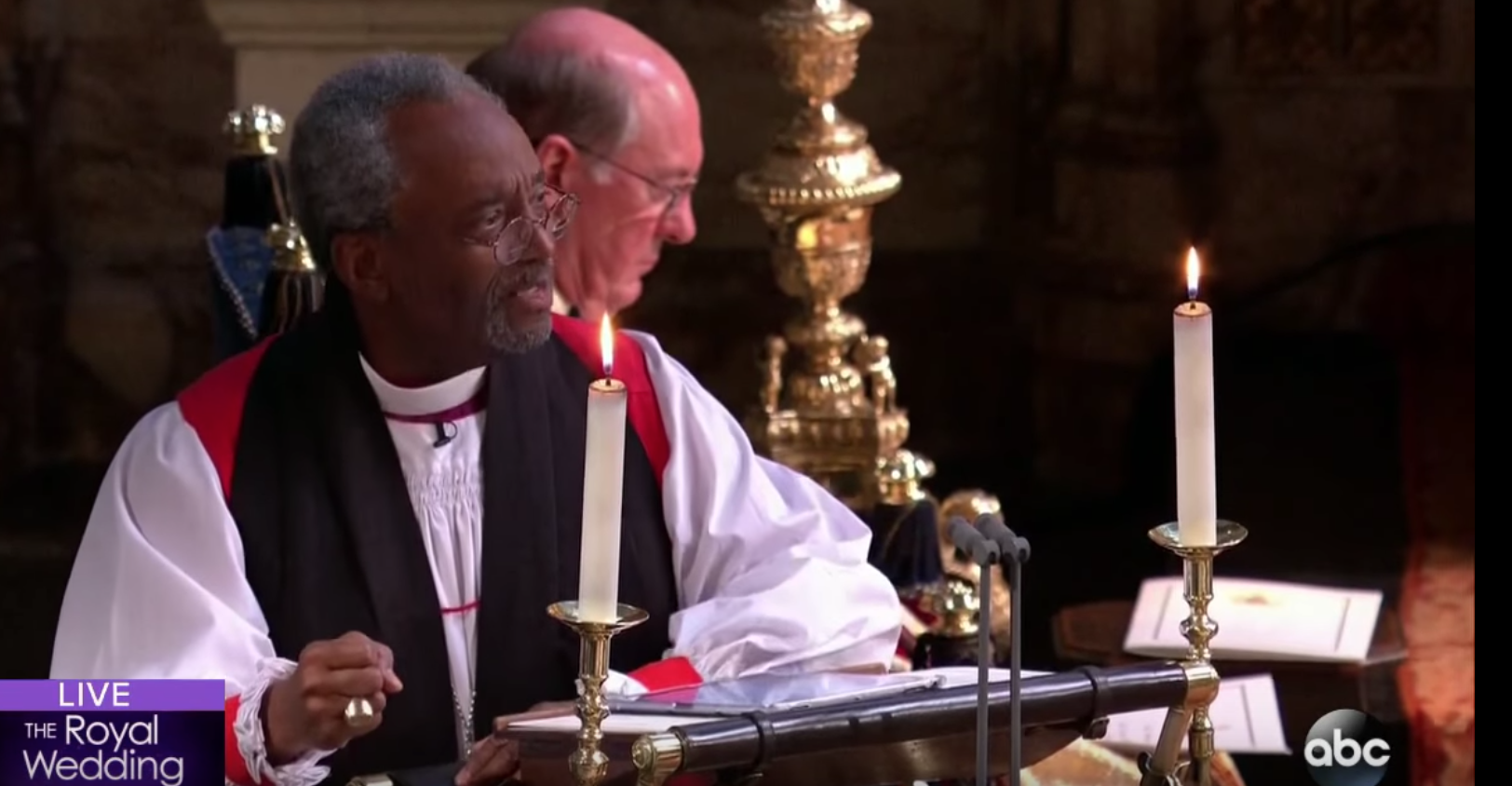
Prior to this sermon which stole the news headlines around the world for days to come, few people had ever heard of Bishop Michael Curry outside The Episcopal Church (TEC), of which he is the Presiding Bishop. Within moments of beginning his homily, social media lit up with Christians and atheists alike, gleaming and expressing likes all-round.
Some voices dared challenge the message and the preacher; I was one of them. I understood why Curry’s sermon might appeal to non-Christians; his words sounded awfully like their own secular worldview, except that he added the idea of God to the conversation. But many Christians were disappointed and even angry by the fact that some Christian leaders questioned the royal sermon. Even when concerns were more fully expressed, some swiped them away as though we were throwing mud at a great man of God.
His sermon was stamped ex cathedra, out of bounds to any criticism. He mentioned love and God, and Jesus was thrown in somewhere, so what’s the problem? Jump off the critic’s chair and join the crowds in celebrating Bishop Curry and his message of love!
Earlier this week, a story reported that this preacher of love is perhaps less loving that he has been made out to be. Indeed, he is less like Apostle Paul who wrote 1 Corinthians 13 and more like Saul, the persecutor of the church.
Christian Today has reported that,
“The head of the US Episcopal Church has taken disciplinary action against the Bishop of Albany for opposing same-sex marriage ceremonies.
Presiding Bishop, the Most Rev Michael Curry, moved to restrict part of Bishop William Love’s ministry after he introduced a policy in the diocese last year preventing churches from performing gay weddings.”
The Bishop famed for his sermon on love has moved to discipline a local bishop who believes in upholding the biblical understanding of marriage.
In 2015, Episcopal Church’s General Convention protected dioceses who banned the practice of same-sex weddings, but those protections were removed last year. Bishop Love has instead chosen to follow what he believes is congruent with God’s word and to guard his congregations against damaging teaching and ceremonies. Bishop Love has responded to Curry’s disciplinary action, saying that his policy reflected the official teaching of the Church that marriage is between one man and one woman, and that no resolutions from the General Convention had overridden this.
Before anyone assumes that this is the first of such instances, Michael Curry has a history of persecuting clergy and churches who don’t support his progressive views of sexuality and marriage.
This was one of the important facts that was whitewashed amidst all the public adulations being heaped on Michael Curry in the wake of the wedding; not only does he deny the biblical definition of marriage, he presides as Bishop over a denomination which has taken its own churches to court in order to remove them from buildings and property, on account that these churches won’t cave into theological liberalism. Michel Curry has been and continues to be one of the chief protagonists responsible for fracturing the Anglican communion not only in America but worldwide.
Curry’s latest actions against a local bishop are just another example of this man who preaches love and practices persecution.
It grieves me to know that while brothers and sisters in Christ in the United States are counting the cost for faithfulness to the Gospel, many other Christians remember that royal wedding sermon with fondness. It perhaps shouldn’t surprise us, but it ought to trouble us, that with a few slick words spoken at a wedding, Christians have sided with the world and decided that Curry’s heterodox beliefs and practices shouldn’t discount the warmth people enjoyed by his presence as he stood and spoke behind that pulpit in St Georges Chapel. It’s almost as though, for the sake of lapping up a captivating presentation, we are prepared to ignore reality and to toss out God’s loving truth, even when these things are made transparent to us.
Let us pray for and learn discernment. Let us side with those who are persecuted, and not with the persecutors. Pray for the churches and clergy who remain in The Episcopal Church and remain in Christ. And ask God that he might lovingly bring Michael Curry to repentance, just as God so graciously did for Paul on that road to Damascus.
“the gospel is bearing fruit and growing throughout the whole world—just as it has been doing among you since the day you heard it and truly understood God’s grace” (Colossians 1:6)
This year we decided to escape one month of the Australian summer by heading for the northern hemisphere. Susan and I had the opportunity to take an overseas holiday with our children, and so we packed our winter coats and gloves, grabbed the passports, made a dash across the equator and didn’t stop for 18000km.
We marched up The Mall to Buckingham Palace. We joined the Tottenham hoards at Wembley Stadium for an EPL game. We toured Lord’s Cricket Ground, wandered the galleries at Tate Modern, drove through Flanders and the First World War battlefields, spent days walking through the beautiful city of Paris, eating a ridiculous amount of tasty French breads and cakes, and finally, a mountain of bbq pork and daily yum cha in the enticing city of Hong Kong. Yes, it was amazing and alluring and many other adjectives beginning with the letter ‘a’.

Amidst visiting and enjoying many wonderful sights, foods, and experiences, there was something else even greater and most astonishing, something we didn’t want to miss out on. To non-Christians, this may sound daft, and sadly, even among many Christians. What could possibly outdo the many places and tastes that garnished our holiday? What beats lunch in Paris and shopping at Selfridges? Answer? It was spending time with God’s people each Sunday. That’s right, the highlight of our trip was Church.
I admit it, I don’t leap out of bed every week for church, let alone when I’m on holidays. It’s not that I don’t want to be with church, but rather, I’m exhausted, in every sense of the word. Nevertheless, I take Hebrews 10:23-24 seriously, and I have a beautiful wife who spurs me on even when I’m lacking motivation. And after all, when Christians in China are facing arrest and imprisonment for gathering together as Church, how can I justify nonattendance because I’m on holiday?
I remind my own congregation that regularly meeting with God’s people is both a command and a comfort, an exhortation and encouragement. Just as eating food is necessary and delicious, so church for the Christian is both vital and pleasing, nourishing the soul and feeding the body. That means, we need time with God, in his word, and with his people, even when I’m on vacation.
We visited several churches during our time away: 3 in London, 1 in Lille (France), and 1 in Hong Kong. We met people for the first time, who were already brothers and sisters on account of Christ. We sat among a French-speaking Church and heard the name of Jesus sung and preached with joyful earnestness. We watched another Church not only accommodate but love special needs children in the most natural and beautiful way; their spasmodic noises and motions were not an interruption to the service but were warmly embraced as part of their worship to God.
On our final Sunday before heading home to Melbourne, we listened to a sermon which captured wonderfully a truth that we experienced throughout our time away.
An old friend, John Percival, serves as the Senior Pastor of Ambassador International Church in Hong Kong. John opened the Scriptures to Colossians 1:1-8.
I was immediately struck by verses 3- 6, which reads,
“We always thank God, the Father of our Lord Jesus Christ, when we pray for you, because we have heard of your faith in Christ Jesus and of the love you have for all God’s people— the faith and love that spring from the hope stored up for you in heaven and about which you have already heard in the true message of the gospel 6 that has come to you. In the same way, the gospel is bearing fruit and growing throughout the whole world—just as it has been doing among you since the day you heard it and truly understood God’s grace.”
What I noticed is how the churches we visited are an embodiment of Colossians 1:3-6 (at the very least, this was our experience of them, as it is has been our joy and privilege in serving at Mentone Baptist for the past 14 years).
Each of the Churches we visited prayed for the nations and for the Gospel to advance throughout the world. They gave thanks for God’s grace at work in bringing people to Christ. The preachers pointed people to the Lord Jesus and called them to believe in him and put their hope in Christ and not the things of this world. It is always exciting to see these words spoken to a small town church 2000 years ago are still working today in the lives of congregations in different parts of the world, and knowing that it is the same Gospel at work in our own lives. And so, just as Paul thanked God for the Gospel at work among the Colossians, I am thankful to God for evidence of his grace among these churches
Our time away was beneficial for many reasons, and among them was seeing again how the Apostolic word is continuing to bear fruit all over the world, just as God said would happen. The same good news that we believe at Mentone Baptist is held by women and men 17000km away. The same message that is preached at Mentone is being proclaimed to people across continents in other languages. The same message that Paul speaks to the Colossians is, 21 Centuries later, still bearing fruit all over the world.
As in the years that have already past by, 2019 will no doubt provide us will another onslaught of church naysayers and Gospel skeptics. We’ll hear unbelievers knock the message of the cross and laugh at the notion of resurrection, and we’ll read about clergy doing the very same thing. New leadership gurus and theological “pioneers” will give advice about how we need to be more ‘radical’ and more ‘revolutionary’ in our approaches to ministry (as though innovation is the Gospel).
Instead, I have been refreshed by words that speak of a faith, love and hope that is growing among churches, born from hearing and understanding God’s grace, “true message of the gospel”.
You see, if we had chosen the ‘easier’ path and not bothered to find a Bible-believing local church, if we had instead skipped church so that I could catch up on lost sleep or see more sights and try new things, we would have missed out on this great encouragement from God. I would have given up Divine food for stuffing myself with a few stale chips, such are medieval buildings, fashion houses, and restaurants, in comparison with what God is growing throughout the whole world.
So as I return to Melbourne and to a new year of pastoral ministry at Mentone, having enjoyed a time away and seeing God’s world and taking pleasure in many wonders of human intellectual and creative exercise. More importantly, I am reminded of the one Gospel which in 2019 will give birth to faith, love, and hope, and being reminded how these things grow together in and through the life of the local church.
Over the past two months, there have been several articles, many conversations, and 100,000s of people engaging in reading and talking about Christian revival.
The catalyst for this discussion is a revival event that is planned for Melbourne next month, “Awakening Australia”. Hundreds of Churches and thousands of Christians across Australia have been energised and excited by the idea of coming together and hearing Christ preached, and praying for many thousands of Aussies to come and to know Christ.
In September, Stephen Tan wrote an article for The Gospel Coalition Australia, in which he offered a critique of Bethel Church and Bill Johnson. Stephen attended a Bethel connected church in Melbourne for several years, and so he has first-hand knowledge of their teaching and practices. The impetus for that article is the upcoming “Awakening Australia’ weekend, which is heavily influenced by, supported by, and promoting Bethel ministries.
I have twice already stated that “Awakening Australia” is more than a Bethel event, but it is not less than. For example, the organiser and one of the keynote speakers, Ben Fitzgerald, is a Bethel missionary, Bill Johnson will be speaking from the platform, and Bethel is supporting the event financially and is sending hundreds of volunteers to serve in Melbourne. In addition, the vision for this event lays in similar events that have been organised in Europe, which again have their origins in Bethel Church, Redding. There is nothing wrong per se with an American Church coming to Australia and bringing other churches together for an event. It is misleading, however, to explain away or to minimise ‘Awakening Australia’s connections with Bethel and with the word of faith movement.
Why am I writing again on this topic? Because, as a Christian and as a pastor and as a Melbournian, I remain very concerned by this event and the potential it has in damaging the physical and spiritual well-being of many people.
One of the concerns that have been raised relates to Bill Johnson’s teaching about the Divinity of Christ, and the ways in which his writings repeatedly minimise and at times seem to deny, that the incarnate Christ is fully Divine. Two weeks ago Bill Johnson issued a statement through text message to Ben Fitzgerald, which I was given permission to make public. The statement clarifies and to some extent corrects Johnson’s own public teaching about the person of Jesus Christ.
If Bill Johnson’s statement reflects a genuine correction, surely he will make further public clarifications and go to great to lengths to correct this teaching in his books. After all, is there any more significant a subject than who is Jesus Christ? To date, Bill Johnson and Bethel have released no such statement on their websites or in any public forum, other than this one casual text message. I find that astonishing.
There have been a number of updates over the past couple of weeks. I wish to bring to attention two of these.
First, a major Christian documentary was released last week. American Gospel: Christ Alone. It is a documentary produced by Americans to warn Christians around the world of what is America’s most dreadful export around the globe, the word of faith movement. The documentary features American theologians and pastors who are decrying a false Christianity that has gained wide acceptance in the United States and is now being transported globally and is leaving behind millions of shattered people. There are two hours of interviews, testimonies and biblical explanations of what the word of faith movement is about, and why it is so dangerous and damaging. Of immediate interest are sections in the documentary that explore some of Bill Johnson’s and Todd White’s teaching and ministry, including White’s connections with Kenneth Copeland and the prosperity gospel, their views about healing and the kenosis heresies. If anyone is interested to know why Stephen Tan, myself, and many others are so concerned about ‘Awakening Australia’ and the word of faith movement more generally, it is worth taking the time to view American Gospel: Christ Alone.
Second, ‘Awakening Australia’ has released and promoted a profile of Bill Johnson, ahead of his visit to Melbourne. As part of this bio, we read,
“healing and deliverance must become the common expression of this gospel of power once again”
“Bill teaches that we owe the world an encounter with God, and that a Gospel without power is not the Gospel that Jesus preached.”
By power Gospel, Bill Johnson believes that miracles and deliverance from evil spirits is an essential aspect of the Gospel of Jesus Christ, so much so that “a Gospel without power is not the Gospel that Jesus preached”.

First of all, let’s note the implication of these words. These statements work against the very claim that the organisers have been making, namely, these revival meetings are about building unity amongst Aussie Churches. Hold on, Awakening Australia has just informed thousands of Churches across the nation that they don’t believe the real Gospel. Straight away, evangelical churches and reformed churches are excluded, based on these statements.
Let’s be clear, both Johnson and White believe that the Gospel centers on the manifestation of miracles and healings, and as Johnson loves to say, ‘on earth as it is in heaven’ (as though we can drag heaven into our lives now and overcome sickness and poverty, etc). This differs substantially from the Gospel of Christ that is revealed and taught in the New Testament.
In American Gospel: Christ Alone, one of the interviewees offers this comment on Todd White’ messaging,
“This method of evangelism by blessing, it’s changing the Gospel from you are dead in your sins and this is what you need by God’s grace, repentance, and faith…it’s changing that message to God loves you, he accepts you, here’s some free stuff. He’ll cure you of your ailments, he’ll heal your back pain”

The focus shifts from sin and God’ wrath, to a positive message of, ‘you’re ok and let me give you a blessing today’. What did the Apostle Paul teach?
“As for you, you were dead in your transgressions and sins, 2 in which you used to live when you followed the ways of this world and of the ruler of the kingdom of the air, the spirit who is now at work in those who are disobedient. 3 All of us also lived among them at one time, gratifying the cravings of our flesh and following its desires and thoughts. Like the rest, we were by nature deserving of wrath. 4 But because of his great love for us, God, who is rich in mercy, 5 made us alive with Christ even when we were dead in transgressions—it is by grace you have been saved.” (Ephesians 2:1-5)
Not only does the New Testament focus on atonement for sin by sufficient death of Christ, New Testament authors specifically repudiate teachers who add to the Gospel of Christ, including those who demand or expect to see signs
“For the message of the cross is foolishness to those who are perishing, but to us who are being saved it is the power of God. 19 For it is written:
“I will destroy the wisdom of the wise;
the intelligence of the intelligent I will frustrate.”
20 Where is the wise person? Where is the teacher of the law? Where is the philosopher of this age? Has not God made foolish the wisdom of the world?21 For since in the wisdom of God the world through its wisdom did not know him, God was pleased through the foolishness of what was preached to save those who believe. 22 Jews demand signs and Greeks look for wisdom, 23 but we preach Christ crucified.” (1 Corinthians 1:18-23)
Hymenaeus and Philetus are two blokes who are mentioned in the Bible, not as examples to emulate, but as people to avoid (2 Timothy other 2:17-18). They taught that the “that the resurrection has already taken place.” In other words, they alleged that the promises that will one day be experienced at the resurrection could be enjoyed in the present. Paul says of these two men that their teaching is like ‘gangrene”, they had “departed from the truth” and that they “destroyed the faith of some.”
God does not promise physical or mental healing in this world. If you’re sick, visit your GP. Doctors and medicine are God’s common grace available to us. We can, of course, pray for God’s healing for our Heavenly Father invites us to talk to him about everything, but it is a lie for any preacher to promise such and to suggest that miracles must accompany the Gospel. The power Gospel is not signs and miracles today, it is Christ crucified: “we preach Christ crucified: a stumbling block to Jews and foolishness to Gentiles, but to those whom God has called, both Jews and Greeks, Christ the power of God and the wisdom of God” (1 Corinthians 1).
Sean DeMars rightly points out in the documentary, “bad theology hurts people.”
I am not suggesting that there are not genuine believers involved in Awakening Australia. I am not discouraging Churches from partnering together in the Gospel. I am not dissuading Christians from praying for revival. Praise God for such things. The greatest joys I have witnessed in life are when I have witnessed or heard of someone coming to know Christ through repentance and faith in him. Christian unity is beautiful and precious, but fudging the Gospel or downplaying aspects of the Gospel will not create a greater sense of unity amongst brothers and sisters; it only distorts and fractures.
Over the past month, a number of people have suggested that it is wrong and divisive to question ‘Awakening Australia’, and instead of criticising we should get behind it. Let’s remind ourselves, by their own promotional material, Awakening has implied that thousands of Australian churches are not preaching the Gospel. My response to those who have pushed back and raised concerns from what I and others have said is this, pastors of churches have a responsibility under God to be concerned for truth and to teach what is right and good and to warn our churches of ideas that or contravene or muddy the Gospel.
Jude exhorts us to “to contend for the faith that was once for all entrusted”
As Paul shared with Timothy that he was being poured out like a drink offering, he gave him this charge,
“In the presence of God and of Christ Jesus, who will judge the living and the dead, and in view of his appearing and his kingdom, I give you this charge:2 Preach the word; be prepared in season and out of season; correct, rebuke and encourage—with great patience and careful instruction. 3 For the time will come when people will not put up with sound doctrine. Instead, to suit their own desires, they will gather around them a great number of teachers to say what their itching ears want to hear. 4 They will turn their ears away from the truth and turn aside to myths. 5 But you, keep your head in all situations, endure hardship, do the work of an evangelist, discharge all the duties of your ministry.”
I trust and pray that this is not the case, but if the Gospel presented at ‘Awakening Australia’ reflects the messaging that Bill Johnson and Todd White are widely known for espousing (and remember they are both speaking at the event), the effect will not be greater Gospel unity or genuine Spirit given Christ glorifying revival. The effect will a hyped up pseudo- spirituality which will fade in the weeks to come and which will confuse unbelievers as to what Christianity is really about, and which will cause great pain for the sick who are offered false promises of healing. Until such time that Awakening Australia distances themselves for these speakers and their links with the word of faith movement, concerns will remain.
Encouraging Update (July 29 2020): Todd White has publicly acknowledged that God has convicted him of preaching an errant gospel and that he is repenting. For the story – https://au.thegospelcoalition.org/article/a-real-miracle-in-prosperity-network/
 MurrayCampbell.net