A response to Waleed Aly’s piece in today’s The Age and some further reflections…
Follow the link for my substack
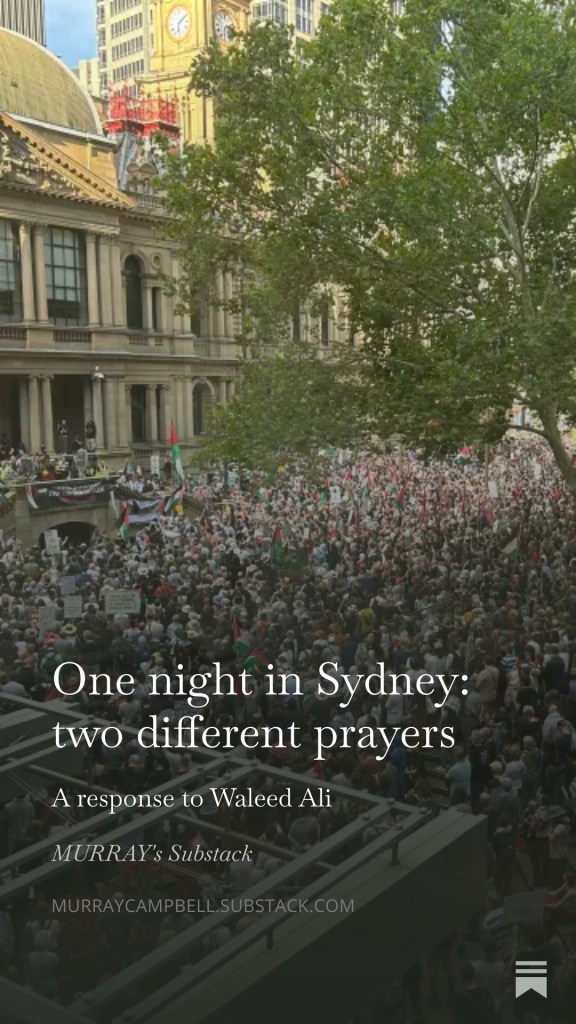
A response to Waleed Aly’s piece in today’s The Age and some further reflections…
Follow the link for my substack
Last night our church building was packed with people, gathered to celebrate the birth of Jesus. While our evening was filled with laughter and joy and praise, what we didn’t know at the time was that a massacre was unfolding at Bondi Beach in Sydney.
Thousands of Jewish Sydneysiders gathered at Bondi Beach to celebrate the first night of Hanukkah. As they welcomed the festival of light, darkness descended as two men dressed in black opened fire.
15 people are now dead, with dozens injured, including 2 police. One of the gunmen is also dead, and his accomplice is critically injured. Police and the NSW Government were quick to announce this as an attack on Jewish people and an act of terrorism.
I am shaken. I am profoundly saddened. What has become of this nation?
I am angry, really angry. Damn those men to hell. Damn those who cultivate and stir hatred toward Jewish people, and those who excuse growing anti-Semitism in Australia.
Can we say that Australia is safe for Jewish people? If the answer wasn’t already tenuous, after last night’s terror, it is difficult to say yes.

Melbourne this year has borne witness to Neo-Nazis leading marches through our city streets. A prominent Neo-Nazi has addressed crowds in public. Arson at Melbourne’s Addas Israel Synagogue saw the building severely damaged 12 months ago. Jewish Aussies are regularly subjected to anti-semitic graffiti and verbal attacks on the streets.
To suggest Australia is safe for Jews rings hollow. It is too our shame.
Stories of heroics are slowly emerging. It needs to be said, given the likely identity of the gunmen, that one hero who emerged last night was a Muslim man who ran and tackled one of the gunmen, almost certainly preventing further loss of life. He in turn was shot twice and is now in hospital.
As hundreds of people came together at Mentone Baptist Church last night, we focused on the God who came. I talked about how hurt and harm naturally produce friction and distance. God knows how deeply divided our cities and suburbs have become. Something counterintuitive happened with Jesus; God determined to come closer. When God saw all the evil in this world and all odious motives and words and deeds, instead of walking away as he had every right to do, he came to us. He came in the most miraculous and vulnerable of ways. The Son of God didn’t come to take away life, but to lay down his own life so that we might gain eternal life.
The birth of Jesus was accompanied by such bright light, and the scene was also interrupted by a wave of evil and darkness. The Gospel of Matthew records the massacre of the innocents, when Herod chose violence and murdered the young of Bethlehem in his hunt to rid the world of the prophesied one.
Matthew turned to these Scriptures to echo the horror,
“A voice is heard in Ramah,
weeping and great mourning,
Rachel weeping for her children
and refusing to be comforted,
because they are no more.”
Today, there is weeping and great mourning in Sydney. This should not be. Why are we not surprised? We are shocked, and yet who is surprised by the blood soaking into the sands of Bondi Beach? Perhaps the location took us by surprise, but our fractured society is losing coherence as we struggle to find something that keeps us together.
Politicians, stop pandering to groups who advocate this bile.
Religious groups, expose and expel religious preachers who teach this evil.
How long must we watch city streets clogged with protesters shouting obscenities and anti-semitic slurs, all in the name of ‘freedom’.
This isn’t a left or right issue, for the hatred has its horns on both ends. It is a religious issue. It is an ideological issue. It is a heart issue, and evidence suggests we are not equipped to respond. Violence isn’t the solution. Vile social media posts won’t bring about peace and healing.
The Gospel of John records Jesus attending Hanukkah. While not one of the Festivals instituted in the Bible, this commemoration of the Second Temple’s restoration in the 2nd Century BC, had quickly found a home in the Jewish calendar. It is unsurprising that Jesus, a Jewish man, participated in this Festival of Light (John 10:22).
A light was snuffed out last night at Bondi Beach, and the light has grown dim around Australia.
Where will we find light to overcome the darkness? Political muscle and social goodwill have some but limited influence. Who can gaze into the soul? Who can outdo evil?
“I am the light of the world. Whoever follows me will never walk in darkness, but will have the light of life.”
Pray for the injured. Pray for the hundreds of victims who were present and witnessed last night’s evil. Pray for our emergency services who today continue to work and protect our streets, investigating last night, and attending to the wounded, both the physically and mentally hurt. Pray for our Jewish friends and neighbours. Check in on them. Assure them of our friendship. Pray for them.
As Hanukkah continues and Christmas approaches, my hope rests in the One about whom it is written,
“The light shines in the darkness, and the darkness has not overcome it.”
Lord, have mercy. Maranatha
The NSW Parliament last week adopted a set of laws prohibiting the conversion of or suppression of peoples sexuality orientation and gender identity. The laws are not as extreme as those in the State of Victoria, nonetheless, there is clear government overreach.
Yes, these new laws in places are bad. They are bad because they introduce needless restrictions on normal Christian faith and practice. They are bad laws because they are defending against practices that are mostly mythical. The laws are bad because they take a smidgen of truth and a lot of illegitimate and aggressive sexology (to use Stephen Mcalpine’s word). The are bad laws because the give Government greater authority over religion (which is an odd position for anyone positing that we are a secular country).
Associate Professor Neil Foster has written a helpful explanation of what the laws do and do not mean and where is ambiguity. I would encourage people to read Foster’s article in light of some misinformation that is floating around and being circulated as fact.
However, Christians have begun to respond to these new laws. I’ve noticed more than a few turning to the Old Testament prophet, Daniel, and have begun quoting that famous incident that landed him in a lion’s den. I happen to think the story of Daniel is one of many helpful Bible places we can turn to as a guide and encouragement. But if we’re going to use Daniel ch.6 for our stump speech, there are a couple of details we need to first take into account.
Firstly, what kind of presence are we in society?
Notice how Babylon’s officials and powerbrokers describe Daniel,
“At this, the administrators and the satraps tried to find grounds for charges against Daniel in his conduct of government affairs, but they were unable to do so. They could find no corruption in him, because he was trustworthy and neither corrupt nor negligent. Finally these men said, “We will never find any basis for charges against this man Daniel unless it has something to do with the law of his God.” (Daniel 6:4-5)
Daniel is a wonderful example to Christians today. There is something that particularly resonates with us about the life and times of Daniel for he was an exile living away from his home, as are all Christians today. He is living and working in a context with foreign gods and ideas dominate the horizon and we’re worshipping God is part of a small minority. Part of the wisdom that we glean from the book of Daniel, and it is a book of wisdom, is how Daniel adapted to life in Babylon and worked hard and judiciously for the common good, and yes obeyed pagan Kings, yet without compromising faithfulness to the one true God.

There have been an inflation of open letters and public declarations of late, mostly from a particular quarter of the Christian faith. These are often highlighting genuine issues, but their content and tone often fall short of usefulness. As someone who has had moments in the past when I’ve employed too many strong adjectives, I’m more conscious these days about precision and not overblowing a situation. It is advisable to read and research before putting your name to a public statement.
As the enraged mood takes hold of so many quarters of society, a Christian voice should be different, but sometimes it is as angry and hyperbolic and therefore indistuishable from others. For example, if your public record is filled with distain for authorities and governments and making antiauthoritarian claims whenever you disagree with a policy or law, when a legitimate concern finally arises, why would those in positions of authority listen to you? It’s like the percussionist in a Symphony Orchestra who is always smashing the symbols as hard as she can strike and often out of time with the rest of the Orchestra. Soon enough the orchestra is going to send you down to the basement and lock you out!
Who wants to listen to the guy who is always shouting at everyone? Who takes seriously the voices who are decrying every issue as a threat to freedom and democracy and religion?
Defiance seems to be the default modus operandi for too many Christians today. However, this shouldn’t be our baseline approach to life in the world and it’s certainly not the way Daniel approached life in Babylon.
There will be some other Christians who have no issue with the new laws in NSW and who are trying to con us into thinking that anyone criticising the law is pulling a furphy. I suspect they’ll be among those who volunteer to be part of the firing squad.
Second, notice how Daniel responded to the unreasonable law.
“Now when Daniel learned that the decree had been published, he went home to his upstairs room where the windows opened toward Jerusalem. Three times a day he got down on his knees and prayed, giving thanks to his God, just as he had done before. Then these men went as a group and found Daniel praying and asking God for help. So they went to the king…”
Daniel continues with what was his normal practice. He didn’t make a song and dance out of it. He simply continued to faithfully pray to God three times a day.
Daniel’s praying wasn’t attention seeking, or brash, he wasn’t revving up the social temperature or resorting to hyperbolic claims or allegations. The window was always open and he carried on as he had always done, with humility and faithfulness.
The problem is, and I understand because I know the injustice of the Victorian laws, too many people are wanting to be David swinging a rock at Goliath’s head, rather than a humble Daniel who went about faithfully serving the Lord and serving the common good of the city where he lived.
In case we think, maybe Daniel is just a one off, I’m about to start a new sermon series at Mentone Baptist on 1 Peter. With little imagination required, I’ve given our series the title, ‘Living away from home’. Like Daniel, Christians are exiles and sojourners, and Peter helpfully explains how Christians ought to live as exiles. In one place he says this,
“Who is going to harm you if you are eager to do good? But even if you should suffer for what is right, you are blessed. “Do not fear their threats; do not be frightened.” But in your hearts revere Christ as Lord. Always be prepared to give an answer to everyone who asks you to give the reason for the hope that you have. But do this with gentleness and respect, keeping a clear conscience, so that those who speak maliciously against your good behavior in Christ may be ashamed of their slander.For it is better, if it is God’s will, to suffer for doing good than for doing evil. (1 Peter 3:13-17)
There is a sense in which we are to embrace suffering for the Lord’s sake. And the manner in which we do also matters according to Peter. Gentleness and respect…not resorting to malicious speech but with good behaviour. So like Daniel and Peter, choose faithfulness, and like Daniel and Peter (and Jesus), part of faithfulness is speaking and behaving with utmost integrity and with grace and refusing to be that clanging cymbal.
While England’s cricket team is battling it out against the Aussies in Yorkshire, the Archbishop of York has picked a fight with God. Stephen Cottrell yesterday addressed the General Synod of the Church of England, arguing that praying to God as ‘our Father’ is problematic.
Understand, unlike the Aussies who play cricket within the rules of the game, Cottrell thought it smart to break the rules of both the Bible and society. As Cottrell would surely know, refusing to use someone’s preferred gender pronouns is paramount to heresy in today’s Western culture. More than that, God gets to choose how he is addressed, and yet the Archbishop of a church has announced that he is stepping outside the crease and he is proud of it.
“For if this God to whom we pray is ‘Father’ – and, yes, I know the word ‘father’ is problematic for those whose experience of earthly fathers has been destructive and abusive, and for all of us have laboured rather too much from an oppressively, patriarchal grip on life – then those of us who say this prayer together, whether we like it or not, whether we acknowledge it or not, even if we determinedly face away from each other, only turning round in order to put a knife in the back of the person standing behind us, are sisters and brothers, family members, the household of God.”

Yes, Stephen Cottrell hasn’t downright rejected Jesus’ call for us to address God as Father; doing so is a step too far for a Church of England Archbishop…for now. Nonetheless, the Archbishop has denigrated the idea of praying ‘our father’ and maligned Jesus in the process.
The Archbishop of York offers 2 reasons why we may (or should) be reluctant to ascribe God as Father. First, he says that some people have terrible fathers. This is sadly true. It is also the experience of many that they have had cruel, abusive, or difficult mothers. As we minister to people we certainly don’t wish to ignore the fact that in our congregation and in the wider community, many people have been mistreated by their Dad. God as Father is unlike them. He is perfect in love and trustworthiness and care and goodness and strength. Praying to ‘our father’ isn’t problematic, it is the ultimate resolution to every need and hint of longing for a good father.
Cottrell’s second objection is more concerning. He asserts that father language smacks of patriarchy. Is the Archbishop implying that Jesus lacks pastoral awareness and that Jesus was complicit in advocating a system of injustice? Patriarchy has become shorthand for sexism, misogyny, inequality, and abuse. In drawing such a close connection between Jesus’ words and patriarchy, the Archbishop comes perilously close to calling Jesus a blasphemer. On this, he doesn’t quite step outside his crease, but he is tempting both keeper and umpire. How far can he go and what can he get away with?
Of course, it was not uncommon for the religious leaders of the day to call Jesus a blasphemer, especially as Jesus identified God as Father and he as God’s Son. On one occasion, Jesus called out his opponents,
“what about the one whom the Father set apart as his very own and sent into the world? Why then do you accuse me of blasphemy because I said, ‘I am God’s Son’? Do not believe me unless I do the works of my Father.” (John 10:36-37)
Jesus wouldn’t be defined by the theological position of Jerusalem’s religious mafia, including their progressive teaching on sexuality. Let’s remember, the Pharisees justified their own sexual inclinations by trying to rewrite the Scriptures whereas Jesus reaffirmed the goodness of God’s design and pattern that is laid out in Genesis chapters 1 and 2.
That’s the thing, when you play with the Bible’s teaching on sexuality and gender, you end up fiddling with the doctrine of God. Stephen Cottrell is among the majority of English bishops who supports the introduction of prayers of blessing for same-sex couples.
A distortion in our anthropology naturally leads to ripping apart the doctrine of God. In recent times Australian politicians have employed a vague and boundary-less concept of a loving God to justify all manner of gender and sexual proclivities. It is one thing for political representatives to fudge God, but it is quite another for a church leader to mislead the people of God.
The pressures to give in to current waves of sexual and gender attitudes is tremendous and standing on Scripture can cost you friends, family and work. The Church should be the one sanctuary where believing God and trusting Jesus isn’t debated and where you’re not called names for sticking with the Bible. Sadly, not so in many cathedral walls and brick parishes.
It shouldn’t surprise us to see ministers who reject Jesus’ teaching on marriage, also cast doubt on what Jesus teaches us about God.
If we think that our understanding of humanity doesn’t interfere with our understanding of God then either, we haven’t been paying attention to ecclesial debates or we’ve convinced ourselves that these matters are not so important.
In order to sustain the view that God is pleased with same-sex marriage and that any gender distinction is arbitrary and even immoral, pastors, and theologians, eventually know that they have to deal with the question of God’s self-revelation. Of course, there is nothing new in Cottrell’s comments. These have been circulating around liberal theological circles for decades, like the boos from a drunken crowd at the Ashes. There is nothing original in his remarks, but they reinforce the perilous state of the Church of England.
The Triune God is revealed to us in the words of Scripture as Father and Son and Holy Spirit. While there are a few examples in the Bible where a feminine simile is used to describe God and by God, there are no feminine metaphors or names used, whereas masculine ones are found frequently.
The Holy Spirit is spoken as he, ““When the Advocate comes, whom I will send to you from the Father—the Spirit of truth who goes out from the Father—he will testify about me.” (John 15:26)
The Son of God is the son and not the daughter, and the Son incarnate became a man, not a woman.
God the Father is the Father.
On the question of similes and metaphors, it’s important to observe a linguistic distinction. For example, someone says to me, ‘Murray you’re as slow as a snail.’ Such a statement is not intending to convey something ontologically true about me, as though I am a snail, but that my walking habits remind them of this slumberous creature. However, God’s self-disclosure as the Father and as the Son is making a statement of ontological reality. That is not to say that God is male or female. God is neither man nor woman (although the Son became a man and is to this very day, fully man and fully God), for sex and gender are tied to biology. God is Spirit and does not have a body. And yet, God reveals himself in his word with gendered language and attributes.
None of this denigrates femaleness in any sense. Both male and female share the imago dei, indeed, Genesis seems to say that it is in the male and female distinction that we together are made in the image of God. As the Bible’s storyline develops, familial language is used by God to describe himself and his love for his people. For just as a son and daughter are equally loved by their earthly father and have equal dignity and worth, so boys and girls and men and women are loved by our heavenly father.
The Archbishop went on to talk about unity and mission, as does every denominational leader who is trying to keep the sinking ship afloat with one hand while drilling a hole with the other. Gospel unity and Gospel mission are sublime, vital, life-giving and God-glorifying realities. But redefine sin and you’ve redefined the atonement and you’ve removed the message of God’s mission. Redefine God and you’ve created a new religion and walked away from the Spirit-given unity as the body of Christ.
Don’t take the Archbishop of York at his word. Listen instead to Jesus. God defines God. Jesus reveals God. Jesus invites us to know God as ‘our Father’. There is beauty and joy and confidence in such prayer, not a problem.
Praying, ‘our father’ isn’t problematic, it is the greatest joy. To ascribe God as ‘our father’ is to hallow his name. It is to be secure in his love and care.
Adoption is the greatest of all Christian gifts given to us through the Lord Jesus. The privileges of being sons and daughters and knowing God as our ‘Father’ is the height of the Christian experience.
“For those who are led by the Spirit of God are the children of God. The Spirit you received does not make you slaves, so that you live in fear again; rather, the Spirit you received brought about your adoption to sonship. And by him we cry, “Abba, Father.” (Romans 8:14-15)
The Lord’s Prayer is once again the subject of dispute in the Victorian Parliament. It is the practice of both Federal and State Governments in Australia to open the parliamentary sitting with the speaker reading out loud the ‘Lord’s Prayer’.
Today in Victoria, Legislative Council Member, Fiona Patten of the “Reason Party” (formerly called the Australia Sex Party), is introducing a motion to have the Lord’s Prayer banned and in its place introduce a moment’s silence at the start of each sitting. Her reasoning is that many Victorians are not Christians and it’s discriminatory toward other religions and to Victorians with no religious affiliation.
As a Christian leader living in Victoria, I’m not persuaded by Patten’s argument, but neither am I calling for the Parliament to hold onto this tradition. Rather, my desire is that our Parliamentarians would come to terms with the meaning of the Lord’s Prayer, and from there, make a decision.
In case anyone is wondering where this prayer originates, it is with Jesus Christ. Jesus introduced this prayer to his disciples early in his ministry and it was written down as part of Scripture and has remained precious to Christians ever since (Matthew 6:9-13; Luke 11:1-4). The prayer, while it can be read verbatim, is probably meant to serve as a model for teaching us ‘how to pray’. Nonetheless this renowned prayer is read verbatim in our Parliaments.

Reading the Lord’s Prayer in the Parliament serves to perform two important functions in our society. First, this is an audible reminder to Victorians of the fact that Australia has been profoundly and positively shaped by Christianity. The prayer offers both an historical and cultural connection to the worldview that has provided vital and foundational influence on Australian life. The Lord’s Prayer serves as one of the few remaining signals in Parliament to our nation’s Christian past. This is a past that many wish to have erased although doing so will also remove the very foundations upon which our society depends for stability, tolerance, and viability.
Second, the Lord’s Prayer is a salient reminder of our humanity and our dependence on God who is Sovereign and good. We ultimately need a God of Biblical proportions to give us wisdom and understanding as we lead, serve and live.
While there is argument for keeping the Lord’s Prayer in the Victorian Parliament, there are more significant reasons for treading cautiously with this prayer. The words Jesus taught are not vague spiritual notions; all nice and innocuous. The Lord’s Prayer is a dangerous prayer to pray. It should probably come with a warning sign or some kind of disclosure before reading. Let me explain,
1. The Lord’s prayer is for believers
The prayer begins with Jesus addressing,
“‘Our Father in heaven”
Jesus invites us to call God, Father. This is an incredibly wonderful idea and it is unique to Christianity. To know God as Father suggests that he is not an impersonal being, but he is relational and personal. What a remarkable concept Jesus is teaching!
However God is not everyone’s Father, and it’s imprudent to call him such. It is inappropriate for any child to call me dad; only my children can do that. Similarly, only God’s children can truly address him as Father. The Bible shows us that we only have the privilege of knowing God as Father through faith in his Son. This is one of the great possibilities that’s opened in Christianity, we can come to know God as Father.
‘In love he predestined us for adoption to sonship through Jesus Christ’ (Ephesians 1:4-5). The Bible teaches us that we can know God as Father, but it is through Jesus. By trusting in his death and resurrection, we are no longer separated from God, but are included into his people and brought into a personal relationship with God.
It is a bold or very foolish politician who addresses God as Father without first placing their faith in his Son.
2. The Lord’s prayer acknowledges God’s utter holiness and otherness
“hallowed be your name”
This line is asking God for glory and greatness to be attributed to his name.
3. The Lord’s prayer asks for God to end this fallen world and to judge wrongdoing.
“your kingdom come,
your will be done,
on earth as it is in heaven.”
The Lord’s prayer asks for God’s Kingdom to come and be manifest. This petition is asking for both judgment and salvation. We’re imploring God to bring an end to all sin, evil and death, and to judge the guilty. It is calling for God to rid the world of every evil and injustice, including our own. It is also an appeal for God to unveil his rule publicly and universally, that we might live under and enjoy eternity with him in the new creation.
Should we encourage people to ask God for this, especially if they themselves don’t believe in Jesus Christ? It’s like playing Russian roulette, except Jesus is persuaded that the Bible’s teaching on judgment is no idle threat, it’s about God righting all that is wrong.
4. The Lord’s Prayer says we need God each day and especially his forgiveness
“Give us today our daily bread.
And forgive us our debts,
as we also have forgiven our debtors.”
He is the God who provides our daily provisions and who is able to do the harder work, of forgiving us our sins.
This petition requires us to recognise our sinfulness, as defined by God’s righteousness and not by our current social norms. At the time, this is breathtaking. In our culture where forgiveness is hard to find and where politics is filled with shaming and guilting others, Jesus’ prayer is humbling and provides a stunning possibility; Divine forgiveness.
5. The Lord’s Prayer asks for a way out from temptation.
“And lead us not into temptation,
but deliver us from the evil one.’”
Are we wanting to embrace and live according to God’s design for life or something else? Given the reputation of our Parliament and many of the decisions made in recent years, one might conclude that our political representatives are consciously jumping into temptation rather than seeking to avoid it.
Let’s be honest, prayer can act like a placebo, serving to trick my consciousness into believing everything will work out. Prayers even in many churches have become about tradition rather than the intended purpose which is about knowing and delighting in God. One cannot read this prayer with understanding and come to those errant conclusions.
Fiona Patten’s reasons for banning the Lord’s Prayer may be about further undermining the important role Christianity plays in our society, but there are bigger and better reasons for avoiding this prayer. Should you speak of God as your father if he is not? Do you understand that calling for the coming Kingdom include Divine judgment? Do you mean it when you ask God to forgive you?
This prayer that provides comfort to millions of Christians is also far more weighty and formidable than I suspect many assume. My advice to the Victorian Parliament is to pause and read it very carefully and to ponder the theological statements Jesus is making and to ask, do I believe this? Can I ask speak these words with a clear conscience? Perhaps, just perhaps, ask yourselves, does this God of the Lord’s Prayer really exist and can I known him and receive the blessings that are promised to those who know God as Father?
For those who have read the article in Sunday’s The Age, “Gay conversion legislation puts Andrews on a collision course with churches”.
The headline is fair. It did not need to be this way, but the current Victorian Government has a poor track record when it comes to dialoguing with faith communities.
Journalist Farrah Tomazin has done a reasonable job trying to squeeze into one article many important factors. I thank her for her courtesy and pleasant conversation. Let it be said, Farrah Tomazin achieved more in that single phone call than the Government has probably done in attempting to understand how Christian churches function and what they in fact believe.
Nonetheless, it is important to reiterate these points that I have long maintained and which have been overlooked by The Age or insufficiently emphasised. Hopefully this encourages more conversation, not less.

A viral photo has been passed around social media this week, mocking Vice President Pence and the Coronavirus Task Force. The photograph shows the group in prayer.

Mocking Christians is hardly an original idea. Ridiculing prayer has been a popular pastime since ancient times. So forgive us when we roll our eyes at this supposed great gotcha moment. Perhaps the disdain has less to do with prayer, and it’s really about politics and searching for another reason to throw mud at the current administration. Whatever the motive, may I suggest that you haven’t quite thought through the logic of this attempted smear.
I understand that for those who hold the belief that there is no God, prayer would seem like a foolish use of time. Of course, this conviction has little to do with the efficacy of prayer but with the firmed a priori belief that prayer is wasted breath. As though, I don’t accept that this medicine will save my life, therefore I refuse to take it!
The commentary pinned to this photograph reveals a wallop of smugness and a waft of superiority breathing over those who practice prayer, as though the truly wise and smart amongst us know that prayer is a useless activity.
If praying was the only thing this task force completed, then we’d have reason to complain. Or is it the fact that they first gathered to pray and then proceeded to work, and to use all their knowledge and wisdom to put together an action plan? Has praying hampered their duties? Has spending a few moments in prayer defused them of the ability or desire to work effectively for the good of the American people?
In what is an interesting twist, the Bible does on occasion empathise with Thomas Chatteron Williams. In Isaiah ch.44, God mocks the idea of praying to wooden statues and gods of human creation.
“From the rest he makes a god, his idol;
he bows down to it and worships.
He prays to it and says,
“Save me! You are my god!”
They know nothing, they understand nothing;
their eyes are plastered over so they cannot see,
and their minds closed so they cannot understand.”
The question about prayer is, does the God to whom we pray exist and does he hear our prayers and can he answer them?
Prayer is not an irrational response to situations facing us, but is perfectly legitimate in light of the biblical view that there is a God and he is truly sovereign. This is the conclusion that only for those men in the room, but for hundreds of millions of people, including many of the most revered minds of our age.
Few tirading twitterers will admit it (or perhaps even realise this simple fact), that many of the smartest people in history (and of today) believe in God and pray to him.
Try standing in front of Francis Collins and call him stupid. Or tweet a photo of William Newsome praying and add the tag, “we’re screwed”. I reckon the really intelligent people among us should create a meme about Nobel Prize winning physicist, Antony Hewish, jeering his belief in God. Of course, It’s not so easy to smear the intellectual credentials of people when we take politics out of the equation.
In fact, a case can be made that without those Bible believing and praying Christians over the last 2,000 years, civilisation would be screwed! Many of the vital scientific and medical breakthroughs, socio-political advances, and ethical foundations that we rely upon today are ours to enjoy thanks to those praying Christians.
But here lies the problem, evidence doesn’t support the thesis that prayer indicates lack of intelligence or capability to perform one’s job. My own church has several members who teach at universities in Melbourne, others are doctors and lawyers. This is not a point not boasting, for the intellectual aptitude of church members does not signal the ‘success’ of a church in any way. I’m simply making the point that intellect does not cancel out belief in prayer. A high IQ or position of great authority and responsibility does not equate to or necessitate a-theism. Belief in prayer has nothing to do with intellectual ability and everything to do with humility. Prayer is for both the genius and the simple, who are both sufficiently wise to know that we can trust God.
Perhaps there is another misunderstanding at play here, as though prayer is currency used to collect what I want out of God. The Bible’s view of prayer is far richer and deeper and more meaningful. Prayer is a gift from God, that we might commune with him and share with him. As Jesus taught, God is Father and like a loving Dad, we can approach him and ask him anything. Also, like a wise Father, he sometimes says yes, sometimes no, and sometimes the answer is to wait. It makes sense to pray to an all-knowing, all-powerful, and all-good God. But does he exist? More important than any the opinions of any scientist or politician or journalist, the person of Jesus Christ says yes. And by his life, words, and deeds, he has demonstrated the reality of this God.
The success of these prayer mocking warriors has failed to evidence high functioning cognitive ability. All it shows is a high level of epistemological narrow-mindedness infused with pride.
I thank God for his gift of prayer, and I’m thankful to see people from all walks of life being humble enough to ask God for wisdom and help.
Around 50 church leaders from across Melbourne met yesterday (Feb 17) to pray for our city.
The Gospel Coalition Australia (TGCA) launched in Brisbane last year, and a Victorian Chapter of TGCA is starting this year.

Photo courtesy of Shebu John
I appreciated the thoughtful approach taken in organising this first public gathering: there was no mass advertising beforehand, no elaborate staging with a ‘worship’ band belting out Christian anthems and celebrity preachers taking the stage. I’m not criticising doing any of those things, but to begin by saying, ‘hey, come and join us so that we can listen to God’s word and pray for Melbourne together’, communicated something beautiful about the tone and purpose of the event.
A few years ago a small group of pastors began meeting to pray for Melbourne and to discuss how evangelicals can more effectively work together in order to see the Gospel grow; not that God is constrained by our prayers and unity, but Scripture teaches us that these things are desirable and useful. Yesterday, was the first of gatherings, purposed to encourage Victorian Christians with the Gospel, and to find ways for working together for the sake of the Gospel.
The morning began with a exposition from Romans 1:1-17, ‘what is the Gospel?’ Andrew Reid (of Holy Trinity, Doncaster) exhorted us to be clear about the Gospel, and to remember that God’s power to save is in this Gospel of Jesus Christ, and not in our methods and personalities. Such a message may be Christianity 101, but it is always good to hear it again, and was particularly relevant given the nature of yesterday’s gathering. If the Apostle Paul felt the need to remind his readers of the Gospel multiple times in every letter, I think we would do well to remind each other when we meet.
Peter Adam then gave a brief and insightful history of Christianity in Melbourne. It was encouraging to be reminded of how God has graciously worked throughout our history, and to consider, if God has worked through his Gospel in the past, can he not also do so today?
For much of the morning we prayed together, for Melbourne itself, for God to grow his Gospel throughout Melbourne, and for each other’s local ministries. It was a rare although enthralling yet ordinary scene, seeing 45-50 Melbourne leaders from many denominations, churches, and organisations, expressing our unity in Christ, and a common desire to see men and women coming to faith in Jesus.
TGCA Victoria will meet again in June/July for another morning of prayer, and there is a more formal event being organised for November with William Taylor (of St Helen’s Bishopsgate).
For details email admin@tgcavic.org
The Lord’s prayer is more wonderful and more dangerous than you think.
A 60 second advert produced by the Church of England has been banned by some of Britain’s cinema chains.
The advert features various individuals and smalls groups taking turn in reciting lines from the Lord’s prayer, and the advert ends with this call, ‘Prayer is for everyone. #justpray’

The pray itself doesn’t belong to the Church of England, the words originate with Jesus himself, and they form part of his broader teaching on prayer to his disciples, which one can read in Matthew’s Gospel.
Digital Cinema Media (who own many of the cinemas), have explained that they have a policy of not accepting political or religious advertisements, in the case that they might cause offence. Leave aside the fact that many movies are an insult to art and to our intelligence, if Digital Cinema Media were so concerned about offending people should they not show care in their choice of movies being screened? How many films offend peoples religions (including Muslim people)?
Speaking to the Guardian, outspoken atheist, Richard Dawkins said, “My immediate response was to tweet that it was a violation of freedom of speech. But I deleted it when respondents convinced me that it was a matter of commercial judgment on the part of the cinemas, not so much a free speech issue. I still strongly object to suppressing the ads on the grounds that they might ‘offend’ people. If anybody is ‘offended’ by something so trivial as a prayer, they deserve to be offended.”
Watch the advert and decide for yourself, but I find myself leaning toward Dr Dawkins (and he says miracles can’t happen!).
While I believe Digital Cinema Media’s decision is silly, I also think the advert’s producers have made some errors.
For example,
#justpray is misleading because it could be easily misconstrued as, just pray to whoever; the details don’t really matter. I realise that’s not the intent, which of course makes the hashtag all the more unhelpful.
A more significant concern is the invitation to call God, Father. This is an incredibly wonderful idea, and it is unique to Christianity. To know God as Father suggests that he is not an impersonal being, but he is relational and personal. What a remarkable concept Jesus is teaching.
But he is not everyone’s Father, and therefore it is imprudent to call him such. The Bible shows us that we only have the privilege of knowing God as Father through faith in his Son. It is inappropriate for any child to call me dad, only my children can do that. Similarly, only God’s children can truly address him as Father. One of the great truths of Christianity however is that we can come to know him as Father.
‘In love he predestined us for adoption to sonship through Jesus Christ’ (Ephesians 1:4-5). The Bible teaches us that we can know God as Father, but it is through Jesus. By trusting in his death and resurrection, we are no longer separated from God, but are included into his people and brought into a personal relationship with God.
Finally, when we pray, ‘your kingdom come’, we are asking for God to not only save, but also to judge this sinful world. It is calling for God to rid the world of every evil and injustice, including our own. Should we encourage people to ask God for this, especially if they themselves don’t believe in Jesus Christ?
I would love to hear more people praying the Lord’s prayer, but it is ill-advised to invite people to pray what they do not believe or understand.
My suggestion is, amend the unhelpful hashtag, and perhaps add a warning about praying without understanding.
Having offered the above criticisms, overall, I really liked the advert. The line which particularly struck me this morning was, ‘Forgive us our sins as we forgive those who sin against us.’ What a powerful testimony this could be in light of the dreadful acts that are being enacted around the world. Jesus is pointing us to God who can forgive sins.
Pray with understanding:
Our Father in heaven,
hallowed be your name,
your kingdom come,
your will be done,
on earth as in heaven.
Give us today our daily bread.
Forgive us our sins
as we forgive those who sin against us.
Lead us not into temptation
but deliver us from evil.
For the kingdom, the power,
and the glory are yours
now and for ever.
Amen.
Praying with our children is a wonderful opportunity and privilege. It not only helps us in talking with our children about what happened in Paris, it reminds us that we can take everything to God in prayer, and it teaches our children how to pray when evil comes.
My suggestion is that you firstly sit down with your children and answer their questions about Islamic State attacks, and then explain the pray to them before praying it with them. There is little point praying what we don’t affirm or understand!
Here is a prayer that you might like to pray with your children:

Heavenly Father,
We thank you that you are God, and that you are good, and are in charge of the world today.
We thank you that we can talk to you in the good times of life and in the sad times.
We are sad and want to cry for the people of Paris, Beirut and Baghdad.
We ask that you may comfort them in their grief, and that you might show them your great love in Christ Jesus.
We pray for the injured, that they will receive the medical help and pastoral care they need.
We ask that Governments and authorities will have great wisdom as they protect their people and as they respond to these attacks.
We thank you for the refugees who are arriving in Australia from Syria. May they be welcomed and cared for. Help us to love our new neighbours as ourselves.
The Bible tells us that evil makes you angry and the cross tell us you have done something about it. Thank you Father for sending your only Son into the world to die on the cross and to rise from the dead so that we know your forgiveness, and have new life and hope.
May the world come to know and see the peace that Jesus brings.
Help us to keep trusting Jesus and to show others that he is trustworthy.
And we ask this in Jesus’ name,
Amen
 MurrayCampbell.net