Last week, I enjoyed Xiao Long Bao with the family in a restaurant just behind Bourke Street in Melbourne City. On our way back to the car, we walked past two billboards casting their messages onto the famous Swanston and Flinders Street intersection.
The first billboard was hilarious; it advertised Melbourne’s Fringe Festival by emulating Paris’ Olympic Opening Ceremony with a Last Supper mock-up. Melbourne’s creatives apparently have the comedic and artistic flair of the inside of a vacuum: ‘Let stupidity repeat itself’! (no I’m not offended, except by the boorishness).
The second billboard stands outside St Paul’s Cathedral. This gothic lookalike sits on the busiest intersection in Melbourne’s CBD. It is a favourite spot for news reporters, city workers, protesters, and more. In every direction a tram is clicketing with passengers heading to the MCG or to theatre shows and the symphony.
With this kind of amazing frontage, which is probably unbeatable anywhere else in all of Melbourne, what message would you like to convey to the 100,000s people who pass by every day? Your Church has an opportunity to say something interesting, provocative, or encouraging to Melbournians on their way to work and home at the end of the day, what button should we press?
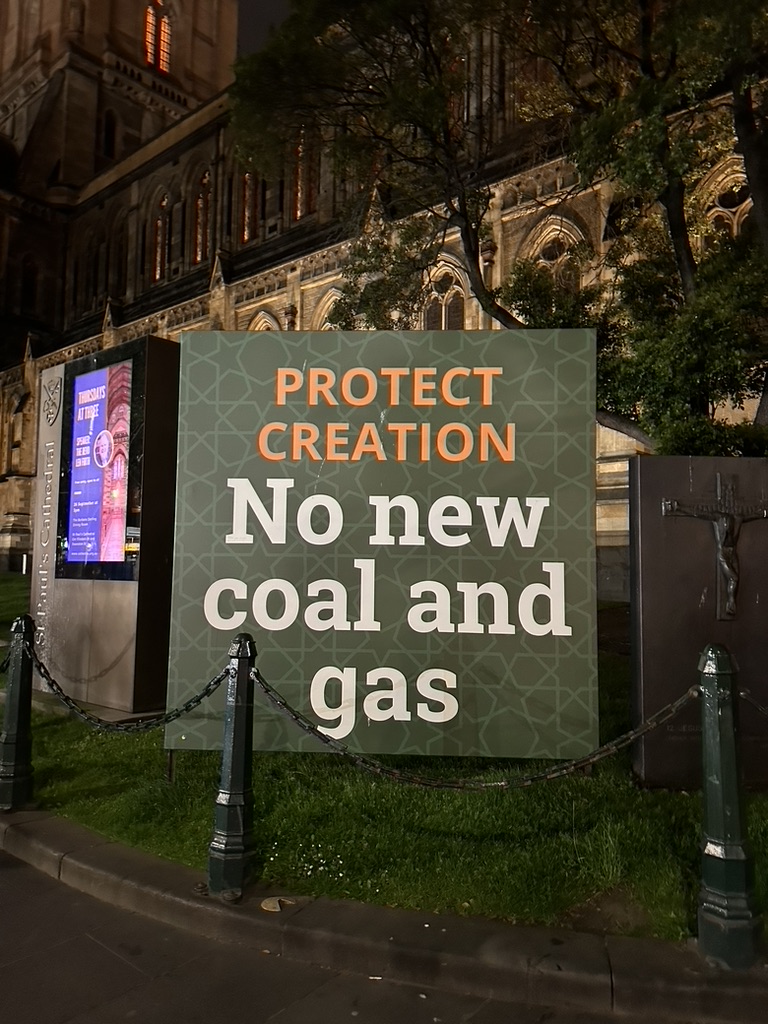
I’m not a climate sceptic, so don’t dump that label on me, but is it really the best message we can send to the city? St Paul’s isn’t alone in this. In fact, it has become the norm for churches to talk about and be known for social concerns. This isn’t new. The term ‘wowsers’ entered the Aussie vernacular because of Christian concerns over alcohol and related social problems. Of course, Churches since the earliest days have cared for the vulnerable. Praise God!
At the same time, Churches understood and prioritised Gospel proclamation, making disciples of Christ and growing churches. Today it sometimes feels that this task is either getting lost, or in too many cases, is no longer believed to be necessary
In other words, we are losing the vertical priority of the Gospel in favour of the horizontal. By vertical, I’m referring to the Bible’s idea that God is above all in holiness, authority and glory, and that sin is foremost a rejection of God’s rules and purposes. The primary issue facing people today is that we are separated from God on account of sin and are sitting under his rightful judgment. Hence, the greatest need we have is God’s forgiveness and reconciliation that is freely given through Jesus Christ.
By horizontal, I’m talking about relationships between people, hence social issues and creation care.
This shift from evangelism to social action didn’t happen overnight, but it has become a huge problem and one we need to talk about. The reasons for preferring the horizontal over the vertical are fairly obvious. Social issues are more tangible than talk about heaven. We can see family discord and poverty. We can hear about the terrible plight brought on by gambling and alcohol. We are regularly reminded of environmental issues facing the globe. The horizontal appears more pressing because in one sense it’s more obvious than talking about the wrath of God and needing God’s mercy and the cross of Jesus.
Social concerns are also more agreeable to the broader community. The city loves churches that provide foodbanks, clothing, and shelter. It’s a win!
People from all walks of life appreciate when churches do the heavy lifting for social needs. Such activities and messages are way less offensive than the bits of Christianity that involve preaching and talking about sin and hell and the cross and resurrection. Promoting the horizontal is palatable whereas focusing on the vertical is vulgar.
It’s not that the horizontal is unimportant. Loving our neighbours belongs to loving God. I think both the Mosaic Law and Jesus were pretty clear: we are not loving God if we are not loving our neighbours. There is something odd if we think that preaching a sermon is suffice and that somehow it’s okay to neglect my neighbour’s broken fence or ignore a child’s cries for help. The resurrection of Christ proves that the whole person matters. But let’s not fool ourselves into thinking we are faithful to God’s mission if we are not prioritising the proclamation of the Gospel to make disciples of Christ and grow his church. Indeed, we’re not fully loving people if we’re not speaking the Gospel into their lives. Don’t buy into delusional hubris that thinks we hit a 6 when the media praises a diocesan decision or the local council gives you another grant.
We don’t choose between the vertical and horizontal. Did Jesus? No. But neither did He allow pressing issues to hijack his mission in the world,
“Let us go somewhere else—to the nearby villages—so I can preach there also. That is why I have come.” (Mark 1:38)
“Now my soul is troubled, and what shall I say? ‘Father, save me from this hour’? No, it was for this very reason I came to this hour. Father, glorify your name!” (John 12:27-28)
In fact, by minimising the Gospel priority of the vertical, we distort the horizontal and the mission becomes less effective. It’s the Melbourne mirage; let’s do what the community wants so that we become more ‘successful’. We think we’re kicking goals. To state the obvious, why would people join your church or become a follower of Jesus if our offerings are little more than a cheap version of what the Government can give us?
Read statements from Archbishops and scan agendas for denominational meetings. Listen to Easter and Christmas sermons, what’s the message? How often does your Church talk about and encourage evangelism? How much of your church’s budget is given to spreading the Gospel and starting churches? When your denomination meets annually, is preaching Christ and calling people to repentance and saving faith in Jesus Christ on the top of the agenda? Does it even appear?
The recent Lausanne gathering in Seoul, South Korea is a case in point. I was invited to attend but due to other commitments was unable. This gathering of 5000 Christian sisters and brothers from around the world to discuss and pray about world evangelisation must have been an incredible experience. The privilege of listening to and learning from brothers and sisters from every corner of the earth would be a joy of a lifetime, a foretaste of heaven.
Each Lausanne Conference produces a paper to reflect, articulate, and explore the nature of reaching the nations with the gospel. For some time there have been some concerns, or at least questions raised, that evangelism and verbal proclamation of the gospel seem to be losing its central place amidst other important issues facing the world today.
There is much to commend in the Seoul Statement. I love the section calling on Christians to holiness. The Seoul Statement includes sections on technology and on human sexuality and gender. There is much to praise God for in these statements. The affirmation of biblical anthropology is a key issue in the 21st Century, where rejecting the Bible’s teaching about men and women leads to a rejection of the Gospel. These things are all really helpful and important. However…
Ed Stetzer is among notable voices who are, however, expressing mild concern that the vertical is being lost. Lost is perhaps too strong a word, but Gospel proclamation seems smaller because of the way horizontal issues are being framed and focused upon. He writes,
“Lausanne: The Need to Prioritize Evangelism…in a time of aggressive religious pluralism (when evangelism receives such significant pushback), evangelism (“declaring”) needs greater focus, particularly in a time of evangelistic decline….“The full name of the Lausanne Movement is the Lausanne Committee on World Evangelization. A stronger statement on the priority of evangelism would help the Seoul Statement. These statements will influence a generation, far more than the congress itself, so let’s make it stronger and not leave #L4Congress without the world knowing that we know mission drift happens—and is already happening in many places in evangelicalism. Let’s help an entire generation know that we are deeply committed to holding evangelism central to the mission.”
I share Ed’s concerns.
Again, Christians shouldn’t choose between the vertical and horizontal. This is not an either/or situation, but neither is it quite a both/and situation. There is an ontological and time priority to the vertical (preaching the gospel and making disciples). Think of it this way, when an oncologist diagnoses a patient, they will treat and care for presenting symptoms and tackle secondary causes, but they will also delve into the root cause. Sin is foremost against God. The Christian mission is about articulating the Gospel of what God has accomplished for us in Christ through his death and resurrection, which brings Divine forgiveness and reconciles us to the living God. This subsequently reconciles us to one another. This incredible coming together in peaceful relations then results in drawing further praise to God (cf Ephesians 2).
The problem is, that too many churches are either giving up on evangelism or no longer see evangelism as essential or it’s getting lost in the myriad of needs. I recall a missions seminar I attended in my denomination where the speaker focused solely on social action. When he was asked about evangelism, it was simply not on his radar.
When has evangelism ever been cool? When has explaining sin and salvation ever been popular on the community charts? When has evangelism ever been easy? And yet without evangelism, churches decline, Christians lose hope, and people go to hell.
Melbournians can be forgiven for thinking that our problems are primarily horizontal ones and God appears little more than in the shadows. Indeed, some churches explain away the vertical dimensions of sin with such Bultmann-like force that we are left wondering whether God is little more than a sociological or psychological category to justify human longings. Stripping God of his Divine power and denuding the Gospel of its vertical imperative is the ultimate humansplaining.
As Tom Holland recently suggested to Christians, “*Keep Christianity Weird… Don’t accommodate to the ideological mainstream, instead major on the supernatural…”
To be clear, I am not suggesting that St Paul’s Cathedral isn’t doing or not believing in evangelism, but their messaging is symptomatic of a disappearing Gospel confidence to provoke people in the best of ways, and to comfort them in eternal ways. The irony is, while the St Paul’s billboard communicates a positive image to one part of society, it’s saying something radically different for those who disagree with zero carbon. And will anyone who agrees with the billboard’s message be warmed to Christianity and think, you know what, I need to get with God? The message wasn’t necessarily wrong, but it’s not the church’s mission.
At the previous Lausanne meeting, held in South Africa, John Piper put it like this, “We care about all suffering now, especially eternal suffering”.
If your Church or denomination has a problem with that statement, then your church or denomination has a problem








 MurrayCampbell.net