Melbourne was an exciting place to be over the weekend.
No, I’m not referring to the footy. Carlton, what are you doing to me?!
Hundreds of men attended the Belgrave Heights Men’s Convention and sat under the word with Sam Allberry and Stephen McAlpine. Lots of Churches around the city and suburbs preached Christ and believers were encouraged and non Christians were intrigued. I was at the Baptist BBQ while the Melbourne Anglican Diocese met to decide who would become the next Archbishop.
For decades the tide has been going out as the force of secularism and scepticism has claimed moral victory after intellectual triumph. And yet, left behind on the sandy shores around Port Phillip Bay isn’t the kind of happiness and freedom and contentment that we were promised. Instead, our streets and suburbs are floundering under the pressure of what is perhaps the worst mental crisis in our history, and growing social, economic, and relationship strain. My generation and my parents’ generation persist in closing the windows, locking the doors and telling the kids that there’s nothing outside; there is no God worth looking to let alone trusting for life. Not everyone is buying that script any longer. The emptying tide has left behind millions of people and exposed layers of rubbish on the sand produced by the materialist ideal.
We are not happier. We are not safer. We are not more content.
Is it surprising that we are hearing reports and stories of a gentle tide coming into shore in the UK and parts of the United States? In some parts of Asia and South America, it is a high tide with huge numbers of people, including Gen Z and younger who are becoming Christians and joining Churches and discovering that the God of the Bible is God today.
We are not seeing a fast-moving incoming tide in Melbourne, but something is happening. I know there are recent reports of baptismal floods, but I suspect some at least are spurious. Nonetheless, there is something happening. Government and academic institutions are continuing to double down on sexual ethics and religious freedom issues, progressive Churches continue to play those songs on their playlist, and yet there is a gentle counter voice that can be heard.
Anecdotally, across various Baptist churches and Anglican, in University Christian groups, and among our Orthodox and Roman Catholic friends, young adults are experiencing Christianity for the first time. They are ignoring the warning signs that my generation posted on every street corner. There is a curiosity emerging, an interest in Jesus, and an intrigue to discover the meaning of the world’s most important book: the Bible.
I wonder, if the Anglican Archbishop election is another small sign of a changing tide toward evangelical Christianity. 4 candidates were nominated for Anglican Archbishop of Melbourne; all 4 are evangelical Christians: Wei Han Kuan, Tim Johnson, Megan Curlis-Gibson, and Ric Thorpe. Someone may correct me, but this is rare and possibly the first time in many decades that all candidates are evangelical. This alone is significant and a result for which we should be thankful.
Ric Thorpe was elected on Saturday afternoon and will be installed as the new Archbishop later this year. Bishop Ric Thorpe is an Englishman with a pedigree from Holy Trinity Brompton and training at Wycliffe Hall, Oxford. He is one of the few Church of England Bishops to uphold a Christian understanding of marriage and human sexuality. He is passionate about evangelism and church planting. These are all great indicators.
Melbourne needs more churches. Melbourne needs 100s more Christ-centred, Gospel-believing and preaching, people-loving churches.
I’m not an Anglican so feel free to take my observations with the same volume of water found in a baptismal font (bad joke). My Melbourne Anglican friends are overwhelmingly encouraged and thankful for all candidates and the outcome, even as the Diocese looks over troubled waters. Like all our Christian denominations, much deep work of theological and spiritual reform needs to take place. Theological liberalism and moral progressivism is like sand in the car after a day at the beach; the granules find their way into different spots and crevices and lingers long afterwards with distraction and annoyance. The fact is, most of our churches (across denominations) are in decline, and biblical literacy and cultural understanding are shallow. That can lead to desperate pragmatism or compromise. But mission with fraudulent theology won’t save anybody, just as sound doctrine without love gives people a spiritual migraine. Church planting without the Gospel is the devil’s strategy. Who would want to be in Christian leadership today?
And yet Christ is on the throne. Evangelism and church planting and revitalisation isn’t God’s Plan B. It’s always been Plan A and there is no plan B. The Gospel remains God’s power to save. The Church is the bride and centrepiece of God’s redeeming purposes. Let’s be thankful for Christian leaders who are convinced of this and who in love can navigate our churches in the shallows and deep.
It may be that as the cultural tide withdraws, small rock pools and large ones will be left behind, and they will become safe places for people to splash and swim and come to know the God who saves. Gospel Churches may be easier to spot and more inviting for those who need rest.
I sense a quiet excitement mixed with soberness as we see the landscape before us. Did we see a glimpse of things to come this past weekend? May it drive God’s people to prayer and eagerness.
Almost as important, someone needs to nudge Ric Thorpe toward the right footy club (Carlton) and teach him how to make a decent coffee and double-check that his visa includes a condition on who to support in the Ashes later this year.
‘after all, is Apollos? And what is Paul? Only servants, through whom you came to believe—as the Lord has assigned to each his task. I planted the seed, Apollos watered it, but God has been making it grow.’
20 years ago today I was inducted as Pastor of Mentone Baptist Church. I won’t lie, it feels like 20 years! Our 3 children have literally grown up in the church. Prior to 2005, Susan and I had spent several years preparing for this scenario. I had always loved serving in my local church, although I had zero desire to move into pastoral ministry. It turned out that God had other plans. My pastor at Camberwell Baps was gracious enough to give me opportunities to teach the Bible; that idea of speaking and sharing God’s words with people got my heart pumping. But an immature 19 year old, is just that, an immature 19 year old! After finishing uni and getting married, Susan and I moved to London and then to Sydney, for training and gaining experience in churches, so that we could return to Melbourne and serve Christ here.
We returned to Melbourne from our place of exile and started at Mentone Baptist Church on February 6 2005.
I’ve wrestled with this for the past week, should I say something about the 20 years or not. I guess it is an anniversary of sorts. As some readers will be aware, I’m someone who writes more than a few words. Through this blog and writing for both Christian and secular publications, I enjoy talking about the gospel and trying to help others think through issues from the lens of scripture. I also love talking about music and cricket, and sharing with friends what my kids are up to and all their latest adventures. Talking about myself, isn’t something I generally do (leaving aside the compulsory self-effacing sermon jokes). I am conscious about not making Murray Campbell the topic of somethingness. It’s hard enough to see Jesus clearly, without my oddities standing in the way!
It was only this morning, as I read my Bible and read those verses in 1 Corinthians 3, that I decided, maybe I’ll put a few thoughts together. Maybe there is something I have learned from serving one church for 20 years that might be helpful to pastors elsewhere. Although, the last impression I want to suggest is that pastoral ministry is about the pastor. I’m not looking for praise (or the inverse!). And serving in the same church for 20 years doesn’t make the work any more or less important than pastors who only serve a few years. I’m also aware of how every church differs in some ways, and that means my particular experiences aren’t identical to a pastor who is serving in Mildura or Maroochydore. Then again, every minister of the Gospel shares the same Bible, the same mission and message, so perhaps similarities and parallels are not so few and far apart.
Here are 20 lessons that I have learned over 20 years of serving at Mentone Baptist Church. It’s not as though I didn’t believe or was unaware of many of these lessons prior to coming to Mentone. And it’s not as though I’ve reached the apex for these 20 themes. Most things in the Christian life are repetitive and a day by day process of sanctification. I’m not planning to provide detailed explanations and examples for these 20 lessons, but rather to note them in passing.
1. I still have much to learn.
I am often amazed at how little I know and how little I understand of the Scriptures and I’m excited at the prospect of continuing to dig deeper and discover more wonders of God in his word.
I’m still learning how to Shepherd a local church. Our Elders are currently reading Andrew Heard’s provocative book, Growth and Change, and am enjoying discussing penetrating questions about ministry and mission. It’s great. I love how the elders (and church) want to keep moving forward in the Gospel and to be more effective in seeing God’s Kingdom growing.
2. God answers prayer.
He really does. When the church has prayed, we have seen God work. Which begs the question, why do we pray so little?
3. God’s Gospel is powerful.
Just last year, our church heard testimonies and witnessed baptisms where the reality of Jesus Christ compelled and changed people’s lives. We have more planned in the early part of 2025. It is so strange to me to hear of churches smudging or avoiding clear and faithful presentation of the Gospel, as though that’s the best strategy for faithfulness and growth. So weird.
4. I’m still learning patience.
I like to run fast but there’s little point sprinting if the church isn’t ready. Sometimes though, I could probably encourage our leaders and members to walk a little faster!
5. God’s word really is beautiful and true and complete.
At Mentone, we use the Bible lots and we want to present God’s words in a way that reflects the treasure that it is. How amazing it is that God has given us a living word that speaks truth and grace today. That’s why we have 2 bible readings every Sunday morning and why we make sure our ministries, from Sunday school to youth group and 1-1 discipleship involve opening, reading and living out his word
6. People will hurt you (and at times you’re no saint either)
Learning to process hurt isn’t quick or easy. Having trusted and godly leaders is really important for working through these times.
7. I’m more convinced about the value of having a plurality of leaders.
The eldership hear me talking about this all the time. We want to grow the number of elders. A church needs a plurality of leaders: from pastors and elders, to deacons, and all kinds of lay ministry leaders. Paul didn’t lay out a paradigm in Ephesians 4 for us to ignore!
8. Make sure the eldership consists of godly men who share a broad breadth of personality, experience and skills.
A church requires greater wisdom than that of one pastor. However, we insist that there is profound and convinced agreement and unity on the church’s doctrine and direction.
9. Trying to set an example for others is hard.
The Bible says that pastors ought to set an example of life and godliness for the believers. It’s a balancing act, trying to share and show how I live outside the pulpit and yet doing so without handing out an autobiography each week.
10. Don’t do everything.
Set early and clear expectations and boundaries and be okay with saying ‘no’. Teach your congregation to be okay in hearing, ‘no’.
11. Membership really is important.
I believed this 20 years ago, and as the years have progressed I’ve become more convinced. Expressive individuals is a scourge on churches and hamstrings Gospel witness and effectiveness. Jesus meant every word when he said, “Love one another. As I have loved you, so you must love one another. By this everyone will know that you are my disciples, if you love one another.” Want to impact the world for Jesus? Then join a church and love the saints.
12. I will make mistakes and that’s ok.
13. The fear of losing people is common, but not dealing with problems generally makes the situation worse.
14. Technology is a curse.
Ok, not entirely. Tech is both good and bad, a useful servant and a terrible master. As technology changes, churches will often adopt and adapt and yet we also need to be wise in its use. Too often churches begin paying a cost without first thinking through behavioural changes that come about through smart phones or AI. Hey, even schools are now recognising these dangers!
I remember Carl Trueman suggesting once that the invention of the car changed people’s behaviours in ways that negatively impacted the local church. Cars are great, what a blessing it is to be able to move about easily and speedily. Cars give people more freedom and as Trueman explains, people started taking long weekends and pursuing more activities, and this turn impacted church attendance and participation. In other words, the car impacted the ministry and mission of the local church and does so even today.
15. We still need to cultivate a better culture of disciple making.
We talk about it and preach on it and we practice it in all kinds of ways, but I think we are yet to be convinced of how important discipleship is to the health and maturity of church.
16. Repetition is key to cultural change (thinking of point 14).
I’m learning that I need to say the same thing over and over again, and when I’ve done that, I need to repeat it again. I’m also trying to encourage our leaders to press repeat so that messages sink in and therefore lead to changed expectations or behaviours or whatever it is we’re trying to move forward.
Part of the issue isn’t reluctance from people, but leaders remembering that people live busy lives and their heads aren’t in the church 24//7 as mine is.
17. Church history is amazing and it matters.
I don’t need to be sold on history. I’ve always enjoyed reading history books and watching documentaries, even as a 3-year-old kid. I studied history at Melbourne University.
Many years later, I am more persuaded that churches should appreciate and understand that who we are today is the result of the sacrifices, thinking, preaching and lives of the saints from old. Churches make mistakes, take wrong turns, and lean into theological mess because we haven’t learned the lessons of church history.
We ran a course last year on Reformation history and this year we are talking about the Council of Nicaea.
18. Protecting my day off was a great idea.
Pastoral ministry isn’t just a job, it is a way of life. Family is family and church is also family. This makes setting boundaries often murky and imprecise. Susan and I have always wanted our children to view church as a family, and yet we never wanted to sacrifice them at the altar of ministry. I’m thankful for the clear and flexible boundaries that Susan and I set together and which the church embraced.
19. Theological liberalism is an easy gospel enemy to spot, but there is an emerging conservatism that we need to be aware of and keep away from the church.
Christian Nationalism which conflates common grace with the Gospel, and Church with State, is a growing concern not only in the United States but also in segments of Australian Churches.
This isn’t a biggy at Mentone Baps, but knowing this flavoured heresy is gaining popularity in some circles, I have already begun talking about these issues in sermons and discipleship (and of course on this blog). The Gospel is neither left nor right. Our mission isn’t defined by a side of politics, but by the Lordship of Christ and his Gospel that brings the forgiveness of sins.
20. There is so much work do to.
When all is said and done, the most pressing issue today remains the eternal state of people in light of the coming judgement of God. How many millions of people in Melbourne may know their left hand and right but are oblivious to Christ the judge and Christ the redeemer?
Pastoral ministry is the worst job in the world. Pastoral ministry is the best job in the world. I get to see and be part of people’s highest and lowest moments of life, to share their joys and sorrows. Pastors have the terrifying responsibility to preach the full counsel of God and dare suggest, see my life and follow my pattern of living. And we do, knowing that God will hold us to account for how we have shepherded his people. It really is a work that people should avoid and embrace.
I don’t spend a lot of time looking back over the years. To be honest, if you asked me for particular highlights in any given previous year, I may not be able to tell you with any precision. When I do reflect on the 20 years, I do so with some embarrassment and also much thankfulness: for Susan and my children, for a church that was patient and kind and who looks after the staff so well, and for God who never lets us down.
Mentone’s current associate pastor, Mike Veith has now been with us for 14 years in this role (and as a student pastor for 2 years before then), so that’s a milestone for which I am thankful.
I realise that 20 years in one church sounds a little bit unusual, but I know pastors who have served their churches for a great deal many more years. I think of Philip Calman from whom I learned so much during my 4 years at Chatswood Baptist as a student. He has been serving as their senior pastor for 28 years and counting. Praise God!
These are 20 of the lessons I’m learning from my 20 years at Mentone Baptist Church. There are many others, but perhaps among this this 20 there is something that might strike a note or encourage another pastor in their work for the Lord.
Victorian Premier Jacinta Allan has announced a new set of laws under the banner ‘social cohesion’.
‘Social cohesion’ when attached to government and laws has a touch of the Machiavellian about it. One doesn’t know whether to think it’s more like George Orwell or Monty Python!
The Government’s initiative includes a new ‘social cohesion pledge’. Any community group applying for government funding will need to make the pledge, promising to support social harmony and inclusivity.
No doubt this is a testing time for any government. There are pressures applied from all kinds of directions, and at times this leads to inaction or delayed resolve. As we have seen over the past year, this has given more oxygen to antisocial, and in this case, antisemitic voices.
I think this specific set of government measures are sensible and necessary, but I cannot but help think that it may open the door to future measures that are unreasonable and damaging.
There is a cowardice hiding behind masked protesters. There is an ugly hatred being propagated by some of the protests we have seen on Melbourne streets. If you can’t protest without wearing masks, carrying threatening objects, and using disgusting slogans, maybe that should signal that you or your cause is a problem.
Victoria was never the perfect State, but we have witnessed developments over the past decade that are injurious and bring grief to many. We are less peaceful than we were. We are less inclusive and kind. There is more personal and social distress and with little sign of a turnaround. Melbourne has become Australia’s protest capital (not a title to boast about). Ever since 2020, when the government turned a blind eye to certain marches while slamming others, every Jane, Nguyen, and Bob has seen fit to grind city streets to a halt. Not a week goes by without banners and angry faces blocking traffic.
I support these particular measures because antisemitism cannot under any circumstance be allowed to fester. If we think that our society is beyond and above 1928 Germany, we are suffering from a greater dose of egomania than I thought.
However, I am not comfortable with Jacinta Allan’s language of ‘social cohesion’. I get it; they are trying to address a specific problem without naming the elephant in the room. Why not call it ‘Rules for Safe Protests’ or something like that?
The reason why I’m uncomfortable about the Government’s language of ‘social cohesion’ is because the task of social cohesion doesn’t belong to the government, but to the people. When government sees itself as the answer to every social ill and when the people demand government to fix every crisis, we are obfuscating personal responsibility and creating systems of governance that cannot bear the weight of such responsibility.
This is one area where the work of Dr Christopher Watkin is worthy of consideration. Monash University’s Dr Watkin articulates a positive and important work on contract theory. He says,
“Civil society is sometimes the neglected dimension of the social contract, the “missing middle” as it has been called. We have a tendency to jump straight from government and law to the individual.
These civil society relationships across different visions of the good are a glue that holds our social contract together.”
From his book, Biblical Critical Theory,
‘the vague and sporadic measures taken by contemporary governments to shore up the social contract with well-meaning but half-hearted attempts at “civic edu- cation” have little effect, when all the while billions of advertising dollars and a destructive paradigm of competition in all areas of society expertly catechize individual consumers to be little predisposed to the civic duties a strong social contract requires. No rewriting of the social contract can be complete without giving serious attention to its cultural and liturgical infrastructure.’
No Government is up for the job, and it’s not designed to be. Part of the problem embedded in any Government setting the rules for social cohesion is that this is never a natural space. This is one of the heresies attached to secularism. Secular may be preferable to Sharia Law and Christian Nationalism, but it is no more epistemologically and morally neutral. Secular is the sum of the worldviews present in and controlling the moral impulses of the day.
There are wonderful pockets of social cohesion is found in all kinds of places and communities across our State. There are sporting clubs and men’s sheds, and there are temples and synagogues. It is certainly experienced in local churches.
Churches are frequently more culturally diverse than the communities surrounding them. Where I have the privilege of serving and belonging, we have people from China and Uganda, families from Vietnam and India, Nigeria and Columbia. Young and old mix together, single and married are friends and serve one another. Of course, Churches have their failings and blindspots, (after all, the very point of Christianity is that there is only one perfect saviour and we’re not him!), and yet there is profound togetherness and other person-centredness.
The Victorian Government is also currently working on expanding anti-vilification laws, which some are concerned will tighten the noose of faith groups from teaching and practising in accordance with their convictions. It’s amazing how often the State has assumed the bishopric role when Christian praxis hasn’t supported their social agenda. There is a mine of irony in Victoria where Government identifies a growing social disorder and yet clamps down on one of the few societal groups who are truly exhibiting positive social health and life. If we are interested in civil society, maybe we ought to return to the worldview that created the ideas and values from which this vision derives: Christianity.
Well, it’s Christmas time, the ultimate day of truce-making, although that first holy night was filled with peril. Nonetheless, the hope born that night in Bethlehem really is the only hope we have today. Come, check out a local church and see that hope in action.
Let me leave you with the great Messianic promise of Isaiah,
“The harvest is past, the summer has ended, and we are not saved.”
Since my people are crushed, I am crushed; I mourn, and horror grips me.
Is there no balm in Gilead? Is there no physician there? Why then is there no healing for the wound of my people?’
(Jeremiah 8:15, 18-22)
Photo from X
Adass Israel Synagogue is located up the road from where I live and the church where I serve. The Synagogue is located in the Council area, adjacent to mine, which, in Melbourne distance, makes us pretty much neighbours.
What took place yesterday was pure unadulterated evil and has tarnished our city, perhaps in ways we may not comprehend for some time to come.
In the early hours of Friday morning, 2 men set fire to the Synagogue, causing extensive damage and injuring two people who were inside at the time. The perpetrators went about their deed, hiding their identities as the cowards they are. There is no courage or moral fortitude in attacking a place of worship.
Melbourne is home to more Holocaust survivors than any other place in the world, apart from Israel. Between my home and the city, stand many Jewish schools and synagogues. My kids regularly played sports with and against local Jewish schools, such is the vibrant community in this part of Melbourne.
William Cooper is one of our great Australians. A Christian man and Aboriginal leader, William Cooper stood in solidarity with the oppressed. With foresight, Cooper understood the unfolding evils in Germany and spoke up when most world leaders remained silent. On December 6 1938, William Cooper led a march in Melbourne to the German Consultant, in response to the infamous Kristallnacht, and condemned the “cruel persecution of the Jewish people by the Nazi government in German.”
86 years later, to the day, my Melbourne, our city, witnesses a burning Synagogue.
For all our pseudo-sophistry and boasting in our cosmopolitan and cultural greatness, travelling in our DNA is the same iniquities that have tainted all cities of old, including what was once considered the most ingenious and advanced culture in the world: Germany. We Melbournians love to sing our own praises, in this gleeful myopia that sometimes has more in common with Nero than William Cooper.
Of course, this chromosomal thread appears in all kinds of ways; sometimes we call it out and other times we call it good or choice. The unnerving fact is that Melbourne has not decided where we will fall.
Today, Jewish families around Melbourne are less certain about tomorrow. They are less confident and free. That ought to bring great sadness to our city and shout a loud warning.
Two millennia ago, an elderly Jewish man lived in Jerusalem. We are told in Holy Scripture,
“Now there was a man in Jerusalem called Simeon, who was righteous and devout. He was waiting for the consolation of Israel, and the Holy Spirit was on him” (Luke 2:25)
May the consolation of Israel pour out His grace and peace.
“Gifts for the naughty and the nice. Share the Joy”
Has Myer rediscovered the evangelistic drive of its founder, Sidney Myer?
Most Australians may be unaware, but 104 years ago, Sidney Myer became a Christian. Myer was an upcoming Melbourne entrepreneur and businessman. Despite growing success, he had made some rather poor choices in life, one of which resulted in his first marriage ending.
One day, another Melbourne businessman named Lee Neil, had his company bought out by Sidney Myer. Neil then went to work for Myer. Neil was a Christian and over time he shared with Myer his most precious possession, God’s good news of Jesus.
Sidney Myer could not buy or afford this news of Divine forgiveness. As the Apostle Paul once explained,
‘it is by grace you have been saved, through faith—and this is not from yourselves, it is the gift of God’
Once Myer realised this message, this gift of God transformed the way he did business. Generosity was part of the parcel of his success. Myer included his employees in the benefits of a growing company and he shared his profits among those who had little. He even celebrated Christmas by organising lunches for 100s of people. Today, Sidney Myer remains one of Australia’s great success stories, but few are aware of the Divine gift that prompted his philanthropy. Indeed, he rarely made mention of it during his lifetime, apart from a few occasions when he was encouraging others to join a charitable cause.
Has Myer recaptured Sidney Myer’s greatest vision?
Perhaps? I suspect not. The furry creature who features on the billboard is named, ‘humbug’, and apparently you can buy your very own soft and cuddly humbug in Myer. From doing a little research today, I’ve learned that humbug represents the annoyance and grrr most of us feel at some point around Christmas (sound familiar?). Whatever the marketing intention, the statement is true: “Gifts for the naughty and the nice. Share the Joy”.
In fact, I reckon Myer’s marketing department has underestimated how true their slogan is. Consider these amazing words from the Bible,
“She will give birth to a son, and you are to give him the name Jesus, because he will save his people from their sins.”” (Matt 1:21)
“Here is a trustworthy saying that deserves full acceptance: Christ Jesus came into the world to save sinners—of whom I am the worst” (1 Timothy 2:15)
If anything, humbug underestimates the seismic problem of the human condition that Christmas exposes, just as the red-suited man from the North Pole gets it wrong. We are more than a little grumpy, and unlike jolly Mr Claus who keeps his studious eyes on 2 very different lists, the God of Christmas delivers a very different message. It’s not the righteous who find blessing and the sinners get lumps of coal; everyone sits on the same page.
Here lays the cutting edge of Christianity, which makes the Gospel unlike every other story, philosophy and religion. God doesn’t choose between the naughty and nice. He says, ‘Christ died for the ungodly…God demonstrates his own love for us in this: While we were still sinners, Christ died for us… the gift is not like the trespass. For if the many died by the trespass of the one man, how much more did God’s grace and the gift that came by the grace of the one man, Jesus Christ, overflow to the many! (Romans 5)
The message of the Christ is one of overflowing love and mercy toward those who are undeserving and unable. Imagine a God who gives gifts unmerited! Imagine God whose only Son sacrificed himself to deliver us from every iniquity, even death? Imagine if the real message of Christmas isn’t ‘be nice not naughty’ but, you are forgiven; come home to God. Of course, we don’t have to imagine. Look at that night in Bethlehem. Check out the infant Jesus and his life, words and deeds. Above all, come to terms with why the only good man chose to die on a Roman cross.
Thank you Myer for your Christmas message this year. I for one, will ‘share the joy’. Jesus really is good news, God’s “Gift for the naughty and the nice.”
Last week, I enjoyed Xiao Long Bao with the family in a restaurant just behind Bourke Street in Melbourne City. On our way back to the car, we walked past two billboards casting their messages onto the famous Swanston and Flinders Street intersection.
The first billboard was hilarious; it advertised Melbourne’s Fringe Festival by emulating Paris’ Olympic Opening Ceremony with a Last Supper mock-up. Melbourne’s creatives apparently have the comedic and artistic flair of the inside of a vacuum: ‘Let stupidity repeat itself’! (no I’m not offended, except by the boorishness).
The second billboard stands outside St Paul’s Cathedral. This gothic lookalike sits on the busiest intersection in Melbourne’s CBD. It is a favourite spot for news reporters, city workers, protesters, and more. In every direction a tram is clicketing with passengers heading to the MCG or to theatre shows and the symphony.
With this kind of amazing frontage, which is probably unbeatable anywhere else in all of Melbourne, what message would you like to convey to the 100,000s people who pass by every day? Your Church has an opportunity to say something interesting, provocative, or encouraging to Melbournians on their way to work and home at the end of the day, what button should we press?
I’m not a climate sceptic, so don’t dump that label on me, but is it really the best message we can send to the city? St Paul’s isn’t alone in this. In fact, it has become the norm for churches to talk about and be known for social concerns. This isn’t new. The term ‘wowsers’ entered the Aussie vernacular because of Christian concerns over alcohol and related social problems. Of course, Churches since the earliest days have cared for the vulnerable. Praise God!
At the same time, Churches understood and prioritised Gospel proclamation, making disciples of Christ and growing churches. Today it sometimes feels that this task is either getting lost, or in too many cases, is no longer believed to be necessary
In other words, we are losing the vertical priority of the Gospel in favour of the horizontal. By vertical, I’m referring to the Bible’s idea that God is above all in holiness, authority and glory, and that sin is foremost a rejection of God’s rules and purposes. The primary issue facing people today is that we are separated from God on account of sin and are sitting under his rightful judgment. Hence, the greatest need we have is God’s forgiveness and reconciliation that is freely given through Jesus Christ.
By horizontal, I’m talking about relationships between people, hence social issues and creation care.
This shift from evangelism to social action didn’t happen overnight, but it has become a huge problem and one we need to talk about. The reasons for preferring the horizontal over the vertical are fairly obvious. Social issues are more tangible than talk about heaven. We can see family discord and poverty. We can hear about the terrible plight brought on by gambling and alcohol. We are regularly reminded of environmental issues facing the globe. The horizontal appears more pressing because in one sense it’s more obvious than talking about the wrath of God and needing God’s mercy and the cross of Jesus.
Social concerns are also more agreeable to the broader community. The city loves churches that provide foodbanks, clothing, and shelter. It’s a win!
People from all walks of life appreciate when churches do the heavy lifting for social needs. Such activities and messages are way less offensive than the bits of Christianity that involve preaching and talking about sin and hell and the cross and resurrection. Promoting the horizontal is palatable whereas focusing on the vertical is vulgar.
It’s not that the horizontal is unimportant. Loving our neighbours belongs to loving God. I think both the Mosaic Law and Jesus were pretty clear: we are not loving God if we are not loving our neighbours. There is something odd if we think that preaching a sermon is suffice and that somehow it’s okay to neglect my neighbour’s broken fence or ignore a child’s cries for help. The resurrection of Christ proves that the whole person matters. But let’s not fool ourselves into thinking we are faithful to God’s mission if we are not prioritising the proclamation of the Gospel to make disciples of Christ and grow his church. Indeed, we’re not fully loving people if we’re not speaking the Gospel into their lives. Don’t buy into delusional hubris that thinks we hit a 6 when the media praises a diocesan decision or the local council gives you another grant.
We don’t choose between the vertical and horizontal. Did Jesus? No. But neither did He allow pressing issues to hijack his mission in the world,
“Let us go somewhere else—to the nearby villages—so I can preach there also. That is why I have come.” (Mark 1:38)
“Now my soul is troubled, and what shall I say? ‘Father, save me from this hour’? No, it was for this very reason I came to this hour. Father, glorify your name!” (John 12:27-28)
In fact, by minimising the Gospel priority of the vertical, we distort the horizontal and the mission becomes less effective. It’s the Melbourne mirage; let’s do what the community wants so that we become more ‘successful’. We think we’re kicking goals. To state the obvious, why would people join your church or become a follower of Jesus if our offerings are little more than a cheap version of what the Government can give us?
Read statements from Archbishops and scan agendas for denominational meetings. Listen to Easter and Christmas sermons, what’s the message? How often does your Church talk about and encourage evangelism? How much of your church’s budget is given to spreading the Gospel and starting churches? When your denomination meets annually, is preaching Christ and calling people to repentance and saving faith in Jesus Christ on the top of the agenda? Does it even appear?
The recent Lausanne gathering in Seoul, South Korea is a case in point. I was invited to attend but due to other commitments was unable. This gathering of 5000 Christian sisters and brothers from around the world to discuss and pray about world evangelisation must have been an incredible experience. The privilege of listening to and learning from brothers and sisters from every corner of the earth would be a joy of a lifetime, a foretaste of heaven.
Each Lausanne Conference produces a paper to reflect, articulate, and explore the nature of reaching the nations with the gospel. For some time there have been some concerns, or at least questions raised, that evangelism and verbal proclamation of the gospel seem to be losing its central place amidst other important issues facing the world today.
There is much to commend in the Seoul Statement. I love the section calling on Christians to holiness. The Seoul Statement includes sections on technology and on human sexuality and gender. There is much to praise God for in these statements. The affirmation of biblical anthropology is a key issue in the 21st Century, where rejecting the Bible’s teaching about men and women leads to a rejection of the Gospel. These things are all really helpful and important. However…
Ed Stetzer is among notable voices who are, however, expressing mild concern that the vertical is being lost. Lost is perhaps too strong a word, but Gospel proclamation seems smaller because of the way horizontal issues are being framed and focused upon. He writes,
“Lausanne: The Need to Prioritize Evangelism…in a time of aggressive religious pluralism (when evangelism receives such significant pushback), evangelism (“declaring”) needs greater focus, particularly in a time of evangelistic decline….“The full name of the Lausanne Movement is the Lausanne Committee on World Evangelization. A stronger statement on the priority of evangelism would help the Seoul Statement. These statements will influence a generation, far more than the congress itself, so let’s make it stronger and not leave #L4Congress without the world knowing that we know mission drift happens—and is already happening in many places in evangelicalism. Let’s help an entire generation know that we are deeply committed to holding evangelism central to the mission.”
I share Ed’s concerns.
Again, Christians shouldn’t choose between the vertical and horizontal. This is not an either/or situation, but neither is it quite a both/and situation. There is an ontological and time priority to the vertical (preaching the gospel and making disciples). Think of it this way, when an oncologist diagnoses a patient, they will treat and care for presenting symptoms and tackle secondary causes, but they will also delve into the root cause. Sin is foremost against God. The Christian mission is about articulating the Gospel of what God has accomplished for us in Christ through his death and resurrection, which brings Divine forgiveness and reconciles us to the living God. This subsequently reconciles us to one another. This incredible coming together in peaceful relations then results in drawing further praise to God (cf Ephesians 2).
The problem is, that too many churches are either giving up on evangelism or no longer see evangelism as essential or it’s getting lost in the myriad of needs. I recall a missions seminar I attended in my denomination where the speaker focused solely on social action. When he was asked about evangelism, it was simply not on his radar.
When has evangelism ever been cool? When has explaining sin and salvation ever been popular on the community charts? When has evangelism ever been easy? And yet without evangelism, churches decline, Christians lose hope, and people go to hell.
Melbournians can be forgiven for thinking that our problems are primarily horizontal ones and God appears little more than in the shadows. Indeed, some churches explain away the vertical dimensions of sin with such Bultmann-like force that we are left wondering whether God is little more than a sociological or psychological category to justify human longings. Stripping God of his Divine power and denuding the Gospel of its vertical imperative is the ultimate humansplaining.
As Tom Holland recently suggested to Christians, “*Keep Christianity Weird… Don’t accommodate to the ideological mainstream, instead major on the supernatural…”
To be clear, I am not suggesting that St Paul’s Cathedral isn’t doing or not believing in evangelism, but their messaging is symptomatic of a disappearing Gospel confidence to provoke people in the best of ways, and to comfort them in eternal ways. The irony is, while the St Paul’s billboard communicates a positive image to one part of society, it’s saying something radically different for those who disagree with zero carbon. And will anyone who agrees with the billboard’s message be warmed to Christianity and think, you know what, I need to get with God? The message wasn’t necessarily wrong, but it’s not the church’s mission.
At the previous Lausanne meeting, held in South Africa, John Piper put it like this, “We care about all suffering now, especially eternal suffering”.
If your Church or denomination has a problem with that statement, then your church or denomination has a problem
Congratulations to Dr Dani Treweek on winning Australia’s Christian Book of the Year, for her outstanding work in, The Meaning of Singleness: Retrieving on eschatological vision for the contemporary church.
Dr Dani Treweek and Dr David Starling will be speaking at this special ministry leaders’ day at Mentone Baptist Church on September 6th.
In an age that is increasingly confused about sex and gender, what are we meant to think? What is a Gospel way to think through these important issues?
Click on the link or QR Code for further information and to book tickets for what will be an encouraging and equipping day.
It’s the season for reflecting on the year that has been. People are compiling lists of the biggest or most momentous events of 2023. While these lists can be interesting, I want to do something a little different here. Rather than taking the usual perspective, I want to remind us that the Scriptures give us another view of reality and it’s one that we can easily miss or forget in the midst of everyday life.
Enjoy and be encouraged and a little bit challenged as well.
Two angels are in heaven. They are enjoying sipping ‘heaven’s nectar’ (single origin bean 2023; naturally) when they strike up a conversation. These 2 angels, let’s call them George and Sally, have seen much in 2023. The date (on earth) is December 14.
The universe may be cut off from heaven, but heaven knows what happens on earth. George and Sally read the New Jerusalem Gazette and learn of decisions and events as they go about serving God.
Amidst the clamour being made by 8 billion people in every corner of the world, the annual sound of Christmas Carols crescendos. Although most carolling fails to hit the heights of heaven, such is the powerless nature of lips singing truth from hearts that don’t believe.
George takes another sip and thinks to himself, ‘if only Melbourne knew what the greatest coffee tastes like!’
As the sweet aroma fills their angelic nostrils and swims around the palate, Sally says to George, what do think are the 7 biggest stories of 2023?
Where do the angels begin? The year has brought about eternal cheer and also much grief. On earth conversations and debates rage over a million stories and events that have influenced and shaped, bringing happiness and sadness. Which of these do angels choose?
Sally began compiling an initial list in her mind. She thought, “The Ashes were certainly memorable…maybe we won’t mention the Commonwealth Games or Rail link…And of course, there have been more than a few political elections this year but none of them make the cut…”
George observes that the 7 biggest stories in 2023 are in fact the same headlines from 2022, and pretty much every year. It’s not that each incident and event is glossed over and ignored. The angels have been around long enough to realise that the human condition remains unchanged and God’s eternal decree continues to work over and through every page of history. Sally agrees, which isn’t surprising given there is no unction for disagreement around God’s eternal home.
So here are the 7 biggest events from 2023 according to George and Sally:
7. Every act of injustice and evil in 2023.
The angels agree that number 7 isn’t on the list because of any virtue or value, but because of Divine outrage that continues against God’s world. Sally and George understand how God grieves every sin and transgression. They appreciate how much more than they, God grasps the gravity of these events that harm and offend and destroy.
Whether the acts are carried out by terrorists in the ancient land or Governments promoting injustice, greedy corporations or the hidden sins of a billion people, God grieves. God angers. His anger thunders with a ferocity that shakes the very foundations of the cosmos. The angels witness that while the most judicious of man-made courts cannot capture every offence, in the heavenly court every perpetrator of evil will face God’s wrath and eternal judgment.
Sally points out to George, how blinded by hubris, human beings readily believe they can circumvent Divine justice. At our worst, we even redefine righteousness and call evil good, but God isn’t fooled by our calculations. Whether it is the slaughter of civilians in Israel, the abusive parent in a suburban street in Melbourne, the academic legitimising the dehumanisation project, or the employer cheating his staff out of fair pay; God sees and condemns and guarantees justice.
Some events make the news in Sydney, New York and Colombo, while a billion go unnoticed or are wilfully ignored by friend and neighbour. There is no such overlooking by the King of Kings.
As the angels consider all the headline news, they ponder that God persists with the world; what a staggering thought. Sally then reminds, George, remember what God has said,
“But do not forget this one thing, dear friends: With the Lord a day is like a thousand years, and a thousand years are like a day. 9 The Lord is not slow in keeping his promise, as some understand slowness. Instead he is patient with you, not wanting anyone to perish, but everyone to come to repentance.
10 But the day of the Lord will come like a thief. The heavens will disappear with a roar; the elements will be destroyed by fire, and the earth and everything done in it will be laid bare” (2 Peter 3:9-10)
6. Christians chasing lesser things that distract from ultimate things.
George remarks, “God has given the most precious gift of all and to people who did not want or ask, his Son. And yet look at all these Christians filling up life with lesser things.
George scratches his head, “God gave himself in Christ but these Christians still aren’t satisfied. They are working harder and earning more and playing more, and yet sacrificing the very thing that can gives them life. And see how they’re teaching their children to chase after the wind. Why are they feeding them junk food when God offers living water? Sure, who doesn’t enjoy a party and decent education or long weekends at the beach. But do they have no sense of discipline and seeking first God’s Kingdom? No wonder millennials don’t take God seriously, when their elders are teaching like this.”
5. Grief over churches abandoning the Gospel and Christians deconstructing the faith
It is another year of sadness as more churches give up Jesus for a seat at the table of respectability, success and ease.
Sally notes a conversation she had with Thomas Cranmer and Hugh Latimer on November 16. She saw them weeping over the Church of England. To give up Divine love for the sake of a moment’s likability staggers the mind. Cranmer reflected on his own moment of weakness and then the grace that caused his repentance. Latimer remarked, that if the bishops of England snuff out the candle, then God will light it again among others.
Spurgeon still can’t get over the joy that his old days of melancholy are over forever. He remains overjoyed knowing that all the superlatives he used in his sermons to convey the wonders of Christ, were barely a tiny impression of the true glory that is being with Christ and seeing him face to face.
As he overhears Latimer talking with Sally, he interjects with Shakespearean flourish, to describe the ongoing downgrade among Baptists as being like the melting polar ice caps. Spiritual climate change is eroding church faithfulness and vitality. Instead of displaying the glory of God in the face of Christ, churches convince themselves that they need to become more like the world to reach the world. The Gospel is melted down and replaced with mirrors to reflect the culture, thus confirming unbelievers’ assumptions about the irrelevance and idiocy of the Christian faith in 2023.
George observed the unusual number of Bibles that are never opened or read.
“It’s like churches don’t ever open the Bible and read what God has to say to them. Don’t churches believe the Lord of the Church? Why do they pretend that the lamb’s 7 letters to the churches are always about someone else and not for them?
Mary and Martha walk past and add, “Churches who choose between love and truth end up losing both.”
Both angels are pleased to announce that the top stories of 2023 include more encouragement and thankfulness than sadness and grief. At number 4 is…
4. Growing holiness in the face of suffering
Sally is convinced that one of the highlights for 2023 is seeing so many people becoming more like Jesus. George gives an emphatic nod of agreement.
It’s amazing to observe the breadth of places and conditions in which people are living and the countless challenges many are facing. Instead of becoming bitter or turning to jealousy or despair, Christ’s light is shining. LED lighting might be seen from space, but the Spirit’s light in people’s lives reaches heaven.
The encouragement and comfort of God’s words produce the perseverance of the saints,
“Let us not become weary in doing good, for at the proper time we will reap a harvest if we do not give up.” (Gal 6:9)
“Since everything will be destroyed in this way, what kind of people ought you to be? You ought to live holy and godly lives 12 as you look forward to the day of God and speed its coming…14 So then, dear friends, since you are looking forward to this, make every effort to be found spotless, blameless and at peace with him.” (2 Peter 3:11-12; 14)
“For this very reason, make every effort to add to your faith goodness; and to goodness, knowledge; 6 and to knowledge, self-control; and to self-control, perseverance; and to perseverance, godliness; 7 and to godliness, mutual affection; and to mutual affection, love. 8 For if you possess these qualities in increasing measure, they will keep you from being ineffective and unproductive in your knowledge of our Lord Jesus Christ.” (1 Peter 1:5-8)
3. Thousands of churches are planted
Sally and George praise God for his faithfulness in 2023. God’s big project in the world is reconciliation and the church is the people of reconciliation. After all, Jesus shed his blood for the church and gave his word, ‘I will build my church’. The Lordship of Christ and the promises of God in the Gospel are intimately tied to God saving a people,
“And God placed all things under his feet and appointed him to be head over everything for the church, 23 which is his body, the fullness of him who fills everything in every way.” (Ephesians 1:22-23)
you are no longer foreigners and strangers, but fellow citizens with God’s people and also members of his household, 20 built on the foundation of the apostles and prophets, with Christ Jesus himself as the chief cornerstone. 21 In him the whole building is joined together and rises to become a holy temple in the Lord. 22 And in him you too are being built together to become a dwelling in which God lives by his Spirit.” (Ephesians 2:19-21)
God is pleased and heaven is enthralled to see churches of all shapes and sizes given birth in Kenya and Cameroon, in Iran and India, in China and Argentina, and even in the great lost nations of England and Australia. People may turn their backs on God, but His Gospel is compelling and he will finish what he has started building.
2. The salvation of millions of people
George and Sally agree that integrally tied to story no.3 is story no.2. Indeed, stories 2 and 3 are easily interchangeable, and really the same story, just from being reported from different angles.
The Church is God’s masterpiece and churches are made up of countless names and faces of the imago dei, sinful, forgiven and redeemed. Conversion may be considered a dirty and immoral word in parts of the world, but heaven rejoices.
2023 is another year of explosive Gospel growth around the world. A few of these names are recognised by society and media and their conversion stories go viral. In heaven the new birth and adoption of every person goes viral among heaven’s choir.
What a massive year for heaven’s choirs! It’s been non-stop singing with all the millions and millions of people from every language, ethnicity and city turning to Christ and coming to know new life in his name. George exclaims, “Every time I finish the chorus we sing it again. In heaven, Taylor Swift never gets a nod, not even Bach is back. It’s constant no.1”
“Salvation belongs to our God,
who sits on the throne,
and to the Lamb.”
1. Welcoming home all who finish the race
Heaven loves a home coming.
George confessed to Sally that while they enjoy a vantage point that those on earth don’t possess, God authored a word for people. It wasn’t to the angels that Scripture was given, but to people.
Sally recalls the words of Jesus,
“My sheep listen to my voice; I know them, and they follow me. 28 I give them eternal life, and they shall never perish; no one will snatch them out of my hand. 29 My Father, who has given them to me, is greater than all; no one can snatch them out of my Father’s hand
George adds the Apostolic voice,
“We know that the whole creation has been groaning as in the pains of childbirth right up to the present time. 23 Not only so, but we ourselves, who have the firstfruits of the Spirit, groan inwardly as we wait eagerly for our adoption to sonship, the redemption of our bodies”
Heaven longs that people daily correct our myopic gaze. It’s not that we have lenses to see through all time and space; naturally, we are not omniscient as is God (and neither are George and Sally). We do have, because of the God of wisdom and grace, His word which reveals more to us than we deserve and can imagine. The Scriptures provide more than a detailed account of human affairs and moral statutes. God opens his Divine foreknowledge to us so that we can see beyond the immanent frame and know a tiny snapshot of what was and what will be. These words from God give great assurance and encouragement to keep going.
A great crowd this year have finished the race and received those words from God, ‘Well done good and faithful servant”.
Sally is fascinated by the commitment people make to winning gold medals, trophies and awards. “See how they pour their lives into attaining a piece of tin or gold or something with a $ sign attached. The number 1 story of 2023 isn’t a World Cup or Grand Slam, but the crown of righteousness given to all who finish the race. In 2023 millions of people have made it home.
Thanks be to God.
“I have fought the good fight, I have finished the race, I have kept the faith. 8 Now there is in store for me the crown of righteousness, which the Lord, the righteous Judge, will award to me on that day—and not only to me, but also to all who have longed for his appearing.” (2 Timothy 4:7-8)
One of the world’s most (in)famous works of art has arrived in Melbourne, ripened just in time for Melbourne’s glamour event for art: Melbourne Gala 2023.
Without peeling away the bare naked observation that many of us have these curvatured pieces in bowls at home and an entire reel of duct tape in the cupboard, nothing communicates ‘wow’ like the real thing sticking to a wall in Melbourne’s National Gallery of Victoria.
As people study and gaze upon the yellow plantain, there is one further sticky observation to make: the original didn’t make it to Australia. Presumably, it became banana pulp; all $120,000US of it! Even then, the world’s second most famous banana (let’s not forget bananas in pyjamas), was substituted out when the original was eaten as an unofficial piece of performance art! Let’s not worry about details.
I first wrote about Maurizio Cattelan’s banana back in 2019 and never dreamed that one day we could view and goo and ga over (and maybe gobble) it here in Melbourne.
As our artistic geniuses examine and ponder the significance of a banana stuck to a wall, let me throw in my 2 cents worth. My opinion may not be worth the prized $120,000 or the $395 that bought you a ticket for opening night, but then again, neither was the bag of bananas I purchased from the supermarket.
Joking aside, I think there is something to this work by Maurizio Cattelan’s work, titled ‘Comedian’.
The Italian satirical artist has created art from real life and sometimes zany objects. His most famous piece was stolen and presumably melted down: a $10 million toilet! Comedia uses two common objects: an overripe banana stuck to a wall with a strip of duct tape. The work was originally exhibited at the Miami Gallery, Art Basel, before being sold for $120,000US.
Before the mockers mock and critics criticise, it is worth observing the success of this Cattelan original. Some might say that the work itself should be subject to ridicule. Add a $120,000 price tag, and the jeering and sneering is more than audible. But the story of this captivating banana isn’t yet finished. A performance artist by the name of David Datuna visited the Art Basel and while admiring ‘Comedian’ up close, he committed the great heresy of reaching out and touching the banana. He didn’t stop there. He ripped the banana and its duct tape from the wall and then proceeded to peel the banana and eat its flesh. Onlookers gasped while others laughed. A security guard appeared, horrified. Datuna exclaimed that his was a work of art and he gave it the name, ‘Hungry Artist’.
He was quickly taken away but later emerged as a free man; free to perform and eat again.
Posting on Instagram he said,
“Art performance by me. I love Maurizio Cattelan artwork and I really love this installation. It’s very delicious,”
The director of the gallery, Lucien Terras, told the Miami Herald,
“[Datuna] did not destroy the artwork. The banana is the idea”.
The $120,000 banana has since been replaced with a fresh banana.
I don’t recommend anyone trying the stunt here in Melbourne. But as thousands flock to admire…or scorn, let me ask this question, who is acting the fool? At the time of the infamous art meal, I recall friends rolling their eyes all over social media and decrying the waste of money. People were quick to point out the foolishness And now Melbourne has bought the banana…for $1.20 from Coles on Elizabeth Street!
Who is the fool? Maurizio Cattelan? After all, all he did was take a banana and stick it on a wall. Far from acting the fool, Cattelan is looking at us and laughing with a $120,000 wry grin, shaped like a banana. More significantly, Cattelan’s genius lies in successfully drawing us into conversation and debate about a slightly smelly piece of fruit. We are the suckers, falling into Maurizio Cattelan’s world of satire. The banana isn’t the subject, we are the subject. Even eating the art piece forms part of the ever evolving expression that has been set in motion by the artist.
So are we the fool? Well, we are certainly silly monkeys for eating into his artistic expression, and then, of course, there’s the fool who paid $120,000 for old fruit and a strip of duct tape!
In the world of commonsense, we are the fool as we offer up our half-digested opinions about a piece of fruit stuck to a wall. However, the world today isn’t ruled by reason. We have become eager participants in Cattelan’s pantomime. In this upside-down world where right is now wrong, and wrong is lauded, and where such divisions are even removed altogether, the only fool here is the security guard who dared assume that eating the banana was an act of vandalism. And yet, as Lucien Terras has declared, even the guard has become an aspect of the artist’s expression.
Art has merged into life. Or should that be, life has merged into art? Everything becomes art. We are the artist’s subject as much as that banana, and all the subsequent bananas that will replace the mould and smell.
As far as originality is concerned, Cattelan’s object is little more than a spin-off from Andy Warhol’s portrait of a banana. He is simply replacing a painting with the object itself. And yet, here we are, talking about a banana.
Now that we’ve established that all of us are fools and yet none of us is the fool, is there a right way to be looking at ‘Comedian’? Is there any single interpretation of ‘Comedian’ that is the right one? Indeed, should we even be talking in such categories?
The sculpture isn’t designed to elucidate a set response but to create an entire spectrum of reactions. It is a portrait of the absurd and the absurd is us. There is no fixed meaning, just meanings. There is no primal purpose, just a bunch of ripening and then slowly rotting contributions.
I’m not quite sure whether ‘Comedian’ is mocking today’s avant garde or is an example of its stupidity (apologies Melbourne). Either way, it is reveals something rather sad and disillusioning about our society. What if the real world is also without overarching meaning and design? What if all we have is 8 billion opinions and convocations and divisions? It would be a truly satirical place to live. In such a world, why shouldn’t we eat and destroy an expensive work of art? Why shouldn’t we deride or laugh or even destroy? Why not spend $120,000 on a banana instead of giving the money to charity?
A universe without God is such a world. In such a closed material construct the only fool is the one who stands up and says “no, you mustn’t do that”. Instead, let people be, to steal, to take, to laugh, to admire, and however else we choose to express ourselves.
If Cattelan’s ultimate objective was to communicate the irreverence and heresy of particular meaning, the joke rests finally on him, for it was after all necessary for Cattelan to image the idea in his mind and then to make it with his hands. There is no art without the artist. Even in the aleatoric movement of John Cage and company, the author could not fully remove himself.
The universe God created and the place in which we live are not such places. It is filled with careful design and purpose. Not all opinions and reviews are equal. Not every action is good. Not every investment is wise or useful. The scary thing is that this world’s creator takes an active interest and he expresses concern for how we treat his creation including one another. As Psalm 2 indicates, he is a God who laughs and scoffs at us for deluding ourselves into pretending that our speculations and philosophising can subvert and replace his revelation.
“The One enthroned in heaven laughs;
the Lord scoffs at them.
He rebukes them in his anger
and terrifies them in his wrath, saying,
“I have installed my king
on Zion, my holy mountain.” (Psalm 2)
How much better is the portrait God has given us of his creation. How much more stunning and meaningful and satisfying is the Creator’s plan for the canvas on which you and I exist and have our being. Indeed, it involved the artist entering his own creation for the purpose of redeeming and reconciling us to His Divine purpose. This doesn’t end with the loss of creative freedom, but with finding greater freedom where we are no longer consumed for the value of an overripe banana.
“In the beginning was the Word, and the Word was with God, and the Word was God. 2 He was with God in the beginning. 3 Through him all things were made; without him nothing was made that has been made. 4 In him was life, and that life was the light of all mankind. 5 The light shines in the darkness, and the darkness has not overcome it…
9 The true light that gives light to everyone was coming into the world. 10 He was in the world, and though the world was made through him, the world did not recognize him. 11 He came to that which was his own, but his own did not receive him. 12 Yet to all who did receive him, to those who believed in his name, he gave the right to become children of God— 13 children born not of natural descent, nor of human decision or a husband’s will, but born of God.
14 The Word became flesh and made his dwelling among us. We have seen his glory, the glory of the one and only Son, who came from the Father, full of grace and truth.”
Mentone Baptist Church celebrated our 70th anniversary yesterday (November 19).
It was a great morning. Our auditorium is often fairly full, but yesterday it was very full and dozens of people spilling over into the foyer and hall to be part of this thanksgiving service. It was encouraging to have former pastors and former members visiting and local MPs giving their time to celebrate with us. Many thanks.
The theme for our celebration was giving thanks for the past and looking to the future. Our Bible text was Philippians 1:3-11 (there is a link to the sermon below).
As we live in the present to worship God, to proclaim Jesus Christ and to show our community the reality of Christ, we give thanks to God for the last 70 years and we are looking to the future.
In recent years aspects of Melbourne’s culture have made much hay out of churches and negative press toward Christianity. Let’s be honest, sometimes Christians deserve the bad press given the awful things committed by some religious figures. At the same time, we might be forgiven for believing that Christianity in Melbourne is on the way out. To be sure, ‘progressive’ forms of Christianity are declining, but the real picture on the ground and in many local churches suggests new growth and new hope.
I want to share a brief history of Mentone Baptist Church that was presented at the anniversary service (it’s impossible to capture every story from 70 years!). There is also the link to our anniversary sermon. I hope you’re encouraged.
Mentone Baptist Church: church for the future
Beginnings
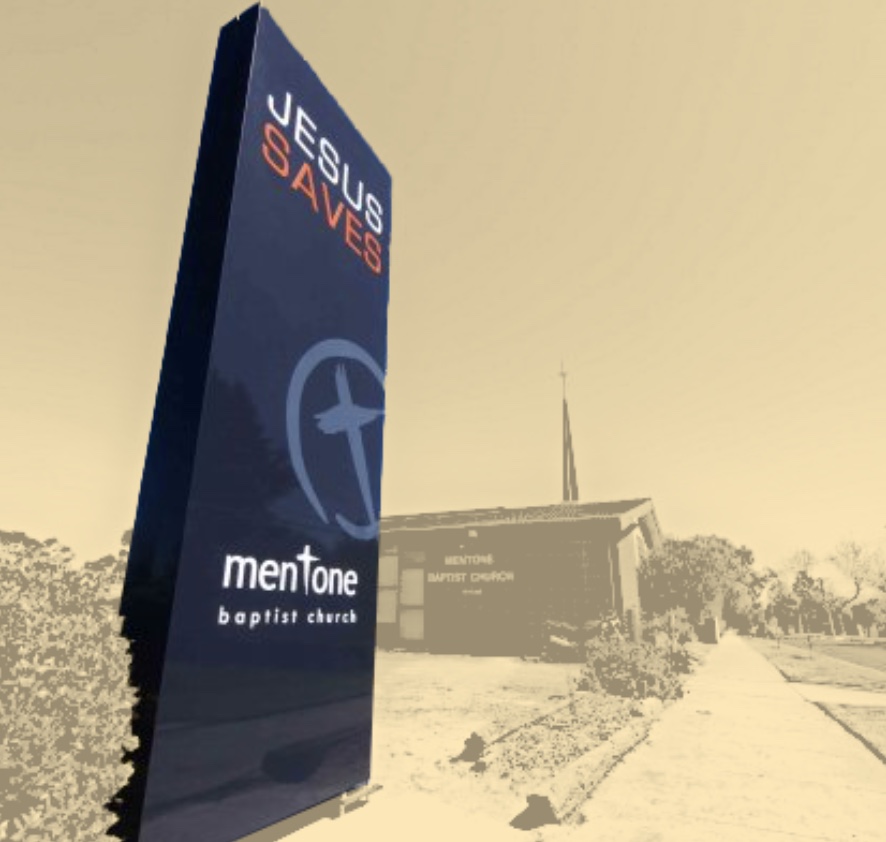
Mentone Baptist Church is known as the church with the sign: ‘Jesus Saves’ and ‘Christ our Hope’.
The original sign was replaced in 2009, and the buildings, people, and times have changed, but our message remains the same.
Mentone Baptist Church was formally constituted as a Church on November 19th 1953, but the origins came earlier. As far back as 1945, there was a desire to start a Baptist church in the area. At that time there was no Baptist church in Melbourne south of Oakleigh.
It wasn’t until 1950 that a group of 10 people living in Mentone and Cheltenham began discussing the possibility of a church. They first met on 9 Nov 1950, in a home on Nepean Hwy. Rev. Hawley led the group which included Reg and Ruby Ward, Jim and Grace Sutherland.
9 months later this group of 10 men and women began praying and searching for a property. A site on the corner of Warrigal Rd and Harpley St was purchased in February 1952 by the Baptist Home Mission Society, although some of the land, including what is today the cark park, was purchased years later.
Horace Jeffs commenced as the first pastor in April 1953, on a part-time basis with a stipend of 1 pound and 12 shillings per week. While waiting for the build, which is what today is known as the church hall. Mentone made news in The Age newspaper, for the novel story about a church meeting in a house and with their own organ! Sunday attendance reached 30-40 people.
On 1 November 1953, the church building opened. But of course, church isn’t the building, it is the people, and so on November 19 with a membership of 23 people, Mentone Baptist Church was formally constituted and the first members meeting conducted. Baptist Churches highly value the priesthood of all believers and so congregational involvement and ownership matters to us. Hence, our (in)famous members meetings!
A manse was purchased in 1955. Today this house is known as the church office, where it is used as office space, meeting rooms and children’s ministry.
Over Mentone’s first 10 years, the church grew to 60 members and always with a strong emphasis on the ministries of prayer and word.
A season for growing
Mentone’s evangelical roots and desire to start new churches continued with a team planting Beaumaris in 1959. This has continued over our history and most recently, Mentone sent out a team under Stephen Tan to plant Regeneration Church, next to Monash University. Over the years we experienced a trickle of university students travelling to us from Monash, with many being baptised at Mentone. We however saw the need and benefit from us moving closer to the university. 6 years later, there are more than 170 students and young adults calling Regeneration Church home (and growing every year).
A key turning point for Mentone took place in 1961 when Alcc White accepted the invitation to become pastor. Alec White was an effective preacher and communicator. He was rightly convinced the Bible is God’s word good and sufficient word, and that Jesus Christ is the way to know God. Under his leadership, and with many folks including the Foxes, the Lees, Betty Boase, the Platts, and the LePage family, the church grew in number and maturity. The Church invested in connecting with the local community, including ministering to the sick at the Kingston Centre and providing RE classes in local schools. Boys and Girls Brigades provided opportunity for local children to enjoy mid-week activities, gain life skills and learn about God. Dorcas commenced, a women’s group providing practical help to disadvantaged people around the world.
For 50 years Rex and Shirley Wills have been faithful members, serving in almost every part of church life. Betty Boase is our only member today who has been part of the church for 60 years.
A right emphasis on the good news of Jesus Christ raised up a generation of men and women who were trained and sent out to serve overseas on mission: Jim and Pam Sterrey, Daphne Smith, Fred Stoll, Chris and Carole Hebert, David and Sim Senator, Roger and Ruth Alder, and more. In the late 1960s, Marsali Ashley joined Mentone while studying at the Melbourne Bible Institute. Following a term in Papua New Guinea, she returned and married John Campbell at Mentone in 1972 (Murray’s parents).
Our current auditorium was built in 1968, with member Don Platt drawing the plans and his company constructing it. Originally, the seats faced north, with a stage in front of the northern window. The space was renovated in 2013 to accommodate more seating. Internal walls were knocked down and the old parent’s room was removed, thus increasing the space from 150 to 230 seats.
In 1981 Ross Prout was inducted as the new pastor and served here for 10 years. Under Ross’ leadership, the church experienced significant growth, especially among young adults. He continued the church’s emphasis on Bible teaching and a heart to see people coming to know Christ.
With Ross and Bronwen moving to Mitcham Baptist in 1991 after 9 years of fruitful ministry, Leigh Diprose commenced his ministry here, with Helen his wife and their 4 children joining. The Church continued to support ministry in the local community and worked alongside Youth Dimension to reach teenagers. Leigh concluded in 2000 and has since served at Altona Baptist and helping rural churches with preaching. Today Leigh serving at City on a Hill at their Melbourne West Campus.
Every church experiences difficult seasons and challenges, and Mentone is no exception. At the start of the new century, a significant number of the Church moved away as housing prices squeezed out young families and the Church lost a sense of direction and what it was about.
The congregation had shrunk to a Sunday attendance of 30 people by the end of 2004.
A new chapter
In 2005 Murray and Susan joined, following 4 years studying at Moore Theological College and gaining pastoral experience at Chatswood Baptist in Sydney. After several years away from Melbourne, the Campbells were excited to return and to make Mentone Baptist Church home for their young family.
The Church started to grow and saw growth of 10-20% each year for several years to come. In 2010, Murray suggested to the church that to help facilitate further growth, it would be advantageous to employ an associate pastor. To see whether the church could finance this, he asked if members would commit to increasing their giving. The Church was able to employ an associate pastor full-time from the first day! The Church called Phil Ninness and he commenced in 2011. Phil is an excellent preacher, and we also began an evening congregation, which attracted university students, and saw many becoming Christians and baptised and joining the church.
Phil and his wife Heather finished after 2 years to take on the Senior Pastoral role at a Baptist church in Tasmania. Mike Veith, who was serving as a student pastor while studying at Ridley College, became the new associate pastor. Mike has served in this role for 10 years, with his wife Camille and daughters part of the church family.
Over the past 18 years, the church has developed strong links with the Christian Union at Monash University. Stuart White and Dan King are both members at Mentone and they work on campus with AFES. We might assume that in our secular society, intelligent university students are disinterested in God; the campus ministry is experiencing quite the opposite.
The church continues to have a heart for mission both locally and overseas. In the past 6 years, several members have been sent out for church planting, pastoral ministry, and mission. We pray that God will add to those numbers in years to come.
The vision that began all those years ago in a Cheltenham house hasn’t been forgotten or lost but continues in 2023: ‘Christ our Hope’ and ‘Jesus Saves’.
70 years ago a tiny church moved from meeting in a house to this property on Warrigal Road. The year 2023 may look and sound very different from 1953. The streets and suburbs look very different today. 70 years ago this area was dominated by small farms and market gardens. There were a few schools and a train line. Southland didn’t exist. There was no McDonalds or KFC! The cars and cricket bats, the coffee and fashion and phones have changed, but the underlying issues and questions and longings of the human heart remain the same.
Our vision and prayer is to see the good news of Jesus Christ growing more and more and lives being transformed by God’s grace, love and truth. We thank God for the past and we look forward to the future and seeing how God continues his good work.