A mass baptism event is being organised this Easter in Frankston (Melbourne).
Before we jump into the water there are red flags to take consider.
Click on the pic to head to the substack article
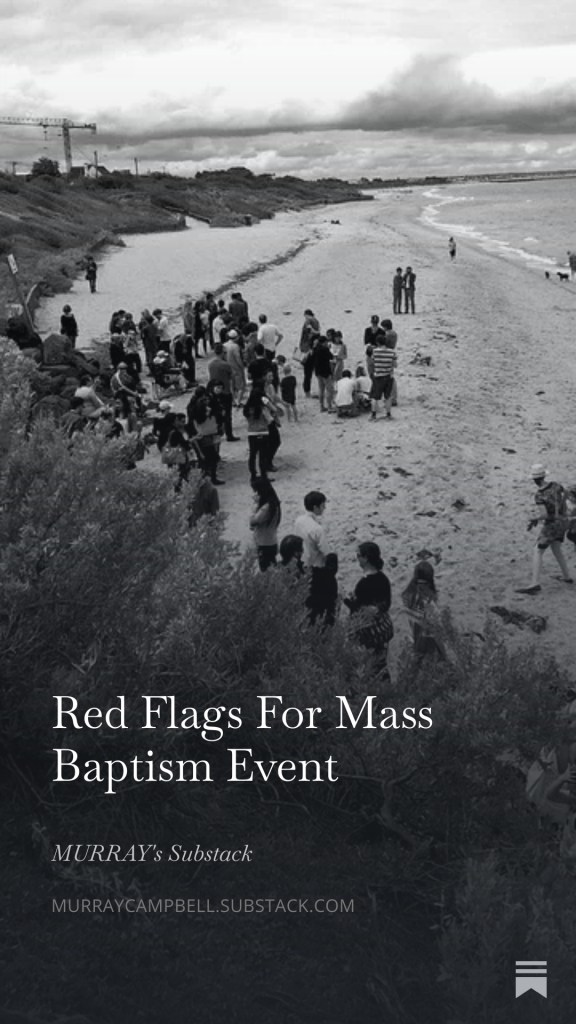
A mass baptism event is being organised this Easter in Frankston (Melbourne).
Before we jump into the water there are red flags to take consider.
Click on the pic to head to the substack article
Last month I launched new substack about Melbourne by a Melbournian, helping us to think through the big issues through the lens of the Gospel. Subscribing means you’ll be alerted to all new articles. And it’s free! Come over and join
https://murraycampbell.substack.com
Go to my new substack to read the article. Click on the photo to read it. Enjoy!
In 2026 my blog is migrating to a new platform.
Hopefully it will be fresh and better than ever.
So you don’t miss out on articles, feel free to subscribe here https://murraycampbell.substack.com
Most of the older articles will remain here for the time being, but for all my new material, please join over at the new substack page
The Baptist Union of Victoria (BUV) and Whitley College are going to the Supreme Court.
It is a sad state of affairs. This isn’t anything to gloat about or take joy in. After all, the Scriptures warn us about taking fellow Christians to court.
“If any of you has a dispute with another, do you dare to take it before the ungodly for judgment instead of before the Lord’s people? 2 Or do you not know that the Lord’s people will judge the world? And if you are to judge the world, are you not competent to judge trivial cases? 3 Do you not know that we will judge angels? How much more the things of this life! 4 Therefore, if you have disputes about such matters, do you ask for a ruling from those whose way of life is scorned in the church? 5 I say this to shame you. Is it possible that there is nobody among you wise enough to judge a dispute between believers? 6 But instead, one brother takes another to court—and this in front of unbelievers!
The very fact that you have lawsuits among you means you have been completely defeated already.” (1 Corinthians 6:1-7)
The fact that the parties are heading to the Supreme Court after a 9-year process signals the nature of the breakdown.

The issue relates to the sale of property used by Whitley College. The College Council sold the residential college (known as the Doughnut) and subsequently held the proceeds of the sale (and began using?). The BUV Council challenged both the sale and requested that the proceeds be turned over to the BUV in line with trust arrangements.
Questions were raised as early as 2016 when, to people’s surprise, the property was sold without informing the BUV. For the most part, discussions have taken place quietly in meetings and privately in boardrooms (which is appropriate for initial resolution seeking). When Union delegates have raised questions at various junctions, answers have either been missing or vague. When a report was given to the Baptist Gathering last year, the matter was addressed in such convoluted legal fashion that few had any idea what was being said.
But now, several years down the track since the property sale, the closed doors have been opened. The issue has been on the public record in the courts for some time, and more so now, through recent correspondence issued by the BUV Council and then from Whitley College Council. It is only a matter of time before the story is circulated even further.
On Wednesday, 24 September, the BUV Council sent a letter explaining that the matter is now going before the Supreme Court of Victoria. In the letter, they state,
“Although the property was held in the name of the Baptist Union of Victoria at the time it was sold, the charitable purposes for which the property was held were unclear, as no Trust Deed had been written setting out the terms. Being the named owner of the property, the BUV operated in good faith assuming charitable trustee responsibilities.
When the property was sold in 2016, the funds remained part of a charitable trust that the BUV must oversee. However, upon settlement of the $24.1 million, funds were directed away from the BUV as owner of the property and were not returned when requested.”
A few days (2nd October), Whitley College Chair and Principal issued a statement disputing the BUV Council’s interpretation of the situation,
“Whitley College has considered its position diligently, and has concluded that Whitley College has and continues to be the steward of these trust funds, faithfully applying them to the purposes of theological education and ministerial formation in line with the intent of those who contributed to the properties and its legacy.
While the BUV has presented a different interpretation, we are confident that the documentation demonstrates Whitley’s consistent and proper role as the steward of these resources. We believe that active involvement in the proceedings, including putting to the court an alternative position to the BUV, is the appropriate way to preserve Whitley’s access to funds, vital to its continued operations.”
I’m not here to take sides, but rather hoping to find answers. While murmurings about the dispute have been dripping in the background for years, the fact is, most BUV members have been left in the dark, and even now, remain unaware of the issues and processes that have led to Supreme Court proceedings. We have woken to learn that we are (essentially) suing ourselves. To say that many Victorian Baptists are stunned, angered, and perplexed this week is putting it mildly; most remain unaware. Hopefully they will become aware before some journalist reports the story. Indeed, we pray that it is resolved before this happens.
I appreciate that there are legal complexities here that require lawyers and legal process. However, the parties have reached the Supreme Court stage, while the churches and delegates have had near-zero prior knowledge of the situation. That’s a problem. The Churches aren’t a third party in this dispute, but very much involved. We (the churches) are the BUV (not the Council or the College), so how can it be that things have progressed to this stage (or rather, degressed) without thorough consultation, prayer, and conversation with the churches?
Earlier this year, I learned that the BUV has already paid more than $1 million in legal fees. I now believe the figure is $2 million. In addition, Whitley College has paid a vast sum for its own legal fees. Both amounts matter because the money belongs to the Baptist family. Indeed, the land, the sale proceeds and the legal costs belong to us.
I have no doubt that all sides involved are troubled by what has transpired, but the lack of transparency is significant; the BUV is taking itself to court and only informing the family at the 11th hour.
The presenting issue is a legal one, but it is also a spiritual and moral one. Both parties are expressing concern; however, this doesn’t mitigate the situation before us. Who will be held to account? Think of what our churches could do with $2.5+ million for mission and ministry?
This is just one of many issues that need resolution.
Last year, the BUV caught attention amongst the major Victorian Christian denominations with its controversial ‘Guide for the Baptist Union of Victoria’, a document produced by the Victorian Government to inform our churches how to deal with questions of sexuality and gender in our churches. On top of that, a breakaway Baptist group calling themselves the ‘Open Baptists’ are setting up an alternative association in NSW and ACT (who formed as a response to Baptists holding a biblical view on marriage and human sexuality). In Victoria, a small group of churches wanting to remain within the BUV are also joining the progressive ‘Open Baptists’.
Whitley College has been a bone of contention among BUV churches for decades. While the College receives students from some quarters, many churches prefer to send students to evangelical colleges for training. Of note, as of this year, NSW’s Morling College has begun teaching units in Melbourne.
Is it time to clarify the role and place of the college?
Should questions be raised about Whitley’s association with the University of Divinity?
How is the Whitley Council accountable to the BUV (the churches) for its financial management?
Is it time to rethink property trust arrangements?
Many of these questions are not new, but are rooted in historical and theological disagreements that go back decades. In attempting to exist as an association with a theological tent as broad as the Pacific Ocean, it is a case about money and property that has taken us to court against ourselves.
Again, such a thing brings sadness. As someone who loves being a Baptist in Victoria and who longs for our churches faithful and growing in the gospel, something has gone seriously wrong, and now it’s out in the open. We rejoice in good things God is doing but the churches require full transparency and accountability from our agencies and councils.
One thing I am confident about is that our BUV needs and appreciates the prayers of God’s people.
The assassination of Charlie Kirk on 10th September will bring unspeakable grief to those who knew and loved him. His death is emblematic of the age in which we are sadly living. Not even an hour was permitted to pass without tirades of opinions and glee expressed online.
People are defending the shooter, even celebrating the murder. Many others dare to say that Charlie Kirk is simply a victim of his own making, while others again try to play the shadowy middle way game of whataboutism.
People are losing the ability and desire to talk to one another about life’s biggest issues. People enraged by hardship and perceived injustice (or real injustice) drink from the fever-inducing cup that is easily found among online socials, justifying and fuelling hatred for the other.
The city of Melbourne, every weekend it seems, now witnesses protests, vile speeches, and violence. Victorian Police are right now preparing for and dreading another day of protest on Saturday. These thousands are but a tiny few of the many more who express their anger over on Bluesky, X and Facebook.

Most people have no idea who I am and have not heard my name, and yet I have written and said enough to have my name printed in newspapers and even on the front page of The Age. The former Victorian Premier resorted to his famous slander under the Parliamentary privilege because of a view I had expressed. I have received more than a few ‘colourful’ letters in the mail or messages on the phone. As a consequence, there have been a couple of Sundays when I have had a quiet word with the Elders, just in case someone might turn up to interrupt or protest our Sunday service. Thankfully, when someone has come as a result of something I’ve written, it is in search of a merciful God and not with an agenda to shout down a preacher.
We will not find a way forward for the common good through joining in the competing choruses online; hate breeds hate, and conspiracy is often countered with misinformation. Of course, there is much going on that is maddening, harmful and concerning. Anger has a place (God can be angry), but it mustn’t be the only key in which we speak. Indeed, how we speak and what we say really does matter. Charlie Kirk, from the little I know of him, engaged his interlocutors with grace, and yet he is now dead. Far from reasoning that kindness doesn’t work, we need to double down on grace and kindness.
I have lost count over the past 5 years of how often I have seen comments from certain Christians who self-identify with the final Beatitude (blessed are the persecuted), and subsequently use this to justify relegating the first 7 Beatitudes to the category of ‘not in season’. Peacemakers and meekness and mercy are deemed an inconvenience; how differently Jesus sees things.
The Christian doesn’t need to second-guess how to respond to world events and how to engage with others. The Christian isn’t left without guidance and recourse. Jesus gives the believer a paradigm in the Beatitudes.
He said:
“Blessed are the poor in spirit,
for theirs is the kingdom of heaven.
Blessed are those who mourn,
for they will be comforted.
Blessed are the meek,
for they will inherit the earth.
Blessed are those who hunger and thirst for righteousness,
for they will be filled.
Blessed are the merciful,
for they will be shown mercy.
Blessed are the pure in heart,
for they will see God.
Blessed are the peacemakers,
for they will be called children of God.
Blessed are those who are persecuted because of righteousness,
for theirs is the kingdom of heaven.
“Blessed are you when people insult you, persecute you and falsely say all kinds of evil against you because of me. Rejoice and be glad, because great is your reward in heaven, for in the same way they persecuted the prophets who were before you.
The Beatitudes don’t detail how one enters the Kingdom of heaven, but the life of those who belong to this Kingdom. This posture in some ways pre-empts the final manifestation of the Kingdom by exhibiting its qualities in the here and now; to use Jonathan Leeman’s analogy, it’s much like an embassy in a foreign country.
Some Christians hold to some of the Beatitudes and play loose with others. Some of us focus on peace-making while sacrificing righteousness in order to achieve this goal. Some grab hold of righteousness with clenched fists, while ignoring how Jesus begins, with confession and contrition of our own sins. It is important to see how the Lord Jesus ties them together in an unbreakable bond. All 8 Beatitudes belong together and work together to build godly character and a life that imitates, albeit imperfectly, the Lord Jesus.
Jesus leads us to begin with confession and contrition, acknowledging our complete dependence on God’s grace, which is his loving gift to us through the atoning death of Christ. The more we grasp the astonishing nature of God’s grace, we can no longer look at other Aussies with any disdain or wanting anything other than their good.
I suspect some of my Christian friends believe that if we follow the first 7 Beatitudes, the outcome will be peace and happy relationships with everyone, but that’s not where Jesus leads us. He says, ‘Blessed are those who are persecuted because of righteousness for theirs is the kingdom of heaven.’
It is true, we can be shouted down because we’ve said stupid things, hurtful things, and said the right things wrongly; I know I’m guilty of all the above. Nonetheless, Jesus indicates that living the Beatitudes and being concerned for God’s righteousness may still result in people being offended and not liking us and attempting to silence us. For Christians to think we can escape verses 10-12 is understandable but somewhat naive.
The Christian song sheet isn’t La Marseillaise,
‘Français, pour nous, ah ! quel outrage
Quels transports il doit exciter!
C’est nous qu’on ose méditer
De rendre à l’antique esclavage!’
If the writer or website you read regularly uses language of ‘revolution’ and ‘war’, ‘taking back’, and throwing around rage and expletives, perhaps it’s time to find a more useful read. After all, Proverbs warns us,
“Do not make friends with a hot-tempered person,
do not associate with one easily angered,
or you may learn their ways
and get yourself ensnared”. (Proverbs 22:24-25)
Blessed are the poor in spirit.
Blessed are those who mourn.
Blessed are the pure in heart.
Melbourne needs Christians leaning ever closer to the Jesus of the Beatitudes. The United States and Australia need Christians who are learning to press closer to Jesus’ words, trusting him and doing as he asks. If you’re not yet convinced, then take a look at the cross. Did Jesus abandon his Beatitudes as he hung crucified? Or did he embrace them, such that he died with and for the sins of the world?
That’s the message our city and world need more than ever. That’s the life our churches need to embody more than ever.
This weekend, I am having a mini break, which means it’s an opportunity to visit another church.
I love the church where I am a member and belong, but annual leave is an opportunity to visit other churches and be encouraged by what God is doing elsewhere.
We had originally thought that we would visit one of the churches in Melbourne CBD, but knowing police are overstretched and multiple protests were being organised, we thought it best not to go. Why add to the business? And who knows how long we’d be stuck in the city while protesters blocked intersections around the CBD.

So we visited Mentone’s daughter church, Regeneration Church in Clayton. It was lovely to catch up with old friends and encouraging to meet around God’s word and see how the church has grown since I last visited. It was a beautiful sight: a room filled with mostly 25-year-olds and representing so many different ethnicities, from all over the world and yet with one voice praising God and enjoying a deep sense of unity in Christ. I said to the pastor afterwards, ‘here [the church] is the answer to all of the friction and suspicion and anger in our community’.
It’s true, if you want to see a glimpse of what God is doing around the world today, go to your local church. If you wish to have a little taste of what life in eternity will be like, drop into your local church next Sunday and see where disconnected men and women from all backgrounds, jobs, education, ethnicity are finding joy and peace and love and life together through Jesus Christ.
Sometimes the music is happening, sometimes it’s out of tune. Sometimes the coffee is proper Melbourne, most of the time it isn’t. Sometimes the kids are noisy; often they are. The building’s architecture may be plain or striking, the preacher a great storyteller or simple words explaining the Scriptures. In these many different settings, from Clayton to Camberwell, from Pakenham to Preston, and from Mentone to Melton, church is like a breath of fresh air compared to the anx and rage filling our streets.
What a contrast with the clashing protests in Melbourne city today, where protests met with counter-protests, one volume of insult matched with further insult and even assault. Yes, many are probably marching for a myriad reasons, concerns over housing and cost of living, and fear of the unknown. But with the surprise element of boiling water burning you, these protests were already marked with signs of what they were about. When a protest is arranged under the banner, ‘stop mass immigration’, and then days out it’s described as defending ‘white heritage’ and denouncing Chinese and Indians in our country, of course, the march was going to go off the rails. So when a known neo-nazi is given a microphone and addresses the crowd from the steps of Parliament House, to the cheers of people below, what were you expecting to see?
A few days ago, Victorian Police expressed concerns that to deal with these protests, they were forced to take away resources from their search to apprehend a man who murdered two of their own and seriously wounded another only 5 days ago. Why would we create further strain on our police after the shocking week they have endured? And then, at the protest in Adelaide, a poster appeared, supporting the alleged police murderer.
Melbourne’s new Lord Mayor wants to claim the title of the ‘optimistic city’, but Melbourne is anything but optimistic or happy. Melbourne has turned into the nation’s protest capital, with weekly interruptions by protests and marches, often promoting the most insidious of causes. Our city is experiencing tumultuous divisions and doubts and fears. One solution often produces another misstep and further erodes public confidence and our social cohesion is increasingly tenuous. We are no longer the city we once were.
Jesus once warned,
“There will be signs in the sun, moon and stars. On the earth, nations will be in anguish and perplexity at the roaring and tossing of the sea. People will faint from terror, apprehensive of what is coming on the world, for the heavenly bodies will be shaken.” (Luke 21)
Tired of bad news? Exhausted by the negativity and fear? There is someone to whom we can turn. I’ve said it before, and I will keep on saying it: there is good news. There is really good news, and it can already be seen and experienced in Melbourne. There is something beautiful and good and happy taking place across our city where people from all manner of backgrounds are finding not a feeling of optimism but a happy and certain hope. To be sure, it won’t make the newspapers of 6pm news; good news stories don’t sell. But boy, do we need a better story than the ones filling every breaking news. As Jesus explained, what we get to see in our churches is tasted and seen in a million different cities and towns around the world and in a thousand languages and on a billion faces,
“This is what is written: The Messiah will suffer and rise from the dead on the third day, and repentance for the forgiveness of sins will be preached in his name to all nations, beginning at Jerusalem.”
Are you happy? How do we measure happiness? Is Melbourne a happy city?
Melbourne’s Lord Mayor, Nick Reece, has announced a grand plan to make Melbourne the ‘most optimistic city’, including KPI’s to measure our happiness.
This audacious vision was conceived out of the recent M2050 Summit where 700 Melbournians brainstormed a future for our city as they enjoyed good wine, cheese and ‘don’t worry, be happy’ on loop (this isn’t a literal translation of what transpired!).
VIctor Perton from the ‘Centre for Optimism’ is championing Melbourne’s new vision (neither did I know that the ‘Centre for Optimism’ was a thing!). Perton has been interviewed alongside the Lord Mayor to promote Melbourne’ new ethos.
When a reporter contacted Perton about a Herald Sun article on the topic, he responded,
“The article was dripping with sarcasm. The writer dismissed optimism as fluff, equating it with naïveté or escapism.
How revealing.
Well, our arguments proved stronger than the cynics.
Later that day, the Lord Mayor and I appeared on several radio and television channels, putting forward a clear, confident case for optimism as a civic virtue, a strategic advantage, and a public good.”
Well, I guess it must be true then.
As I delved deeper into the website of optimism, I came across this bold and optimistic claim,
“The answer to life’s most pressing questions is optimism.
That is the optimism principle
The Optimism Principle distils the wisdom and insights acquired over ten (10) years of research on Australian Leadership and Optimism. We have found that optimism isn’t merely beneficial; it’s fundamental to achieving personal and organisational success and catalysing positive change.”
Hmmm. Not buying it? Neither do I. This approach smells familiar, much like the prophets of Jeremiah’s day who repeated the mantra, ‘peace, peace’, all while the city fell apart.
“They dress the wound of my people
as though it were not serious.
‘Peace, peace,’ they say,
when there is no peace.’ (Jeremiah 6:14)
Like a naked Emperor parading down Swanston Street or a French Queen with an appetite to, ‘let them eat cake’, just thinking positive doesn’t make it so. You can be the most optimistic person in the world, but like the Yarra River 200 years ago, people see through it. People need hope with substance. People need answers that go deeper than that iteration of the hedonist dream.

Now, I love Melbourne. Melbourne is the city where I live and where Susan and I raised our children. I started this blog 8 years ago to offer ‘ideas about and for Melbourne’. So, this isn’t an anti-Melbourne rant. It is rather an appeal to be real, and to recognise that our 5 million plus people need a better hope than what the Lord Mayor is offering.
The most obvious flaw in the Mayor’s plan is the implicit consensus that we are not a happy city. Melbourne is not an optimistic place, and we are not a particularly happy people. The Mayor wants to cultivate the mood change because optimism isn’t our thing.
One would have to be lying on a Tahitian beach for the past 6 years not to realise that a dark cloud hovers over Melbourne’s city and suburbs.
And the list continues longer than the Nepean Hwy.
Despite popular conception, our situation wasn’t created by the pandemic. Two years of almost constant lockdowns and restrictions certainly took their toll on us, but it wasn’t the catalyst that brought about pessimism or diminished energy and positive outlook. COVID functioned like a fast retreating high tide, exposing our hidden skeletons. The pandemic uncovered conditions that were already at work in our city: We are not happy. We are more anxious, troubled, divided and afraid, and with little hope of that trend changing soon.
Our optimist friends point to,
“we are cool.
From laneway galleries and artisan coffee to the Australian Open and cutting-edge science precincts, Melbourne has earned global recognition as one of the coolest cities on the planet. A city of thinkers, creators, performers, innovators.”
Sure, I guess that’s kind of true. But is this the sum total of what constitutes ‘happiness’?
It is somewhat telling that, as far as most global measures are concerned, it doesn’t get better than Melbourne. We are still considered one of the most liveable cities in the world, and yet we don’t feel it. When it comes to education, standard of living, food, sport, and culture, we are the Mount Everest of metropolises, as tall as Babel. Nevertheless, Melbourne is a melancholic city. We are more Nick Cave than Kylie Minogue. We are Marc Rothko, not Andy Warhol, we’re into abstract expressionism not pop art. We are a monochrome city. Our uniform is black on black with only the occasional shade of grey to separate the layers of black. Moodiness is what we do well. Perhaps part of our problem is our insufferable pride. Our expectations are so high and our competitiveness so insistent, that we normalcy and averageness are seen as failure.
There is also an intrinsic misstep in our approach to life. We decided that we no longer need God and we don’t need a new creation, because we can create heaven on earth. And we succeeded, and it wasn’t enough.
In 2006, world-renowned psychologist Jonathan Haidt wrote, ‘The Happiness Hypothesis’. Haidt argues,
“Happiness is not something that you can find, acquire, or achieve directly. You have to get the conditions right and then wait.
“Those who think money can’t buy happiness just don’t know where to shop … People would be happier and healthier if they took more time off and spent it with their family and friends, yet America has long been heading in the opposite direction. People would be happier if they reduced their commuting time, even if it meant living in smaller houses, yet American trends are toward even larger houses and ever longer commutes. People would be happier and healthier if they took longer vacations even if that meant earning less, yet vacation times are shrinking in the United States, and in Europe as well. People would be happier, and in the long run and wealthier, if they bought basic functional appliances, automobiles, and wristwatches, and invested the money they saved for future consumption; yet, Americans and in particular spend almost everything they have – and sometimes more – on goods for present consumption, often paying a large premium for designer names and superfluous features.”
Interestingly, ‘The Happiness Hypothesis’ was followed in 2012 with ‘The Righteous Mind’, and then, ‘The Coddling of the American Mind’ (2018), and finally, in 2024, ‘The Anxious Generation. If we need an illustration that speaks to the unravelling of a generation in 12 short years, Haidt’s thoughtful output is demonstrative.
We don’t overturn an anxious generation with skin-deep positive thinking, but with hope and a hope that has deeper meaning and consolation than a good coffee and money to pay the rent. That’s the problem, Melbourne’s new vision isn’t honest enough. Sure, we can pump out Pharrell Williams ‘Happy’ all day long, and ‘look at the bright side of life’, but cliches and forced smiles won’t cut it.
We have lost the ability to forgive. We are proficient at naming and shaming, while we wait for the day when our own sins will be exposed. We don’t know how to forgive, and without forgiveness, there is no happiness.
We have lost our grip on community. We know how much people need other people. Friendships and human connection is a basic life requirement, and yet almost every step in our society works against building community.
We have lost contentment. Contented lives are anathema in Melbourne, as businesses, schools and sporting codes vie for our attention and promise more. The contented person is almost frowned upon. How can you be happy with a small house or less than average income? How dare you be happy while living with chronic illness.
We have lost hope. Happiness without hope cannot exist, but where in our city do we find hope? Hope that depends on us will either lead to pride because ‘we can do it’ or to despair because reality catches up and we can’t. Which leads to this next ingredient essential for true happiness.
We have lost transcendence. This is something Zoomers seem to be waking up to as many under 25s are beginning to ask questions about spiritual realities and are beginning to read the Bible and turn up to churches around Melbourne. While my generation mocks Christianity and even calls it ‘dangerous’, and while Melbourne Councils find little to no room for places of worship in their grand designs, on the ground, there is an emerging recognition that we need God and that we are wired for God.
Ecclesiastes, the ancient book of wisdom, was right all along,
“He has made everything beautiful in its time. He has also set eternity in the human heart; yet no one can fathom what God has done from beginning to end.”
The Bible’s offering goes deeper than any optimist strategy. The Scriptures address the raw and real of the human condition. There’s no sugar coating in the Bible. We do however, find costly love and sacrifice, and hope for the helpless and joy that will outlast the best of what Melbourne has to offer.
As a Christian, I don’t subscribe to optimism or to pessimism, because the good news of Jesus Christ breaks pessimism apart and it won’t give room to hubristic ventures. This good news message offers people a way of viewing life with greater clarity, humility, thankfulness and joy. It doesn’t ignore material needs and the gains from improving education and green spaces, and hospitals, it does provide a firmer foundation, and it breaks the world open to what has eternal value.
The world’s most famous book on happiness (joy) is found in the Bible, Paul’s letter to the Philippians. From beginning to end, this short letter is filled with expressions of joy by man who was struck in a prison cell and facing an uncertain end.
“Yes, and I will continue to rejoice, for I know that through your prayers and God’s provision of the Spirit of Jesus Christ what has happened to me will turn out for my deliverance. I eagerly expect and hope that I will in no way be ashamed, but will have sufficient courage so that now as always Christ will be exalted in my body, whether by life or by death. 21 For to me, to live is Christ and to die is gain. 22 If I am to go on living in the body, this will mean fruitful labor for me. Yet what shall I choose? I do not know! 23 I am torn between the two…
whatever were gains to me I now consider loss for the sake of Christ. What is more, I consider everything a loss because of the surpassing worth of knowing Christ Jesus my Lord, for whose sake I have lost all things. I consider them garbage, that I may gain Christ and be found in him… not having a righteousness of my own that comes from the law, but that which is through faith in[ Christ… I want to know Christ—yes, to know the power of his resurrection and participation in his sufferings, becoming like him in his death, and so, somehow, attaining to the resurrection from the dead.”
If we are hoping for happiness, we will need to find forgiveness, friends, contentment, hope and transcendence. I’ll happily argue any day of the week that these realities are found in the person of Jesus and experienced in local churches that are scattered around Melbourne. If these KPIs are missing from Melbourne’s vision, then the project is already bound to fail.
Our Lord Mayor’s vision for Melbourne is too superficial. We are not plastic people who can be made happy by sensory experiences alone. Human beings are made for communion with God and made for community. The heart cannot be satisfied by material gain alone. As Jesus famously quipped, ‘what does it profit a man to gain the whole world and lose his soul’.
Melbourne and footy are synonymous, so it’s only fitting to dedicate a whole episode to footy and faith! Geelong AFL player, Ollie Dempsey, has recently shared his story about faith and footy. He is one of many professional athletes in Australia who believe in and follow Jesus. Maybe it sounds strange, but why are more young people investigating Jesus? His story might serve as a quiet encouragement to many young people
I really enjoyed reading two recent interviews with Ollie Dempsey. His openness about the challenges of believing in Jesus is normal to the Christian experience and an encouragement.
You can watch my latest episode in ‘Tomorrow’s Melbourne’ below on youtube or on your preferred podcast platform.
As Zoomers try out church, many are looking toward older and more traditional churches. What is behind the growing interest in liturgical and classical churches? What are some helpful tips for choosing an authentic and legitimate church? In this episode, I explore 2 ways to assess the ‘real thing’: learning history and going back to first principles, namely the Bible.
or listen on Apple Podcast
Or on spotify
 MurrayCampbell.net