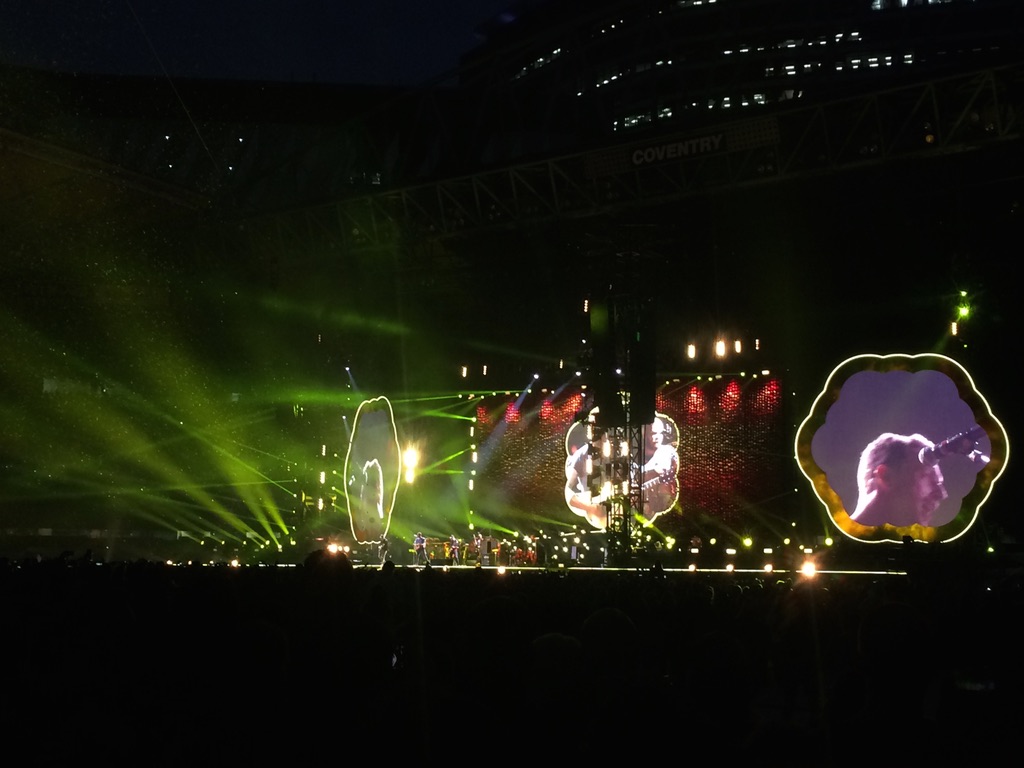
Coldplay’s prayer in Melbourne

Coldplay is in town. It seems like every second friend has bought tickets and is  joining in the chorus of ‘Yellow’ and singing, ‘I used to rule the world’

The last time Coldplay performed in Melbourne was in 2016,  and I took my 2 boys to the concert.  The eldest, who was 11 at the time, had aspirations to be a drummer like Will Champion. The night was a kaleidoscope of colour and light and memorable tunes.

Coldplay is back in Melbourne and singing a prayer. 

By prayer, I’m not referring to fans hoping to see Guy Berryman after illness forced him to miss out on performing with the quartet for the first time in their 27 year history (I believe he returned last night for their second Melbourne concert). Coldplay’s latest hit song is called, ‘We pray’.

‘We pray’ was written by lead singer, Chris Martin, in conjunction with a group of musicians from around the world, and it explores his personal journey in spirituality and understanding the human condition. 

The song itself is a congregational invocation to prayer. The lyrics are deliberately vague for no particular god is addressed and his character and personality are unknown. The song is about the human longing for help, hope and forgiveness.

‘We pray’ is clever because people can fill in the gaps however the wish, but is that point of prayer? The word grabs onto some vague and universalist notion of the Divine: unnamed and unknown. 

It’s hoping without knowing, it’s needing and not possessing.

Take a look at some of the lyrics, 

Pray that I don’t give up
Pray that I do my best
Pray that I can lift up
Pray my brother is blessed
Praying for enough
Pray Virgilio wins
Pray I – I – I
Judge nobody and forgive me my sins
I pray we make it
Pray my friend will pull through
Pray as I take it
Unto others I do
Praying on your love
We pray with every breath
Though I – I – I’m in the valley of the shadow of death

Pray that we make it to the end of the day
And so We Pray
I know somewhere that heaven is waiting
And so We Pray
I know somewhere there’s something amazing
And so We Pray
I know somewhere we’ll feel no pain
Until we make it to the end of the day

Coldplay is, of course, singing a similar tune to one that is all over our streets and suburbs today.

Human beings are deeply spiritual. The sum of who we are cannot be reduced to skin, bones, blood, and organs. This is one reason why the new atheism was always doomed to be little more than a cultural fad. The materialist world cannot sustain or explain the needs and hopes found in the human soul. But neither are we left in the realm of guessing and taking a stab in the dark.

New Atheism is dead. In places like Australia and the UK, neo-paganism is gaining traction, Eastern religions are growing (largely through migration), and people are dabbling in alternative spiritualities in volumes I’ve not seen before. Why? The soul needs peace. We need hope.

‘We pray’ is a descriptor of the human condition but it doesn’t give any substantive answer.

Prayer isn’t a magical amulet that I rub and repeat. Prayer without relationship with the actual living, listening and loving God is little more than a placebo. What if real prayer was possible?

Coldplay’s idea of prayer isn’t original. The city of Athens was renowned in ancient times for its religious pluralism. In fact on the day the Apostle Paul walked through that great city, he noticed a statue to the Unknown God. The citizens of Athens erected a monument to a God with no name, just in case the pantheon of gods had missed one and so people could pray and pay homage to this unknown divinity, hoping to find blessing and help.

Paul, this early Christian leader, made a commentary about this Athenian spirituality, when the leading intellectuals invited the him to address the famous Areopagus, “May we know what this new teaching is that you are presenting? You are bringing some strange ideas to our ears, and we would like to know what they mean.” 

What follows is one of the great speeches of history. The words of this address, both astonished and intrigued people in what was the equivalent of Oxford in the day, and I suspect there is good reason for the people of Melbourne to be similarly astonished and intrigued today.

“People of Athens! I see that in every way you are very religious. 23 For as I walked around and looked carefully at your objects of worship, I even found an altar with this inscription: to an unknown god. So you are ignorant of the very thing you worship—and this is what I am going to proclaim to you.

“The God who made the world and everything in it is the Lord of heaven and earth and does not live in temples built by human hands. 25 And he is not served by human hands, as if he needed anything. Rather, he himself gives everyone life and breath and everything else. 26 From one man he made all the nations, that they should inhabit the whole earth; and he marked out their appointed times in history and the boundaries of their lands. 27 God did this so that they would seek him and perhaps reach out for him and find him, though he is not far from any one of us. 28 ‘For in him we live and move and have our being.’ As some of your own poets have said, ‘We are his offspring.’

29 “Therefore since we are God’s offspring, we should not think that the divine being is like gold or silver or stone—an image made by human design and skill. 30 In the past God overlooked such ignorance, but now he commands all people everywhere to repent. 31 For he has set a day when he will judge the world with justice by the man he has appointed. He has given proof of this to everyone by raising him from the dead.” (Acts 17)

In summary, he explains:

  • There is a God and he is the powerful and purposeful creator of the universe.
  • This God doesn’t need us but provides us with life and breath. 
  • God has made himself known
  • We don’t fashion God’s existence.
  • The world will be held to account by God (how we need a God is right and just and will do justice)
  • The definitive proof of God is the resurrection of Jesus Christ from the dead.

Understand, these points are but the introduction to all that Paul had to say, but straight away he eliminates vagueness and universality. There is God and he is this God. It’s not guesswork and speculation, but the resurrection of Jesus is proof. 

Does it matter to whom we pray? Is the efficacious nature of prayer found in the activity itself or in the one to whom we address? 

Why does it matter which God we pray to, if the spiritual and psychological benefit lies in the activity?

By way of illustration, would it matter if  I spoke to any individual and in any way, assuming or hoping that they were my spouse? Would it be appropriate to pour out my heart in a married kind of way with any random person who happened to hear me talking out loud on the street?

Apart from the fact that they have no duty to listen or respond to my words, how belittling and insulting it is to the person who actually is my spouse!

To whom we pray does matter. 

On one occasion Jesus speaks about lostness.  This being lost is a way of describing our natural state; being disconnected from God and the forgiveness and life that can be found in him. We wander about and test and experiment, looking for a way to leave behind this state of hopelessness and uncertainty. Jesus says, he is the way. He is the One who came to seek and save the lost.

Don’t believe me? You don’t have to take my word, check out the resurrection of Jesus. 

I love this prayer that Jesus taught. It is to God who is named, known, who is just, who forgives, and in whom we can depend,

Our Father in heaven,

hallowed be your name,

your kingdom come,

your will be done,

    on earth as it is in heaven.

Give us today our daily bread.

And forgive us our debts,

    as we also have forgiven our debtors.

And lead us not into temptation,

    but deliver us from the evil one

Australian Catholic University speech causes mass walk out

The media is having a field day over a story that erupted at a graduation ceremony yesterday for the Australian Catholic University (ACU). 

Former Union chief, Joe de Bruyn, was awarded an honorary doctorate and delivered a speech to the newly graduating students. What followed led to 90% of students, staff, and family members walking out in disgust. 

I know very little about de Bruyn and I’m not making a judgment about where his heart is, but his speech may well go down in the annals of ‘how not to present a Christian viewpoint’ (if indeed this can be classified as Christian).

In his 15-minute address (which ACU heads knew about in advance), de Bruyn offered a critique of all that is evil in Australian society. He hit at 3 subjects in particular: abortion, IVF, and same-sex marriage. 

Unpopular opinion: it is possible to agree with the substance of his concerns (or agree in part) and also think de Bruyn’s speech is counterproductive and even unChristian.

First of all, I believe abortion is a terrible practice for society to accept. Taking the lives of the unborn isn’t a sign of cultural maturity and success; quite the opposite. Second, I accept Jesus’ understanding of marriage, and how marriage is between one man and one woman, intended for life. Third, I disagree with de Bruyn’s cancellation of IVF. IVF, like so many technological developments, presents us with ethical dilemmas that require much wisdom. For instance, a Christian couple may proceed with IVF along with agreed conditions, thus using the technology but with a much narrower moral parameter than what is set by law. More importantly, framing all these issues without the Gospel of Jesus Christ, will in fact distort each one and therefore misrepresent how we ought to speak of these issues in both church and society.

Second, why do I suggest that the speech was unwarranted and unhelpful?

There are 3 key components that work together and de Bruyn failed in 2 ½ of these:

i. What he said…

ii. How he said it…

iii. The occasion in which he said it…

Let’s start with the occasion. This was a graduation ceremony at a university, albeit a Catholic one. Being Catholic, I imagine this provides more latitude for Christian language and ideas to be present than if it was a secular institution. Even with this, is a graduation service the appropriate time to list all the evils in Australia and to vent all one’s personal axes and anxes onto the students and their families? I would be stunned if such a speech was delivered at a Christian theological college, let alone a mainstream university.

Second, I’m reminded of how often the Bible tells us that how we speak is as crucial as what we speak. 

Proverbs 15:1 says, “A gentle answer turns away wrath, but a harsh word stirs up anger.”

The Apostle Peter exhorts, 

“But in your hearts revere Christ as Lord. Always be prepared to give an answer to everyone who asks you to give the reason for the hope that you have. But do this with gentleness and respect” (1 Peter 3:15)

Paul writes, 

Therefore, as God’s chosen people, holy and dearly loved, clothe yourselves with compassion, kindness, humility, gentleness and patience.  (Colossians 3:12)

Speech that is void of love is like a cymbal repeatedly clashing in your ears; it’s jarring and we do your hearing no favours. As the Apostle says,

“If I speak in the tongues of men or of angels, but do not have love, I am only a resounding gong or a clanging cymbal” (1 Corinthians 13:1)

Of course, truth can and often does offend, even when spoken with the gentleness, patience, and kindness of Christ. Look at how society responded to Jesus when he taught and showed the grace of God! Nonetheless, this doesn’t legitimise aggression or slander and a host of accompaniments that betray the Christian message. It may also be worth pointing out that when anger is expressed by God, Jesus, or the Apostles, it is often aimed at religious people for their hypocrisy and their failure to live out the faith they claim to have.

Why I am writing about Joe de Byun’s ACU speech? A reason for making a comment is because this address is symptomatic of a theme that is becoming far too common and accepted today in ‘Christian’ circles. It’s as though angry words mean faithful words. No, it doesn’t. Yesterday’s incident is all the more bewildering given that he was invited to speak, knowing his track record, and with some knowledge of what he was planning to say. 

Too often we are seeing angry Christians throw around words in the public space as though they are faithfully representing Jesus. Don’t get me wrong, anger has a place, but it shouldn’t be a regular go-to in public discourse. Are we trying to win applause from vocal supporters or are we trying to persuade people of a Gospel vision for life?

Hundreds of people walked away, a few staunch supporters remained, while others sat uncomfortably and embarrassed and required to continue with their duties. Did anyone leave with a better understanding of the Christian Gospel or of a life-affirming view of God?

Thankfully there were other words spoken at yesterday’s ACU Graduation. These words aren’t being reported in the newspapers but they were shared and how much more befitting,

 “As you take you next step, remember our mission. 

First, Act in truth and love. These words are from Paul’s letter to the Ephesians. Paul was writing to a community of Christians struggling with persecution and division. The love Paul talked about here doesn’t translate perfectly into English. He wasn’t talking about romantic love or the love between friends. He certainly was not talking about an emotion or anything sentimental. Paul was talking about a decision – an act of will – to live in ways that serve, and meet the needs of other people, especially when doing so is hard, and costly.

Second, Pursue knowledge. Knowledge founded in truth, and communicated with grace and compassion. We see every day the ugliness of discourse as it exists on social media. I encourage you to make the decision to mediate the knowledge you gained through your study at ACU by acting with gentleness and kindness.

Third, remember that all people are valuable. As you grow in confidence in your professional lives, don’t forget what it was to be unsure, vulnerable or unpopular. 

Finally work for the Common Good. My hope for you is that your professional lives promote the wellbeing of the peoples you encounter in your communities and in the wider world.   

… I’d entreat you though to remember that the real test before you as you enter the next stage of your lives as teachers, knowledge professionals, pastoral workers and business leaders is how you work for the good of others when you get no thanks or acknowledgement, when those ‘others’ are very different from you, when they challenge your patience, when they are hurtful and when your differences seem irreconcilable. As an institution inspired by its Christian ethos our mission would have us love the unlovable and reconcile the irreconcilable. 

Commit to this as you step through life and I am sure you will leave your piece of the world transformed for the better.    

Once again, my congratulations to you all and I wish you the very best in all you aspire to achieve”

Talks from ‘Sex, Gender and the Good News of the Gospel’ now available

Last week’s ministry conference in Melbourne was an encouraging and stimulating day. Many thanks to David Starling and Dani Treweek for serving us well. Each of the talks and the QandA session are now available for listening to on youtube.

Sex, Gender and the Good News of the Gospel

Congratulations to Dr Dani Treweek on winning Australia’s Christian Book of the Year, for her outstanding work in, The Meaning of Singleness: Retrieving on eschatological vision for the contemporary church.

Dr Dani Treweek and Dr David Starling will be speaking at this special ministry leaders’ day at Mentone Baptist Church on September 6th.

In an age that is increasingly confused about sex and gender, what are we meant to think? What is a Gospel way to think through these important issues?

Click on the link or QR Code for further information and to book tickets for what will be an encouraging and equipping day.

https://events.humanitix.com/sex-gender-and-the-good-news-of-the-gospel-sbjsm9s9

The Olympic Vision: ‘My Way’

The Paris Olympic Games began with the humanist anthem, ‘Imagine’ and closed with another, ’My Way’. 

This notion of a world where humanity climbs to the top of the Eiffel Tower (or Babel!) and no longer relies on God, is as common in France as the baguette. Indeed, the French Enlightenment has profoundly influenced how we look at the world today: secular humanism. 

Whereas Imagine empties the world of ultimate meaning, design and hope, My Way is the crooner’s funeral dirge. 

‘And now, the end is near

And so I face the final curtain

My friends, I’ll say it clear

I’ll state my case of which I’m certain

I’ve lived a life that’s full

I traveled each and every highway

But more, much more than this

I did it my way’.

French singer, Yseult, performed ‘My Way’ with gusto and fireworks, but the song is delusional. ‘My Way’ is a self-justifying way of looking back over life and saying, ‘yep, I screwed up, but at least I did it my way!’

Don’t misunderstand, I’m not an Olympic critic. I enjoy the Olympics as much as any diehard sporting fan. And watching the Green and Gold outdo the Red, Blue and White is kinda ‘slay’.

There was, however, a hubris weaving throughout the Games that tarnished the gold, silver, and bronze. The alkaline isn’t achievement and success, it’s Rousseau’s imagining that set the Olympic message from start to finish: secular humanism.

The humanist project is appealing for it hooks onto every aspiration for personal freedom and success. The dream is then set within the possibility of imagining no hell and heaven, and no religion too. It’s very French. It’s thumbing our noses at the establishment (whoever they may be), and a finger salute toward religion. Ironically, and as the Olympics have shown, secular humanism is as religious and worshipful as the Temple of Artemis and any local Mosque or Church across Paris.

Like the moon glistening over the Seine at midnight, the Olympic message is romantic… until you jump into the river. It is a myopic vision in these 3 ways.

The Backdrop

The backdrop to the Olympic Games is Venezuela, Myanmar, Gaza, Ukraine, and Bangladesh. Political and social unrest is found in English cities and Australian streets. Geopolitical tensions are so high that political leaders are not asking if there will be a global war, but when?

‘My Way’ just isn’t believable. Doesn’t the message feel somewhat empty when we look outside the Parisian bubble?

Tony Estanguet, President of the Organising Committee, presented this stirring offering at the Opening Ceremony,  

“Tonight you have reminded us how beautiful humanity is when we come together.

And when you return to the Olympic Village, you will be sending a message of hope to the whole world: that there is a place where people of every nationality, every culture and every religion can live together. You’ll be reminding us: it is possible.

For the next 16 days, you will be the best version of humanity.

You’ll remind us that the emotions of sport form a universal language that we all share.”

There is a smidgen of truth and goodness here. It feels kinda right. But then we see that the words are canvassed by imagining a world without God, and without ultimate justice and hope. It’s up to us and we can do it!

What’s the answer Mr Olympics? Sport unites?

I wonder how this resonates for those who can’t return home because of war or persecution?

The Backhand Swipe

The Olympic message also serves up a backhanded spin toward all those parts of the world who don’t buy into this self-human deification.  

I guarantee there are more than 3 athletes uncomfortable with the Imagine My Way vision of life, and more than 4 viewers. The message is a backhanded slap in the face to many people in the 2/3s world who don’t buy into humanism.  Today, much of the world is turning to the gospel of Jesus Christ and is looking at the West with weird fascination as they see celebratory pride in the midst of decline. It’s Camus’ Myth of Sisyphus. Except, Sisyphus is no longer pushing the boulder uphill it’s fast chasing him down the hill and yet strangely Sisyphus is shouting,  ‘Look at me, I’m free!’

There is an arrogance attached to the humanist project. It relies on hubris because humility requires depending on a source and foundation that is other. The ‘My Way’ syndrome can’t afford to accept the human condition and it relies on the notion that we won’t repeat the mistakes from the past.  And yet we do. Secular humanism has become a lame duck that employs all the boisterous noise of an Olympic triumph; mesmerising and leaving behind a truckload of debt. 

A Modern Heresy

A third way the Olympics is short-sighted is its failure to understand how secular humanism functions as a Christian heresy. It’s not a Monet original, it’s a third-rate copy.

Tom Holland, Glen Scrivener and others have effectively shown that the air we breathe in our culture is oxygenated by Christianity. The Olympics doesn’t derive notions of equality from thin air! Even our anti or post Christian beliefs are immersed in the teaching and person of Jesus Christ.

As Christopher Watkin notes, 

‘The most interesting migration of all concerns the secular itself. Claiming to have chased religion from its home, the secular has moved in and kept all the furniture. The secular is built on the assumption that there are two domains— the religious and the secular—and that one can grow as the other shrinks. As Tom Holland points out, this is a thoroughly and deeply religious idea, reaching back to Augustine’s notion of two cities. When secularism arrived on the scene it “came trailing incense clouds of meaning that were irrevocably and venerably Christian,” and the very idea of secularism witnesses not to Christianity’s decline but “to its seemingly infinite capacity for evolution.’

While trying to keep her love child in a backroom closet, secular humanism is courting a new friend from the depths of pagan Europe.

From Bacchus the Smurf crashing the Last Supper at the Opening Ceremony, to the ‘Hymn of Apollo’ that was set to music for the Closing Ceremony, neo-paganism is trending again,

‘I will remember, nor could I forget, far-shooting Apollo,

 whom gods tremble before as in Zeus’s abode he is striding—

 then as he comes up close to the place they are sitting, they leap up,

all of them, out of their seats, as he stretches his glittering bow back.’

Let’s leave aside the irony of thinking that it’s cool and inclusive to sing a hymn to fictitious gods, yet honouring the God who gives us breath and strength is anathema!  The repeated dipping into neo-paganism is more than acknowledging the Olympics’ story of origin, it’s looking into the murky Seine and needing to explain the world and provide a moral compass should Christianity be taken to the guillotine. It’s an impossible task of course, because without Christianity, all our best values lose their mooring.

Tom Holland exposes this forced marriage between Humanism and neo-paganism. He points out how the ancient gods of Greece and Rome, “cared nothing for the poor,” and “to think otherwise was ‘airhead talk”. 

It’s Christianity that changed everything and yet we want to sing ‘Imagine’ and ‘My Way’. It is Christianity that transformed the way we view the poor and the excluded. It is Christianity that gave rise to feminism’s first revolution in those early centuries AD. It is Christianity that altered the way society looks upon the young and the vulnerable. Any hints of moral goodness flowing through secular humanism has its roots in the very thing it wants to dismantle: Christianity. 

Because of this, perhaps ‘My Way’ was a fitting end to the Paris Olympic Games. The Olympic flame was snuffed out, its dying embers a sign of where ‘Imagine’ becomes reality.

Another Way

There were glimpses of a better way sneaking through the Olympics. There was Nicola Olyslagers at the Village, accompanying athletes from across the world on the piano in song and praise to God. There was the Fijian contingent in one voice proclaiming Jesus. Again, there was Nicola Olyslagers who chose to glorify God in her sport, 

“My worship may not be singing, it’s in my feet jumping over a bar”.

There is America’s gold medallist, Sydney Mclaughlin Levrone, 

‘What I have in Christ is far greater than what I have or don’t have in life…he has prepared me for a moment such as this. That I may use the gifts he has given me to point all the attention back to him”.

Hubris or humility?

Self-seeking or God-glorifying?

As the athletes flooded into the Stade de France for the final time, the music pumped out, ‘no time for losers’. Athletes swayed with arms raised to the heavens and shouting out, ‘no time for losers’.  Should we mention the 90%+ of the world’s Olympians who failed to medal in any event? And what of thousands more who failed to make an Olympic team?

Secular humanism is a temporary fix for the strong and successful. Christianity is the gospel for losers. The message of Jesus Christ is for those who have failed and lost and grossly miscalculated. This is the true Gospel of liberty and equality and fraternity because the onus and hope lays with  God and because this salvation is by grace. This message is about the God who came down and drew all the world’s evils and suffering and went to the cross.

As Jesus puts it (I’m mulling over these words before preaching this week)

‘I have come that they may have life, and have it to the full.’

How?

‘“I am the good shepherd; I know my sheep and my sheep know me—just as the Father knows me and I know the Father—and I lay down my life for the sheep.’

Olympic ‘Last Supper’ depiction with a French Twist

I do enjoy French quirkiness and the absurd. It is often playful and sometimes provocative. And sometimes it is attention-seeking and puerile.

I loved much of the innovation and freshness that the French gave the opening ceremony of the Olympic Games. The interplay between art and athletes, and the sitz im leben of the city instead of stadium was pretty cool.

During the Opening Ceremony, there were many highlights, and of course, there was controversy. There was the mass reenactment of Marie Antoinette’s beheading with geysers of blood reaching the skies. If blood lust didn’t do it for you, another scene was depicted, and unsurprisingly it was most controversial, consciously so. although as myopic and unoriginal as a school kid’s impression of Monet’s water lilies. 

I’m still unsure how Leonardo Da Vinci’s The Last Supper relates to the Olympics. Let’s leave aside that the painting is Italian, not French. The French do however enjoy the question and leave us without the answer.   In this Olympic staged drama, the French have, as artists previously mimed, revised this Biblical scene where Jesus teaches his disciples over the Passover meal, on the night before his crucifixion. The French Jesus isn’t a male. Of course, let’s turn Jesus into an obese woman with a halo hovering over her head. The disciples can’t be men either. No, let’s have men in drag and a child and a splash of androgyny. 

More than a few people are angered by or upset by this depiction of Jesus and his disciples. I don’t like it either. Mocking Jesus is kinda stupid and unoriginal. It’s a pale copy of the original setting where the crowds, Pharisees, and soldiers mocked Jesus every step to and on the cross.

Bear with me, but this reminded of the sermon that I’ve prepped for church tomorrow. W e are looking at that most famous and intriguing saying of Jesus,

“the truth will set us free” 

Without giving too much away ,there is a line in my notes where I explore contemporary understandings of freedom and at one point, already with the French in mind, I say this,

‘When it comes to art, in painting, music and film, it does is pushes into the absurd or obscene, because freedom requires difference, new and fresh.”

The French have just provided a classic example! In this sense, the artistic directors for the Opening Ceremony are doing little more than conforming to the overdone narrative that is now basic to university education, social commentary and Parliamentary halls. 

France is famous for revolutionary undertones; it’s part of the kindergarten curriculum: how to protest and exhibit violence 101.  For example, French Protestant Christians were nearly wiped out in the 16th and 17th centuries, and Christianity has been a tiny minority ever since. In a way, Christianity is an easy target for the French (and yes, for Aussies too). Although, if the organisers had thought for more than a French moment, they’d have realised that more many African and Asian and South American Olympians, Jesus isn’t a parody or obtuse figure of derision; he is worthy of more honour and glory than all Olympic gold combined. Maybe they aren’t so concerned about social and international tolerance!

If the French were really daring, they would imagine an Islamic scene and the prophet Mohammed But of course, we know how that would quickly turn into real bloodshed  (by the way, I think that would be a really dumb idea for all kinds of reasons: not least, because it’s not a way to love our Muslim friends).

So why depict Jesus and his disciples in feminine and trans robes? Is it a call to equality or sexual expression? Is the city of love trying to deconstruct the patriarchy? Like many things French, who knows! One thing on display however is this return to paganism that is popping up in Western cultures. The Olympic Games have their origins in paganism and as recent Olympic Games have intimated, we are returning to these superstitious waters.

This dramatic display turns the Last Supper into a hyper-sexualised trans orgy with Greek mythological overtones (hence Bacchus the smurf turning up).

I suspect this is not the intention, but there is in this boorish parody of The Last Supper, something that at least opens a question to what Jesus was showing that night.

The revolution planned by God before all eternity and carried out by his Son involved the shedding of blood, as the Passover meal vividly showed.  The bloodshed didn’t involve chopping off the heads of his enemies, but dying in their place for their salvation.

If we are looking for the absurd and obscene, the beautiful and original, the cross of Jesus Christ to which the Last Supper prepares, is as French as it gets. It is the efficacious symbol for the peoples of the world.  Not for the glory of sport, but where God’s good news draws people from everywhere corner in freedom and truth and love and grace. And yes, this will include people whom we find unlikable and uncomfortable or just different from us.  That’s true originality: the cross speaks volumes about the foolishness of freedom searching without God and of staggering Divine love for these very people. As those who don’t fit gaze upon the crucified and risen Christ, there is not an emptiness or sterile religion, but a holy and loving God who forgives and frees. Stick that in your baguette and enjoy it!


Update Jul 29.

Olympic organisers have apologised. They confirm that the scene was depicting the Last Supper, infused with Greek paganism (Bacchus the blue smurf). It was a conscience artistic and moral judgment to sexualise and trans the Last Supper and with pagan elements added into the mix.

The apology sounds like the unrepentant juvenile caught stealing on CC TV, but I can afford to accept the apology.

One wonders what the closing ceremony will include!

https://www.theguardian.com/sport/article/2024/jul/28/paris-olympics-organisers-apologise-to-christians-for-last-supper-parody

https://www.yahoo.com/news/paris-olympics-producers-confirm-last-173957068.html?

Horoscopes are on the news!

Since when does superstition qualify as news?

Look no further, astrology is coming to a news channel near you. Channel 7 has announced that their nightly news will have a new and regular segment on the stars to inform viewers on what Sagittarius and Capricorn are up to today. 

Laugh not; the producers are quite serious. 

It’s been reported

“Channel 7 has defended a new daily astrology segment to be introduced as part of its evening news bulletin.

The network has confirmed it will be bringing in the new segment featuring an astrology report from Natasha Weber, also known as ‘Astro Tash’.

Ms Weber’s new segment will be about 20 seconds and will be aired after the weather forecast.  

New Director of News and Current Affairs Anthony De Ceglie said it was part of “exploring new ideas and concepts”

Photo by Mikhail Nilov on Pexels.com

Channel 7s entertainment reporter, Peter Ford, explains that the decision is motivated by shrinking audiences on commercial television,

“the EPs of the news services in Melbourne and Sydney are under a lot more pressure than in Perth, because the competition is much, much tighter. So this is a response to that.”

He also admits that Natasha Weber is a real believer in horoscopes, 

“She’s deadset serious about it all.”

What a juxtaposition, following the daily meteorological report will be a report on the stars. It’s science versus superstition. Horoscopes now equals journalism!

This shift is less surprising than we might think. Sure, it feels like desperation, but I reckon the Seven News boss Anthony De Ceglie knows something, and that is, belief in alternate spiritualities is on the rise in Australia. 

In one sense, this isn’t new, but it has been suppressed by the weight of hubristic rationalism and the ride taken by the new atheists.

When we remove God from the picture,  we must find an alternative to create meaning and fill life. The new atheists put up an effort for 20 years, but their ‘godless’ alternative leans either toward a moral and spiritual vacuum or a gladiatorial arena where power wins and the weak are trodden. A world without God is brittle; no wonder issues of identity and self worth are paralysing a young generation.

The Gospel Coalition have reported how in the United States, astrology and horoscopes are finding popularity primarily among millennials. It’s not sceptical Generation X or the latter-day baby boomers, but teenagers and young 20-somethings who are grasping for meaning and hope.

Why is this the case? Hard-core materialism doesn’t work. Millennials are smart enough to see through that crusty materials don’t satisfy and they have been sufficiently indoctrinated to assume organised religions, especially Christianity, can’t be trusted. So where we do go? Like swings and roundabouts, let’s revisit pagan Europe and source wisdom from the gods of Greece and Babylon. Let’s turn our gaze again to the stars as though they offer droplets of guidance and words of hope.

For all the talk about science, human beings are a suspicious lot. For all our reasoning and cognitive faculties, our society is replacing empiricism with emotion,  and truth with neo-paganism. Part of the reason is the emptiness offered by secular humanism and the new atheism. Another reason is a biblical one: God has wired us for eternity.

‘He has also set eternity in the human heart’ (Ecclesiastes 3:11) 

We are made to worship. At our core, human beings are worshippers, seeking Divine purpose and design. 

Don’t misunderstand, the Bible isn’t anti-science. Far from it; it is the biblical worldview that can gave rise to much modern science and intellectual growth. I’m simply affirming the BIble’s thesis, that the default setting in our heads and hearts knows there is a God and spiritual realities that govern and interact, subject and even save. 

For example, the former juggernaut of the new atheists, Ayaan Hirsi Ali,  is now a professing Christian and follower of Jesus! She speaks of her mental agony and former belief that ‘she can do all things by self’ but with ‘humility’, she has experienced a ‘spiritual awakening…my life has changed, it’s been transformed’.

Ali has found that the alternative to crippling unbelief isn’t to believe in anything and everything but to grasp a concrete hope in a real God.

It seems that Channel 7 news will be following the weather by reporting a very human imprint on celestial gaze. But it’s not news and it’s certainly not journalism. It’s old fashion suspicion and gaslighting. 

Will I fall in love?

Should I buy that house?

How can I find meaning?

 Does life have real purpose?

Don’t worship the stars. Worship the God who made the stars.

Psalm 8 puts it like this, 

“Lord, our Lord,
    how majestic is your name in all the earth!

You have set your glory
    in the heavens.

Through the praise of children and infants
    you have established a stronghold against your enemies,
    to silence the foe and the avenger.

When I consider your heavens,
    the work of your fingers,
the moon and the stars,
    which you have set in place,

what is mankind that you are mindful of them,
    human beings that you care for them?”

Last year at church, a woman was baptised after becoming a Christian. For many years she immersed herself in alternate spiritualities, what we often call ‘new age’. While her attention didn’t lay with horoscopes, she tapped into almost everything else. This is some of what she had to say, 

“My New Age practices were strengthening as I became focused on positivity and not allowing negative energy to flow into my life. I’m not going to lie, it was exhausting. Having routines and rituals, having crystals, stones, special essential oils, cleansing spaces, clearing your mind and meditating. The New Age practises which are supposed to be to clear your mind so you can just ‘be’ involved doing the exact opposite. They involve work, concentration, work and more work on your part and if you get it wrong, you’re the one to blame.”

Then she read the Bible and in those words, she met Jesus and like an exploding star, she found peace, for God had found her. She continued,

“After becoming a Christian it’s been amazing to see how God has opened my eyes to so many things. From that moment onwards my life was different. God had given me new eyes. Everything I once saw in the New Age and believed to be good I realised had come from darkness. I also had a sudden awareness of my sin, things I had done and how I had fallen from God. 

Since becoming a Christian I wake every day with a sense of peace. Peace about why we are here on earth, our purpose, which of course is to glorify God. There isn’t a day that goes by where I don’t thank God for sending Jesus to die for my sins. For those of you who see me here, I often hide in the back, primarily because even now, 3 years on I still get so emotional and teary singing in church about God’s grace and the grace he has shown in saving me. I often think people must look and think ‘who is that crazy girl crying at the back’. 

Since becoming a Christian, going to church and attending growth groups here at Mentone I have been blown away by the impact God has had in my life. The first and biggest change is the sense of peace I have in my heart. Whilst there are the obvious happy and sad events that take place in life… put those aside and I now live in a place of contentment. There is absolutely nothing anyone could give me or take away from me to take that. No money, no person, no material object can bring me and more joy or peace. I already have all the peace I need inside me from Jesus. He is my peace.”

Don’t listen to the horoscope, listen to Jesus. 

Christopher Watkin speaks on creating a healthy society

On July 25th at Mentone Baptist Church, Dr Christopher Watkin will be addressing one of the key social issues facing Australia in the 2020s:

‘How can we build a healthy society in a fractured age?’

Australia is wrestling with important issues surrounding religious and social freedoms and responsibilities. Dr Watkin will help us navigate a way forward.

In 2021, Chris addressed political and community leaders in Parliament House, Canberra, outlining a positive vision for civil society. It’s a great opportunity for Melbournians to engage with ideas that can shape tomorrow.


Dr Christopher Watkin is the ARC Future Fellow at Monash University. He is the author of the award-winning book, ‘Biblical Critical Theory’ and numerous other volumes including, ‘Difficult Atheism’.

Reserve your tickets today:

https://events.humanitix.com/building-a-healthy-society-in-s-fractured-age

Brian Cox is angry at the Bible

“The Future Is Real. The Past Is All Made Up.” (Logan Roy)

“Let God be true, and every human being a liar.” (The Apostle Paul,  Romans 3:4)

Brian Cox is a brilliant actor, but I suspect he needs some direction when it comes to understanding the Bible. He is angry at the Bible. Cox is raging against the Bible. In a recent interview, he let loose his fury as though gathering up Logan Roy, Agamemnon, and Ward Abbott into a single character, and creating a whirlwind of resentment. 

To say Brian Cox is not a fan of the Bible is an understatement. 

“The Bible is one of the worst books ever, for me, from my point of view. Because it starts with the idea that out of Adam’s rib, this woman was created, and [people will] believe it cause they’re stupid enough.”

“They’re not dealing with who we are. We’re dealing with, ‘Oh if God says this and God does that,’ and you go, ‘Well what is God?’ We’ve created that idea of God, and we’ve created it as a control issue, and it’s also a patriarchal issue.”

“We have to honor [women], and we have to give them their place and we’re resistant to that because it’s Adam and Eve. I mean, the propaganda goes right way back.”

It’s hard to argue against this cogent line of thought. Stupid people! Yes. all these Bible-believing people are idiotic, intellectual shrimps. What on earth was Augustine ever thinking? It’s all become clear, Aquinas, Isaac Watts, Medal, Faraday, and Calvin aren’t intellectual giants from the past, but shrivelling stupids whose ideas should be ditched.  Let’s also add C.S Lewis to the rolls of stupids, and J.S Bach, Wilberforce and more. When I think of the Bible, my mind naturally turns to all those dull-witted Christians in my church with a PhD and even who dare lecture students in our universities: science, law, and philosophy. What about those poor sick people in our cities who are attended to by medical doctors, who give the impression of medical expertise but are secretly carrying a Bible app on their phone?! 

Brian Cox, obviously you have a gripe against the Bible, and against God, but calling people stupid on account of their positive view of the Bible is akin to claiming Shakespeare is a third-rate literary hack.

Leaving aside Cox’s erudite assault on Bible-believing men and women, in his performative speech act, the Scottish actor failed to mention several salient points. Or rather, perhaps he is unaware he is plagiarising the words of another. 

Let me explain,.

First up, Brian Cox wants to blame the Bible for certain views about men and women, in particular where women are viewed as lesser than men.   To be sure, there have been some pretty horrific attitudes toward women in history,  including by many of the characters Cox has played over the years. Agamemnon is hardly a model for positive masculinity! While he is letting loose on the Bible, perhaps Cox would like to share what he thinks about how women are treated in Islamic countries or the Hindi practice of Sati? 

No sensible person (Christian or not) denies that women haven’t always been given the respect and dignity deserved, even under the guise of Christianity. It is also undeniable that the very notion of female equality and worth is deeply rooted in the Bible, and yes, from its earliest pages in Genesis chs.1 and 2. The very notion of gender equality comes from the Biblical idea of the image dei

The great egalitarian project is a direct product of the Bible’s anthological vision. As the Apostle Paul wrote almost 2000 years ago, 

“There is neither Jew nor Gentile, neither slave nor free, nor is there male and female, for you are all one in Christ Jesus.” (Galatians 3:28)

It is this thoroughly Judeo-Christian notion, exemplified in the life of Jesus, that shocked the Roman world and with time, transformed attitudes toward women, the young, the elderly and the most marginalised in society. Historian Tom Holland, explains

‘Christianity gave women a dignity that no previous sexual dispensation had offered’

Instead of men using their ‘power’ to subject women and use them for sexual gratification, Christianity taught that sex should be reserved for marriage and that a husband is to follow Christ’s example and lay down his life for his wife. Christianity drew boundaries which began to dismantle mysogeny, 

“over the course of the first centuries of Christianity, this understanding of sex eats like a kind of acid through the understanding that the Romans previously had of how sex operates. And over the course of Christian history, the church imposes on believing Christians this sense that being a powerful male does not license you to have multiple wives and concubines. You have to focus on one.”

Sexual restraint was an anti-roman view of the world,  and it’s one Tom Holland notes is alive today and whose pushback is anonymously Christian, 

But it turns out, as we see now in America, that this idea that free love is a great thing, have sex any way you want, actually turns out to be better for men than for women, because essentially, it’s licences for men to sexually harass their social inferiors. And that’s what the Harvey Weinstein Me Too thing is all about. And, and, in a way, the perfect illustration of this paradox, a kind of moral Mobius Strip, is that when women go on their marches to protest against sexual harassment, many of them will wear red robes and white bonnets.

This is the uniform that they’ve taken from The Handmaid’s Tale, a novel by Margaret Atwood, which then became a TV series: a dystopian satire set in a future America that’s become basically fundamentalist Christian. And it’s drawing on the model of Puritan New England. But what is it that these women are demanding? They’re demanding that men become Puritan.”

So Brian Cox is irritated by the Bible even though it is the Bible that gave birth to the glory and value of womanhood.

The irony of Cox’s confessions continues. As I listened to Brian Cox’s rage against the Bible, it’s hard not to notice that he is being incredibly biblical. He’s playing a character from inside the pages of the Scriptures. Even his unbelief is a product of the Bible. Whether it’s Pharaoh or Herod, Cox’s words conform to the pattern of Biblical unbelief. As in the case of Pharaoh, Pharaonic hubris and obstinacy against the God who speaks did little except reinforce what God had spoken. 

Cox is also angry about the role religion plays in global violence and unrest. Preach it, Brian! As a Christian, I also find it distressing. Indeed, take a look at the Bible and we’ll find more than a few verses that express God’s anger at human conflict. For a moment, let’s play along Cox’s script and close the Bible for good, as though that were actually possible. Let’s now imagine how peace-loving and egalitarian our world would be…or should tell someone tell him about all those atheistic peace-loving regimes who created utopia for their people: Lenin, Stalin Mao Zedong, and Pol Pot.  And let’s not forget that bastian of Freedom, North Korea.

Brian, you may well believe everything you have said about the Bible, and if you want to be consistent, then you really ought to reject the very ideas and values that originate in the Bible. I suspect you are not keen to return to the days of ancient Rome or the times of the Trojan War and validate the Agamemnon’s, the Paris’, and Andrew Tate’s of the world?

Religion is problematic and so is its removal. And this is where, Brian Cox, you have greatly misunderstood the Bible.

One of the brilliant things about the Bible is how it does not fit neatly inside any single culture or time. The Bible confronts and comforts, the words on the page astonish and shake, they subvert and heal.

Regardless of how we feel about the Bible, this book is the most extraordinary volume ever written and the work that has had greater influence upon our world today than any other. We might respond with anger, but we cannot ignore it.

I guess I could write a version of the Bible that conforms with every idea and attitude I want validated. It might possible to write a story of the world where I get to define righteousness and truth. But then the Bible would lose its independence, authority, and power. It would turn into one of Logan Roy’s lackeys, rather than the words of a loving Father appealing for reconciliation and offering grace.

The God of the Bible couldn’t be further from the vindictive, spiteful, and manipulative Logan Roy and power abusive Agamemnon. To be sure, the God of the Bible believes in big T truth and a big R righteousness. Do we really want to live in a world without ultimate truth and justice? Accompanying these epistemological and moral necessities is the Bible’s central theme: grace. 

I’m preaching this Sunday on a portion of the Bible from the book of Hebrews and there in chapter 9 we come across the idea of inheritance. Receiving the father’s inheritance is not performative or about power, aka Succession, but grace. We might suffer siblings from rivalry, and plot the Father’s downfall as though God’s name is Logan Roy. But the God of grace longs to extend grace and offer as a gift, an inheritance that will never spoil fade or disappoint. 

You see, the Bible is about Jesus. Act 1 of the Bible is preparing for and pointing to the coming of God’s only Son.  Act 2 reveals the Son. The Bible is about Jesus, and he gets to tell us what God is like.

You may not like the Bible, but at least understand the Bible’s message and how many of our greatest needs, hopes and values, depend upon the promise of these very Scriptures. 

“I’m a cultural Christian”, says Richard Dawkins

“When you give up Christian faith, you pull the rug out from under your right to Christian morality as well. This is anything but obvious: you have to keep driving this point home, English idiots to the contrary.” (Nietzsche)

Richard Dawkins is now a self professing, “cultural Christian”.

Richard Dawkins is probably the most famous atheist of my lifetime. He is a noted scientist, author of the best-selling book, The God Delusion, and fanboy for many an ardent God nonbeliever. For more than 20 years, Richard Dawkins has provided millions with reason not to believe, and with an ammunition dump of rhetorical flares for dismissing theism, and especially Christianity.

“You know I love hymns and Christmas Carols. I feel at home in the Christian ethos. I feel that we are a Christian country in that sense”.

The new atheism, like earlier thought movements and ones yet to come, arrived on the scene, peaked, and is now crumbling. There will be devotees who will hold onto splintered rocks as they come hurtling down. Dawkins, however, seems to have jumped.

Okay, ‘jumped’ is an overstatement, but Dawkins’ version of atheism seems to have changed tack, and in a positive way (or at least in this interview). He has left behind the stinging attacks and is gently embracing the world that Christianity has provided.

To some, Dawkins must have suffered a brain aneurysm. 

Aaron Bastoni tweeted,

“Bizarre from Dawkins, who wrote a book called ‘The God Delusion’ claiming religion was a deeply malevolent, dividing force in the world. 

Now he’s calling himself a ‘cultural Christian’? Find it odd to use religion to extend your secular political points.”

In comes Tom Holland, the super historian to the scene of the crime. 

“Not really, because secularism & Dawkins’ own brand of evangelical atheism are both expressions of a specifically Christian culture – as Dawkins himself, sitting on the branch he’s been sawing through and gazing nervously at the ground far below, seems to have begun to realise.”

Holland is spot on. My initial response was this,

“Richard Dawkins wants to keep the fruit of Christianity while rejecting the beliefs of Christianity. 

Of course that’s not logical or desirable. Nonetheless, is Richard Dawkins moving away from his past rhetoric and a priori assumptions?”

The fruit of Christianity, the ethics and architecture, the music and its role in shaping political theory and the marketplace, all have an origin story in the Bible and especially in the God-Man Jesus Christ. The fruit comes from somewhere and that somewhere is more audacious and stunning than 21st Century observers realise.

The claim of Christianity is that there is a God behind all the fruit we taste and eat and enjoy. He is not an error or grumpy old jack-in-the-box who loves to surprise us with horrible things. 

Dawkins admits that the social good has an origins story and it is integrally tied to the Christian faith, although he is still unwilling to believe in the Divine.

“There is a difference between being a believing Christian and a cultural Christian”.

Yes,  there is one who enjoys the fruit and gives thanks to the giver, and those who eat and have their fill while not giving thanks to the provider.

Dawkin’s admission is an intellectually and morally honest one. Read Holland’s, ‘Dominion’; or Glen Scrivener’s ‘The Air We Breathe’.  For those who wish to press more eagerly into the bedrock that gives our culture form and substance, read Dr Christopher Watkin’s masterpiece, ‘Biblical Critical Theory’. 

The beautiful and the good, the necessary and the true, haven’t altogether disappeared from our culture. And while these depend upon a God of such quality, excising God has not yet fully removed them from the scene. Chris Watkin notes, 

“religious and theological ideas have not been threshed away from society, nor have they been abandoned in a general disenchantment. They have merely migrated within society, moving away from God and attaching themselves to other ideas and institutions (primarily the nation state) where their influence is still profound. “

Watkin develops what he calls, the ‘migration thesis’, 

“For the migration thesis, secular late modernity relates to Christianity neither as an antithesis nor as a carbon copy but as a parody: “The city is a poor imitation of heavenly community; the modern state, a deformed version of the ecclesia; the market, a distortion of consummation; modern entertainment, a caricature of joy; schooling, a misrepresentation of true formation; liberalism, a crass simulacrum of freedom; and the sovereignty we accord to the self, a parody of God himself.

What all these instances of migration share is a desire to appropriate the goods and benefits of God while ignoring and excluding God himself, a move I have elsewhere called “imitative atheism.””

In other words, Richard Dawkins is admiring and eating the fruit of Christianity. He is happily tasting the sweetness and embracing the aromas and feeling the textures of the fruit, but he still denies the reality of the living tree from which the fruit has grown. The tree is no more dead or invisible than is the fruit we eat.

If you are looking for a ‘right now’ example of where both the root and the fruit of Christianity have been severed, look no further than Matthew Parris and his Easter edict in The Times. In ‘We can’t afford a taboo on assisted dying’, Parris says the unspeakable, euthanasia should not be limited to those with terminal and imminent death, but open to all who are a ‘burden’ on society. 

“Let’s acknowledge and confront the strongest argument against assisted dying. As (objectors say) the practice spreads, social and cultural pressure will grow on the terminally ill to hasten their own deaths so as “not to be a burden” on others or themselves.I believe this will indeed come to pass. And I would welcome it.”

The elderly, the mentally unwell, the sick, and the poor, should all have death presented to them as a viable option, to stop their lives from being a burden to others.

“Often not for the final years of these extended retirements, often characterised by immobility, ill-health and dementia: and typically wildly expensive, cornering resources to fund our health and social care sectors. This imbalance helps explain governments’ desperate reliance on immigration — to the rage of electorates who won’t face the fundamental question: how are our economies going to pay for the ruinously expensive overhang that dare not speak its name: old age and infirmity?”

Parris is willing to throw away both the fruit and the tree. What remains? It’s every man for themselves. It is self-interest and self-preservation. He isn’t utilising the more carefully constructed argument of how euthanasia is an act of love for the sufferer. No, he preaches that those who weigh down society with cost and time and energy, are a problem to him and his own flourishing.

For all the double-speak about equality and human rights, the logical endpoint of secular humanism is mass selective death: death of the vulnerable, the aged and infirmed, for the sake of the fit and strong. 

Australia’s Peter Singer has been singing this tune for decades, following his mate Nietzsche. He has been lauded in the halls of our ABC and presented as a voice to listen to. Universities pine for opportunities to hear him espouse his liberation to death sequence of ethics. And now, voices like Matthew Harris are deemed important enough to have their vision of death published in the United Kingdom’s most famed newspaper. 

The irony of the timing. Easter has been and gone, but the reality of the Easter event remains constant and ever relevant. 

God hates death and so should we. His Son endured death on our behalf. The resurrection of Jesus says that every human life has value. Death is a great enemy. How different is the Apostolic testimony to Matthew Parris. Which resonates more? You are a burden, so die! Or the words of the Apostle Paul,

“I declare to you, brothers and sisters, that flesh and blood cannot inherit the kingdom of God, nor does the perishable inherit the imperishable. Listen, I tell you a mystery: We will not all sleep, but we will all be changed— in a flash, in the twinkling of an eye, at the last trumpet. For the trumpet will sound, the dead will be raised imperishable, and we will be changed. For the perishable must clothe itself with the imperishable, and the mortal with immortality.  When the perishable has been clothed with the imperishable, and the mortal with immortality, then the saying that is written will come true: “Death has been swallowed up in victory.”

 “Where, O death, is your victory?
    Where, O death, is your sting?

 The sting of death is sin, and the power of sin is the law.  But thanks be to God! He gives us the victory through our Lord Jesus Christ”. (1 Corinthians 15:50-57)

Going back to Dr Dawkins, perhaps we have entered a ‘watch this space’ moment. 

We can only eat the fruit of Christianity for so long before the season runs out. Then, we will either go hungry and starve, or we will repent and return to the source and cry out to God for food to eat and enjoy.