The end of secular education?

The Age has published an article that every Australian ought to read, for the implications of what has been written could forever change the face of Australian education and society.

1447883812106.jpg

Photo: Nick Moir. Taken from The Age


Anthony Bergin and Clare Murphy from the Australian Strategic Policy Institute, have argued that we must give away the idea that we are a secular nation and have secular education, in order to introduce a program into schools that teaches students about religions. Berlin and Murphy have recognised that some young Muslims in our country are being ‘radcalised’, and key to prevention they believe is teaching religions in our schools.

“Our future is as a multi-faith nation. It is better to speak of Australia not as a secular society, but rather a civil society where there’s freedom of religion and separation of religion and state.

Education ministries speak about secular education because of the mantra “free, secular and compulsory”. But it’s time to change the discourse; why call it “secular instruction” when teaching about the histories, beliefs and practices of the major world religions, as well as the role and function of religion in society, is simply “educational” and should be seen as a normal part of the curriculum.”

I want to affirm Anthony Bergin and Clare Murphy’s aim to prevent future attacks. I agree that there is a threat being realised with young Muslims becoming ‘radicalised’, and we need to find ways to avert this evil pathway. But I am  concerned by the answer they offer.

First, is it the role of Government to teach religion?

This is one of the reasons why Church groups were invited into schools to teach SRI. Society had acknowledged the role of Christianity and thus believed in giving students opportunity to understand its basic beliefs and practices, but these half hour lessons were optional and not taught by teachers.

Is it really wise for the Government to step-in to the role of teaching religion? Do we want that?

The state school that my children attend have a set of values. These values are taught and encouraged, and they do so effectively without need for a curriculum on world religions.

Secondly, there is no neutral theological ground. This is one of grave misnomers that secularists pontificate; they see themselves as religiously neutral and therefore objective, but that is no more true than there being fairies living in my back garden. The worldview one holds inevitably informs and skews the way we understand alternative worldviews. Anthony Bergin and Clare Murphy offer a clear example of this failure:

“Teaching about the role of religion in society and in the creation of social unity might help students distinguish between religion and ideology.”

Outlining the difference between Islam as a faith and Islamism as a political ideology could help young people make sense of the way fundamentalist and literalist interpretations of religions become political movements, some of which turn violent. Teaching about religion could also assist in countering right-wing extremism by reducing the fear of difference.”

The reality is by far more complex. There are Muslims who would accept the above statement, but many would not and with warrant. Separating theology from ideology fails to grasp the very nature of Islam, and ignores the teaching of the Koran and the Hadiths (see this piece in The Atlantic). What Bergin and Murphy have done is erroneously imposed onto Islam, a view of religion that derives from Enlightenment and Kantian constructs.

Bergin and Murphy also include this strange paragraph, which further evidences their failure to understand religion, and so provides another reason why we must be  careful about introducing any religious course into schools.

“In Victoria, Premier Daniel Andrews has ordered special religious instruction classes to be held outside school time from next year, and replaced in school hours with content on world histories, cultures, faith and ethics. We don’t know what’s  taught in the religious classes of Muslim schools, just as we don’t know what’s  taught in the Rudolf Steiner, evangelical Christian and Brethren schools.” 

I am not sure whether Bergin and Murphy are attempting a moment of political correctness or whether they genuinely believe that the SRI program and Christian schools are also dangerous. Either way, mentioning them in this context is poor form; there is simply no parallel between what is happening amongst some young Muslims and with Christians teaching students the Bible.

Bergin and Murphy’s own ideological agenda comes into the open when the say,

‘Providing students with the basic principles of major world religions in their formative years would provide a safe space for students to raise questions about religion that may be uncomfortable, but which require answers from a responsible and open mentor, and are better addressed sooner rather than later. It would assist them to engage meaningfully in a conversation about religious identity and celebrate religious diversity.’

To what extent should our children be taught to ‘celebrate religious diversity’? This is hardly a theologically neutral statement. There is a sense in which we want our children to recognise the reality of religious diversity, and to respect people who hold different views (Christians will take it further and say we should love them), but celebrate? Certainly, we should be thankful that we live in a society where freedom of religion exists, and we can celebrate that, but the word is loaded and can assume that all religions have the same merit or veracity. In other words, any course that teaches the sameness of religions fails theology 101 and insults the people who hold to their faith.

Thirdly, on a practical note, my understanding is that where students are being ‘radicalised’ in schools, it is in Islamic schools and not the State system. In other words, the course  is made redundant because it won’t reach the people it is designed to influence.

I don’t want to see the end of secular education in this country.  Indeed, it is my Christian theology that convinces me about the separation of church and state, not its absence.

Bergin and Murphy’s proposal is rash and it will remove one of the fundamental building blocks of Australian society, namely the separation of church and state. They have admitted that this so, but they believe the cost is worth it. My sense though is that they are falling into the fear trap that ISIL is setting around the world; they want us to change our ways, they want us to turn on each other and to restrict freedoms.

It is not the role of Government to teach religion. I recognise that the issues are incredibly complex and we must do something but this proposal is thwart with problems. Are we really willing to sacrifice secular education? I pray not.

Cultural Blindspots

I have noticed how people on social media, including friends of mine, are questioning why we are talking more about the attacks in Paris, than those in Beirut, Baghdad and Nigeria.
menton-france_2541437b

Mentone in France (courtesy of the Telegraph UK)

There seems to be a sense of frustration, and even anger that we are somehow more concerned for Paris than we are for these other cities which have also witnessed terrifying atrocities in recent days.

To be fair, our focus is partly shaped by the media and what the media choose to bring to our attention. Twitter and social media have to some extent eroded our dependence upon established media, but their influence remains significant. Having said that, the major news outlets have reported these other terrorist attacks, but not to the degree of the coverage in Paris.

I think the criticism holds some weight, and it is also probably a little unfair.

I do not believe that the lives of French people are more important than the lives of Syrians, Iraqis and Nigerians. The Bible makes it clear that every human being has intrinsic value and are equally God’s image-bearers. And yet, the value we attribute to people is evident not by our words alone, but our actions. Are we more concerned for wellbeing of white European citizens? Is the life of a Nigerian worth less to us? Is the security of Beirut less important to us?
12227803_10153387236821731_2174880505013799328_n

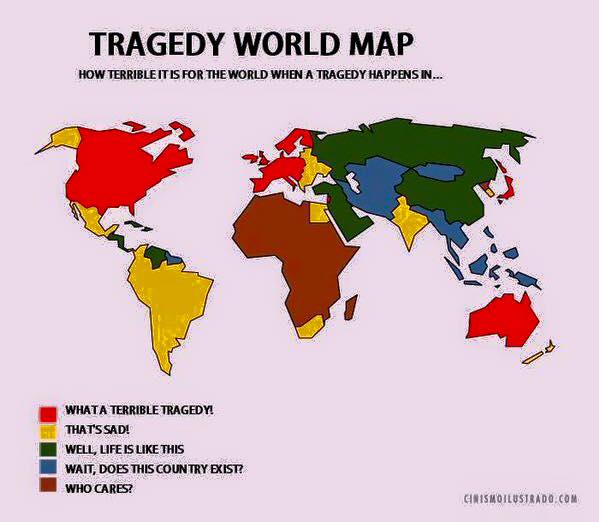
This graphic is being sent around social media; it is certainly cynical. It is communicating something true (and sad), but I think it fails to appreciate laws of proximity. The closer we are aligned to a group culturally, the more affinity we feel with them when tragedy strikes.

To use an analogy, the way I am affected by the death in a family will be more intense than grief I feel in the death of a friend, and it will be certainly greater than my reaction to the death of a stranger. The closer the relationship, the more acute my reaction.

As an example, I admit that I personally have more cultural affinity with France than I do with Middle Eastern and African cultures:

  • My favourite cuisine has always been French (seriously, nothing surpasses truffles)
  • Susan and I celebrated our first wedding anniversary in Paris
  • My favourite art has always been French Impressionism
  • As a pianist I loved performing Debussy, and I still regularly listen to his piano and orchestral works. My favourite orchestral work is Prélude à l’après-midi d’un faune.
  • My favourite fashion label is also French, although a Pastor’s salary doesn’t permit shopping at Hermes! Those were the days of music.
  • I live in Mentone and my church is Mentone Baptist Church.

These ‘likes’ and affinities are not saying that, for example, Lebanon’s Shia population are therefore less important. Not at all. 

What can we do? Cultural proximity is fact of life, but it is not an excuse for neglecting people who are often more at risk and in need.

Find ways to acknowledge the suffering of people in other parts of the world.

  • We should pray for these other nations.
  • We should investigate what kind of assistance they need. A reality is that France is in a better financial place to assist its citizens in need.
  • In our conversations don’t forget the Non-Western world.

The reality is, our concerns and griefs will always be partial and limited. We don’t have exhaustive emotional energy, and it’s not only cultural leanings, but our sinful inclinations also impact our preferences more than we appreciate. Which is why I thank God that he is God. There exists a good and sovereign God who understands all things and who is able to embrace all of the world’s ills, who is sufficiently righteous not to neglect any injustice, and  who merciful enough to forgive the unjust, even me.

Take a moment to read these words from Isaiah ch.40.

A voice of one calling:

“In the wilderness prepare

    the way for the Lord;

make straight in the desert

    a highway for our God.

4 Every valley shall be raised up,

    every mountain and hill made low;

the rough ground shall become level,

    the rugged places a plain.

5 And the glory of the Lord will be revealed,

    and all people will see it together.

For the mouth of the Lord has spoken.”

6 A voice says, “Cry out.”

    And I said, “What shall I cry?”

“All people are like grass,

    and all their faithfulness is like the flowers of the field.

7 The grass withers and the flowers fall,

    because the breath of the Lord blows on them.

    Surely the people are grass.

8 The grass withers and the flowers fall,

    but the word of our God endures forever.”

9 You who bring good news to Zion,

    go up on a high mountain.

You who bring good news to Jerusalem,

    lift up your voice with a shout,

lift it up, do not be afraid;

    say to the towns of Judah,

    “Here is your God!”

10 See, the Sovereign Lord comes with power,

    and he rules with a mighty arm.

See, his reward is with him,

    and his recompense accompanies him.

11 He tends his flock like a shepherd:

    He gathers the lambs in his arms

and carries them close to his heart;

    he gently leads those that have young.

12 Who has measured the waters in the hollow of his hand,

    or with the breadth of his hand marked off the heavens?

Who has held the dust of the earth in a basket,

    or weighed the mountains on the scales

    and the hills in a balance?

13 Who can fathom the Spirit of the Lord,

    or instruct the Lord as his counselor?

14 Whom did the Lord consult to enlighten him,

    and who taught him the right way?

Who was it that taught him knowledge,

    or showed him the path of understanding?

15 Surely the nations are like a drop in a bucket;

    they are regarded as dust on the scales;

    he weighs the islands as though they were fine dust.

16 Lebanon is not sufficient for altar fires,

    nor its animals enough for burnt offerings.

17 Before him all the nations are as nothing;

    they are regarded by him as worthless

    and less than nothing.

18 With whom, then, will you compare God?

    To what image will you liken him?

19 As for an idol, a metalworker casts it,

    and a goldsmith overlays it with gold

    and fashions silver chains for it.

20 A person too poor to present such an offering

    selects wood that will not rot;

they look for a skilled worker

    to set up an idol that will not topple.

21 Do you not know?

    Have you not heard?

Has it not been told you from the beginning?

    Have you not understood since the earth was founded?

22 He sits enthroned above the circle of the earth,

    and its people are like grasshoppers.

He stretches out the heavens like a canopy,

    and spreads them out like a tent to live in.

23 He brings princes to naught

    and reduces the rulers of this world to nothing.

24 No sooner are they planted,

    no sooner are they sown,

    no sooner do they take root in the ground,

than he blows on them and they wither,

    and a whirlwind sweeps them away like chaff.

25 “To whom will you compare me?

    Or who is my equal?” says the Holy One.

26 Lift up your eyes and look to the heavens:

    Who created all these?

He who brings out the starry host one by one

    and calls forth each of them by name.

Because of his great power and mighty strength,

    not one of them is missing.

27 Why do you complain, Jacob?

    Why do you say, Israel,

“My way is hidden from the Lord;

    my cause is disregarded by my God”?

28 Do you not know?

    Have you not heard?

The Lord is the everlasting God,

    the Creator of the ends of the earth.

He will not grow tired or weary,

    and his understanding no one can fathom.

29 He gives strength to the weary

    and increases the power of the weak.

30 Even youths grow tired and weary,

    and young men stumble and fall;

31 but those who hope in the Lord

    will renew their strength.

They will soar on wings like eagles;

    they will run and not grow weary,

    they will walk and not be faint.

Do we have religious freedom anymore?

Dr Michael Bird breathes some common sense into what is fast becoming a ludicrous situation in Tasmania.

This is an important read for every Australian who believes in freedom of speech.

http://www.onlineopinion.com.au/view.asp?article=17832


‘be prepared to die for God’: Misleading headline of the year award

In my opinion, The Australian newspaper has resorted to the worse kind of sensationalised journalism in the piece, ‘Be prepared to die for God’, kids told in state school classes (October 17th).

It is worth mentioning that the story pursued by The Australian was discussed in the media several months ago, and the issues raised were then adequately dealt with by the NSW Government and the providers of SRE.

you_an_introduction_michael_jensen

And by issues, it should be noted that there was no fire (perhaps a really small candle), just a lot of smoke being blown north by a group of angry Victorians (FIRIS). Unfortunately, while reasonable minds did address the expressed concerns, FIRIS have continued to blow smoke into NSW. Having scorched Victoria of rational and gracious discourse, I guess they need a new land to conquer. But my question here is, why did The Australian choose to regurgitate a non-story from months ago?

Following the dreadful murder of Curtis Cheng by schoolboy Farhad Jabar, the media has been right to report issues relating to the radicalisation of young Muslims. These are genuine concerns for Australia, but sadly there are Australians who are distastefully seizing upon this issue and using it to try and remove Christian teaching and presence from schools in NSW (disappointingly, the Victorian Government has already succumbed to this obtuse fear mongering). And it seems as though The Australian correspondent, Natasha Bita, has jumped onto this bandwagon. Look at the headline, ‘be prepared to die for God’, kids told in state school classes. Obviously, these Christians are training young children to commit murder in our streets and schools. There must be hate filled speeches and promises of virgins in heaven for any willing martyrs! But of course, the headline is misleading, and the article itself falls flat in its attempt to make SRE appear dangerous, “harmful” and “damaging”.

All of the extreme ideas cited by Natasha Bita, are of course nothing of the sort. Michael Jensen’s book, You: An Introduction, is designed to start a conversation. It certainly holds a view of God who is holy and love, and of a world that is simultaneously amazing and broken, joy giving and painful, but all this fit perfectly within orthodox Christianity. Yes, it uses the word sin to explain what has gone wrong in the world, but only a fool would argue that there is no evil in the world. In fact, the concept of sin is one of the most self-evident ideas of the Bible.

And far from being dangerous, read further and you’ll find that is no inciting to anger and hate, but there is much encouragement to love and respect, and to think deeply about life and biggest questions of the cosmos.

And in response to the criticism given to a letter that was written by Bronwyn Chin, who died of pancreatic cancer in 2013, is it not appropriate to share stories of hope in the midst of suffering, or should our teenage children only have access to stories where the narrative is hopeless and meaning allusive?

It is pretty shabby that The Australian decided to run this piece. Not just Christians, but Australians in general understand that aligning Christianity with Islamic extremism is absurd and bordering on slander.

It is fine to not like SRE, and it is also fine to not like the fact that it remains in NSW State schools, and it is fine to argue for its removal, but it is not fine to harness public fears about real issues and to suggest that SRE is somehow akin to or might lead to the kinds of evil ISIS are perpetrating around the globe.

Finally, it is important for readers to understand these two basic points that Natasha Bita fails to mention in her article:

1. Along with John Dickson’s book, ‘A Sneaking Suspicion’, You: An Introduction, was temporarily banned from NSW schools earlier in the year, but they were quickly re-introduced once the Education Minister was made aware of the situation and no issue found with them.

2. These SRE classes are not compulsory. No parent is forced to have their children attend the classes. These classes are for families who want their children participating, and clearly there are significant numbers of families who do want these classes.

Are Sydney Anglicans really so dangerous? FIRIS believe so, but really? No one is forced to believe the views they present or to even attend the classes, and yet these are ideas that have profoundly aided our nation for two centuries, and even if we disagree with them, is it not valuable for our children to have the opportunity to at least read and engage with these ideas for themselves?

Grand Final hype and Christian passion

Only once have I missed the Grand Final, and that was in 1999. I was living in London at the time, but even then, I woke up at 4 in the morning to read the then minute by minute updates that were being published on the internet (yes, this was before the days of live-streaming).

351432-tlsnewslandscape

It doesn’t matter whether my team is playing on Grand Final day or not, it’s un-Melbourne like to not watch the game.

Tomorrow there will be 100,00 people filling the MCG and living out their love for football, with millions more watching on television at home or at the pub.

We took our children into the city yesterday and had fun at the Foxtel Footy Festival next to the MCG. Everywhere you looked there were men, women and children wearing footy jumpers and scarves (more West Coast colours than anything!). Football fans are not hard to spot: they are committed to supporting their team, they’re enthusiastic, they attend matches and if they can’t they will watch it on tv, they talk about footy at work, there are footballs lying around the house to hold and caress.

Grand Final day is so important to Melbourne that we now celebrate a public holiday on the day before Grand Final!

For the three Melbournians who doesn’t love footy, there will be something else that you’re passionate about – art, music, gardening, cooking, technology,  spending time with friends, travel.

To prove that I’m not just another nodular barely-civilised football fan (can’t think why Freemantle comes to mind!), remember that famous balcony scene in Romeo and Juliet where Juliet is standing outside in the night sky and Romeo sees her, and is smitten and starts talking to himself, 

‘See how she leans her cheek upon her hand. O that I were a glove upon that hand, That I might touch that cheek.’

Romeo would be satisfied to be a glove on her hand so that he could touch her cheek. It’s all very romantic, but that’s what happens with passions and desires. Whatever the heart most desires, we think and talk and dream about it.

Football, music and poetry are among the many good things we enjoy under a good God, but Grand Final week makes me wonder why Christians don’t exhibit similar enthusiasm for the Gospel of Jesus Christ?

I think of Paul who wrote,

“I speak the truth in Christ—I am not lying, my conscience confirms it through the Holy Spirit— 2 I have great sorrow and unceasing anguish in my heart. 3 For I could wish that I myself were cursed and cut off from Christ for the sake of my people, those of my own race”.

I think of Jesus who as he approached Jerusalem, wept, and said,

‘“If you, even you, had only known on this day what would bring you peace’

Where is this Gospel driven passion today? Where is the deep-heart-convinced desire to tell Melbournians the Gospel? We are passionate about many things and yet the purposes of God in Christ is rarely one of them.

Imagine if Christians preferenced time with Church over lazy weekends and sporting events?

Imagine if Christians gave just a portion of their football fanaticism to the Great Commission instead?

Charles Spurgeon once remarked, ‘‘Have you no wish for others to be saved? Then you’re not saved yourself, be sure of that!”

The thing is, while we may give intellectual assent to Surgeon’s question, what we truly desire is evident by what we give our energies too and the decisions we make in life.

Imagine, if Christians put first in their lives, God’s mission into the world?

Like everyone, I have limited time and energy, and so I need be wise and ensure that how I live is being driven by the reality that I am persuaded is of greatest value. Friends, make it the Gospel.

FYI Hawks by 48 points!