Baptists believe in Freedom of Association

Until Friday, I had never heard of Logan Robertson or Pillar Baptist Church in Queensland. Today, all Australia knows his name.

Logan Robertson and two other men have been charged with public nuisance offences following events that took place during the week at two Brisbane mosques. The incidents were ugly, offensive, and without warrant.

Mr Robertson is a New Zealand national who has already gained notoriety in his homeland for extreme religious views, including being subject to a police investigation regarding his public conduct. Prior to entering Australia a year ago, Robertson was cautioned about his behavior. Tonight he is in custody and will be shortly deported back to New Zealand.

Screen Shot 2018-07-07 at 9.46.15 pm

To begin with, along with Christians across the country, I wish to apologise to our Muslim Australians who were subjected to Robertson’s unruly conduct. People of any religion should be permitted to worship in freedom and without threat. We have seen other nasty incidents in recent months, usually with Christian churches and groups being targeted. On this occasion though,  the perpetrators were a group who purport to be Christian. We do not want Westboro or Münster type religious fanatics interfering with peoples religious freedoms, regardless of what their religion may be.

It is understandable that this story has made headline news across the country; this is a time when religious freedom is a topic of national conversation and we await the Government’s report on the Ruddock review. In the middle of these discussions, here is a ‘Christian’ minister intruding on a Muslim time of prayer and intimidating worshippers, including teenage boys.

Why does this matter? There are two issues here. First, there is the criminal charges and social ills that Robertson and others have allegedly engaged in. We should not intimidate other Australians by entering their worship spaces and interrupting religious services. Second, it is important to address this story, because just like the fake gynaecologist who was caught out and imprisoned in Melbourne this past week, a fake Baptist should also be called out because of the dangers in misrepresenting what Baptists, and Christians in general, believe.

While Logan Robertson self-identifies as a Baptist, as the media have rightly stated, he and his church have no affiliation with the Queensland Baptist Union and the Baptist Union of Australia. Indeed, there is little about Pillar Baptist Church that can be called Baptist.

As with all Christians, Baptist beliefs and practices are shaped by the Bible. What Christian Churches share in common is far greater than any differences. For example, while Baptists don’t baptise infants as do Anglicans and Presbyterians, and our church governance differs, otherwise,  we share the same beliefs that have been taught and lived out for 2000 years.

I have read the Doctrinal Statement of Pillar Baptist Church, and it does not resemble any Baptist confession that I have ever read before, and it includes some very strange ideas indeed.

Most Baptist Churches in Australia belong to the Baptist Union of Australia, and so they are in formal association with one another. There are also independent Baptist churches, and these vary in their beliefs and practices. Independence does not alone denote what a church is like, but as with every church (including those belonging to a traditional denomination), we ought to examine their doctrine and life closely. At the very least, when a Church states that it “reject[s] the teaching of the universal church” and does not associate with other Christian groups, that ought to raise serious questions.

Not only does Robertson’s Church have a doctrinal statement that doesn’t fit with historic Baptist faith, and not only are they unrelated to any formal Baptist association, it is clear that Logan Robertson has abrogated two important Baptist principles, namely that of freedom of conscience and freedom of association. While these principles are not owned by Baptists, they are closely aligned with Baptist thinking through the Centuries. Freedom of thought and freedom of association found clear expression among Baptists in the 17th Century, at a time when religious freedom didn’t exist but was often controlled by the crown, by Parliament, and by establishment churches. Baptists were often oppressed and even imprisoned for holding these beliefs. The author of Pilgrim’s Progress, John Bunyan, was twice imprisoned because he believed in and practiced freedom of religious association.

These two principles are not saying that Baptists agree with other religions or that we think that these religions are intellectually coherent, spiritually healthy, and morally good. Baptists are not theological and moral relativists. It does, however, mean that we believe Christianity is accepted through persuasion not by coercion, by gracious explanation and not by galling intimidation. Freedom of belief is not about privileging  one religious group over another, but positively guaranteeing that all Australians can speak and live their beliefs without harassment. Neither the State nor individuals in the community should resort to browbeating in order to change another person’s mind on an issue. We cannot create a healthy society by thuggery, whether it is noisy secularists forcing out Christians from the public square or religious fanatics spitting out their dogma in our faces.

Australia needs honest conversations about the big questions of life. We need these discussions happening in public spaces and in private meetings, and yet sadly, people like Logan Robertson caste a shadow on our optimism, and authoritarian secularists are throwing even darker clouds over the social and religious freedoms that we have long enjoyed in this country.

It is easy to say that Logan Robertson’s behaviour is unAustralian, but I’m not sure if I want to indict my New Zealand friends on this occasion! Robertson’s ideas and behaviour are certainly anti-Baptist, and therefore they have caused confusion over the beauty and goodness of the Gospel of Jesus Christ. When Jesus met people with whom he held profound disagreement, he loved them and he went to a cross to die that they might come to know and enjoy God forever. That is how Australians can tell a Christian, not that we agree with your beliefs, but that we love you and above everything we desire for you to know the Lord Jesus Christ, not to force him upon you, but with grace and fervour, with openness and humility, to explain the reason for the hope with have in Him.

What Senator David Leyonhjelm’s words teach us about ourselves

Like most Australians, I was disgusted by what Senator David Leyonhjelm said to Senator Sarah Hanson-Young and to television interviewer, Angela Bishop.

His remarks are vile and sexist and unbecoming of one who represents the Australian people in Parliament.

During a discussion on women’s safety inside the Upper House Chamber, Senator Leyonhjelm told Senator Hanson-Young to “stop shagging men”.

Over on Twitter, Senator Leyonhjelm responded to Angela Bishop’s criticism of him by calling her “a bigoted b#tch”.

Senator Leyonhjelm remains unapologetic, and offered this defense on ABC news radio yesterday,

“It is a normal Australian behavior”

“I am a normal Australian, I am elected by normal Australians, normal Australians call people bitches, bastards, shut up, various things of that nature.

“I don’t discriminate between men and women.”

Screen Shot 2018-07-04 at 7.44.11 pm.png

I don’t know whether Senator Leyonhjelm truly believes his own defense, but let’s suppose he does. For argument sake, let’s assume Senator Leyonhjelm believes that he ought to speak to women in the same manner as he does with men. Is this not the kind of equality we are hoping to attain as a society? Should men and women not speak to each other in undifferentiating ways? Aussie blokes are known for their colourful language. I’m not agreeing with this cultural ‘norm’, but swearing and deriding each other long been a sign of social acceptance…and also of insult (discerning the difference isn’t always straightforward!). If men and women are identical and should be treated equally, should we not use the Aussie vocabulary tool bag for men and women alike?

Let me be clear, I believe Senator Leyonhjelm’s comments are indefensible and that he should apologise without reservation. It is entirely appropriate for Senator Hanson-Young to call him out and to expect an apology. Indeed, Senator Hanson-Young has revealed that this is only the latest in what is a culture of bile-like rhetoric which is thrown around the corridors of Canberra. I doubt if many of us are surprised, but surely it is entirely right for Senator Hanson-Young, and for all of us, to expect better from our political representatives.

Prime Minister Malcolm Turnbull, has spoken up, saying,

“That type of language has no place in Parliament, it shouldn’t have a place in any workplace…Respect for women in particular is one of the highest priorities that we should be focused on.”

His emphasis, “respect for women in particular”, is worth noting. Why do Senator Leyonhjelm’s derogatory comments jar? Because we know it’s wrong, it’s always wrong, and as Prime Minister Turnbull states, it is particularly wrong when a man speaks to a woman in such a way. A man can get away with calling another bloke a ‘b#stard’, but it is entirely different when a man refers to a woman as a ‘b#tch’. This is not about social conventions, but an inherent-born-with understanding that men should not belittle and abuse women by their words or actions. We know it’s wrong. Boys were raised to respect girls and to treat them well, not because there’s some masculine superiority complex at play, but because it is how men should behave. Boys might fight each other, but you never hit a girl. Boys might open a door and walk through it first, but most women appreciate the man who stops and opens the door for them first. 

While Senator Leyonhjelm’s obscenity is receiving widespread condemnation, this same Australian culture has, however, embraced other language that is designed to denigrate and silence other Australians. For example, last year’s marriage debate witnessed people slandering gay and lesbian Australians and also slandering heterosexual Australians. The former was rightly called out, but the latter was often supported by and even used by our political representatives and media personalities to popular adulation. Another body of language has recently come into common usage, which aims to deride white males, because apparently if you are white and male you represent everything that is wrong with society. The point is, our problem is much deeper than simple misogyny. 

Whether we like it or not, Senator Leyonhjelm has revealed something ugly about Australian society, and it is more complex than gender equality. We have taught ourselves to treat men and women without distinction and we have encouraged a culture of vulgarity. We often praise the outspoken disparager. We believe in freedom of expression, where obscenity is even called artful and humorous. Let’s pile a hundred naked men and women on a supermarket roof in Prahran, take a photo, and call it art. Listen to the Shakespearen-like lyrics of Beyonce and other pop musicians that we download in the millions. Walk into any Melbourne comedy club and find an act that’s not going to resort to jokes about peoples’ private parts and sexual proclivities! The jokes don’t even need to be funny, just say a dirty word and the audience will laugh.

How different is the verbal posture presented by the Apostle Paul,

“No foul language is to come from your mouth, but only what is good for building up someone in need, so that it gives grace to those who hear.” (Ephesians 4:29)

Of course, Paul is writing to Christians here, and so this a word that we Christians must take seriously. It’s also pretty good advice for everyone. Instead of following the Australian way, which loves to kick the pedestal out from others, perhaps we need to introduce the language of honour and respect. Maybe we should be teaching young boys to respect girls. Maybe we should be doing more to tackle the problem of pornography.  Maybe we shouldn’t demonise gender differences but acknowledge them as a common good. And maybe self-control is not so detrimental to our health, but considering our words before speaking them is important for healthy relationships.

While there is a great deal of public anger this week, it doesn’t suffice to shame men like Senator Leyonhjelm, or to call for resignations, or to argue that we need more education. Jesus reveals an uncomfortable truth about ourselves,

“what comes out of the mouth comes from the heart, and this defiles a man. (Matt 15:18)

Our words are revealing, communicating to others what is going on in our hearts. We speak what we think, and we verbalise the deep-seated attitudes that we hold. It is interesting to note that Jesus spoke these words in the context of a conversation regarding the family unit, and how children and parents relate to each other (Matt 15:8-16). Jesus continues,

 For from within, out of people’s hearts, come evil thoughts, sexual immoralities, thefts, murders, 22 adulteries, greed, evil actions, deceit, promiscuity, stinginess, blasphemy, pride, and foolishness. 23 All these evil things come from within and defile a person.”

Our problem in Australia is that we don’t believe Jesus. We ’re unconvinced by his analysis, and that many of these heart attitudes are wrong. Jesus said, “You are the ones who justify yourselves in the sight of others, but God knows your hearts. For what is highly admired by people is revolting in God’s sight” (Luke 16:15). It’s true, we often justify our loves and actions and use all manner of social slogans to protect ourselves, and yet our social engineering projects are building communities that are deeply fractured and tearing. We are becoming proficient at identifying social ills,  but we are falling far short of adequate solutions. We need to ask ourselves some hard questions about our hearts, not of the girl or guy next to us, but our own hearts. But are willing to acknowledge what we discover? Without a gracious and merciful God, the Proverb will be true,

“At the end of your life, you will lament when your physical body has been consumed, and you will say, “How I hated discipline, and how my heart despised correction. (Proverbs 5:11-12)

Ashpenaz’s Children: ALP National Platform to separate children from parents

“In you they have treated father and mother with contempt” (Ezekiel 22:7a)

“How the precious children of Zion, once worth their weight in gold, are now considered as pots of clay, the work of a potter’s hands!” (Lamentations 4:2)

Like many people watching from Australia, it has been distressing to see footage of children being separated from their parents along the United States’s border with Mexico. The Trump administration’s ploy to discourage undocumented migration is cruel and immoral. The policy may have been put in place by an earlier administration, but President Trump has made it clear that he is using these children to discourage illegal migration into the United States.

Russell Moore (President, Ethics & Religious Liberty Commission of the Southern Baptist Convention) is one of many signing a public letter to the Government, saying, “The traumatic effects of this separation on these young children, which could be devastating and long-lasting, are of utmost concern.”

While we in Australia look on with disgust at this violation of the family unit, the Australian Labor Party (ALP) have announced their national platform, which includes a policy to remove children from a new wave of ‘disgraced’ parents.

ALP Conference.png

According to policy initiatives that are to be presented and adopted at this year’s ALP national conference, parents who don’t support their child’s wish to transition to another gender, are guilty of abusing their children and therefore will subject to a new range of laws.

“LGBTI Conversion Therapy

Labor accepts the scientific evidence that claims by those purporting to change people’s sexual orientation or gender identity are both false and harmful and does not accept that such claims should continue to be made or, worse, be acted upon. Those who make these claims prey upon those vulnerable to the anti-LGBTI prejudices of the circles in which they or their families move.

Current laws regulating false and misleading conduct in trade or commerce, or professional misconduct in the health professions, are inadequate to deal with perpetrators who can evade health regulation by not being registered, and evade consumer protection laws by claiming to be conducting religious activities.

Labor will:

  • Ensure, in cooperation with the States and Territories, that adequate laws and systems are put in place to ensure the protection of children, adolescents and others from the false claims and psychological harms of so-called “ex-gay” therapies
  • Ensure that child protection authorities acknowledge attempts to “cure” Same-Sex Attracted or Gender Questioning children and young people as serious psychological abuse; and
  • Acknowledge these harms, when suffered within the family, as domestic violence against the child.”

(Chapter 8, pp 236-7)

“Labor opposes the practice of so-called conversion and reparative therapies on LGBTIQ+ people and seek to criminalise these practices.”

(ALP 48th National Conference (Consultation Draft 2018), chapter 8, p.205)


Child abuse is a very real and very terrible evil in our society. It is incumbent upon us to guard our children against such ignominious harm. But what are the facts here? Is this domestic violence?

In 2016, Prof Patrick Parkinson published an important evaluation of the Safe Schools program. In this research paper Prof Parkinson noted that contrary to Safe Schools, which claims that 4% of the population is transgender, research suggests that the real number is about 0.35%. This number encompasses a broad definition of transgenderism, based on surveys rather than proper diagnosis by medical professionals. Prof Parkinson then cites The American Psychiatric Association which estimates the rates of gender identity disorder for natal adult males to be at 0.005% to 0.014%, and for natal females, from 0.002% to 0.003%.

The numbers of children who identify as gay or lesbian is significantly higher, but percentage remains relatively small, somewhere between 2-4% of the population. It needs to be said that because these numbers of small, doesn’t diminish the importance of these kids, and of their need for love and support; no child is insignificant.

In the most recent edition of The Atlantic, Jesse Singal has written a thorough piece, exploring the complexities of treating children with gender dysphoria, cautioning against preempting treatments,

“the World Professional Association for Transgender Health…states that while some teenagers should go on hormones, that decision should be made with deliberation: “Before any physical interventions are considered for adolescents, extensive exploration of psychological, family, and social issues should be undertaken.” The American Psychological Association’s guidelines sound a similar note, explaining the benefits of hormones but also noting that “adolescents can become intensely focused on their immediate desires.” It goes on: “This intense focus on immediate needs may create challenges in assuring that adolescents are cognitively and emotionally able to make life-altering decisions…But some clinicians are moving toward a faster process. And other resources, including those produced by major LGBTQ organizations, place the emphasis on acceptance rather than inquiry. The Human Rights Campaign’s “Transgender Children & Youth: Understanding the Basics” web page, for example, encourages parents to seek the guidance of a gender specialist. It also asserts that “being transgender is not a phase, and trying to dismiss it as such can be harmful during a time when your child most needs support and validation.”

“Ignoring the diversity of these experiences and focusing only on those who were effectively “born in the wrong body” could cause harm. That is the argument of a small but vocal group of men and women who have transitioned, only to return to their assigned sex.”

Prof Patrick Parkinson makes the important point,

“One reason for great caution about what we teach children is that gender dysphoria may be transitory.”

There is a growing volume of research that is exploring the relationship between age and gender dysphoria. Depending on the study, evidence shows that somewhere between 80-98% of children will no longer experience gender dysphoria after puberty. That is a staggering indictment on the claims being made by the ALP. Even if we ignore the data from the highest end of the spectrum and only accept the most conservative percentile (80%), this still indicates that the overwhelming majority of children will return to identifying with their biological sex by the time they reach adulthood. For argument sake, let’s manipulate the data even further and assume that the conservative 80% is an exaggeration and that the real number of children recovering from gender dysphoria is half that number; that is still 4 out of every 10 children who have gender dysphoria. But according to the ALP, producing such evidence is simply to “prey upon those vulnerable to the anti-LGBTI prejudices of the circles in which they or their families move.”

While the ALP’s National Platform refers to “accepting the scientific evidence”, they cite zero studies, and they fail to account for many academic articles that have been published in recent years which either contradict or at the very least, nuance the position which the ALP is claiming as Gospel fact.

Some LGBTIQ Australians will experience a change of orientation and of gender identity, especially in the case of children with gender dysphoria who later come to affirm their biological sex. This is a simple statement of fact, not an affirmation for certain gay conversion therapies that have been reported in the media in recent months. Because I am a Christian, I do not support gay conversion therapy, as defined in terms of using pseudo-scientific and unbiblical methods to change a person’s sexuality. There is, however, a massive difference between offering shock therapy or performing a supposed exorcism, and reading the Bible with someone and them concluding that they no longer wish to identify as same-sex attracted or transgender. It is disturbing to see the ALP platform insist upon a zero-sum game, whereby everyone who doesn’t fully subscribe to the new gender agenda, is called names and will be accused of abuse.

What of the child or adult who no longer wishes to identify as LGBTIQ? What if an individual, while having LGBTIQ affections, does not wish to be identified as such? What of men and women who have undergone sex change surgery and have since detransitioned? The point is obvious and yet the ALP policy has no room to accept the reality that there are LGBTIQ people who do change and cease to identify as transgender, gay or lesbian.

The ALP platform is more troubling, for they are moving to criminalise therapies/ministries that fail to affirm people in their self-assigned gender and sexuality, and they are moving to accuse parents of domestic violence for not supporting children into transition.

How dare an Australian political party throw around the language of abuse and threaten to taken children from their parents; it is immoral and unspeakable, and it insults victims of real child abuse.

It is a sad irony, that on the one hand, voices calling for a ban on LGBTIQ conversion therapies, are at the same time, promoting sex changes for children. So, children are free to change one way, but not another?

At best, the ALP’s position on LBGTIQ issues is an attempt to show compassion toward vulnerable children, but it is a platform built on unstable and dangerous ideology.

As a parent, I know that not everything a child feels and wants is in their best interest, and chances are, they will change their mind by next week. Parents can discern the difference between a child’s fad and a deeper issue and. Parents love their children and want to see them safe and healthy and flourishing in life. This is not about bullying people into gender stereotypes or funneling children into strange and potentially harmful practices. This isn’t about parents patiently and lovingly caring for children who are struggling with their sexual identity; the ALP platform is about conformity to a new pattern for sexuality, and about using the weight of the law to force religious groups and parents to sign up to the sexual revolution.

I understand that some people may read this as an anti-ALP and perhaps pro-conservative article; that is not my agenda. As a Christian minister, I am not defined by such socio-political parameters. My concern is for children and for parents, who will face the onslaught of this irrational and dangerous ideologue, should the ALP platform gain traction. I am also concerned by these political attempts to place traditional Christian teaching on the wrong side of the law.

Churches need to appreciate that without due consideration and careful definition, the ALP’s platform can be used to constrain Christian teaching on sexuality, from the pulpit through to pastoral counselling.

Parents need to appreciate the gravity of the situation being outlined. For example, say a son comes home from school and announces that he feels like his true identity is as a girl. If the child returns to school and mentions to his teacher that mum and dad are not convinced and are reluctant to buy him dresses, the school may be obliged to report a case of child abuse.

I urge members of the Australian Labor Party to speak up and to vote against these dangerous and unnecessary measures. I also encourage members of the public to contact their local State and Federal Labor members and to share your concerns with them.

Tasmanian Art Needs Saving

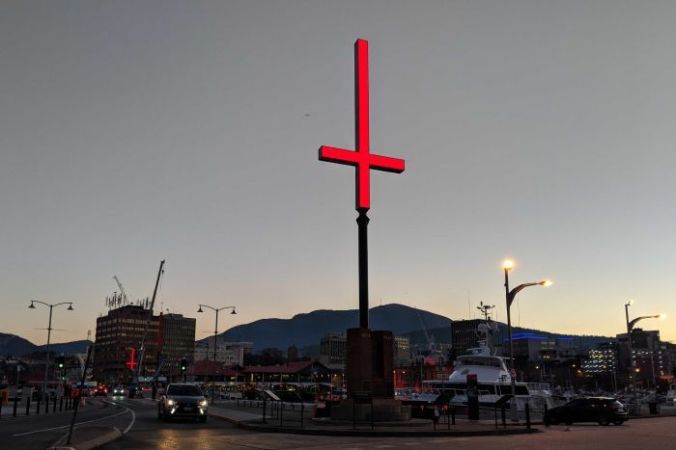
Last month a friend was about to visit Hobart and asked me whether it was worth visiting the Mona (Museum of Modern Art in Hobart). At first I thought he said MOMA, and so I proceeded to give a rapturous endorsement of this famous art gallery in New York City. He then clarified that he had said Mona and not Moma, at which point I was no longer able to help him. Perhaps there is a vibrant contemporary art scene in Tasmania, perhaps not. But then today, as I peered outside my Melbourne window and across Bass Strait, the distant feint red glow of upside down crosses didn’t succeed in turning around  my opinion about Tasmanian art.

9845166-3x2-700x467 (1).jpg

ABC

This is art? I realise that in Tasmania, the ministry of the Arts is combined with Justice, Correction, and the Environment. Was someone in the ministry confused when they opened the public purse? Or is Tasmania introducing a new form of justice and correction?

These so called ‘Crosses of Saint Peter’ look more like half assembled mood lights from Bunnings, rather than works of art. Then again, perhaps I’m being unfair to Bunnings!

Dark Mofo is a winter solstice festival, which aims to shock and to subvert. Last year, the Festival caused controversy in its ‘artistic’ use of slaughtered bulls, with blood and guts smeared all over people. This year, there is an anti-Christian theme, which would be innovative and interesting, except that it’s not. It’s kind of old and tried, about 2000 years so,  and sticking a few coloured LEDs onto  crosses is somewhat pedestrian.

Speaking of which, also appearing during the Dark Mofo Festival, is another artist, Mike Parr, who is going to bury himself under a road for three days. It’s unlikely though that his performance will have the same energy and excitement as the real resurrection, given that he’s not actually dead, and presumably he’ll need to eat and drink and poo and sleep. The more pressing question is this,  how is Mr Parr going to assess the critics reviews? Is trampling and driving over his ‘grave’ a sign of critical acclaim or of people expressing disinterest in the stupidity of the stunt?

Going back to these disco coloured inverted crosses, not only are they advertising an absence of artistic creativity, surely this project is a theological and social misfire.

The sight of these crosses is upsetting some Christians around Hobart, and I understand their reasons. Indeed, for millions of women and men around the world, they are being imprisoned and even killed because they love and believe the message of the cross, but why we would allow such facts to interrupt the creative processes. More so, I also think that once we’ve taken a step back, we can evaluate these cultural illuminatatis in a different way.

In his interview on the ABC, Mikey Lynch said it well,

“My immediate reaction was a bit of an eye roll — here we go, a shock jock statement that gets Christians grumpy.

“It’s a religious symbol and so for some people it is precious, so of course people are going to find that hurtful.

“For Christians, the cross is a symbol of shame and it’s about God taking on shame for the salvation of the world, so there’s a weird irony in getting offended by a symbol which in itself is offensive.”

These artists are taking what is the most offensive object of history, the cross, and are attempting to make some subversive statement about Christianity and to offend Christians in the process. Really? Let’s shame the symbol of shame? Perhaps the point has escaped the genius of these Dark Mofo artists, because surely their own subversive and unoriginal interpretations of the cross in fact reinforces the original point that was proven on the cross.

The Apostle Paul put it most aptly when he wrote,

“18 For the message of the cross is foolishness to those who are perishing, but to us who are being saved it is the power of God. 19 For it is written:

“I will destroy the wisdom of the wise;
    the intelligence of the intelligent I will frustrate.”

20 Where is the wise person? Where is the teacher of the law? Where is the philosopher of this age? Has not God made foolish the wisdom of the world?21 For since in the wisdom of God the world through its wisdom did not know him, God was pleased through the foolishness of what was preached to save those who believe. 22 Jews demand signs and Greeks look for wisdom, 23 but we preach Christ crucified: a stumbling block to Jews and foolishness to Gentiles, 24 but to those whom God has called, both Jews and Greeks, Christ the power of God and the wisdom of God. 25 For the foolishness of God is wiser than human wisdom, and the weakness of God is stronger than human strength.” (1 Corinthians 1)

Tasmania may be disconnected from the mainland by 500km of water, but apparently there also exists an ocean separating the Dark Mofo team from the world of art. Artists of Tasmania, please paint and sculpt, and resurrect what remains of your reputation.

They have may failed to set the art world alight, but these winter solstice revellers have given Tasmanians a new reason to ask questions about the cross. What a great conversation starter for Christians in Hobart this week.

Gehenna’s Dead

Screen Shot 2018-05-27 at 8.14.31 pm


Piled in unmarked graves,

Ashes to ashes, dust to dust.

Filling Gehenna with what remains,

Of flesh and blood and marrow.


Who are these nameless ones,

Whose time on earth so short?

What mountain of horror to see,

the scandalous unwanted dead.


No coffin or ceremony,

No words of solace spoken.

Though lingering in the deep,

Are perhaps doubts and disquiet,

Wonderings and hopes.


What cause,

What appeal,

What affliction has created this disturbance?

What necessity or hate has so consumed,

That life is deemed discretional?


Who would give their children to Molek,

Or present offerings to Eros and Aphrodite?

What god so insatiable must we appease,

To pull from womb ones so dear?


A public commotion shudders the earth,

Let us dance and celebrate;

Cheers reverberate through the streets;

We are free to kill.

We choose to kill.

Little ones, do not deny our liberty.


Jezebel, she is a jealous prophet;

Let us prove our dignity and worth.

For freedom sake,

Give us our rights.

We choose ourselves,

And we vote to forfeit others.


The altar of self is a bloody place.

The smell of burning corpses stiffens the air.

Winning is losing and the losers die.

Is this progress’ price,

Suffer the little children, and let them not come?


“Death has climbed in through our windows and has entered our fortresses;

it has removed the children.”

With approval we look on;

Humanity scorched, and losing soul.


Who will love these little ones, imago dei?

Who will remember them, their smiles and motions,

their cries and laughter,

that first word and step?

Who will celebrate their first birthday,

Hug them and say, ‘I love you’?


Who would give life to these unwanted,

to those disdained and sacrificed for Molek?

What name is given to these young lives,

Who are found amidst rubbish and refuse alike?


Greater Josiah has come.

He will love them.

He will welcome them home.

This greater Josiah;

A King upon a cross,

purify Gehenna,

redeem the dead,

forgive the transgressor.

Come Lord Jesus, come.

Richard Condie’s Positive Steps to help victims of child abuse

I want to commend the steps taken by Tasmania’s Anglican Bishop, Richard Condie, to redress the issue of child sexual abuse.

According to this evening’s ABC report,

“Tasmania’s Anglican Diocese is proposing to sell more than 120 properties, including churches, halls, houses and vacant land, to fund redress for survivors of child sexual abuse.

The church said it would need to sell just under half of its Tasmanian properties to cover an estimated $8 million of liability in additional payments to survivors.

It has been lobbying for the State Government to sign up to the National Redress Scheme for survivors, due to start on July 1 as a result of the Royal Commission into Institutional Responses to Child Sexual Abuse.

The Tasmanian Diocese also agreed to increase the payment cap for its own Pastoral Support and Assistance Scheme from $75,000 to $150,000 per claim.

Previous claimants will be entitled to have their claims reassessed, which may result in extra payments.

The figure of $8 million is based on advice that 150 survivors may be eligible to receive the average payment of $78,000 under the national scheme, or a similar figure from the church’s own scheme.”

“Survivors will not be able to claim from both schemes but, unlike the national scheme, the Tasmanian Anglican scheme is open to non-Australian citizens, those with a criminal conviction or people who were abused as adults.”

bishop-richard-condie-tasmania-2


Christian denominations and organisations have been rightly rebuked for the evil acts of child abuse that have been carried out by clergy and employees over many decades.  The abomination is not only the fact that the lives of young children have been devoured by demonic men, but that some groups covered up the crimes, or through inadequate training others did not respond to the cries of victims as they needed.

In part due to the Royal Commission into Institutional Responses to Child Sexual Abuse, Australians are more aware of the depth and breadth of the issue, and positive moves are now being taken to ensure children are safe and that Churches and other groups are better informed as to how to deal with reports of abuse. It still saddens me that the Royal Commission was ever required, but we should thankful for the tireless work of those who organised and participated. It is also encouraging to see many organisations being quick to follow the report’s recommendations, and it is disturbing to hear of others who are slow to practice repentance.

The damage created by decades of abuse will remain with us for decades to come. Thousands of Australians have been personally scarred, and their families too. Confidence in many institutions, including Churches, has been understandably broken. Churches have given Australians reason to doubt the authenticity of the Gospel, and to disbelieve the witness of Churches. This should never have been the case, for the name of Jesus Christ is good and holy, and without a single spot of unrighteousness, and followers of Jesus are called to be like their Lord and show others how good He is. Yet men from hell came and covered themselves in white robes and stole innocence. God is just and their evil behaviour will be recompensed in full, but  we are being naive if we believe that Aussies will quickly forgive or forget. We should not forget, we must repent.

I am reminded of the Law in the Old Testament. The Pentateuch may have fallen out of favour in our culture, like an out of date carton of milk, but perhaps we shouldn’t be so quick to pass judgment. Yes, the Mosaic law sours when it’s misapplied, but the law is more useful and essential than we might be willing to admit. In reading the law we learn two profound truths: Justice is paramount, and mercy is desperately needed.

“Do not deny justice to your poor people in their lawsuits.” (Exodus 23:6)

“Do not pervert justice or show partiality.” (Deuteronomy 6:19)

I thank God for Richard Condie’s leadership in practicing public and genuine repentance. He has not minimised the sins of past generations, and he is willing to go beyond recommendations in order to offer compensation to victims.

“When justice is done, it brings joy to the righteous but terror to evildoers” (Proverbs 21:15).

Let justice be done. My prayer is that others will follow the example of the Tasmanian Anglican Diocese (and that of the Sydney Anglican Diocese who have also made welcoming steps forward).

Are we prepared to walk away, for sake of Christ?

Israel Folau has come out and explained his recent remark on Instagram that has led to huge public controversy, and has involved Rugby Australia and their chief sponsors. It seems as though everyone has an opinion, and so it has been helpful to hear Israel speak for himself.

I appreciate his honesty and his humility. It made me think of the Apostle Paul’s words,

The grace of our Lord was poured out on me abundantly, along with the faith and love that are in Christ Jesus.

Here is a trustworthy saying that deserves full acceptance: Christ Jesus came into the world to save sinners—of whom I am the worst. But for that very reason I was shown mercy so that in me, the worst of sinners, Christ Jesus might display his immense patience as an example for those who would believe in him and receive eternal life”. (1 Timothy 1:14-16)

I appreciate Folau’s clarification about what believes. I appreciate his unswerving faith in Jesus Christ and his trust that the Bible is true and good,

“I believe when Jesus died on the cross for us, it gave us all the opportunity to accept and believe in Him if we wanted to. To enter the kingdom of Heaven, though, we must try our best to follow His teachings and, when we fall short, to seek His forgiveness.”

FOLAU_PV3_1280x560-1.jpg

He has indicated that should Rugby Australia find his views to be untenable he would resign,

“After we’d all talked, I told Raelene if she felt the situation had become untenable – that I was hurting Rugby Australia, its sponsors and the Australian rugby community to such a degree that things couldn’t be worked through – I would walk away from my contract, immediately.”

At this point in time, no decision has been made by either Folau or Rugby Australia. Last week, Rugby Australia chief executive Raelene Castle, admitted the difficulty she is facing,

“This is a difficult issue when you think you are trying to combine religious beliefs, freedom of speech and inclusion, respect and the use of social media,” 

“We’re proud of the fact that he’s a strong believer and he’s prepared to stand up for what he believes in.

“We want athletes in our code who are prepared to do that and that’s really important.

“But at the same time, Rugby Australia’s got a policy and position of inclusion and using social media with respect.

“So that’s where we shared stories, shared ideas and shared positions and both of us recognise that what we want is a situation where we use our social media platforms in a respectful and positive way.”

I think Castle helpfully summarises some of the tensions that now exist in the broader community. As a nation we are struggling to cope with societal pluralism. Sexuality has now been defined in such strong terms, that alternative views, as reasonable and loving as they may be expressed, are now perceived as evil and unacceptable. It’s reached the point that sporting codes are now making theological commentary, and assuming a position on hell. Unfolding before us is another test for Australian society. Are we serious about religious freedoms and freedom of speech, or does the rhetoric only apply when beliefs fall into line with the new sexual morality? Do we accept that millions of Australians don’t subscribe to the now popular view on marriage and sexuality, and that these Australians have a right to express their opinions? While politicians and company CEOS and sporting organisations wrangle over a position on religious freedom, it is even more important for Australian Christians to be thinking through these issues. What do we really believe? How can we best communicated what we believe? What are prepared to lose for the sake of knowing Christ Jesus as Lord?

Even though Folau’s sporting future remains uncertain, his testimony presents a healthy challenge to the rest of us Aussies who profess faith in Jesus Christ. Would we be prepared to walk away from job security? Would we be willing to give up a lucrative income? Are we ready to embrace public abuse?

I hope no one is thinking, Israel Folau can afford to make a decision to leave because he’s already earned millions of dollars and he has options in front of him to return to Rugby League. First of all, those who have more often find it exponentially harder to give it up. It is relatively easy to keep our beliefs quiet and to ourselves, and the pressure to compromise can be immense. Second, in standing by his Christian convictions, Folau is likely to face further public backlash. Third, NRL chief executive Todd Greenberg, has made it clear that Folau’s belief in hell would be unacceptable in their code, meaning that there is far from any guarantee that he could return to Rugby League.

When Jesus spoke about taking up a cross and giving up the world’s offerings, he wasn’t speaking rhetorically. Perhaps it is time for us to ponder his words and examine our own hearts and ambitions,

Then he called the crowd to him along with his disciples and said: “Whoever wants to be my disciple must deny themselves and take up their cross and follow me.  For whoever wants to save their life will lose it, but whoever loses their life for me and for the gospel will save it.  What good is it for someone to gain the whole world, yet forfeit their soul?  Or what can anyone give in exchange for their soul? If anyone is ashamed of me and my words in this adulterous and sinful generation, the Son of Man will be ashamed of them when he comes in his Father’s glory with the holy angels.” (Mark 8)

Public Speech: the New Code of Conduct

Last week the national crisis was cricket, this week it’s Rugby. The cricket story concerned 3 members of the national side who were caught cheating; the rugby headlines concern an individual player who has made a statement on instagram about his religious convictions.

I don’t follow Rugby Union; I’ve grown up with AFL, the game Israel Folau once tried to play. However, one doesn’t need to understand the rules of Rugby, to grasp that the rules for public speaking have changed in Australia. Governments are yet to determine what laws and codes of conduct will be written to support the recent amendment to the Marriage Act, but sporting codes and iconic companies are making it clear where they want lines to be drawn.


folau.jpg

On his instagram account, Israel Folau responded to a question about “gods plan for gay people” by saying, “Hell…unless they repent of their sins and turn to God”.

First up, did Israel Folau say anything untrue?

Did he suggest anything that is out of sync with the Christian faith? No.

Could he have said it in a better way? I think so. Folau could have said something like, “Homosexual practices are one example of many ways in which we ignore God’s purposes. All of us, including myself, are guilty of living without regard for God and because of that we deserve hell. God  is holy and he also merciful, and that’s why Jesus came and died on the cross. The amazing thing is, by trusting in Jesus we are forgiven and the direction for life changes for the better, and we are promised a future that we don’t deserve but is God’s incredible gift to us.”

Perhaps he could have ignored the questioner who was clearly trying to trigger a response. Sometimes the wise thing to do is to say nothing. However, Israel Folau chose to speak up, and good on him for doing so. I wish he had been more gentle and nuanced with his answer, but his words were not wrong.

Christian beliefs are grounded in the Bible, and the Bible’s message about sexuality is clear and consistent.  As the Bible itself teaches, there is a trajectory within its story line, and so we are meant to read and interpret the Old Testament in light of the New Testament, and to apply meaning through the lens of Jesus Christ. That means there are Bible verses which were spoken for a particular people and time, and no longer directly applicable to us. It also means that parts of the Bible are describing events to us us rather than prescribing specific norms for today. Nonetheless, the Bible’s teaching about human sexuality, including homosexuality and of marriage, retains a moral goodness and integrity from Genesis to Revelation.

Rugby Australia boss Raelene Castle has stated, “Israel’s comment reflects his personal religious beliefs, however it does not represent the view of Rugby Australia or NSW Rugby…We are aligned in our view that rugby is a game for all, regardless of sexuality, race, religion or gender, which is clearly articulated in rugby’s inclusion policy.”

There are two clear problems with Castle’s comments: First, Rugby Australia’s inclusion policy theoretically includes ‘religion’, and yet all the talk is about excluding Folau and his religious convictions, and these are beliefs which are in line with orthodox, historic Christianity and which are believed by thousands of Christian Australian who are playing sport at every level in this country. Second, there is a massive assumption being made here, that is, Folau’s comment is “homophobic”.

The policy states, “There is no place for homophobia or any form of discrimination in our game and our actions and words both on and off the field must reflect this”.

Here lies the problem. It is now taken as fact, certainly by Alan Joyce and others, that affirming the Bible’s view on sexuality is homophobic. If you agree with the Bible, you are a bigot. This is simply untrue. For example, Jesus spoke many words of disagreement to people around him, but was his motivation fear and hatred, or was it love and kindness? Did Jesus insist on calling sin, sin, because he wanted to crush people or because he wanted to save people? Sadly, there are individuals who are hateful toward people in the LGBTI community, and it is awful, and without excuse, and we Christians need to stand with you against any tirade of abuse.

Jesus once said, “the truth will set you free.” He didn’t say, the truth will agree with you, for he goes on to say, “Very truly I tell you, everyone who sins is a slave to sin. Now a slave has no permanent place in the family, but a son belongs to it forever. So if the Son sets you free, you will be free indeed.”

This goes to the very heart of Christianity, which is God who disagrees with us, and yet became incarnate, speaking and living truth, dying and rising from the dead to redeem sinners. This message may not be popular in Australia of 2018, but then again, history shows us that the Gospel has rarely been a social media success, and yet it is too good and too important for silence. There is no other God who is honest with us like Jesus, and there is no one else who loved us to the extent of suffering crucifixion for our eternal joy and good.

It is not homophobic to hold to the Bible’s teaching on sexuality. That’s not to say, people should listen to or accept this message, but calling it hate speech is false. Should Israel Folau be sanctioned for his comment? Is Qantas right to threaten Rugby Australia with their sponsorship?

I don’t agree with Alan Joyce’s views on sexuality, and I don’t like the way he has rebranded QANTAS as a gay pride flag flying company. Have I boycotted Qantas? No, in fact I’m flying with them tomorrow! What we are seeing is a major Australian company pressuring a sport to exclude a player who professes Christian beliefs. I think it would be unwise, but they might. I would ask,  is this the Australia we want to call home?

The Coopers Beer saga of last year served as a watershed (or should that be, beershed?!) moment in Australian social history, indicating that there would be a social and economic cost to anyone who doesn’t subscribe to the new morality. The art of toleration in Australia is being scrubbed out by a vocal priesthood of humanistic secularists who are intent on reframing the Australian identity and conscience. It is not only anti-Christian, it is an anti-freedom movement and is serving to diminish both religious and public non-conformity. Israel Folau is but another inevitable target of what will become many more in months and years to come.

————–

Late this afternoon at a press conference, RA chief executive Raelene Castle has said,

““This is a difficult issue when you think you are trying to combine religious beliefs, freedom of speech and inclusion, respect and the use of social media,” Castle said.

“We’re proud of the fact that he’s a strong believer and he’s prepared to stand up for what he believes in.

“We’re proud of the fact that he’s a strong believer and he’s prepared to stand up for what he believes in.

“We want athletes in our code who are prepared to do that and that’s really important.

“But at the same time, Rugby Australia’s got a policy and position of inclusion and using social media with respect.

“So that’s where we shared stories, shared ideas and shared positions and both of us recognise that what we want is a situation where we use our social media platforms in a respectful and positive way.”

There are some positives here and it’ll be interesting to see how it unfolds over the next few days, especially as to whether Qantas will turn down their rhetoric. Also interesting is Castle’s recognition of a now existing ‘tension’. Perhaps this is an opportunity for good listeners and reasonable minds to sit down and begin talking about how we can regain the art of disagreement in public discourse.

Foreign Aid and Australia’s Disappearing Generosity


“Those who trust in their riches will fall, but the righteous will thrive like a green leaf.” (Proverbs 11:28)

““Surely everyone goes around like a mere phantom;  in vain they rush about, heaping up wealth without knowing whose it will finally be.” (Psalm 39:6)


The Age yesterday reported that not only is Australia’s Foreign Aid on the decline, Australians in general are giving less to charitable causes.

  • In 1994 Australia was ranked 9th on the international league table of overseas aid donors (measured by the share of gross national income devoted to overseas development assistance). In 2018, we have dropped to 17th.
  • In 1994, Australia gave 34 cents for every $100 of national income to foreign aid (0.34%). In 2018, the contribution is now 22 cents for every $100 (0.22%).
  • Foreign Aid spending has decreased in the ministry of 7 of our last 10 Foreign Ministers.
  • “Even on the current budget numbers Australia’s aid spending is expected to slump to just 0.20 per cent of gross national income by 2021.”

According to the research raised by Matt Wade,

“The National Australia Bank’s Charitable Giving Index, which tracks donations made through online channels, shows giving to “humanitarian service” organisations like World Vision, Red Cross and Oxfam has declined as a share of all charitable giving over the past three years. In 2015 the humanitarian services sector received 35 per cent of all donations but that had fallen to 32 per cent by last year. The average donation to the sector was also down.

That fall came despite a plethora of international humanitarian crises…the public response in Australia was strangely muted.”

Depending on which research one uses, somewhere between 65-80% of Australians contribute to charitable causes, both within the country and to NGO’s. Again depending on which study we rely on, per capita contributions equate to between $200-300 per annum, which works out to be approximately 0.25-0.3% of the median household income in Australia.

I have three theories as to why we are seeing this trajectory:

  1. Foreign Aid doesn’t win votes. I’m sure it is a factor for Christians and for some conscientious Australians from other backgrounds, but the reality is, Foreign Aid is not a political game changer.
  2. Most Australians base their charitable giving from their disposable income, rather than regularly setting aside an amount from the total income. We are spontaneous givers, not planned givers.
  3. Uncertain times create caution, and thus a reluctance to give money to various causes. There are certainly many geo-political tensions in the world today, and these may well mute our responses. There are also domestic economic issues that again call into question what we feel able to contribute beyond our own immediate concerns. Then again, is this not always the case? Are there not always socio-economic question marks and pressures? When has there ever been an ideal time to given generously to those without? And as Matt Wade exclaimed, Australia today has never been more rich, and yet we are moving from modest giving to miserly.


It is easy to stand in the public gallery and shout out advice to Governments. But perhaps we should be aiming the megaphone at ourselves. Whether we like it or not, Governments are, at least in liberal democracies, a mirror of the dominant society. Government policies to a very great extent reflect the attitudes and priorities of the general community. Is it of coincidence that the slide in Foreign Aid is tracking at a similar level to the average charitable giving by Australians?

Before we tear down the Government for another moral failing, there are several important caveats and consideration.

First, the social and economic priorities of a Government should depend, at least in part, on what one believes the responsibility of Government to be. I think we make a lot of assumptions about the role of Government. Our list of expectations seems to be growing, and the end result is that we are creating bigger Governments, and I’m not so sure that that is particularly healthy for our society. Have we become too reliant on Governments? For example, once a upon a time, a family would care for their own elderly parents and for their own young children, but now, do we too readily call upon the State to assist?

How Government spends money, largely reflects the values and the priorities of voters. The relationship is even more complex, for there are times when we want Government to do the kinds of things we should be doing ourselves. We wish to alleviate ourselves of responsibility by loading governments with even more.

Second, the priorities of a government should primarily focus on its own people, and yet we also belong to a global community, so surely it is right for us to share some of our bounty with communities across the world who are struggling at this time? If the shoe was on the other foot, would we not hope that someone would see our plight and have compassion on us?

Third, if we want our government to change perhaps we need to start with ourselves. If we are serious about changing Foreign Aid to levels that a more akin to those in 1996, what will we voluntarily give up? Are we willing to ask for a cut in sport or in the arts? What about infrastructure, Defence, social services, and a thousand other areas of expenditure? Does not the very definition of generosity imply a cost and sacrifice? What are we prepared to give up?

What does it mean to love our neighbour as ourselves? This is a principle taught by Jesus Christ, although I realise Christianity has nothing worth saying in the public square and we should never permit Christian values to influence public policy; perish the thought!

Thankfully it was a journalist from a progressive newspaper that reported this story. Can you imagine if a Christian minister had suggested that Australians are becoming less generous and more like Scrooge incarnate? The response would be unsurprising,

“here’s another example of judgmentalism and moral condescension from our Churches.”

Perhaps this 20 year trend is more revealing than we want it to be. Is it because our personal wealth has diminished over the years? No, the opposite is true. Is it because there are greater economic uncertainties today than 20 years ago? Again, the answer is no. Is it because there are fewer global opportunities to assist the poor and disadvantaged? Global poverty is thankfully in decline, but there is never a shortage of need. Is there perhaps a connection between society’s move away from Christianity and our decreasing generosity toward those in need? I don’t know of any research that has examined such a hypothesis,  but I would not be surprised if it were so. Juxtaposed to declining charitable giving across Australia, evidence suggests that Christians continue to give many times more than the national average.


Screen Shot 2017-12-27 at 10.21.35 am

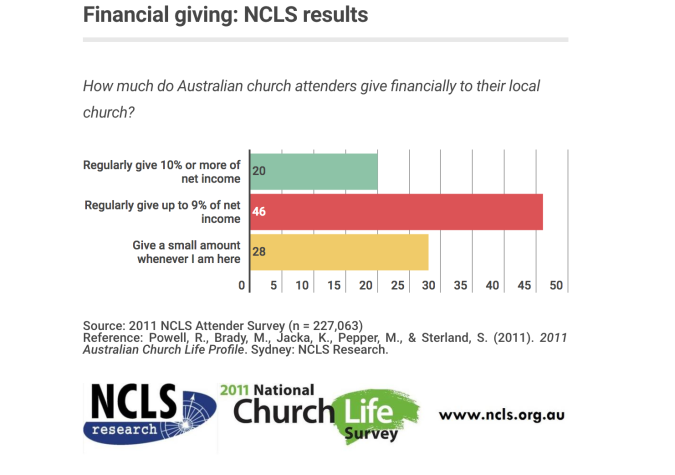
According to NCLS research (a national survey across Christian denominations, which involved 10,000s of participants), 66%  of church attenders give regularly, with 20% of attendees regularly giving over 10% of their income. It is important to note that these figures only include financial contributions to the local church, and does not include all the charitable giving beyond. It should also be pointed out that these financial contributions are not tax deductible.

The question is, why is the gap between general Australia and Christian Australia so great? I’m sure that some Christians give out of a sense of obligation (although they should not), and others give because of a dubious understanding of Divine blessing (ie the prosperity Gospel). But those two reasons cannot explain the giving that continues in evangelical Churches across the country.

So what is the reason?

My hypothesis is a simple one, and it comes from the Bible: Grace changes peoples’ hearts.

“Each of you should give what you have decided in your heart to give, not reluctantly or under compulsion, for God loves a cheerful giver.” (2 Corinthians 9:7)

“For you know the grace of our Lord Jesus Christ, that though he was rich, yet for your sake he became poor, so that you through his poverty might become rich.” (2 Corinthians 8:9)

This is not to say that people from other religions and with no religion cannot also show generosity with their finances, but the difference between the average Australian and the practicing Christian is staggering. Please don’t mistake my point, in no way am I talking up Christians, rather I am talking up Jesus Christ.

When one has come to experience the sacrificial love of God in Christ Jesus, and how the Lord of the universe gave up everything, even his life on the cross, this good news changes you inside and it reorients the way you view your income and the way you look at other people. I’m not suggesting that Christians are better people; Christians are ordinary citizens who face the same financial responsibilities as other Aussies. I am however proposing that there is a difference, and that difference turns on belief in the Gospel of Jesus Christ. The extraordinary gift of forgiveness that is found in Jesus, not only frees people to give generously but installs a joy in giving to others.

If Australians are concerned about Foreign Aid and the downward direction of our generosity, we need to look beyond Government and to our own hearts. What kind of people do we want to be? What type of nation do we wish to be? I am reminded of what Jesus once said, ‘you can try and gain the whole world and yet forfeit your soul. Where is the gain in that?’ (Mark 8:36)

It’s not cricket: “Crucify him”

In the wake of one of the most controversial weeks in Australian sporting history, Shane Warne was out in the press today and bowling this delivery,

“You shouldn’t crucify someone unless they deserve to be crucified.”

By this, Shane Warne is suggesting that the punishment being hand out to the guilty players is excessive.

“We are all so hurt and angry and maybe we weren’t so sure how to react. We’d just never seen it before.

But the jump to hysteria is something that has elevated the offence beyond what they actually did, and maybe we’re at a point where the punishment just might not fit the crime.”

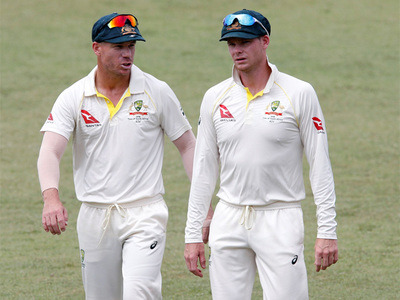
I actually think Warnie has written a thoughtful piece. He doesn’t minimise the actions of Steve Smith, David Warner and Cameron Bancroft, and he is asking for Australians not to over react.

“I am still trying to wrestle with what I think the punishment should be. They have to be harsh, but if they are rubbed out for a year, the punishment does not fit the crime.

Let’s take the emotion out of it. We are all feeling angry and embarrassed. But you need a level head and you shouldn’t destroy someone unless they deserve to be destroyed.

Their actions were indefendable, and they need to be severely punished. But I don’t think a one-year ban is the answer.

My punishment would have been to miss the fourth Test match, a huge fine, and be sacked as captain and vice-captain.”

smith


It seems though that Shane Warne has a thing for the word, ‘crucified’. In the lead up to the 2013 Ashes series he called for English batsman, Joe Root, to be crucified,

“They could be crucifying him”.

I’m pretty sure Joe Root wasn’t guilt of ball tampering. In fact, Warnie was simply doing what Aussie cricketers have a habit of doing, and that is, tossing a googly into the head of an opposition player: If I suggest that Root is vulnerable to our fast bowlers, then he might begin to think it also.

Warnie’s analogy couldn’t be more fitting, because this weekend happens to be Easter. On the very same day, on the Thursday, crowds had gathered at a courtroom in Jerusalem, and there they denounced an innocent man, and called for his crucifixion. The Roman Governor acknowledged the man’s innocence, and he tried to bargain with the mob.

15 Now it was the governor’s custom at the festival to release a prisoner chosen by the crowd. 16 At that time they had a well-known prisoner whose name was Jesus Barabbas. 17 So when the crowd had gathered, Pilate asked them, “Which one do you want me to release to you: Jesus Barabbas, or Jesus who is called the Messiah?” 18 For he knew it was out of self-interest that they had handed Jesus over to him.”

The plan backfired and Pontius Pilate was forced to release Barabbas and instead sentence the innocent man to death on a cross.

21 “Which of the two do you want me to release to you?” asked the governor.

“Barabbas,” they answered.

22 “What shall I do, then, with Jesus who is called the Messiah?” Pilate asked.

They all answered, “Crucify him!”

23 “Why? What crime has he committed?” asked Pilate.

But they shouted all the louder, “Crucify him!”

24 When Pilate saw that he was getting nowhere, but that instead an uproar was starting, he took water and washed his hands in front of the crowd. “I am innocent of this man’s blood,” he said. “It is your responsibility!”

25 All the people answered, “His blood is on us and on our children!”

26 Then he released Barabbas to them. But he had Jesus flogged, and handed him over to be crucified.” (Matthew 27)

When we Australians found out what our nation’s cricketers had done, we were angry and disappointed. They had not only broken the rules of our national game, they had failed us as a country, and made Australian sport a mockery around the globe. I’ve also noticed how this sad affair has driven to the fore of the nation’s consciousness the fact that there is a thing called right and wrong, and that right and wrong matters, and such a distinction exists even on the cricket pitch.

Easter is all about the innocent been crucified in the place of the guilty. What is right? No, and yes. The crowds persuaded Pilate to kill Jesus because they were vindictive and couldn’t tolerate what Jesus stood for. The idea that Jesus claimed to be God gave them an insatiable desire for blood. At the same time, God ordained the cross because he is loving and merciful. For you see, God made the world with purpose and design. There are rules, and everyday we break them. Should there not be consequences?

Easter demonstrated to the world that there is consequence and it is weightier than a 12 month suspension. But the God who exists is not only utterly holy and hates those who bend and break the rules, he also loves the very same people.

For Christ also suffered once for sins, the righteous for the unrighteous, to bring you to God. He was put to death in the body but made alive in the Spirit”. (1 Peter 3:18)

Shane Warne was right, we shouldn’t crucify someone who is undeserving, and yet that is exactly what Jesus volunteered to do.  Next time we talk about crucifying someone, perhaps we should also remember the One who was crucified for us.