Ellen DeGeneres is told to change her friends

According to The Age columnist, Robert Moran, progressives will now choose our friends. We don’t have to worry about making friends any longer because they have stepped in and will select suitable friends for each of us, that is, if you deserve a friend.

Ellen DeGeneres and I share little in common. For one thing, I’d prefer to watch the hands of a clock rotate around for an hour overviewing daytime television with Hollywood celebrities salivating over each other under the guise of ‘interview’. However, Ellen DeGeneres did and said something that I thought was refreshing and encouraging to hear, as did millions of other people.

DeGeneres was spotted sitting with President Bush at an NFL game last week. If that was bad enough, the two appeared to be enjoying each other’s company. Within a nano second, social media begun to meltdown again as left handed trolls shook their fists with rage.

The fact that Ellen DeGeneres is Hollywood and that she cuts a significant slice of the intersectional pyramid, wasn’t enough to save her from this social heresy. She has apparently betrayed her own, not just because she was caught being nice to a conservative politician, but she then had the gall to suggest it’s ok to be friends with people who don’t agree with you.

“Here’s the thing: I’m friends with George Bush…In fact, I’m friends with a lot of people who don’t share the same beliefs that I have.”

Writing for The Age, Robert Moran has joined the screechy chorus against Ellen Degeneres’ choice of friends.  Amidst the  air of superiority in which progressives hover over the rest of us mortals, Moran didn’t even bother to disguise his condescension toward those who differ from him,

“We all have that polite, otherwise lovable, friend or acquaintance who at some point mutters some off-colour remark about abortion rights, or immigration, or Soundcloud rap”.

I don’t even know what Soundcloud rap is. Is it that bad?

On the other hand, Moran wants to tell us about “Hollywood good guy, Mark Ruffalo”.

Moran counts the Incredible Hulk as a more suitable friend in life because lashed out at DeGeneres’ choice of friends. Ruffalo tweeted,

“Sorry, until George W. Bush is brought to justice for the crimes of the Iraq War, (including American-lead torture, Iraqi deaths & displacement, and the deep scars—emotional & otherwise—inflicted on our military that served his folly), we can’t even begin to talk about kindness.”

Doesn’t Gruffalo, sorry, Ruffalo realise that he isn’t a member of the intersectional pyramid, with all his whiteness and maleness and wealth? How can he forget rule no.1 in today’s society: he’s not allowed to question someone on the intersectional pyramid, even if he is as angry as the Incredible Hulk. Or does his eerie ability to turn green elevate him up a few spots?!  What is clear, both Hollywood and the media are a forgiving bunch, because Ruffalo’s object of disdain involved a Bush. The double standards and hypocrisy stand out more than an oversized green man smashing cars through downtown Manhattan.

This entertainment reporter  informs his readers that,

“Ellen needs new friends and, specifically, regular types”

“I’ve found Ellen’s uncomfortable misstep offers a useful reminder: not to “be kind to everyone”, but to be a Mark Ruffalo.”

Think about it. Surely, it is a sad state of affairs when journalists begin telling us whom we can and can’t be friends with. This is further evidence of how our culture has drifted far away from civility and sanity.

Thank you, Robert Moran, for telling a woman what kind of friends she ought to have. And it is so kind of you to remind us all “not to “be kind to everyone””! Upon short reflection I think I’ll take my cue from someone else.

One of the greatest privileges I have each week is to open the Bible and to tell people about Jesus Christ. Jesus expressed kindness to people who were unlike him. Jesus chose to be friends with people whom the cultural elites thought were unworthy of friendship. Jesus loved those who were unlikable, regardless of their station in life: a national leader or a wealthy businessman, a child, or a prostitute. As Jesus did so, his detractors retorted with similar moronic style, “‘Here is a glutton and a drunkard, a friend of tax collectors and sinners.’ They believed they were mocking Jesus, but how mistaken they were. Isn’t this the type of kindness we need more of as a society?

The Bible reminds me to “be kind to everyone”. Ellen DeGeneres has taken a note from this book (whether she realises this or not, I don’t know). Kindness is more powerful and more beautiful than the Hulk like impressions that clog up our newspapers and twitter feeds. Well done Ellen DeGeneres. Thank you for looking outside the glass pyramid and for sticking with friends who are unlike you.

Ridley College explains its position on marriage

A good news story has come out of Melbourne evangelicalism this week. In what may be a first, an Australian theological College has produced a formal statement about their position on marriage.


download.png

Ridley College in Melbourne has released a letter in which they affirm the biblical (or ‘traditional’) understanding of marriage. They explain the reason behind the decision to articulate the College’s position,

“Our purpose in writing this brief letter is to support our fellow Anglicans in wrestling with this issue by offering a summary of the scholarly discussion over what the Bible teaches on homosexuality, and an explanation for why we believe the traditional path on marriage and sexuality is the one that Christ is calling us to take.”

Ridley’s influence extends beyond the Anglican communion, touching denominations across Melbourne and indeed around Australia. Accordingly, this letter is an encouragement not only to Anglicans, but also to Baptists, Charismatics, Presbyterians, and others.

The document goes onto outline 3 primary views on marriage that are held by various people under the Christian umbrella. They explain why Ridley College rejects both the revisionist and the progressive view on marriage, and instead why they affirm the belief that “Bible teaches that sex is designed for marriage between a man and a woman, and that we should do what the Bible says”.

You can read the full letter here:

Two weeks ago I wrote about the mounting pressure on Christian organisations to either capitulate or accommodate to the current sexual morality. Many other denominations and leaders have chosen to defer or kick the can down the street, so to speak, as though avoiding the issue is dealing with the issue. Ridley College has chosen the third and only proper Christian option, faithfulness.

As the letter makes clear, Gospel fidelity doesn’t stand in opposition to love and grace, rather it is a rightly ordered expression of these virtues. Adhering to the classical understanding of marriage doesn’t diminish the beauty of the Gospel, but is a God-given reflection of the good news of Jesus Christ.

“We are convinced that the biblical vision for human sexuality is clear. We also believe that it is beautiful, and that God’s commands are for our good as well as for his glory.”

The letter opens by acknowledging that this no mere academic exercise for these scholars,

“We acknowledge that homosexuality is a difficult topic to discuss. This is not because the Bible’s teaching on marriage and sexuality is especially unclear, but because its implications are so deeply personal. We are Bible scholars, but we are also people. All of us have wrestled with God’s teaching on marriage on a personal level as it relates to those we love –  our children, our friends, those we pastor  –  and indeed to our own lives.”

The letter also rightly points out the wonderful example in our churches of same sex attracted believers, who have chosen fidelity and godliness over and above the narrative that is being fed to us in almost every part of the culture, and which is sadly becoming normalised within some of our churches and institutions. 

As I read this sentence, “The traditional path may be a hard one to travel, but it is the one we are called to take”, I was reminded of the College’s namesake, Bishop Nicholas Ridley. Almost 500 years ago, Nicholas Ridley taught against erring doctrine and practised what he believed was in line with Biblical Christianity. He did so in the face of severe opposition, which ultimately cost him his life. His famous example reminds the Churches that holding onto biblical truths rarely garners popular adulation, but it does prepare the soil for a Gospel harvest.

God honours faithfulness. I suspect that there will be some backlash as a result of this letter but isn’t that what the Lord Jesus taught us to expect as we follow him in this world? Faithfulness is almost always hard, and it may create some difficulties for us in the days ahead, but faithfulness never fails in the end.

 It gave me great joy when some believers came and testified about your faithfulness to the truth, telling how you continue to walk in it. I have no greater joy than to hear that my children are walking in the truth.” (3 John 3-4)

I am thankful to God for Ridley College’s public testimony in this letter. We can pray that other Christian colleges and institutions have the courage to follow suit.

The power of forgiveness

Amber Guyger is a former Dallas police officer who has been found guilty of murdering Botham Jean. The case became a national story because of the circumstances surrounding the crime, which included allegations of racism. Guyger is white and was a police officer; Botham Jean was an African American. Guyger shot and killed him in his own home—alleging that she had mistakenly entered the wrong apartment and thought he was a burglar.

Guyger has been sentenced to 10 years imprisonment. Many people outside the courtroom have decried the sentence, insisting that it is far too lenient. Inside the courtroom, another voice was heard, from the brother of Botham Jean, Brandt. He gave a statement where he forgave Amber Guyger and explained that he did not wish her any harm. He instead encouraged her to look to Christ. Brandt Jean looked at Guyger and told her that he loved her. He then asked the Judge if he could approach Guyger and give her a hug.

It is worth taking 4 minutes to watch and listen to Brandt Jean’s words. The weeping in the courtroom is palpable, with even the Judge wiping tears from her eyes.

According to CNN, shortly afterwards the Judge, Tammy Kemp, handed Guyger a Bible to take with her, saying,

“You can have mine. I have three or four more at home,” the judge said. “This is the one I use every day. This is your job for the next month. It says right here. John 3:16. And this is where you start. ‘For God so loved the world…'”

Out of evil and tremendous sadness has come an extraordinary act of grace and kindness. Brandt Jean’s actions in that courtroom represent the heart of the Christian message, which is about undeserved forgiveness and reconciliation.

The Gospel of Luke records while Jesus hung on the cross, he cried out, “Father, forgive them, for they do not know what they are doing.”

The Apostles’ echoed his words in their own:

In him, we have redemption through his blood, the forgiveness of sins, in accordance with the riches of God’s grace. (Ephesians 1:7)

If we confess our sins, he is faithful and just and will forgive us our sins and purify us from all unrighteousness. (1 John 1:7)

Christianity is often portrayed as being foolish, stupid and even evil.  In our wisdom, we have decided that we no longer require the teaching and habits of the Christian faith. Many of our cultural spokespeople are trying to banish Christian thinking from the public square, as if it were a virus that needed to be contained or inoculated-against. Certainly, some Christians give Christianity a bad wrap. Sometimes Christians forget what the Gospel of Jesus Christ is about. But what a timely reminder Brandt Jean gives both Christians and non-Christians of real Christianity.

The first Christians also knew about this tendency to forgetfulness. Paul once wrote:

Here is a trustworthy saying that deserves full acceptance: Christ Jesus came into the world to save sinners—of whom I am the worst. (1Tim 1:15)

Our world doesn’t need to hear less of this Divine forgiveness. In this age of constant rage and anger and malice, the message offered by Brandt to the woman who murdered his brother is both extraordinary and subversive and offers us a healing antidote.

The Psalmist captured the human condition well when he pleaded with God,

“If you, Lord, kept a record of sins,

    Lord, who could stand?

But with you there is forgiveness,

    so that we can, with reverence, serve you.” (Psalm 130)

I thank God for Divine forgiveness, and for the beautiful and powerful way in which Brandt Jean has today given this ancient Gospel renewed clarity and pertinence.


—————————————

Further extraordinary and beautiful scenes: here is the video of Judge tammy Kemp embracing Amber Guyger following the trial and giving her own Bible for Guyger to keep. 

A Corinthian Tale

Because I do not love you? God knows I do!” 

(2 Corinthians 11:11)


There are growing signs that the ecclesial weather is changing and our churches are not prepared.

As the broader culture becomes more insistent about its moral narrative, Churches have become less certain. Universities, media personalities, and political representatives vocalise a secular righteousness with increasing confidence, while ecclesial leaders pray that kicking the can down the street will do the trick.


P1017923.JPG

Last Sunday I preached on 2 Corinthians ch.10 at Mentone. The Church in Corinth was known as an ‘inclusive’ community: they had welcomed ‘false apostles’ into their midst and they had accepted members who followed the sexual ethics of the city. The Apostle Paul responded by pointing out that their accommodation didn’t strengthen Christian unity and witness, but rather they had caused significant harm to both these things. As he later exclaims, “you put up with it easily enough” (11:5).

The Apostle takes a very different posture to the one we are seeing many clergy adopt in the current climate. Instead of moral silence, Paul speaks up. Instead of accommodating heterodox ideas, Paul tackles them. He also explains his motivation for speaking up and calling out bad ideas; he wants to see the church built up (v.8) and the Gospel grow out (vv.15-16). He isn’t driven by bigotry and narrow mindedness,  it is love that galvanises him into action. Paul loves the Corinthians too much to simply hand her over to divisive and destructive ideas. For the Apostle, such de facto fellowship contradicts the identity of the local church,

“Do not be yoked together with unbelievers. For what do righteousness and wickedness have in common? Or what fellowship can light have with darkness?  What harmony is there between Christ and Belial? Or what does a believer have in common with an unbeliever? What agreement is there between the temple of God and idols? For we are the temple of the living God. As God has said:

“I will live with them
and walk among them,
and I will be their God,
and they will be my people” (2 Corinthians 6:14-17)


Over the past month, there have been developments regarding how Christian Churches in Australia are handling the issue of same-sex marriages. While the outcomes are yet to be determined, the signs are ominous and Christian denominations across the nation must discuss and decide how they are going to respond.

Wangaratta Anglicans 

The initial incident relates to the Anglican Diocese of Wangaratta. The Anglican Communion in Australia formally holds to the classical understanding of marriage. There are, however, some who wish to navigate around this by instituting ‘blessing ceremonies’ for same sex couples. In August, the Wangaratta synod voted to permit same sex blessing ceremonies for couples who have been married (67 in favour, 18 against, and one abstention). Retiring Bishop John Parkes led the way in calling for his Diocese to support the practice.

The Primate, Archbishop Philip Frier, responded to concerns raised among numerous Anglicans across Australia by referring the matter to the Appellate Tribunal. It is believed that this process may take many months, and the outcome is less than certain. Archbishop Frier asked that Wangaratta refrain from using their newly adopted service until after the Tribunal has looked into the case. Bishop Parkes subsequently agreed to delay, although I believe some kind of ceremony still proceeded over the weekend, following the very public wedding of two male Anglican priests.

Dean of St Andrew’s Cathedral and member of GAFCON Council, Australia, Rev Kanishka Raffel, referred to the move in Wangaratta as apostasy, the formal walking away from the faith. He asked, how can one bless (in God’s name) something God does not bless? Indeed, how can one invoke the name of Jesus for a union that Christ opposes?

The Archbishop of Sydney, Glenn Davies, noted parallels with the situation in Canada which gave rise to the breaking of the global Anglican Communion,

“The circumstances of this event are reminiscent of the actions of the Diocese of New Westminster in Canada in 2003. It is now universally acknowledged that those events were the beginning of the ‘tear in the fabric of the Anglican Communion’. Moreover, to claim the authority of our Church to carry out a service of blessing contrary to the biblical view of marriage and the doctrine of our Church will certainly fracture the Anglican Church of Australia.”

What will Churches decide?

We need to appreciate that this is not a merely theoretical or hypothetical question. No Christian denomination or Church in Australia can afford to play dodge ball with the marriage issue. As far as I can see, there are only three options available for churches and denominations: choose capitulation, accommodation, or faithfulness.

Most Christian associations will reject the first option. The second, however, is finding traction among some associations. For example, this was the approach adopted by the Uniting Church. But of course, accommodation is in reality just a politically correct and ultimately dishonest way of capitulating to the new sexual narrative. It demonstrates that either we don’t know what the biblical understanding of marriage is or that we don’t believe it’s so important that agreement is necessary for Christian fellowship and unity. It is this disingenuous compromise position that some Anglicans are also advocating.

Doing nothing is not a solution. To ultimately decide on inaction is a form of accommodation. In Victoria, at least one same sex wedding has already been conducted in a Baptist Union Church. There are at least a few Baptist Churches that have either already sanctioned same sex blessing services or are considering them. Further, recent events have once again demonstrated that there are clergy and churches who have no intention of giving up their cause. Davidould.net last week revealed the public stance of yet another Church, St John’s Toorak, 

“We deeply regret that at the present time, it is not legally possible for Anglican clergy to conduct marriage services for couples of the same sex. We look forward to the day when we will be able to do so. Until this legal problem is addressed, however, the clergy of St. John’s would be pleased to welcome any couple, including couples of the same sex, to have a service for the blessing of their marriage, including a renewal of vows, following a legal marriage conducted by a celebrant licensed to do so.”

Over the weekend the Anglican Bishop of Newcastle Dr Peter Stuart publicised intent to begin practising same-sex blessings, following approval by the Synod. In his letter he explained,

“Conversations about human sexuality

There is no doubt that these ‘Private Members’ Bills will cause anguish to some in the Diocesan community as well as being a cause of celebration for others. In a real way the debate that has being underway in the Anglican Communion for over 20 years, and is a very current debate in the Anglican Church of Australia, will be a live debate in the formal processes of our Diocese. Our engagement with and response to LGBTIQ+ Anglicans has been actively discussed for some time.

The Doctrine Commission of the General Synod has published a series of essays as part of this conversation (https://anglican.org.au/wp-content/uploads/2019/07/Marriage-Doctrine-Essays-Final.pdf)

I shared with the clergy recently a summary of the main standpoints of Anglicans that has been workshopped by Bishops Stephen Pickard and Michael Stead –

1. The church should exclude those with LGB identity because it is a sin

2.The church should encourage a person to repent of LGB identity and seek to live as a heterosexual

3.The church should fully and unreservedly welcome people who are LGB, but expect them to live in singleness and abstinence

4. The church should fully and unreservedly welcome LGB couples who live a celibate life

5.The church should fully and unreservedly welcome LGB couples who live in a legally

recognised civil relationship/same-sex marriage

6. The church should endorse a liturgy to bless the marriage/relationship of LGB couples

7. The church should solemnise LBG marriages as a religious marriage

All of these views are expressed within our Diocesan family and will be present within the Synod.I have written previously to the Synod about my experience of the National Meeting of Bishops. I am looking forward to Bishop Pickard assisting the Synod frame this significant conversation.

The Primate has already referred a similar regulation to

Blessing of Persons Married According to the Marriage Act Regulation 2019 from the Diocese of Wangaratta to the Appellate Tribunal. Should our Synod pass this regulation and/or the Clergy Discipline Ordinance of 1966 Amending

Ordinance 2019 it is likely, and to be welcomed, that the Primate would refer them also to the Appellate Tribunal. The combined processes of Diocesan Synods, the General Synod and the Appellate Tribunal over the next two years will fashion what is lawful in the Anglican Church of Australia and what approaches Diocese’s will take.”

It is clear how Peter Stuart wishes to proceed. The argument is simple, effective, and completely misses the point of Christian praxis. To summarise,  the suggestion is,  given the diverse opinions within a denomination it is only appropriate that freedom is given to clergy and churches to practice whichever position they see fit. It’s as though Peter Stuart read Judges 17:6 and mistook it to be an endorsement!

“Everyone did what was right in his own eyes.”

The longer Christian associations kick the can down the road, the harder it will be to pick it up. The Church should never be treated in such a reckless way. She is precious and holy to God. Delaying or wishing away difficult decisions will only result in further confusion and harm. Not only this, these matters relate to real people who are made in God’s image; to offer them misleading hope and blessing amounts to a grave betrayal of trust and truth. By following the Gospel, our churches ought to be safe and welcoming communities for people who don’t identify as heterosexual. As people who have ourselves experienced sexual brokenness and sin, and have come to know God’s love and mercy in Christ Jesus, how can we not embrace others? But blessing that which God does not bless is not loving our neighbour but is performing the worse kind of misrepresentation.

Of what use is a doctrinal statement if churches can freely ignore or reject articles without consequence? Of what benefit is a definition of marriage if churches and pastors can circumvent the rules and pursue alternate avenues without disciplinary procedures both defined and enacted? These clergy and churches have either broken fellowship or they have not.

If a pastor or Church no longer subscribes to the theological convictions of the Church/denomination surely it is a matter of integrity that they resign and leave the Church and/or denomination. If they refuse, surely it is the responsibility of the broader fellowship to call them to repentance, and should they persist in their views, they ought to be disaffiliated. 

To borrow Paul’s analogy in Ephesians ch.4, our associations are becoming like ships without a rudder, being blown and tossed about by whatever cultural wave is currently landings on the shore. The difficulty is, in the face of intense cultural conditions and fears of losing people and especially money, many leaders don’t want to touch the rudder. In the meantime, the ship is getting beaten up and the Sirens of Sirenum scopuli are luring churches closer to the rocky shoreline.

Will not God honour the faithfulness of his Church? Will God be displeased if we choose his good design? Choosing faithfulness is unlikely to win over many fans among the cultural elites but why should we allow their agenda to determine our actions? It may be counter-intuitive in today’s climate, but remember, Christian sexual ethics was also foreign to First Century Corinth. Paul makes the very point to the Church in Corinth that trusting and living out Christian sexual ethics will not detract from Christian unity and Gospel growth; the opposite is the case. The Church will be built up and the Gospel will grow out (2 Cor 10:8; 15-16).

Will our churches choose faithfulness over accommodation. Do we desire Gospel unity over religious diversity? We can’t predict how everyone will respond, whether those inside our churches or in the community at large, but we can be assured that God will honour the faithfulness of his people. 

Composers according to the month

Obviously, this is for life in the Southern Hemisphere!

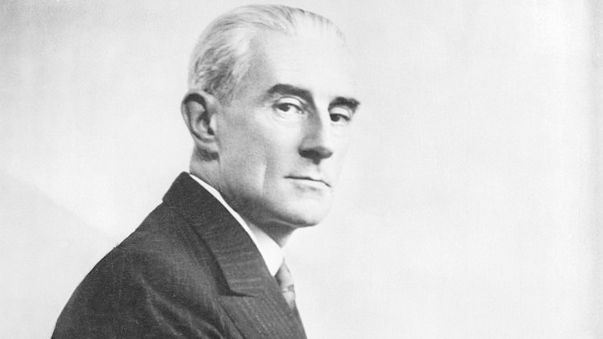
maurice_ravel.jpg

Composer of the month


January: Debussy

The height of summer requires La Mer and La fille aux cheveux de lin. What better way to relax on a hot afternoon than to sit outside with a cool drink, a book, and with Prélude à l’après-midi d’un faune playing in the air.

February: Tchaikovsky

The month for outdoor concerts and that means big sounds and large orchestras

March: Mozart

Serious music to engage the mind for serious work and to spur on imagination and creativity

April: J.S Bach.

Easter. From heaven and looking back to the heavens

May: Rachmaninoff

The Russian steppe always looks wintery. Rachmaninoff’s melancholy prepares the bones for the winter ahead

June: Bach again

A Well Tempered Clavier and 200 Cantatas defrost the brain, like a decent cup of coffee

July: Shostakovich

If Shostakovich can write astonishing music in the middle of a Soviet winter, then there’s hope for us all

August: Beethoven

Angry at winter? Listen to a Beethoven sonata. Fed up with the white noise of twitter? Choose a Symphony and turn up the volume

September: Ravel

Spring is here and Ravel unleashes a warm hope

October: Stravinksy

Who doesn’t want to dance in October? (metaphorically of course!)

November:  Chopin

One upon a time November meant music exams, hence, lots of Chopin. These days Chopin is for reminiscing, looking to the past and looking forward to holidays

December: Christmas Carols of course!

Which Story of Children will our Society Esteem?

The way our society treats its children is a reflection of the gods we make and worship. The gods of Sepharvaim had an insatiable appetite in Ancient Babylon, requiring the sacrifice of the young. The Valley of Benn Hinnom, just outside Jerusalem, was a place of liberation in the Eighth Century BC. Children were offered up to the gods as a means to find personal freedoms and prosperity.  More revealing, the mistreatment of children is a sign of decaying society and failing religion.

Will we never learn the lessons from the past?

Two stunning revelations have been made over the weekend and yet neither are being reported by most Australian media. Truth and moral good ought to be relevant to our television news producers and newspaper editors but some truths are inconvenient to the prescribed narrative.

First of all, an interview went viral on social media with a BBC journalist being visibly shaken by the confessions of an abortion doctor in the United States. Not only did DR Leroy Carhart freely admit that the babies he kills are children, but he also explained how he refers to them as children in front of his patients. There is no hiding behind the disingenuous rhetoric of babies being a clump of cells or foetuses. When pressed about late term abortions, ‘does he perform abortions up until 38 weeks…39 weeks…’, he refused to answer.

Second, one of Australia’s major providers of abortion has acknowledged that they have no issue with gender-specific abortion. Phillip Goldstone, who is the Director of Marie Stopes, stated in a submission to the NSW Government’s inquiry into abortion,

“We do not support the inclusion of gender selection in the Bill and we strongly caution against amendments to the legislation as the issue of gender selection and termination of pregnancy is not grounded in evidence.

Further public debate or amendments on this issue has the potential to discriminate against multicultural and diverse communities in Australia and would unfairly target people who already face barriers in accessing abortion care.”

The narrative that our newspapers are presenting is that abortion is:

  1. The very difficult decision being made by courageous women
  2. Late term abortions are rare
  3. Gender selective abortion isn’t an issue

The problem with points 2 and 3 is that they are simply not true. What constitutes rare? 500 babies per annum? 300…200…100? Does rare constitute unimportant? I certainly hope not.

After the Bill passed the Legislative Assembly last week, Premier, Gladys Berejiklian, spoke up on the issue of gender selective abortion, suggesting,  “Everybody regards that as an abhorrent practice.”

Her words echo about the chamber that has just refused an amendment that would have prohibited gender selective abortion. The Assembly refused to protect vulnerable girls in the face of not only a moral imperative and commonsense but did so with evidence coming from Victoria that reveals gender based abortion is a fact in Australia. In Victoria, girls are more likely to be aborted than boys. And as Phillip Goldstone has made clear, this should be a viable option for women. The Sydney Morning Herald interviewed Dr Goldstone last week but failed to ask him about why he refuses to back amendments that would ban gender selective abortion. 

It is astonishing to see that as the facts surrounding abortion come to light, notable social commentators and reporters, and even politicians, simply suppress or explain away and even ignore what is true. The truth is ghastly. It is truly horrendous. It is the determined killing of children with full knowledge of what is happening. What is more telling about a society’s soul than the way it treats children?

There is one truth that the media have conveyed, and that is how for many women, abortion is a moral dilemma. Circumstances surrounding pregnancy can be extremely difficult. We can empathise and we can help write a better story that shows good coming from choosing the harder road. There are organisations whose sole purpose is to care for and support women through unplanned or difficult pregnancies. There are many local churches who already support women through such situations, and gladly so. Australia has its Ahazes but also its Boazes and Josephs.

We ought to recognise and speak of the life supporting options and good that is found in local communities. The media’s commitment to facts, or lack thereof, reflects what they believe the public wants to hear. The media’s choice of storytelling reveals something of our society’s heart. Our politicians’ decisions speak back to us our own moral inclinations. What does our behaviour toward children suggest?

As a Christian, I like to give God the last word. In the 8th Century BC when the Valley of Benn Hinnom (known in the New Testament as Gehenna) was the scene of continual fire and burning of baby’s bodies, the righteous judge offered an extraordinary word of mercy. Even as I write I’m aware that some readers are going to ridicule these words with all manner of interesting and colourful language, but there is always someone for whom the crap in popular rhetoric doesn’t sway. Imagine a God who sees our choices and understands them and is appalled by them and yet offers redemption?

“I have made you, you are my servant;

    Israel, I will not forget you.

I have swept away your offenses like a cloud,

    your sins like the morning mist.

…Return to me,

    for I have redeemed you.”“This is what the Lord says— your Redeemer, who formed you in the womb: I am the Lord, the Maker of all things, who stretches out the heavens, who spreads out the earth by myself, (Isaiah 44: 21b-22;24)

The Premier and an Archbishop and a Mediating Baptist

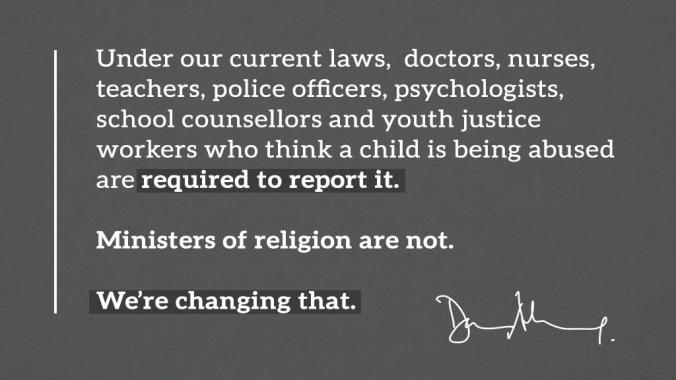
A war of words has broken out between the Victorian Government and the Roman Catholic Church. The Premier is bidding to outlaw the seal of the confessional while Catholic hierarchy is defending it as sacrosanct.

EB6VI9IW4AAsHQa.jpeg

First of all, I need to note an important correction to the Premier’s statement. Most ministers of most churches are required to report suspected child abuse, according to the rules of their own denomination. Indeed, mandatory reporting is practiced by Baptists across Victoria (and indeed, around the nation) and we want this to be the case. Even if it was not mandatory, we would still report suspected child abuse. It makes no sense not to do so.

The Confessional

Canon law states that”The sacramental seal is inviolable; therefore it is absolutely forbidden for a confessor to betray in any way a penitent in words or in any manner and for any reason.”

Any priest who breaks the seal is automatically excommunicated from the church. Only the Pope can overturn this.

Melbourne Catholic Archbishop Peter Comensoli has come out and said that he would prefer to go to jail than break the seal of the confessional. While saying that he would encourage an offender to go to the police, he wouldn’t break the seal if they refused to do so.

At the moment I think both Archbishop Comensoli and Premier Daniel Andrews are missing the mark.

On the one hand, I commend Daniel Andrews for taking further action on this terrible issue. And yet his rhetoric about putting ‘children first’ rings a little hollow. There are those in the community who are concerned for all children and aggrieved by the fact that vulnerable children become hay in politicking. The Premier’s record demonstrates that he often puts ideology first. For example, he ensured that an amendment to the Abortion Law Reform Act was defeated, a step which would have protected children from late-term abortion. Also, the rebirth of the birth certificate bill puts children at risk. In 2016 he introduced an amendment to the Equal Opportunity Act which would have stripped religious organisations, schools, and churches, of their freedom to insist that employees adhere to the doctrinal and ethical convictions of their religious institution.

At the same time, the issue of child sexual abuse has exposed a theological flaw in Catholic dogma, as well as a moral one. The Confessional grew out of an inflated and unbiblical notion of the priesthood. One could enter into a long discussion here about the historical and theological premises the lay behind the seal of the confessional, but in short, this is not a practice encouraged by or mandated in the Bible. Indeed, it clearly conflicts with the teaching of the New Testament Church.

“For there is one God and one mediator between God and mankind, the man Christ Jesus,” (1 Timothy 2:5).

No priest can absolve another person’s sins, let alone their own. We can certainly confess our own sins to those whom we have offended and to ask for their forgiveness. There is a place for corporate confession to God. But no priest can represent God and absolve another’s sin. We can listen to others and offer advice, but we cannot stand as Divine judge over a person and officiate Divine forgiveness or judgment. 

As a member of the community who is not Roman Catholic, one of the things that continues to concern me is how Archdiocese’s rhetoric continues to signal the wrong message; namely that they do not truly take child sexual abuse seriously. As a father of three children, this sickens me and makes me empathise with those who no longer trust religious institutions. I wish to say that the real Jesus is safe and good, and many churches are safe and wonderful places to investigate and come to terms with the greatest realities of life. But this immense positive is often lost in the face of due public scrutiny of institutions who have failed our children.

The Conscience and the Government

As I consider the debate, there are broader questions that should not be ignored. We mustn’t overlook for example these two further considerations: the conscience, and the role of Government. The conscience of individuals is important, even when we disagree with their religious views. The conscience is, of course, not God or infallible The Bible acknowledges that the conscience can be seared as with a hot iron (1 Timothy 4:2). However, we should be slow to stamp our own conscience on others.

We must also be wary of Government intrusion into religious practices. Do we really want Government dictating what are and are not valid religious convictions? I am not supporting the Roman Catholic Church’s position; I find it reprehensible. But neither do I believe it is right or healthy for the Government to interfere with a church’s traditional teaching. The issue is further complexed because Daniel Andrews is right in suggesting that religious leaders are not and should not be outside the law. In my view, both Mr Andrews and the Catholic Archbishop are throwing speech bombs at each other rather than working toward a solution.

A potential solution

Perhaps the most sensible solution that I have seen thus far comes from the words of a progressive Muslim, Waleed Aly. I don’t think it’s foolproof by any measure, but at least it is an offering in the right direction In 2018, writing for the New York Times, Aly rightly notes that a law, such as the one being proposed today, will fail because the consequences facing a priest who breaks the confessional are far greater than those imposed by the State. In addition, given the nature of the confessional, it is unlikely that those sealed revelations made by abusers will be uncovered by authorities.

“the royal commission reported on testimony from several priests who said, in the words of one, that a priest hearing confessions “has always been required to have at least ‘moral certitude’ of the penitent’s contrition and purpose of amendment before granting absolution.”

Accordingly, the commission’s said that “a priest can defer granting absolution until the act of satisfaction” has been carried out. For example, the report says, a confessed abuser would not be forgiven by a priest unless he reports himself to the police. Several priests told the commission that this is exactly what priests hearing confession should do.

This approach is far more likely to curtail reoffending than any attempt to compromise the institution of the confessional. It certainly addresses the commission’s finding that the easy availability of absolution contributes to reoffending. It would increase the likelihood that abusers will go to the authorities since it is the only way they can receive forgiveness.

And since keeping the state out of the confession booth wouldn’t require priests to commit an excommunicable offense, it is far more likely to be applied than a law that extends mandatory reporting into the confessional booth.”

Waleed Aly has offered an alternative, which may work. This position will remain distasteful for many Christians because it upholds a practice that undermines the sole and sufficient mediatorial work of Jesus Christ. This is an unnecessary tradition and one that gives false assurances to those who make use of the confessional. The confessional remains a box in which a man presumes the role of God. At yet, could Aly’s proposal allow conscience to be preserved and hold back undue Governmental interference into religious doctrinal matters?

I am calling on the Melbourne Archdiocese to re-evaluate their unsound and unethical practice of confessional seal. And I call on the Government to work harder to provide a workable and important solution to protect our children. Indeed, much good has come from this evil in recent years and I pray that we continue on this road.

Growing Concerns over treatment for children

Self-identifying genderism is perhaps not so free. The Australian has published a series of articles that should concern parents across the nation, especially those living in Victoria.

Last week Cricket Australia announced that men can now play for women’s teams, so long as their testosterone levels remain below 10 nanomoles per litre continuously for 12 months or more

Screen Shot 2018-11-12 at 10.01.37 am

Last week the NSW Legislative Assembly passed legislation that not only decriminalises abortion but will permit late-term abortion and gender-selective abortion. The latter proves the idiocy under which our society now governs the definition of sex and gender. We are being told that a penis and vagina is no indication of what constitutes male and female, and neither can xy or xx chromosomes. And yet, a woman is being given the legal right to terminate a pregnancy based on the biological assumption that the baby is a girl or boy. The Spectator last week published a telling cartoon in which a baby girl in the womb is crying out to the doctor who is about to kill her, ‘Stop, I identify as a boy’.

This week the Victorian Parliament is debating legislation which will allow boys and girls to change the gender on their birth certificates without needing sex reassignment surgery. A person does not even require a signed letter from a medical practitioner or psychologist as evidence that the person believes they are a gender that differs from their biological sex.

There is a dangerous shift taking place in our culture, one where children are victims to unscientific social engineering. As a Father with 3 children, this movement toward initiating hormonal therapy and sex reassignment surgery on children is staggering in its myopic vision and ethical bullying.

According to a report in The Australian, since 2014, 2415 children have been referred for medical gender treatment in Australia. There has been a 41% increase in cases in Victoria, which coincides with the introduction of the Safe Schools program, and with Dr Roz Ward and others encouraging gender transition inside local schools across the State.

Bernard Lane explains,

“Girls as young as nine are ­believed to be put on “puberty blocker” drugs, and boys from about 11.”

The article also notes growing concerns amongst paediatricians. Professor Whitehall said, “Who gave ethics approval for this treatment (at children’s hospitals) when it lacks any scientific basis and therefore is an experiment?…We should give the psychiatry and psychology a full run before we start castrating children.”

Of course, ideology always influences political and societal thinking, and the medical fraternity is not immune to this. Most doctors have integrity and only give advice to patients based on best knowledge and practice, but neither are they free from social pressures being applied by ideologues who are intent on cutting away all residue of the biological and traditional understanding of men and women and the social structures upon which we build communities. Bernard Lane notes that in the United Kingdom, lobbying from transgender groups is “contaminating clinical decisions”. Also, doctors in Australia are afraid to speak out on the issue because of the possibility of professional ostracisation and job loss.

The fact that there is a significant rise in gender transitioning where Safe Schools is most prevalent, raises questions. Is there a correlation?

Also writing in The Australian, Jennifer Oriel today has further justified concerns. She begins,

“castrating children” is the phrase used by pediatrics profess John Whitehall to describe unscientific experimentation on youth in the name of transgenderism.”

At the very least, these revelations should cause us to pause and investigate the claims being made.

In the normal state of affairs, the kind of psychological and physical intrusion being thrust upon these kids would amount to abuse. They are crying out for help, but not short term and potentially devastating manipulation of their bodies. This is also likely to cause long term harm to children, not least because most gender dysphoria children will want to identify with the birth sex by the time they reach adulthood.

In raising the subject we must not cast dispersions onto these children or onto transgender people. As I have said on many occasions, all people have inherent dignity and worth, and we are to love and care for them no matter their sex and gender. That does not, however, indicate that every social decision is healthy and good. This doesn’t entail that every choice made by an individual is right or beneficial. However, those responsible for pushing this new wave of gender ideology ought to be held to account. Those who have jumped on board legislations that will inevitably harm children, have a duty to pause further amendments to the law. Instead, the wellbeing of our children demands that the concerns of medical experts are heard and steps are taken to investigate what is now taking place in our schools and in some clinics.


Here’s one example of a recent article with a psychologist expressing concerns  – https://t.co/JDW3s4Bt8d?amp=1

NSW loses its moral impetus

It was only a few months ago that the public was shocked by words and sights coming from the United States. New York City lit up the night sky in the colour pink to celebrate the passing of abortion laws.

Virginia Governor, Ralph Northam, made the suggestion that the life of a newborn child can be legitimately ended if that is the wish of the mother and attending physician.

“If a mother is in labor…the infant would be delivered. The infant would be kept comfortable. The infant would be resuscitated if that’s what the mother and the family desired, and then a discussion would ensue between the physicians & mother”

Similar words and images are now home in New South Wales.

In an attempt to curb the cruellest edges of legislation that will decriminalise abortion in that State, several amendments were presented and voted down. One of these amendments asked that babies who are born alive following a botched abortion (as can happen) must be given due medical attention. The majority of MPs voted against the amendment, arguing that a living boy or girl can be killed or left to die outside the womb. This is legalised infanticide.

EBcKJEuUwAANza2.jpeg

Tweet by David Ould

As the extreme abortion laws were passed in the New South Wales Parliament House last night, the Sydney Morning Herald ran with the headline, “Cheers and Applause as lower house votes to decriminalise abortion in NSW”.

Assuming the Bill will also pass the Legislative Council, will the Sydney Opera House and Harbour Bridge be lit in the colour pink? Will Macquarie street be filled celebrations? Last night’s laudable triumphs in the halls of Parliament suggests that this may indeed occur. It is one thing to vote to take innocent human life,  but it is unnecessary and gross to celebrate it.

As a Victorian, living in a State that already has such ignominious laws, I weep for my NSW friends today.

Australia in 2019 has become a strange and disturbing land in some respects. For example, logic rarely wins debates in our culture. Scientific facts are unlikely to move a person’ position. What is obvious can no longer be stated as such. The most basic observable units of reality are contested. If the acknowledged humanity of a person does not suffice for offering protection and rights, we have indeed walked off the precipice without a rope. What is true no longer matters and what is good is an unwelcome obstacle to personal choice: I have become god and there is no other. This rampant individualism comes at a cost, and the cost today will be the lives of 10,000s of young children, many who will be aborted because they are girls or because they may suffer some kind of physical or mental disability.

In many of life’s unimportant measures (food, sport, and everything else) Victoria runs ahead of NSW. But when it came to those all-important ethical subjects, NSW often stood tall when Victoria turned south. Sadly, NSW has now followed Victoria and the other Australian States in losing its moral authority. Indeed, many Churches have already overturned their moral voice because of deep-seated sins. How can a society speak of defending life and humanity when we are bent on destroying the youngest and most vulnerable of lives? Our voice has become shard, an empty and hypocritical shrill.

I am not suggesting that there are women who aren’t in heart-wrenching circumstances. Not for a second am I whitewashing real and difficult situations that face some women when falling pregnant. A loving society would gather around them and support them. In Victoria there are many churches who would open their arms to help these women; I have seen this with my own eyes. There are organisations, such as the amazing The Babes Project who assist pregnant women who are struggling to decide whether to keep their child or not. Governments could invest in such positive community agencies rather than turning to the awful alternatives.

The passing of the abortion Bill in the Lower House will create some big winners in NSW and many losers:

The big losers:

– 10,000s of young children every year

– Children with disability

– Young girls

– Mothers

– Fathers

– Society who will never see the contributions of these little ones whose lives are cut short.

The big winners:

– Men who don’t want the responsibility of caring for their children

– Abortion Providers


Before anyone retorts, but you’re a man, you shouldn’t have a voice on this women’s issue, let’s remember that the Bill’s chief architect is also a man, Alex Greenwich. Why hasn’t he been told to keep his nose out of women’s affairs? The reason is obvious, he supports the decriminalisation of abortion, that’s why? Men have a role to play in the making of babies, and most women believe that men have a responsibility in raising children; I agree. Of the children who are aborted, thousands are little boys. It is surely incumbent upon men to speak for women’s health and dignity as well as the health and dignity of the unborn.

In the days of Ancient Rome Christians found and took in unwanted babies who were left on hillsides to die of exposure. In 18th Century England, Christian groups opened orphanages to care for children whose parents couldn’t support them. Churches can once again open our eyes to needs in our communities and find ways to support and love women who are facing an unwanted or difficult pregnancy. How can we put away the platitudes and open up our hearts to them? Society has lost its way, but the imperative remains for us to live like the Lord Jesus. How can we sacrifice and present a better way forward, for the good of women, the life of children, and the health of our society?

As a Victorian, I pray that NSW will not follow our lead

As a Victorian, I am praying that NSW will not follow our lead.  This week NSW Parliamentarians have begun preparing to debate and pass legislation that will legalise abortion in NSW up until birth. This is a sickening idea, and it is incredibly sad to see the Premier State losing its way, even with some conservative MPs advocating for the legislation.

67345232_10158734464874447_1969001540370825216_o

I am all too aware of these debates, with my own State passing the most progressive abortion laws in the country over a decade ago. As a Pastor, I have seen the pain and guilt on women’s faces as they struggle with their past having had abortions. I have also seen women come to know the beautiful and powerful grace of a forgiving God.

In  2016, then member of the Victorian Legislative Council, Rachel Carling-Jenkins, presented a Bill hoping to overturn a 2008 law which legalised late-term abortions.

The law allows women in Victoria to have an abortion after 24 weeks of pregnancy, right up until the time of birth. All that is required is for two doctors to give approval.

The Abortion Law Reform Act 2008 stipulates that late-term abortions are permissible so long as two medical practitioners “reasonably believe that the abortion is appropriate in all the circumstances”. “Circumstances” is defined as the medical practitioner having regard to

“(a) all relevant medical circumstances; and

(b) the woman’s current and future physical, psychological and social circumstances.”

The Bill was defeated 27 votes to 11.

At the time I did not engage in the conversation. Perhaps I was busy. Maybe I was focusing on other matters of importance. I remember a debate taking place in Parliament but to my shame, it wasn’t on my radar as it ought.

If there is one thing I have learned over the past few years is that evil doesn’t slow down its agenda simply because we are paying attention or not paying attention. No one can address every act of immorality and speak to every grave issue facing the world; we need an omnipotent and loving God. However, when we can speak, should we not give voice to those who cannot speak for themselves?

Societal shift on abortion has been swift. In the space of three years, we’ve witnessed the culture move from justifying abortion to celebrating abortion, from permitting the practice during the early weeks of pregnancy to licensing third-trimester abortions, even when these very same infants could survive and live outside the womb.

Understand, these laws are not about saving the life of the mother, for, in such rare and terrifying circumstances, the life of the mother is surely and already prioritised. The aim in those rare situations is not to kill the child but to save the life of the mother. This is far from where the abortion argument now finds itself. The newly adopted law in New York State, the proposed Bill in Virginia, and the current practice in Victoria where I live do not require the mother’s life to be at risk. The grounds are,  can she persuade a doctor (in Victoria the law requires 2 Drs) that she no longer wishes to keep the pregnancy. As the harrowing video reveals, this decision can be made as late as during labor.

According to the Victorian State Government’s health website, in 2016, 14.9% of all perinatal deaths in Victoria were accounted by abortions for “maternal psychosocial indications”. 40.32% of all late-term abortions (from 20 weeks) are for “psychosocial” reasons, meaning there is nothing wrong with the baby or physical health of the mother.  Please note, my understanding is that these numbers include terminations that occurred in hospitals and does not include abortions that take place in clinics.

If the pronouncements of these lawmakers aren’t enough to turn the stomach, Virginia Governor, Ralph Northam, made the suggestion earlier this year that the life of a newborn child can be legitimately ended if that is the wish of the mother and attending physician.

“If a mother is in labor…the infant would be delivered. The infant would be kept comfortable. The infant would be resuscitated if that’s what the mother and the family desired, and then a discussion would ensue between the physicians & mother”

This is not a slippery slope, this is the natural outworking of an ethic without God. This is the world of Peter Singer. 20 years ago many people sneered at some of Singer’s views and found them repugnant. Today, much of his thinking has become the norm in Western countries. His utilitarian thinking supports the killing of lesser human beings, those who are disabled and are considered less than fully functioning. Singer’s arguments supporting infanticide are now finding their way into mainstream politics and legislative agendas. Have we not learned from history? Are not past stories of the mass killing of innocence enough to steer us from ever going there again? The answer is, no. Our civilised and progressive societies are eager to venture into those dark hellish places once again.

What makes our society even more culpable than past societies is that we are committing the same sins but with greater knowledge and with greater ability. Modern knowledge reveals truths about how babies are formed in the womb, things that were once believed but could not be seen until the invention of ultrasounds. We can see the heartbeat of a baby in the earliest weeks. We can delight at a child’s fingers and toes growing at 6 weeks. We now know that babies can hear and respond to music by 16 weeks; the next Mozart is already learning to feel and marvel at the beauty of sound.

Medical advancements give us unparalleled ability to care for both mother and child, to even perform surgery on a baby while it is in the womb. When these little ones surprise us by coming into the world early we have the know-how to save the lives of these children as young as 22 weeks.

This is a grotesque reality in which we live: despite superior knowledge of human life in the womb and superior medical technology to save life, our commitment to destroying life has also increased.

I suspect some readers will respond with partial agreement; you dislike late-term abortions, but you don’t have a problem with ending a pregnancy during the first trimester. This is not an uncommon position to hold.

May I respond by asking you this question, at what point can we draw an absolute moral line? At what point can we justify the moral shift from being okay with killing the child to believing it is not okay?  Is the moral threshold when the baby begins to feel pain? Is it the moment cognitive awareness starts? Is it the week when their limbs have formed? Is it the moment the heart begins to beat? There is no ontological moment during a pregnancy at which we can argue, at this stage, it is okay to abort a child.

This needs to stop. Members of the NSW Parliament, please do not lead your State down this deadly and awful path.

I understand that this issue is very real and personal for many women in our society. I don’t want to ignore the pain and guilt thousands of women experience following an abortion. To them, I say, there is the hope of forgiveness and renewal for those who seek it.

How different is the answer that we find with the God of the Bible. The Bible insists that every human being, from the moment of conception, is precious and made in the image of God. Gender, age, health, mental faculties, physical appearance, do not detract from a person’s inestimable worth.

Jesus loved the unwanted. Throughout his three years of ministry, Jesus was known for befriending and caring for those whom society thought little and had often neglected. No one was too insignificant for him to take interest in and show love.

On one occasion we are told,

“A man with leprosy came and knelt before him and said, “Lord, if you are willing, you can make me clean.”

Jesus reached out his hand and touched the man. “I am willing,” he said. “Be clean!” Immediately he was cleansed of his leprosy.” (Matthew 8:2-3)

Jesus didn’t stop there, the extent of love that God demonstrated was found on a Roman cross, where the Son of God sacrificed his life for the salvation of others.

“Surely he took up our pain

    and bore our suffering,

yet we considered him punished by God,

    stricken by him, and afflicted.

But he was pierced for our transgressions,

    he was crushed for our iniquities;

the punishment that brought us peace was on him,

    and by his wounds we are healed.” (Isaiah 53:4-5)