One of the largest memorial services in American history has just concluded.
Whether we approve or not, whether we are invested in the story or not, the assassination of Charlie Kirk has dominated the news cycle and continues to do so today, with his memorial service taking place in Glendale, Arizona.
The papers and social media are speaking about very little else. It’s not that this is the only thing that matters today, but there are moments in history that capture the public imagination in ways that coinciding events do not.
It’s clear that there were two narratives running through the memorial service, and we mustn’t confuse them as being the same or necessarily belonging together. I want to pull apart the politics that were present and the gospel that was also present.
Several members of the Trump administration spoke, including the President. Donald Trump gave a speech in which this line has already gone viral,
“He [Charlie Kirk] didn’t hate his opponents. He wanted the best for them – that’s where I disagreed with Charlie. I HATE my opponent and I DON’T want the best for them.
I suspect the President said these words with a certain tongue in cheek. He was bringing a moment’s levity to what was a very sombre occasion. At the same time, that does seem to be his modus operandi. But of course, Trump’s words are not his alone; this is the norm and assumed posture across religions and ideologies and politics. Whether it is fascist or anti-fascists or left or right, and most of the middle, we think ill of those who disagree with us. That the President is saying so with knowledge of the truth isn’t laughable, it’s woeful. Doubling down on hate doesn’t resolve the growing friction and factions that are disintegrating our societies. That leaves us with a game of power where the loudest, fastest and strongest aim to take charge and impose their will on the rest of us.
Trump, the ever populist and pragmatist, may well use whatever movement that helps maintain momentum. That’s a problem, as it was when previous American presidents co-opted Christian language and concepts to promote their own ethics and agendas.
On Saturday, I gave a lecture at the Reformed Theological College, where I outlined 3 principles for doing public theology:
Don’t conflate Church and state.
Don’t confuse common grace with particular grace.
Understand both the common good and the eternal good.
Christian pundits, commentators and pastors would do well and serve our congregations and the unbelieving public by recognising and practising those distinctions. Of course, the differences are not always perfectly clear and it is true that the gospel of Jesus changes every part of us, but nonetheless, we will do well to avoid those trappings. Why? In part, because the gospel is too important to be confused or co-opted by red or blue or green.
Merging the Christian faith with politics is fraught with dangers, and that’s true across the political spectrum. If you think that your particular position is exempt from that rule, that only exemplifies the very problem. It doesn’t mean every political ideology is equally true or good or respectable. Of course not. How we value the unborn really does matter. How we view migrants and the poor matters. And many other topics.
As I said earlier, two narratives were present in the memorial service, and it is the second one that I hope shines the most.
Charlie Kirk’s pastor, Rob McCoy, gave a clear presentation of the good news of Jesus. He said.
“Charlie knew … at an early age … he entrusted his life to the Savior of the World. . Jesus came to this earth, was tempted in all ways, yet was without sin, was crucified upon the cross…”
“His blood was poured out because blood must be shed for the remission of sins…And His death upon that cross was sufficient for all the world’s sins, but only efficient for those who, like Charlie, would receive Him as their Savior.”
Can we say an Amen to those words?
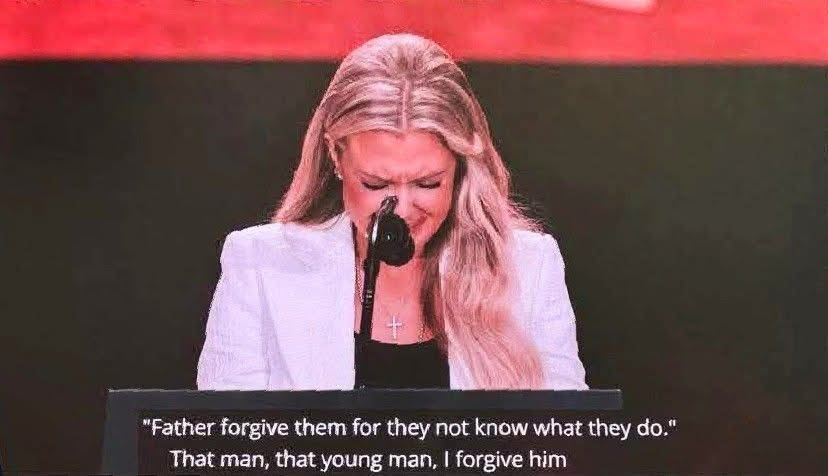
Erika Kirk then addressed the crowds and uttered the impossible word,
“I forgive him…I forgive him because it was what Christ did, and it is what Charlie would do.”
“The answer to hate is not hate,” she said. “The answer we know from the gospel is love and always love – love for our enemies and love for those who persecute us.”
This is the message our polarised world needs to hear. I thank God that God has not judged me according to every word I have said and every thought I have entertained. I am eternally thankful to God that he forgives sinners such as me. And grasping this gospel does something to us, where Trump’s words disappear and where love and forgiveness take shape.
What is so sad and troubling is that I know our culture well enough to see how this is going to play out in the media and social media: most people will simply double down on their prior commitments and attitudes. People are so entrenched in their ideological preferences that we will read the room as our glasses are glued onto our faces, and we are unable to see any other perspective. MAGA supporting Aussie conservatives will criticise me for my posture here and progressive Aussies will criticise me for not damning Charlie Kirk to hell alongside the President.
Reality is almost always more complicated and nuanced. One does not need to elevate Charlie Kirk to the status of Stephen (Acts 6) or label him ‘ult right’. The Christian truth is that sinners are saved by grace alone on account of the perfect sacrifice of Jesus alone. Anything else is hubris.
Here is a thought: regardless of our political leanings, if God uses the gospel preached at Charlie Kirk’s funeral to convince some people of God’s saving news through Jesus, will we rejoice or will we resent & grumble like Jonah in Ninevah?
The mystery of Christianity’s ongoing relevance in Australia continues.
Shining through the dark clouds and rain of Tokyo last night was an Australian woman. It wasn’t her winning the high jump at the Athletics World Championship that so much elevated the spotlight (as impressive as this is) but how Nicola Olyslagers pointed her praise and joy to God.
“And every time that I was jumping. It was just worship. I was like, let’s go. And so even if waiting and out there in the rain, I have such a joy because I know these moments are forever, the gold medal was the added bonus.”
She’s right, it was worship. It was worship not because her performance was outstanding (as it was) or because of her world-class athletic ability, but because Nicola Olyslagers was using her gift in delight of and for glory of God. The Apostle Paul describes the entire Christian life as a living sacrifice of worship to God. It is a life of thanksgiving and joy to and for the God who made us and whose Son gave everything for our redemption.
It’s not only the Ancient Greeks who deified their athletes. Australians raise our athletes to a bar that they, nor anyone, can measure up to, whether it’s sporting successes or their personal lives. We stick them on a mantle and throw garlands of gushing praise that would make Hercules blush.
There is something humbling and attractive when winners don’t point to themselves. How interesting it is to hear athletes directing praise not toward themselves but to God. In Western countries like Australia, we pride ourselves in the so-called decline of religion in general, and Christianity specifically. We preach how we have built an alternative society in the vein of John Lennon’s hopeless ‘Imagine’. But as we’re discovering, this secular humanism is more like Camus’ Myth of Sisyphus. Except, Sisyphus is no longer pushing the boulder uphill; it’s fast chasing him down the hill, and yet strangely Sisyphus is shouting, ‘Look at me, I’m free!’
No matter how we try to squeeze out or sanitise Jesus, he won’t be locked in a cultural box, but in so many areas of Australian life, and yes, even among our athletes, this Jesus is making an appearance. Think of Geelong’s Ollie Dempsey, who is playing in the AFL Grand Final this Saturday, or Gary Ablett Jnr, Labuschagne and a host of NRL players.
Nicola Olyslagers’ words may appear strange to many of our ears, partly because God is the idea we are trying hard to leave behind. Who needs God today? We’ve also accepted a popular myth; God is baggage that keeps us from having success and happiness. Nicola Olyslagers is one of may athletes at this year’s World Championships showing us otherwise.
It is one thing to compete for self-satisfaction or actualisation. It is another thing to represent one’s country. It is reaching beyond the stars when athletes strive and exert for the glory of God. It’s not that the last of these is the least or cancels out the love of sport and the honour of running, jumping and throwing for your country. Competing for God raises the bar, not the bar of expectation, but the bar of realised contentment and happiness.
Think of it this way, if competing for yourself brings about a certain but limited happiness, and competing for others brings a higher level of wonder, then to jump or run for God’s pleasure is the greatest pleasure of all.
“God made me fast. And when I run, I feel His pleasure,” so said Eric Liddell, the 400m gold medalist from the 1924 Paris Olympics Games.
At the 2021 Tokyo Olympic Games Nicola Olyslagers shared,
“I think as a teenager I was always an outcast; and I got welcomed into a faith community that loved me. And I just remember encountering god’s love and it changed the way I thought of myself – as a misfit why was I created so tall and stuff – and it gave me passion and purpose to use it.
“In 2017, it was my big moment when it flicked the switch and I decided to pursue God over sport.- whatever comes from sport is a bonus, but I am already complete and perfect and loved as a person regardless of it.
“That just allowed me to soar over high jump bar and not be scared anymore because I am loved and that is the most important piece.”
There are extraordinary athletes who follow Jesus, and there are extraordinary athletes who do not. This is the case in every field of endeavour. Some of the most brilliant minds in the world today are followers of Jesus, while others are not. Many of history’s most influential thinkers were professing Christians, and others not. Today, in the fields of medicine, law, science, music, film, and economics, there are men and women who profess the name of Jesus, and there are men and women who do not.
The difference doesn’t depend on a person’s intellect or effort, but in the category that is greater than all others. Neither is the distinguishing characteristic success, as though Christians are more likely to win Word Championships or unbelievers are more likely.
One of the lessons here is that you don’t need to sacrifice God for sporting achievement. You don’t need to ditch God in order to find success. We are not required to ignore God in order to find our truest self. Nicola McDermott and Sydney McLaughlin are among the many athletes who prove this myth to be false. And what these athletes have shared is a message of good news that surpasses sporting achievement. Eric Liddell who felt God’s pleasure as he raced to gold, also said this, “Many of us are missing something in life because we are after the second best.”
The Apostle Paul once wrote a letter to a young man. He used a sporting analogy to describe the greatest race worth running.
“ I have fought the good fight, I have finished the race, I have kept the faith. Now there is in store for me the crown of righteousness, which the Lord, the righteous Judge, will award to me on that day—and not only to me, but also to all who have longed for his appearing.”
You see, Christianity’s ongoing relevance in Australia isn’t a mystery. My generation may be stuck with ‘Imagine’ on repeat, but Zoomers are looking for meaning and realisation beyond the low and crumbling ceiling we call ‘self-actualisation’.
No doubt many young Aussies are dreaming about future sporting success. Many more are thinking about the future and considering the possibilities before them. We do not need to make the mistake of locking God out of life. Indeed, through Jesus Christ, he promises something of eternal meaning, joy and satisfaction. A few may eventually win a World Championship medal or AFL Grand Final, but let’s not miss out because we are after the second best.
This is a national day of action, when Australians are urged “to inspire and empower everyone to meaningfully connect with the people around them and start a conversation with those in their world who may be struggling with life.”
R U OK?
The chosen day is somewhat ironic, given the historic significance of September 11. I will never forget that night, turning on the television to watch the late-night news and seeing live footage of airplane slamming into the World Trade Centre. I was so confused that I thought I was watching a movie. But then, I understood what I was watching, the moment that killed the hubristic ‘end of history’ motif and which began to expose the tectonic plates of clashing culture and spirituality.
R U OK?
My daughter’s school has organised special events for today, to remind the kids of laughter and to teach them how to laugh. I guess, such is the despondency and anxieties capturing our society, that we need help to learn how to laugh.
R U OK?
This morning, we all woke to the horrifying news of Charlie Kirk being shot and murdered at a College event in Utah.
Once doesn’t need to agree with every view Charlie Kirk promoted, even if he was right about the things that matter most. As others testify, Kirk’s ability to listen, engage, and respond with clarity and a smile is a dying art in our polarised world.
It is a testament to his contribution to civil life that Presidents and political leaders and religious leaders alike feel the need to offer public condolences. Yes, there are the haters too, and the whataboutism pundits who ever fail to read the room. A word to the whatabout crowd, please don’t. Eliphaz, Bildad and Zophar are examples to avoid not copy.
The immediate outcry of sadness and shock is quite incredible. Reading the commentary today feels as though a black veil has descended upon America. Here in Australia, young people especially know the name Charlie Kirk. He was followed by millions, including many Gen X and millennials across Australia.
This murder further accentuates how our societies have lost the ability to communicate, disagree and debate. The appetite for hate and rage is strong, and like a virus, it is eating away at our soul. Police in Melbourne are again expressing profound concerns over proposed marches and protests that are planned for this weekend. We no longer speak to each other and seek to understand; we yell and spit and throw projectiles.
R U OK?
Many today are not ok.
Next week I’m giving an address at the Reformed Theological College in Melbourne, where I’ve been asked to speak to this topic: ‘Engaging Society: A Gospel Response.’
Without giving too much away, may I point us in the direction that God points. Ephesians 2 spells out God’s plan of peace and it is a heavenly vision designed to be experienced on earth. The full embodiment of this promised peace will have to wait for the resurrection day, but it is nonetheless a given and realised even in the middle of tumultuous times,
“But now in Christ Jesus you who once were far away have been brought near by the blood of Christ.
For he himself is our peace, who has made the two groups one and has destroyed the barrier, the dividing wall of hostility” (Ephesians 2:13-14)
God has announced his peace plan. With staggering undeserved grace, he paid the price for peace: the death of his only son. God’s plan of peace reconciles separated people, those separated from God and from one another. The Gospel of Jesus Christ really is the answer to all our brokenness and divisions, our frustrations and hates. Leaning ever closer to this Divine peace is the antidote. This plan will outlast and defeat every hatred and misunderstanding, every anxiety and fear.
I didn’t know Charlie Kirk, but amidst his words and views, a living faith in the risen Christ was apparent. That counts for everything.
R U OK?
I’m looking forward to this day spoken of by the prophet Micah when God’s peace covers the earth,
“Many nations will come and say,
“Come, let us go up to the mountain of the Lord, to the temple of the God of Jacob. He will teach us his ways, so that we may walk in his paths.” The law will go out from Zion, the word of the Lord from Jerusalem.
He will judge between many peoples and will settle disputes for strong nations far and wide. They will beat their swords into plowshares and their spears into pruning hooks. Nation will not take up sword against nation, nor will they train for war anymore.
Everyone will sit under their own vine and under their own fig tree, and no one will make them afraid, for the Lord Almighty has spoken.”
This weekend, I am having a mini break, which means it’s an opportunity to visit another church.
I love the church where I am a member and belong, but annual leave is an opportunity to visit other churches and be encouraged by what God is doing elsewhere.
We had originally thought that we would visit one of the churches in Melbourne CBD, but knowing police are overstretched and multiple protests were being organised, we thought it best not to go. Why add to the business? And who knows how long we’d be stuck in the city while protesters blocked intersections around the CBD.
So we visited Mentone’s daughter church, Regeneration Church in Clayton. It was lovely to catch up with old friends and encouraging to meet around God’s word and see how the church has grown since I last visited. It was a beautiful sight: a room filled with mostly 25-year-olds and representing so many different ethnicities, from all over the world and yet with one voice praising God and enjoying a deep sense of unity in Christ. I said to the pastor afterwards, ‘here [the church] is the answer to all of the friction and suspicion and anger in our community’.
It’s true, if you want to see a glimpse of what God is doing around the world today, go to your local church. If you wish to have a little taste of what life in eternity will be like, drop into your local church next Sunday and see where disconnected men and women from all backgrounds, jobs, education, ethnicity are finding joy and peace and love and life together through Jesus Christ.
Sometimes the music is happening, sometimes it’s out of tune. Sometimes the coffee is proper Melbourne, most of the time it isn’t. Sometimes the kids are noisy; often they are. The building’s architecture may be plain or striking, the preacher a great storyteller or simple words explaining the Scriptures. In these many different settings, from Clayton to Camberwell, from Pakenham to Preston, and from Mentone to Melton, church is like a breath of fresh air compared to the anx and rage filling our streets.
What a contrast with the clashing protests in Melbourne city today, where protests met with counter-protests, one volume of insult matched with further insult and even assault. Yes, many are probably marching for a myriad reasons, concerns over housing and cost of living, and fear of the unknown. But with the surprise element of boiling water burning you, these protests were already marked with signs of what they were about. When a protest is arranged under the banner, ‘stop mass immigration’, and then days out it’s described as defending ‘white heritage’ and denouncing Chinese and Indians in our country, of course, the march was going to go off the rails. So when a known neo-nazi is given a microphone and addresses the crowd from the steps of Parliament House, to the cheers of people below, what were you expecting to see?
A few days ago, Victorian Police expressed concerns that to deal with these protests, they were forced to take away resources from their search to apprehend a man who murdered two of their own and seriously wounded another only 5 days ago. Why would we create further strain on our police after the shocking week they have endured? And then, at the protest in Adelaide, a poster appeared, supporting the alleged police murderer.
Melbourne’s new Lord Mayor wants to claim the title of the ‘optimistic city’, but Melbourne is anything but optimistic or happy. Melbourne has turned into the nation’s protest capital, with weekly interruptions by protests and marches, often promoting the most insidious of causes. Our city is experiencing tumultuous divisions and doubts and fears. One solution often produces another misstep and further erodes public confidence and our social cohesion is increasingly tenuous. We are no longer the city we once were.
Jesus once warned,
“There will be signs in the sun, moon and stars. On the earth, nations will be in anguish and perplexity at the roaring and tossing of the sea. People will faint from terror, apprehensive of what is coming on the world, for the heavenly bodies will be shaken.” (Luke 21)
Tired of bad news? Exhausted by the negativity and fear? There is someone to whom we can turn. I’ve said it before, and I will keep on saying it: there is good news. There is really good news, and it can already be seen and experienced in Melbourne. There is something beautiful and good and happy taking place across our city where people from all manner of backgrounds are finding not a feeling of optimism but a happy and certain hope. To be sure, it won’t make the newspapers of 6pm news; good news stories don’t sell. But boy, do we need a better story than the ones filling every breaking news. As Jesus explained, what we get to see in our churches is tasted and seen in a million different cities and towns around the world and in a thousand languages and on a billion faces,
“This is what is written: The Messiah will suffer and rise from the dead on the third day, and repentance for the forgiveness of sins will be preached in his name to all nations, beginning at Jerusalem.”
“For those who’ve come across the seas We’ve boundless plains to share”
Australia has a rich and wonderful history of immigration. It is not overstating the case to say that our great nation is largely built on the blood, sweat and tears of migrants. Australia also has a mixed and difficult history with immigration; from the treatment of Chinese settlers in the 19th Century, to the Irish and sectarianism, the arrival of Italians, the white Australia policy, to welcoming Cambodian and Vietnamese refugees and more.
Like in the United Kingdom and the United States, there are growing noises here demanding that Australia shut down mass immigration.
A march is being organised across Australian cities for next Sunday. I would never have known about it except for a couple of individuals plugging it on social media. The website claims,
“Australia is changing in ways most of us never agreed to. People are waking up to a country they barely recognise. Endless migration, weak leadership, and political cowardice have brought us here, and it’s time to put a stop to it.
Immigration poses exciting possibilities. Also, immigration always presents significant challenges. There are genuine questions to be asked of Islam, as there are of Christian Nationalism and other isms. Nations rightly have borders, laws, and citizenship that govern and give shape to a country. To be pro-immigration doesn’t mean zero borders and no caps on immigration. There are real and complex questions relating to social cohesion in Australia. Deciding on intake numbers and who comes into the country and under what conditions isn’t an easy task. If you have ever spoken with an immigration officer, you’ll understand that they take their work with utmost seriousness.
People are afraid, fearful of losing the known, fearful of losing identity, and fearful of the other. But is the answer to fear, demanding the end to large immigration? Is the answer to wrap ourselves around the Australian flag, close the borders and keep out those who look different from us?
There is a major problem with this ‘March for Australia’.
The problem lies both in its starting point and in its trajectory. In short, ‘March for Australia’ is grounded in fear, ethnocentrism, and at times racism. I’m sure many people who’ll be swept up in the march are not racists, they are Aussies concerned about their country, and they’re unduly jumping onto a movement who while willing to give them a voice, is promoting xenophobic and racist ideas.
When your slogan is, ‘Stop Mass Immigration’, you are in fact acting in an anti-Australian way, because Australia is a nation made up from the nations, and we have always been. Who among us isn’t a descendant of migrants? Who among us hasn’t brought our culture into our cities, both good and bad? Have we forgotten sectarianism? It’s more than that, it is this Christian notion of the dignity of every human being, loving your neighbour and welcoming the poor and oppressed, that gave moral impetus to welcoming people to our shores. We do not welcome them because they are like us, but because we are ‘the lucky country’, and, to quote our National Anthem, “For those who’ve come across the seas, We’ve boundless plains to share”.
If your starting place is ‘immigration is bad and we must stop it’, then what follows will almost certainly be unhelpful. If, however, we begin by affirming the goodness of immigration, then we can have a conversation.
The trajectory is already being shown. When I hear a promoter say that ‘Australia has too many Chinese and too many Indians’, that is racism. And that way of thinking is gross and an affront to huge numbers of Aussies of Chinese and Indian descent, and I take it personally on behalf of my family and friends.
As one friend pointed out, this march is essentially calling for a return to the White Australia policy.
Another person alleged that anti-semitism is the reason why we must clamp down on immigration. I have said more about anti-semitism than most Christian leaders over the last couple of years, and while there is an evil anti-semitic undertone among some Muslim people, most of the anti-semitism I see is from university students and old socialists of white European heritage.
To allege immigration must stop is to say something about our character and how we view the other. It is building a society based on fear, not grace, on protectionism, not generosity, on self-actualisation, not sacrifice. In that sense, it’s all law and zero gospel. Now, that may not bother the average unbelieving Aussie, but it should surely concern the Christian. What casts out fear? Not hate, it’s love.
The wonder of the Christian message is that God includes the outsider. God’s only Son gave his life to welcome into God’s Kingdom the very people who do not belong and do not deserve citizenship. God’s Gospel is about grace, kindness, love of neighbour and for the nations.
While the Gospel and the Parable of the Good Samaritan do not outline an immigration policy, they are doing something deeper and broader. If Jesus died to save people from Morocco and Mexico, and from China and Chad, surely this changes the way we will view these image bearers of God.
Yesterday I posted a comment about immigration as a blessing, not a curse. One of the problems with my interlocutors yesterday is that as soon as I said, ‘immigration is a blessing’, they read it as saying I’m advocating for open immigration, even though my very next sentence stated that immigration brings challenges. They can’t seem to distinguish between no borders and generous immigration. But this march isn’t calling for generous immigration, according to many comments I’ve read; they want Muslims, Chinese, and Indians kept out of our country.
We are a nation of plenty. We are a nation of extraordinary wealth and prosperity. We are also a society wrapped up in red tape and layers of bureaucracy that make even simple decisions near impossible (ie solving housing). I find it interesting how Jesus didn’t say, ‘Let me come and help out so long as it doesn’t cost me anything’.
What especially stood out to me was the fact that a couple of Christians think that this march is a good idea. First of all, this protest would require you to skip church. Sure, it begins at midday, but for most people, that means missing church. If a movement or march requires you to miss church, do you think its origins are of God? Second, do they really believe that changing government policy will save our nation? That’s not a Christian answer.
Several years ago, Russell Moore was asked a question about Muslims moving into the community and wanting to build a mosque. Moore not only espoused a Baptist view of religious freedom and toleration, he also said this,
“That doesn’t turn people into Christians, that turns people into pretend Christians and sends them straight to hell. The answer to Islam isn’t Government it is the Gospel of Jesus Christ and the new birth that comes from that”.
Russell Moore is right.
Ephesians ch. 2 makes it clear that God’s reconciliation plan isn’t accomplished through Government or political means, but through the Gospel of Jesus Christ. This kind of Jesus reconciling brings disparate people together; it unites the great divide between Jew and Gentile.
“remember that at that time you were separate from Christ, excluded from citizenship in Israel and foreigners to the covenants of the promise, without hope and without God in the world. But now in Christ Jesus you who once were far away have been brought near by the blood of Christ.
For he himself is our peace, who has made the two groups one and has destroyed the barrier, the dividing wall of hostility, by setting aside in his flesh the law with its commands and regulations. His purpose was to create in himself one new humanity out of the two, thus making peace, and in one body to reconcile both of them to God through the cross, by which he put to death their hostility. He came and preached peace to you who were far away and peace to those who were near. For through him we both have access to the Father by one Spirit.
Consequently, you are no longer foreigners and strangers, but fellow citizens with God’s people and also members of his household”
If you think Australia will be saved through less immigration, you have missed the gospel, you probably won’t enjoy heaven, and you’re behaving more like the Levite than the Samaritan.
Jesus didn’t side with the Sadducees (who might be described as Roman conformists) nor with the Zealots. Modern-day Australian religious zealots may be feeling and seeing social discord, but rather than bringing reconciliation, they add to the discord.
Next week’s march is no more Christian than many of the protests that belong to the left-edge side of culture. Those already caffeinated on rage and scribbling out their placards for the march, will probably not like what I have written. If anything, the rage temperature will increase; perhaps it is a self-fulfilling prophecy!
However, if you’re one of those followers of Jesus who are troubled by social divisions and the fracturing we are witnessing in our streets and suburbs, press closer to the gospel of Jesus and believe God’s purposes through his son.
If you have issues with Islam, as I certainly do, love your Muslim neighbours, don’t hate on them; invite them over to your home for a meal with the family, don’t ostracise them. Invite them to Church and make them feel welcome, because they are.
Our Church is hoping to begin a ministry next year to migrant families in our community. Why? Because we want to serve them and we want them to know the good news of Jesus, just as someone once shared with us.
I love how yesterday in Western Sydney, a Sydney Anglican Church hosted a conference. It was given the name, ONE FOR ALL, and Archbishop Kanishka Raffel preached on the gospel that crosses cultures. Australia needs more of that.
If you hear people saying that there are too many Chinese or Indians or whoever in our country, call them out.
On Sunday, 31 August, go to Church as you ought, worship God with his people from among the nations, love each other, and hear again how the gospel of grace is our answer.
Update: the Melbourne march was attended by people from many different persuasions. However, the march was led by a group of self-identifying neo-Nazis, and a prominent neo-Nazi spoke from the platform to address the crowd.
Are you happy? How do we measure happiness? Is Melbourne a happy city?
Melbourne’s Lord Mayor, Nick Reece, has announced a grand plan to make Melbourne the ‘most optimistic city’, including KPI’s to measure our happiness.
This audacious vision was conceived out of the recent M2050 Summit where 700 Melbournians brainstormed a future for our city as they enjoyed good wine, cheese and ‘don’t worry, be happy’ on loop (this isn’t a literal translation of what transpired!).
VIctor Perton from the ‘Centre for Optimism’ is championing Melbourne’s new vision (neither did I know that the ‘Centre for Optimism’ was a thing!). Perton has been interviewed alongside the Lord Mayor to promote Melbourne’ new ethos.
When a reporter contacted Perton about a Herald Sun article on the topic, he responded,
“The article was dripping with sarcasm. The writer dismissed optimism as fluff, equating it with naïveté or escapism.
How revealing.
Well, our arguments proved stronger than the cynics.
Later that day, the Lord Mayor and I appeared on several radio and television channels, putting forward a clear, confident case for optimism as a civic virtue, a strategic advantage, and a public good.”
Well, I guess it must be true then.
As I delved deeper into the website of optimism, I came across this bold and optimistic claim,
“The answer to life’s most pressing questions is optimism.
That is the optimism principle
The Optimism Principle distils the wisdom and insights acquired over ten (10) years of research on Australian Leadership and Optimism. We have found that optimism isn’t merely beneficial; it’s fundamental to achieving personal and organisational success and catalysing positive change.”
Hmmm. Not buying it? Neither do I. This approach smells familiar, much like the prophets of Jeremiah’s day who repeated the mantra, ‘peace, peace’, all while the city fell apart.
“They dress the wound of my people
as though it were not serious.
‘Peace, peace,’ they say,
when there is no peace.’ (Jeremiah 6:14)
Like a naked Emperor parading down Swanston Street or a French Queen with an appetite to, ‘let them eat cake’, just thinking positive doesn’t make it so. You can be the most optimistic person in the world, but like the Yarra River 200 years ago, people see through it. People need hope with substance. People need answers that go deeper than that iteration of the hedonist dream.
Now, I love Melbourne. Melbourne is the city where I live and where Susan and I raised our children. I started this blog 8 years ago to offer ‘ideas about and for Melbourne’. So, this isn’t an anti-Melbourne rant. It is rather an appeal to be real, and to recognise that our 5 million plus people need a better hope than what the Lord Mayor is offering.
The most obvious flaw in the Mayor’s plan is the implicit consensus that we are not a happy city. Melbourne is not an optimistic place, and we are not a particularly happy people. The Mayor wants to cultivate the mood change because optimism isn’t our thing.
One would have to be lying on a Tahitian beach for the past 6 years not to realise that a dark cloud hovers over Melbourne’s city and suburbs.
Levels of youth mental health issues is beyond blue, it is one of the few true crises facing us.
The volume of student absentee days across Prep-Year 12.
Our State Government blows out public infrastructure projects by $ billions, and then doubles down when costs are revealed.
Crippling State debt that will haunt generations to come.
Youth Crime and underworld crime is increasing and police often feel helpless to intervene.
The cost of housing and the cost of living are driving 100,000s of families to despair
Children need their mum and dad, but parents are caught in this vicious cycle of chasing the Australian dream, which forces parents to work more and earn more and therefore spend less time at home.
Social fracturing as demonstrated by weekly protests and growing anti-semitism.
Public transport that works and runs on time.
And the list continues longer than the Nepean Hwy.
Despite popular conception, our situation wasn’t created by the pandemic. Two years of almost constant lockdowns and restrictions certainly took their toll on us, but it wasn’t the catalyst that brought about pessimism or diminished energy and positive outlook. COVID functioned like a fast retreating high tide, exposing our hidden skeletons. The pandemic uncovered conditions that were already at work in our city: We are not happy. We are more anxious, troubled, divided and afraid, and with little hope of that trend changing soon.
Our optimist friends point to,
“we are cool.
From laneway galleries and artisan coffee to the Australian Open and cutting-edge science precincts, Melbourne has earned global recognition as one of the coolest cities on the planet. A city of thinkers, creators, performers, innovators.”
Sure, I guess that’s kind of true. But is this the sum total of what constitutes ‘happiness’?
It is somewhat telling that, as far as most global measures are concerned, it doesn’t get better than Melbourne. We are still considered one of the most liveable cities in the world, and yet we don’t feel it. When it comes to education, standard of living, food, sport, and culture, we are the Mount Everest of metropolises, as tall as Babel. Nevertheless, Melbourne is a melancholic city. We are more Nick Cave than Kylie Minogue. We are Marc Rothko, not Andy Warhol, we’re into abstract expressionism not pop art. We are a monochrome city. Our uniform is black on black with only the occasional shade of grey to separate the layers of black. Moodiness is what we do well. Perhaps part of our problem is our insufferable pride. Our expectations are so high and our competitiveness so insistent, that we normalcy and averageness are seen as failure.
There is also an intrinsic misstep in our approach to life. We decided that we no longer need God and we don’t need a new creation, because we can create heaven on earth. And we succeeded, and it wasn’t enough.
In 2006, world-renowned psychologist Jonathan Haidt wrote, ‘The Happiness Hypothesis’. Haidt argues,
“Happiness is not something that you can find, acquire, or achieve directly. You have to get the conditions right and then wait.
“Those who think money can’t buy happiness just don’t know where to shop … People would be happier and healthier if they took more time off and spent it with their family and friends, yet America has long been heading in the opposite direction. People would be happier if they reduced their commuting time, even if it meant living in smaller houses, yet American trends are toward even larger houses and ever longer commutes. People would be happier and healthier if they took longer vacations even if that meant earning less, yet vacation times are shrinking in the United States, and in Europe as well. People would be happier, and in the long run and wealthier, if they bought basic functional appliances, automobiles, and wristwatches, and invested the money they saved for future consumption; yet, Americans and in particular spend almost everything they have – and sometimes more – on goods for present consumption, often paying a large premium for designer names and superfluous features.”
Interestingly, ‘The Happiness Hypothesis’ was followed in 2012 with ‘The Righteous Mind’, and then, ‘The Coddling of the American Mind’ (2018), and finally, in 2024, ‘The Anxious Generation. If we need an illustration that speaks to the unravelling of a generation in 12 short years, Haidt’s thoughtful output is demonstrative.
We don’t overturn an anxious generation with skin-deep positive thinking, but with hope and a hope that has deeper meaning and consolation than a good coffee and money to pay the rent. That’s the problem, Melbourne’s new vision isn’t honest enough. Sure, we can pump out Pharrell Williams ‘Happy’ all day long, and ‘look at the bright side of life’, but cliches and forced smiles won’t cut it.
We have lost the ability to forgive. We are proficient at naming and shaming, while we wait for the day when our own sins will be exposed. We don’t know how to forgive, and without forgiveness, there is no happiness.
We have lost our grip on community. We know how much people need other people. Friendships and human connection is a basic life requirement, and yet almost every step in our society works against building community.
We have lost contentment. Contented lives are anathema in Melbourne, as businesses, schools and sporting codes vie for our attention and promise more. The contented person is almost frowned upon. How can you be happy with a small house or less than average income? How dare you be happy while living with chronic illness.
We have lost hope. Happiness without hope cannot exist, but where in our city do we find hope? Hope that depends on us will either lead to pride because ‘we can do it’ or to despair because reality catches up and we can’t. Which leads to this next ingredient essential for true happiness.
We have lost transcendence. This is something Zoomers seem to be waking up to as many under 25s are beginning to ask questions about spiritual realities and are beginning to read the Bible and turn up to churches around Melbourne. While my generation mocks Christianity and even calls it ‘dangerous’, and while Melbourne Councils find little to no room for places of worship in their grand designs, on the ground, there is an emerging recognition that we need God and that we are wired for God.
Ecclesiastes, the ancient book of wisdom, was right all along,
“He has made everything beautiful in its time. He has also set eternity in the human heart; yet no one can fathom what God has done from beginning to end.”
The Bible’s offering goes deeper than any optimist strategy. The Scriptures address the raw and real of the human condition. There’s no sugar coating in the Bible. We do however, find costly love and sacrifice, and hope for the helpless and joy that will outlast the best of what Melbourne has to offer.
As a Christian, I don’t subscribe to optimism or to pessimism, because the good news of Jesus Christ breaks pessimism apart and it won’t give room to hubristic ventures. This good news message offers people a way of viewing life with greater clarity, humility, thankfulness and joy. It doesn’t ignore material needs and the gains from improving education and green spaces, and hospitals, it does provide a firmer foundation, and it breaks the world open to what has eternal value.
The world’s most famous book on happiness (joy) is found in the Bible, Paul’s letter to the Philippians. From beginning to end, this short letter is filled with expressions of joy by man who was struck in a prison cell and facing an uncertain end.
“Yes, and I will continue to rejoice, for I know that through your prayers and God’s provision of the Spirit of Jesus Christ what has happened to me will turn out for my deliverance.I eagerly expect and hope that I will in no way be ashamed, but will have sufficient courage so that now as always Christ will be exalted in my body, whether by life or by death. 21 For to me, to live is Christ and to die is gain. 22 If I am to go on living in the body, this will mean fruitful labor for me. Yet what shall I choose? I do not know! 23 I am torn between the two…
whatever were gains to me I now consider loss for the sake of Christ. What is more, I consider everything a loss because of the surpassing worth of knowing Christ Jesus my Lord, for whose sake I have lost all things. I consider them garbage, that I may gain Christ and be found in him… not having a righteousness of my own that comes from the law, but that which is through faith in[ Christ… I want to know Christ—yes, to know the power of his resurrection and participation in his sufferings, becoming like him in his death, and so, somehow, attaining to the resurrection from the dead.”
If we are hoping for happiness, we will need to find forgiveness, friends, contentment, hope and transcendence. I’ll happily argue any day of the week that these realities are found in the person of Jesus and experienced in local churches that are scattered around Melbourne. If these KPIs are missing from Melbourne’s vision, then the project is already bound to fail.
Our Lord Mayor’s vision for Melbourne is too superficial. We are not plastic people who can be made happy by sensory experiences alone. Human beings are made for communion with God and made for community. The heart cannot be satisfied by material gain alone. As Jesus famously quipped, ‘what does it profit a man to gain the whole world and lose his soul’.
I love the footy. AFL is part of Melbourne’s DNA, and it’s one of our most successful exports to the rest of the country. But I don’t love AFL that much that I want to sell my soul. Our streets are awash with domestic abuse, where women (and children) live in fear and where indescribable things take place. As a society, we are meant to be learning and improving, even with the likes of Andrew Tate and Doug Wilson espousing their grotesque language and imagery. And then the AFL announces with pride,
‘I know what we need: let’s display our sport to the world and entertain the masses with a man who raps about demeaning women.’
Last month, the Carlton Football Club wore orange on their match-day jumper to promote gender equality and the prevention of violence against women. Well done, Navy Blues, our season may be a failure but this one was a win. Two weeks later, AFL CEO Andrew Dillon announced that Snoop Dogg would headline the AFL Grand Final entertainment.
How does the AFL square their stance on violence against women while inviting Snoop ‘let me find another vile word to say about women’ Dogg, to be the headline act on Grand Final day?
Bewildering is one word. If the rapper has genuinely repented and changed his life around, that’s one thing. We should and do believe in forgiveness. However, Snoop Dogg is on the record saying that while his attitudes towards women have changed, he doesn’t regret the songs he once wrote (and which continue to be played millions of times every month).
Calvin Cordozar Broadus Jr. is one of the biggest names in the music industry, and the sporting world seems to love him, from the Super Bowl to the Olympics, and to the world of Menulog!
He certainly has charisma and a thing for wearing sunglasses, but I doubt these are the reasons why the AFL is paying Snoop Dogg a truckload of cash to perform at this year’s Grand Final.
The dude is a singing misogynist, with lyrics so explicit in their sexism and degradation of women, if the AFL paid me what their paying the Dogg, I still wouldn’t share the words here. Those who know his songs know exactly what I mean, and those who don’t are better off. The issues don’t end with his songs, but with a litany of allegations and cases that have been brought against Snoop Dogg since the mid-1990s.
What kind of artist could we promote for families on Grand Final Day? What kind of music will help younger men think well of women? What kinds of songs tell us better stories? Is there no one available in our big big world who can sing, dance and perform? Even silent Snoopy the Dog would be a better choice.
Andrew Dillon, we’re not pooping on the party; we just don’t need Snoop Dogg, or a 100 other hip hop gold wearing, pyjama wearing artists who make Pablo Picasso look like a PG rated artist.
This is yet another example of our sex confused culture. It’s kiss cam all over again, with Coldplay singing, ‘I used to rule the world’. Condemn the CEO…but love is love…The poor wife…but he’s embracing his inner self…such betrayal….but this is a consensual relationship…
We don’t want to give up on the sex hype and yet it is leaving behind a very long trial of harm.
By the way, if you’re wondering how men should relate to women, it wouldn’t hurt to pay more attention to the old book. The old book isn’t so old. Its relevance is just what we need in our age of utter confusion about gender, sex and relationships. Take ,for instance, this advice that the Apostle Paul gave to a young bloke named Timothy, “Treat younger men as brothers, older women as mothers, and younger women as sisters, with absolute purity.”
Or these age words written to a man named Titus,
“encourage the young men to be self-controlled. In everything set them an example by doing what is good. In your teaching show integrity, seriousness and soundness of speech that cannot be condemned.”
I guess it’s not sexy enough, not enough risk and hormones letting fly.
Or take the story from the book of Judges, when Israel responded to the horrific incident of a woman being raped and murdered: they went to war against the offending tribe.
Will wise heads prevail? Will the allure of profit win the day? Or will we pay and praise a misognist in front of our daughters, mums and wives?
The reporter’s focus is on US Defence Secretary Peter Hegseth and his association with CREC (a new church association in the United States headed up by Doug Wilson). If it were not for Mr Hegseth reposting a video on X about Doug Wilson, Wilson and his Moscow movement might have remained in the cold, as far as Australian media is concerned.
The word is now out, and no doubt a large number of Australians are scratching their heads and wondering, what on earth is going on here? Is Doug Wilson a legit Christian voice? Do his views reflect what Australian Churches are teaching and practising?
Let me bring assurance and a note of caution. First up, no, Melbourne isn’t Moscow, but like a cold Russian winter, the chill can cross borders.
Doug Wilson and Christian Nationalism are not anonymous in the Aussie Christian scene. Thankfully, they are only a tiny voice, and yet it is more prominent than it was 5 years ago. There are now conferences and websites and some churches that regularly appeal to Wilson and Moscow, and invite speakers from their broad tribe to Australia.
As a quick aside, the Doug Wilson who was preaching and teaching some useful and valuable ideas a decade ago is quite different from the problematic man and his movement today. Whether he always held the positions he is now propagating and kept them quiet, or whether he’s shifted over the decade, I don’t know which is the case. Either way, the Moscow vibe, as I call it (Wilson lives in Moscow, Idaho) brings a chill that we do not need in our churches or country.
The presenting story that led to the AP piece is a view promoted by Wilson’s church, whereby women should lose the right to vote. I wasn’t shocked to read this, as it fits into their view of men and family life. In the last week, I have also heard the scenario where some (a tiny, tiny number) of Christians now advocate that women should not have voting privileges in a church! The idea is preposterous as it conflicts with one of the Bible’s wonderful teachings: the priesthood of all believers, and therefore the value of all members of the church and their contributions. And what of single women? In the world of Moscow, single women are frowned upon and offered and often derided. More of this in a moment.
It doesn’t need saying (although perhaps it does) that Christianity never fits neatly into any culture; for the Christian message is transcultural. This is one of the stunning truths of Christianity, that whether Korean or Ugandan or Bolivian, the Bible and the Christ of Scripture cross time and place and ethnicity. Part of that means, though, that there will always be some element of pushback, disagreement, and confusion as to how people understand and respond to Christianity. After all, if Christianity was nothing more than a mirror to Australia 2025, there would be little incentive and reason for anyone to become a follower of Jesus Christ and join a local church. And yet, not every idea preached by every religious leader is an accurate reflection of the Christian Gospel, and hence, when the unbelieving public are perplexed by and even finds a view repellent, they are right to do so.
There are evangelical leaders in the United States expressing concern over the normalisation of ‘Christian nationalism’ in some circles. Similarly, in Australia, there are voices raising concerns about Doug Wilson and his Moscow crowd.
Stephen McAlpine and myself are among a number of Australian pastors who have been sending up flares to warn Aussie Christians about the rise of Christian Nationalism. Again, while their influence is small, the Moscow flu is catching on in some more conservative churches in Australia, and it’s an ailment that inevitably makes people sick. Symptoms include public rage, thinking ‘normal’ evangelical churches and leaders have lost the gospel, one-sided politically, anti-authority, and demeaning toward various minority groups.
Let me observe 2 examples here, one in relation to how women are viewed and one that articulates concerns about Christian Nationalism.
Christian Nationalists love to talk tough love. Their men are vocal and grow long beards and know how to skin a beaver with their bare hands. These blokey males also have a way of using their strength to demean women.
A few years ago, Sydney theologian, Dani Treweek challenged Doug Wilson and another American pastor, Michael Foster, for how they speak about single women in churches.
Treweek said,
“Wilson and Foster embark on a shared lament about the impending crisis facing churches whose pews are soon to be filled with lonely, unlikeable, tubby spinsters who have nothing in their lives and so spend their days endlessly seeking the benevolent attention of their ever-patient but extremely busy and very important senior pastor.”
She sums up Foster and Wilson’s views on single women as:
the reason women are single is because “Baby […] You can do better than this. You’re not likeable” or because they are too “tubby” to be considered of marital value to the men around them (at least the ones they haven’t driven into the arms of Islam);
single women are derogatorily dismissed as a “bunch of old spinsters”
anyone not married by the time they are 40 are issued the dire warning that they ‘will be lonely’
elderly widowed women are depicted as a tiresome burden upon the senior pastor’s time and energy
the only valuable and valid expression of love in action is if it is directed towards someone’s own offspring and then their offspring
single women are the harbingers of “chaos”
unmarried women don’t “have anything” in their lives”
With the surprise of an AFL team beating the local u12 boys team, they responded with a tirade of personal attacks on Dani Treweek’s singleness and theological credentials!.
Then there is this issue with ‘Christian Nationalism’, which readers of The Age may be wondering about. At this point, allow me to repeat a few paragraphs from an article I wrote on the subject in 2023, following up a series of pieces written by Stephen McAlpine as he reviewed Stephen Wolfe’s ‘The Case For Christian Nationalism’. McAlpine eventually gave up reading Wolfe after several bouts of diarrhoea!
“The tectonic plates of belief and hope are moving and causing major disruptions to every sphere of life. One of the answers being proposed by Christians (in some circles) is one gaining some traction in some areas of American and European Christianity, and it’s finding its way onto Australian shores as well: Christian Nationalism.
It’s not as though Christian Nationalism is brand new; iterations have existed at different points in history, often with long-term disappointment, bloodshed, and Gospel compromise.
I understand why Christians across the United States are concerned and even angry at some of the values and views that have captured hearts. I appreciate why Aussie believers are troubled by various moral agendas that have been normalised in our political and educational institutions. However, frustration and concern with politicians and the political process is not a reason for reactionary theology and poor exegesis.
We don’t fix one problem by adding another one; that way, we end up with a bigger mess!
Christian Nationalism ends up making the State into the church and the church into a political party and turning the Gospel of grace into a weapon to beat down political opponents. Instead of being God’s message of reconciliation, it distorts the gospel into a message of social conservatism and one that sees political progressivism as the great Satan. Social and moral conservatism can be as dangerous to spiritual health in its intentions to create new forms of legalism and allegiances.
I’m not saying that Christians in Australia walk away from the public square and sit tight on uncomfortable pews behind stained glass windows. It’s not that Christians shouldn’t participate in the political process. It’s not that we should ignore social issues and cultural debates. Such things are part of common grace and ways we can love our neighbours. Christianity influencing the public square isn’t Christian Nationalism, it is a wonderful byproduct of the goodness and sensibility of Christianity.”
Australia is one of numerous countries where governments are getting bigger, and the people are looking increasingly to government to be the saviour of all their issues and hopes and fears. This has the unfortunate effect of giving more authority and responsibility to the State and, negatively, it diminishes the role of the community to take responsibility. That critique aside, in the eyes of Scripture, the State is not the main game, but it is the church. In this sense, Christian Nationalism makes a similar error to other heresies, like the prosperity gospel and social justice gospel. They all aim at changing society (and controlling society) through policy and behaviour.
The problem with that mindset is that it contradicts the nature of the Gospel and the purpose of the church (aka Ephesians ch.2). The halls of Parliament and legislative offices are not the places where God is working out his redemptive plans. It is in the church and by the Gospel of Christ that God is achieving his purposes.
Christian Nationalists may well identify some sins of America (or Australia), and yet the answer according to Scripture isn’t to make America great again or Australia, but to present the Gospel of Christ and make disciples of all nations. Christianity is international and multi ethnic, and any attempt to contract the gospel to a particular nation-state is enormously problematic.
Make Christianity weird again, not make Christianity skewed again! The message of Jesus Christ has this remarkable ability to weave and connect through every fabric of society. Christianity eventually revolutionised how the Roman Empire viewed women, babies, slaves, and more. Our modern equality sensibilities didn’t arrive by chance, but through Christianity. And yet it wasn’t through some militant takeover bid fueled with rage and demeaning the downtrodden, but with sacrifice and through persuasion, and the God of grace bringing forgiveness and newness of life.
If there is a ‘sin of empathy’ (yes, Moscow is also responsible for the ‘sin of empathy’ vibe), it is to show empathy with this movement blowing its cold weather in a westerly direction over the Pacific Ocean. My advice, avoid it like the plague. Instead, be captured by the Apostle Paul’s vision for the Christian Church in Ephesus. In that ancient metropolis of commercial and religious influence, Paul reminds the local church of God’s message of peace and being God’s people of peace. I’m convinced, we (churches) will do well to keep working hard at this:
He came and preached peace to you who were far away and peace to those who were near. 18 For through him we both have access to the Father by one Spirit.
19 Consequently, you are no longer foreigners and strangers, but fellow citizens with God’s people and also members of his household, 20 built on the foundation of the apostles and prophets, with Christ Jesus himself as the chief cornerstone. 21 In him the whole building is joined together and rises to become a holy temple in the Lord. 22 And in him you too are being built together to become a dwelling in which God lives by his Spirit. (Ephesians 2:17-22)
Mike Bird has written a series of helpful articles about Christian Nationalism, including reviewing Wiliam Wolfe’s book, ‘The Case for Christian Nationalism
Melbourne and footy are synonymous, so it’s only fitting to dedicate a whole episode to footy and faith! Geelong AFL player, Ollie Dempsey, has recently shared his story about faith and footy. He is one of many professional athletes in Australia who believe in and follow Jesus. Maybe it sounds strange, but why are more young people investigating Jesus? His story might serve as a quiet encouragement to many young people
I really enjoyed reading two recent interviews with Ollie Dempsey. His openness about the challenges of believing in Jesus is normal to the Christian experience and an encouragement.
You can watch my latest episode in ‘Tomorrow’s Melbourne’ below on youtube or on your preferred podcast platform.
As Zoomers try out church, many are looking toward older and more traditional churches. What is behind the growing interest in liturgical and classical churches? What are some helpful tips for choosing an authentic and legitimate church? In this episode, I explore 2 ways to assess the ‘real thing’: learning history and going back to first principles, namely the Bible.




 MurrayCampbell.net