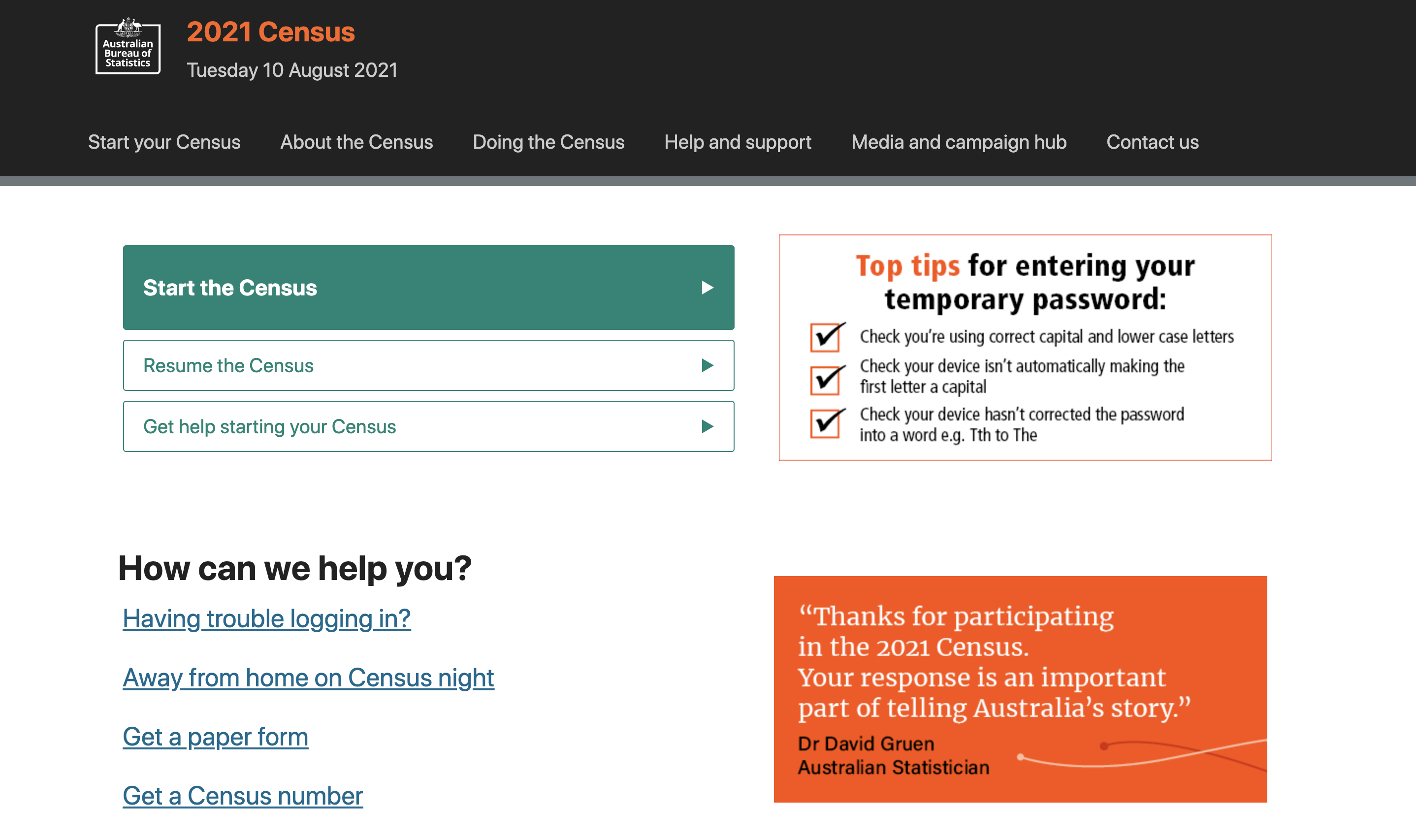
Tuesday August 10th is Australia’s favourite night of the year. Every person will be in their house, flat, unit or caravan. Studiously we will open laptops or take out a pen and the journey will begin: Census 2021. Although, like myself you may be one of the millions who’ve jumped the gun and completed the form in advance.
Our local atheistic allies have been campaigning hard as though the Census is an election of some kind. The conversion plan is overtly evangelistic and with promises of life ending in nothingness to all who join them. In advance of victory, I can almost hear their voices warming up to sing another rendition of ‘Imagine’.
Monica Dux, writing for the Sydney Morning Herald, tries to sway lapsed Catholics by reminding them of all the things they mustn’t like about Catholicism. She claims,
“In the upcoming census, religious affiliation is a category that will be closely watched, in part because participation in organised religion has declined so sharply, to the point that, in the 2016 census, the fastest growing belief was non-belief.”
Not so fast! ‘No religion’ is not a synonym for ‘non-belief’. ‘No religion’ is simply a junk draw for unbelievers, undecideds, spiritualists, and independents alike.
My advice is simple, just be honest.
Perhaps for Census 2026 we can add another box, “uptight atheist”.
There is however a major flaw with the question on religion. No, I’m not referring to the top of the page preference that’s given to ‘no religion’. The error is this, Christianity doesn’t appear as an option.
Instead, Anglican, Baptist and Presbyterian, appear alongside Islam and Buddhism and Hinduism as though they are all different religions. As a friend noted, Pentecostalism doesn’t appear at all, even though there are more Pentecostal Christians in Australia than most of the denominations specified.
I’m all for learning about the breakdown of how many Aussies identify with all the different Christian denominations; that’s useful information for a pastor such as myself. But Baptists are not a different religion to Anglican or Presbyterian or the Uniting Church (well, there is case that this last one should be separated).
Let me illustrate,
It’s like the census asking this question, what sport do you play? Then the options given are the following;
Carlton
Hawthorn
Swimming
Tennis
Collingwood
Golf
Cycling
St Kilda
It’s stupid! Carlton isn’t a sport, it’s a club that plays the same sport as Hawthorn, Collingwood and St Kilda. It may be a legitimate question to find out who supports which AFL club, but that’s not the same question as ‘what sport do you play?’.
Will our Census counters combine the numbers from across the Christian denominations? If so, will they include or exclude in those numbers cult like groups such as the Jehovah’s Witnesses and the Mormons?
Before sociologists explain to us why Australia is no longer a Christian nation (by the way, the answer is, we never were and we are not meant to be), it’s kinda important to know how the solicited answers shape the question being asked. It’s also worth pointing out that in the last census only 60% of Australians answered the question on religion. So, just like a plebiscite, the answers have some value, but what the other 40% think and what Australian genuinely believe about religion remain a Census mystery.
The Census provides useful and interesting information about the people who make up our nation. The data provides Governments, Councils, and community organisations a window into the people around us. We learn interesting facts about how old we are and how much income we earn and what languages we speak at home.
The Australia Bureau of Statistics explains why there is a question on religion,
“A person’s religion is asked as part of a suite of questions on cultural diversity and has been collected since the first national Census in 1911. This is the only optional question on the Census. Information gathered is used by religious organisations and government agencies to plan service delivery and encompass religious practices within community services, such as education, hospitals and aged care facilities.”
This information also becomes political hay and ammunition agitating for future Government funding and policy making. One thing the Census is not, and that is a measure of the spiritual health and intelligence of our country.
There is merit in knowing how people formally identify with different faith groups. Indeed, the fact that this question remains is quite telling. However, I’m more interested in knowing how many Aussies are in fact attending and actively belonging to a Christian Church and what are their beliefs and struggles and joys. I’m interested in learning why other Aussies have dropped out of church and /or why they no longer believe the Gospel of Jesus Christ. I’m interested in learning about what is it about other religions that appeals to people. These questions are for more interesting and beneficial.
I am tired of people misusing Christianity for all kinds or political and moral messaging. Whether it’s intellectual know-it-alls who explain away all the bits of the Bible that doesn’t fit with contemporary moral proclivities or those who get sucked in by crazy conspiracies and then justify them from loopy readings of the Bible. Indeed, some of this isn’t’ just odd, it is downright dangerous and blasphemous.
Take for example, this sign that was waving about during an anti lockdown protest yesterday,
“The blood of Christ is my vaccine.”
I do hope people realise that Christians don’t support or agree with this banner that was displayed at an anti-lockdown protest yesterday in Australia. I suppose a few Christians might like the banner, but that doesn’t make it true or helpful.
This is a difficult year
I will address this appalling sign shortly, but first of all I want to say that I understand how many people are frustrated and fed up and hurting during the COVID-19 pandemic. I doubt if there are many Australians who don’t feel at the very least one of those emotions right now. I have seen many struggling Aussies over the last 19 months and I know it’s hard. No one wants to be in the situation that we’re currently experiencing.
I’m not arguing here for or against lockdowns. Neither am I advocating for or against other measures taken during the pandemic. It’s not that I don’t have opinions about such things but that I’m aware of the fact that I’m not a medical professional and these are complex matters and I don’t have to shoulder responsibility for millions of people. It may well be the case that we won’t know what the right course of action was for several years to come. Uncertainties and confusion have often been compounded by the unnecessary politicisation of the pandemic and the at times enflaming journalism by some members of the media (as opposed to the great reporting that’s been done by many other journalists).
When it comes to protests my view is that it’s unwise to protest right now (that was my position last year as well), yes even selfish. At the same time we can be concerned by any Government who stifles peoples’ right to protest, even when we disagree with their point of view. Two things can be right at the same time. The higher biblical ethic however isn’t to push for my rights, it is to love the other.
The Bible doesn’t support conspiracies
I digress, my concern here is the so called Christian messaging present in these protests. If you are someone who claims to follow Jesus Christ, before making any decision first ask, am I faithfully promoting the good news of Jesus Christ? Another question I should ask is, am I loving my neighbour by joining in this unlawful and untimely rally? While I am sure there were a few well-meaning Christians protesting yesterday, that is no excuse for screwing up the beautiful Christian message by twisting it with anti-VAX nonsense.
There is a difference between someone who declines vaccination as a result of carefully thought out reasoning and one who is saying no because they’re believe speculative hearsay and conspiracy theories. For me, I’m convinced taking the vaccine is sensible and it’s is foremost about loving others and putting their health above my own (I’ve had my first round of Pfizer).
The Bible itself is not anti medicine anymore than the Bible isn’t anti-science. The Apostle Paul once says to a young Timothy, I hear that you’re unwell, take medicine. On many occasions when the Bible records people who are hungry, the answer was to provide food so that they may eat. When people were tired they slept. We are physical beings for God has made a physical world, not just a psychological and spiritual world. He has made a world in such that we can understand its mechanics and make advancements in technology and science and medicine.
The Bible talks about people who advocate and believe wonky ideas and calls on churches to guard against them For example, n the First Pastoral Epistle the Apostle Paul famously calls out conspiracy theories and demonstrated why they have no place in the Christian community. He wrote,
As I urged you when I went into Macedonia, stay there in Ephesus so that you may command certain people not to teach false doctrines any longeror to devote themselves to myths and endless genealogies. Such things promote controversial speculations rather than advancing God’s work—which is by faith.The goal of this command is love, which comes from a pure heart and a good conscience and a sincere faith.Some have departed from these and have turned to meaningless talk.They want to be teachers of the law, but they do not know what they are talking about or what they so confidently affirm. (1 Timothy 1:3-7)
Scholars can’t be certain about the precise content of these myths and genealogies. However, later in 1 Timothy (ch.4), Paul talks about people who were advocating distorted views of marriage, food, and other everyday norms. The Apostle is adamant,
“Such teachings come through hypocritical liars, whose consciences have been seared as with a hot iron”
Indeed, Paul argues that such abuse of Christian doctrine is harmful to people physical and spiritual wellbeing” (1 Timothy 4).
The meaning of the blood of Jesus
When people mix the Christian message with speculative theories we find absurd statements such as the banner which many journos are enjoying sharing around on social media, “The blood of Christ is my vaccine”.
What an awful slogan. This kind of misrepresentation is as detrimental to the Christian message as was the false teachers whom Paul spoke against.
Just in case someone is wondering, the blood of Jesus does not have physical properties that will so how mingle with our cardiovascular system to fight and destroy viral infection. Such medieval thinking is superstition not Christian.
However, I will never ridicule the idea of the ‘blood of Christ’. This idea of Christ’s blood is a crucial and central aspect of Christian belief. Without this blood there is no Christianity.
I get it, the very thought of blood isn’t attractive to our modern sensibilities. The theological significance of blood may not be as familiar to us as it is in other cultures. Blood is graphic. If we find the notion of spilled blood uncomfortable and even gross, we have come some way to understand the significance of blood in Biblical teaching and practice. The shedding of blood goes a long way to demonstrate the true horror of human sinfulness and the extraordinary length God went to bring atonement and deliver reconciliation.
Blood is used in many different ways in the Bible, but most of the time it signifies death. Blood is often used in a technical sense to refer to sacrificial death. In the first place blood speaks of sacrifices conducted in the Old Testament, and these are preparing for and pointing to the truly efficacious sacrifice that atones for human sin; the death of Jesus Christ.
”For you know that it was not with perishable things such as silver or gold that you were redeemed from the empty way of life handed down to you from your ancestors,but with the precious blood of Christ, a lamb without blemish or defect.He was chosen before the creation of the world, but was revealed in these last times for your sake. (1 Peter 1:18-20)
“remember that at that time you were separate from Christ, excluded from citizenship in Israel and foreigners to the covenants of the promise, without hope and without God in the world.But now in Christ Jesus you who once were far away have been brought near by the blood of Christ. For he himself is our peace, who has made the two groups one and has destroyed the barrier, the dividing wall of hostility,” (Ephesians 2:18-20)
Let me explain it this way, while the biblical language of blood may be unusual for many of us, we do understand the concept of sacrifice. The notion of someone laying down their life in order to save another is a common theme in literature and film. In real life, such events are often mentioned on the news for they are rare and wonderful examples of love.
Melbourne’s Shrine of Remembrance has these words engraved in the interior of the building, “Greater love hath no man”.
While these words aptly describe the sacrifice of our war dead, these are in fact words spoken by Jesus. These words speak of the greatest sacrifice we can make for the sake of another, and the point to the ultimate sacrifice; the cross.
“But God demonstrates his own love for us in this: While we were still sinners, Christ died for us.” (Romans 5:8)
When a protester distorts the Christian message and attaches it do something like the anti-vac movement, people will understandably mock her. Sadly, they may also go away with the wrong view of Christ and of Christianity. I’m thankful that most Christians have more sense, and hopefully better theology. For the rest of Australia, please don’t judge the truly sublime message of Jesus Christ by a few dreadful banners. Instead, find a Christian church, open a Bible, and discover the good news of Jesus for yourself.
I enjoy the Olympics. I’m not one these anti-sport types or anti-cultural wowsers. There’s no doubt that my family and I will be watching the Aussies over the next couple of weeks. We expect to see some amazing athleticism and competition, and we’ll be cheering on as proud Aussies. There are plenty of non Aussies that I’m keen to see compete as well. And ‘yay’ to Tokyo! I’m happy for the people of Tokyo. Despite the trauma and uncertainty of the past 18 months the game have begun; well done!
There was much to enjoy and amaze in what was a scaled down opening ceremony. The cauldron is spectacular. And yes, mask wearing athletes waving to a near empty stadium is kind of weird but welcome to 2021. I also assumed there would be some element at the Games that’ll make us cringe. On this occasion, the irksome bit was in fact the contribution made by Australia’s very own Keith Urban. Or rather, Urban shared the honours with a Legend named John and two other singers who each represented a different continent.
Together they performed a virtual rendition of John Lennon’s Imagine. Really? Yep. We couldn’t think of something more imaginative to captivate the audience? Even a few lines from Puccini would have given us a better dose of goose bumps than Lennon’s dreary Imagine. Despite Lennon’s best efforts to produce a mediocre song, Imagine has become something of a global anthem for times of trouble and bizarrely even at Christmas time.
But let’s stop for a moment and use our brains. Think about the lyrics. Forget about the ho-hum melodic line. Leave aside the earnest yodelling of Keith Urban, the swaying arms of a choir and the army of drones circling above to create a unified world. Truth ain’t measured by a spectacularly scripted show!
Imagine is hardly good news. It’s a pop song designed to imagine life without ultimate meaning and hope. Despite its claim, it doesn’t bring people together for it erases any story that’s bigger than ourselves and strong enough to heal the unreconcilable. It’s the perfect anthem for our neighbourhood nihilists, not for a hurting world.
At a time when the world in the thralls of a pandemic, facing enormous financial debt, geopolitical threats of warlike imminence, and the fracturing of western civilisation, Imagine is not the song we need to hear. What does this imaginary song offer us?
Imagine there is no ultimate meaning, purpose or goal toward which our lives are headed.
Imagine there is no overarching design and no inherent significance.
Imagine if our lives were reduced to the pot luck outcome of billions of years of impersonal atoms and molecules running around hitting and missing, making and destroying.
Imagine a world where the reality of conscience and moral choice has no grounding in a purpose beyond that of group survival in the evolutionary race to the top.
Imagine human affections are ultimately an illusion, a cruel joke orchestrated by the impersonal rules pf physics.
Imagine all the people living for today, for tomorrow is the end.
Imagine’s meaning isn’t so great, is it?
In contrast to Lennon’s nihilist proclamation, people want to know that there is hope beyond a crisis and that there is hope when faced with mortality. Times of economic uncertainty can drive people to the kinds of selfish and greedy hoarding of supplies that we have been witnessing. A health crisis can lead to further fragmentation in societies. Indeed, the longer this crisis continues the more likely we are going to witness the breaking of social cohesion. And yet as these economic, social and health pressures tighten, it is all the more necessary for people to hear news of hope.
There is little consolation to a gravely ill person that not only is death imminent, but that it is ultimately meaningless. This atheistic ethic doesn’t do much to help grieving families who have just witnessed a loved one being ripped from their lives. To quote one friend, Imagine is “tone deaf”.
We want there to be a heaven, a better world with a better life. We want the cessation of sorrow and suffering, but Imagine cannot offer any such promise.
At the same time, hell is also a necessity, for we do not want to live in a world where evil wins or where injustice prevails. While we should be thankful for our judicial system, it is not full proof and many terrible deeds are never prosecuted. People need to know that in death the wicked do not escape justice. Imagining there is no hell would be a form of hell its self.
John Lennon’s song collapses in on its own irrationality. He imagines ‘living life in peace’, and there being no “greed or hunger”, but such talk demands a form and purpose; atheism and naturalism cannot provide such a definition.
The COVID-19 crisis is a voracious reminder of the fragility of life and the uncertainty of building society on credit. Hedonism is vanity. Pushing against greed and social disharmony suggests meaning, but meaning is disqualified in a God absent universe. As Solomon the wise wrote in the book of Ecclesiastes,
“Meaningless! Meaningless!”
says the Teacher.
“Utterly meaningless!
Everything is meaningless.”
Nietzsche was right, at least as far his logic is concerned, that “the masses blink and say ‘We are all equal – Man is but man, before God – we are equal.’ Before God! But now this God has died.” A contemporary of Nietsche, Anatole France retorted without regret,
“It is almost impossible systematically to constitute a natural moral law. Nature has no principles. She furnishes us with no reason to believe that human life is to be respected. Nature, in her indifference, makes no distinction between good and evil.”
What if there is heaven and hell? What if God exists?
Everything must change. What we think and say has greater import. How we live and how we treat others has far more consequence.
What if the God who exists is the God of the Bible: who is Sovereign, and altogether righteous and loving, just and kind?
What if Jesus Christ is the perfect image of God, the One who as John testifies,
“In the beginning was the Word, and the Word was with God, and the Word was God. He was with God in the beginning. Through him all things were made; without him nothing was made that has been made. In him was life, and that life was the light of all mankind. The light shines in the darkness, and the darkness has not overcome it… The Word became flesh and made his dwelling among us. We have seen his glory, the glory of the one and only Son, who came from the Father, full of grace and truth.”
These words are far more sustainable and substantial than the sentiment of living in a world without Divine structure. A Biblical view of the world both assesses its beauty and its horror, the worth and the uncertainty. These Scriptures bring us to the most astonishing words, ones that counter John Lennon’s pipe dream with concrete hope,
“For God so loved the world that he gave his one and only Son, that whoever believes in him shall not perish but have eternal life.” (John 3:16)
One of the few heresies today is to suggest that there are many if any differences between men and women. We are even at the point where some are arguing gender is so fluid that categories like men and women are becoming superfluous. I suspect however that few will find offence with a hypothesis that submits that anger is a more aggressive issue among men than for women.
The reason for mentioning this is because I’ve come across research that supports a biblical proposition. The Bible presents many positive differences between men and women but on this occasion I’m thinking of a negative example.
I’m about to start preaching through Paul’s first letter to Timothy at Mentone Baptist. The Epistle is filled with encouragements and instruction for churches, which together provide directives for how a church is to conduct herself. As Paul says to Timothy, this conduct matters because God’s household is “church of the living God, the pillar and foundation of the truth”.
Despite the positive and constructive way the Apostle outlines life for a local church, some parts of the letter have created significant controversy; not least are the sections that discuss the roles of men and women in the church. I’ll preaching through the entire letter, including ch.2, but for now I want to share an interesting article that I recently came across which may help us further understand what Paul means in 2:8,
“Therefore I want the men everywhere to pray, lifting up holy hands without anger or disputing”
Verse 8 is an instruction given by God to men in the church. What follows in vv.9-15 are instructions given to women in the church.
Paul introduces verse 8 (and the following verses, 9-15, for they form a coherent section) with the strong conjunction, ‘therefore’. Paul is tying this application with what he has written previously in verses 1-7. The connection between vv.1-7 and v.8 is not only the subject of prayer, it is also ‘godliness and holiness’. Similarly, godliness and holiness is the concern of vv.9-15. The Apostle is concerned with godly behaviour in the church as it pleases God and because it functions as a Gospel witness to outsiders. That godliness is on view in v.8 is confirmed by the way Paul contrasts hands used in prayer and hands used in anger.
Why does Paul’s teaching on men here focus on ‘anger’? Surely anger isn’t a male only attribute?
1 Timothy 2:8 seems to support the idea that anger is a greater issue among men than it is for women. In a paragraph where Paul is making distinctions between men and women in the church, it is observable to Paul that a proclivity toward anger is one characteristic that sufficiently differentiates men from women. It’s not the only distinctive attribute but it is one.
It’s not that women don’t experience anger. Of course women can be angry, for good reasons as well as for sinful reasons. Is there however something in Paul’s statement that rings true? For example, we know that most cases of domestic violence are perpetrated by men. We also know that most violent crimes are committed by men. Do men and women process anger in different ways? It’s not only such extreme forms of anger.
In 2018, The Conversation published an article on differences between men and women. The focus was on ‘happiness’ and how men and women experience happiness in different ways. The article also speaks of the converse,
“Gender differences in depression are well established and studies have found that biological, psychological and social factors contribute to the disparity.”
I note that despite all the talk about how cultural influences inform and determine behaviours research suggests that social factors lack the explanatory power for defining how men and women experience the highs and lows of life in distinctive ways. There is more going on.
I think of 1 Thessalonians where Paul speaks of masculine traits and feminine traits, not because they are mutually exclusive but because there are observable differences between the two genders. The fact that these analogies make sense to us living in 21st Century suggests the meaning is not fixed to those living in Thessaloniki in 50-51AD. It’s also worth highlighting that these metaphors are used positively and with affection.
“But we were gentle among you, like a nursing mother taking care of her own children. So, being affectionately desirous of you, we were ready to share with you not only the gospel of God but also our own selves, because you had become very dear to us.” (1 Thess. 2:7–8).
“For you know how, like a father with his children, we exhorted each one of you and encouraged you and charged you to walk in a manner worthy of God, who calls you into his own kingdom and glory” (1 Thess. 2:11–12).
Back to 1 Timothy. As I read the piece in The Conversation, my eyes were drawn to the section on anger. According to the piece, research demonstrates that men and women express anger differently.
“Psychologically it seems men and women differ in the way they process and express emotions. With the exception of anger, women experience emotions more intensely and share their emotions more openly with others.”
“However within these studies lies a significant blind spot, which is that women often do feel anger as intensely as men, but do not express it openly as it is not viewed as socially acceptable.
When men feel angry they are more likely to vocalise it and direct it at others, whereas women are more likely to internalise and direct the anger at themselves. Women ruminate rather than speak out. And this is where women’s vulnerability to stress and depression lies.”
This makes sense of Paul’s observation about men raising hands in anger. It’s not that 1 Timothy 2:8 is valid because of what researchers are learning, but rather we shouldn’t be surprised to find that reality matches what Scripture teaches and affirms.
In any discourse about men and women it is unhelpful to overstate differences. What we share, namely our humanity and the imago dei and union with Christ is of staggering beauty and importance. Without losing or diminishing any of those things and more, it is also unwise to downplay or ignore the simple fact that there are also differences. As The Conversation explains, these differences extend beyond social influences, and neither can they fully explained by physiology such as muscle and bone density, and sexual organs. There are psychological and personality differences. 1 Timothy 2:8 seems be to a Scriptural acknowledgment of such differentiation. Indeed, I would argue differences also exist for theological reasons, but that’s a topic for another ocassion.
At a time when we are hearing so many stories about men mistreating women, even within churches, 1 Timothy 2:8 is a timely verse (not that the verse is specifically aimed at men’s behaviour toward women but it surely includes such). It’s also an example of how Paul’s ecclesiastical paradigm in 1 Timothy isn’t limited to First Century Ephesus but how the God’s ways remains poignant and powerful today.
As our society recognises harmful versions of masculinity, it’s good to be reminded that God is also in opposition. God does not condone sinful anger, and neither should the church. The Apostle mentions anger because despite its prevalence among men, it is out of place in God’s household. The answer though isn’t simply to cease a certain behaviour or attitude, it is to replace it with one that is better and is good. It’s a picture of repentance. Paul instructs men, instead of using hands in anger, men ought to lift their hands in prayer. In other words, men should use their bodies for godliness not sinfulness, and they should focus their attention on God who brings peace rather than igniting disputes.
For men who are aware of anger issues in their life, reach out for help. If you’re part of a church, talk to your pastor. For women who are living with an angry man, please reach out for help.
“Do not conform to the pattern of this world, but be transformed by the renewing of your mind. Then you will be able to test and approve what God’s will is—his good, pleasing and perfect will.” (Romans 12:2)
The Anglican Bishop of Liverpool (UK) has come up with a strategy to turn around the frailing Church of England. What insight is he offering? What move is he announcing? Imitate Christ? Preach the Gospel? Persevere in prayer? Paul Bayes’ message is none of the above. In what sounds like a defiant ‘no’ to Romans 12:2, the Bishop of Liverpool wants churches to become more like the world!
In a speech last week, the Bishop of Liverpool, Paul Bayes, called for “gender-neutral marriage canon”. He notes that “world beyond the church” has found the church’s teaching and practice of marriage is “offensive, oppressive and hypocritical”. [1]
There is a certain ‘duh’ that’s appropriate here. Societies often regard certain Christian teachings as offensive; it comes with the territory. I’m pretty sure Jesus said something about not expecting or looking for adulation from the culture at large,
“If the world hates you, keep in mind that it hated me first.If you belonged to the world, it would love you as its own. As it is, you do not belong to the world, but I have chosen you out of the world. That is why the world hates you”. (John 15:19)
The Bishop’s logic is simple, the outside world doesn’t approve of Christian teaching (especially on marriage and sexuality), therefore we must change in order to the win the approval of the world. That’s like saying to Americans, I can see you don’t like cricket, so we’ll put away the bat and instead take up baseball. Or to change the analogy, it’s like submitting to anti-vaxxers: we sense your fury about taking a COVID vaccine, so to avoid offending you we will throw out every last vial.
In case we are left in any doubt, Paul Bayes gives churches an example to follow. Following Jesus sounds like a great idea to me, but no, this clergyman is telling Churches to become more like the English soccer team (apologies, ‘football’!). I’m not convinced that footballers are the paragons of virtue we ought to be emulating, but according to this Bishop they are our exemplars.
“Look at our football team, kneeling in the face of the boos of the sleepwalkers so as to advocate for justice. The world beyond the church has set the moral agenda, and those who kneel with our footballers, or who see no difference between attending the marriage of their gay or their straight friends or work colleagues, find the community of faith to be wanting and indeed increasingly offensive. Nowhere is that more true than in the area of human sexuality”.
Be more like England! I assume the Bishop might add…and be less like Hungary. For those following Euro 2020, Hungary is portrayed as the bad guys at the moment due to the way their Government is pushing back on the popular sexuality narrative that has captured the West. The current European football championship has led to arguments over stadiums lighting up in rainbow colours and all manner of virtue signalling.
The reality is, churches shouldn’t look like England or Hungary. The Church is called not to be a synonym for the world nor its antonym. Rather, the New Testament vision is of a redeemed community communicating by both life and teaching God’s revealed truth in the Gospel of Jesus. For instance, 1 Timothy 3:14-15 explains,
“Although I hope to come to you soon, I am writing you these instructions so that, if I am delayed, you will know how people ought to conduct themselves in God’s household, which is the church of the living God, the pillar and foundation of the truth.”
Far from emulating the world, the Apostle’s descriptor of the church is that it’s like a new building set apart from all others in the city. In contrast to the Temples in Ephesus (the city where Timothy was living), the Church is distinct for two reasons: one, the foundation (it’s built on God’s truth), and second, its life (the church upholds God’s truth in both life and teaching). George Knight comments on these verses, “the living God has established his church to be the embodiment of his truth.”
What makes Christianity distinct and enthralling, shocking and appealing, is that it does not sit comfortably in any given culture. Genuine Christianity doesn’t feel like England and it doesn’t look like Hungary. For this reason, there is always a sense in which we (Christians) never truly fit and are at home in the places we live, work, and play.
I recall an observation made last year by British historian Tom Holland,
“I see no point in bishops or preachers or Christian evangelists just recycling the kind of stuff you can get from any kind of soft left liberal because everyone is giving that…if they’ve got views on original sin I would be very interested to hear that”.
Holland is not a Christian but he understands the lunacy of ecclesiastical leaders sacrificing Christian beliefs at the expense of pursuing favourable opinion polls. Didn’t Jesus say, “You are the salt of the earth. But if the salt loses its saltiness, how can it be made salty again? It is no longer good for anything, except to be thrown out and trampled underfoot”?
As soon as Christians begin talking about truth, some readers will pushback with suggestions of narrow-mindedness and archaic bigotry. That’s not how Christian truth works. The truth Paul is affirming mustn’t be misaligned with power plays, abrasiveness, and hatred, for doing so tarnishes the truth. Truth’s companion is love and truth’s context is grace. Anyone building pillars of truth without the essential ingredients of love and grace, is building a structure that’s certain to fall down.
For example, in the same letter Paul urges Timothy to confront false teaching and he explains how “the goal of this command is love, which comes from a pure heart and a good conscience and a sincere faith.”
Paul can both speak of behaviours that contradict sound doctrine and the Gospel, and he can speak of God’s great love for law breakers, “Here is a trustworthy saying that deserves full acceptance: Christ Jesus came into the world to save sinners—of whom I am the worst.But for that very reason I was shown mercy so that in me, the worst of sinners, Christ Jesus might display his immense patience as an example for those who would believe in him and receive eternal life.”
In calling for a church of the world, the Archbishop of Liverpool fails to mention this crucial point: churches that stick with the Bible and who hold onto the Christian view of marriage, do in fact love and accept people from across backgrounds and persuasions. It is this distinct community that is so appealing for those who are weighed down with guilt and sense of helplessness. The Church isn’t a heterosexual club, it’s the community of men and women who have found God’s grace and mercy in Jesus Christ and who are now learning to find their truest identity and contentment in Him. This truth is not oppressive, it is freeing. It’s not life destroying, it’s life building. I am among the first to recognise that churches don’t always do this well, but often they do, and the more churches are enthralled by the Gospel of Christ, the more wonderfully they display the character of God and the beauty of his good news.
As Jesus says, “love one another and the world will know that you are my disciples”.
The Bishop of Liverpool is essentially calling for churches to dismantle 1 Timothy 3:14-16. Such betrayal by a church leader does not encourage Christians who are seeking to follow Christ in the world, it confuses them and causes them to doubt what God’s good purposes. Neither will this kind of revisionism help people outside to become Christians; it only gives further reason to view Christianity as an irrelevance.
There are churches who’ve capitulated and become servants of today’ cultural Kings. Other churches understand what’s at stake and are standing on this firm foundation. Again, others are hoping they can remain on the fence and they’re hoping no one ever asks them what they truly believe.
The future doesn’t lie with camouflaging the Biblical vision of marriage and sexuality, nor in taking the advice from the Bishop of Liverpool. Churches, we need to become less like the world, whether it’s the world of England or Hungary, and let’s become more like the Lord Jesus.
Another public figure has found themselves given the finger by today’s moral umpires.
Ollie Robinson is, or rather was, England’s newest Test cricketer. The 27 year old fast bowler made his international Test debut during the week against New Zealand. Despite a promising match with the ball, Robinson was caught out. In fact, he is now suspended from all international cricket until a disciplinary investigation has been completed.
It wasn’t Robinson’s on field performance that led to this very public humiliation, but a series of tweets that he posted as a teenager back in 2012/13. I’ve read Robinson’s tweets and they’re not great. They are inappropriate, tasteless, and at times crude. Despite issuing an apology, the England and Wales Cricket Board, have cancelled his next Test appearance and his future in cricket is now far from certain.
Ollie Robinson is the latest of what is becoming a very crowded space of people who have had their careers and even lives ruined because of past transgressions on social media.
Do I think his sins deserve suspension? No. I think an apology was appropriate and hopefully he will learn and grow, but should stupid words from childhood serve as cause to lose his place in the nation’s cricket team? The England and Wales Cricket Board certainly believe so, and I suspect the same would occur in many sporting codes today.
In our culture’s obsession with finding hidden skeletons, there is little nuance or attempt to understand. If you break the rules, you’re damned to hell. This is problematic for several reasons. First of all, these rules are constantly moving about like Warnie bowling to Gatting. One moment you’re safe and the next the rules have shifted and you’re stumped! There is no scale for measuring wrongdoing. A person who misspeaks someone’s preferred pronoun can as easily lose their job as someone who bullies a colleague. A Christian may pray with a person and find themselves facing a prison term that’s longer than a real criminal who inflicts bodily harm on another. Another issue is that the rules we’re all meant to follow are often made by the mob and with authorities bowing before whoever is appealing the loudest.
For a few recalcitrants, there is a way out of hades; sure, you’ll lose your soul but you just might be allowed to return to your sport or place of work. All you have to do is fully endorse and join groupthink. Just carry around around your Twitter handle a placard of shame, and then nod and repeat everything that our culture’s new bishops tell us to say, think, and feel.
In the case of Ollie Robinson, did he make comments that were bordering on sexist and racist? Yes. Was he a teenager at the time? Yes. Was it malicious? I doubt it. Foolish? Certainly. I also suspect that if the trolls and governing authorities dig deep enough, every single player in the English team will find themselves suspended for one transgression or another. And let’s not forget the Aussies either!
We all have done dumb things in our past and said things that we’ve later regretted. We are masters at stuffing up, and with maturity we realise our hopeless inability to erase the past. As the Bible reminds us, “you may be sure that your sin will find you out.” (Numbers 32:23)
As a society we are moving well beyond anything the Bible envisages. We are creating a hyper moralistic, self righteous, and legalistic culture where there is easy rage, much finger pointing and very little forgiveness.
Where is the forgiveness? Do we even believe in forgiveness any longer? I don’t mean for us personally, but offering forgiveness to others.
We are living in strange times. I remember a time not so long ago when Christians were portrayed as hyper moralistic and judgemental. Christians were supposedly the crowd who went around condemning every moral failing and sinful shift in society. Sure there is a touch of truth in that. More so, Christians are known for experiencing Divine forgiveness and forgiving others. The whole fabric of the Christian faith is about knowing the forgiveness of a loving and holy God and how this good news transforms our lives.
There are still moments when I’m horrified at the thought that God knows my entire past; every sinful deed and thought. Of course, God’s measurement for right and wrong isn’t defined by the latest social theory or groupthink, it’s shaped by his unchanging character and purposes. However, my distress finds great comfort through knowing the Lord Jesus died for all my transgressions. The God who sees my true failings has in love offered forgiveness and reconciliation.
The thing is, as societies like the UK and Australia turn our backs on the Christian faith it shouldn’t surprise us that we are becoming less tolerant and more fractious. It really is the Gospel of Jesus Christ alone that can hold together justice and mercy, righteousness and forgiveness.
The England and Wales Cricket Board are simply echoing the cries of a failing society that is bent of bowling bouncers and little else. We are seeing lots of shots being pulled in anger, but surely we are desperate to find grace and mercy. If we are not going find forgiveness in our decaying culture, then perhaps we can revisit those communities that are founded upon Divine forgiveness and who are learning to live in the light of the goodness.
I hope to see Ollie Robinson playing in the upcoming Ashes series…and watching the Aussies make lots of runs!
“They are clouds without rain, blown along by the wind; autumn trees, without fruit and uprooted—twice dead.” (Jude 12b)
When I learnt to walk across the road as a young child, like all parents, mine taught me to look both right and left. It’s one thing to look right, but what if there’s a truck hurtling down the road from my left? Or, I might notice the truck to my left and be oblivious to the SUV that’s roaring toward me on my right. In this current season threats to Christian orthodoxy and life are coming to us from the left and the right.
‘Everyone did as they saw fit’ has become the Christian mantra for today. But of course, the book of Judges wasn’t offering us an invitation to change the Christian message, it was the stark assessment of God’s people who hard hardened their hearts.
Take for example, Christian Nationalism. This is a dangerous and anti-Christian movement. Christian nationalism has found many expressions in history, and many of us probably assumed that with the close of the 20th Century, such appalling abuse of the Gospel would have ceased. Sadly, that is not the case. Christian Nationalism attempts to fuse the Christian message and hope with the political and cultural ambitions of a particular nation or people group. In the end, the Gospel becomes a tool of nationalism, serving not to proclaim the Lordship of Christ to the nations but to preserve a way of life draped in Stars and Stripes (or whichever country it happens to be).
The rise of Christian Nationalism has produced a new product which is now being marketed across the USA. A ‘new’ Bible was been launched: the God Bless the USA Bible. What makes this edition blasphemous is not changes made to the actual words of Scripture (I’m not aware of any such alterations), but the name given to the Bible and the compendium that is added. The name, God Bless the USA Bible is a dead give away; it is unequivocally nationalist is meaning and tone. The Stars and Stripes motif that covers the book is another indicator that something is seriously wrong. There’s more, when the book is opened not only can you read God’s Holy Word, but included is a handwritten chorus to God Bless The USA , The US Constitution, The Bill of Rights, The Declaration of Independence, and The Pledge of Allegiance.
This publication is blasphemous and offensive to Christians across the world. I hope you also find this troubling and problematic. This abduction is an attack on the message, nature and sufficiency of Scripture. Indeed, it is an assault on the Gospel of Jesus Christ which does not belong to any single nation or culture. It’s interesting to observe that while friends on the left may see the follow of this attempt to nationalise the Bible, they too are guilty of similar offense. So much of the discourse surrounding ‘redeeming society’ and ‘saving the world’ has the effect of minimising things like conversion and the central purpose of the Church, and instead encourages things like cultural engagement through social and political means.
If the Bible you use cannot cross borders without losing its significance, then you should probably change the Bible you are reading. Indeed, the God Bless the USA Bible is proving divisive even within the United States.
In another story, a bishop from the Lutheran denomination in the United States has announced that they are changing the teaching of the Nicean Council so that it conforms to transgender ideology. The Nicene Creed is one the most important documents written in the history of the Church, and it remains foundational in explaining and summarising essential Christian doctrines to this day. Many of our churches probably recite the Nicene Creed (if not, perhaps we should).
The new elected bishop, Megan Rohrer, identifies as transgender. This alone should ring alarm bells for a Christian Church, but sadly adherence to the latest versions of the sexual revolution is often deemed more important than fidelity to Scripture.
She announced,
“The first council of Nicaea’s first action was to try to limit the leadership roles of trans pastors and bishops. I’m grateful the Lutherans of the @sps_elca are beginning to dismantle this and some of the the other hurdles BIPOC and LGBTQ pastor’s encounter.”
In other words, Christian teaching that doesn’t fit with personal identity or agenda needs either revising or removal.
You may be familiar with old saying, ‘the stinking rich’. The stench from those wealthy people buried beneath ecclesiastical buildings is nothing compared to the smell of dying people listening to the putrescine odour expiring from the mouths of these ‘progressive’ preachers. But of course, these things are not only happening across the Pacific Ocean, but such thinking and attitudes are taking shape here among Christian denominations in Australia. These conversations are difficult and we want to be mindful of individuals who are genuinely struggling with their sexuality and gender; the Gospel is a big enough stumbling block without us making more. However, I take it that when Jude urged his readers to “contend for the faith that was once for all entrusted to God’s holy people,” he really meant it. Too often, I suspect we’ve replaced Jude’s urging with a screwed up sloganing of Judge’s assessment.
The examples that I’ve mentioned are but two of what is becoming a crowded space. Here’s are some further examples,
The State of Victoria has banned Bible conversations and prayers on a range of anthropological topics (ie. sex and gender).
The Chinese Communist Government published their own version of the Bible which has removed all the bits that might be interpreted as unfavourable toward the State.
I remember the former principal of Whitley College giving an address in 2016 where he bemoaned the language of God as Father. To know and call God Father is the greatest of privileges and graces. This is the Divine invitation made possible through Jesus Christ. Indeed, Jesus teaches us to pray, ‘Our Father’. Instead, this baptist academic encouraged his listeners to use feminine pronouns for God. He asserted,
“We have gone backwards on gender inclusive language in many of our official events. These elements include a resurgence of emphasis on God as Father, without any balancing awareness of other ways of naming God.”
His point was not that we cannot speak of God as Father, but that such language is biased and ‘narrow’. This was an exercise for justifying a feminist critique of Christianity and criticising what he saw as a return to normal and biblical speech about God.
When our language of God sounds like it’s inspired by the Shack or Dan Brown’s Da Vinci Code, the alarm is ringing and someone needs turn off the microphone. Instead, too often we quietly let these thoughts simmer away without correction, which of course means that they later on become part of the vocabulary in our churches.
Attacks on biblical orthodoxy are wide and coming from many different directions. Despite their differences they do share this in common: they cast doubt on and even deny the truthfulness, goodness, and sufficiency of Scripture. They find God revealed in Scripture as objectionable and needing to be recast in the image of their particular inclinations and agendas.
If your church takes a lackadaisical approach to theology, don’t be surprised when all manner of weird and whacky ideas jump out from the pulpit. We need our eyes and ears alert to influences and ideas coming from all directions, whether it’s left or right. It seems pretty clear that the Apostle Paul didn’t want Timothy to be caught napping,
“Preach the word; be prepared in season and out of season; correct, rebuke and encourage—with great patience and careful instruction.For the time will come when people will not put up with sound doctrine. Instead, to suit their own desires, they will gather around them a great number of teachers to say what their itching ears want to hear. They will turn their ears away from the truth and turn aside to myths.” (2 Tim 4:1-4)
This task is important for all believers, and especially it is a responsibility given to entrusted in overseeing the local Church. Paul said to the Ephesian Elders,
“Keep watch over yourselves and all the flock of which the Holy Spirit has made you overseers. Be shepherds of the church of God, which he bought with his own blood.I know that after I leave, savage wolves will come in among you and will not spare the flock. Even from your own number men will arise and distort the truth in order to draw away disciples after them. So be on your guard! Remember that for three years I never stopped warning each of you night and day with tears.” (Acts 20:28-31)
That’s serious advice. At the end of the day however, the foremost issue isn’t left or right, it’s internal. Maybe you are higher up on the holy scale than me, but I reckon we have a propensity to latch onto new ideas because they validate a priori affections which are lurking around inside us. We need to guard our pulpits, doctrinal statement and leadership qualifications, but we must also tend to the heart.
“Above all else, guard your heart, for everything you do flows from it.” (Proverbs 4:23)
Such careful evaluation requires a posture of humility, a confidence in Scripture, and also the gentle and loving community of the local church.
“Let the message of Christ dwell among you richly as you teach and admonish one another with all wisdom through psalms, hymns, and songs from the Spirit, singing to God with gratitude in your hearts.” (Col 3:16)
This internal examination requires us to soak our lives with the Gospel and as Colossians 3:16 explains, this is only made more beneficial when done in community, with the church together teaching and admonishing.
Let’s be watchful of what’s coming toward us from left and right, and above all, let us be mindful of the dangers that arise from our own hearts.
The original version included a reference to the Bible Society which was incorrect and I have subsequently corrected it
Fairfax have published their latest exposé on Prime Minister Scott Morrisons’ Christianity. ‘PM says social media being used by ‘evil one’, gives rare insight into Pentecostal faith’ is a strange and sophomoric non-story. I think it illustrates how shallow our grasp of Christianity is in Australia. I suspect it’s another attempted subterfuge to undermine the credibility of the Prime Minister.
As I read Daniela White’s piece, it felt like an Aussie version of those famed letters by Pliny the Younger. Pliny was a magistrate in first century Rome. He who felt obliged to tell the Roman Emperor Trajan about those weird Christians who practice a “depraved, excessive superstition”. According to Pliny the Younger, these Christians drink human blood and practice cannibalism, they call each other brothers and sisters, they let women oversee programs and they do really nice things for other people!
There are plenty of issues worthy of reporting in relation to the Federal Government: among them, the painfully slow roll out of the COVID-19 vaccines and the mistreatment of women in Parliament. With a stale and predictable breathe, like waking up every morning, readers of The Age and Sydney Morning Herald have been given another dose of Scott Morrison’s faith.
Daniella White explains that the Prime Minister participates in, “the Pentecostal practice of laying on of hands”.
Okay…well, so what? The practice of ‘laying on hands’ is not just a pentecostal thing, it harkens back to New Testament times and it is practised by pretty much all Christians churches to this day. It’s a physical symbol representing a spiritual committal (ie praying for an individual).
That is not all. Readers are reminded of this vital piece of evidence,
“Mr Morrison was photographed raising his hands in a church service during the 2019 election”.
This is indeed disturbing behaviour by a Christian! Seriously, this is as silly as reporting, ‘a football fan was photographed raising her hands during Saturday’s game at the MCG”.
One of the Prime Minister’s words that caught Daniela White’s attention was him talking to a Christian audience about the dangers of social media. He said,
“It is going to take our young people… it’s going to take their hope, it’s going to steal their hope”.
“Sure, social media has its virtues and its values and enables us to connect with people in ways we’ve never had before, terrific, terrific, but those weapons can also be used by the evil one and we need to call that out.”
Does anyone think social media is never used to promote dangerous ideas and to harm people? You may not believe in a real and personal devil as do Christians (and remember, so did Jesus), but you probably believe in a devil in some metaphoric way while to trying to explain the sheer volume of evil that is promoted and bullied on social media platforms.
The article amounts to the revelation: Scott Morrison, a self confessing Christian, engages in normal Christian practices and beliefs. Wow. Big news!
I am tempted to mock the article because it is inane and it’s a classic example of a non-story being whipped up into what still amounts to a non-story.
Nevertheless, the piece does reveal something important. It illustrates what is a common thread in Australia today: people don’t understand Christianity. Most Aussies have little or no idea what the church is about. It is normal today for children to grow up and not even know who Jesus is, and that the cross and resurrection of Christ is the central pivot of all human history.
It is not only the key teachings of Christianity that are being distanced in our communities, there is gaping hole in our understanding of how Christianity has positively shaped the society in which we live and benefit. Christian residue remains attached to our culture and provides foundational material without which our society would crumble.
The British historian Tom Holland made a similar observation earlier this week when discussing the topic of culture wars. Holland explains how (in the West) many of our cultural and moral leanings arise from Christian theology, it’s just that we no longer see the connections. For example, he suggests,
“The anxieties around statutes today are bred of deeply Christian ideas, just that the people campaigning against it don’t recognise it as Christian…this is drawing on the assumption that making a profit from slaves and conquering vast reaches of territory and killing people while doing so is not something deserving of praise, and these are assumptions that are bred of the great heritage of Christian history….They’ve escaped the moorings of Christian doctrine and they now just kind of percolate in the air and people breathe them in and take them for granted.”
“Culture wars…are arguments about theology that do not recognise themselves as being arguments about theology”.
We don’t even realise that our moral impulses to fight against racism stem from a Judeo-Christian understanding of the world. Scott Morrison’s statement that was reported is exactly right,
“It’s so important that we continue to reach out and let every Australian know that they are important, that they are significant.
“Because we believe that they are created in the image of God.”
A friend of mine made a comment last night about a different story, one that relates to a local high school. His point nonetheless translates well,
“As far as I can see, Christianity is the best chance we have of creating an equitable society. It teaches that all humans are made in the image of God and thus to be valued. All people have a problem with meeting their own standards of goodness and thus require forgiveness and patience. Love for God and neighbour is the greatest good. The West was built on these principles and yet we’ve still fallen horribly short.
How much worse will we be living under an ideology which demonises those who disagree, peddles a view of ‘goodness’ which is constantly changing and hard to define, and believes in inescapable guilt upon those born with the wrong skin colour and sex?”
Of course, Christianity is far more than a system of beliefs and values that provide a framework for civil society and cultural progress; Christianity is about a person. Christianity is about God sending his son into the world to atone for sin that we might be reconciled to the living God. That is sublime news that remains as good today as it was in the days of Pliny the Younger.
Christianity cannot be reduced to a game of knowledge but it certainly necessitates knowledge. For Christians, surely we don’t want to mislead or confuse people as to the reality of the Christian message, either by our teaching or by our actions.
All Christians across churches and denominational brandings have opportunity and responsibility before God and in love for our neighbour to try and correct the misnomers and myths that are tossed about on a regular basis. The fault lays less with journalists, we need to realise that we’re not always upfront or clear about the great news of Christ. The task is hamstrung when ‘Christians’ perpetrate evil acts against other people. The Gospel of Christ is betrayed when our own lives contradict the message. The cause isn’t helped when so many church leaders today spit out garbage from the pulpit. My advise is, go and find a church that believes and teaches what the Apostles Paul says is ‘sound doctrine’.
Even if we become the clearest, most winsome and most Jesus like people to have ever lived, plenty of people will still conclude that Christianity is not for them. There will be people who think you stink like the stench of death. Isn’t that how the Pharisees and crowds responded when they saw and heard the incarnate Son of God? Others though will conclude, ‘yes I believe this Jesus is the son of God.’
The Australian Prime Minister is again trending on Twitter because of another ‘Christians are weird’ article. Let’s turn it around , maybe it’s opportunity and one you might like to take. If you don’t really know what Christianity is about and are interested even for the reason for discovering why you like or don’t like Scott Morrison, go check out a church sometime or open a Bible and start to read it. The Gospel of Luke is a great place to begin an investigation.
The local high school in my suburb made the news yesterday. I have friends with children at this school and know many families with children attending Parkdale Secondary College.
Several Victorian schools have made headlines this year as students engage in inappropriate and even abusive behaviour. On this occasion, it wasn’t the students who did anything wrong, rather they were subjected to a demeaning and abusive tirade.
A youth worker from the local city council was invited to give a presentation as part of a ‘diversity and inclusion’ program. According to eyewitness accounts, year 11 boys were “ordered to stand up in class”. What followed was anything but diverse and inclusive.
The Herald Sun reports that the boys were then “slammed by a council youth worker for being white, male and Christian “oppressors”.
“If the students were “ if they were “white”, “male” and “Christian”, they were made to stand and face public humiliation as this youth worker “ told them they were responsible for being “privileged” and “oppressors”.”
A 16 year old students spoke to the Herald Sun,
“It was so messed up, we thought for a moment it was a joke, but then we realised it wasn’t and we were so upset and angry by it all,” the 16-year-old said.
“She basically said straight, white, Christian males were oppressors and they held all the power and privilege in society.”
She said the male students had felt “ashamed” and “targeted” during the presentation.
“We were shocked but it was quite difficult to say anything because she was also talking about LGBTQI+ and if you spoke out against that you feared you’d be called homophobic,” she said.”
Students were understandably shaken by this unjustifiable shaming by an individual who knows nothing about the personal lives of these boys. Parents are understandably angered. Thankfully the school is also disappointed and has complained to Kingston city council. Also pleasing is how Kingston Council has apologised and began an investigation. Kingston City Council chief executive, Tim Tamlin, said,
“It is never council’s intention to enter into identity politics … we are carefully reviewing the youth services program and will take measures to ensure this can never happen again.”
Well done to both the school and the Council for these positive responses.
On this occasion, the intolerant attitudes attached to identity politics were met with rebuke. This is often no longer the case as academic institutions and workplaces assume these ideologies and compel faculty members and employees to subscribe without question. The kind of thinking presented to these school students is now flowing mainstream in our culture This story at Parkdale secondary College further highlights how this ideology is no longer kept inside the shadows of a lecturer’s study or limited to the next Netflix series; there is a confidence in these self appointed truth-tellers to publicly shame students in school. Again, these boys were not judged guilty for doing any wrong, but simply on account of their skin colour, their gender, and their potential affiliation with the Christian religion.
It’s hard to overlook the fact that in Victoria a person can face imprisonment if they pray or speak with someone about sexuality in line with Christian beliefs, but school children can be subjected to racial or gender abuse by a council employee. Again, thankfully this school has spoken up but how many other schools are teaching this nonsense? We know that this is not the only school to have this situation; boys at a Warrnambool school faced a similar attack only a couple of weeks ago. I look forward to the Victorian Education Minister responding to the incident.
We don’t fix one problem by introducing another
There are real issues of gender based abuse in our society and issues of racism. we have been reminded of these around the country this year. Burying our heads in the sand is not going to help anyone. However replacing one problematic attitude with another is no solution. Destroying one culture by introducing one that is worse will not benefit our children. The rules of wokeology are unscientific and immoral. Propagating this kind of harmful teaching will not solve the issues society is wrestling with, it will only produce a new wave of trouble and end with moral and social disillusionment. Let the reader understand, this is the very design and goal of today’s social educators. I’m sure many people jump on board some of these ideas because of attractive rhetoric and out of desire to make a better society, but words have meaning and purpose. Let us be clear, authors of today’s anthropological story have quite adamant ambitions: the eradication of Christianity, the removal of the family unit, and the disintegration of gender is the aim. In 2017, Roz Ward, a chief architect of safe schools , admitted the underlying political agenda but the government of the time chose to ignore the confession. Doubters should read Carl Truman’s latest volume, The Rise and Triumph of the Modern Self: Cultural Amnesia, Expressive Individualism, and the Road to Sexual Revolution.
Wilhelm Reich may have written, The Sexual Revolution in 1936, but Trueman explains Reich’s influence on today’s culture,
“Reich also believes that the state must be used to coerce families and, where necessary, actively punish those who dissent from the sexual liberation being proposed. In short, the state has the right to intervene in family matters because the family is potentially the primary opponent of political liberation through its cultivation and policing of traditional sexual codes. … What is significant in Reich’s comment is not so much the principle of state intervention to stop abuse but the underlying definition of abuse with which he is operating. It is a psychological one, specifically one rooted in a highly sexualized psychology. … The importance of Reich’s point here can scarcely be overestimated. It has had a decisive influence on Western political thought, most obviously for the Left but, as it connects to the rise of a psychological conception of victimhood, for Western society in general. When oppression comes to be thought of as primarily psychological, then victimhood becomes a potentially much broader—and much more subjective—category. This affects everything…”
Trueman then explores how,
“The sexual education of the child is simply of too much social and political consequence to be left to the parents. After all, it is the parents as those in authority who actually constitute the problem. The family as traditionally understood needs to be dismantled.”
Attitudes and ideas deriding boys and heterosexuality and Christianity are not in their infancy in Victorian schools. Much of this is already present and taught. For example, Safe Schools and Healthy Relationships are now part of the curriculum in every Government school and many private schools. These programs describe heterosexuality in negative ways. To assume heterosexuality is considered a form of sexism and bigotry. Our children are taught to doubt their biological bodies and encouraged to experiment sexually. Despite the volume of material on offer, almost none discuss marriage. Where marriage does appear, it is usually held up as a negative illustration. Safe schools has been deemed so dangerous that the Federal Government banned the material a few years ago, although the State of Victoria responded with loud enthusiasm.
What is new is the unabashed confidence among some who are now teaching our children.
Parents, talk to your your school
Parents, ask questions to your school about what your children are being taught and told on important social issues. You may discover that even the schools are unaware of the some of the content being fed to students.
Parents, take responsibility as the primary carers and educators of your children. As a father of two boys and a girl, I understand the pressures, failures and struggles like other parents. Let’s not however rescind our roles and hand them over to schools and to the Government. I’m not saying schools have no role to play but they are not meant to be our children’s father and mother.
“Listen, my son, to your father’s instruction
and do not forsake your mother’s teaching.
They are a garland to grace your head
and a chain to adorn your neck.” (Proverbs 1:8-9)
“Start children off on the way they should go,
and even when they are old they will not turn from it.” (Proverbs 22:6)
An alternative vision of inclusion
Down the road from Parkdale Secondary School is Mentone Baptist Church, where I serve as a pastor. While no church is perfect for we are all a work in progress, we do experience a very real glimpse of what it means to a multiethnic and multigenerational community where people find love and community and identity in God. We don’t ignore or condone the sins of our society. We ourselves don’t pretend to be without fault. We confess our own sinfulness and look to Jesus Christ who graciously forgives and atones for all our wrongdoing. Instead of standing in shame, we stand together on Sundays to worship God and celebrate who we are in Christ Jesus: men and women, married and single, young and old, white, yellow and brown, professionals and tradies, together finding friendship and enjoying God.
The answer to sexism, abuse, racism, and a host of other evils is not current progressive and neither is it old school conservatism. It is found in local churches like Mentone Baptist (and countless others around Melbourne). It is ironic and even predictable, that the very idea that these local high school students were told is oppressive is in fact God’s freeing vision of reconciliation, healing, and dignity for every human being: namely the person and work of Jesus Christ.
The national diary appears to be heading on a collision course with the Gregorian calendar as we squeeze more and more special days into the week. It’s like every other day we are being encouraged to wear a ribbon or a coloured item of clothing, to hashtag a slogan and to make another speech. One doesn’t want to be caught out by not wearing the right uniform of the day!
This Tuesday schools are celebrating Harmony Day. While the day is actually March 21, as the date fell on the weekend, schools are commemorating Harmony today. What is Harmony Day, you ask? According to the official website,
“Our diversity makes Australia a great place to live. Harmony Day is a celebration of our cultural diversity – a day of cultural respect for everyone who calls Australia home.
The message of Harmony Day is ‘everyone belongs’, the Day aims to engage people to participate in their community, respect cultural and religious diversity and foster sense of belonging for everyone.
Since 1999, more than 70,000 Harmony Day events have been held in childcare centres, schools, community groups, churches, businesses and federal, state and local government agencies across Australia.”
As a way of celebrating Harmony Day people are encouraged to wear the colour orange. Leaving aside the fact that orange also represents a fruit, a cleaning detergent, one of the world’s most exclusive fashion labels, and most ironic of all, a sectarian Protestant movement in Northern Ireland…other than these orange icons, apparently the colour “traditionally…signifies social communication and meaningful conversations.” Clearly someone forget to pass on that message to Northern Ireland!
It’s refreshing to find a ‘day’ that I can happily support and where I don’t need to sit down and have one of those “this is why we don’t celebrate xyz” conversations with my children. Perhaps there is some deeper and not so positive agenda behind Harmony Day, but from what I know, it sounds like Tuesday should be orange day (that is, if I had anything orange to wear!).
The cultural experiences in Australia are not the norm across the world. There are few places on earth that have witnessed more positive cultural assimilation and multi-ethnic embracement. Our children’s school has students from many different countries and ethnic backgrounds, and our surrounding suburbs are home to thousands of migrants from all over the world.
This is not to say that racism is only an historical problem in Australia, its ugliness remains with us in 2021, and is probably more prevalent than many would like to admit. Racism is abhorrent. To undermine or deny a person’s humanity and dignity because of their skin colour or language is beyond reprehensible. I do think though that some societal discord is less about racism and is more about the fear of the unknown and the sense of losing cultural norms and habits. We can be thankful for the ‘harmony’ that is experienced in Australia and we can continue to strive to do better.
Harmony Day is a day that I can say to my children, “this is worthwhile celebrating”. It not only reflects an Australian value that is good, it also intimates a significance beyond a nation’s identity.
The book of Acts in the Bible gives an account of Christianity’s growth in the First Century AD. One of the book’s chief concerns is demonstrating that not only did the Gospel of Jesus Christ penetrate different cultures and people groups, this new born unifying agent was of Divine purpose. Following Jesus’ resurrection from the dead, he commissioned his disciples to be his witnesses to the ends of the earth. God is concerned for the nations and his good news message is for people from all nations and races and places.
Throughout Acts we read about thousands of Jewish people become followers of Jesus Christ, and also of Samaritans, an Ethiopian, Greeks and Romans, and many others throughout the world. The Gospel not only found home across ethnicities and languages, but it cut across cultural barriers among rich and poor, men and women, leaders and servants, all now worshiping God together and living out of love for each other. The Gospel call is higher than toleration, it even exceeds the idea of friendship; the Gospel unites otherwise disparate people together in Christ, and creates relationships as close as family. 2,000 years on, this story is continuing, even in Australia.
This year Harmony Day falls only days before another public celebratory day: Good Friday. Good Friday is a day when Christians remember the extent of God’s love for the world,
“For God so loved the world that he gave his one and only Son, that whoever believes in him shall not perish but have eternal life.” (John 3:16)
That day Jesus didn’t wear the colour orange, his accusers dressed him in a purple robe and imbedded a crown of thorns into his head. He carried a wooden cross to a place called Golgotha, where nails were driven through his hands and feet, and where he was hung until death. This was the cost Jesus bore so that God might reconcile the nations to himself.
Good Friday creates Churches and communities of such depth and peace and love that it makes the United Nations’ best attempts seem rickety and faint. At Mentone Baptist we haven’t celebrated a single day of ‘Harmony’, because we are living it every day; perhaps not perfectly but certainly with genuine joy and gratitude. Like thousands of Churches all over the country, we are a big family made up of many different nationalities and cultures: from Uganda and the United Kingdom, to Russia and Malaysia, from Columbia, Chile and the USA, to China, India and the Middle East.