The symbol of shame is removed from Calvary Hospital

On Sunday afternoon as the sun shone in Canberra, a shadow emerged as the cross was removed from Calvary Hospital. The blue cross that hung on the building front and centre, was taken down as the ACT Government prepares to take control of the Hospital Monday morning.

Calvary Hospital is (was) owned and run by the Catholic Church, along with the ACT”s only inpatient palliative care home, Clare Holland House. As of Monday, both will. be under the control of the Government, a government that is also preparing to introduce legislation allowing 14 year old children access to euthanasia. 

Whether it’s the youngest or the terminally ill, Catholic hospitals are renowned for believing in the sanctity of life. We don’t take the life of the unborn and we don’t assist the terminally ill to take their own life. As we sit fit to turn our backs on the God of the Bible, Western cultures are turning to ideas and practices that so often belittle the vulnerable, and in the name of ‘kindness’ or ‘choice’, we invite and protect their killing. 

Christian Churches have long been associated with hospitals and hospices. Indeed, Australia continues to rely upon these healthcare providers to carry the weight of caring for the sick, the injured, and the dying. Aussie society may be turning its back on Churches, but whether it’s education, social work, and medical care, we require the organisations that our churches have started and support.  Monday morning will see a hospital and hospice join the ranks of our post-Christian culture that perceives the message of the cross as objectionable and interfering with our preferred ethics of life and death, truth and lie. 

Calvary is a Bible word, describing the location outside Jerusalem where Jesus was crucified. The symbol of shame has been removed from Calvary Hospital by the Government. I’m not one for displaying religious images, icons, and crosses. We are a people of the word not iron illuminated icons. But leaving aside the question of physical representations of the faith, the sight of a government taking down the Christian cross is telling. It’s as though through the blindness or perhaps sheer arrogance of government officials, they think that removing the cross is a mark of progress. Far from it! 

The cross, now so familiar to the world, carries with it disdain and misunderstanding. For some, it is a fashion item to wear around the neck imbedded with jewels. For others, the cross represents an era of human history that we will do well to move on from. 

The cross has caused offence for millennia. The Romans understood the ignominy and shame attached to this cruel machine of torture and execution. More recently, ISIS crucified Christians in Syria and Iraq as an attempt to terrorise populations into submission. Philosophers and comedians alike continue to ridicule the cross, as though it’s worthy of a public mocking. 

The early Christians were aware of both the political and personal shame attached to the figure of the cross, as was Jesus. The Apostle Paul famously picked up on this theme of shame in his letter to the sex crazed city of Corinth. Writing to the Christians of Corinth, he said, 

“For the message of the cross is foolishness to those who are perishing, but to us who are being saved it is the power of God.  For it is written:

“I will destroy the wisdom of the wise;
    the intelligence of the intelligent I will frustrate.”

Where is the wise person? Where is the teacher of the law? Where is the philosopher of this age? Has not God made foolish the wisdom of the world?  For since in the wisdom of God the world through its wisdom did not know him, God was pleased through the foolishness of what was preached to save those who believe. Jews demand signs and Greeks look for wisdom,  but we preach Christ crucified: a stumbling block to Jews and foolishness to Gentiles,  but to those whom God has called, both Jews and Greeks, Christ the power of God and the wisdom of God.  For the foolishness of God is wiser than human wisdom, and the weakness of God is stronger than human strength.”

The cross is the ultimate emblem of suffering and shame. The cross is also the symbol of salvation and life. For in that single death, our shame was taken by the one without, and he died the death that sinners deserve. The cross also confuses and collides and will not allow us to ignore it: we either embrace its message or push against it.

Perhaps there are internal politics going on between the government and calvary care that we are not privy to. But from the information that has been published and made public, it’s difficult not to conclude that there is something hideous about a government punishing an organisation for not welcoming death for young and old alike. There is no sophistry in denigrating the cross. There is no wisdom or pride found in removing Christian freedoms and stamping the authority of the State on religious institutions. What you call the stench of death, the believer finds the aroma of life, for in the crucified and risen Christ is the greatest stimulus for love for neighbour and care for society’s most vulnerable.

To build an ethic of medicine and care while rejecting the Lord of life is doomed to failure. But the long and dark road is likely to be littered with the bodies of the unwanted and the inconvenient. My mother died recently, following a long illness, and the care she received in both hospital and hospice was excellent and ensured her pain was managed. If hospitals are in short supply of effective pain management for the terminally ill, then we would do well to better finance and equip doctors and nurses for such essential care. 

As Jesus hung on the cross, gasping for breath, muscles contorted, and with blood, running down his fastened body, he cried out these words which have echoed through the generations, 

 “Father, forgive them, for they do not know what they are doing.”


Subsequent to public statements made including by Archbishop Christopher Prowse who explained,

“The very first thing a totalitarian government does, when it seizes Christian assets, the very first thing they all do … they take down the crucifix…When the religious cage is shaken by a wolf, when the cross … is taken down, we realise how important our religion is, when it’s under attack’,

The ACT Government and Hospital Board have each produced a statement, saying that it was the Hosptial who took down the cross and not the Government (https://www.abc.net.au/news/2023-07-03/former-calvary-hospital-becomes-north-canberra-hospital/102554384). The distinction in this case is little. It’s a case of semantics as the Govt has taken control of the hospital (despite Calvary appealing to the Federal Court to stop the take over). The removal of the cross is symbolic of this forcible snatching and bringing Calvary health under the control of the ACT.

As one friend has suggested, given the Government wasn’t behind the removal, are they now prepared to reinstate it?


An American export we can do without

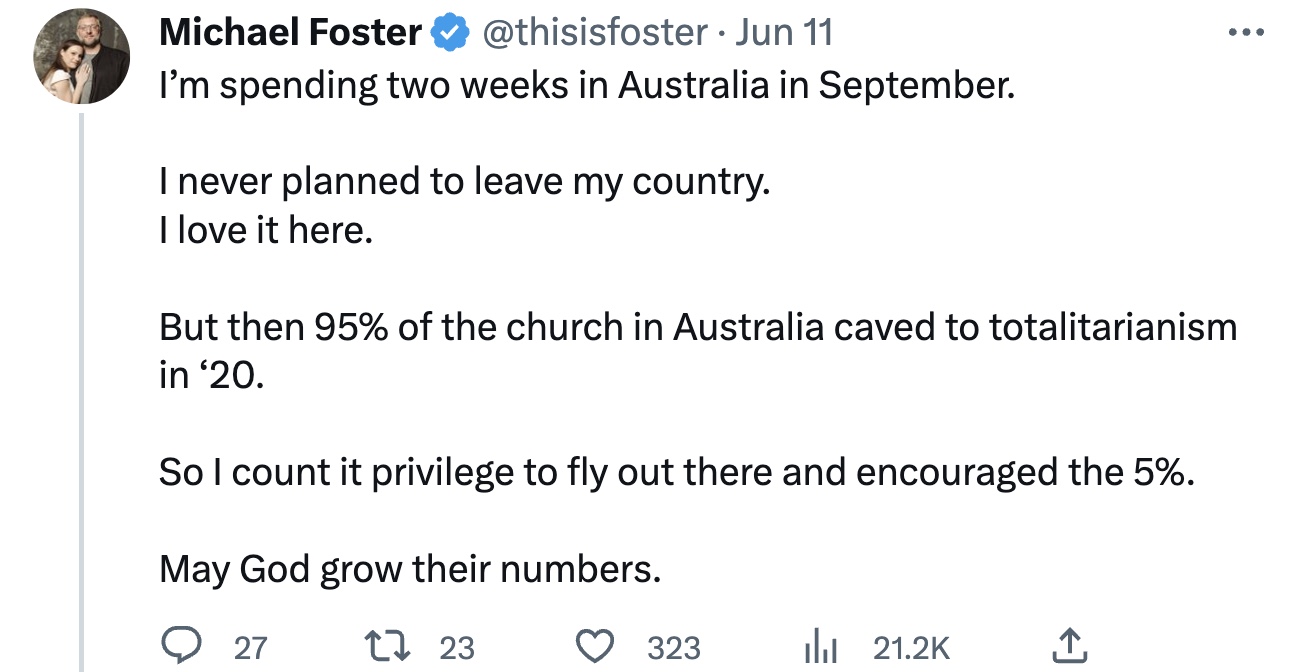
Can anyone else see what’s wrong with this tweet?

“I choose the Australian church for my first “mission trip” because no one cares about white Christian Westerners.”

Michael Foster is an American Pastor who is coming to Australia later in the year on a mission. Apparently no on cares about ‘white Christian Westerners’ in Australia and the issue is so pressing that we need an American to fly across the Pacific and bring salvation. 

Foster has never visited Australia, and yet in recent days he issued a series of clarion calls on what is wrong with Australian Christianity and he has the guts to fix our ills!

“Im spending two weeks in Australia in September.

I never planned to leave my country.

I love it here. 

But then 95% of the church in Australia caved to totalitarianism in ‘20.

So I count it privilege to fly out there and encouraged the 5%. 

May God grow their numbers.”

Leaving aside Foster’s superficial take on the cultural and Christian landscape of a nation he’s never spent time in, what point is he trying to make when he alleges, ‘no one cares about white Christian Westerners’ and what is his mission?

Does this American not realise that Australia has the highest percentage of migrants of any country in the Western world? Is this a bad thing? 

That aside, what does this tweet suggest to the huge numbers of Asian, African and Middle Eastern brothers and sisters who belong to our churches and who are amazing and vital members in the work of the gospel here?

What is Foster trying to say about churches in Melbourne that don’t speak English or who are majority Chinese or Persian or Korean and Vietnamese? 

One of the places Foster is due to speak is a Melbourne suburb where 55% of residents were not born in Australia. More residents are ethnically Chinese, Vietnamese, Cambodian, Indian and Sri Lankan, than of Western descent. What kind of message is Foster’s tweet sending to this local community? 

Does Keysborough need rescuing from some white American dude? And do white Christian Westerners require some kind of protection or assistance from this American preacher? If anything we can be learning lessons from our brothers and sisters in China and Iran and Nigeria. 

If Michael Foster’s mission to Australia isn’t enough to throw up a red flag, there’s more. Foster is apparently coming to fight for the small number of Aussie churches who railed against Romans 13 during the COVID pandemic. 

Titus 3:1 tells Church leaders to “remind the people to be subject to rulers and authorities, to be obedient, to be ready to do whatever is good”. Foster has another mission.

Yes, the pandemic was an incredibly hard season for all Australians. Yes, the pandemic response has created all kinds of social, health, and economic pressures we will be addressing for years to come (as early as 2020 it was clear that prolonged lockdowns would have this effect). Yes, not everyone agreed with every Government policy. Yes, mistakes were made (hindsight is an easy tool to wave around).  Yes, Christians have many responsibilities and our attitudes and decisions should be informed by multiple theological threads. Christians hold together multiple responsibilities at the same time. Yes, Christians have some warrant for concern by Government overreach on different issues. Yes, some Christians acted selfishly and promoted anti-authoritarian and even dangerous ideas. There were of course a few churches filled with self-taught epidemiologists and prophets who were able to discern that Covid was fake news, or at most, just a really nasty virus. The majority of churches however chose a different path, one that neither blindly disobeyed Government and one that didn’t cave into totalitarianism. 

Foster’s shallow and even misinformed view of how Australian Churches lived through the pandemic is easy to call out. Although he doesn’t seem to be the type of guy who’s up for conversation.  When I pushed back on him yesterday, he insisted that I be ‘defrocked’! Can you imagine defrocking a baptist pastor?! 

I wouldn’t have known Michael Foster was visiting Australia later this year, nor would even know his name except that a friend messaged me yesterday and reminded me of an American Pastor who has a nasty habit of denigrating women.

The first time I came across Michael Foster was last year and once more a few months ago. The context was an online exchange between Foster, Douglas Wilson and others. I was appalled by how he spoke about and to women. 

And before a reader asks, is Foster a complementarian? No, he is not. He rejects complementariansm and his online attacks (those I’ve seen) have been aimed against complementarian women.

Dr Dani Treweek is (in no particular order) a theologian, a Sydney Anglican, a Deacon, a complementarian, a woman, and single! Dani is a thoughtful and engaging academic who has recently published a significant work, The Meaning of Singleness: Retrieving an Eschatological Vision for the Contemporary Church. Dani is a gift to the church and her study on the subject of singleness is a blessing to Australian Christianity. 

Last year, Dani challenged views expressed by Michael Foster and Douglas Wilson on a podcast.

“Wilson and Foster embark on a shared lament about the impending crisis facing churches whose pews are soon to be filled with lonely, unlikeable, tubby spinsters who have nothing in their lives and so spend their days endlessly seeking the benevolent attention of their ever-patient but extremely busy and very important senior pastor.”

She sums up Foster and Wilson’s views on single women as:

  • the reason women are single is because “Baby […] You can do better than this. You’re not likeable” or because they are too “tubby” to be considered of marital value to the men around them (at least the ones they haven’t driven into the arms of Islam);
  • single women are derogatorily dismissed as a “bunch of old spinsters
  • anyone not married by the time they are 40 are issued the dire warning that they ‘will be lonely
  • elderly widowed women are depicted as a tiresome burden upon the senior pastor’s time and energy
  • the only valuable and valid expression of love in action is if it is directed towards someone’s own offspring and then their offspring
  • single women are the harbingers of “chaos
  • unmarried women don’t “have anything” in their lives”

If your pastor holds these kinds of attitudes toward single women, please save yourself and find another church. 

Someone shared Dani’s material with Michael Foster over on Twitter and his initial response was this,

“I find all exegetical criticism suspect from any woman who calls herself a “Reverend.”

Thankfully several people pushed back on his tweet, including this,

“Really poor form to start your response to a carefully argued and Biblically sound critique “I find all exegetical criticism suspect from any woman who calls herself a “Reverend.” You could start by reading her article & repenting of your cavalier attitude to a godly sister.”

Sadly, this wasn’t a one off bad moment on social media. In an exchange this year, Michael Foster presented a tirade of condescending and sexist comments including these, 

“Ma’am, I’m not interested in more of the same.

I’ll spend my time gutting this nonsense, normalizing marriage, & equipping couples to live happy & fulfilled lives serving God.

The trendiness of pandering to lifelong singleness is coming to an end. You’ll soon need a new trend.”

And this…

“Yes, it is you who needs me. The sun is setting on your ilk, Rev. Dr. Ma’am.”

And let’s not forget…

“Don’t let heartless PhD mislead you.”

And once again…

“My last word to you is God will hold you accountable for those who mislead. 

It’s heartless and cruel to tell both men and women that the state of singleness is the same as a gift of celibacy.”

Condescension? Absolutely. Misogyny? Certainly sounds like it. But I’m told that Michael Foster has written the manual for men! 

As it happens, I have many American friends. They are godly, thoughtful, and generous people. I love my American friends and spending time with them is a great joy. We in Australia have also benefited much from Christian men and women from the United States who share their gifts and time with us. We can and do learn from them. But let’s be honest, the United States is also famous for exporting some ideas and people that we can do without. 

The last time an American visited our shores to preach about all that Aussie Churches were doing wrong, we listened politely and tried to find a useful strand amidst the straw. I don’t think we need another.

So why I have bothered putting together a few words about an American far far away? Because I think Foster’s online presence gives Christians a bad name and  I think men who speak to women in the manner that he does, should be called out. Perhaps those inviting Foster are unaware of some of his ideas and words? I don’t know.

Of course, Christian organisations and churches are free to invite whomever they wish. Churches have a freedom to align themselves with teachers and teachings. Not everyone agrees with everything I write or every conference I’ve helped organise. I get that. No doubt, there is a market, albeit a small one, for Foster’s views about women and defence of ‘white Christian Westernism’. It is also appropriate for others to send up a red flare to signal, do we really need another preacher fostering these kinds of attitudes Down Under.

Tim Keller’s life and death point us to a great hope

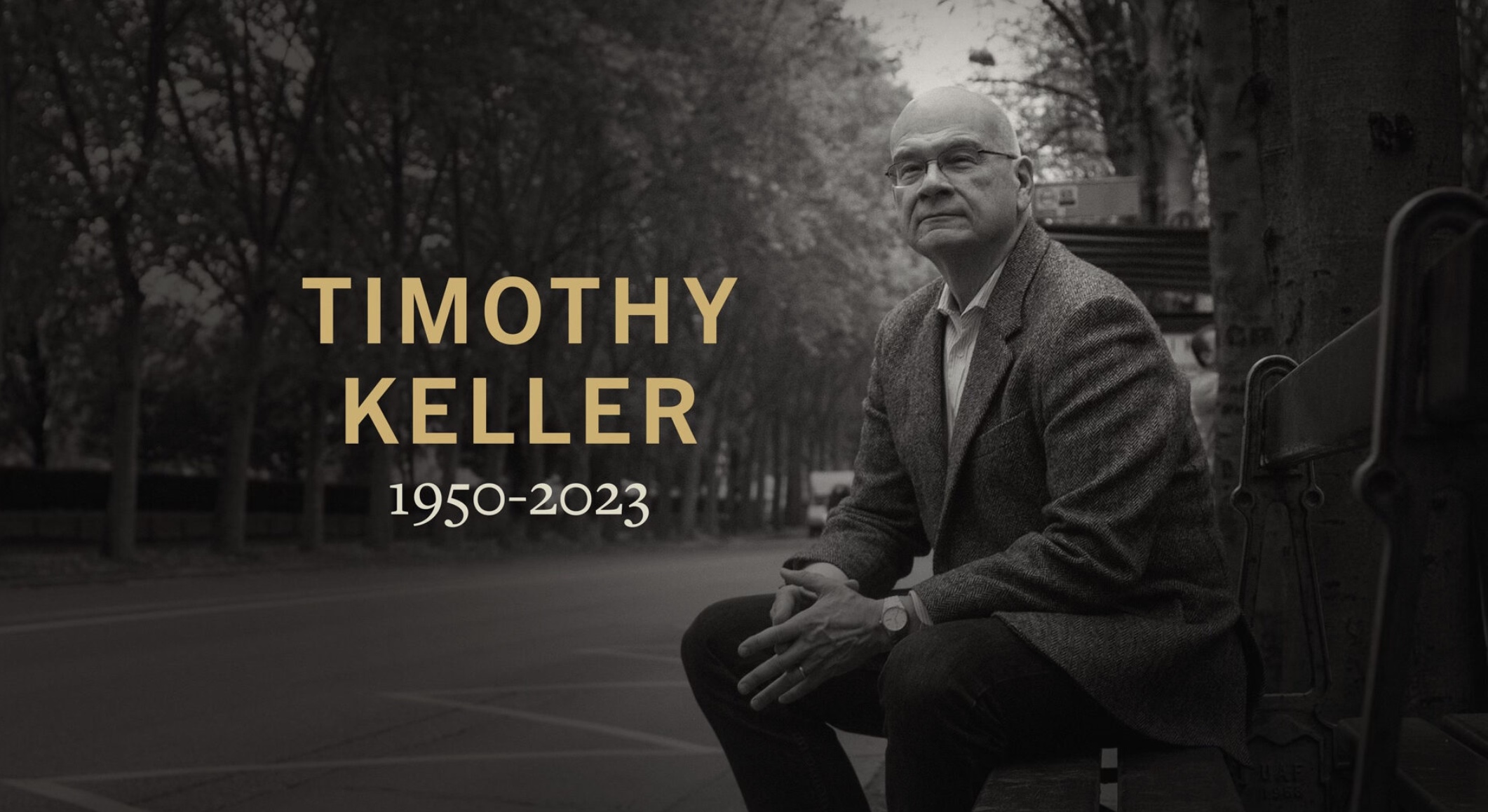
I have decided to write a few words about the death of Timothy Keller, realising that many words will be composed over the coming days about Manhattan’s Pastor. 

Few evangelical Christians have not been influenced by Tim Keller in some way over the past 30 years. While he preached for New Yorkers and planted churches for New York, his Gospel-centred teaching has impacted Christians all around the world, including Australia. 

I first heard the name Tim Keller in June 2000 at the annual Evangelical Ministry Assembly in London. The topic of the conference was church planting, and the speakers included Dick Lucas, D.A Carson, John Chapman, Phillip Jensen, and Tim Keller. Yes, the theological spiritual meal those days surpassed the menu at Eleven Madison Park. Keller’s preaching didn’t contain the charisma and firepower that was present among some figures on the platform, but over the years I began to increasingly appreciate and understand the hows and whys of his teaching ministry, and to learn from him.

I’ve only met Tim Keller once, and it was a conversation on a sidewalk in midtown Manhattan; it was brief and unassuming. Over the years I have read some although not all of his books. Making Sense of God may well pass the test of generations like CS Lewis’ Mere Christianity. Another book, The Prodigal God has remained with me, helping shape my own heart before God and the manner in which I am seeking to learn to write and teach.  I am forever grateful for the ways Keller has helped me think and write, not through the prism of left or right, progressive or conservative, the legalist or the antinomian, but in that better space filled with God’s truth and grace, his righteousness and his love. Indeed, I haven’t needed to read every Keller book and listen to every Keller sermon to understand his theological heartbeat because he was all about Jesus and helping people to see and grasp and believe the greatest story the world can know: the Gospel of Jesus Christ. By digging deeper into the treasure of God’s good news helps us see the key to Keller’s mission and ministry. 

Many will be mourning his death today, and understandably so. The world will see few Tim Keller’s in a generation. But then again, and going back to his heartbeat, what motivated Keller and what his ministry oozed with, was the same beautiful and powerful Gospel that is at work in the lives of all who trust in Christ. His unique and influential ministry is extraordinarily ordinary in that once, and that is what made it worthwhile. 

I am also grateful for the way Tim Keller helped uncover and encouraged a new generation writer by the name of Christopher Watkin. While I’ve had the joy of knowing Chris for 9 years and been deeply impacted by his thinking, few knew the name until Tim Keller read Chris’ book, Thinking Through Creation. Last year, Chris Watkin’s, Biblical Critical theory was published. Tim wrote the Forward and in it he explained how he had waited for years for someone to come along and write this book. Time will tell, but Biblical Critical Theory is already considered to be one of the most important books written this century. Thank you Tim Keller for encouraging Chris and in Christian service helping the world find more Christian truth to be read and grow and benefit.

The reason for writing this short reflection about Tim Keller is less about talking about Tim Keller but to offer a corollary point. Because you see, my mum is currently in palliative care and we don’t expect her to live out the day. She has been unwell for a very long time and the last 4 months have been particularly difficult for her and my dad. We have been called into the hospital numerous times over the last few weeks, as staff expected her to pass any moment. As I write, my mum is still alive although her final hours are coming to an end. But you see, my mum trusts and believes the same Jesus as Tim Keller. Her hope isn’t in her own righteousness but knowing that Jesus died and was raised from the dead. And that makes all the difference. It really does. 

My mum never wrote any books and will certainly not receive an obituary in the New York Times, but like Keller and a billion people around the globe today, she is known by God. That fact is both the great leveller and elevator.

The Apostle Paul famously wrote, 

“For to me, to live is Christ and to die is gain. If I am to go on living in the body, this will mean fruitful labor for me. Yet what shall I choose? I do not know!”

The Christian cannot lose.

Our age of self-realisation isn’t producing great volumes of satisfaction, hope and life. We are more frail and fearful than ever. Among both the great and the small, the known and the little known, there really is concrete hope that frees us to live well today and be certain about eternity

Tim Keller’s son, Michael, shared on social media yesterday that his dad say, “I’m ready to see Jesus. I can’t wait to see Jesus. Send me home.”

I know my mum is thinking those very words as well, and I pray that others too might not just find some vague solace in the comforting words, but the living hope that is for all who come to the Lord Jesus.

Peter Hollingworth keeps his ‘holy orders’ and victims are understandably angered

I have to confess, I was shocked to read that Peter Hollingworth has kept his holy orders. I was also surprised to learn that he hadn’t been removed from ministry years ago. 

Peter Hollingworth served as the Anglican Archbishop of Brisbane from 1989-2001 when he was appointed the Governor General of Australia. He was also made the Australia of the Year in 1995. Two years into his role as the Queen’s representative in Australia, Hollingworth resigned due to serious allegations made against him for covering up pedophile priests. Calls for Peter Hollingworth to be stripped of his ‘holy orders’ led to an inquiry which has this week determined that he is fit for ministry. While the Professional Standards Board of the Anglican Church recognised Peter Hollingworth’s failures and has limited the type of ministry he can now engage in, he will remain a priest of the Anglican Church and able to conduct weddings, funerals and baptisms. 

Our society often gets it wrong when it comes to evaluating churches and church leaders, but sometimes they are right. And it’s frustrating when churches cannot even meet that low standard. The standard for churches is not the same as society at large. It is far higher, or at least it ought to be. 

I want to be clear and make the important distinction between the bar for someone becoming a Christian and the bar for those wanting to serve as Christian pastors. The bar for becoming a Christian is in one sense, very low: the Son of God died for sinners. Repentance is necessary and trust in Christ, but God justifies and forgives on account of the perfect sacrifice of Jesus, not by any resume or sense of holiness that we might attribute to ourselves. That’s good news because I’m not redeemed by religiosity or spiritual intensity, but simply by saying yes to the one crucified and raised from the dead. By definition Churches are not made up of the self-righteous but those who realise we are not. But of course, that kind of life-saving work turns life around and begins to change affections, attitudes, and actions.

However, for those who desire to serve as ministers, the bar is set high. Take a look at this one example passage from the New Testament, 

“Here is a trustworthy saying: Whoever aspires to be an overseer desires a noble task. Now the overseer is to be above reproach, faithful to his wife, temperate, self-controlled, respectable, hospitable, able to teach, not given to drunkenness, not violent but gentle, not quarrelsome, not a lover of money. He must manage his own family well and see that his children obey him, and he must do so in a manner worthy of full respect. (If anyone does not know how to manage his own family, how can he take care of God’s church?) He must not be a recent convert, or he may become conceited and fall under the same judgment as the devil. He must also have a good reputation with outsiders, so that he will not fall into disgrace and into the devil’s trap.”

The role and responsibilities attached to being a shepherd of Christ’s church are so important that the qualifications are set high. Hence, I appreciate why many people are not only scratching their heads this morning, but are feeling sick at hearing the news that the Anglican Church believes Peter Hollingworth is fit for duty.

The Professional Standards Board of the Anglican Church is perhaps privy to information that the public is not. Although, Peter Hollingworth has admitted fault. I acknowledge that I am not across this story as fully as others, but the optics look bad. More than public perception, there is a serious question here about doing what is right in the eyes of God and for the sake of victims of horrendous evil. 

It shouldn’t surprise us to see that where denominations or dioceses play loose with the Bible’s teaching on sexuality and where orthodoxy is treated as optional, morality and godliness is also found wanting. Where doctrine falls it only takes a few steps for godliness to fail. Indeed, it often works the other way around; we change our doctrine to fit our desired morality.  Of course, there are other reasons for excusing or covering up child sexual abuse: complicity, fear,  power, and an array of unbecoming qualities for any who has the responsibility to care for Christ’s Church.

I think it is also the case that even 20 years ago,  we were unaware of the extent to which such evil was taking place in some ecclesial quarters. Churches and Christian denominations have certainly upped their game in recent years.  There are healthy and rigorous processes in place, not only for those seeking ordained ministry but in order to keep their qualifications. That is a good thing. But that’s what makes this decision so baffling and understandably survivors of sexual abuse are angered, confused and losing even the tenuous hopes they had in churches doing the right now. 

If you are baffled by the decision made by the Professional Standards Board of the Anglican Church, so am I. At the very least, greater clarity needs to be provided as to why Peter Hollingworth is fit to keep his ‘holy orders. In the meantime, I grieve the repeated failures of our churches. I know most are unlike the villains portrayed in the media, but can we blame our secular friends for finding it difficult to see the difference?

These words from the book of Ezekiel are formidable. The religious leaders in Ezekiel’s day weren’t taking the responsibilities seriously, both in terms of what they taught and how they lived. God gave a damming assessment, and it’s one that perhaps ecclesiastical leaders need to once again read and tremble before, 

“Son of man, prophesy against the shepherds of Israel; prophesy and say to them: ‘This is what the Sovereign Lord says: Woe to you shepherds of Israel who only take care of yourselves! Should not shepherds take care of the flock? You eat the curds, clothe yourselves with the wool and slaughter the choice animals, but you do not take care of the flock. You have not strengthened the weak or healed the sick or bound up the injured. You have not brought back the strays or searched for the lost. You have ruled them harshly and brutally. So they were scattered because there was no shepherd, and when they were scattered they became food for all the wild animals. My sheep wandered over all the mountains and on every high hill. They were scattered over the whole earth, and no one searched or looked for them.”

Thank God He provides a Shepherd who never fails or falls short, the Good Shepherd, 

“This is what the Sovereign Lord says: I am against the shepherds and will hold them accountable for my flock. I will remove them from tending the flock so that the shepherds can no longer feed themselves. I will rescue my flock from their mouths, and it will no longer be food for them.

11 “‘For this is what the Sovereign Lord says: I myself will search for my sheep and look after them. 12 As a shepherd looks after his scattered flock when he is with them, so will I look after my sheep. I will rescue them from all the places where they were scattered on a day of clouds and darkness.” 

Melbourne is officially the biggest city and yet churches are declining

News broke yesterday confirming that Melbourne is Australia’s largest city. Thanks to the city planner who has redrawn the city limits, Melton is now part of Melbourne and hence, Melbourne is the biggest city in Australia, with now 4,875,400 residents and growing!

A certain degree of pride is deserved. After all, until we grabbed the title of the world’s lockdown capital, Melbourne was acclaimed as the world’s most liveable city. And while we may have lost that near totally useless title, we still have the best coffee in the world and the MCG!

The day after capturing another somewhat superfluous title, the Herald Sun exposed a not-so-secret story about our town, namely, fewer people are attending and belonging to churches in Melbourne.

Mandy Squires reported,

“Christian churches are closing in Melbourne suburbs like Box Hill and Victorian regions like Ballarat

Once the anchor of communities, increasing numbers of Christian churches are closing across the state. This is why suburban and regional Victoria is losing traditional religion.”

But “the faithful” are ever fewer in Victoria, and Christian churches are closing their doors across the state at an alarming rate – a process some research suggests was hastened by harsh Covid lockdowns and restrictions.

Dwindling congregation sizes have combined with rising insurance fees, maintenance costs and increasingly onerous building safety compliance expectations, to make the price of keeping ageing churches operational simply too high for many denominations.

The burden of upkeep has also largely fallen to an ever smaller group of, also ageing, parishioners.”

There is a complex web of data and factors that need to be taken into consideration when evaluating how churches are doing in Melbourne today. COVID has impacted every part of life and it’s hit churches hard, both financially and with peoples’ capacity to serve and volunteer. At the same time, I think Squires’ summary is fair. The pandemic didn’t kill churches, it simply sped up the dying process. There is something to grieve in this; An ageing congregation can be a faithful church and yet unable to keep going under the weight of regulations, rules, and costs. It’s difficult enough for a middle-sized church where I serve, let alone a congregation where all that remains are 20 elderly members.

As Mandy Squires notes, church closures are not only happening across Melbourne suburbs but also across regional Victoria. This isn’t a Victoria only phenomenon, this is widespread across much of Australia and indeed the Western world. Alternative belief systems, most notably the god of the self, have captured the imaginations of our streets and roads. After all, the priests of expressive individualism promise freedom and happiness and a sinless life for sin is nothing more than oppression dipped in sanctified language. We don’t need God, for Melbourne is as close to heaven as it gets. Sure the pandemic proved otherwise, but now we are waking up from the nightmare and hoping that normalcy returns.

Squires notes that there are evangelical churches growing and attracting younger people. This growth isn’t at a rate that can overturn the overall decline but these churches are often an oasis in the middle of a spiritual desert. Reader, please note, by evangelical, we don’t mean some American religiopolitical craziness. I use the term with its proper meaning: Evangelical refers to churches that are grounded in and preach the evangel (evangel is an English word for gospel). These are churches that believe and teach the Gospel of Jesus Christ as handed down to the church by the Apostles in the Bible. 

Reading Squire’s piece can feel like another dreaded reminder. But before the doom and gloom set over the conversation like a Melbourne winter, we do well to remember that this same ancient Gospel is growing around the world today. For example, while the UK may be becoming less Christian, there are more people in London today who belong to a church than in many decades. And in France, evangelical Christianity is seeing remarkable growth, with around 745,000 adherent today in contrast to around 50,000 in 1950. And if we’re interested to see where Christianity is truly blossoming, look to China and Iran and to Africa.  While  Church of England parishes are declining in England and in many parts of Australia (take note, it’s not all cities and regions), Anglicanism is growing across Africa. Indeed, Anglican’s home is no longer Canterbury but places like Nigeria and Rwanda where GACFON is currently meeting.

Christianity isn’t dying, Melbourne is witnessing the death of nominal Christianity. Where classical Christianity is believed and taught, there is growth. It may not always be in line with population trends but nonetheless, unbelievers become believers.

The church where I have the privilege of serving grew from 30 people in 2005 to over 200 people by 2017. We then planted a church near Monash University (Regeneration Church). Praise God, they continue to grow. They are seeing people become Christians, especially university students. To be honest, Mentone Baptist Church has struggled to grow in the last few years (COVID has been a substantial factor), but this year we are again seeing many visitors and people curious to find out more about Jesus. I know of many more Melbourne Churches that have seen growth in the past decade and at higher rates than Mentone.

There is of course no silver bullet when it comes to church growth, as though employing the right technique or strategy is the key. The missing ingredient isn’t to give people what they want. Sure, we can find the odd church that puts on a weekly production that’s as impressive as U2 in concert, but also note how people leave these performing venues through the back door almost as quickly as they enter through the front.

There is, however, a connection between what is believed and taught and the health of a congregation. Churches that have a high view of the truthfulness and sufficiency of the Bible, who believe in the sinfulness of humanity, who trust the substitutionary atonement of Jesus Christ, and who follow the Gospel call for repentance and faith in Jesus, are more likely to experience health and growth. The more progressive a church is, the more likely it will experience decline. The classic example is the Uniting Church which has lost something like 50% of is adherents since its beginning in 1977. Anglicans and Baptists who’ve followed this liberalist agenda of dumping the Bible of its Divinity and reliability also find themselves with a growing number of empty chairs as the years move on.  Faithfulness to the Bible actually works.

The topic of gender and sexuality is an interesting one. We know for example that the Christian view on these matters is a significant reason why millennials are disinterested in Christianity. Part of this misunderstanding is the product of successful campaigning by Hollywood, social commentators and activists who demonise even Jesus. What’s interesting,  is that those churches that adopt the culture’s sexual ethics are more likely to shrink, while churches that uphold the classical Christian teaching on these matters tend to either hold their ground or see growth, including among millennials. 

After all, why join a church if all it does is mirror popular culture back to me?

I recall an observation made by British historian Tom Holland in 2020. He said,

“I see no point in bishops or preachers or Christian evangelists just recycling the kind of stuff you can get from any kind of soft left liberal because everyone is giving that…if they’ve got views on original sin I would be very interested to hear that”.

Holland isn’t a Christian but he understands the lunacy of ecclesiastical leaders sacrificing Christian beliefs at the expense of pursuing favourable opinion polls or trying to draw in potential pew sitters. Didn’t Jesus say, “You are the salt of the earth. But if the salt loses its saltiness, how can it be made salty again? It is no longer good for anything, except to be thrown out and trampled underfoot”?

What makes Christianity distinct and enthralling, shocking and appealing, is that it does not sit comfortably in any given culture. The Church is the community where people from progressive and conservative backgrounds, religious and nones, all find in Jesus Christ the God of truth and grace, love and goodness.

Melbourne (and Victoria) needs more churches. 

For a moment, let’s leave aside the religious aspect of church life. Of course, this is impossible given how the Christian faith is embedded into every song, brick and cup of coffee.  And it is, after all, the Christian message that gives birth to a church. But from a sociological perspective, the loss of Christian churches is creating a social vacuum in local communities that has not been replaced. Human beings need social interaction and relationships and such spaces are rare in today’s fast pace and time-poor society. Sure, there are schools, the local cricket club and a men’s shed, but there’s little else that brings people together, especially bringing together people who have little in common. And let’s stretch the imagination for a moment, what of a group that meets regularly and has little in common and yet shares everything in love and with happy sacrifice? 

Going back to the expressive individual that we idolise today. This good news message of ‘being yourself’ and ‘expressing yourself’ is popular and attractive, but let’s be honest, it doesn’t build togetherness, much less bring together diverse people into deep friendships. The very ethos Melbournians are taught to pursue, pushes against belonging, and without that sense of community we lose ourselves. As Jesus argued, there isn’t much point in gaining the world if in the process we lose our soul!

Melbourne needs 50 new churches today (and with 200 people in each) just to keep up with the annual population growth which stands are around 100,000 people. Melbourne needs small churches and big churches, meeting in different shaped buildings with different styles of music and preaching in different languages. Melbourne may be a great city, and the city I love, but it’s still going to hell without Jesus. Premier Daniel Andrews can’t atone for your sins. Governments, schools and universities aren’t fitted for the task of reconciling God to us. The footy club might provide exercise and a beer, but it won’t fill the soul. An afternoon of shopping at Chadstone might bring a little relief but it can’t heal the human heart.

There is something stunning and ordinary about the local suburban church. There is a goodness that can be uncovered, not inherent in the people but in the Christ whom they are getting to know and trust. Churches are not perfect communities. Indeed, we have learned how cassocks and altars are stained with the blood of innocent children. Most of the time, our churches are made up of ordinary people from all kinds of backgrounds who are together coming to know God. I can’t think of a greater community building project than this.

Melbourne needs Christian communities filled with thankful, gracious, loving, and truthful men and women. We need more churches that are clear on the gospel and convicted by the gospel and courageous to keep speaking the gospel. The question is, are churches up for it? Are churches ready to make the necessary changes (or should we call it reformation!)? I guess it depends on how much we love: love God, love the church, and love the people of Melbourne. 

QandA Episode raises questions about religion in Australia

Last night’s episode of QandA on the ABC featured a discussion about God in Australian life, culture and politics. Questions and conversations were wide ranging, and like in the real world, God’s talk wasn’t far away, although I suspect Easter had something to do with it. 

The program conducted an online poll, asking, ‘Should politicians still say the Lord’s Prayer at the start of each sitting day?’

Of course, conducting a poll on ABC today is like surveying AFL supporters and asking whether they prefer to watch AFL or lawn bowls?

The surprise wasn’t the 83.5% who said no to the Lord’s Prayer but the 13.6% who said yes. By the way,   if you’re interested to read what is a typical Christian view on this topic, take a look at this article. You may find the answer surprising.

Conversations among the guests were cordial and void of the spite that is sometimes present.  It’s not as though they were unified in political or religious agreement, but the Anglican Archbishop, Muslim Labor Senator, the Indigenous Academic, the young liberal, and the British journalist, went about it with a tone of respect and humility.

The online world is of course a different place. It’s like navigating the Australian bush,  with sharp teeth and claws ready to devour any dislikable opinion. Throughout the show, tweets were displayed on our television screens, selected by the producers. These pithy opinions played out a regular pattern: religion should stay out of politics, Churches should stay silent on the Voice to Parliament, and others citing with certainty what Jesus would do today! In contrast, panellist Anne Pattel-Gray and an Indigenous woman from the audience both called on Churches to be more proactive in speaking about the proposed Constitutional changes.

I want to address one question in particular which became the focus of the final minutes of the program.

The question came from audience member, Oliver Damian. He asked,

“According to the 2021 Australian census, those declaring that they have “no religion”, the nones, increased to almost 40 per cent second only to Christianity. David Foster Wallace said “There is no such thing as not worshipping. Everybody worships. The only choice we get is what to worship.” Do you think these “nones” really ditched religion or have they just shifted to worshipping things that are much worse? And what does this mean for the soul of our nation?”

Andrew Neil answered, “Of course. Reality television, worshipping themselves, validating things they believe in…”

People took offence at Neil’s suggestion and defended their non-religiosity. 

I threw my hat in the ring and tweeted this,

“There are no religious free people. We are worshippers at our core”.

People were similarly offended. But should the nones take offence? It’s worthwhile exploring this phenomenon and further explaining the thesis that everyone worships.

First, we can’t escape religion.

Andrew O Neil observed on QandA how Christianity is declining in Western nations, including France and his own United Kingdom. Australia can be added to that list. While we can’t deny the trend, there are also counter trends. For example, the number of practising Christians living in London is increasing, and the number of evangelical Christians in France is also growing, with around 745,000 adherent today in contrast to around 50,000 in 1950. Then, of course, Christianity is growing at phenomenal rates in many other parts of the world today. What we view as dangerous, millions of people in Africa, Asia, and South America are discovering is good news. 

Australia’s nones may claim neutrality as though there exists a pure secularist mindset freed from any religious entanglements. Such a posture is framed by self-righteousness and it’s one that is already beginning to fray and lose its shape. 

We can’t escape religion. Built from a narrow bend in the Enlightenment road, we Westerners love to mock belief in God. Our hubris convinces us that the world no longer needs notions of heavenly realities and life to come. This world is all there is and there is no overarching design or purpose beyond that which we determine for ourselves.

The British historian, Tom Holland has demonstrated in his book Dominion that our culture is not the only indebted to Christianity, but Christian ideas remain t deeply embedded in our subconsciousness, such that they continue to direct and influence our moral categories and judgements today.

“If secular humanism derives not from reason or from science, but from the distinctive course of Christianity’s evolution—a course that, in the opinion of growing numbers in Europe and America, has left God dead—then how are its values anything more than the shadow of a corpse? What are the foundations of its morality, if not a myth?” 

In cities like Melbourne, we are creating drought like conditions for the garden. That is, we are trying hard to remove theological language and spiritual concepts from the public space, but killing off every blade of grass and every root is harder than we might imagine.

As the book of Ecclesiastes puts it, 

“God has also set eternity in the human heart; yet no one can fathom what God has done from beginning to end.” 

We are wired to believe in God. Searching for meaning and hope beyond blood and brain, and behind the molecular and physics is instinctive. 

While the amassing nones like to claim autonomy, and a sense of epistemic and moral maturity, in blowing off God, they are, in fact, still relying upon posits or values instilled in us via the Christian God. Hence what we have today is not less worship, but rather a distorted worship.

Indeed, to rid ourselves of Christianity is to uproot basic societal goods such as notions of equality, forgiveness, and tolerance. All these things and more find their origins in the God of the Bible.  That is not to say that the atheist doesn’t have a moral framework, of course, she does. But these ethics have a Christian vein running through them and even when they don’t,  they are ethics created in opposition to the Christian God. 

Second, everyone worships.

Everyone worships. Worship does not necessitate a higher being or god of some description. Worship isn’t limited to temples, churches, prayers and choral music. Worship is about giving oneself to a person, object or idea. Worship means giving credence to and sacrificing for the cause that your heart most desires.

The Bible itself doesn’t reduce worship to acts of prayer and song that are contained within a religious ceremony and building. While there is a particular emphasis on communal worship (whether it is at the Temple or church), the language of worship extends to all of life. For example, Romans 12:1

“Therefore, I urge you, brothers and sisters, in view of God’s mercy, to offer your bodies as a living sacrifice, holy and pleasing to God—this is your true and proper worship”.

As both the law and Jesus teach, 

‘Love the Lord your God with all your heart and with all your soul and with all your strength and with all your mind’; and, ‘Love your neighbor as yourself.’” (Luke 10:27)

Not only is worship an all-of-life attitude, but it is also often centring on areas of life that might surprise. Timothy  Keller has made this powerful and somewhat disturbing observation about American politics in recent years,

 “They have put the kind of hope in their political leaders and policies that once was reserved for God and the work of the gospel. When their political leaders are out of power, they experience a death “

As philosopher Dr Christopher Watkin notes in his best selling book, ‘Biblical Critical Theory (an idol is a Bible way of describing substitutes for God), 

“Any idol engenders this sort of dogmatic totalitarianism because it becomes, within creation, the ulti-mate measure of what is good, drawing a line down the middle of the created order and classifying some of its objects, impulses, and values as unmitigatedly good and others as unrelentingly evil. This is the lot of those who “have sup- posed that the Final Good and Evil are to be found in this life” and so “with wondrous vanity . . . have wished to be happy here and now, and to achieve bless- edness by their own efforts.”

The only way to escape this totalitarianism is to have an object of worship that is outside the created order. Any idol on the creature side of the creator- creature distinction will lead to a situation in which some thing or things in the world are pursued in an unqualified and undiscerning way, and other things (whatever gets in the way of or stands opposed to the chosen idol) will be denounced or loathed in a similarly dogmatic way” 

The convinced naturalist or materialist isn’t without gods and idols, they simply take on a different form. Dr Watkin again, 

“These idols have their own cultic rituals, argues Richard Bauckham, namely the advertising that mediates to us their values and desires. Adverts are not sell- ing objects; they are selling us ourselves, repackaged and dependent on the aura of this or that product to graft onto us a borrowed identity”.

Worship is an act and attitude of thankfulness, adoration, and love. It’s something we all do from the Internet to work, from the shopping centre and to the church. The only question is, who or what are we worshipping? Who or what are we giving our lives to?

Indeed, the ancient gods of Molech and Artemis may have changed their names, but their insatiable desires remain with us. We label them with sociological terms such as self determination and expressive individualism. 

The worship of gods can be oppressive and problematic. The worship of self is arduous, stifling, and egocentric, for it means that everyone else and everything exists to serve me. We can’t deny the fact that religion is responsible for all kinds of heinous activities throughout history, both as a distortion of religions and sometimes as a result of faithful adherence to religious beliefs.  It is also the case that our godless counterparts have been proud participants in what is called sin and evil.

Australia may be trying to move away from Christianity, but we can’t easily distance ourselves from the cross: that symbol of Divine love, justice and mercy. We do, after all, acknowledge Good Friday as a national public holiday. 

For all our advancements and developments, we haven’t found a substitute for the cross of Jesus Christ, and neither do we need one. If Jesus should die for my sins and then defeat death on the third day with his resurrection, surely that should at least cause us to consider, does my religion or lack thereof, offering this kind of freedom and new life?

Donald Trump isn’t the Messiah

Donald Trump is being compared to Jesus Christ this week. Suffering and crucifixion analogies have been thrown around during Passion Week as President Donald Trump prepared to learn of the charges against him and then presented himself to the authorities in New York State.

Representative Marjorie Taylor Greene, protested in Manhattan,

“Jesus was arrested and murdered by the Roman government,” she said. “There have been many people throughout history that have been arrested and persecuted by radical corrupt governments, and it’s beginning today in New York City.”

As the President left the Course house and boarded his plane to Florida,  he joined in a ‘prayer call’, comprising an eclectic group of religious Trump followers.

I have seen footage of and tweets all week that make comparisons between Donald Trump’s trial and that of Jesus.  None of this is new. Adopting and hijacking the person and work of Jesus for political and social agendas is more common than we might realise. People have been doing so since Jesus’ actual trial and crucifixion. Constantine tried it at Milivian Bridge, David’s ‘The Death of Marat’ and 1000 other paintings that superimpose Christ’s sufferings,  the Confederacy and the KKK, the Taiping Rebellion, Horst Wessel,  some anti-vax campaigners, and more. 

Political agendas from both right and left have a long history of misappropriating the person and mission of Jesus Christ. I recall an incident only two years ago; a representative of the Victorian government informed a group of Melbourne church leaders what Jesus’ views on gender would be today, and then told us that contravening this thinking may lead to criminal charges. In case you’re wondering, this person was not even close to reflecting Jesus’ teaching. 

Sadly, there are times when members of Christian communities and leaders of Churches get swept up by these false narratives. That doesn’t mean that there is never any validity to the concerns they raise, but that it is bad theology and even blasphemous to equate their situation with that of Jesus’ suffering. 

Notice the religious language that President Trump chose for his speech following his court appearance?

 “America is going to hell”

Well, yes, that is a theological truism. It also accurately describes people in every nation, but it has nothing to do with allegiance to Donald Trump or some other political leader, but whether we can find atonement before God for our own sinfulness.

It is of course possible to think that the charges against President Trump are politically motivated and also believe that Trump has little moral compass. After all, behind the 34 felony charges of falsifying financial records are allegations of adultery and sexual immorality. There is no semblance of Jesus in this story. That is not to suggest for a moment that the political alternatives are morally or spiritually better. As a Christian leader, my responsibility isn’t to navigate political left or right but to follow Jesus and faithfully point people to him, a course that is altogether different.

Let it be said again, lest anyone is unclear, there is no comparison between President Donald Trump and Jesus Christ. One is a deeply sinful human being, the other the innocent Son of God. The former President carries with him a lifetime of transgressions, Jesus went to the cross taking our sins onto himself.

It is intriguing to see how again our society never moves far from the cross of Jesus Christ. All of history pivots on those three days: from the cross to the grave and to resurrection. And despite our best attempts to rid the culture of Christianity’s DNA, people from all walks of life and with all kinds of agendas, still think it is advantageous to attach themselves to the image of the suffering and dying Christ. 

What if, instead of identifying with the crucified One, we understand what the Easter story really does tell us, and that is, we all stand against Him. Rather than seeing ourselves close to Jesus, we are more like Peter who disowns, Judas who betrays, the Pharisees who denounce, and the crowds who mock.

Donald Trump is no Messiah figure. He is not an innocent lamb laying down his life to save a nation. He may or may not be innocent of these particular charges. But neither Trump nor President Biden and any political leader comes remotely close to the one who had written above his head on the cross, ‘the king’.

Regardless of where we find ourselves on the political spectrum, it’s nonetheless intuitive for us to find a hero in the story. We walk through life searching for someone who triumphs over adversity and overcomes iniquity and who can bring about the new Jerusalem.

Sometimes we put ourselves in that position as the hero, but when the hubris dissipates we are left with despair.  Sometimes we elevate our favourite celebrity or politician, but none of them qualifies to carry the burden. There is only one hero and Easter reveals him, and what a hero Jesus is,

“Father, forgive them, for they do not know what they are doing.”

An evening with Dr Christopher Watkin

Mentone Baptist Church recently organised a special event for our local community with Dr Christopher Watkin.

Knowing ourselves is one of the great questions. 

Christopher Watkin is an Associate Professor of European Languages (French) at Monash University, Melbourne. His books include Difficult Atheism (2011), French Philosophy Today (2016) and Biblical Critical Theory (2022).

Chris is emerging as an important intellectual figure in Australia today and he has a rare gift for explaining profundity and complexity with great clarity. Even more than his academic contributions, I value his epistemic humility and the gracious way he interacts with other people and ideas, and his servant’s heart.

His latest book, Biblical Critical Theory, has been likened to a 21st-century version of Augustine’s City of God. If you are able to find and purchase a copy, it is indeed well worth one’s time.

Both Chris’ presentation and QandA are recorded in the video below. Enjoy.

Email admin@mentonebaptist.com.au if you are interested to learn more about the subject matter raised in this presentation.

There really is hope: Why Easter is such good news

Sadness, shock, anger, disappointment, frustration, and despair. Such feelings are not uncommon in our streets and suburbs. Of course, there is much for us to enjoy, and opportunities abound for most people across Melbourne, and yet more and more data suggest that a cavity exists in many lives and it is only growing with time. 

In the extraordinary musical, Les Miserables, Fantine sings a song that haunts. The words tell her story. It is a story of lingering hope. It is a story of desperate hope that fades. It is a story that too many of our neighbours and friends resonate with, and perhaps even yourself.

I dreamed a dream in time gone by

When hope was high and life worth living

I dreamed that love would never die

I prayed that God would be forgiving

Then I was young and unafraid

And dreams were made and used and wasted

There was no ransom to be paid

No song unsung, no wine untasted

But the tigers come at night

With their voices soft as thunder

As they tear your hopes apart

And they turn your dreams to shame

And still I dream he’d come to me

That we would live the years together

But there are dreams that cannot be

And there are storms we cannot weather

I had a dream my life would be

So different from this hell I’m living

So different now from what it seemed

Now life has killed the dream, I dreamed

In our search for hope, we are often urged to look inside ourselves or to carry on and push through barriers. On other occasions, we are encouraged to hold onto relationships or careers as though these can secure contentment and peace. What happens when these things fall apart or fail? What happens when we reach all our goals, only to discover that they cannot fulfil the burden we placed upon them? 

Easter really does give us the answer. Maybe that sounds a little too Christian for you; an unimaginative and prosaic offering.  I don’t mean the long weekend or colourfully wrapped chocolate bunnies and eggs. I’m referring to the historic events that took place just outside Jerusalem about 2000 years ago. Even today, with all our latest gadgets and knowledge,  the world hasn’t overcome the irresistible story of God who gave his life for hopeless and helpless people. 

Over Easter, my church is exploring (as will churches across Melbourne) the good news story that never dies or fades or disappoints. On that cross, the darkest dark fell upon the Son of God in the place of a sinful world. On the Sunday morning, a light more brilliant than the dawning of the sun pierced history and continues to shed light on millions of lives across the world. 

Our Bible text for Easter Sunday this year includes these breathtaking words from John’s Gospel, 

“For God so loved the world that he gave his one and only Son, that whoever believes in him shall not perish but have eternal life. For God did not send his Son into the world to condemn the world, but to save the world through him. Whoever believes in him is not condemned, but whoever does not believe stands condemned already because they have not believed in the name of God’s one and only Son. This is the verdict: Light has come into the world, but people loved darkness instead of light because their deeds were evil. Everyone who does evil hates the light, and will not come into the light for fear that their deeds will be exposed. But whoever lives by the truth comes into the light, so that it may be seen plainly that what they have done has been done in the sight of God.” (John 3:16-21)

Notice, how God is described as recognising there is something not right in the world. Also, note how these verses assume God doesn’t agree with every want and desire and activity we pour our lives into; it’s as though we’re not the standard for righteousness. At the same time, there is a profound love spoken and expressed.

A lot of Aussies have given up on Church. Millions have discounted Christianity. When we’re being honest we can understand why this is sometimes the case, given the horrors uncovered in some church buildings and lives of clergy. At the same time, most churches aren’t playing games of pretension and hypocrisy, but they are filled with ordinary people who are convinced by the power and goodness of the God who has loved the world.

Many of our dreams cannot be and some ought not to be. But life cannot kill the greatest dream: God is forgiving. Jesus has paid the ransom. 

Why not visit a church this Easter? Perhaps open a Bible and read the Easter story for yourself (Mark chs. 14-16; John chs. 18-21)*

————————————

* You can read the Bible online for free. https://www.biblegateway.com/ is one of many great websites that allow us to search and read any part of the Bible)