It’s all Dutch to me

You may have read these startling words a few days ago:

“profit from making misery out of the lives of others”

“Australians are harming themselves and others”

These statements were among others released last week, raising suspicions as to what pernicious if not terrorist plans are being mounted in Australia.

Why are they calling for people to take advantage of those in desperate circumstances? How are Australians harming others, and who are these others? Syrians? Iraqis?

Far from belonging to a foiled terror plot, all three sentences were in fact spoken by Prime Minister Malcolm Turnbull, as part of a speech he gave last week at St Vincent’s hospital, Sydney. He was announcing the release of a report looking into the terrible trauma that the drug ice is inflicting on our society.

Without context, each of these lines could be interpreted in a range of ways, including a worst case scenario.

bibles

You may be one of the million or more people who have now watched on youtube, ‘The Holy Quran Experiment’. Last week, two Dutch filmmakers, Sacha Harland and Alexander Spoor, had the bright idea of taking a Bible and disguising its cover to  look like a copy of the Koran. They then walked the streets asking people for their reactions to certain ‘shocking’ verses that were read to them from the “Koran”. The Koran  of course was never cited, only Bible passages were read, such as from Leviticus ch.20 and ch.26 and from 1 Timothy ch.2.

People were genuinely convinced that the Bible verses being read to them where sayings from the Koran, and they offered comments such as,

“To me this sounds like they want to oppress you and force you to believe what they believe.”

“If you’ve been raised with this book and these kinds of thoughts, it’s going to influence the way you think.”

At the start of the video, Harland and Spoor offer this explanation for the experiment, “Muslims have been accused of following a faith that has no place in our Western culture. What about Christianity? A religion that has influenced our culture greatly”.

This “comic” Bible-Koran experiment might possibly reveal something about Dutch attitudes toward Islam, but what it really proves is sadly how illiterate people are when it comes to knowing the Bible (and also the Koran).

If the intent was, as the video suggests, to demonstrate how Christianity contains awful ideas and practices, they haven’t done a particularly stellar job. Ripping Bible verses out of their context says no more about Christianity than what you learnt about Malcolm Turnbull when I cut and pasted from his speech on fighting drugs. Phrases and sentences have historic and literary contexts, without which, they lose the meaning given to them, and thus we end up reaching all kinds of strange conclusions that were never intended. That is not to say that the Bible doesn’t describe some pretty shocking events or contain ideas that challenge our modern sensibilities, but reciting words without their context helps no one to understand either the Bible or Islam. If anything, these Dutch comedians haven’t mocked the Bible, they’ve  made a bad joke about their own methodology.

I wonder if Australians are as biblically illiterate as the Dutch? I hope not, but I suspect so. Perhaps there is a lesson here though, read the Bible more not less!

Lord’s Prayer Banned

The Lord’s prayer is more wonderful and more dangerous than you think.

A 60 second advert produced by the Church of England has been banned by some of Britain’s cinema chains.

The advert features various individuals and smalls groups taking turn in reciting lines from the Lord’s prayer, and the advert ends with this call, ‘Prayer is for everyone. #justpray’

IMG_3856

The pray itself doesn’t belong to the Church of England, the words originate with Jesus himself, and they form part of his broader teaching on prayer to his disciples, which one can read in Matthew’s Gospel.

Digital Cinema Media (who own many of the cinemas), have explained that they have a policy of not accepting political or religious advertisements, in the case that they might cause offence. Leave aside the fact that many movies are an insult to art and to our intelligence, if Digital Cinema Media were so concerned about offending people should they not show care in their choice of movies being screened? How many films offend peoples religions (including Muslim people)?

Speaking to the Guardian, outspoken atheist, Richard Dawkins said, “My immediate response was to tweet that it was a violation of freedom of speech. But I deleted it when respondents convinced me that it was a matter of commercial judgment on the part of the cinemas, not so much a free speech issue. I still strongly object to suppressing the ads on the grounds that they might ‘offend’ people. If anybody is ‘offended’ by something so trivial as a prayer, they deserve to be offended.”

Watch the advert and decide for yourself, but I find myself leaning toward Dr Dawkins (and he says miracles can’t happen!).

While I believe Digital Cinema Media’s decision is silly, I also think the advert’s producers have made some errors.

For example,

#justpray is misleading because it could be easily misconstrued as, just pray to whoever; the details don’t really matter. I realise that’s not the intent, which of course makes the hashtag all the more unhelpful.

A more significant concern is the invitation to call God, Father. This is an incredibly wonderful idea, and it is unique to Christianity. To know God as Father suggests that he is not an impersonal being, but he is relational and personal. What a remarkable concept Jesus is teaching.

But he is not everyone’s Father, and therefore it is imprudent to call him such. The Bible shows us that we only have the privilege of knowing God as Father through faith in his Son. It is inappropriate for any child to call me dad, only my children can do that. Similarly, only God’s children can truly address him as Father. One of the great truths of Christianity however is that we can come to know him as Father.

‘In love he predestined us for adoption to sonship through Jesus Christ’ (Ephesians 1:4-5). The Bible teaches us that we can know God as Father, but it is through Jesus. By trusting in his death and resurrection, we are no longer separated from God, but are included into his people and brought into a personal relationship with God.

Finally, when we pray, ‘your kingdom come’, we are asking for God to not only save, but also to judge this sinful world. It is calling for God to rid the world of every evil and injustice, including our own. Should we encourage people to ask God for this, especially if they themselves don’t believe in Jesus Christ?

I would love to hear more people praying the Lord’s prayer, but it is ill-advised to invite people to pray what they do not believe or understand.

My suggestion is, amend the unhelpful hashtag, and perhaps add a warning about praying without understanding.

Having offered the above criticisms, overall, I really liked the advert. The line which particularly struck me this morning was, ‘Forgive us our sins as we forgive those who sin against us.’ What a powerful testimony this could be in light of the dreadful acts that are being enacted around the world. Jesus is pointing us to God who can forgive sins.

Pray with understanding:

Our Father in heaven,

hallowed be your name,

your kingdom come,

your will be done,

on earth as in heaven.

Give us today our daily bread.

Forgive us our sins

as we forgive those who sin against us.

Lead us not into temptation

but deliver us from evil.

For the kingdom, the power,

and the glory are yours

now and for ever.

Amen.

Cultural Blindspots

I have noticed how people on social media, including friends of mine, are questioning why we are talking more about the attacks in Paris, than those in Beirut, Baghdad and Nigeria.
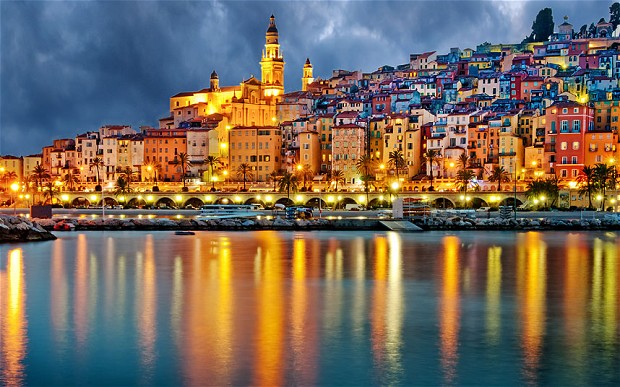
menton-france_2541437b

Mentone in France (courtesy of the Telegraph UK)

There seems to be a sense of frustration, and even anger that we are somehow more concerned for Paris than we are for these other cities which have also witnessed terrifying atrocities in recent days.

To be fair, our focus is partly shaped by the media and what the media choose to bring to our attention. Twitter and social media have to some extent eroded our dependence upon established media, but their influence remains significant. Having said that, the major news outlets have reported these other terrorist attacks, but not to the degree of the coverage in Paris.

I think the criticism holds some weight, and it is also probably a little unfair.

I do not believe that the lives of French people are more important than the lives of Syrians, Iraqis and Nigerians. The Bible makes it clear that every human being has intrinsic value and are equally God’s image-bearers. And yet, the value we attribute to people is evident not by our words alone, but our actions. Are we more concerned for wellbeing of white European citizens? Is the life of a Nigerian worth less to us? Is the security of Beirut less important to us?
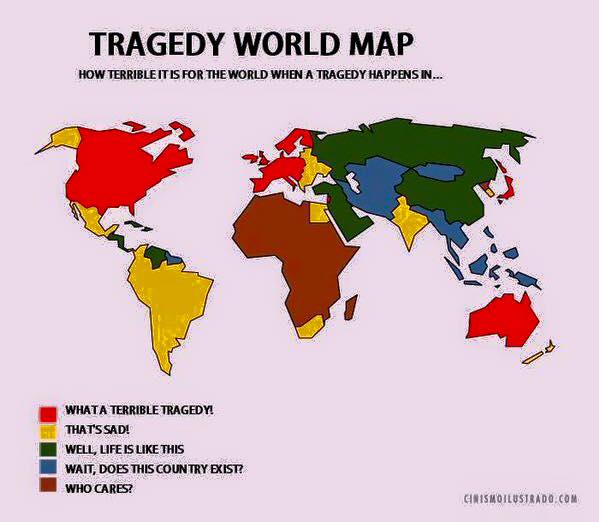
12227803_10153387236821731_2174880505013799328_n

This graphic is being sent around social media; it is certainly cynical. It is communicating something true (and sad), but I think it fails to appreciate laws of proximity. The closer we are aligned to a group culturally, the more affinity we feel with them when tragedy strikes.

To use an analogy, the way I am affected by the death in a family will be more intense than grief I feel in the death of a friend, and it will be certainly greater than my reaction to the death of a stranger. The closer the relationship, the more acute my reaction.

As an example, I admit that I personally have more cultural affinity with France than I do with Middle Eastern and African cultures:

  • My favourite cuisine has always been French (seriously, nothing surpasses truffles)
  • Susan and I celebrated our first wedding anniversary in Paris
  • My favourite art has always been French Impressionism
  • As a pianist I loved performing Debussy, and I still regularly listen to his piano and orchestral works. My favourite orchestral work is Prélude à l’après-midi d’un faune.
  • My favourite fashion label is also French, although a Pastor’s salary doesn’t permit shopping at Hermes! Those were the days of music.
  • I live in Mentone and my church is Mentone Baptist Church.

These ‘likes’ and affinities are not saying that, for example, Lebanon’s Shia population are therefore less important. Not at all. 

What can we do? Cultural proximity is fact of life, but it is not an excuse for neglecting people who are often more at risk and in need.

Find ways to acknowledge the suffering of people in other parts of the world.

  • We should pray for these other nations.
  • We should investigate what kind of assistance they need. A reality is that France is in a better financial place to assist its citizens in need.
  • In our conversations don’t forget the Non-Western world.

The reality is, our concerns and griefs will always be partial and limited. We don’t have exhaustive emotional energy, and it’s not only cultural leanings, but our sinful inclinations also impact our preferences more than we appreciate. Which is why I thank God that he is God. There exists a good and sovereign God who understands all things and who is able to embrace all of the world’s ills, who is sufficiently righteous not to neglect any injustice, and  who merciful enough to forgive the unjust, even me.

Take a moment to read these words from Isaiah ch.40.

A voice of one calling:

“In the wilderness prepare

    the way for the Lord;

make straight in the desert

    a highway for our God.

4 Every valley shall be raised up,

    every mountain and hill made low;

the rough ground shall become level,

    the rugged places a plain.

5 And the glory of the Lord will be revealed,

    and all people will see it together.

For the mouth of the Lord has spoken.”

6 A voice says, “Cry out.”

    And I said, “What shall I cry?”

“All people are like grass,

    and all their faithfulness is like the flowers of the field.

7 The grass withers and the flowers fall,

    because the breath of the Lord blows on them.

    Surely the people are grass.

8 The grass withers and the flowers fall,

    but the word of our God endures forever.”

9 You who bring good news to Zion,

    go up on a high mountain.

You who bring good news to Jerusalem,

    lift up your voice with a shout,

lift it up, do not be afraid;

    say to the towns of Judah,

    “Here is your God!”

10 See, the Sovereign Lord comes with power,

    and he rules with a mighty arm.

See, his reward is with him,

    and his recompense accompanies him.

11 He tends his flock like a shepherd:

    He gathers the lambs in his arms

and carries them close to his heart;

    he gently leads those that have young.

12 Who has measured the waters in the hollow of his hand,

    or with the breadth of his hand marked off the heavens?

Who has held the dust of the earth in a basket,

    or weighed the mountains on the scales

    and the hills in a balance?

13 Who can fathom the Spirit of the Lord,

    or instruct the Lord as his counselor?

14 Whom did the Lord consult to enlighten him,

    and who taught him the right way?

Who was it that taught him knowledge,

    or showed him the path of understanding?

15 Surely the nations are like a drop in a bucket;

    they are regarded as dust on the scales;

    he weighs the islands as though they were fine dust.

16 Lebanon is not sufficient for altar fires,

    nor its animals enough for burnt offerings.

17 Before him all the nations are as nothing;

    they are regarded by him as worthless

    and less than nothing.

18 With whom, then, will you compare God?

    To what image will you liken him?

19 As for an idol, a metalworker casts it,

    and a goldsmith overlays it with gold

    and fashions silver chains for it.

20 A person too poor to present such an offering

    selects wood that will not rot;

they look for a skilled worker

    to set up an idol that will not topple.

21 Do you not know?

    Have you not heard?

Has it not been told you from the beginning?

    Have you not understood since the earth was founded?

22 He sits enthroned above the circle of the earth,

    and its people are like grasshoppers.

He stretches out the heavens like a canopy,

    and spreads them out like a tent to live in.

23 He brings princes to naught

    and reduces the rulers of this world to nothing.

24 No sooner are they planted,

    no sooner are they sown,

    no sooner do they take root in the ground,

than he blows on them and they wither,

    and a whirlwind sweeps them away like chaff.

25 “To whom will you compare me?

    Or who is my equal?” says the Holy One.

26 Lift up your eyes and look to the heavens:

    Who created all these?

He who brings out the starry host one by one

    and calls forth each of them by name.

Because of his great power and mighty strength,

    not one of them is missing.

27 Why do you complain, Jacob?

    Why do you say, Israel,

“My way is hidden from the Lord;

    my cause is disregarded by my God”?

28 Do you not know?

    Have you not heard?

The Lord is the everlasting God,

    the Creator of the ends of the earth.

He will not grow tired or weary,

    and his understanding no one can fathom.

29 He gives strength to the weary

    and increases the power of the weak.

30 Even youths grow tired and weary,

    and young men stumble and fall;

31 but those who hope in the Lord

    will renew their strength.

They will soar on wings like eagles;

    they will run and not grow weary,

    they will walk and not be faint.

A Christian response to Paris & the problem of religion

Australians (and the West at large)  don’t know what to do with religion. We don’t want to say that one religion is better or worse than another, but how do we deal with aspects of religion that are unacceptable? While ISIL are not supported by most Muslims, adherents are nonetheless practicing a devotion to Islam that finds support in the Koran. However because their ideology does not conform to the accepted pluralist world-view that all religions are valid, we hear political and religious leaders being forced to explain them away.

I don’t claim to speak for everyone and I don’t want to suggest that what I’ve written isn’t without bias. What I have written is a list of criteria that I try to practice when I’m talking with people about my Christian beliefs.

CT1mToqUkAAuT2u

1. Show grace. Pride is not a Christian virtue. The very nature of Christian faith is that knowing God is a gift from God through Jesus Christ. Therefore, as we engage in conversation with people from different religions we avoid arrogance and pride, both in what we say and in the manner we speak.

2. Be gentle and respectful. When we talk to men and women we are speaking with people who are God’s image-bearers. That imago Dei, like in ourselves, is broken, but we maintain that they have value and ought to be treated with dignity. Therefore we don’t support graffiti on Mosques or other buildings, and we don’t support verbal or physical abuse toward people of other religions

3. Be honest about differences, and recognise that some contrarieties really do matter. One of the great weaknesses in current religious discourse is the unwillingness to call a spade a spade. Where there is commonality and agreement it should be recognised, but the pretend game of sameness is intellectually dishonest and shows disrespect to the many who hold to those points of difference.

There is no value in diminishing, ignoring or lying about differences in theology, ethics, or politics. For example, Christians and Muslims must not pretend that they share the same view of Jesus: Muslims do not believe that Jesus is fully and eternally God, Christians do. Muslims do not believe that Jesus was crucified and died on the cross, Christians do. Muslims do not accept that the Bible is God’s authoritative, sufficient and final word, Christians do. In the same way Christians don’t accept the Koran as a holy book, whereas Muslims do.

There exists an epistemological crisis in the world right now. The current crisis is not merely  a moral one, but it is about how we understand truth. September 11 2001 shocked the world, not only because of the scale of evil perpetrated, but because it exposed the foolishness of our deference to the philosophical liberalism in the West; we were reminded that not every world-view is equally good or valid. Despite the warning, 14 years have now past and most of us in the West continue to walk the line of relativism. Will the recent and appalling rise of ISIL rouse us from the age of the post-critical conscience or will we keep popping our everyone-is-right pills?

4. Don’t excuse or protect the sins of your family. Sin is sin, whether it is perpetrated by someone else or by me. Christians can be guilty of wrongdoing: sometimes they break the law, other times they act lawfully but in ways that are unloving and therefore spurious. In the name of Christ, men and women have committed acts of cruelty and hate, not because of the Christian Bible but because they have abused the Bible in the pursuit of personal agendas. Where and when we are wrong we need to confess and repent, and repentance includes accepting the cost of restitution.

5. Aim to persuade. Coercion, threats, insults, violence – such things don’t help anyone. Beating someone down with a string of rapid rhetorical assaults does little more than create more distance between people, making genuine communication even more difficult. Persuasion, however, is healthy because it gives due weight to the subject at hand and it shows respect for the person with whom you are dialoguing. Persuasion says that people matter and the topic of dispute is too important for flippant dismissal or violent suppression. Persuasion includes using considered argument, showing coherence in your reasoning and providing evidence, using story and testimony, appealing to peoples hopes and desires, pointing out the weaknesses and untruths in alternative beliefs, and speaking with clarity and conviction.

6. Don’t caricature people or their beliefs. Not all atheists are like Richard Dawkins. Not all Muslims support ISIL. Not all Arabs are Muslim. Not all politicians are self-seeking egomaniacs. Not all Baptists are tee-totalling anti-fun facebook club members!

7. Seek to understand. Too often we assume what other people  think and believe. Let’s not ignore the power of attentive listening, and of asking questions and taking time to research what other religions believe, teach and practice.

8. Live what you believe. Christianity doesn’t begin or end on the blog or at the public meeting, it continues through every encounter in all of life. If what Christians believe is true and good then it will influence every aspect of our interactions, both private and public.

When was the last time we smiled at and said hello to someone who was Muslim or Hindu? When was the last time we invited into our home for a meal someone who practices another religion? When was the last time we shared the good news of Jesus with someone from another religion? Why not put these things on our agenda?

9. The State and not the Church has the role to exercise civil and military authority. Unlike Muslim Scriptures, the Christian Bible recognises a distinction between the Church and the State. Throughout history not everyone has properly practiced this, but that has been due to a rejection of the Bible’s teaching, not adherence. However, in Islam there is no such distinction between religious and civil law and Government, hence Saudi Arabia and some of nations, as well as the theology underpinning ISIL. Having said that, other Muslim majority nations such as Turkey, have managed to move away from this orthodox Islamic worldview. (This article in The Atlantic about “What ISIL Really Wants” is worth reading)

“For the one in authority is God’s servant for your good. But if you do wrong, be afraid, for rulers do not bear the sword for no reason. They are God’s servants, agents of wrath to bring punishment on the wrongdoer. 5 Therefore, it is necessary to submit to the authorities, not only because of possible punishment but also as a matter of conscience.” (Romans 13:3-5)

My point here, is that  Governments have responsibility to protect its citizens and to punish those who harm its people. It is not wrong for the French people to desire justice, and we must recognise that issues surrounding a response are complex. Doing nothing is hardly going to stop ISIL and engaging militarily seems to play into their agenda. Recognising them as a legitimate state is out of the question, given their propensity to abuse and kill thousands under their the control, and they are clearly not content to limit their borders at their current places. What we can do is pray for our Governments.

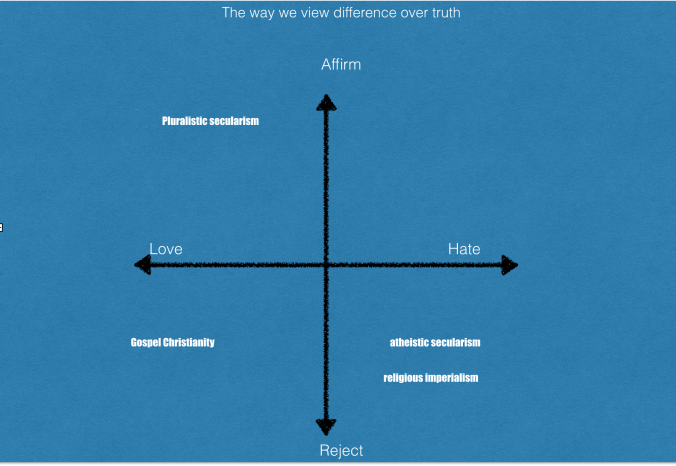
Below is a diagram that represents various approaches to viewing difference:

 the way we view difference
——-
This article has been adapted from a piece I published last year at Engaging with Religions

The non-controversial controversial program in our pre-schools

In August this year the Daniel Andrews Government banned SRI classes from Victorian Schools. Despite the fact that this has been a valued program for many decades, and that many schools are still keen to give space for this 1/2 hour weekly lesson, the Government caved into pressure from various lobby groups. Replacing this opt-in program will be a compulsory ethics/well-being/religious curriculum. Whilst announcing that this program will run from the start 2016,  the Government is yet to provide any details of its content and who will teach it. Indeed, schools remain in the dark as to what is happening.

Today, The Age has reported that ACCESS Ministries are now offering a program in Victorian pre-schools, called Explore Christianity.

FIRIS have notified their supporters on facebook, saying

“SPECIAL RELIGIOUS INSTRUCTION – COMING TO A KINDERGARTEN AND CHILDCARE CENTRE NEAR YOU!

ACCESS have now discovered a new mission field – they have transferred their proselytizing to a softer market.

They are like the Gecko, who loses its tail, only to grow another one back again. They have reinvented themselves and found another way to get to the children.

FIRIS has known about this for some time, and the VIC government was first notified about this from us back in May.

It appears that now very young children will be segregated by religion and parents who object to their children being indoctrinated while at child care will need to accept this segregation as the norm, or find another centre.

The government has been taken offguard by ACCESS’ metamorphosis and will have to either choose to deal with it – or look the other way.

The obvious concerns are:

* Proselytising

* Treats offered as an incentive to children

* Religious segregation of very young children

* The opt out nature of the program

  • Adequate informed consent being provided to parents”

I agree that any program must have transparency, and provide adequate information for parents, and it should have  either an opt-in or opt-out clause. These things are sensible and appear to be in place already.

But even if all of these  ‘concerns’ were fully met, history gives reason to suspect that FIRIS will keep pressing for this program to be shut down.

Given that, let’s look at these important facts that The Age reported today:

  1. Parents asked the Emmanuel Early Learning Centre to introduce this program and the Centre management agreed.
  2. The overwhelming majority of families are participating. After receiving consent forms, only 3 families chose to opt-out their children.
  3. The program teaches, “Christian values and beliefs, in addition to stories from the Bible.” In other words, it is teaching they very things that a program about Christianity should teach.
  4. Volunteers who run the program are accredited by ACCESS Ministries, in accord with strict requirements that have been set by the Education Department for SRI teachers in schools.

Pre-empting any call to close down the program, Minister for Families and Children Jenny Mikakos said to the The Age that, early childhood services operated independently, and any “decision on offering religious education as part of a service provider’s program is a decision for each individual provider and parents of children attending the service”.

It will be interesting to see what and if any pressure that the Government will try to apply to these early childhood centres. As it stands, they are providing a program within the law, based on parental interest and request, and with substantial by-in from both the Centre and its families.

Where is the controversy?

—————-

Photo from The Age (Nov 10): Joe Armao

Religion Makes us Meaner

I agree.

Like sharks smelling a drop of blood, the media is swarming around the latest ‘religion is bad’ news story. This time, it comes in the form of a report that has been published in the journal Current ­Biology, by a group of researchers at Chicago University.

OLYMPUS DIGITAL CAMERA

Research leader, Dr Jean Decety, has said, “Together, these results reveal the similarity across countries in how religion negatively influences children’s altruism. They challenge the view that religiosity facilitates prosocial behavior, and call into question whether religion is vital for moral development—suggesting the secularization of moral discourse does not reduce human kindness. In fact, it does just the opposite,”¹

That is one gargantuan call to make, and with significant implications should the assertion be true.

The Australian newspaper offered this helpful summary of the study (Nov 6):

“In the study, more than 1100 kids aged between five and 12 were asked to share stickers with anonymous schoolmates. The subjects lived in North America, the Middle East, South Africa and China, and included Christians, Muslims, Jews, Buddhists and Hindus.

Those from agnostic and atheist households consistently proved less likely to keep the best stickers to themselves. “The more religious the parents, the less altruistic the children, irrespective of the religion,” Dr Decety told The Australian.

He attributed the findings to a phenomenon dubbed “moral licensing”, where people’s perceptions that they were doing good — in this case, practising religion — exempted them from the obligation to perform other worthy deeds. “Apparently, doing something that helps strengthen our positive self-image also makes us less worried about the consequences of immoral behaviour,” he said.

The study also found that when the children were shown videos of “mundane” affronts, such as people bumping and pushing each other, religious kids were more inclined to decide harsh punishment was warranted. Dr Decety said this supported previous findings that organised religion promoted intolerance and punitiveness.”

I agree…in part.

I affirm the idea that religion can make people meaner and more selfish. This idea is hardly new, Christians have understood this since its earliest days, and it conforms to what the Bible has been saying since it was first written, millennia ago.

As Tim Keller put it in The Reason for God, “Those who believe they have pleased God by the quality of their devotion and moral goodness naturally feel that they and their group deserve deference and power over others. The God of Jesus and the prophets, however, saves completely by grace. He cannot be manipulated by religious and moral performance–he can only be reached through repentance, through the giving up of power. If we are saved by sheer grace we can only become grateful, willing servants of God and of everyone around us.”

According to Roman ch.1 religion stems from suppressing what is true, and creating and then depending upon things that are not true for meaning and salvation.

Subsequently, it is unsurprising to learn that religion is largely about self-justification; it is the human attempt to persuade God and others of one’s worthiness and goodness. Religion is about doing things and saying things in order to win God’s favour. Even acts of kindness can be a cover for gaining approval and for feeling better or happier about oneself. In other words, we shouldn’t be surprised to find that religion can make people, even children, mean.

The study doesn’t only suggest that religion makes children mean, it would have us believe that atheism makes children kind. Does unbelief enhance out potential for true altruism? A survey of non Government welfare agencies and charities will be hard pressed to find more than a handful that don’t have their foundations and funding in organised religion, especially Christianity. How many atheistic organisations can you think of that are working in our local communities and across the world to care for the poor and needy?

The average Australian gives away less than $200 each year, whereas Christians give on average, 5-9% of their annual income, and many give considerably more².

While I know some very friendly atheists, atheists are also among the most intolerant people in our society; listen to how many journalists, politicians, and social commentators now address Christians. For not subscribing to the secular agenda, Christians are labelled stupid and bigots, and Christian programs are being shutdown across the country.

History and contemporary society demonstrate that both religion and atheism are a problem. Should we debate who is worse, ISIS or Stalin? Surely evil is evil, whether it is perpetrated by the religious or irreligious.

How then, do we explain the findings of this outcome?

While I’m not dismissing the research, there are problems. For example,

1. In my opinion the study does not adequately differentiate between nominal religious believers and those who actually practice their religion. In particular, I am thinking of the distinction between Gospel (or Evangelical) Christianity and cultural Christianity. The use of the Duke Religiosity Questionaire may be useful as a sociology calculator but it is a poor theological and spiritual one.

2. The findings don’t properly differentiate between various religions. Islam and Christianity are at times lumped together, while other religions didn’t receive a large enough sample size to warrant analysis.

3. The research is making strong claims based upon limited research. Children completed a game and parents filled out a questionnaire, and from this we can now confirm that non religious families exude greater kindness than religious families? I think we call that, overreach.   

4. “Children from religious households favored stronger punishments for anti-social behavior and judged such behavior more harshly than non-religious children”. Why is this deemed a negative? It is quite possible that children from religious families have a stronger moral compass and therefore a greater sense of justice.

5. The study involved children from 6 countries: Canada, China, Jordan, South Africa, Turkey and the United States. To what extent have the researchers accounted for cultural differences, and how these affect the way children behave? The way that culture and religion relate in Jordan is different from China and indeed the USA.

In my view, there are simply too many questions for people to be jumping on the bandwagon. Remember, this is one study, and it is worth noting that its findings conflict with other research that has been conducted in recent times, which have found that belief in God makes people happier and more community oriented (https://murraycampbell.net/2015/09/24/new-evidence-suggests-that-the-closure-of-sri-was-a-mistake/).

Dr Decety and the team from Chicago University have driven us to an all to familiar dead end street: we want to maintain that religion and irreligion are our only options, but there is a third way. That is why the message of Christianity is so subversive and why it does not fit with the dimensions of human expectations.

Christianity teaches that everyone is sinful, yes, even children. Isn’t it ironic that when Christians make this suggestion it is called ‘child abuse’, and when secular academics make the same observation it is called science! We shouldn’t be surprised to learn that young children exhibit selfish and judgemental traits; it is human nature. Sometimes we clothe it in God-speech and promises of eternal reward, and other times we simply call upon humanitarianism.

Altruism is unattainable because we simply cannot do it. Both religious and non religious people are capable of love and acts of kindness, but inconsistently, partially, and often for self-seeking reasons. The history of the world is our autobiography, and we are seriously kidding ourselves if we think that we have climbed up the evolutionary tree: domestic violence in 1 in 3 Australian homes, over 80,000 unborn children killed each year, the revelations on Ashley Madison, cruel Asylum Seeker policies, ka-ching and the masterminds behind the pokies industry, and on and on.

But in Jesus Christ we see perfect love, selfless service and sacrifice for the good of others; he is uncompromising in holiness and generous in mercy:

“This is love: not that we loved God, but that he loved us and sent his Son as an atoning sacrifice for our sins”. (1 John 4:10)

This is the essence of Christianity:

“The gospel is this: We are more sinful and flawed in ourselves than we ever dared believe, yet at the very same time we are more loved and accepted in Jesus Christ than we ever dared hope.” (Tim Keller)

When a person comes to know this declaration of God’s love, they are changed, forgiven and liberated to truly love God with our whole being and to love our neighbour. It changes us to give without expectation of return, and to sacrifice for the good of those who despite us. Religion and irreligion are proven dead ends, but the Gospel of Jesus Christ promises a light that changes how we see everything.

——————

  1. http://news.uchicago.edu/article/2015/11/05/religious-upbringing-associated-less-altruism-study-finds
  2. See NCLS research for information regarding giving habits of Australian Christians. A summary of broader Australian giving can be found here – http://www.businessinsider.com.au/here-are-the-top-20-most-generous-suburbs-in-australia-2014-5