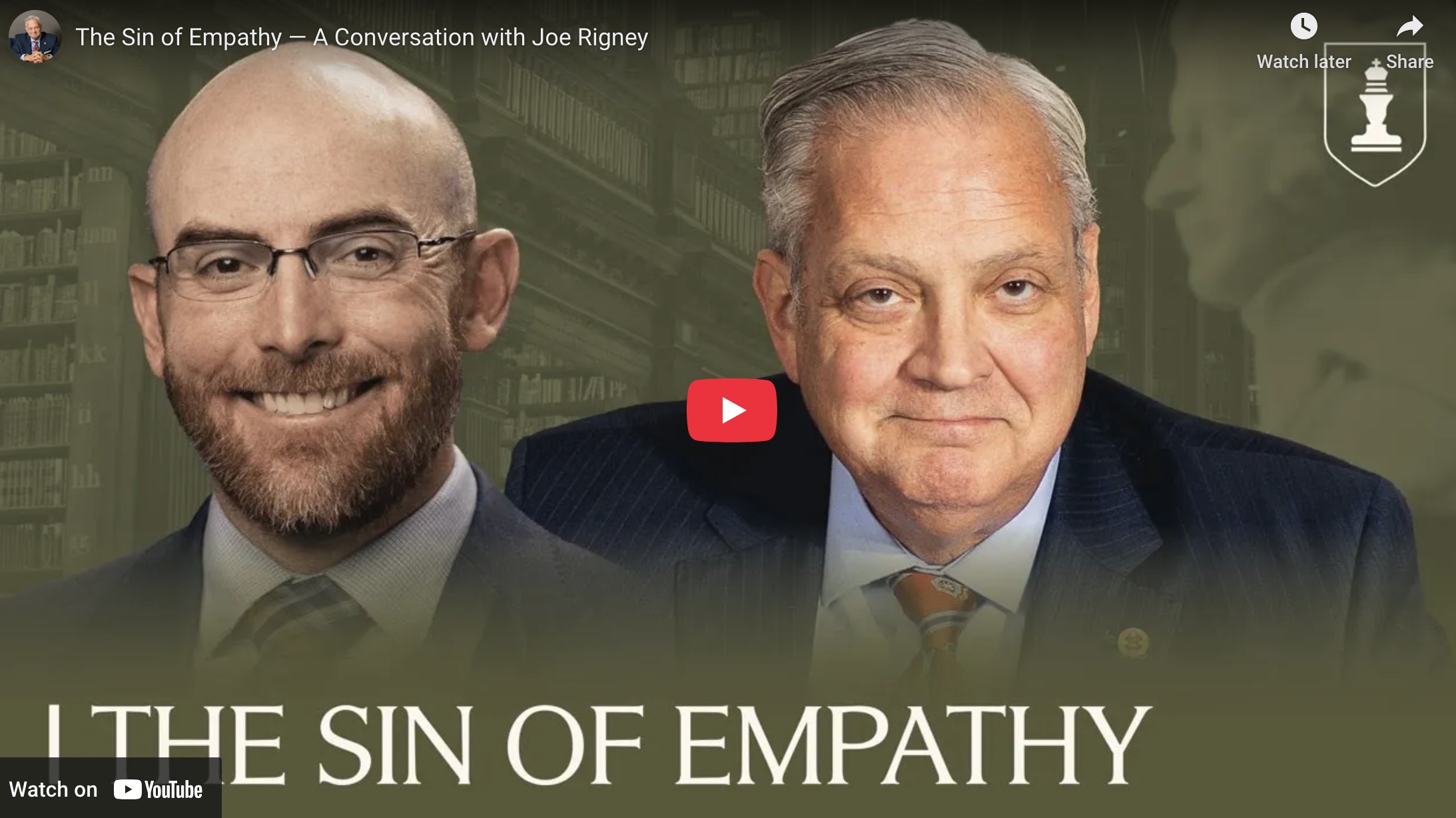
I’ve witnessed the  ‘Sin of Empathy’ in action

I’ve witnessed the  ‘Sin of Empathy’ in action.

To begin with, our Western societies are obviously deeply confused about gender. Are there 2 or 74 genders? Is there any difference between men and women?  Masculinity is largely defined in negative terms and one can barely say the word without someone assuming toxicity. And what is a woman? One can lose their job if they dare suggest a definition. 

The thing is, we don’t resolve one set of problems by introducing another set of problematic ideas. Reactionary theology becomes, or least can become, as destructive as the concerns originally identified. And so we end up with a vicious game of ping-pong, except the ping-pong ball is a live grenade.

The Bible’s vision for both men and women is beautiful and attractive and good. The complementary nature of Genesis chs 1 and 2 is affirmed by the Lord Jesus,  and He and the Apostles present in Scripture the full eschatological picture of the glory of being men and women. Every generation finds ways to undermine or twist Christ’s vision and replace it with an alternative. This has been going on since the earliest of days.

Instead of adorning male and female with the Gospel and the fruit of the Spirit, there are men (and a few women) who somewhere think that demeaning women is righteous and noble. 

Photo by Sora Shimazaki on Pexels.com

Anger and verbal abuse is their modus operandi. There is zero positive Gospel vision, simply one denouncement after another, as though they’re playing the role of Athanasius or Spurgeon and everyone else is either Arius or a British Baptist! But like the little boy who called wolf, no one is paying attention should they ever get it right for once. 

The background to this latest stream of vitriol is Joe Rigney’s appearance on Al Mohler’s show last week to talk about his book, ‘The Sin of Empathy’. I discussed the interview in my previous blog post. Just in case, Rigney’s basic thesis is that empathy is a feminine trait and is largely responsible for the theological drift we are witnessing in our churches. Empathy is this feminist Trojan horse corrupting Christian life and witness. Yes, I know, Jesus is a man and he’s our empathetic High Priest, so go figure!

As I wrote my own reflections on the interview, I suggested, 

‘I am sure the ‘theo-bros’ on X will dismiss me as another weak ‘effeminate’ ‘woke’ pastor’. 

No one needs to be a prophet to realise how inevitable that was! However, I  have a different reason for writing this follow-up piece, and it is to highlight the kind of fruit patriarchy is growing.

A friend of mine and respected Australian theologian, Dani Treweek, is reading Rigney’s book and has begun posting her reflections on X (Twitter). She soon became subject to a targeted troll attack by the ‘theo-bros’. Dani is a complementarian and used to receiving pushback from one direction, but being complementarian isn’t enough forsome conservative circles.

This is how the theobros treat women. It is vile and anti-Christian in every way.

And no, the trolling wasn’t only by anonymous accounts. Megan Basham jumped on and William Wolfe got into the action with a couple of revealing cheap shots. In fact, a week earlier, Wolfe nailed his colours with this preemptive strike,

‘Watching all these church ladies of both sexes getting worked up about @joe_rigney’s book “The Sin of Empathy” only makes me more excited to read it!’

It reminds me of the shelo asani isha, the old Jewish prayer that thanks God for not making me a woman.

I’m unsure where the man himself was, Joe Rigney.  He was certainly present online, and he happily responded to Dani Treweek and as well as some others, but not once (to my knowledge) did he rebuke and call out any of misogyny and disgusting pile on. Why? I do not know.

We could simply ignore this latest online abuse, and for the most part, we ought to ignore the ‘theo-bros’.  They are widely regarded as being unreachable, and they love nothing more than an argument. And after all, it’s social media, and much of it is an American echo chamber. Except public words, even those online, either represent or misrepresent the God whom we claim to worship. That’s a problem for public Christianity. Also, the echo chamber has bored a hole under the ocean and is appearing in different segments of Aussie churches. 

Take one Presy minister from Australia today who excused the bile by suggesting Dani was asking for it because she made a comment about having a PhD. How often has a man used that defence, ‘she was asking for it’.  In fact, it’s his comments that have caused me to stop for a few minutes this morning and write this blog.

This is part of the problem. Slander, insult and assault are often excused or explained away, or we remain silent. Where these men are identified and if they are members of a church somewhere, the Elders ought to be dragging them into a meeting and calling them to repentance or removing them from the church. 

What did Paul tell Titus, 

“Similarly, encourage the young men to be self-controlled. In everything set them an example by doing what is good. In your teaching show integrity, seriousness and soundness of speech that cannot be condemned, so that those who oppose you may be ashamed because they have nothing bad to say about us.”

And Paul had a word of warning for Timothy about men who demean women,

People will be lovers of themselves, lovers of money, boastful, proud, abusive, disobedient to their parents, ungrateful, unholy, without love, unforgiving, slanderous, without self-control, brutal, not lovers of the good, treacherous, rash, conceited, lovers of pleasure rather than lovers of God— having a form of godliness but denying its power. Have nothing to do with such people.”

I’m not writing any of this to give the ‘theobros’ oxygen, but rather encourage brothers and sisters: don’t let your church be a place that accepts or excuses the kind of garbage my friend has experienced far too often, and indeed, what many women have experienced (and yes, men too). Churches, teach the Bible well, display the goodness of God’s creative and redemptive purposes, and guard against the patriarchy. 


April 10 Update: Read Dani Treweek’s excellent and detailed review of Joe Rigney’s ‘Sin of empathy’ over at Mereorthodoxy https://mereorthodoxy.com/sin-of-empathy-joe-rigney-book-review

We need more empathy not less

‘Before you criticize a man, walk a mile in his shoes. That way, when you do criticize him, you’ll be a mile away and have his shoes.’ (Steve Martin)

An easterly wind is blowing across the Pacific and blowing dust into some Aussie churches. From Moscow to Queensland, there is a mood swirling about that believes what we need today is a strong Christianity that will defeat the hoards of hell. Weakness is to be blamed for the status quo and to save the day we need a particular masculine-styled Christianity. Out with gentle Jesus, bring in Excalibur Jesus!

Of course, we don’t want to be reductionist and suggest that the Christ who is gentle and kind is not also awesome in power and the judge of the world. He is both the God of mercy and the God of justice. 

There is an emerging vigilante approach to Gospel ministry and mission which is, I contend, as big a problem as the spiritual and moral hopelessness it claims to be redeeming. 

And before the bros throw around their customary innuendos, I learnt to shoot when I was 10, I know from experience how to chase down a thief and stand up to a violent man, I have a son who made grown men cower when he bowled,  and I am proud of my eldest who is serving in the military; so you can stick your manly verbiage in your salad!

Some of the masculine talking and taunting that’s coming out of the United States and sprouting in certain ecclesial Aussie backyards, isn’t  complementarianism and therefore not biblical. It’s two versions of a gender culture war playing ping pong against each other, and unfortunately using the church as the table.

If you don’t believe me, Neil Shenvi yesterday sent a test balloon on X, 

 “If a man were described as kind, gentle, patient, loving, peaceful, joyful, good, and faithful, large segments of Twitter would call him effeminate.”

With the surprise of learning that sea water contains salt, Shenvi is right.

This supposed muscular Christianity found recent expression on the Al Mohler show when Al Mohler interviewed Joe Rigney for his book, ‘the Sin of Empathy’.

Over the years, I have appreciated some of what Al Mohler has said and stood for. This, not so much.

No, I haven’t read Rigney’s book, and I have little desire to do so. Rigney has however, expressed his ideas in this interview, and so presumably he agrees with his own words to Al Mohler. In short, Rigney’s thesis is that empathy is sinful and responsible for churches losing their way today.

Rigney’s complaint is that churches are guilty of the sin of empathy,

“There is a reason that the empathetic sex that women are barred from the pastoral office, they were barred from the priestly office in the Old Testament for the same reason. Because priests and pastors, priests in the Old Testament, pastors and ministers and elders in the New Testament, are charged fundamentally with guarding the doctrine and worship of the church, of setting the perimeter for what is in and out. That’s the calling. And therefore the sex that is bent and wired towards care, nurture, compassion and empathy is ill-suited to that role. So it’s no surprise that in a culture that has become dominated by feminism, it’s deep in the American system at this point, that in that same timeframe, you would have an outbreak of empathy that would become the steering wheel by which every institution is hijacked.”

In other words,  empathy is a problem because it’s a trait found in women, and permitting that leads to the slippery slope of feminism and last stop, hell. 

No doubt, many readers will find this as problematic as do I, not least because it smacks of misogyny.

Rigney is convinced that the slippery slope of liberalism clambers back to a weak Christianity that is too sympathetic (by which he means, to feminine)

“Every church faces some version of this kind of pressure to have women in the room where it happens to let them make, let’s have them in the room, let’s have them making decisions. We won’t call them pastors, at least initially, but once you started down that road, you’ve effectively seeded the ground that men and women are interchangeable. We don’t know why the Bible says that only men can be pastors. And until we can twist that verse, we’ll hold the line on that one little thing, but it’s a complimentarian thread that’s trying to hold up an egalitarian boulder, and it will not hold in the long run.”

Mohler has also bought into this line of thinking, 

“No, and the argument about hermeneutics is I think amply, tragically demonstrable. I don’t know of a single body that has genuinely affirmed women in the pulpit that has not eventually affirmed the LGBTQ revolution. Because if you can take the plain teachings of Scripture, and by the way, reflected all the way through creation order, and you can deny that when it comes to a woman as a pastor of a church, and it’s not that women don’t have many of the gifts, it’s that women, it’s ontologically forbidden by scripture.”

The problem with those statements is that it’s not necessarily true. The slippery slope argument is sometimes real and other times not. Now, before you suggest that I’m some wet slippery progressive who’s drinking the cool-aid, I’m writing as a convinced complementarian and someone who has expressed concerns about current gender ideologies, such that it’s made front page news on major newspapers. The reality is, there are different hermeneutical grids among egalitarians. Not all egalitarians are identical. There are some who hold to a theological framework that does slide into gender fluidity and adopting the latest cultural norms of sex and gender, and there are others whose theological convictions do not permit the slide. 

Take Mike Bird for example. Rigney said of Bird this week,

“This comment is particularly funny coming out of a decade or more in which feminism, wokeness, and soft-pedaling sodomy infiltrated the SBC, the PCA, and other conservative evangelical contexts. That’s who I wrote it for.”

yeah, nah. Mike Bird is egalitarian. He’s wrong on this one (and I still love him) but I also know he has a robust anthropology that will not let him fall down into gender relativity or matters like same sex marriage. 

The thing is, we don’t advocate for what is and has been the norm among Christian churches throughout its history by adorning men with a 6 pack and rifle slung over the shoulder and making them sound more gruff. Be more Christlike. Be more Biblical, not less.

How does this sin of empathy square with Christ who is our empathetic High Priest? At the very least, Rigney’s interview causes us to cast doubts over or to explain away Bible statements like Hebrews 4:15,

 “For we do not have a high priest who is unable to empathize with our weaknesses, but we have one who has been tempted in every way, just as we are—yet he did not sin.” (Hebrews 4:15)

In his commentary on Hebrews, Paul Ellingworth paraphrases, “Our high priest can feel with us in our weaknesses, because he has been tempted in all respects as we are…”

The verb συμπαθῆσαι and its cognates, as Ellingworth notes, “are used most often of family affection”.  Peter O’Brien explains, “the verb rendered empathize was used of a bond similar to a mother’s feeling for her children or one brother’s feeling for another.”

Peter O’ Brien notes, “Believers have in heaven a high priest with an unequalled capacity for empathising with them in all their weaknesses, especially the weakness that result in sin”. 

If that’s too much empathy for you, let’s bring in a Puritan, Thomas Goodwin,

“The word is a deep one. He suffers with you, he is as tender in his bowels to you as ever he was; that he might be moved to pity you. 

He is willing to suffer, as it were, that one place to be left naked, and to be flesh still, on which he may be wounded with your miseries, that so he might be your merciful high priest.”

Al Mohler suggested in the interview that empathy is a 20th Century concept. Goodwin and Hebrews suggests that’s not the case. What’s more likely is that the division between sympathy and empathy is a 20th Century construct.

Can empathy be problematic? Sure, of course it can. When we sever any human emotion or disposition from the work of the Spirit, we are in danger of misuse and misapplication. That doesn’t mean empathy is the sin of our age; the church doesn’t need less empathy, but more.

Some Christian men have the impression that being ferocious like is Jesus is good, whereas showing the gentleness of Jesus somehow inhibits our masculinity and church steadfastness. Everyone wants to be Jesus overthrowing tables and using a whip in the Temple. They love to argue online and are quick to jump on others. Strength and power and angry tone is just as dangerous a foe to Christian vitality as those more gentle of virtues when separated from the Spirit.. Besides, real masculinity does not deny strength or power, but uses it in the service of others. It is therefore humble, sacrificial, gentle and kind. It doesn’t demean women, it honours them. If your version of strong Christianity produces mysogony, think again.

Let’s remember the Apostle Paul who rebuked the Corinthians for their liking of strength and power,

‘Jews demand signs and Greeks look for wisdom, but we preach Christ crucified: a stumbling block to Jews and foolishness to Gentiles,  but to those whom God has called, both Jews and Greeks, Christ the power of God and the wisdom of God. For the foolishness of God is wiser than human wisdom, and the weakness of God is stronger than human strength.’

This is part of the problem with this neo-masculine movement. It doesn’t want weakness and it derides anything that appears ‘effeminate’. If you think empathy is a sign of weakness, I suggest you take that up with our High Priest. 


April 10 Update: Read Dani Treweek’s excellent and detailed review of Joe Rigney’s ‘Sin of empathy’ over at Mereorthodoxy https://mereorthodoxy.com/sin-of-empathy-joe-rigney-book-review

How we treat the human body speaks volumes

Hamas has paraded four coffins through the streets of Gaza as though they were trophies. Men brandishing their rifles, flagging Hamas regalia while masking their faces, cheered and accompanied four black coffins carrying four Israelis who had been taken hostage on October 7 and murdered subsequently. The 4 coffins included an elderly man, Oded Lifshitz, 83, the two little Bibas children, and their mother, Shiri.

The remains of these 4 human beings were then presented on a stage wrapped in anti-Israel messages and weapons to threaten.

Once the bodies were handed over to the Red Cross and eventually returned to Israel, propaganda was found stuffed inside the coffins. If such insult and injury were not more than the grieving could cope with, it turns out Shiri Bibas was not among the dead. Hamas had placed the body of another woman inside the coffin.

We ought to feel sickened inside at the pictures being shown around the world; I am. I will not show the footage here. Instead, here are Israelis lining the streets as the coffins are driven by.

To humiliate the body of the deceased is to move into a new level of hatred. It is to join the ranks of cultures who abused flesh and bone to humiliate and cripple them in the life to come. This is the action of a deranged and evil group. Sadly, we can already imagine the excuses and justifications being uttered in Hamas’ defence, such are the times we are now living in. 

Criminals are afforded a proper burial. Even in war, the dead are respected by the enemy. Mustafa Kamal famously said of the Anzacs buried at Gallipoli,

You, the mothers who sent their sons from faraway countries, wipe away your tears; your sons are now lying in our bosom and are in peace. After having lost their lives on this land they have become our sons as well.

The human body matters, both in life and in death. Our physical being is part of who we are. God has made us with body, mind, heart, and spirit. Harming the body is an affront to human dignity and life. Mistreating the remains of the dead signals a level of disdain both for the dead and for those who are left behind that is inhuman.

A human body is treated with such respect because the life of the human being is of incalculable worth. To return the wrong body and to return bodies with ignominious glee and to stuff coffins with propaganda is unspeakably shocking.

God values the human body so much that his only Son took on human flesh. He became incarnate, a man. When Jesus was crucified he was buried. When God raised the same Jesus to life, he was resurrected, that is with a real physical living heart beating body. 

There is so much evil in our world. It has been this way since the fall. The hubris of the optimist believed that with advancing science and technology, and with prosperity winning globally, the world will enter a new age of progress and even ‘the end of history’. This is not utopia. Recent years have taught us that humankind is bent on repeating history. 

It is an evil world. Ours is a beautiful world with much to love and enjoy, and yet from the human heart spawns tremendous wickedness. It is astonishing that God should show such patience and grace.

Here is what my Bible reading was this morning, and frankly it is not what we deserve and it cuts against even how my own society often thinks of the human body, and yet it is profoundly good and light and life. In death and life, while enjoying the warmth of the sun or sitting in the darkest place, here is God’s promise, 

“Listen, I am telling you a mystery: We will not all fall asleep, but we will all be changed, in a moment, in the twinkling of an eye, at the last trumpet. For the trumpet will sound, and the dead will be raised incorruptible, and we will be changed.  For this corruptible body must be clothed with incorruptibility, and this mortal body must be clothed with immortality. When this corruptible body is clothed with incorruptibility, and this mortal body is clothed with immortality, then the saying that is written will take place:

Death has been swallowed up in victory.

Where, death, is your victory?
Where, death, is your sting?

The sting of death is sin, and the power of sin is the law. 57 But thanks be to God, who gives us the victory through our Lord Jesus Christ!” (1 Corinthians 15:51-57)

How can athletes thank God after losing the Super Bowl?

Neil DeGrasse Tyson can’t fathom why Christian athletes don’t blame God when they lose a final, even a Super Bowl. The famous astrophysicist from television told his 14 million followers, 

“Curious that talented athletes frequently credit God when they win, but we rarely see them blame God when they lose.”

I’m assuming he’s reacting to a tweet from Kanas City’s star quarterback, Patrick Mahomes, following their loss to Philadelphia in Super Bowl LIX,

“Appreciate all the love and support from #ChiefsKingdom  

I let y’all down today. I’ll always continue to work and try and learn and be better for it. 

Want to give thanks to God for every opportunity he has given me.

We will be back.”

The astrophysicist can’t explain why the footballer would thank God even in a defeat as brutal as the one the Chiefs received yesterday. 

I can’t speak for Patrick Mahomes or for the numerous players from both the Chiefs and Eagles who are known for publicly identifying as Christians, but let me offer 3 reasons why Christians are able to give thanks to God whether they come home with a trophy or not. 

  1. Christians have an identity more secure and satisfying than sporting glory. 

To be a professional athlete requires astonishing levels of not only natural ability but determination and sacrifice. Athletes don’t win Olympic gold or the Super Bowl without years of dedication, self-control and pain. It’s little wonder that players break down in tears when they fall short of their goals. How can you say, thank you God when you lose?

The not-so-secret answer was laid out in the days leading up to the Super Bowl when several Chief and Eagles players shared their testimonies

Carson Wentz said, “At the end of the day, He’s the only way. He’s the truth and the life,”

Rick Lovato, What He did for our sins, is something that I will always be in debt of.”

“I keep the focus on making my identity outside of sport – I do sport, but it’s not who I am. That’s been the breakthrough for me – realising that my performance does not determine my identity. Once you do that, you realise that it doesn’t matter whether you win the Olympics or come last, you’re still the same person.”

It’s about perspective. In other words, Jesus Christ provides a ballast and hope that outweighs even winning a Super Bowl. 

It’s a shallow religion that can only accept successes. Do we only want to worship a God who is in control when we win and not when life turns difficult? We all need to ground our hopes and selves in a reality that can outlast a sporting match and that can deliver in the darkest moments.

I’m reminded of Australian Olympian medallist, Nicola McDermott who explained in an interview last year, 

“I keep the focus on making my identity outside of sport – I do sport, but it’s not who I am. That’s been the breakthrough for me – realising that my performance does not determine my identity. Once you do that, you realise that it doesn’t matter whether you win the Olympics or come last, you’re still the same person.”

It’s almost as though Neil DeGrasse Tyson has adopted a ‘prosperity’ version of Christianity, which claims that faith in Jesus leads to material prosperity and worldly gain, like Midas’s touch. That’s not Christianity, that’s a serpentine fallacy.

This ‘Christ given identity’ not only fits professional athletes but translates into the norms of life for all Christians. Our identity runs deeper than the state of work, relationships and health. We are not defined by VCE marks or job promotion, marital status or the suburb where we live. There is a profound joy that cannot be shaken by success and failure. The Apostle Paul explains it in this remarkable way, 

No, in all these things we are more than conquerors through him who loved us. For I am convinced that neither death nor life, neither angels nor demons, neither the present nor the future, nor any powers,neither height nor depth, nor anything else in all creation, will be able to separate us from the love of God that is in Christ Jesus our Lord.

2. The Eric Liddell approach. 

It’s not that Christian athletes are less committed and passionate about their sport. In following Jesus, there is an added dimension. I like to call it the Eric Liddell approach. Eric Liddell (of Chariots of Fire fame) won the 400m track gold medal at the 1924 Paris Olympic Games. Liddell said of running, 

“God made me fast. And when I run, I feel His pleasure.”

It is one thing to compete for yourself, it is an ever great good to compete for your teammate, club and supporters. To enjoy God and glorify him in your athleticism is another step up. It’s not an either-or proposition, but both/and, and the addition of glorifying God elevates the privilege and joy in running, throwing, kicking and whatever sport it is. 

Noah Gray from the Chiefs said during the week, “Regardless of where you’re at in your life, the fact that God came down and took on flesh and died for our sins, that’s the biggest thing I take away and hold near and dear to my heart every day when I go and make decisions for my family and play football. If God can do that, I can go out there and try to be the best I possibly can in glorifying Him in everything.”

3. What matters most

Eric Liddell won his Olympic gold medal and then became a missionary to China where he died in a Japanese concentration camp during the Second World War. He joyfully laid aside Olympic glory for a crown of righteousness. 

Christian faith gives perspective for what is good and what is ultimate, what is temporary and what is eternal. And that gives us permission to fail without being crushed, to lose without life falling apart.

Geelong AFL player, Ollie Dempsey who won the Rising Star award last season, was interviewed by the AFL last week about his football and faith. Well done AFL for having some guts to give a footballer the opportunity to talk about Jesus

Dempsey was open and vulnerable as he shared his personal shortcomings. He left home at 18 to move city and become a professional footballer. He talked about his fears in sharing his faith with his teammates and of his friendship with the great Gary Ablett  Jnr who has encouraged him to keep walking with Jesus.

Dempsey shared,

“I put my favourite bible verses on my wrist tape. It’s something I’ve done every game since my second year. Even say I’m having a tough game, I’ll think to myself ‘Trust in God, I’m here for a reason and it’s all part of His plan’. It helps me through the ups and downs of the game.”  

“I truly believe that I’m here in the AFL for a purpose bigger than just playing footy and it’s to spread the goodness of Jesus. Especially with my story and only playing six games of school football and somehow getting drafted, which is still crazy to me, I try to give all glory to God for any of my achievements”.

“I still struggle with this and being public about it all because I don’t always live it. I’m never going to be one in someone’s face trying to convert them to Christianity, that’s just not me. But I feel especially this last year by just being myself, trying to be happy and loving, people can see God shining through me and that’s just how I try to approach life.”

For Dempsey, being a Christian doesn’t diminish his desire to excel and become a better athlete and help bring more success to Geelong, his trust in Jesus provides greater motivation and reason.

Do we not accept the Lord of times of winning and losing?  The difference between the Christian and the non-Christian in sports is not winning or losing games, and neither is it in feeling elation or sadness. But it is in the fact that knowing your identity is not determined by such things and that the joy and hope you have far out ways the greatest of human triumph. Hence Christian thankfulness is a great antidote to pride and despair, to elation in winning and disappointment in losing.

Why would a Christian athlete blame God for a loss?  Neil DeGrasse Tyson might have a grasp on the movement of stars, but he doesn’t seem to understand how a Christian can praise God in the midst of loss.

Christians to this day, sing and repeat Job’s refrain  Job is a dude from the Bible who suffered the loss of property, wealth and his children. His friends came along side himself, assuming that he must be guilty of some great sin. How else can you explain his suffering? Job declared, 

“Naked I came from my mother’s womb,

    and naked I will depart.

The Lord gave and the Lord has taken away;

    may the name of the Lord be praised.”

This isn’t nasty fatalism or foolishness, but a depth of knowledge that God remains sovereign and he can be trusted in all life situations.

Last Sunday as a Church, we looked at these words of Jesus from John’s Gospel, words Jesus spoke immediately following Judas’s leaving to betray him, and only hours before he was crucified, 

‘Now the Son of Man is glorified and God is glorified in him.If God is glorified in him, God will glorify the Son in himself, and will glorify him at once’.

Jesus didn’t define betrayal as failure but understood God is strong enough to not only out manoeuvre but to use betrayal and Jesus’ crucifixion for real glory. Death wasn’t Jesus failing, it was the means by which he would bring forgiveness.

I wonder if Neil DeGrasse Tyson sees the cross of Jesus as foolish and weak and a failure? Or perhaps look at it from Jesus’ perspective and see how the cross served as glory? You see, all Christian faith comes back to understanding the cross and grasping that Jesus’ death (as evil and shocking as it was) served to bring about monumental good, even eternal life. No wonder those NFL players are happy to love their footy and also praise Jesus. 

The search for irrelevance: The British public is asked to suggest who should be the next Archbishop of Canterbury

My teenage daughter has an eye for noting desperation. She perceptively sees through attempts by adults to make Christianity cool, relevant and whatever adjectives are now used among Gen Z. Whether it is the band playing like U2 or the preacher dressing like he’s vying for Vogue, my daughter is able to spot a try-hard attempt from a mile away.

It turns out that the Church of England is turning to the British public for assistance in choosing the next Archbishop of Canterbury. The BBC reports,

“The public is being invited to suggest candidates for the next Archbishop of Canterbury following Justin Welby’s resignation…The Church said the consultation, which runs until 28 March, was “an opportunity to gather the views of a wide range of people from across England and the Anglican Communion on the gifts, qualities and skills needed” for the role.”

How does it look when the British public is asked who’d they like as the next Archbishop of Canterbury? I wouldn’t be surprised if they nominated a man named Rowan (no, not the former Arch Druid, I’m referring to Atkinson). After all Rowan Atkinson has played the role of the archbishop before on stage.

To preempt what some readers are thinking, yes, there are already issues with the traditional process where the Government and King are involved. But this latest attempt takes ‘try hard’ to a new level.

Is the Archbishop of Canterbury a popularity contest? Is this one of those pop idol shows where you send in a text and vote for your favourite? 

Does the public even know what the biblical requirements are for Church leadership? Is the public familiar with Christian doctrine? Does the average Brit prefer to have church leaders who believe and can teach such doctrine? Can you imagine the everyday Britt wanting to uphold Christian ethics and where there’s an Archbishop who believes in marriage and godliness in sexuality? Yeah, neither can I.

Either the establishment cannot find a suitable candidate (which wouldn’t surprise anyone given the current college of bishops) or some marketing guru thought, ‘I know what will make the Anglican Church great again, let’s run a popularity contest’. Populism might work in the political world but it’s a certain path to irrelevance for a church. Character really does matter. Believing the Bible and holding to classical Christian teaching really does matter.

Of course, if choosing church leaders is akin to who has the biggest Instagram following, then Jesus would have zero chance. Remember, what happened when God the Son came to earth? People conspired against him and had been crucified. 

Even a quick read through the Bible will tell us that it is the responsibility of the church to appoint from their own, a man who is qualified. The Church, not subbing out to politicians and everyone stuck in the London tube during peakhour.

The Apostle Paul on one occasion gave Titus instructions to appoint elders (same as bishop or pastor) in local churches. Here’s what he had to say, 

 An elder must be blameless, faithful to his wife, a man whose children believe and are not open to the charge of being wild and disobedient.  Since an overseer manages God’s household, he must be blameless—not overbearing, not quick-tempered, not given to drunkenness, not violent, not pursuing dishonest gain.  Rather, he must be hospitable, one who loves what is good, who is self-controlled, upright, holy and disciplined.  He must hold firmly to the trustworthy message as it has been taught so that he can encourage others by sound doctrine and refute those who oppose it.”

Can such a man be found in all of England? Yes, there are many, and likely members of non-establishment churches. There are also, like in the days of Elijah, within local Church of England parishes, men and women of character and who will defend the truths of the faith. I know of many, although they’ll never get a look in. Why?  The Bishops have set their course and an unbelieving public will have little interest in nominating anyone other than a prophet who preaches their own preferences. And that, of course, only reinforces why the public is disinterested and the pews are emptying. Why bother with church when I can hear the same hopeless message at uni or at this week’s Grammys? 

May God have mercy on the Church of England. May he bring repentance and raise up a leader whom they do not deserve and yet desperately need. At stake is a lampstand, let the reader understand. 

——————-

4th October Postscript:  Dame Sarah Mullally has been appointed as the 106th Archbishop of Canterbury. Her service in the public health sector is widely recognised. Her spiritual and theological commitments follow the current trajectory of the Church of England. Rather than being an appointment that can bring healing and restoration of the Gospel and faithfulness to the word of God, Mullaly’s views on Scripture, Church and human sexuality will only exacerbate the divide. May the Lord have mercy.

20 Lessons from 20 years of Pastoral Ministry

‘after all, is Apollos? And what is Paul? Only servants, through whom you came to believe—as the Lord has assigned to each his task. I planted the seed, Apollos watered it, but God has been making it grow.’

20 years ago today I was inducted as Pastor of Mentone Baptist Church. I won’t lie, it feels like 20 years! Our 3 children have literally grown up in the church. Prior to 2005, Susan and I had spent several years preparing for this scenario.  I had always loved serving in my local church, although I had zero desire to move into pastoral ministry. It turned out that God had other plans. My pastor at Camberwell Baps was gracious enough to give me opportunities to teach the Bible; that idea of speaking and sharing God’s words with people got my heart pumping. But an immature 19 year old, is just that, an immature 19 year old! After finishing uni and getting married, Susan and I moved to London and then to Sydney, for training and gaining experience in churches, so that we could return to Melbourne and serve Christ here.

We returned to Melbourne from our place of exile and started at Mentone Baptist Church on February 6 2005.

I’ve wrestled with this for the past week, should I say something about the 20 years or not. I guess it is an anniversary of sorts. As some readers will be aware, I’m someone who writes more than a few words.  Through this blog and writing for both Christian and secular publications, I enjoy talking about the gospel and trying to help others think through issues from the lens of scripture. I also love talking about music and cricket, and sharing with friends what my kids are up to and all their latest adventures.  Talking about myself, isn’t something I generally do (leaving aside the compulsory self-effacing sermon jokes). I am conscious about not making Murray Campbell the topic of somethingness.  It’s hard enough to see Jesus clearly, without my oddities standing in the way!

It was only this morning, as I read my Bible and read those verses in 1 Corinthians 3, that I decided, maybe I’ll put a few thoughts together. Maybe there is something I have learned from serving one church for 20 years that might be helpful to pastors elsewhere. Although, the last impression I want to suggest is that pastoral ministry is about the pastor. I’m not looking for praise (or the inverse!).  And serving in the same church for 20 years doesn’t make the work any more or less important than pastors who only serve a few years.  I’m also aware of how every church differs in some ways, and that means my particular experiences aren’t identical to a pastor who is serving in Mildura or Maroochydore. Then again,  every minister of the Gospel shares the same Bible,  the same mission and message, so perhaps similarities and parallels are not so few and far apart.

Here are 20 lessons that I have learned over 20 years of serving at Mentone Baptist Church. It’s not as though I didn’t believe or was unaware of many of these lessons prior to coming to Mentone. And it’s not as though I’ve reached the apex for these 20 themes.  Most things in the Christian life are repetitive and a day by day process of sanctification. I’m not planning to provide detailed explanations and examples for these 20 lessons, but rather to note them in passing. 

1. I still have much to learn.

I am often amazed at how little I know and how little I understand of the Scriptures and I’m excited at the prospect of continuing to dig deeper and discover more wonders of God in his word.

I’m still learning how to Shepherd a local church. Our Elders are currently reading Andrew Heard’s provocative book, Growth and Change, and am enjoying discussing penetrating questions about ministry and mission. It’s great. I love how the elders (and church) want to keep moving forward in the Gospel and to be more effective in seeing God’s Kingdom growing.

2. God answers prayer. 

He really does. When the church has prayed, we have seen God work. Which begs the question, why do we pray so little?

3. God’s Gospel is powerful. 

Just last year, our church heard testimonies and witnessed baptisms where the reality of Jesus Christ compelled and changed people’s lives. We have more planned in the early part of 2025. It is so strange to me to hear of churches smudging or avoiding clear and faithful presentation of the Gospel, as though that’s the best strategy for faithfulness and growth.  So weird. 

4. I’m still learning patience. 

I like to run fast but there’s little point sprinting if the church isn’t ready. Sometimes though, I could probably encourage our leaders and members to walk a little faster!

5. God’s word really is beautiful and true and complete. 

At Mentone, we use the Bible lots and we want to present God’s words in a way that reflects the treasure that it is. How amazing it is that God has given us a living word that speaks truth and grace today. That’s why we have 2 bible readings every Sunday morning and why we make sure our ministries, from Sunday school to youth group and 1-1 discipleship involve opening, reading and living out his word

6. People will hurt you (and at times you’re no saint either)

Learning to process hurt isn’t quick or easy. Having trusted and godly leaders is really important for working through these times.

7. I’m more convinced about the value of having a plurality of leaders.

The eldership hear me talking about this all the time. We want to grow the number of elders.  A church needs a plurality of leaders: from pastors and elders, to deacons, and all kinds of lay ministry leaders. Paul didn’t lay out a paradigm in Ephesians 4 for us to ignore!

8. Make sure the eldership consists of godly men who share a broad breadth of personality, experience and skills.

A church requires greater wisdom than that of one pastor. However, we insist that there is profound and convinced agreement and unity on the church’s doctrine and direction.

9. Trying to set an example for others is hard. 

 The Bible says that pastors ought to set an example of life and godliness for the believers. It’s a balancing act, trying to share and show how I live outside the pulpit and yet doing so without handing out an autobiography each week. 

10. Don’t do everything. 

Set early and clear expectations and boundaries and be okay with saying ‘no’. Teach your congregation to be okay in hearing, ‘no’. 

11. Membership really is important.

I believed this 20 years ago, and as the years have progressed I’ve become more convinced.  Expressive individuals is a scourge on churches and hamstrings Gospel witness and effectiveness. Jesus meant every word when he said,  “Love one another. As I have loved you, so you must love one another. By this everyone will know that you are my disciples, if you love one another.” Want to impact the world for Jesus? Then join a church and love the saints. 

12. I will make mistakes and that’s ok.

13. The fear of losing people is common, but not dealing with problems generally makes the situation worse.

14. Technology is a curse. 

Ok, not entirely. Tech is both good and bad, a useful servant and a terrible master. As technology changes, churches will often adopt and adapt and yet we also need to be wise in its use. Too often churches begin paying a cost without first thinking through behavioural changes that come about through smart phones or AI. Hey, even schools are now recognising these dangers!

I remember Carl Trueman suggesting once that the invention of the car changed people’s behaviours in ways that negatively impacted the local church.  Cars are great, what a blessing it is to be able to move about easily and speedily. Cars give people more freedom and as Trueman explains, people started taking long weekends and pursuing more activities, and this turn impacted church attendance and participation. In other words, the car impacted the ministry and mission of the local church and does so even today.

15. We still need to cultivate a better culture of disciple making. 

We talk about it and preach on it and we practice it in all kinds of ways, but I think we are yet to be  convinced of how important discipleship is to the health and maturity of church. 

16. Repetition is key to cultural change (thinking of point 14).

I’m learning that I need to say the same thing over and over again, and when I’ve done that, I need to repeat it again.  I’m also trying to encourage our leaders to press repeat so that messages sink in and therefore lead to changed expectations or behaviours or whatever it is we’re trying to move forward. 

Part of the issue isn’t reluctance from people, but leaders remembering that people live busy lives and their heads aren’t in the church 24//7 as mine is. 

17. Church history is amazing and it matters. 

I don’t need to be sold on history. I’ve always enjoyed reading history books and watching documentaries, even as a 3-year-old kid. I studied history at Melbourne University. 

Many years later, I am more persuaded that churches should appreciate and understand that who we are today is the result of the sacrifices, thinking, preaching and lives of the saints from old. Churches make mistakes,  take wrong turns, and lean into theological mess because we haven’t learned the lessons of church history.  

We ran a course last year on Reformation history and this year we are talking about the Council of Nicaea. 

18. Protecting my day off was a great idea.

 Pastoral ministry isn’t just a job, it is a way of life. Family is family and church is also family. This makes setting boundaries often murky and imprecise. Susan and I have always wanted our children to view church as a family, and yet we never wanted to sacrifice them at the altar of ministry. I’m thankful for the clear and flexible boundaries that Susan and I set together and which the church embraced.

19. Theological liberalism is an easy gospel enemy to spot, but there is an emerging conservatism that we need to be aware of and keep away from the church.

Christian Nationalism which conflates common grace with the Gospel, and Church with State, is a growing concern not only in the United States but also in segments of Australian Churches.

This isn’t a biggy at Mentone Baps, but knowing this flavoured heresy is gaining popularity in some circles, I have already begun talking about these issues in sermons and discipleship (and of course on this blog). The Gospel is neither left nor right. Our mission isn’t defined by a side of politics, but by the Lordship of Christ and his Gospel that brings the forgiveness of sins. 

20. There is so much work do to.

When all is said and done, the most pressing issue today remains the eternal state of people in light of the coming judgement of God. How many millions of people in Melbourne may know their left hand and right but are oblivious to Christ the judge and Christ the redeemer?

Pastoral ministry is the worst job in the world. Pastoral ministry is the best job in the world. I get to see and be part of people’s highest and lowest moments of life, to share their joys and sorrows. Pastors have the terrifying responsibility to preach the full counsel of God and dare suggest, see my life and follow my pattern of living. And we do, knowing that God will hold us to account for how we have shepherded his people. It really is a work that people should avoid and embrace.

I don’t spend a lot of time looking back over the years. To be honest, if you asked me for particular highlights in any given previous year, I may not be able to tell you with any precision. When I do reflect on the 20 years, I do so with some embarrassment and also much thankfulness: for Susan and my children, for a church that was patient and kind and who looks after the staff so well, and for God who never lets us down.

Mentone’s current associate pastor, Mike Veith has now been with us for 14 years in this role (and as a student pastor for 2 years before then), so that’s a milestone for which I am thankful.

I realise that 20 years in one church sounds a little bit unusual, but I know pastors who have served their churches for a great deal many more years.  I think of Philip Calman from whom I learned so much during my 4 years at Chatswood Baptist as a student. He has been serving as their senior pastor for 28 years and counting. Praise God!

These are 20 of the lessons I’m learning from my 20 years at Mentone Baptist Church. There are many others, but perhaps among this this 20 there is something that might strike a note or encourage another pastor in their work for the Lord.

Sola Deo Gloria

3 Reasons for reciting the Nicene Creed

People enjoy a big celebration. Whether it is a family birthday, school anniversary or national holiday, people swing into the mood and remember significant milestones: often with food, music and fireworks.

This year, Christians worldwide are commemorating the 1700th Anniversary of one of Christianity’s pivotal moments: the Council of Nicaea. I’m not anticipating fireworks, but this is an anniversary worth celebrating.

I get it, 1700 years sounds and feels like an awful long time ago; that’s because it is! But this length of time doesn’t mean that Nicaea is irrelevant or unhelpful to us today. At Mentone Baptist this year, we’ll be joining with churches from Edinburgh to Egypt, as we affirm the Nicene Creed together and find helpful ways to reflect upon this historic event.

Some people love history, and others not so much. That’s ok. Not every Christian needs to read up on Athanasius and Basil, but neither is if sound or safe for churches to divorce themselves from the hard work these early theologians fought and affirmed, for the benefit of Christ’s mission in the world. 

One of the basic rules of life is that who we are today is shaped by what has happened in the past. If we want to understand today, learn history. If we want to secure our churches in something more concrete than the latest weather predictions for Melbourne, ground our people and ministries in the deep truths of the faith, revealed by the Holy Spirit in Scripture, and helpfully posited in these documents known as Creeds.

To this day, churches around the world affirm four Creeds, all 4 were written in the first centuries AD. The Creeds don’t hold the same authority as the Bible, but they are nonetheless accepted as faithful and authoritative documents for churches, whether Anglican or Baptist, Charismatic, Orthodox or Catholic. Creeds are not the only theological statements that churches value. In addition to Creeds, down the centuries churches have produced Confessions; these were predominately written during the Reformation and post-Reformation centuries. It may surprise some readers to learn that it’s not the Presys who stood at the front of this queue, it is the Baptists who produced more Confessions than anyone! Confessions don’t sit in opposition to the Creeds nor do they claim similar standing, but they often provide further details on not only central doctrines but also secondary matters (including church polity). On a third and more local tier,  denominations and Christian organisations normally have their own statement of faith, which marks out basic requirements for joining. 

There are some church traditions today that still value the Creeds and where discipling new believers includes at least recognition of the Creeds. For many other churches, Creeds have largely fallen behind the pew and are collecting dust. What I want to do here is suggest 3 reasons why we should shake off the dust, copy and paste into PowerPoint and declare as churches ‘what we believe’.

1. Creeds are a way to summarise key Christian beliefs.

Creeds are not essays or sermons, they are a set of short and carefully worded statements that summarise foundational Christian beliefs, especially in regard to the nature of our Triune God.

It shouldn’t surprise most readers that I’m a sola Scriptura kind of guy. I wholeheartedly affirm the complete truthfulness and sufficiency of the Bible. I believe that the Bible is the final authority for matters pertaining to life and doctrine. But as theologians will rightly note,  the reformation principle isn’t solo Scriptura, as though we only carry a Bible around with us and ignore the law or medical textbooks or systematic theologies. 

When a visitor comes to church and asks what Mentone Baptist Church believes, I could simply hand them a Bible without uttering a word. We love giving away Bibles to people, to the joy of the office who are constantly replenishing our supplies. A visitor might ask, what do we believe about the incarnation or about the Holy Spirit? Straight away, as I speak,  I am offering an explanation in using words and summarising the Bible’s teaching on that topic. I am synthesising in a pithy way (or convoluted as can be the case) what the Bible teaches. I’m already systematising and trying to explain our church’s beliefs.  One of the benefits of Creeds (and statements of faith) is that they lay out in short form, what we mean by particular important doctrines. There are wiser heads than me who have done the hard work and created these useful summaries.

2. Creeds are a way to guard churches against false doctrine and the misuse of Bible words. 

As one of the leaders at my church said recently, Creeds are useful for exposing cults and making clear distinctions between Christianity and other religions. For example, we are Trinitarians, not Muslims or Jehovah’s Witnesses. 

How often have I heard someone say, ‘I believe in the Bible’ but when we’ve unpacked their ideas, I discover that they are misusing Bible verses and words. 

Reciting a Creed as a church communicates something important to a visitor and it reminds church members of what we do believe. It’s easy for us to forget or even subconsciously drift from sound teaching. Creeds can serve as a useful reminder and correction.

The Creeds function not only to guard against what is false, they are primarily positive documents of what we affirm. For this end, they are helpful catechising tools and encouraging congregational reminders.

The Nicene Creed, for example, addresses particular theological issues that were being debated at the time. Nicaea didn’t create Christian beliefs about the Trinity and Jesus’ nature, rather they articulated and affirmed the Scriptures. Nicaea was important for drawing a line between Christian faith and Arius and his buddies (who were denying key aspects of Jesus Being and of the Trinity). This time situation doesn’t make Nicaea culture and time-bound like a  Cyndi Lauper song.  The Nicene Creed was universally adopted and quickly became a key document for churches to spell out what we believe. 

Any quick read of the Creeds and we notice there are important issues not addressed. For example, not much is made of what has become today a massive issue: anthropology; what does it mean to be a man and a woman? No one says that the Creeds are saying everything important or that the only definition for who’s in and who’s out are the Creeds.   Although I suspect, where Christians drift from the Bible on anthropology, they have probably already fallen away from Nicaea at some pivotal junction. 


3. Creeds are a way to avoid cultish tendencies and express unity with churches across time and space.

In other words, we are not claiming special knowledge or being the only faithful church. We are not making up what we believe or deviating from the Christian faith, but are in line with historic and orthodox Christianity.

Carl Truman makes the interesting observation,  that today’s expressive individualism is one reason why Christians are uncomfortable with Creeds and Confessions. The idea that there is a standard to which Christians should conform and shape their lives, is anathema to a culture that values ‘my truth’ over truth. This is one of the mistakes that some Baptists make when they place personal liberty and freedom of conscience as the highest value. Freedom of conscience is important, but it should not reign above God or be used to justify explaining away what God has spoken. Freedom of conscience for the Christian necessarily sits under the authority of Scripture.

I find it amusing that some who suggest, ‘no Creed but the Bible’, often don’t believe their own 5 word confession. Such anti-creedalists can often be found arguing for the Holy Spirit speaking new words outside of and beyond the Bible. How often have I heard the ‘no Creed but the Bible’ crowd argue for changing doctrine because of human experience and using current ethical theories as the key interpretive grid for reading and even removing parts of the Bible.  

At the other end of the spectrum, are neo-fundamentalists, who with their KJVs (not knocking the translation, just the ‘KJV alone’ fan club), claim to be among the few remaining faithful believers on the planet. Creeds protect churches from cultish tendencies, like a road that keeps cars from swerving into houses and rivers and other obstacles.

There is something Gospel-minded and positive about recognising and giving thanks for Christ’s Churches scattered around our cities and countries, and throughout history. We are not the only holders of the truth. We stand with and stand on millions of churches and saints who have gone before us. Being a follower of Jesus can be isolating and lonely (join a church!). By declaring the Creeds we are reminding one another that we are not alone, but there is a great chorus heard even in heaven, of millions upon millions affirming the wonders of God and his salvation. Of course, we can do all this without Creeds, but these historic documents of the living faith will certainly add to this universal and joyful union.

Have you considered talking about and even reciting the Nicene Creed at your church this year?

What I think about Bishop Mariann Edgar Budde’s sermon to President Trump

President Trump and Bishop Mariann Edgar Budde have run into each other for a second time. The first occasion was outside St John’s church in Washington DC, this time it is inside the National Cathedral.

In 2020, Donald Trump stood outside St John’s building following an arson attack the previous night. He held a Bible aloft. The bishop criticised Trump for standing on church property and organising a photo op. 

I suggested at the time…

“A friend of mine noted the irony of this chosen site for politico-religious vanity. Outside St John’s, the cameras took photos of a President who does not believe the Scriptures nor does he practice what they teach. Inside St John’s Church, there are clergy who also do not believe or practice the Scriptures. St John’s Church and the presiding bishop of Washington are known for their errant views about Christianity. Both inside and out, they treat the Bible with disdain.”

Yesterday, at the Inauguration Prayer Service in Washington DC, the Episcopalian Bishop of Washington delivered a 15 minute sermon in front of and toward President Donald Trump.

Bishop Mariann Edgar Budde spoke of national unity, prayer and action.

The sermon has gone viral and become headline news around the world, as the Bishop no doubt knew would be the case when speaking truth to power. Had the Bishop spoken of support for the President, few would have been interested, but standing up to Donald Trump is global news!

The lines that grabbed attention were the bishop’s call for mercy and compassion toward illegal immigrants and  LGBT children.

Unsurprisingly the reception of her sermon is divided largely between the political divide (which is probably a clue that there is something amiss in the sermon). There are also many Christians lauding her address. Might I suggest that we stop and pause and consider a few things first. 

I don’t have a problem with preachers calling for compassion and mercy. How can we not when we have understood God’s exquisite compassion and mercy toward us in Christ. The problem I have with the sermon is that while Bishop Mariann Edgar Budde uses some Bible language and invokes God’s name, what she means by these words is often quite different from what the Bible is saying. If a pastor’s sermon fits neatly into a political convention (regardless of political side), I want to suggest that there is possibly something skewed.

I have listened to her sermon in its entirety. The bishop communicates well and clearly (and quite differently from the viral videos of her deriding the President on other occasions). Yes, she uses Christian language and some Bible categories. But even within this sermon, there are giveaway signs of the troubling theology that underpins her views. For example, she makes the claim that all religions believe in the inherent dignity and worth of all people (which is not the case) and then suggests these many religions somehow represent and find origin in ‘our one God’.  Really?  And then, where was the Gospel? A bishop chooses to speak ‘truth’ to power and leaves out the Gospel?

As listeners we’ve all done it; we hear a Christian word spoken and our brains translate it in the way we understand the language and therefore we assume they are saying what we believe. That’s not always the case. Let’s not be ignorant and assume that this particular cleric means by these words what the Bible explains. That is not the case. This is made obvious by one example that she gives in her sermon in regard to LGBT people.

Christians ought (indeed, necessarily) to show kindness and love to people regardless of their sexuality and gender. I’m not mocking the idea of mercy, we need more mercy. Railing against contemporary sexual ethics, Christians can sometimes neglect to speak and exhibit Christ-like kindness. But is it compassionate to affirm or call good what God calls sinful? Is it compassionate to reject a creational paradigm and pretend that gender is fluid and that men can be women and vice versa?

A slightly different question, although relevant to the situation at hand, can we separate Donald Trump from the idea that there are only two genders? Yes, we can. His Presidency does not own the definition of gender however it is repudiating an immoral and harmful notion that’s become normalised in the academy and in pop culture, and that is, gender is fluid and cascading with options and possibilities.. Both Bible and biology communicate that we are made male or female. This is a wonderful blessing and common good, and distorting this is producing all kinds of problems, and incredible harm, especially among children. 

It is possible and indeed biblical to both affirm 2 genders and show compassion. Affirming the two genders should not diminish the fact that there are also boys and girls, men and women who find themselves in a distressing place where they are not comfortable within their biological body; they do require compassion.  Is this what the Bishop means? Previous teachings and statements by the bishop points in a different direction, and that what she means is the full affirmation of current sexual ethics, as though current gender theories are moral goods and even Christian-like. That’s a problem.

The heart of the Gospel of compassion and mercy is Christ’s substitutionary death on the cross. The Bishop could have taken the President there, but I note, this is something Bishop Mariann Edgar Budde repudiates. She says of penal substitutionary atonement, that it is “justifiably offensive”. That’s a big problem because God’s rich mercy toward us centres on Christ who bore the punishment for our sins in our place. That’s the good news of the Gospel: God forgives and reconciles and treats us not as our sins deserve because of the atonement. 

Not only this, but God’s mercy toward us in Christ does not leave us in our sins but transforms us in the power of the Holy Spirit.

This story of the Bishop Curry so-called ‘love’ sermon at Prince Harry’s and Meghan Markle’s wedding several years ago. Christians were enthralled by the smiling Bishop who spoke of love. But his message had very little to do with God’s love but preaching a Hollywood version of love and grinning while persecuting churches in his diocese for holding onto the Bible.  It’s probably of no coincidence that Bishop Curry wrote the forward for Bishop Mariann Edgar Budde’s recent book, ‘Receiving Jesus: The Way of Love’!

Christian, please don’t praise this Episcopalian Bishop as though her speech represents the Christian message. She may use Bible language at times but what she means is often quite different to what the Bible means. That doesn’t mean we are siding with Donald Trump or affirming Republican or Democrat. That’s part of the problem that we’re buying into in this fractious age.

The thing is, we don’t have to choose between President Donald Trump or Bishop Mariann Edgar Budde. I sense that sometimes we are choosing sides based more on our political preferences or social leanings rather than being guided by Scripture and the Gospel. This is happening among both left and right leaning Christians, and it’s a problem. We need to recognise that as sojourners and aliens, the Christian will often not sit comfortably at the table of power or public discourse. Sometimes we are going to be left on the bench, not choosing either side but instead taking a less popular and more lonely position. Why? Because both doctrine and life require us to take that harder route.

There is often little gospel advancement when Christians jump into bed with any political party. We may find favour with one group and then leave everyone else the impression that to be Christian is to be left or to be right,  Republican or Democrat, Liberal or Labour. That’s not to suggest that all politicians are equal or that every policy is good for society or that we Christians don’t speak truth to power.

Christians will and can disagree over many Government policies. Read Prof Sarah Irving StoneBraker’s excellent new volume, Priests of History. Even when it comes to immigration (an ideal that I value and thank God for), public safety and social cohesion do matter as do compassion and mercy. It’s one reason why we need to pray for our political leaders, for their task isn’t easy.

My point here though is not to dissect American policies but caution Christians against buying into this political and cultural partisanship that has become normalised in places like America and Australia. President Trump is not the Messiah and the Bishop is not representing God; both such notions are folly. Whether you are an evangelical praising Trump’s ascendancy or an Episcopalian disguising progressive politics behind Christian language, are we presenting the beauty and goodness and power of the gospel or simply adding to the confusion? At stake is not an election cycle or the West Wing, but the judgment seat of God and eternity. 


Additional Note (January 24):

A few people have asked, how do we know that the bishop was using Bible words in non Bible ways. In the article I’ve already cited some examples, but here are more,

The Cathedral service included prayers offered by other religions, including a Muslim call to prayer. Such things are anathema to a Christian Church. 

Lest we think this is a one-off, in 2021 the National Cathedral invited Max Lucado to preach. Washington Episcopalians went into meltdown. Read what the Dean of the Cathedral, Randolph Marshall Hollerith, said, 

“When we only engage with those with whom we agree on every issue, we find ourselves in a dangerous (and lonely) place…That means this cathedral, and this pulpit, are big enough and strong enough to welcome pastors, rabbis, imams, clergy of every faith.”

Hollerith then apologised to angry Anglicans, ‘In my straight privilege I failed to see and fully understand the pain he has caused. I failed to appreciate the depth of injury his words have had on many in the LGBTQ community. I failed to see the pain I was continuing. I was wrong.”

Bishop Mariann Budde also apologised, saying, ‘”I made you feel at risk and unwelcome in your spiritual home.’

There it is, Budde believes that a Bible believing preacher is a danger to her Diocese, while a Muslim Iman in the pulpit is not.

I realise some Christians maintain that Mariann Budde is offering a prophetic voice, but seriously? She is no more prophetic than the prophets of Jeremiah ch6 who were effectively conning God’s people with their ‘Bible’ words, 

“They dress the wound of my people

    as though it were not serious.

‘Peace, peace,’ they say,

    when there is no peace.”

Do we need another Creed?

A new declaration,  ‘The Australian Creed for Sexual Integrity,’ was launched late last year. I hadn’t heard of this Sex Creed until a friend on Facebook made a comment before Christmas, and another friend messaged me about it. Since then, I’ve read the website and asked for friends’ opinions. One question that immediately came to mind is, do we need another Creed?

I love and appreciate a good Creed. Indeed, to this day, the universal church subscribes to four formal Creeds: The Apostles, The Nicene, The Athanasian, and Chalcedon.

Despite the rumours, Baptists affirm the ancient Creeds. To be sure, some baptists insist upon the mantra, ‘no creed but the bible’, but they do so ignoring much of Baptist history and overlooking the Creedal material found in the Bible itself. Leaving aside that in-house debate, what do I think of the ‘The Australian Creed for Sexual Integrity’?

First, I want to commend the idea of addressing biblical anthropology.  There is merit (if not necessity) for churches, denominations, and paragroups to clarify and confess a Christian understanding of sex, gender, and the Gospel. What it means to be human is one of the biggest issues of our time. It is one reason why theologians like Brian Rosner and Carl Trueman are writing important volumes on the subject. Scholars like Dani Treweek and Christian apologists including Rebecca McLaughlin are speaking to vital questions surrounding human sexuality and being.  It isn’t hyperbole to say that our society is confused about what it means to be a man and a woman. Even more basic,  we live in an age that is increasingly unclear about what it means to be human. This haze easily hovers over and influences Christians in the pew. It is not easy to be a Christian in the workplace or at school and believe what the Bible affirms about marriage and sex.

It is the role of pastors to preach the full council of God, and with grace and gentleness teach the Bible’s vision for human sexuality and gender. It is incumbent upon denominational heads and Christian organisations to ensure we are guarding the faith and protecting the people under our care by providing sufficient affirmation of and clarity on these topics. 

Churches need greater clarity and conviction on the Bible’s teaching on humanity, not less. We need better discipling in our churches to help people think in a Bible and Gospel way about what it means to be human. Accompanying truth, we need oceans of grace, kindness and patience. How we draw lines in the sand matters.

So what about the, ‘The Australian Creed for Sexual Integrity’? 

There are a number of church and parachurch leaders who have signed the document, although that number remains tiny in comparison to the actual number of denominational and church leaders across the country. Several notable evangelical leaders have signed, as well as a number of friends of mine, men for whom I have great respect and personal friendship. 

(As a quick aside, I was amazed as I read the list to note how many Christian organisations exist in Australia. I had never heard of some of the organisations.  It feels as though every Bob, Jane, and pet dog has its own registered ministry organisation, which all sounds very significant and important!  The list also includes Roman Catholics, secular professionals, and a few from overseas.)

At this stage, I have 4 questions/observations, which I have asked of others and haven’t yet found adequate answers.

First, who wrote the Creed? The authors’ names are not published anywhere. From what I have gleaned after asking a friend who signed the Creed, a group called the Canberra Declaration is behind it. Apparently, there are so many people involved, that they didn’t wish to identify specific authors. That doesn’t quite wash given that if 100 people were involved, there would yet only be a small handful of people editing and finalising the end product. Knowing who is behind the document is important.

Second, while there is good theology contained in the statements (for which I’m thankful), where is the Gospel? The final article mentions forgiveness, but for a document that is supposed to summarise the Christian view on sexuality and gender, there is little weight given to the Gospel of grace and no attention offered to the eschatological vision for human sexuality and gender. In these two ways, the statement is lacking. 

Third, I find the language of ‘Creed’ problematic. A Creed by definition is authoritative and formal and is universally recognised. This is one reason why in the history of the Church, the number of recognised Creeds is incredibly small: fourto be exact. Throughout history, other types of important documents have been written. For example, there are Confessions of Faith, which are more numerous than Creeds, and which hold weight for Christians within particular denominations or movements. Creeds, however, are considered more weighty. Even during the Reformation, which produced countless Confessions and Statements, the Reformers didn’t propose further Creeds. In the waves of 20th Century liberalism, where almost every Christian doctrine has been attacked or undermined by progressivism, Churches have not written a new Creed.

According to their website, the category of Creed is deliberate. On more than one occasion they refer to the Nicene Creed and assume a similar position for ‘The Australian Creed for Sexual Integrity.

“Every era has its particular heresies. In the 21st century, heresies abound in the area of human sexuality. The church has not been immune to these errors. We believe the time has come for a new creed that affirms the timeless teachings of the church regarding sexual integrity, and that articulates God’s glorious design for sex and marriage as revealed in Holy Scripture.

Our hope and prayer is that the Australian Creed for Sexual Integrity will gain global approval from biblically orthodox leaders in the Catholic Church, the Anglican/Episcopalian Church, the Lutheran Church, the Presbyterian Church, the Orthodox Church, Evangelical and Pentecostal churches, and many more besides. We also welcome the support of Christian schools, charities, para-church ministries and missionary organisations.”

Lest anyone think that this Murray Campbell is hiding behind his laptop and unable to affirm a biblical anthropology, the record shows that I have been more vocal on these issues than many.  In 2021 I featured on the front page of The Age newspaper for standing up to the Victorian Government which introduced dreadful laws that stifle Christian speech and practice about sexuality. Several years earlier, I received numerous lovely fan letters for advocating the classical view of marriage on the ABC. So, no, I’m not one of these compromising or complicit chaps. I do, however, disagree with using the category of ‘Creed’ for such a statement. 

I note this 2024 conversation between Al Mohler and Carl Trueman. Trueman is no slouch when it comes to upholding Christian orthodoxy and he’s no poor student of history. He made these comments about the ascendancy of anthropology as a mark of Christian faithfulness, 

“I still believe that the best way for churches to preserve the faith and to make sure it’s communicated in a stable way, both to the people in the pew today and for future generations, is to have creeds and confessions, or the equivalent thereof, in our churches functioning as a way of capturing the essence, the deposit of the faith. I think what has changed in the last couple of, well really in the last decade, the whole question of identity has become much more pressing, and that’s raised a whole host of issues that I didn’t anticipate at the time I wrote the first book, but which I think confessionalism also addresses. In addition to the stuff that I did cover, I would use an example, for example, gay marriage that popped up really. It was brewing, but it became a big thing sort of 2013 to 2015 in the United States, and I remember a lot of friends saying, “Do we need to add, say a chapter to the Westminster Confession, or the second London Baptist confession to address the issue of gay marriage?” And my answer was always, I don’t think so.

I think what we need to do is first of all use our confessions and apply them to the issues that arise today. But I also became aware in answering that question that way, that one of the things that confessions did that I think has become very, very important is precisely because they give a summary of the faith. They also show how different elements of the faith interlock and interconnect with each other, and they show the broad framework of Christian doctrine that then allows us to address, for example, questions of sexuality or identity by realizing that, well actually, we’re not looking for a Bible verse on this. We have to think in terms of holistic structure of Christian doctrine, and creeds and confessions really do help us, I think, see that sort of architectonic structure that is very, very helpful in facing the crazy stuff that we’re addressing at the moment.”

Unfortunately, by claiming ‘Creed’, the document comes across as a little pretentious, like some other recent declarations that claim to offer a prophetic voice to the Australian Church and society. I’m generally wary of such posturing. 

If the aim is to be a truly national Creed, why not take proper time to work through formal processes? This comes to my fourth point, 

Fourth, this document hasn’t gone through the necessary rigour and ecclesial channels to hold the weight of ‘Creed’.

Historically, Creeds were the outworking of ecumenical Councils where Church leaders attended and worked through presenting theological issues. Unless I’m mistaken or missed the invite in my inbox(!) this Creed has not undergone any such Synod or Conference.

My biggest issue with ‘The Australian Creed for Sexual Integrity’ is that it purports to be something that it is not. It’s like claiming a PhD without going to university or driving on the road without a licence simply because you know how to drive. This Creed claims too much, and it lacks a transparent and considered pathway for instituting such weighty words. Perhaps these are among the reasons why the majority of Reformed evangelical leaders have not signed it.

Others have noted certain ‘nationalistic’ overtones on the Creed’s website and explanatory notes.  The website authors themselves highlight a conscious decision to incorporate the Australian flag colours in the logo and to launch the Creed on the same day as the Australian Lighthouse Charge at Beersheba. Why draw such parallels? When one realises some of the groups who are putting their names to the Creed, their reputation of signalling Christian nationalism and anti-everything is telling, and unfortunate. 

I understand the pull to sign a document. Christians are looking for clarity. Christians are looking for leadership. As we feel the assault of culture that is taking one blind turn after another, and causing grief and harm to people we care about, we want to see people healed and protected and coming to know the Lord Jesus.  Had we not been in the situation where many Christian leaders have been reluctant to stand on Holy Scripture*, we may not find ourselves in a place where a group of unordained individuals have grabbed the bullhorn and produced a less than satisfactory piece of writing. 

I appreciate that not everyone will agree, but there are better ways forward. I’m happy to be persuaded otherwise, but at this point in time, my view is that we don’t need another Creed. Statements, yes. Updated polices, Yes. We need ongoing clarity and commitment to biblical anthropology by faithfully teaching and living out God’s words and ways, and by Christian denominations finding constructive ways to affirm what God has ordained in his word. 

—————————-

*this statement needs some qualifying for there are Christians leaders who have stood firm with pastoral conviction and love)

Is Wes Huff correct, did Jesus believe he is God?

Joe Rogan’s interview with Wes Huff has reached millions of views. As a (now former) non-Joe Rogan fan, I wanna say that it is well worth the 3 hours, not least for Rogan’s masterful conversational style.

Until last week Wesley Huff was little known outside the icy lands of Canada. Huff is an academic and Christian apologist who is currently undertaking PhD studies in the New Testament field. His field of expertise relates to ancient texts, in particular studying ancient New Testament manuscripts. In case you’re thinking that this is the making of a somewhat dry and brief Rogan episode, think again.

If you’re keen, here is the link to the interview. My interest here is not to regurgitate the entire 3 hours or comment on every online response. I’m interested in one salient point that came out during the interview and which has stirred the waters since.

During the interview, Wes made a series of assertions about Jesus in quick succession,

“You have this Jewish itinerant guy who is walking around Roman occupied first century Judea, he is making some pretty audacious claims; he claims to be God himself and then he predicts his own death and resurrection…’

It’s the line about Jesus ‘audaciously going around claiming to be God Himself’ that has grabbed attention and has created something of a stir. Isn’t it fascinating how Jesus’ identity remains a hot topic today as it was during his lifetime? No matter how many elements of culture try to tame Jesus, he continues to surprise and subvert and reignite interest.

Alex O’Connor is a popular YouTube influencer with more than 1 million followers on his ‘CosmicSkeptic’ Channel. He put together a response to the Rogan interview and has tried to dissect and rebut some of Huff’s statements. Gavin Ortlund has done a fine job responding to O’Connor’s critique. I want to speak to this one particular objection O’Connor made to Wed Huff, and that is, Jesus claimed to be God, 

“[Jesus] was audaciously going around claiming to be God Himself. I don’t think that’s true. Nowhere in Mark, Matthew, or Luke does Jesus actually claim to be God in His own words. At best it’s just in John’s Gospel that divine claims begin to appear.”

O’Connor’s suggestion is big news, if true. If he’s right, it undercuts 2000 years of Christianity and in all probability, destroys Christianity’s credibility. Of course, his claim isn’t new. I’d be surprised if you haven’t heard people making similar conclusions whether in your own education or among friends. In 2015, Australia’s Phillip Adams interviewed Frederic Raphael where Raphael threw out as though it was vernacular truth, ‘the Jews who would not accept that Jesus was the Son of God, nor of course did Jesus’. 

Who is right, O’Connor or Huff? In our cyber connected world that’s deluged with opinions and comments and points of view, finding the truth can be tricky. Sometimes it feels as though the truth has been locked in a vault and cast into a blackhole somewhere past Uranus and well beyond our scope. 

And the question of Jesus’ Divinity is about as big a question as they come. It is not, however, one of the questions where we are left to ruminate and wonder and remain in the dark. We can go to the sources and investigate for ourselves (which is one of Huff’s main theses). Scholarship and academia is useful and insightful (can be), but one of the qualities of the Bible is that it is an every person’s book. Anyone can read and grapple with it for themselves. When it comes to the question, ‘Did Jesus claim to be God’?, open a Bible and find out.

Is it the case that Jesus claimed to be God? The question, is Jesus God?, is slightly different from the former one, but they are nonetheless intimately connected.

Obviously, this is a huge topic and one could write a 27-volume tome exploring it, but I suspect few would read it (including myself). Plus, I’m currently on holidays and so brevity is the way to go. What I wish to do here is note a few places that indicate not only Jesus’ Divinity, but also demonstrate that Jesus understood himself to be God the Son. 

In the below list of Jesus quotations, I am including ones from John’s Gospel, because John, like the Synoptic Gospels (Matthew, Mark, Luke) belongs to the New Testament Canon. O Connor wants John excluded from the discussion (presumably because he thinks John is a 2nd-century document, a view which scholarship widely discounts today).  Imagine a detective explaining to the court, that we have discarded this this evidence because it doesn’t fit with the conclusions we had already made!

Each Gospel, including each of the synoptic gospels, offer different perspectives and material and emphases, but none contradict the other others, but rather they complement one another. The fact that there are a couple of details that leave scholars scratching their heads to this day, says more about our own limitations than it does about the Bible texts where there is extraordinary coherence and synthesis.

Even if we take up O’Connor’s challenge and leave John’s Gospel aside, there is ample evidence that displays Jesus’ self awareness of being God. But given John’s place in the Canon, I will at times include Johannine references. 

The clear but subtle awareness of Jesus’ Godness

Jesus’ ministry was not set in 21st-century Australia or America, as though he is answering our questions by using stories about the iPhone or analogies from cricket or Taylor Swift. Jesus was a first-century Jew.  He lived in a Roman occupied region and who’s ideas, words, and actions were consciously steeped in and fulfilling Old Testament themes and promises. That means, that when Jesus talks about himself, he regularly deferred to the Jewish Scriptures and spoke in those categories. One of the implications of this is that as we understand the meaning of Old Testament names and images for God and we see Jesus applying them to himself, we begin to see a picture of the One who says he is God.

Take for example, the title, Shepherd. Shepherd has connotations with King David and therefore Messianic expectations, but in places like Ezekiel ch.34,  God equates himself to shepherd who will come, deliver, protect and provide for his people, 

“‘For this is what the Sovereign Lord says: I myself will search for my sheep and look after them. 12 As a shepherd looks after his scattered flock when he is with them, so will I look after my sheep. I will rescue them from all the places where they were scattered on a day of clouds and darkness. 13 I will bring them out from the nations and gather them from the countries, and I will bring them into their own land. I will pasture them on the mountains of Israel, in the ravines and in all the settlements in the land. 14 I will tend them in a good pasture, and the mountain heights of Israel will be their grazing land. There they will lie down in good grazing land, and there they will feed in a rich pasture on the mountains of Israel. 15 I myself will tend my sheep and have them lie down, declares the Sovereign Lord. 16 I will search for the lost and bring back the strays. I will bind up the injured and strengthen the weak, but the sleek and the strong I will destroy. I will shepherd the flock with justice.”

Famously in John 10, Jesus declares, ‘I am the Good Shepherd’. Not only does Jesus speak the unspeakable name of God, he attributes the name to himself (ἐγώ εἰμι).  Jesus sums up his person as the God who is the Good Shepherd. For those who wish to keep John’s Gospel to the side for this debate, it’s not only John’s Gospel that makes the connection between Jesus, God and Shepherd. The Synoptics also do this (cf Matt 2:6; Mark 6:34). In Matthew, Jesus explains his own mission as coming to find the ‘lost sheep of Israel’ (Matt 15:24). Now, is this an explicit claim of personal Divinity? When read in its context, Jesus certainly seems to be making the case. 

Another motif that comes from the lips of Jesus is that of Divine forgiveness. He not only taught that God forgives sins, he did so. When Jesus forgave sins, both his interlocutors and adversaries understood the Divine authority Jesus supposed behind his words, 

“Who is this fellow who speaks blasphemy? Who can forgive sins but God alone?” (Luke 5:21). It is this charge of blasphemy against Jesus that sets the trajectory of opposition toward Jesus and which ultimately leads to his crucifixion. 

The themes of Shepherd and forgiveness are but 2 of many that are taken up by Jesus to ascribe and describe himself and his ministry and mission. There is subtleness in much of Jesus’ language and today’s readers may not pick up the connections if we’re unfamiliar with the Old Testament, but one thing is clear, Jesus’ enemies got the message, and with time Jesus own disciples and friends also understood: Jesus is saying that he’s God.

Jesus’ self revelation as God is not restricted to his words, but also to his life and deeds. Whether it is controlling a storm at sea or raising the Lazarus from the dead or throwing out demons and evil spirits, his life repeatedly signals more than a man of great kindness and love and strength, but one who is excising Divine authority and purpose.

Jesus’ words

“If you are the Son of God,” he said, “throw yourself down. For it is written: “‘He will command his angels concerning you, and they will lift you up in their hands, so that you will not strike your foot against a stone.” Jesus answered him, “It is also written: ‘Do not put the Lord your God to the test.’” (Matthew 4:6-7)

‘I am the God of Abraham, the God of Isaac, and the God of Jacob’? He is not the God of the dead but of the living.” (Matthew 22:32)

“It is written in the Prophets: ‘They will all be taught by God.’ Everyone who has heard the Father and learned from him comes to me. 46 No one has seen the Father except the one who is from God; only he has seen the Father.  Very truly I tell you, the one who believes has eternal life”.  (John 6:45-47)

“Very truly I tell you, a time is coming and has now come when the dead will hear the voice of the Son of God and those who hear will live”. (John 5:25)

“Very truly I tell you,” Jesus answered, “before Abraham was born, I am!” (John 8:58)

Jesus replied, “If I glorify myself, my glory means nothing. My Father, whom you claim as your God, is the one who glorifies me. (John 8:54)

“I and the Father are one” (John 10:30)

“Why then do you accuse me of blasphemy because I said, ‘I am God’s Son’? Do not believe me unless I do the works of my Father.  But if I do them, even though you do not believe me, believe the works, that you may know and understand that the Father is in me, and I in the Father.” (John 10:36-38)

“How can you say, ‘Show us the Father’? Don’t you believe that I am in the Father, and that the Father is in me? The words I say to you I do not speak on my own authority. Rather, it is the Father, living in me, who is doing his work” (John 14:9b-10)

The many ‘I AM’ sayings of Jesus in John’s Gospel are less about English grammar and is the holy name of Israel’s God, revealed to Moses at the burning bush. The religious intelligentsia rightly understood Jesus’ use of the phrase as calling himself the God of Abraham, Isaac and Jacob. 

In addition, Jesus’ most frequently used title was ‘Son of Man. While it’s meaning was somewhat enigmatic, Jesus spoke and acted in ways that accorded with the Old Testament and therefore it is difficult to conclude that Jesus viewed the title, ‘Son of Man’, in a way that differed from its use in Daniel chapter 7, where the ‘Son of Man’ is described as one who is given the authority and power of God, and is worshiped accordingly.

What about the Great Commission in Matthew 28:16-20? Here are told that 11 disciples (remember Judas Iscariot had killed himself) are meeting with the resurrected Jesus and worshipping him as God. Like a document that doesn’t whitewash history, Matthew notes that some still doubted, but generally speaking, the penny has dropped and the disciples are worshipping Jesus as God. Does Jesus reject this homage? Instead, he claims an authority that only God has and he reveals the One God (notice how Jesus says, ‘the name’ singular) who is the Father and the Son and the Holy Spirit. 

“Then the eleven disciples went to Galilee, to the mountain where Jesus had told them to go. 17 When they saw him, they worshiped him; but some doubted. 18 Then Jesus came to them and said, “All authority in heaven and on earth has been given to me. 19 Therefore go and make disciples of all nations, baptizing them in the name of the Father and of the Son and of the Holy Spirit, 20 and teaching them to obey everything I have commanded you. And surely I am with you always, to the very end of the age.”

This is a crystal clear example of Jesus claiming to be God and accepting worship as God.

Words from others that Jesus did not repudiate

“The tempter came to him and said, “If you are the Son of God, tell these stones to become bread.” ((Matthew 4:3)

“What do you want with us, Son of God?” they shouted. “Have you come here to torture us before the appointed time?” (Matthew 8:29)

“Then those who were in the boat worshiped him, saying, “Truly you are the Son of God.” (Matthew 14:33)

“Simon Peter answered, “You are the Messiah, the Son of the living God.” (Matthew 16:16)

“Some of the Pharisees said, “This man is not from God, for he does not keep the Sabbath.” But others asked, “How can a sinner perform such signs?” So they were divided. Then they turned again to the blind man, “What have you to say about him? It was your eyes he opened.” (John 9:16-17)

“When Jesus saw their faith, he said, “Friend, your sins are forgiven.” The Pharisees and the teachers of the law began thinking to themselves, “Who is this fellow who speaks blasphemy? Who can forgive sins but God alone?” (Luke 5:20-21)

“Again his Jewish opponents picked up stones to stone him, but Jesus said to them, “I have shown you many good works from the Father. For which of these do you stone me?” “We are not stoning you for any good work,” they replied, “but for blasphemy, because you, a mere man, claim to be God.” (John 10:31-33)

“Yes, Lord,” she replied, “I believe that you are the Messiah, the Son of God, who is to come into the world.” (John 11:27)

“Thomas said to him, “My Lord and my God!” (John 20:28)

The reason for Jesus’ crucifixion

Jesus wasn’t crucified because he was leading a rebellion or not being nice to his neighbours. Authorities wanted Jesus dead because he claimed to be God. 

“For this reason they tried all the more to kill him; not only was he breaking the Sabbath, but he was even calling God his own Father, making himself equal with God”. (John 5:18)

“The Jewish leaders insisted, “We have a law, and according to that law he must die, because he claimed to be the Son of God.” (John 19:7)

You can’t ignore the rest of the New Testament

Alex O’Connor suggests that we leave John’s Gospel aside and he doesn’t even entertain what the rest of the New Testament shows us about Jesus’ identity. In this, he’s mimicking Red Letter Christians who surmise that Jesus’ words are the only ones we need to take seriously, as opposed to other bible words and writers. That fails to read the New Testament on its own terms and it fails to take Jesus’ own words seriously

Not only does Jesus insist that all Scripture is about him and fulfilled in him, he spells out to his disciples that under the direction of the Holy Spirit they will teach and provide what we call today the ‘Apostolic testimony’, which is the foundation of Christian truth and life today. Jesus won’t let us think that the disciples’ words are somehow less true or reliable than his. Rather, their words are his words. What Peter, John, and later Paul would write to the churches can be trusted. Their theology of God is Jesus’. Their insistence on both the humanity and the Deity of Christ is perfectly in sync with Jesus.

“the Advocate, the Holy Spirit, whom the Father will send in my name, will teach you all things and will remind you of everything I have said to you. (John 14:26)

“When the Advocate comes, whom I will send to you from the Father—the Spirit of truth who goes out from the Father—he will testify about me. 27 And you also must testify, for you have been with me from the beginning. (John 15:26-27)

To summarise the evidence:

  • On numerous occasions Jesus indicated that he is God’s Son.
  • Jesus’ opponents believed that Jesus was claiming to be God, and for the said reason they had him killed.
  • Many people believed that Jesus was God and Jesus did not correct them
  • Jesus’ life, character, works, miracles, death and resurrection are unique in the entire history of the world, and each adds weight to his claim of Divinity, not detracts.
  • The first Christians, many of whom were eye-witnesses to the life of Jesus and others were at one time opponents, were prepared to suffer imprisonment and even death for the confession, Jesus is Lord.

Conclusion

The evidence weighs heavily against Alex O Connor and falls in agreement with Wesley  Huff. Jesus made pretty audacious claims, claiming to be God. 

Dripping from this key question of whether Jesus is God, there are all kinds of topics and issues relating to the most momentous things. What kind of God is he? What does it mean for the world if Jesus is God? What does it say about the world? What does this say about me?”

The question of Jesus’ Divinity is more than an interesting topic of conversation among friends or for a podcast. It is too big and important to remain stuck in the books of academics and theologians and philosophers. This world could not contain the message of Jesus Christ in the first century, neither can it today. It demands our attention. Let me finish with the question Jesus once asked of Peter, ‘Who do you say I am?”