When you are insulted

Did Turnbull Malcolm speak too soon?

As the Dean Smith Bill was about to be receive its final reading in Parliament yesterday afternoon, Prime Minister Malcolm Turnbull proclaimed,

“Australia has done it. What a day for love, for equality, for respect.”

It’s attractive rhetoric, and perhaps Mr Turnbull really believes what he said, or maybe he’s just hoping for the best. Whatever is the case, Australia hasn’t disappointed because soon after he spoke these words, trending across Australia on twitter was hashtag Lyle. Even out doing many hashtags dedicated to celebrating yesterday’s decision, thousands of people are sending offensive tweets to Lyle Shelton, using all kind of base language in order to offend. Telling a fellow human being to eat excrement, in my opinion, is shameful. It doesn’t matter whether you agree with Shelton’s views or not, it is simply disgusting.

For those who may not be aware, Lyle Shelton is the Managing Director of ACL (Australian Christian Lobby), and he took a key role in the national campaign to uphold the classical view of marriage in Australia.

OLYMPUS DIGITAL CAMERA

No doubt Lyle Shelton is a controversial figure. Not every Christian would agree with everything he says or how he has said it, but his view of marriage is certainly in keeping with the Christian understanding. More than that, he is respectful and gracious when interacting with people, even those who send him verbal parcels of expletives and insult.

This national pronouncement of love and respect isn’t only being directed toward Lyle Shelton, but it has been a sad the trend throughout much of the debate on same sex marriage. Gay and Lesbian Australians have have been subjected to awful mud slinging, and many supporters of classical marriage have had all manner of insult and assault aimed at them. The difference between the two is that the latter has often found public and media support. Remember when Bill Shorten and other Federal members equating opponents of same sex marriage with haters and bigots?

Remember when comedian and Fairfax columnist, Benjamin Law, threatened to sexually assault Government MP, Andrew Hastie? Apparently, it’s not only ok, but it’s funny to make a joke about raping a politician. More humour from Mr Law last night,

“Now I am become Lyle, the eater of shit”

Even before the vote was taken on Thursday, throughout the day’s proceedings, the public gallery in Parliament continually interrupted MPs who dared suggest that Australia is likely to see a reduction of religious freedoms in light of changing the Marriage Act.  It was impossible not to see the irony, while fellow MPs referred to concerns over religious freedoms as “baseless”, the choir sitting in the public gallery repeatedly applauded and cheered in triumph when any MP suggested religious freedom would be reduced.

No doubt there have been many people from across the opinion divide who have expressed their views respectfully and who have been quick to speak against those who are hateful. Maybe I’m wrong, but I suspect that our Prime Minister’s words are already destitute. A truly pluralist and tolerant society is able to handle rigorous debate and can avoid jumping into the sewer. Last night and again today, thousands of Australians can’t contain their eagerness to take scoop down and start throwing it at high profiled defenders of classical marriage.

It’s not nice, it’s awful, but should we be surprised? Didn’t Jesus tell us in advance that this would happen? The final vestiges of our Christian culture have up til now served as padding against some of the slings and arrows of social outrage. Yesterday’s Parliamentary “victory” has been interpreted by thousands as justification to knock down those who didn’t support the cause. I suspect that for some, they’re simply letting off steam following months of anger and frustration, although I’m not sure that a justified reason.

While this was unfolding, I was preparing my sermon for Church this Sunday. At Mentone Baptist we are looking at Matthew ch.10. While the context of that passage is mission, and Jesus instructing his disciples how to go about mission and what to expect when they are sent into surrounding towns, it’s hard not to notice some relevance.

Jesus is forewarning his disciples that not everyone is going to welcome them and welcome their message. In fact, at times it’s going to be incredibly hard. People will turn on you, insult you, and even take you to court.

Jesus says, “be as shrewd as snakes and as innocent as doves (Matt 10:16). The combination of both qualities is essential: shrewdness without innocence can lead to deceitfulness and unkind methodology, and innocence without shrewdness can lead to naivety or to a foolish bravado. In other words, don’t be stupid and don’t be sinful. Don’t respond to trouble in kind.

While many Australians are today celebrating, many others are today disappointed and saddened by how easily our Parliamentary representatives dismissed the genuine concerns about religious liberties, don’t leap onto social media and say something stupid and sinful. Stop, think, and read these verses:

“8 Finally, all of you, be like-minded, be sympathetic, love one another, be compassionate and humble. 9 Do not repay evil with evil or insult with insult. On the contrary, repay evil with blessing, because to this you were called so that you may inherit a blessing. 10 For,

“Whoever would love life
and see good days
must keep their tongue from evil
and their lips from deceitful speech”. (1 Peter 8:10)


Jerusalem and Gaza, the home for many

As Jerusalem makes headline news across the world today, as so often is the case, my mind turned to a letter written by a friend a couple of years ago. At the time, with his permission, I posted it on the Mentone Baptist Church blog. Again with his permission I’m publishing the letter here, because it brings to the fore an often forgotten group of people who are living in that most beautiful yet tumultuous land. His letter doesn’t concern Jerusalem per se, but it does bring a nuance, and timely theological reflection, to a context which is too often misunderstood in binary ways. It was written in 2014.


23926558_10156000240969973_3512398476017643912_o.jpg

G. Athas (2017)

Editor’s note: due to the sensitivity of the issues I have withheld the author’s name. It is written by a Christian friend from Palestine who now lives in Melbourne. I am publishing, with their consent, part of an email correspondence from last week that came about after I learnt that members of their family have been killed in Gaza in recent days. 


“It is a sad reality…our loss is for my dad’s cousin, and 2 of my second cousins.  My dad is somewhat bitter about the events dominating the land since 1948 and the gradual ethnic cleansing since, and his family (and my mothers) experienced much sorrow seeing Christians flee – taking with them the true heritage of the land. 

Over the years, we have experienced losses that are hard to understand.  Another of my first cousins was shot in the hip, though is alive, and cannot walk around properly.  He has 2 daughters that he struggles to feed because he cannot work.  Therefore my dad and I have supported him somewhat – including his extended family.  This particular incident happened a few years ago in the previous incursion.  He’s a believer and knows that the Lord has a plan – but he struggles.  They live day by day.  His daughter, my niece, did not really know that bananas were yellow, because she had never seen one in real life.  Another of my cousins died late last year because he was unable to obtain medical treatment, and he was my age, and had 3 children.  The family is in great pain knowing that he may have been saved, but was not.

In Australia and much of the west it is very easy to take essential provisions for granted.  Food, water, warmth, basic amenities, and the freedom to worship as a Church or body of Christian believers.  Such rights as voting, police protection, medical and health cover, or a simple roof over your head do not exist to many in Palestine.  Freedom to move around from suburb to suburb within the nation do not exist.  There is no right to external travel, and no right of return.  

 We pray for Christians to be strengthened during this time.  We pray that they will not lose hope, and that they will not blame God, or Christ for the suffering and anguish they endure at the hand of politics, greed and selfishness – the inherent heart of man!  I know they have not got the answers they so desperately seek and they yearn for understanding and adequate explanation.  It is most undoubtedly a difficult time for them (and us being somewhat helpless here), and it seems like there is no real end in sight.  Every day passes by without offering a hint of improvement.  Another day of this life passes by and it cannot ever be reversed.  I know that this eats away at them because they feel they cannot even enjoy the simplest of lives with their children and families.  Uncertainty and persecution is everywhere.  Many fall in despair and suggest God is only a God of the Jews, and hater of the Palestinians.  They consider God hated Ishmael – whereas instead God saved him in the wilderness, and blessed him bringing into his line 12 princes.  The pain distorts their view on God’s true love and equitable justice.  God is not the racist they often time feel He is portrayed as.

So we do sincerely appreciate your prayer, and love in action.  Nothing else helps.  Earnest and fervent petition to our Lord to hear the voice of His people (Christians), whom He loves.  To incline His ear and see their affliction, and turn and answer them and heal their pain – bringing them closer to Himself.  And while doing so, to bring many more others to His Name that were once lost that they too may worship the One True God.  Selah. Amen. 

 As believers, we know that Jews can’t bring true peace.  Muslims can’t bring true peace.  But the Lord of the Bible can.

 I pray this is the Lord’s will for that land.  But I fear more trouble comes first.”

Australia is Changing and Churches are unprepared

Note from today (December 7):

During the course of today, several MPs have offered amendments to the Parliament in order to ensure that religious freedoms and freedom of conscience will continue without threat, once the Marriage Act changes to legalise same sex marriage. As in the Senate, every single motion has failed to win sufficient support in the House of Representatives. No one is surprised by this. What has surprise me was when the member of Canning, Andrew Hastie, sought to table correspondence from religious leaders across the country and was denied. He was not even permitted to table the concerns from many of the nation’s most respected religious leaders.

The constant response to proposed amendments has been, fears of limiting religious freedoms are “baseless”, and they have ironically insisted upon this while the choir sitting in the public gallery have all day applauded and cheered when any MP has suggested religious freedom will be reduced.

One thing we can guarantee once the law passes, a point that I raised a couple of weeks ago, “As soon as the Marriage Act is reworded, future laws and interpretations of these laws, and future social norms will all be defined by this wording. This raises important questions for millions of Australians who with good conscience, do not support the corollary of expectations that will ensue throughout many parts of Australian culture.”

——————————

Since I was a child, Governments have promised to deliver a high speed train, to service Melbourne to Sydney. Last night, the Senate in Canberra began to deliver. The sexual revolution was offered a free upgrade which will ensure that it can accelerate toward its unaccommodating vision for Australia.

high_speed_rail_1920x1005

Social progressives have declared their agenda for many years now, but other progressives felt the need to either downplay or ignore their voices, at least in public. Their dream for Australia seemed too bold, too audacious, too big to swallow all at once. 

The Australian public was reassured that same-sex marriage had nothing to do with freedom of religion, although social commentators and even politicians, dedicated an awful lots of words to insist that opponents of same-sex marriage are all haters and need to be silenced. Indeed, within minutes of the marriage survey results being announced, Fairfax had published an article calling for Parliament to ignore the of religious freedoms,

“So let’s not be hoodwinked into changing the law to pander to bogus religious freedom lobbyists.”

Even prior to the marriage survey’s announcement, there was a chorus of public voices explaining how the debate on marriage was connected to religion, and that marriage is the instrument of choice to erase religion from public life altogether.

Mauvre Marsden, in the Sydney Morning Herald (Oct 4),

“Yes, marriage is not the final frontier. Yes, we want safe schools. Yes, gay conversion therapy is child abuse. Yes, we want transgender kids’ agency to be respected and supported – regardless of what their parents want. Yes.”

Auberry Perry in The Age (Sept 3),

“This survey offers us a conscious opportunity to make a firm stand in support of a secular government and to reject discrimination or favouritism based on religion. It’s our opportunity to say that religion has no part in the shaping of our laws. A vote against same-sex marriage is a vote for religious bias and discrimination in our legislation, our public schools, our healthcare, and ultimately, in the foundation of our social structure.”

We should not forget, that only last year the Victorian Government attempted to pass legislation that would have taken freedom from religious organisations in hiring staff who subscribe with their values. By values, the Government was targeting beliefs that didn’t fall into line with the sexual revolution. It was, as Dr Michael Bird explained at the time, an example of Secularized Erastianism, a philosophy which asserts that the State shapes and controls religious belief and practice. Is this the direction Australia wants to head?

Remember all the assurances given to Australians during the same-sex marriage campaign, of how very little will change? Only a couple of weeks ago, the Prime Minister assured the nation that,

“I just want to reassure Australians that as strongly as I believe in the right of same-sex couples to marry, as strongly as I believe in that, even more strongly, if you like, do I believe in religious freedom…”

Last night in Canberra, we were given assurances that much will change. So what was decided in the Senate last night? In short, there will be no safety net for any person or organisation who oppose same sex marriage, except for clergy when it comes to performing weddings and perhaps also for official ‘church’ buildings (although, the ABC is reporting that religious institutions will not be able to refuse to hire out church halls for same-sex weddings).

Stephen McAlpine gives this helpful summary of the main points thus far (based on reporting from The Australian):

  • Protect Civil Celebrants refusing to marry gay couples
  • Create two definitions of marriage – one as between a man and a woman and the other as between two people
  • protect “relevant beliefs’ around marriage
  • prevent governments and agencies from taking action against people with a traditional view of marriage
  • Allow parents to remove their children from classes if they believe material taught is inconsistent with their view of marriage

McAlpine is spot on,

“I totally get points one, two…I didn’t expect anything different on those, and can’t really see an argument around them.  But to refuse protection around “relevant beliefs” about marriage?  That opens the door to all sorts of activism, and it will cost religious groups dearly.

But it’s that idea that the Parliament does not see fit to protect people with a traditional view of marriage from having action taken against them by governments and other agencies that is particularly unfortunate.  You can hear the knives sharpening already, can’t you?”

The prophets of the sexual revolution don’t appear so crazy this morning; they were right and they’ve won the social and political battle. This debate was never about equality, but always about social conformity with the new sexual milieu. There are certainly Australians who still believe that all this is solely about equality and human rights, but they are pawns being played for a much bigger game.

Social pluralism is on the way out, and adherence to the new gods of sexuality is obligatory. Pluralism in Australian could only continue so long as those in authority encouraged alternative views to be expressed publicly, without fear of litigation or threats of violence. The Senate has taken the next step to ensure that such freedoms will decline. This should concern all Australians, not because pluralism is god, and not because we are moral and spiritual relativists, but because we believe a healthy society requires its citizens to argue and persuade, and to allow others to make up their minds.

It’s not too late for the Parliament to deliver sensible legislation, but slowing down the train will be interpreted as a betrayal, and will likely have you thrown off. I’m not suggesting that Parliament puts on the brakes in relation to changing the Marriage Act. I’ve stated elsewhere that Parliament should not unnecessarily delay this process. However, it is incongruous to not fully address, the broader issues which are in fact the main issues.

It is important to remind ourselves that the future of the Gospel in Australia doesn’t ultimately need political assurances from the Government, for it is too good and too true. Charles Spurgeon was right when he said,

“The Word of God is like a lion. You don’t have to defend a lion. Unchain it and it will defend itself.”

The Parliament is however, setting up the scene whereby being a Christian will carry more cost than it has in the past. It is time for Aussie Christians to take  their cross from under the bed, give it a good dusting, and start following Jesus.

Those who identify as progressive of course have nothing to fear from any legislation, because they eagerly jumped on board and abandoned the Gospel 6 stations ago. It doesn’t matter that their churches are dying,  they are happy to pay the price for a seat in business class.

I also suspect that many more Christians will go on pretending as though nothing has changed, until such time that they too have their convictions forced out of them and are then left vulnerable, having their dreams of a prosperous life derailed. When will we wake up and realise Jesus was telling us the truth all along?

19 “Do not store up for yourselves treasures on earth, where moths and vermin destroy, and where thieves break in and steal. 20 But store up for yourselves treasures in heaven, where moths and vermin do not destroy, and where thieves do not break in and steal. 21 For where your treasure is, there your heart will be also.

22 “The eye is the lamp of the body. If your eyes are healthy, your whole body will be full of light. 23 But if your eyes are unhealthy,[your whole body will be full of darkness. If then the light within you is darkness, how great is that darkness!

24 “No one can serve two masters. Either you will hate the one and love the other, or you will be devoted to the one and despise the other. You cannot serve both God and money.” (Matthew 6)

The notions of liberal democracy and social liberalism lost some shape last night, and before this journey is over, we will have a nation that is less tolerant and less free. Christianity will survive because it is not defined by these terms, but we can no longer afford a cost free faith. Christians though are not the only ones who are likely to pay; eventually we will see people wanting to get off the train, and churches need to be there and ready to minister to the injured and hurting.

Are we ready?


An earlier report had suggest that Defence Chaplains were not given exemption. That was incorrect and have since made the correction here

Australia’s Pharisees

John Dickson has this afternoon written a helpful response to Julia Baird’s column, “Same-sex marriage result was a defeat for only one type of Christianity – and a triumph for the grassroots sitting in church pews”.

He has corrected important mistakes made by Baird about the nature of grace and the love of Christ. For instance, while the current secular definition of love insists upon agreement, the love God displayed toward in Christ Jesus is premised on the fact that God does not agree with us.

John also challenged Baird’s unsubstantiated claim, that the majority of people in the pews support same sex marriage. With great certainty, Baird proclaimed,

“Who speaks for God?”

The answer according to Julia Baird is, the silent majority in Church pews who support same sex marriage.

“It was… a defeat for a certain brand of public, conservative Christianity, one that has focused on sexuality, morality and traditional views of men and women…

And a triumph for the grassroots, those in the pews who – as polls repeatedly showed – quietly tolerated but did not share the views of their church leaders.”

In addition to the evidence John has produced, is research conducted by NCLS in 2016. This data is more substantive than the few straw polls that have elsewhere been conducted, for the simple reason, NCLS was asking the question to people in Churches, as opposed to the general population.  Other polling failed to differentiate between nominal Christians & practicing Christians. NCLS is at least polling people who are attending Church (the demographic that Baird alleges  are in majority supportive of same sex marriage). NCLS data reveals:

73% of church attenders did not support same sex marriage

14% were unsure, 

13% were in favour.

Having said that, even if the majority of people in our pews support same sex marriage, does that make it the voice of God, as Baird purports? Of course not. Christianity is defined by Jesus Christ in the Scripture, not by ecclesial consensus or popular vote. It’s one of the great dangers when we turn to popularism rather than biblical truth for our theological and moral convictions.

OLYMPUS DIGITAL CAMERA


In this post I wish to add to the conversation, a comment about Julia Baird’s use of the word, Pharisee. In her article she compares Christians who don’t support same sex marriage with Pharisees, whereas those who truly speak for God are the masses inside the nation’s churches who are letting out a great  “Amen” to same sex marriage.

Name calling is a particularly unhelpful by-product of the current social climate, and even we Christians are sometimes guilty of joining in.  It is easy to call a group of Christians, Pharisee, but is it the right label? Or as Stephen McAlpine asked yesterday, is this the new Godwin’s Law?

Everyone knows the name of the most famous group of bad guys in the story on Jesus, the Pharisees. But who were the Pharisees, and has Julia Baird got it right? I reckon she is mostly wrong and little bit right.

Pharisees were a class of social and political elites who greatly influenced and controlled much of Jewish society in the century before Christ and into first century A.D. Very few Pharisees belonged to the priesthood (they were not clergy), although they held considerable religious sway. According to the Jewish historian Josephus, their influence eventually diminished due to a series of sharp disagreements between themselves and the official Jewish clergy in the First Century.

Pharisees are most remembered for their opposition to the ministry and mission of Jesus Christ. In the historical records we learn of the Pharisees’ persistent harassment of Jesus, protesting his preaching, criticising his good deeds, condemning his beliefs, and plotting his downfall. They didn’t stop at expressing disagreement, but resorted to all the tactics available at their disposal in order to have Jesus silenced.

We need to keep in mind that while the name Pharisee is today a pejorative term, this was not the case at the time of Jesus’ earthly ministry; they were greatly esteemed and respected in local communities, and having the ear of the ruling authorities of the day. The New Testament reveals another side to the Pharisees, namely their intolerance toward those in society who didn’t live up to their standards. They couldn’t stomach Jesus’ commitment to the poor and outcast.

It is also important to understand that the problem with Pharisees was not that they held God’s law and righteousness too highly, but that they were self-righteous. They took pride in their self-perceived ability to follow the Mosaic law, and given that they were governed by pride, they managed to find loop holes and extensions to the law in order to satiate their wants. They added hundreds of stipulations that had no grounding in the Jewish Scriptures. For example, whereas the law commanded fasting once a year, on the day of atonement, Pharisees fasted twice a week. This new social norm was not followed by Jesus and he was criticised for not adhering to it.

Important to the topic at hand, it was not Jesus who taught a progressive view of marriage, it was the Pharisees. Jesus consistently and repeatedly affirmed the Genesis paradigm for marriage (which continues to be held by Christians today). Pharisees, on the other hand, had deconstructed and reframed marriage in order to justify their sexual proclivities, and they challenged Jesus for not supporting their progressive views. So, if we are wanting to follow Jesus (accepting his view of marriage and to love and show grace), it is paramount that we resist the current modelling in many Western cultures.

By the way, I am not suggesting that there are no Pharisees within Australian Churches, either among clergy or congregation. Of course there are, but the insult kinda falls flat when the word is misappropriated. Nevertheless, there is something in Baird’s criticism that is worth being reminded of, and to humbly check before God – while Pharisaism is incompatible with the Lord Jesus and therefore with Christianity, are there not occasions when we dip into self-righteousness and are tempted to measure others by our own standards? 

The root of self-justification is unbelief and pride, and pride inherently sets the self against others, belittling those who don’t meet your standard and envying those who out do you. Self-Justification in all its guises is ugly and self-defeating, which is perhaps why Jesus dedicates so many words to exposing the Pharisees.

We are not presenting a truthful or attractive Gospel if we parade the streets of Melbourne in saintly masks and garb; self-righteousness doesn’t fool anyone. And yet, a Christianity that modulates with the changing currents of the culture, is almost certainly one that has drifted from the anchor that is the Gospel. It is no wonder that progressive theology in Australia always leads to declining churches, moral confusion, and the praise of society. If our version of Christianity consistently reflects popular sexual ethics, might I suggest that there is something amiss with our understanding of Christianity. Our nation and our churches don’t need any more Pharisees, whether appear as social conservatives or social progressives. Australia needs Christians who walk with grace and conviction, love and faithfulness, not exuding self confidence and avoiding cultural-pleasing.

“Remain in me, as I also remain in you. No branch can bear fruit by itself; it must remain in the vine. Neither can you bear fruit unless you remain in me.” (Jn 15:4).


Julia has since attempted to qualify her article on social media, explaining that she is not calling all conservatives, Pharisees.  In response to John’s article, she said, “NB: I wasn’t calling parish priests or conservatives Pharisees! I was referring to church leaders w. skewed priorities.”

This qualification however doesn’t diminish the charge she makes in the original piece.


Gearing up for the Marriage Survey Outcome

Tomorrow morning, the results of the national marriage survey will be announced. While I suspect many Australians are moderately interested, many others are waiting with much anticipation and anxiety.

I was thinking through the book of Daniel this morning and realised again how instructive it is for us. So, ahead of tomorrow’s results I wish to suggest, for Christians, some lessons worth learning from this Old Testament book.

1. Choice when there is no choice.

Daniel did not choose the time in which he lived, nor did he decide to leave his homeland for Babylon, where he was forced into the service of King Nebuchadnezzar. He did however have choices as to how he would live in this place of exile.

2. Ask permission

Soon after his move to Babylon, Daniel made the decision to refuse food that would defile him (i.e. cause him to disobey God’s food laws). While he was firm in his conviction, Daniel nonetheless asked permission from his supervisor to eat an alternative. He even proposed a trial period, to see whether it was beneficial for the broader group.

Daniel was strong in his views but he did not push this on everyone else. Rather, he did encouraged a better way via presenting clear requests to those in charge.

3. Seek the wellbeing of society

Daniel find himself living in a very different culture to where he had been raised and understood. He was now living in a city that had destroyed his own city, and had removed all that was common to and valued by God’s people. He was living in a place which showed little regard for the God of Israel and his purposes. Despite all this, throughout the entire book, Daniel uses his wisdom for the good of Babylon, even the Kings of Babylon: he gave regular counsel, and his 3 friends became administrators over Babylonian Provinces.

4. Work for mercy

One one occasion when Nebuchadnezzar became fed up with his advisors and threatened to have them executed, Daniel mediated on their behalf. Despite the irreconcilable worldview being propagated by these figures and the damage inflicted by their whacky views, Daniel called for mercy. 

This is one of the greatest gifts we have to offer Australian society. In our culture that is becoming sharply polarised, and where disagreeable ideas are quickly associated with ‘extreme’ and hateful ideologies, Christians can resist this behavior. “Blessed are the merciful”, says Jesus. Seek the good of those who do not tolerate Christianity, be generous in our attitudes toward fellow Australians who have no time for Christian speech and ideas in the public square.

5. Faithfulness is always better than freedom

Daniel and his friends repeatedly risked their security and position, choosing to honour God over obeying wrongful laws. From this we shouldn’t surmise that Daniel was not a loud voice or angry voice or hateful voice. He was courageous, not stupid.

When a law was introduced, forbidding prayers to anyone except the King, Daniel continued in praying only to God. He didn’t make a song and dance out of it, but quietly maintained his practice.

Daniel didn’t abandon or avoid what he believed was right and good, and when asked to give an account, he spoke truthfully, with clarity and courage. Of what value is societal freedom if we have to sell the soul and give up God?  

For Daniel, faithfulness to God would at times result in threats, and other times, especially when God’s word was demonstrably proven true, Daniel was vindicated. Vindication normally follows faithfulness, not the other way round, and the only vindication promised to Christians in Scripture, will come about when the Lord Jesus appears on the last day.

6. Whose word is our hope?

Unlike Melbourne’s much loved Elm trees that are sadly facing extinction, no matter tomorrow’s marriage survey outcome, the good news of Jesus Christ will remain true and good.

“the grass withers and the flowers fall,  but the word of the Lord endures forever.” (1 Peter 1:24b-25a)

Daniel didn’t view exile as the end of his story, nor that of the people of God. Through the word of God, Daniel was often reminded about the faithfulness of God’s promises and appeals to Him.

“15 “Now, Lord our God, who brought your people out of Egypt with a mighty hand and who made for yourself a name that endures to this day, we have sinned, we have done wrong. 16 Lord, in keeping with all your righteous acts, turn away your anger and your wrath from Jerusalem, your city, your holy hill. Our sins and the iniquities of our ancestors have made Jerusalem and your people an object of scorn to all those around us.

17 “Now, our God, hear the prayers and petitions of your servant. For your sake, Lord, look with favor on your desolate sanctuary. 18 Give ear, our God, and hear; open your eyes and see the desolation of the city that bears your Name. We do not make requests of you because we are righteous, but because of your great mercy. 19 Lord, listen! Lord, forgive! Lord, hear and act! For your sake, my God, do not delay, because your city and your people bear your Name.” (Daniel 9:15-19)

7. Conscious about confessing sin

Daniel was not ignorant of Israel’s history of covenantal unfaithfulness, and nor did he try to cover it up. Chapter 9 records a prayer of confession, and a request for Divine mercy in light of the multitude of sin,

“Lord, the great and awesome God, who keeps his covenant of love with those who love him and keep his commandments, 5 we have sinned and done wrong.We have been wicked and have rebelled; we have turned away from your commands and laws. 6 We have not listened to your servants the prophets, who spoke in your name to our kings, our princes and our ancestors, and to all the people of the land.

7 “Lord, you are righteous, but this day we are covered with shame—the people of Judah and the inhabitants of Jerusalem and all Israel, both near and far, in all the countries where you have scattered us because of our unfaithfulness to you.8 We and our kings, our princes and our ancestors are covered with shame, Lord, because we have sinned against you. 9 The Lord our God is merciful and forgiving, even though we have rebelled against him; 10 we have not obeyed the Lord our God or kept the laws he gave us through his servants the prophets.11 All Israel has transgressed your law and turned away, refusing to obey you.”

babylon


I’ll have more to say tomorrow, once the results have been published, but dear Christian, as we wait let us guard our hearts and check our motives and think carefully about our words.

We pray as did Daniel, “We do not make requests of you because we are righteous, but because of your great mercy.”

Thinking Through Creation: A review

I am often asked to read and review books for this blog, and I rarely do so; not because I’m uninterested but time doesn’t often permit. In this instance, I haven’t been asked to offer a review, but this book is too important and useful to keep to myself. I want to encourage everyone to read Thinking Through Creation: Genesis 1 and 2 as Tools of Cultural Critique, Christians and non-Christians alike.

One of the great false dichotomies in Western culture today is the separation between secular and spiritual,  state and religion. It is readily assumed that these things are not only different, but that they are necessarily and irretrievably distinct and to be kept separate. This has meant that God-talk has been left on the side-line in many pursuits, whether it be in politics, science, or education. Scholars and social commentators hold tightly to the Nietzschean war cry, ‘God is dead’, and they do so with great passion and with little empirical proof.

There are of course many Bible believing Christians teaching in Australian universities, and across the full spectrum of academic study, contributing in the fields of science, law, medicine, and education, and economics. Their work does not, for the most part, require overt theological statements and Bible verses. There is however, significant pressure on many fine scholars to assume a God-free zone when contributing to their fields of expertise, as though the marketplace of ideas belongs to atheology and atheism.

Dr Chris Watkin is one Australian academic who is challenging the status quo. He is a Senior Lecturer at Monash University, Melbourne, teaching French Studies. He has authored several books, focusing his attention on philosophy, and French post-modern philosophy in particular.

61bBc6dYKbL._SX327_BO1,204,203,200_

In his latest contribution, Thinking Through Creation, Chris is encouraging readers not to ignore the Bible, nor to stop at simply thinking about the Bible, but to think through the Bible.

“We read the Bible not only as a set of ideas and stories to think about, but also as a set of patterns and disputes through which we can think about everything and through which we live the whole of life.”

His thesis is that the Bible gives us a more comprehensive and more attractive grid for understanding the world than the alternatives. Using Genesis chs 1 and 2, he builds a philosophy for understanding the world around us. In particular, Chris grounds reality in the unique Christian doctrine of the Trinity.

Dr Watkin introduces into the world of ideas, the word, diagonalization. Where much contemporary philosophy leaves us having to choose sides between two seemingly opposing and yet important ideas, Chris argues through the Bible, showing how many of these in fact belong together. For example, the one and the many, impersonal structure and unstructured person, functionality and beauty, facts and values, and many more.

It is a short book, only 145 pages, and yet it contains ideas which have significant implications for understanding the world.  He has the rare ability to write about monumental concepts with great care and clarity. In an age where nuance often loses out to polarisation and false dichotomies go unchallenged, Chris offers a humble yet rigorous critique of culture through the lens of the Bible.

At a time when Australian culture assumes that doing away with the Bible is the moral course of action, in this book, we find one of the nation’s emerging philosophical minds calling us to revisit those ancient words of Genesis chapters 1 and 2, and to reconsider them in order that we may better understand the world and ourselves.

Professor John Frame has written the Forward for Thinking Through Creation. I smiled when I read this sentence, “Watkin is a surprise: a well-trained philosopher who is also a clear and helpful writer”.

He adds, “I hope that through the publication of this volume, his will become much better known in America and that he will become a major player in our discussions of Christian philosophy”.

That is no small commendation!

I trust that Chris’ work will become much better known in Australia, through our secular academic institutions as well as in our theological colleges. This is first rate theology written by a fine Australian philosopher.

Finally, I need to add that I have known Chris for several years, as his Pastor and as a friend. I have valued the way his thinking has developed and sharpened, and more so, that he is living a life congruent with the ideas he articulates. For what worth does great thinking have if one can’t use it in life?

I highly recommend this volume for all who are keen students of the world

The ongoing offence of the Gospel and of Sydney Anglican Diocese

My brothers and sisters in the Sydney Anglican diocese have donated $1 million to aid the ‘no’ vote on the marriage campaign. The almost instantaneous public backlash following the announcement was as surprising as hay fever in Spring. Critics jumped on board to advise the Diocese as to how they should be using their money.

A balanced media report would have explained how the Diocese uses all its funds, including the near million dollars raised to help Syrian refugees, the huge sums invested into Anglicare, and the even larger sums that are raised annually within churches for many different projects. Naturally, there is more to the story than social media is sharing, but examining the fuller picture isn’t what critics do best. Fairfax once again performed valiantly as they lifted a facebook comment by one Sydney Minister, cutting and pasting his opinion with the surgical skill of my 3 year old pet dog.

I am not saying that I finally agree with their decision (Baptist blood runs thick!), it was not my decision to make and I am not privy to conversations inside the Standing Committee. I am grateful though that the Sydney Diocese is treating this issue with the seriousness it deserves, and they are prepared to back up their words with action and money. Archbishop Glenn Davies is correct in his analysis of the current debate and of the consequences that will inevitably follow should marriage be redefined.

“I believe that a change in the definition of marriage is unwarranted, not just because it is in opposition to the teaching of Scripture and our Lord himself in Matthew 19, but because I believe marriage, traditionally understood as a union of one man and one woman, is a positive good for our society, where marriage and the procreation of children are bound together as the foundational fabric of our society, notwithstanding the sad reality that not all married couples are able to conceive. Moreover, I consider the consequences of removing gender from the marriage construct will have irreparable consequences for our society, for our freedom of speech, our freedom of conscience and freedom of religion. It is disingenuous to think otherwise, given the evidence to the contrary in Canada, the US and the UK.”

Same-sex marriage is about redefining society. It is about degendering  the family unit, and removing the rights of  children to be raised by their biological mother and father.  Numerous social activists are telling us how marriage is only the next stage of the much larger agenda to remove gender altogether and remove religion from public society.

Mauvre Marsden wrote in the Sydney Morning Herald (Oct 4),

“Yes, marriage is not the final frontier. Yes, we want safe schools. Yes, gay conversion therapy is child abuse. Yes, we want transgender kids’ agency to be respected and supported – regardless of what their parents want. Yes.”

Auberry Perry argued in The Age (Sept 3),

“This survey offers us a conscious opportunity to make a firm stand in support of a secular government and to reject discrimination or favouritism based on religion. It’s our opportunity to say that religion has no part in the shaping of our laws. A vote against same-sex marriage is a vote for religious bias and discrimination in our legislation, our public schools, our healthcare, and ultimately, in the foundation of our social structure.”

If the same-sex marriage activists are telling us the truth about their aims, surely we are loving our neighbours by trying to speak up about the good of marriage.


9033538-3x2-340x227

Sydney Anglican Media

There is one particular criticism over the Diocesan donation that I wish to comment on, and it is coming from a few Christians who are suggesting that this will make evangelism more difficult. I understand the point, but I don’t buy it.

People will always be offended by the Gospel and by Christians expressing God’s righteousness.

Society has its own grid for defining moral rights and wrongs, and this isn’t always in tune with God’s righteousness. Sometimes when the culture says I’m a hypocrite, I am acting like a hypocrite. Other times, society just doesn’t like the fact that I’m not agreeing with them. Believing something different to the culture doesn’t make me hypocritical.

As Christians we want to be wise and not glibly explain away offences people may take at us, for it may well be that we ourselves have been blinded by our own sins and it takes an unbeliever to point it out to us. The reality is, the Sydney Diocese has a positive track record of acknowledging wrongdoing and seeking restitution. Last night’s domestic violence policy is the latest testimony to this. I even suspect that Sydney Anglicans are doing a better job than most in serving society’s vulnerable and needy. This may be partly due to the means available to them, but it’s partly because they’re living out what they preach and believe. It is however foolish to suggest that any current social milieu holds truth captive and is the arbiter of moral axioms, and that’s precisely the problem here – the Diocese isn’t conforming to the controlling pattern of our culture.

Same sex marriage was only one of several important social issues being addressed at Synod, including their important policy dealing with domestic abuse. This news story has received some media attention, but pales in comparison to the $1 million donation. Why? Because Sydney Anglicans gave the money to the “wrong” side. Alan Joyce’s $1 million donation and the free advertising given by the NRL are lauded because they conform to the set narrative. I guarantee that if a Christian denomination had donated money to the ‘yes’ campaign, the media would be praising them for their love and boldness.

I don’t believe Sydney’s donation will make evangelism harder, it simply affirms how hard it already is. Who knows, instead of fearing that critics and heretics will take another swing at the Church, perhaps in God’s kindness, this may create new  Gospel opportunities as people in our community see that someone has the guts to stand and be counted.

My caution to Christians is this, be very careful about defining our decisions by public opinion. I’m not saying that the beliefs and ideas of people around us don’t matter to us, but it’s the wrong starting question. We ought to first ask, how we can faithfully and wisely apply what we believe to be true and good in God’s word. We won’t always get this right, but I am thankful for those Churches and denominations who are trying.


In accordance with s 6(5) of the Marriage Law Survey (Additional Safeguards) Act 2017, this communication was authorised by Murray Campbell , of Melbourne, Victoria.

An Open Letter to LGBTI Australians about the marriage debate

Dear LGBTI Australians,

I am writing this open letter to express some thoughts in relation to the issue of same sex marriage. My intention is not to address every question—for that would require a very lengthy letter indeed—but I do wish offer a few reflections.

I want to begin by saying that I truly want you to live happy and fulfilling lives. I am sorry for the abuse and hate you have experienced from the community, even at times from Christians. 

Not for a moment will I pretend that I have always treated others with the dignity and love that I should. I am far from a perfect human being. I do however grieve the fact that so many LGBTI Australians have experienced much pain and sorrow.

When it comes to same-sex marriage, I understand that there is great diversity of opinion in our society. Even among LGBTI Australians, there is a wide range of views. Some folk wish to legalise same sex marriage simply because they believe in the institution of marriage and want the opportunity to marry. Others argue that legalising same-sex marriage is part of a broader campaign to dissolve marriage altogether along with all structures associated with a conservative and non-socialist agenda. Yet other gay couples have shared that they believe marriage should not be redefined. For example, Ben Rogers and Mark Poidevin who have been in a relationship for 15 years recently spoke out against gay marriage,

“If we make one exception for one community, that being the same-sex couples, where does it stop?” 

Again, other people are professing Christians and believe that celibacy, unless married to someone of the opposite gender, is the best way to live. 

I mention all this because it is very easy to make generalisations and to assume the ‘yes’ and ‘no’ camps are without nuance. I realise that not everyone laughed at Benjamin’s Law’s “humour” about sexual assaulting MPs, and not everyone is okay with last week’s violent protest at the University of Sydney. Similarly, the assault on Kevin Rudd’s godson was absolutely wrong and cannot be defended.

P1017915.JPG

In the last few years I have written several articles on the topic of marriage and sexuality because, while marriage is incredibly personal and private, it is also a public institution. Marriage is a way in which society self-defines and divides according to family units. Governments involve themselves in marriage because of children—to safeguard children so that they may be raised by their biological parents, except in unfortunate and extreme circumstances.

Given the public nature of marriage and how Acts of Parliament are purposed to influence society, I believe it is reasonable for fellow Australians to have freedom to speak and to argue their case. 

Sadly, in the same way that some journalists and social groups paint all LGBTI Australians with the same brushstroke, we are unfortunately seeing politicians and social commentators taking the same approach to caricature any Australian who opposes same-sex marriage. 

Contrary to a series of recent journalistic efforts by Fairfax writers, believing in classical marriage is not forcing a view on to society, rather it is bringing to the public square a view on why the current legal definition makes good sense. If we cannot have freedom to do this in Australia, we no longer have freedom. If public dissent from popular opinion is no longer allowed, we are moving toward a very precarious view of society.

I wonder, even for a moment, if you might consider the possibility that someone might vote ‘no’, not because they are hateful, but because they believe love requires us to say ‘no’ at times? For now, I’m not assuming the rightness and wrongness of any particular position. But can the word ‘no’ ever be tied to good intentions?

Regrettably, there are a small number of people who, for reasons that are hateful, don’t want marriage laws to change. The reality is, most people arguing for the status quo are doing so because of good reasons and out of love, even love for those who hold a different opinion. I will return to this below.

You may disagree with my understanding of marriage, but surely it’s possible to see that it is not illogical for people to believe that marriage is only between a man and a woman. Until a few years ago, this was the universal understanding of marriage. Indeed, many of the now vocal advocates in Parliament for same sex marriage were, until recently, vocal supporters of heterosexual only marriage. And while a few societies throughout world history have embraced homosexual relationships, none believed that they should be defined as marriage. To believe that marriage is for a man and a woman committing to life-long union is deeply rooted in history and logic and biology, and yes even theology. 

Many relationships can be described as loving, but not all are marriage. While I believe in dignity and inherent worth of every individual, we should not confuse equity with equivalence, for that ultimately makes marriage a meaningless word. Have we forgotten the two heterosexual men from New Zealand who in 2014, married in order to win free tickets to the Rugby World Cup? Also, we should not continue to build societal structures where more children will be raised without one or both of their biological parents.

I understand that for some Australians, the ‘no’ word will be unacceptable unless it is accompanied with a ‘yes’ vote. But I wish to convey to those who can cut through the piles of unhelpful rhetoric, it is possible to stand against bigotry and to believe that marriage should not be redefined.

Hate and violence derives from commitment to a worldview that cannot tolerate difference. This worldview may be have a religious orchestration or its shape may be that of secular humanism.

In my mind are the words of Jesus, who once said that it’s relatively easy to love those whom you like and who agree with you; it takes grace to love those with whom you disagree. We all fall short of this ideal, which would leave us hopeless, except there is one who lived the ideal without ever misstepping.

“But to you who are listening I say: Love your enemies, do good to those who hate you, bless those who curse you, pray for those who mistreat you. If someone slaps you on one cheek, turn to them the other also. If someone takes your coat, do not withhold your shirt from them. Give to everyone who asks you, and if anyone takes what belongs to you, do not demand it back. Do to others as you would have them do to you.

“If you love those who love you, what credit is that to you? Even sinners love those who love them. And if you do good to those who are good to you, what credit is that to you? Even sinners do that. And if you lend to those from whom you expect repayment, what credit is that to you? Even sinners lend to sinners, expecting to be repaid in full. But love your enemies, do good to them, and lend to them without expecting to get anything back. Then your reward will be great, and you will be children of the Most High, because he is kind to the ungrateful and wicked. Be merciful, just as your Father is merciful.” (Luke 6:27-36)

In the life of Jesus, we learn that he maintained the Bible’s view on marriage, that it is between a man and a woman intended for life. Jesus insisted on this even when the governing authorities of the day tried to change his mind (they were looking to justify divorce for any reason(s). At the same time, Jesus went out his way to spend time with and care for people who were often made to feel left out and were pushed aside by mainstream society. He could love a Samaritan woman without approving of her sexual past. He would choose the poor over the wealthy, or befriend the ‘sinner’ over the religious.

A Christian must not hate, because we have been on the other side; we have belonged to the crowd who have hurt others and thrown stones of hate, pride, and greed. Christians, if they are Christian, confess their spiritual and moral destitution, and yet we have come to experience the undeserving and loving grace of God who forgives our trespasses through Jesus. Once the human heart has experienced Divine forgiveness, we cannot walk back into old attitudes of disdain for other people, nor hold onto some cold and languid acquiescence toward popular moral thought. When God replaces hate with love, it is a commitment to affirm what is good as defined by God.

I understand the difference between religious and civic marriages, and so I’m not trying to conflate the two. The point I’m making here is that disagreement and hate are not synonymous. Cannot love lead us to disagree with fellow human beings?

I do not hate you. I would willingly stand alongside you against those who insult and assault you. These same values also convince me, by reason and love, that marriage should remain as currently defined.


In accordance with s 6(5) of the Marriage Law Survey (Additional Safeguards) Act 2017, this communication was authorised by Murray Campbell , of Melbourne, Victoria.

Since when has Christianity been so concerned about religious freedom?

Fairfax Contributor, Matt Holden, has asked the question,

“since when has Christianity been so concerned about religious freedom?”

With a skilful display of not letting truth get in the way, he has answered,

“Not ever, really, is the short answer.”

The question is not, have forms of Christianity ever led to the diminishment of peoples’ religious freedoms, for history gives us such examples. However, history give many more examples where Christianity provides the philosophic undergirding for a genuine pluralist society. Holden cites the campaign against the Bendigo Mosque in 2016, asking, where were the Christians then? The truth is, there were Christians in Bendigo doing the very thing Holden alleges did not happen. Perhaps he should be asking, why did the media not report it? More recently, when Waverley Council in Sydney refused the building of a Synagogue in Bondi, Christian groups were vocal in calling for the Council to change their position.


OLYMPUS DIGITAL CAMERA

In a recent article for the Gospel Coalition, Dr Russell Moore (President of Ethics & Religious Liberty Commission of the Southern Baptist Convention), wrote,

“when we say—as Baptists and many other Christians always have—that freedom of religion applies to all people, Christian or not, we are not suggesting that there are many paths to God, or that truth claims are relative. We are fighting for the opposite. We are saying religion should be free from state control because we believe every person must give an account before the Judgment Seat of Christ.”

Have Christians always done this well? No, but more often they have, and the reality is, the social pluralism we enjoy in this country relies upon a Christian worldview. It is not irreligion that brought religious pluralism to our shores, but the Christian view that we ought to love our neighbours, and that authentic belief in God comes about through persuasion not coercion. This is another unfortunate mistake made by Holden. It seems as though he has swallowed the now popular myth that Christians are forcing their views onto society and that evangelism amounts to bullying. The reality is very different. By definition, Christianity is a conversion religion. No one is born Christian, but people become convinced by the claims of Jesus Christ; that he is true and good. Christianity is a persuasion religion, speaking and articulating and convincing others of what the Bible says.

Holden gives himself away when he insists, “‘the best guarantee of religious freedom is keeping religion out of politics”. In other words,  he doesn’t want religious Australians having the freedom to present their point of view. As it is, we enjoy one of the safest and most stable society’s in the world, where people of faith and none are free to express their beliefs, and to persuade others of their opinion. Holden says, those days must end.

He adds,

“This sudden defence of religious freedom by churches and religious lobby groups just doesn’t wash.”

I’m not sure how Holden would define ‘sudden’, but 116 years ago, in 1901, the framers of the Australian constitution used Judeo-Christian principles to establish a secular nation. By secular they did not mean banning religious thought from politics and public discourse. true secularism means the freedom to speak regardless of ones religious affiliation, or lack thereof. Indeed, this understanding of religious freedom can be traced back to the Bible and to the teaching of Jesus Christ.

The issue is, certain elements of the community don’t like what Christian have to say on about marriage and other social issues, but instead of engaging reasonably with argument, folk like Matt Holden are aiming to shut down those who disagree. Whether he is aware or not, Holden is not proposing secularism, but State imposed atheism; it is anti-pluralism. If the only permitted discourse must void of language deferring to God and religion, then what we have is exclusive and intolerant atheism.

We know how anti-religious world views have had a shot at taking charge of nations, and they have produced for the world Stalin, Mao Zedong, Pol Pot, and North Korea. I’m fairly sure that this is not the kind of country most Australians are wanting to become.

Last year the Victorian Government attempted to pass legislation that would have taken freedom from religious organisations in hiring staff. It was, as Dr Michael Bird explained at the time, an example of Secularized Erastianism, a philosophy which asserts that the State shapes and controls religious belief and practice. Is this the direction Australia wants to head?

Finally, despite various politicians and social commentators insisting that same-sex marriage has nothing to do with freedom of religion, they are dedicating an awful lots of words to argue how opponents of same-sex marriage are all haters and need to be silenced. Two weeks ago another Fairfax Columnist, Aubrey Perry, argued that the debate on marriage has everything to do with religion, by which she meant, let’s use marriage as a weapon to remove religion from public life altogether.

Pluralism in Australian will only continue so long as those in authority allow alternative views to be expressed publicly, without fear of litigation or threats of violence. To the surprise of many, the global movement in the early 21st Century is not away from religion to irreligion or from faith to reason, but away from philosophical pluralism to both religious and secular authoritarianism.  We are a long way from where things could lead, but we are no longer standing from the sideline and pontificating the possibilities. As Sherlock Holmes would say, ‘the game is afoot’. This should concern all Australians, not because pluralism is god, and not because we are moral and spiritual relativists, but because we believe a healthy society requires its citizens to argue and persuade, and to allow others to make up their minds.


In accordance with s 6(5) of the Marriage Law Survey (Additional Safeguards) Act 2017, this communication was authorised by Murray Campbell , of Melbourne, Victoria.

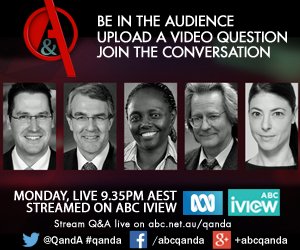
Meaningless Marriage on QandA

If you watched QandA last night, you may be left wondering why is Australia  having a discussion about marriage at all? It’s not because reason shows us that marriage should remain between a man and a woman, and it’s not because of impassioned stories from gay couples, but because we were told by two QandA panelists that we ought to get rid of marriage altogether.

DJZ6iwZVYAARmAS


English philosopher, AC Grayling, claimed that the origins of marriage were sexist, but now “there’s another sense of the word marriage which is the commitment that two or perhaps more — I don’t know — people make to one another about pooling their resources, mutually supporting one another.”

He added that he doesn’t support the institution of marriage (despite the fact that he is married), although he does support same-sex marriage.

Merav Michaeli is a former journalist and currently serves as a member of Israel’s Parliament. Like Grayling, Michaeli has a very negative view of marriage and thinks society expunge marriage altogether.

“This is not something that we should maintain in the world when we realise all of us are human beings.”

Why?

“Marriage has nothing to do with love but is a tool created to dominate women, and not somethin that should be sustained”.

“In many countries … your parents make you marry someone because of their social status, because of the family they come from, because they want to keep the property in a specific family or another family.”

Any audience member wearing their ‘love is love’ t-shirt last night, must have felt a little awkward…or enraged. Don’t worry, Michaeli was about to insult almost everyone on the planet. Not only is marriage not about love, it is an indictment on society for it is, according to Michaeli and Grayling, a system of oppression. Merav Michaeli went even further and alleged that marriage is a danger to children,

“The core family is the least safe place for children”.

“The custody, this total custody that we have in this structure of marriage which still gives men domination, complete domination over their children and too often over their women … is a part of the ongoing hurt in children.”

When host Virginia Trioli asked Ms Michaeli what is her alternative to marriage and the nuclear family, the answer was, the State should take responsibility for determining who will raise children. In other words, it should not be assumed that biological parents will raise their own children. In fact parents should not have inherent  rights to raise their children, but the State should be given authority to allocate children to what Michaeli calls, ‘share households’.

If your jaw dropped last night, I understand why. Pause for a moment and hear what Michaeli is suggesting; parents should not have the right to raise their own children. I’m guessing that Australians are sensible enough to know how absurd and immoral that idea is. It’s crazy. It’s George Orwell revisited. While we may not be in 1984, we do however need to appreciate that should marriage be redefined, the State will encourage children to be raised without one or both biological parents. Same sex marriage, even more than existing adoption laws, will institutionalise the raising of children without both biological parents. Not for a second am I suggesting that the State will be knocking on doors and taking children away without parental consent, but it does encourage a culture where children can and should be raised without mum or dad.

I have no doubt that there are Australians who have had a terrible experience in marriage. I know couples today whose marriages are not the beautiful and safe relationship that they imagined it would be. There are however many more examples where marriage does not reflect, in any way, the negative and abusive regime model that Michaeli describes. And where marriages have failed and are broken, most couples celebrate this situation, they wish that their experience was one where marriage was full of love and security and flourishing.

it is also important to note that, Michaeli and Grayling were not describing marriage as it was in the beginning, or the countless wonderful ways in which marriage has been expressed throughout history in different cultures. Instead, their arguments depend on taking poor historical examples of marriage, and fallaciously presenting them as normative.

The very first marriage is described in terms of goodness and intimacy and faithfulness,

“for Adam no suitable helper was found. 21 So the Lord God caused the man to fall into a deep sleep; and while he was sleeping, he took one of the man’s ribs  and then closed up the place with flesh. 22 Then the Lord God made a woman from the rib he had taken out of the man, and he brought her to the man.

23 The man said,

“This is now bone of my bones

    and flesh of my flesh;

she shall be called ‘woman,’

    for she was taken out of man.”

24 That is why a man leaves his father and mother and is united to his wife, and they become one flesh.

25 Adam and his wife were both naked, and they felt no shame.”

The Apostle Paul in Ephesians chapter 5 speaks of marriage with tenderness and other person centredness: a husband should lay down his life for his wife. A wife can choose to respect her husband, and help him be the kind of man he ought to be.

While both AC Grayling and Merav Michaeli said marriage was bad, both they, and Shadow Attorney General, Mark Dreyfus, presented the concept of marriage as relative and so not fixed in any ontological or purposeful way. Despite this, every historical example of marriage that was inferred in last night’s program, depended on the fact that marriage is between a man and a woman. Why is that? Could it be that no matter the extent to which a society tries to recalibrate marriage, in less than helpful ways, some things remained unchangeable?

The program also revealed that debates over marriage are much more complex than often presented. Among those who support classical marriage, are arguments grounded in biology, ontology, sociological reasons for raising children, and at times theology. Common among those advocating for marriage change is the view that marriage is a malleable and ultimately groundless institution that should reflect what people want it to mean. The logical extension of this view is exactly what we find Merav Michaeli advocating: let’s get rid of marriage altogether.

The lesson from history is not that marriage is wrong or that marriage is relative, but that we grieve when marriage goes awry.  When society adopts the less than ideal of marriage, surely the answer is not to further walk away from the ideal, but to return to it?

Listening to last night’s conversation on QandA once again reminded me that the first question Australian should be asking, what is marriage? Is marriage love is love, or something more? Is marriage a meaningless term that everyone has the right to use however they choose? Is marriage about property rights?