It was a momentous day at Sydney’s St Andrews Cathedral as celebrities and politicians gathered…for a funeral service.
John Laws’ State Funeral was televised live around Australia this afternoon on Channel 7.
The funeral is, of course, significant for family and friends, for those who knew and loved him. His passing is also emblematic of an older Australia that has become less familiar. Listening to John Laws on 2UE Radio was a regular ritual during my 4-year hiatus in Sydney. He was entertaining and a great interviewer, one whose golden voice softened many a brittle caller. John Laws was one of a dying breed: old school dink di Aussie. He exuded Australia, much like Sydney Harbour, Bondi Beach and the Akrubra. He was an everyman Aussie, who could chat with celebrities and common folk alike with equal measure and interest.
St Andrews Cathedral was filled with the rich and famous, with media personalities and politicians. Russell Crowe gave a moving eulogy, and John Williams echoed the Aussie larrikin spirit with a rendition of ‘True Blue’.
Speaking into the service, woven from beginning to end, were the words of one who was far less popular than John Laws in the day. His words didn’t give him a golden microphone; he instead wore a crown made of thorns. His words will, however, outlast every rhetorical flourish we will ever utter.
And so Kanishka Raffel, Archbishop of Sydney, opened the service with these words,
“We come to together to mourn John Laws, to honour him and to lay to rest his mortal body and to support one another in grief.
We face the certainty of our own death nd judgment. But those who die in Christ share eternal life with him. Therefore in faith and hope we turn to God. “
“In grief we turn to the word made flesh, Jesus, who speak to us grace and truth.”
How much we need men and women who speak with grace and truth. But the reality is, we all fall short in our words and lives. Whether it is with a smooth baritone sound or Estelle Costanza, we’ll all drop like a mic before the throne of God, except for the exceeding grace and kindness of God in Jesus.
‘be kind to each other’
“Be kind to each other” was John Law’s famous sign-off at the end of each show. Boy, we need more kindness, don’t we? More kindness in our homes and schools, more kindness in our cities and offices, more kindness toward friends and those whom we struggle to tolerate.
That is why we’ll do well to return to Jesus. We need the kind of kindness he displayed. Our communities need the kind of truth-telling and grace Jesus was able to speak and show. For his kindness cuts deeper and goes to the very soul of man; indeed, as the Bible explains, it was because of kindness of love that he volunteered to enter the grave.
“when the kindness and love of God our Savior appeared, 5 he saved us, not because of righteous things we had done, but because of his mercy.” (Titus 3:4-5)
Here is the link to the State Funeral and watch, listen (including Michael Jensen’s excellent homily) and enjoy
I was catching up with one of the young guys from church this afternoon. We have been reading through Philippians together. Today, we looked at chapter 4, and as we were reading and then discussing it together, it dawned on us how striking Paul’s directives are, and how much they contrast the kind of words and ideas that we see dominating the media and online discussions every day.
Rejoice in the Lord always. I will say it again: Rejoice! 5 Let your gentleness be evident to all. The Lord is near. 6 Do not be anxious about anything, but in every situation, by prayer and petition, with thanksgiving, present your requests to God. 7 And the peace of God, which transcends all understanding, will guard your hearts and your minds in Christ Jesus.
Finally, brothers and sisters, whatever is true, whatever is noble, whatever is right, whatever is pure, whatever is lovely, whatever is admirable—if anything is excellent or praiseworthy—think about such things. 9 Whatever you have learned or received or heard from me, or seen in me—put it into practice. And the God of peace will be with you.”
What an antidote! What an alternative to 98% of what Christians and non-Christians alike share on their socials these days.
Doom scrolling is a thing. Doom sharing is also a thing. And algorithms are only too happy to feed these negative appetites and drag us further into the vortex of polarisation.
I follow loads of people online, Christians and atheists, left and right, and everyone in between. I have to say, it’s not pleasant out there in the cyber world (and neither is it in general life as well sometimes). There is this unhealthy, although understandable, negative undertone that is taking people hostage. Like a self-fulfilling prophecy, it is the critical spirit and judgmental tone that attracts the most attention.
Sometimes I’m reading yet another comment and I’m thinking, does this person ever think anything good, noble and encouraging? Sometimes you leave wondering, is there t nothing good happening in the world? Some Christians would have us think it’s all bad and evil, and the church is worse today than it was yesterday, and yesterday the Church was the biggest problem of all! (All these weak insipid feminised men not expressing anger with the same degree that I am feeling!…you know the posts). If your impression of Christianity is these kinds of public verbiage, I don’t blame you. Some religious voices are a constant negative tune, like an irritating cat screeching through the night. Why would we think Jesus is good when Christians are always so angry and unkind.
The thing is, there are real and really dangerous and serious issues facing our world and our country. I don’t think it’s hyperbole to suggest that we are moving toward one of the most dangerous periods in all history, and playing cricket while people go to hell is a little bit sadistic. However, and it is a BIG however, at the same time, this isn’t just the worst of times, it is always the best of times. The Gospel of Jesus remains good and true. God is changing lives and growing churches all over the world. There seems to be a growing interest in Christianity among young Aussie guys and girls. I suspect the interest is greater today than it has been for generations: this is a profound encouragement.
If I may suggest a word to Christians who find themselves online a lot, and unable to control yet another word of complaint or rage or criticism, what if we change the song list? Could you share something different for a change?
Instead of everything being triple forte and with dissonant chords, find a melody in F major where there is lyricism, beauty and goodness.
Goodness and beauty are interesting. They are complex. They are intriguing and stimulating and attractive. Can anyone deny the nobility of Bach’s Preludes and Fugues? Or the wondrous sounds of a Chopin Ballade? Or even the captivating story of many a pop ballad.
There is occasion for a requiem to be sung and there is a time for hardcore punk anger and listening to Shostakovich’s C Minor String Quartet. But they should not and must not be our constant melodic line.
Is the gospel of Jesus good news or not?
So instead of doom scrolling, remember the Lord’s goodness and rejoice and share that joy.
Instead of topping up rage with the latest daily outrage, follow Paul’s advice and focus on what is noble and beautiful and useful. Not only will this do your own soul much good, it will paint a more accurate portrait of Christ and that is surely what we want to do above everything; to show people the compelling good news of the God who saves.
Notice where Paul lands at the end of his encouragement: “the God of peace will be with you.”
How much our tumultuous world needs peace. How much our cities and streets need this Divine peace. If peace is our aim, to be at peace with God through Christ, start practising Philippians 4:4-9
One of the largest memorial services in American history has just concluded.
Whether we approve or not, whether we are invested in the story or not, the assassination of Charlie Kirk has dominated the news cycle and continues to do so today, with his memorial service taking place in Glendale, Arizona.
The papers and social media are speaking about very little else. It’s not that this is the only thing that matters today, but there are moments in history that capture the public imagination in ways that coinciding events do not.
It’s clear that there were two narratives running through the memorial service, and we mustn’t confuse them as being the same or necessarily belonging together. I want to pull apart the politics that were present and the gospel that was also present.
Several members of the Trump administration spoke, including the President. Donald Trump gave a speech in which this line has already gone viral,
“He [Charlie Kirk] didn’t hate his opponents. He wanted the best for them – that’s where I disagreed with Charlie. I HATE my opponent and I DON’T want the best for them.
I suspect the President said these words with a certain tongue in cheek. He was bringing a moment’s levity to what was a very sombre occasion. At the same time, that does seem to be his modus operandi. But of course, Trump’s words are not his alone; this is the norm and assumed posture across religions and ideologies and politics. Whether it is fascist or anti-fascists or left or right, and most of the middle, we think ill of those who disagree with us. That the President is saying so with knowledge of the truth isn’t laughable, it’s woeful. Doubling down on hate doesn’t resolve the growing friction and factions that are disintegrating our societies. That leaves us with a game of power where the loudest, fastest and strongest aim to take charge and impose their will on the rest of us.
Trump, the ever populist and pragmatist, may well use whatever movement that helps maintain momentum. That’s a problem, as it was when previous American presidents co-opted Christian language and concepts to promote their own ethics and agendas.
On Saturday, I gave a lecture at the Reformed Theological College, where I outlined 3 principles for doing public theology:
Don’t conflate Church and state.
Don’t confuse common grace with particular grace.
Understand both the common good and the eternal good.
Christian pundits, commentators and pastors would do well and serve our congregations and the unbelieving public by recognising and practising those distinctions. Of course, the differences are not always perfectly clear and it is true that the gospel of Jesus changes every part of us, but nonetheless, we will do well to avoid those trappings. Why? In part, because the gospel is too important to be confused or co-opted by red or blue or green.
Merging the Christian faith with politics is fraught with dangers, and that’s true across the political spectrum. If you think that your particular position is exempt from that rule, that only exemplifies the very problem. It doesn’t mean every political ideology is equally true or good or respectable. Of course not. How we value the unborn really does matter. How we view migrants and the poor matters. And many other topics.
As I said earlier, two narratives were present in the memorial service, and it is the second one that I hope shines the most.
Charlie Kirk’s pastor, Rob McCoy, gave a clear presentation of the good news of Jesus. He said.
“Charlie knew … at an early age … he entrusted his life to the Savior of the World. . Jesus came to this earth, was tempted in all ways, yet was without sin, was crucified upon the cross…”
“His blood was poured out because blood must be shed for the remission of sins…And His death upon that cross was sufficient for all the world’s sins, but only efficient for those who, like Charlie, would receive Him as their Savior.”
Can we say an Amen to those words?
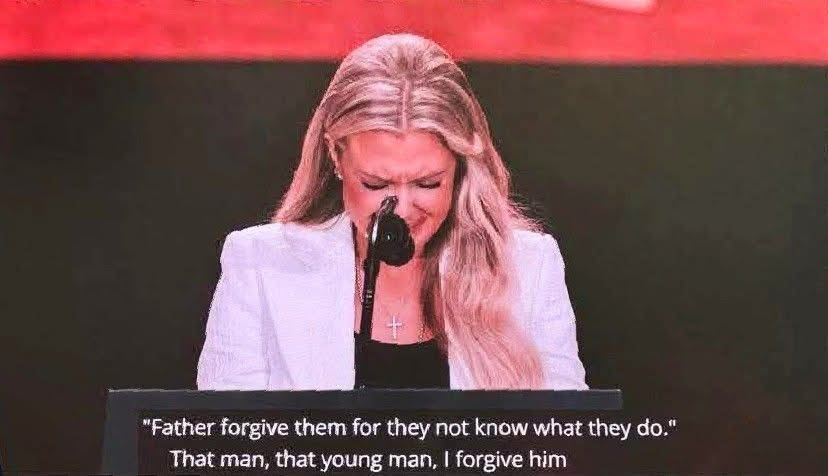
Erika Kirk then addressed the crowds and uttered the impossible word,
“I forgive him…I forgive him because it was what Christ did, and it is what Charlie would do.”
“The answer to hate is not hate,” she said. “The answer we know from the gospel is love and always love – love for our enemies and love for those who persecute us.”
This is the message our polarised world needs to hear. I thank God that God has not judged me according to every word I have said and every thought I have entertained. I am eternally thankful to God that he forgives sinners such as me. And grasping this gospel does something to us, where Trump’s words disappear and where love and forgiveness take shape.
What is so sad and troubling is that I know our culture well enough to see how this is going to play out in the media and social media: most people will simply double down on their prior commitments and attitudes. People are so entrenched in their ideological preferences that we will read the room as our glasses are glued onto our faces, and we are unable to see any other perspective. MAGA supporting Aussie conservatives will criticise me for my posture here and progressive Aussies will criticise me for not damning Charlie Kirk to hell alongside the President.
Reality is almost always more complicated and nuanced. One does not need to elevate Charlie Kirk to the status of Stephen (Acts 6) or label him ‘ult right’. The Christian truth is that sinners are saved by grace alone on account of the perfect sacrifice of Jesus alone. Anything else is hubris.
Here is a thought: regardless of our political leanings, if God uses the gospel preached at Charlie Kirk’s funeral to convince some people of God’s saving news through Jesus, will we rejoice or will we resent & grumble like Jonah in Ninevah?
The mystery of Christianity’s ongoing relevance in Australia continues.
Shining through the dark clouds and rain of Tokyo last night was an Australian woman. It wasn’t her winning the high jump at the Athletics World Championship that so much elevated the spotlight (as impressive as this is) but how Nicola Olyslagers pointed her praise and joy to God.
“And every time that I was jumping. It was just worship. I was like, let’s go. And so even if waiting and out there in the rain, I have such a joy because I know these moments are forever, the gold medal was the added bonus.”
She’s right, it was worship. It was worship not because her performance was outstanding (as it was) or because of her world-class athletic ability, but because Nicola Olyslagers was using her gift in delight of and for glory of God. The Apostle Paul describes the entire Christian life as a living sacrifice of worship to God. It is a life of thanksgiving and joy to and for the God who made us and whose Son gave everything for our redemption.
It’s not only the Ancient Greeks who deified their athletes. Australians raise our athletes to a bar that they, nor anyone, can measure up to, whether it’s sporting successes or their personal lives. We stick them on a mantle and throw garlands of gushing praise that would make Hercules blush.
There is something humbling and attractive when winners don’t point to themselves. How interesting it is to hear athletes directing praise not toward themselves but to God. In Western countries like Australia, we pride ourselves in the so-called decline of religion in general, and Christianity specifically. We preach how we have built an alternative society in the vein of John Lennon’s hopeless ‘Imagine’. But as we’re discovering, this secular humanism is more like Camus’ Myth of Sisyphus. Except, Sisyphus is no longer pushing the boulder uphill; it’s fast chasing him down the hill, and yet strangely Sisyphus is shouting, ‘Look at me, I’m free!’
No matter how we try to squeeze out or sanitise Jesus, he won’t be locked in a cultural box, but in so many areas of Australian life, and yes, even among our athletes, this Jesus is making an appearance. Think of Geelong’s Ollie Dempsey, who is playing in the AFL Grand Final this Saturday, or Gary Ablett Jnr, Labuschagne and a host of NRL players.
Nicola Olyslagers’ words may appear strange to many of our ears, partly because God is the idea we are trying hard to leave behind. Who needs God today? We’ve also accepted a popular myth; God is baggage that keeps us from having success and happiness. Nicola Olyslagers is one of may athletes at this year’s World Championships showing us otherwise.
It is one thing to compete for self-satisfaction or actualisation. It is another thing to represent one’s country. It is reaching beyond the stars when athletes strive and exert for the glory of God. It’s not that the last of these is the least or cancels out the love of sport and the honour of running, jumping and throwing for your country. Competing for God raises the bar, not the bar of expectation, but the bar of realised contentment and happiness.
Think of it this way, if competing for yourself brings about a certain but limited happiness, and competing for others brings a higher level of wonder, then to jump or run for God’s pleasure is the greatest pleasure of all.
“God made me fast. And when I run, I feel His pleasure,” so said Eric Liddell, the 400m gold medalist from the 1924 Paris Olympics Games.
At the 2021 Tokyo Olympic Games Nicola Olyslagers shared,
“I think as a teenager I was always an outcast; and I got welcomed into a faith community that loved me. And I just remember encountering god’s love and it changed the way I thought of myself – as a misfit why was I created so tall and stuff – and it gave me passion and purpose to use it.
“In 2017, it was my big moment when it flicked the switch and I decided to pursue God over sport.- whatever comes from sport is a bonus, but I am already complete and perfect and loved as a person regardless of it.
“That just allowed me to soar over high jump bar and not be scared anymore because I am loved and that is the most important piece.”
There are extraordinary athletes who follow Jesus, and there are extraordinary athletes who do not. This is the case in every field of endeavour. Some of the most brilliant minds in the world today are followers of Jesus, while others are not. Many of history’s most influential thinkers were professing Christians, and others not. Today, in the fields of medicine, law, science, music, film, and economics, there are men and women who profess the name of Jesus, and there are men and women who do not.
The difference doesn’t depend on a person’s intellect or effort, but in the category that is greater than all others. Neither is the distinguishing characteristic success, as though Christians are more likely to win Word Championships or unbelievers are more likely.
One of the lessons here is that you don’t need to sacrifice God for sporting achievement. You don’t need to ditch God in order to find success. We are not required to ignore God in order to find our truest self. Nicola McDermott and Sydney McLaughlin are among the many athletes who prove this myth to be false. And what these athletes have shared is a message of good news that surpasses sporting achievement. Eric Liddell who felt God’s pleasure as he raced to gold, also said this, “Many of us are missing something in life because we are after the second best.”
The Apostle Paul once wrote a letter to a young man. He used a sporting analogy to describe the greatest race worth running.
“ I have fought the good fight, I have finished the race, I have kept the faith. Now there is in store for me the crown of righteousness, which the Lord, the righteous Judge, will award to me on that day—and not only to me, but also to all who have longed for his appearing.”
You see, Christianity’s ongoing relevance in Australia isn’t a mystery. My generation may be stuck with ‘Imagine’ on repeat, but Zoomers are looking for meaning and realisation beyond the low and crumbling ceiling we call ‘self-actualisation’.
No doubt many young Aussies are dreaming about future sporting success. Many more are thinking about the future and considering the possibilities before them. We do not need to make the mistake of locking God out of life. Indeed, through Jesus Christ, he promises something of eternal meaning, joy and satisfaction. A few may eventually win a World Championship medal or AFL Grand Final, but let’s not miss out because we are after the second best.
The assassination of Charlie Kirk on 10th September will bring unspeakable grief to those who knew and loved him. His death is emblematic of the age in which we are sadly living. Not even an hour was permitted to pass without tirades of opinions and glee expressed online.
People are defending the shooter, even celebrating the murder. Many others dare to say that Charlie Kirk is simply a victim of his own making, while others again try to play the shadowy middle way game of whataboutism.
People are losing the ability and desire to talk to one another about life’s biggest issues. People enraged by hardship and perceived injustice (or real injustice) drink from the fever-inducing cup that is easily found among online socials, justifying and fuelling hatred for the other.
The city of Melbourne, every weekend it seems, now witnesses protests, vile speeches, and violence. Victorian Police are right now preparing for and dreading another day of protest on Saturday. These thousands are but a tiny few of the many more who express their anger over on Bluesky, X and Facebook.
Most people have no idea who I am and have not heard my name, and yet I have written and said enough to have my name printed in newspapers and even on the front page of The Age. The former Victorian Premier resorted to his famous slander under the Parliamentary privilege because of a view I had expressed. I have received more than a few ‘colourful’ letters in the mail or messages on the phone. As a consequence, there have been a couple of Sundays when I have had a quiet word with the Elders, just in case someone might turn up to interrupt or protest our Sunday service. Thankfully, when someone has come as a result of something I’ve written, it is in search of a merciful God and not with an agenda to shout down a preacher.
We will not find a way forward for the common good through joining in the competing choruses online; hate breeds hate, and conspiracy is often countered with misinformation. Of course, there is much going on that is maddening, harmful and concerning. Anger has a place (God can be angry), but it mustn’t be the only key in which we speak. Indeed, how we speak and what we say really does matter. Charlie Kirk, from the little I know of him, engaged his interlocutors with grace, and yet he is now dead. Far from reasoning that kindness doesn’t work, we need to double down on grace and kindness.
I have lost count over the past 5 years of how often I have seen comments from certain Christians who self-identify with the final Beatitude (blessed are the persecuted), and subsequently use this to justify relegating the first 7 Beatitudes to the category of ‘not in season’. Peacemakers and meekness and mercy are deemed an inconvenience; how differently Jesus sees things.
The Christian doesn’t need to second-guess how to respond to world events and how to engage with others. The Christian isn’t left without guidance and recourse. Jesus gives the believer a paradigm in the Beatitudes.
He said:
“Blessed are the poor in spirit, for theirs is the kingdom of heaven.
Blessed are those who mourn, for they will be comforted.
Blessed are the meek, for they will inherit the earth.
Blessed are those who hunger and thirst for righteousness, for they will be filled.
Blessed are the merciful, for they will be shown mercy.
Blessed are the pure in heart, for they will see God.
Blessed are the peacemakers, for they will be called children of God.
Blessed are those who are persecuted because of righteousness, for theirs is the kingdom of heaven.
“Blessed are you when people insult you, persecute you and falsely say all kinds of evil against you because of me. Rejoice and be glad, because great is your reward in heaven, for in the same way they persecuted the prophets who were before you.
The Beatitudes don’t detail how one enters the Kingdom of heaven, but the life of those who belong to this Kingdom. This posture in some ways pre-empts the final manifestation of the Kingdom by exhibiting its qualities in the here and now; to use Jonathan Leeman’s analogy, it’s much like an embassy in a foreign country.
Some Christians hold to some of the Beatitudes and play loose with others. Some of us focus on peace-making while sacrificing righteousness in order to achieve this goal. Some grab hold of righteousness with clenched fists, while ignoring how Jesus begins, with confession and contrition of our own sins. It is important to see how the Lord Jesus ties them together in an unbreakable bond. All 8 Beatitudes belong together and work together to build godly character and a life that imitates, albeit imperfectly, the Lord Jesus.
Jesus leads us to begin with confession and contrition, acknowledging our complete dependence on God’s grace, which is his loving gift to us through the atoning death of Christ. The more we grasp the astonishing nature of God’s grace, we can no longer look at other Aussies with any disdain or wanting anything other than their good.
I suspect some of my Christian friends believe that if we follow the first 7 Beatitudes, the outcome will be peace and happy relationships with everyone, but that’s not where Jesus leads us. He says, ‘Blessed are those who are persecuted because of righteousness for theirs is the kingdom of heaven.’
It is true, we can be shouted down because we’ve said stupid things, hurtful things, and said the right things wrongly; I know I’m guilty of all the above. Nonetheless, Jesus indicates that living the Beatitudes and being concerned for God’s righteousness may still result in people being offended and not liking us and attempting to silence us. For Christians to think we can escape verses 10-12 is understandable but somewhat naive.
The Christian song sheet isn’t La Marseillaise,
‘Français, pour nous, ah ! quel outrage
Quels transports il doit exciter!
C’est nous qu’on ose méditer
De rendre à l’antique esclavage!’
If the writer or website you read regularly uses language of ‘revolution’ and ‘war’, ‘taking back’, and throwing around rage and expletives, perhaps it’s time to find a more useful read. After all, Proverbs warns us,
“Do not make friends with a hot-tempered person,
do not associate with one easily angered,
or you may learn their ways
and get yourself ensnared”. (Proverbs 22:24-25)
Blessed are the poor in spirit.
Blessed are those who mourn.
Blessed are the pure in heart.
Melbourne needs Christians leaning ever closer to the Jesus of the Beatitudes. The United States and Australia need Christians who are learning to press closer to Jesus’ words, trusting him and doing as he asks. If you’re not yet convinced, then take a look at the cross. Did Jesus abandon his Beatitudes as he hung crucified? Or did he embrace them, such that he died with and for the sins of the world?
That’s the message our city and world need more than ever. That’s the life our churches need to embody more than ever.
This is a national day of action, when Australians are urged “to inspire and empower everyone to meaningfully connect with the people around them and start a conversation with those in their world who may be struggling with life.”
R U OK?
The chosen day is somewhat ironic, given the historic significance of September 11. I will never forget that night, turning on the television to watch the late-night news and seeing live footage of airplane slamming into the World Trade Centre. I was so confused that I thought I was watching a movie. But then, I understood what I was watching, the moment that killed the hubristic ‘end of history’ motif and which began to expose the tectonic plates of clashing culture and spirituality.
R U OK?
My daughter’s school has organised special events for today, to remind the kids of laughter and to teach them how to laugh. I guess, such is the despondency and anxieties capturing our society, that we need help to learn how to laugh.
R U OK?
This morning, we all woke to the horrifying news of Charlie Kirk being shot and murdered at a College event in Utah.
Once doesn’t need to agree with every view Charlie Kirk promoted, even if he was right about the things that matter most. As others testify, Kirk’s ability to listen, engage, and respond with clarity and a smile is a dying art in our polarised world.
It is a testament to his contribution to civil life that Presidents and political leaders and religious leaders alike feel the need to offer public condolences. Yes, there are the haters too, and the whataboutism pundits who ever fail to read the room. A word to the whatabout crowd, please don’t. Eliphaz, Bildad and Zophar are examples to avoid not copy.
The immediate outcry of sadness and shock is quite incredible. Reading the commentary today feels as though a black veil has descended upon America. Here in Australia, young people especially know the name Charlie Kirk. He was followed by millions, including many Gen X and millennials across Australia.
This murder further accentuates how our societies have lost the ability to communicate, disagree and debate. The appetite for hate and rage is strong, and like a virus, it is eating away at our soul. Police in Melbourne are again expressing profound concerns over proposed marches and protests that are planned for this weekend. We no longer speak to each other and seek to understand; we yell and spit and throw projectiles.
R U OK?
Many today are not ok.
Next week I’m giving an address at the Reformed Theological College in Melbourne, where I’ve been asked to speak to this topic: ‘Engaging Society: A Gospel Response.’
Without giving too much away, may I point us in the direction that God points. Ephesians 2 spells out God’s plan of peace and it is a heavenly vision designed to be experienced on earth. The full embodiment of this promised peace will have to wait for the resurrection day, but it is nonetheless a given and realised even in the middle of tumultuous times,
“But now in Christ Jesus you who once were far away have been brought near by the blood of Christ.
For he himself is our peace, who has made the two groups one and has destroyed the barrier, the dividing wall of hostility” (Ephesians 2:13-14)
God has announced his peace plan. With staggering undeserved grace, he paid the price for peace: the death of his only son. God’s plan of peace reconciles separated people, those separated from God and from one another. The Gospel of Jesus Christ really is the answer to all our brokenness and divisions, our frustrations and hates. Leaning ever closer to this Divine peace is the antidote. This plan will outlast and defeat every hatred and misunderstanding, every anxiety and fear.
I didn’t know Charlie Kirk, but amidst his words and views, a living faith in the risen Christ was apparent. That counts for everything.
R U OK?
I’m looking forward to this day spoken of by the prophet Micah when God’s peace covers the earth,
“Many nations will come and say,
“Come, let us go up to the mountain of the Lord, to the temple of the God of Jacob. He will teach us his ways, so that we may walk in his paths.” The law will go out from Zion, the word of the Lord from Jerusalem.
He will judge between many peoples and will settle disputes for strong nations far and wide. They will beat their swords into plowshares and their spears into pruning hooks. Nation will not take up sword against nation, nor will they train for war anymore.
Everyone will sit under their own vine and under their own fig tree, and no one will make them afraid, for the Lord Almighty has spoken.”
This weekend, I am having a mini break, which means it’s an opportunity to visit another church.
I love the church where I am a member and belong, but annual leave is an opportunity to visit other churches and be encouraged by what God is doing elsewhere.
We had originally thought that we would visit one of the churches in Melbourne CBD, but knowing police are overstretched and multiple protests were being organised, we thought it best not to go. Why add to the business? And who knows how long we’d be stuck in the city while protesters blocked intersections around the CBD.
So we visited Mentone’s daughter church, Regeneration Church in Clayton. It was lovely to catch up with old friends and encouraging to meet around God’s word and see how the church has grown since I last visited. It was a beautiful sight: a room filled with mostly 25-year-olds and representing so many different ethnicities, from all over the world and yet with one voice praising God and enjoying a deep sense of unity in Christ. I said to the pastor afterwards, ‘here [the church] is the answer to all of the friction and suspicion and anger in our community’.
It’s true, if you want to see a glimpse of what God is doing around the world today, go to your local church. If you wish to have a little taste of what life in eternity will be like, drop into your local church next Sunday and see where disconnected men and women from all backgrounds, jobs, education, ethnicity are finding joy and peace and love and life together through Jesus Christ.
Sometimes the music is happening, sometimes it’s out of tune. Sometimes the coffee is proper Melbourne, most of the time it isn’t. Sometimes the kids are noisy; often they are. The building’s architecture may be plain or striking, the preacher a great storyteller or simple words explaining the Scriptures. In these many different settings, from Clayton to Camberwell, from Pakenham to Preston, and from Mentone to Melton, church is like a breath of fresh air compared to the anx and rage filling our streets.
What a contrast with the clashing protests in Melbourne city today, where protests met with counter-protests, one volume of insult matched with further insult and even assault. Yes, many are probably marching for a myriad reasons, concerns over housing and cost of living, and fear of the unknown. But with the surprise element of boiling water burning you, these protests were already marked with signs of what they were about. When a protest is arranged under the banner, ‘stop mass immigration’, and then days out it’s described as defending ‘white heritage’ and denouncing Chinese and Indians in our country, of course, the march was going to go off the rails. So when a known neo-nazi is given a microphone and addresses the crowd from the steps of Parliament House, to the cheers of people below, what were you expecting to see?
A few days ago, Victorian Police expressed concerns that to deal with these protests, they were forced to take away resources from their search to apprehend a man who murdered two of their own and seriously wounded another only 5 days ago. Why would we create further strain on our police after the shocking week they have endured? And then, at the protest in Adelaide, a poster appeared, supporting the alleged police murderer.
Melbourne’s new Lord Mayor wants to claim the title of the ‘optimistic city’, but Melbourne is anything but optimistic or happy. Melbourne has turned into the nation’s protest capital, with weekly interruptions by protests and marches, often promoting the most insidious of causes. Our city is experiencing tumultuous divisions and doubts and fears. One solution often produces another misstep and further erodes public confidence and our social cohesion is increasingly tenuous. We are no longer the city we once were.
Jesus once warned,
“There will be signs in the sun, moon and stars. On the earth, nations will be in anguish and perplexity at the roaring and tossing of the sea. People will faint from terror, apprehensive of what is coming on the world, for the heavenly bodies will be shaken.” (Luke 21)
Tired of bad news? Exhausted by the negativity and fear? There is someone to whom we can turn. I’ve said it before, and I will keep on saying it: there is good news. There is really good news, and it can already be seen and experienced in Melbourne. There is something beautiful and good and happy taking place across our city where people from all manner of backgrounds are finding not a feeling of optimism but a happy and certain hope. To be sure, it won’t make the newspapers of 6pm news; good news stories don’t sell. But boy, do we need a better story than the ones filling every breaking news. As Jesus explained, what we get to see in our churches is tasted and seen in a million different cities and towns around the world and in a thousand languages and on a billion faces,
“This is what is written: The Messiah will suffer and rise from the dead on the third day, and repentance for the forgiveness of sins will be preached in his name to all nations, beginning at Jerusalem.”
“For those who’ve come across the seas We’ve boundless plains to share”
Australia has a rich and wonderful history of immigration. It is not overstating the case to say that our great nation is largely built on the blood, sweat and tears of migrants. Australia also has a mixed and difficult history with immigration; from the treatment of Chinese settlers in the 19th Century, to the Irish and sectarianism, the arrival of Italians, the white Australia policy, to welcoming Cambodian and Vietnamese refugees and more.
Like in the United Kingdom and the United States, there are growing noises here demanding that Australia shut down mass immigration.
A march is being organised across Australian cities for next Sunday. I would never have known about it except for a couple of individuals plugging it on social media. The website claims,
“Australia is changing in ways most of us never agreed to. People are waking up to a country they barely recognise. Endless migration, weak leadership, and political cowardice have brought us here, and it’s time to put a stop to it.
Immigration poses exciting possibilities. Also, immigration always presents significant challenges. There are genuine questions to be asked of Islam, as there are of Christian Nationalism and other isms. Nations rightly have borders, laws, and citizenship that govern and give shape to a country. To be pro-immigration doesn’t mean zero borders and no caps on immigration. There are real and complex questions relating to social cohesion in Australia. Deciding on intake numbers and who comes into the country and under what conditions isn’t an easy task. If you have ever spoken with an immigration officer, you’ll understand that they take their work with utmost seriousness.
People are afraid, fearful of losing the known, fearful of losing identity, and fearful of the other. But is the answer to fear, demanding the end to large immigration? Is the answer to wrap ourselves around the Australian flag, close the borders and keep out those who look different from us?
There is a major problem with this ‘March for Australia’.
The problem lies both in its starting point and in its trajectory. In short, ‘March for Australia’ is grounded in fear, ethnocentrism, and at times racism. I’m sure many people who’ll be swept up in the march are not racists, they are Aussies concerned about their country, and they’re unduly jumping onto a movement who while willing to give them a voice, is promoting xenophobic and racist ideas.
When your slogan is, ‘Stop Mass Immigration’, you are in fact acting in an anti-Australian way, because Australia is a nation made up from the nations, and we have always been. Who among us isn’t a descendant of migrants? Who among us hasn’t brought our culture into our cities, both good and bad? Have we forgotten sectarianism? It’s more than that, it is this Christian notion of the dignity of every human being, loving your neighbour and welcoming the poor and oppressed, that gave moral impetus to welcoming people to our shores. We do not welcome them because they are like us, but because we are ‘the lucky country’, and, to quote our National Anthem, “For those who’ve come across the seas, We’ve boundless plains to share”.
If your starting place is ‘immigration is bad and we must stop it’, then what follows will almost certainly be unhelpful. If, however, we begin by affirming the goodness of immigration, then we can have a conversation.
The trajectory is already being shown. When I hear a promoter say that ‘Australia has too many Chinese and too many Indians’, that is racism. And that way of thinking is gross and an affront to huge numbers of Aussies of Chinese and Indian descent, and I take it personally on behalf of my family and friends.
As one friend pointed out, this march is essentially calling for a return to the White Australia policy.
Another person alleged that anti-semitism is the reason why we must clamp down on immigration. I have said more about anti-semitism than most Christian leaders over the last couple of years, and while there is an evil anti-semitic undertone among some Muslim people, most of the anti-semitism I see is from university students and old socialists of white European heritage.
To allege immigration must stop is to say something about our character and how we view the other. It is building a society based on fear, not grace, on protectionism, not generosity, on self-actualisation, not sacrifice. In that sense, it’s all law and zero gospel. Now, that may not bother the average unbelieving Aussie, but it should surely concern the Christian. What casts out fear? Not hate, it’s love.
The wonder of the Christian message is that God includes the outsider. God’s only Son gave his life to welcome into God’s Kingdom the very people who do not belong and do not deserve citizenship. God’s Gospel is about grace, kindness, love of neighbour and for the nations.
While the Gospel and the Parable of the Good Samaritan do not outline an immigration policy, they are doing something deeper and broader. If Jesus died to save people from Morocco and Mexico, and from China and Chad, surely this changes the way we will view these image bearers of God.
Yesterday I posted a comment about immigration as a blessing, not a curse. One of the problems with my interlocutors yesterday is that as soon as I said, ‘immigration is a blessing’, they read it as saying I’m advocating for open immigration, even though my very next sentence stated that immigration brings challenges. They can’t seem to distinguish between no borders and generous immigration. But this march isn’t calling for generous immigration, according to many comments I’ve read; they want Muslims, Chinese, and Indians kept out of our country.
We are a nation of plenty. We are a nation of extraordinary wealth and prosperity. We are also a society wrapped up in red tape and layers of bureaucracy that make even simple decisions near impossible (ie solving housing). I find it interesting how Jesus didn’t say, ‘Let me come and help out so long as it doesn’t cost me anything’.
What especially stood out to me was the fact that a couple of Christians think that this march is a good idea. First of all, this protest would require you to skip church. Sure, it begins at midday, but for most people, that means missing church. If a movement or march requires you to miss church, do you think its origins are of God? Second, do they really believe that changing government policy will save our nation? That’s not a Christian answer.
Several years ago, Russell Moore was asked a question about Muslims moving into the community and wanting to build a mosque. Moore not only espoused a Baptist view of religious freedom and toleration, he also said this,
“That doesn’t turn people into Christians, that turns people into pretend Christians and sends them straight to hell. The answer to Islam isn’t Government it is the Gospel of Jesus Christ and the new birth that comes from that”.
Russell Moore is right.
Ephesians ch. 2 makes it clear that God’s reconciliation plan isn’t accomplished through Government or political means, but through the Gospel of Jesus Christ. This kind of Jesus reconciling brings disparate people together; it unites the great divide between Jew and Gentile.
“remember that at that time you were separate from Christ, excluded from citizenship in Israel and foreigners to the covenants of the promise, without hope and without God in the world. But now in Christ Jesus you who once were far away have been brought near by the blood of Christ.
For he himself is our peace, who has made the two groups one and has destroyed the barrier, the dividing wall of hostility, by setting aside in his flesh the law with its commands and regulations. His purpose was to create in himself one new humanity out of the two, thus making peace, and in one body to reconcile both of them to God through the cross, by which he put to death their hostility. He came and preached peace to you who were far away and peace to those who were near. For through him we both have access to the Father by one Spirit.
Consequently, you are no longer foreigners and strangers, but fellow citizens with God’s people and also members of his household”
If you think Australia will be saved through less immigration, you have missed the gospel, you probably won’t enjoy heaven, and you’re behaving more like the Levite than the Samaritan.
Jesus didn’t side with the Sadducees (who might be described as Roman conformists) nor with the Zealots. Modern-day Australian religious zealots may be feeling and seeing social discord, but rather than bringing reconciliation, they add to the discord.
Next week’s march is no more Christian than many of the protests that belong to the left-edge side of culture. Those already caffeinated on rage and scribbling out their placards for the march, will probably not like what I have written. If anything, the rage temperature will increase; perhaps it is a self-fulfilling prophecy!
However, if you’re one of those followers of Jesus who are troubled by social divisions and the fracturing we are witnessing in our streets and suburbs, press closer to the gospel of Jesus and believe God’s purposes through his son.
If you have issues with Islam, as I certainly do, love your Muslim neighbours, don’t hate on them; invite them over to your home for a meal with the family, don’t ostracise them. Invite them to Church and make them feel welcome, because they are.
Our Church is hoping to begin a ministry next year to migrant families in our community. Why? Because we want to serve them and we want them to know the good news of Jesus, just as someone once shared with us.
I love how yesterday in Western Sydney, a Sydney Anglican Church hosted a conference. It was given the name, ONE FOR ALL, and Archbishop Kanishka Raffel preached on the gospel that crosses cultures. Australia needs more of that.
If you hear people saying that there are too many Chinese or Indians or whoever in our country, call them out.
On Sunday, 31 August, go to Church as you ought, worship God with his people from among the nations, love each other, and hear again how the gospel of grace is our answer.
Update: the Melbourne march was attended by people from many different persuasions. However, the march was led by a group of self-identifying neo-Nazis, and a prominent neo-Nazi spoke from the platform to address the crowd.
I didn’t expect that question to be going viral this week! But then again, we are all living Alice’s Wonderland of the late Roman Empire.
This week, during an interview on Fox & Friends, President Trump was speaking of the negotiations between Ukraine and Russia. As he spoke of the hopes for the war coming to an end and for some kind of peace to be established, he mentioned his hope for heaven.
“I wanna end it. You know, we’re not losing American lives … we’re losing Russian and Ukrainian mostly soldiers…I wanna try and get to heaven if possible. I’m hearing I’m not doing well. I am really at the bottom of the totem pole. But if I can get to heaven, this will be one of the reasons.”
Whatever one might think of the sitting American president, he has a sense of humour, and even these remarks contain a touch of jocularity. Part of the problem when writing about President Trump is that people are so entrenched in their opinions, any thought bubble not fitting prior judgments of the man simply blows away. No doubt, Trumpites are trumpeting his sainthood and have already assumed he is the 13th Apostle. Others are equally convinced Donald Trump is the Devil incarnate and worse than Hitler!
Later on, White House Press Secretary Karoline Leavitt was asked if the President was “partially seeking peace in order to get to heaven. Was he joking or is there spiritual motivation?”
She answered,
“I think the President was serious. I think the President wants to get to heaven as I hope we all do in this room”.
I’m not God (obvious), and so I don’t have access to the President’s heart. He certainly has a public record that spells out danger. If, however, there is something to the rumours circulating since the first attempt on his life one year ago, President Trump has, at the very least, been forced to examine the question of mortality.
The question of heaven is one that almost every single person on the planet will ask. Even the most ‘true blue’ naturalist and atheist is likely to ponder whether the God who doesn’t exist will let them into the heaven they believe is fiction. When confronted with death, the word from Ecclesiastes proves true, ‘He has also set eternity in the human heart’ (3:11). We ask. We even long for an answer in the affirmative.
What must I do to gain entry into heaven? Who must I be or become to find welcome into God’s home?
Before we get to the answer given by Jesus, let’s consider the President’s plan.
Whether his comment was said in jest or with a doss of honesty, Donald Trump signals that he’s near the bottom of the pile. His working assumption is that getting to heaven is about moral conduct and or spiritual aptitude. It’s a totem pole or ladder we climb. If the President can bring to a close what is the worst war in Europe since 1945, surely that counts as a big leg up in God’s eyes.
In effect, the President is relying on the same view of God and heaven that is shared among most of the world’s religions (including distorted views of Christianity): Heaven is reward for the holy, and we achieve this status through self-improvement and helping others, whether it is a volume of good works or spiritual exercises.
The problem with this assumption is that it doesn’t work. It places too much confidence in our ability to create personal righteousness, it belittles our record of personal transgressions, and it thinks too lowly of God’s holiness and too little of God’s grace. Let me explain.
The Gospel of Luke famously retells two encounters where an individual asks the question of Jesus,
“what must I do to inherit eternal life?’”
It’s essentially the same question Donald Trump is asking.
The first man to approach Jesus was a religious academic. The second man is described as a ruler. He was a local official of some description who also had significant wealth. One can read about the religious leader in Luke 10:25-37, but let’s focus on the second inquisitor.
A local ruler asks Jesus, ‘What must I do to inherit eternal life?’ Jesus turns and asks a question about the requirements in God’s law: Don’t murder, don’t commit adultery, and so on.
The ruler recites the laws, and, whether he’s being honest or dishonest or delusional, he informs Jesus that he has judiciously followed God’s precepts since boyhood. Sounds good so far. But then Jesus went where the man did not want to go: his heart.
“You still lack one thing. Sell everything you have and give to the poor, and you will have treasure in heaven. Then come, follow me.”
“When he heard this, he became very sad, because he was very wealthy. Jesus looked at him and said, “How hard it is for the rich to enter the kingdom of God! Indeed, it is easier for a camel to go through the eye of a needle than for someone who is rich to enter the kingdom of God.”
The point is not that one can enter God’s Kingdom if our godliness measures up; the point is, no one does.
If Jesus’ assessment isn’t explosive enough, when the disciples follow up with this question, ‘who then can be saved?’, Jesus states the obvious:
“What is impossible with man is possible with God.”
We can’t con God. The bloke who is paying for his kids’ school fees while having an affair is still behaving reprehensibly, no matter how much the school fees are costing him. The President who secures a peace deal (as good as that is, and we pray that he will succeed), does not remove or justify or excuse a lifetime of dishonouring the God who exists and mistreating others.
In what can only be described as a devastating analysis of human hubris and religious zeal, the Apostle Paul exposes the notion that human beings can ascend to where God is,
“You, therefore, have no excuse, you who pass judgment on someone else, for at whatever point you judge another, you are condemning yourself, because you who pass judgment do the same things. Now we know that God’s judgment against those who do such things is based on truth. So when you, a mere human being, pass judgment on them and yet do the same things, do you think you will escape God’s judgment? Or do you show contempt for the riches of his kindness, forbearance and patience, not realizing that God’s kindness is intended to lead you to repentance?
But because of your stubbornness and your unrepentant heart, you are storing up wrath against yourself for the day of God’s wrath, when his righteous judgment will be revealed.” (Romans 2:1-5)
These words jar and clash with our sensibilities, but thank God someone is honest with us. Paul continues,
“There is no one righteous, not even one;
there is no one who understands;
there is no one who seeks God.
All have turned away,”
We might even mutter an ‘Amen’ to these words as we consider the American President, but the thing is Paul is also speaking of us.
This is one of the key ideas of Christianity that unsettled the world in those early centuries AD, and again in the 16th Century and still today in many parts of the world. Christianity is not a religion of merit, but of grace. It’s not about reward, but repentance. It’s not forging a golden staircase to heaven but receiving forgiveness brought about by a bloody cross.
Another American President once preached, ‘ask not what your country can do for you — ask what you can do for your country.’
Jesus preached a very different message. He came down from heaven and announced, ‘what’s impossible for you is possible for God’: salvation is not what we do for God, it is what God has accomplished for us. He then laid down his life to pay for the sins of many.
Heaven isn’t a reward for the best of humanity; it is the gift of God to the worst.
Once we realise God’s peace plan, it changes us inside out. It requires humility and confession. This grace changes your outlook and ambition; it reorients how we view the people around us.
So, will Donald Trump make it to heaven? According to Jesus, the answer is no, not if he believes in himself and thinks that his ‘good’ conduct is going to impress the God of the universe. If, like anyone who is convinced by Jesus, and so repents and believes God’s gracious gift, then the answer is yes, Donald Trump will be welcomed by God.
That answer will probably grate on the many who see the American President as an existential threat to whatever it is you value, and it might bring a smile to those who adore Donald Trump. But both those responses fail to appreciate the nature of grace. Presidents and Prime Ministers, billionaires and the poor, company executives and employees, everyone without exception will meet God and be held to account. That prospect ought to terrify even the most self-confident.
Should God…can God… open his heart and home to the moral incalcitrant and spiritually vacuous? For us, it’s impossible, but with the God of grace through Jesus, it is certain.
Are you happy? How do we measure happiness? Is Melbourne a happy city?
Melbourne’s Lord Mayor, Nick Reece, has announced a grand plan to make Melbourne the ‘most optimistic city’, including KPI’s to measure our happiness.
This audacious vision was conceived out of the recent M2050 Summit where 700 Melbournians brainstormed a future for our city as they enjoyed good wine, cheese and ‘don’t worry, be happy’ on loop (this isn’t a literal translation of what transpired!).
VIctor Perton from the ‘Centre for Optimism’ is championing Melbourne’s new vision (neither did I know that the ‘Centre for Optimism’ was a thing!). Perton has been interviewed alongside the Lord Mayor to promote Melbourne’ new ethos.
When a reporter contacted Perton about a Herald Sun article on the topic, he responded,
“The article was dripping with sarcasm. The writer dismissed optimism as fluff, equating it with naïveté or escapism.
How revealing.
Well, our arguments proved stronger than the cynics.
Later that day, the Lord Mayor and I appeared on several radio and television channels, putting forward a clear, confident case for optimism as a civic virtue, a strategic advantage, and a public good.”
Well, I guess it must be true then.
As I delved deeper into the website of optimism, I came across this bold and optimistic claim,
“The answer to life’s most pressing questions is optimism.
That is the optimism principle
The Optimism Principle distils the wisdom and insights acquired over ten (10) years of research on Australian Leadership and Optimism. We have found that optimism isn’t merely beneficial; it’s fundamental to achieving personal and organisational success and catalysing positive change.”
Hmmm. Not buying it? Neither do I. This approach smells familiar, much like the prophets of Jeremiah’s day who repeated the mantra, ‘peace, peace’, all while the city fell apart.
“They dress the wound of my people
as though it were not serious.
‘Peace, peace,’ they say,
when there is no peace.’ (Jeremiah 6:14)
Like a naked Emperor parading down Swanston Street or a French Queen with an appetite to, ‘let them eat cake’, just thinking positive doesn’t make it so. You can be the most optimistic person in the world, but like the Yarra River 200 years ago, people see through it. People need hope with substance. People need answers that go deeper than that iteration of the hedonist dream.
Now, I love Melbourne. Melbourne is the city where I live and where Susan and I raised our children. I started this blog 8 years ago to offer ‘ideas about and for Melbourne’. So, this isn’t an anti-Melbourne rant. It is rather an appeal to be real, and to recognise that our 5 million plus people need a better hope than what the Lord Mayor is offering.
The most obvious flaw in the Mayor’s plan is the implicit consensus that we are not a happy city. Melbourne is not an optimistic place, and we are not a particularly happy people. The Mayor wants to cultivate the mood change because optimism isn’t our thing.
One would have to be lying on a Tahitian beach for the past 6 years not to realise that a dark cloud hovers over Melbourne’s city and suburbs.
Levels of youth mental health issues is beyond blue, it is one of the few true crises facing us.
The volume of student absentee days across Prep-Year 12.
Our State Government blows out public infrastructure projects by $ billions, and then doubles down when costs are revealed.
Crippling State debt that will haunt generations to come.
Youth Crime and underworld crime is increasing and police often feel helpless to intervene.
The cost of housing and the cost of living are driving 100,000s of families to despair
Children need their mum and dad, but parents are caught in this vicious cycle of chasing the Australian dream, which forces parents to work more and earn more and therefore spend less time at home.
Social fracturing as demonstrated by weekly protests and growing anti-semitism.
Public transport that works and runs on time.
And the list continues longer than the Nepean Hwy.
Despite popular conception, our situation wasn’t created by the pandemic. Two years of almost constant lockdowns and restrictions certainly took their toll on us, but it wasn’t the catalyst that brought about pessimism or diminished energy and positive outlook. COVID functioned like a fast retreating high tide, exposing our hidden skeletons. The pandemic uncovered conditions that were already at work in our city: We are not happy. We are more anxious, troubled, divided and afraid, and with little hope of that trend changing soon.
Our optimist friends point to,
“we are cool.
From laneway galleries and artisan coffee to the Australian Open and cutting-edge science precincts, Melbourne has earned global recognition as one of the coolest cities on the planet. A city of thinkers, creators, performers, innovators.”
Sure, I guess that’s kind of true. But is this the sum total of what constitutes ‘happiness’?
It is somewhat telling that, as far as most global measures are concerned, it doesn’t get better than Melbourne. We are still considered one of the most liveable cities in the world, and yet we don’t feel it. When it comes to education, standard of living, food, sport, and culture, we are the Mount Everest of metropolises, as tall as Babel. Nevertheless, Melbourne is a melancholic city. We are more Nick Cave than Kylie Minogue. We are Marc Rothko, not Andy Warhol, we’re into abstract expressionism not pop art. We are a monochrome city. Our uniform is black on black with only the occasional shade of grey to separate the layers of black. Moodiness is what we do well. Perhaps part of our problem is our insufferable pride. Our expectations are so high and our competitiveness so insistent, that we normalcy and averageness are seen as failure.
There is also an intrinsic misstep in our approach to life. We decided that we no longer need God and we don’t need a new creation, because we can create heaven on earth. And we succeeded, and it wasn’t enough.
In 2006, world-renowned psychologist Jonathan Haidt wrote, ‘The Happiness Hypothesis’. Haidt argues,
“Happiness is not something that you can find, acquire, or achieve directly. You have to get the conditions right and then wait.
“Those who think money can’t buy happiness just don’t know where to shop … People would be happier and healthier if they took more time off and spent it with their family and friends, yet America has long been heading in the opposite direction. People would be happier if they reduced their commuting time, even if it meant living in smaller houses, yet American trends are toward even larger houses and ever longer commutes. People would be happier and healthier if they took longer vacations even if that meant earning less, yet vacation times are shrinking in the United States, and in Europe as well. People would be happier, and in the long run and wealthier, if they bought basic functional appliances, automobiles, and wristwatches, and invested the money they saved for future consumption; yet, Americans and in particular spend almost everything they have – and sometimes more – on goods for present consumption, often paying a large premium for designer names and superfluous features.”
Interestingly, ‘The Happiness Hypothesis’ was followed in 2012 with ‘The Righteous Mind’, and then, ‘The Coddling of the American Mind’ (2018), and finally, in 2024, ‘The Anxious Generation. If we need an illustration that speaks to the unravelling of a generation in 12 short years, Haidt’s thoughtful output is demonstrative.
We don’t overturn an anxious generation with skin-deep positive thinking, but with hope and a hope that has deeper meaning and consolation than a good coffee and money to pay the rent. That’s the problem, Melbourne’s new vision isn’t honest enough. Sure, we can pump out Pharrell Williams ‘Happy’ all day long, and ‘look at the bright side of life’, but cliches and forced smiles won’t cut it.
We have lost the ability to forgive. We are proficient at naming and shaming, while we wait for the day when our own sins will be exposed. We don’t know how to forgive, and without forgiveness, there is no happiness.
We have lost our grip on community. We know how much people need other people. Friendships and human connection is a basic life requirement, and yet almost every step in our society works against building community.
We have lost contentment. Contented lives are anathema in Melbourne, as businesses, schools and sporting codes vie for our attention and promise more. The contented person is almost frowned upon. How can you be happy with a small house or less than average income? How dare you be happy while living with chronic illness.
We have lost hope. Happiness without hope cannot exist, but where in our city do we find hope? Hope that depends on us will either lead to pride because ‘we can do it’ or to despair because reality catches up and we can’t. Which leads to this next ingredient essential for true happiness.
We have lost transcendence. This is something Zoomers seem to be waking up to as many under 25s are beginning to ask questions about spiritual realities and are beginning to read the Bible and turn up to churches around Melbourne. While my generation mocks Christianity and even calls it ‘dangerous’, and while Melbourne Councils find little to no room for places of worship in their grand designs, on the ground, there is an emerging recognition that we need God and that we are wired for God.
Ecclesiastes, the ancient book of wisdom, was right all along,
“He has made everything beautiful in its time. He has also set eternity in the human heart; yet no one can fathom what God has done from beginning to end.”
The Bible’s offering goes deeper than any optimist strategy. The Scriptures address the raw and real of the human condition. There’s no sugar coating in the Bible. We do however, find costly love and sacrifice, and hope for the helpless and joy that will outlast the best of what Melbourne has to offer.
As a Christian, I don’t subscribe to optimism or to pessimism, because the good news of Jesus Christ breaks pessimism apart and it won’t give room to hubristic ventures. This good news message offers people a way of viewing life with greater clarity, humility, thankfulness and joy. It doesn’t ignore material needs and the gains from improving education and green spaces, and hospitals, it does provide a firmer foundation, and it breaks the world open to what has eternal value.
The world’s most famous book on happiness (joy) is found in the Bible, Paul’s letter to the Philippians. From beginning to end, this short letter is filled with expressions of joy by man who was struck in a prison cell and facing an uncertain end.
“Yes, and I will continue to rejoice, for I know that through your prayers and God’s provision of the Spirit of Jesus Christ what has happened to me will turn out for my deliverance.I eagerly expect and hope that I will in no way be ashamed, but will have sufficient courage so that now as always Christ will be exalted in my body, whether by life or by death. 21 For to me, to live is Christ and to die is gain. 22 If I am to go on living in the body, this will mean fruitful labor for me. Yet what shall I choose? I do not know! 23 I am torn between the two…
whatever were gains to me I now consider loss for the sake of Christ. What is more, I consider everything a loss because of the surpassing worth of knowing Christ Jesus my Lord, for whose sake I have lost all things. I consider them garbage, that I may gain Christ and be found in him… not having a righteousness of my own that comes from the law, but that which is through faith in[ Christ… I want to know Christ—yes, to know the power of his resurrection and participation in his sufferings, becoming like him in his death, and so, somehow, attaining to the resurrection from the dead.”
If we are hoping for happiness, we will need to find forgiveness, friends, contentment, hope and transcendence. I’ll happily argue any day of the week that these realities are found in the person of Jesus and experienced in local churches that are scattered around Melbourne. If these KPIs are missing from Melbourne’s vision, then the project is already bound to fail.
Our Lord Mayor’s vision for Melbourne is too superficial. We are not plastic people who can be made happy by sensory experiences alone. Human beings are made for communion with God and made for community. The heart cannot be satisfied by material gain alone. As Jesus famously quipped, ‘what does it profit a man to gain the whole world and lose his soul’.






 MurrayCampbell.net