Concerns with ‘Awakening Australia’ remain

Over the past two months, there have been several articles, many conversations, and 100,000s of people engaging in reading and talking about Christian revival.

The catalyst for this discussion is a revival event that is planned for  Melbourne next month, “Awakening Australia”.  Hundreds of Churches and thousands of Christians across Australia have been energised and excited by the idea of coming together and hearing Christ preached, and praying for many thousands of Aussies to come and to know Christ.

In September, Stephen Tan wrote an article for The Gospel Coalition Australia, in which he offered a critique of Bethel Church and Bill Johnson. Stephen attended a Bethel connected church in Melbourne for several years, and so he has first-hand knowledge of their teaching and practices. The impetus for that article is the upcoming “Awakening Australia’ weekend, which is heavily influenced by, supported by, and promoting Bethel ministries.

I have twice already stated that “Awakening Australia” is more than a Bethel event, but it is not less than. For example, the organiser and one of the keynote speakers, Ben Fitzgerald, is a Bethel missionary, Bill Johnson will be speaking from the platform, and Bethel is supporting the event financially and is sending hundreds of volunteers to serve in Melbourne. In addition, the vision for this event lays in similar events that have been organised in Europe, which again have their origins in Bethel Church, Redding. There is nothing wrong per se with an American Church coming to Australia and bringing other churches together for an event. It is misleading, however, to explain away or to minimise ‘Awakening Australia’s connections with Bethel and with the word of faith movement.

Why am I writing again on this topic? Because, as a Christian and as a pastor and as a Melbournian, I remain very concerned by this event and the potential it has in damaging the physical and spiritual well-being of many people.

One of the concerns that have been raised relates to Bill Johnson’s teaching about the Divinity of Christ, and the ways in which his writings repeatedly minimise and at times seem to deny, that the incarnate Christ is fully Divine. Two weeks ago Bill Johnson issued a statement through text message to Ben Fitzgerald, which I was given permission to make public. The statement clarifies and to some extent corrects Johnson’s own public teaching about the person of Jesus Christ.

If Bill Johnson’s statement reflects a genuine correction, surely he will make further public clarifications and go to great to lengths to correct this teaching in his books. After all, is there any more significant a subject than who is Jesus Christ? To date, Bill Johnson and Bethel have released no such statement on their websites or in any public forum, other than this one casual text message. I find that astonishing.

There have been a number of updates over the past couple of weeks. I wish to bring to attention two of these.

First, a major Christian documentary was released last week. American Gospel: Christ Alone. It is a documentary produced by Americans to warn Christians around the world of what is America’s most dreadful export around the globe, the word of faith movement. The documentary features  American theologians and pastors who are decrying a false Christianity that has gained wide acceptance in the United States and is now being transported globally and is leaving behind millions of shattered people.  There are two hours of interviews, testimonies and biblical explanations of what the word of faith movement is about, and why it is so dangerous and damaging. Of immediate interest are sections in the documentary that explore some of Bill Johnson’s and Todd White’s teaching and ministry, including White’s connections with Kenneth Copeland and the prosperity gospel, their views about healing and the kenosis heresies. If anyone is interested to know why Stephen Tan, myself, and many others are so concerned about ‘Awakening Australia’ and the word of faith movement more generally, it is worth taking the time to view American Gospel: Christ Alone.

Second, ‘Awakening Australia’ has released and promoted a profile of Bill Johnson, ahead of his visit to Melbourne. As part of this bio, we read,

“healing and deliverance must become the common expression of this gospel of power once again”

“Bill teaches that we owe the world an encounter with God, and that a Gospel without power is not the Gospel that Jesus preached.”

By power Gospel, Bill Johnson believes that miracles and deliverance from evil spirits is an essential aspect of the Gospel of Jesus Christ, so much so that “a Gospel without power is not the Gospel that Jesus preached”.


Screen Shot 2018-10-25 at 8.35.11 am.png

First of all, let’s note the implication of these words. These statements work against the very claim that the organisers have been making, namely, these revival meetings are about building unity amongst Aussie Churches.  Hold on, Awakening Australia has just informed thousands of Churches across the nation that they don’t believe the real Gospel. Straight away, evangelical churches and reformed churches are excluded, based on these statements.

Let’s be clear, both Johnson and White believe that the Gospel centers on the manifestation of miracles and healings, and as Johnson loves to say, ‘on earth as it is in heaven’ (as though we can drag heaven into our lives now and overcome sickness and poverty, etc). This differs substantially from the Gospel of Christ that is revealed and taught in the New Testament.

In American Gospel: Christ Alone, one of the interviewees offers this comment on Todd White’ messaging,

“This method of evangelism by blessing, it’s changing the Gospel from you are dead in your sins and this is what you need by God’s grace, repentance, and faith…it’s changing that message to God loves you, he accepts you, here’s some free stuff. He’ll cure you of your ailments, he’ll heal  your back pain”

Screen Shot 2018-10-25 at 10.03.46 am.png


The focus shifts from sin and God’ wrath, to a positive message of, ‘you’re ok and let me give you a blessing today’. What did the Apostle Paul teach?

“As for you, you were dead in your transgressions and sins, in which you used to live when you followed the ways of this world and of the ruler of the kingdom of the air, the spirit who is now at work in those who are disobedient. All of us also lived among them at one time, gratifying the cravings of our flesh and following its desires and thoughts. Like the rest, we were by nature deserving of wrath. But because of his great love for us, God, who is rich in mercy, made us alive with Christ even when we were dead in transgressions—it is by grace you have been saved.” (Ephesians 2:1-5) 

Not only does the New Testament focus on atonement for sin by sufficient death of Christ, New Testament authors specifically repudiate teachers who add to the Gospel of Christ, including those who demand or expect to see signs

For the message of the cross is foolishness to those who are perishing, but to us who are being saved it is the power of God. 19 For it is written:

“I will destroy the wisdom of the wise;
the intelligence of the intelligent I will frustrate.”

20 Where is the wise person? Where is the teacher of the law? Where is the philosopher of this age? Has not God made foolish the wisdom of the world?21 For since in the wisdom of God the world through its wisdom did not know him, God was pleased through the foolishness of what was preached to save those who believe. 22 Jews demand signs and Greeks look for wisdom, 23 but we preach Christ crucified.” (1 Corinthians 1:18-23)

Hymenaeus and Philetus are two blokes who are mentioned in the Bible, not as examples to emulate, but as people to avoid (2 Timothy other 2:17-18). They taught that the “that the resurrection has already taken place.” In other words, they alleged that the promises that will one day be experienced at the resurrection could be enjoyed in the present. Paul says of these two men that their teaching is like ‘gangrene”, they had “departed from the truth” and that they “destroyed the faith of some.”

God does not promise physical or mental healing in this world. If you’re sick, visit your GP. Doctors and medicine are God’s common grace available to us. We can, of course, pray for God’s healing for our Heavenly Father invites us to talk to him about everything, but it is a lie for any preacher to promise such and to suggest that miracles must accompany the Gospel. The power Gospel is not signs and miracles today, it is Christ crucified: “we preach Christ crucified: a stumbling block to Jews and foolishness to Gentiles, but to those whom God has called, both Jews and Greeks, Christ the power of God and the wisdom of God” (1 Corinthians 1).

Sean DeMars rightly points out in the documentary, “bad theology hurts people.”

I am not suggesting that there are not genuine believers involved in Awakening Australia. I am not discouraging Churches from partnering together in the Gospel. I am not dissuading Christians from praying for revival. Praise God for such things. The greatest joys I have witnessed in life are when I have witnessed or heard of someone coming to know Christ through repentance and faith in him. Christian unity is beautiful and precious, but fudging the Gospel or downplaying aspects of the Gospel will not create a greater sense of unity amongst brothers and sisters; it only distorts and fractures.

Over the past month, a number of people have suggested that it is wrong and divisive to question ‘Awakening Australia’, and instead of criticising we should get behind it. Let’s remind ourselves, by their own promotional material,  Awakening has implied that thousands of Australian churches are not preaching the Gospel.  My response to those who have pushed back and raised concerns from what I and others have said is this, pastors of churches have a responsibility under God to be concerned for truth and to teach what is right and good and to warn our churches of ideas that or contravene or muddy the Gospel.

Jude exhorts us to “to contend for the faith that was once for all entrusted”

As Paul shared with Timothy that he was being poured out like a drink offering, he gave him this charge,

“In the presence of God and of Christ Jesus, who will judge the living and the dead, and in view of his appearing and his kingdom, I give you this charge:Preach the word; be prepared in season and out of season; correct, rebuke and encourage—with great patience and careful instruction. For the time will come when people will not put up with sound doctrine. Instead, to suit their own desires, they will gather around them a great number of teachers to say what their itching ears want to hear. They will turn their ears away from the truth and turn aside to myths. But you, keep your head in all situations, endure hardship, do the work of an evangelist, discharge all the duties of your ministry.”

I trust and pray that this is not the case, but if the Gospel presented at ‘Awakening Australia’ reflects the messaging that Bill Johnson and Todd White are widely known for espousing (and remember they are both speaking at the event), the effect will not be greater Gospel unity or genuine Spirit given Christ glorifying revival. The effect will a hyped up pseudo- spirituality which will fade in the weeks to come and which will confuse unbelievers as to what Christianity is really about, and which will cause great pain for the sick who are offered false promises of healing. Until such time that Awakening Australia distances themselves for these speakers and their links with the word of faith movement, concerns will remain.


Encouraging Update (July 29 2020): Todd White has publicly acknowledged that God has convicted him of preaching an errant gospel and that he is repenting. For the story – https://au.thegospelcoalition.org/article/a-real-miracle-in-prosperity-network/

Did Jesus empty himself of his Divine Powers?

“Believe me when I say that I am in the Father and the Father is in me; or at least believe on the evidence of the works themselves.” (John 14:11)

The Word became flesh and made his dwelling among us. We have seen his glory, the glory of the one and only Son, who came from the Father, full of grace and truth. (John 1:14)


No one likes to be misrepresented; it hurts and offends. We don’t appreciate it when people attribute to us characteristics, words or actions that are false. If faithful representation matters to us, how much more important it is when we are speaking about God.

“The study is arduous, for we are dealing with matters too great for us, which we must bow in worship, recognising, our utter inadequacy.” (Calvin)

Bethel Church, Redding, and their Senior Pastor, Bill Johnson, have received significant attention in recent days, with two important articles being published: one by Stephen Tan (who formerly attended a Bethel connected Church) and the other by Joe Carter. Their commentary includes serious charges, and I trust that the leadership of Bethel and ‘Awakening Australia’ will soon offer a considered response. Among the more weighty concerns is Johnson’s view of Jesus’ Divinity.

Throughout the history of the Church, there have been many attempts to explain the Divinity of Christ and the humanity of Christ. Many different formulations have strayed from the Biblical testimony, either undermining the humanity or the Divinity of Christ or fusing the two natures together in compositions that once again err. These errors are sometimes referred to as heresy, for they misrepresent the person who is Jesus Christ, which unavoidably impacts our understanding of God, and which leads to confusing and even denying a corollary of important Christian doctrines.

One of the more modern Christological heresies is known as the kenosis heresy, which speaks of an emptying, and it argues that the incarnate Christ gave up or lessened his Divinity during his earthly ministry. There are variations within this view, from Jesus ceasing to be God while on earth to Jesus laying aside certain Divine attributes, in particular, the omnis (ie. omnipotence, omniscience).  To put it simply, was the Lord Jesus on earth, in any way, less than fully God? It is this issue that is being asked of Bill Johnson and Bethel Church.

The question is being asked (and has been raised for some years now) because Bill Johnson has made several comments in which he appears to deny the Divinity of Christ on earth.


For example, writing for Charisma Magazine Bill Johnson explains,

“While Jesus is eternally God, He emptied Himself of His divine powers and became a man (see Phil. 2:7). It’s vital to note that He did all His miracles as a man, not as God. 

If He did them as God, I would still be impressed. But because He did them as a man yielded to God, I am now unsatisfied with my life, being compelled to follow the example He has given us. Jesus is the only model for us to follow.”

According to Bill Johnson (Tan cites other references where Johnson makes a similar point), we should expect to see and even do miracles because Jesus did so and he performed his miracles not as God, but as a man. Apparently, if Jesus had performed miracles as God, we shouldn’t expect miracles by Christians today. This is problematic for at least two reasons. In the first place, while Jesus’ miracles were loving acts of compassion and mercy, they were designed to point to his Divinity. Second, Johnson has misinterpreted Phil 2:7 in a very significant way.

To begin with, Bill Johnson cites Philippians 2:7 as evidence of Jesus giving up his “divine powers”. Does this verse teach what Johnson is claiming? Let’s take a look,

In Philippians ch.2 the Apostle Paul writes,

“In your relationships with one another, have the same mindset as Christ Jesus:

Who, being in very nature God,
did not consider equality with God something to be used to his own advantage;

rather, he made himself nothing
by taking the very nature of a servant,
being made in human likeness.

And being found in appearance as a man,
he humbled himself
by becoming obedient to death—
even death on a cross!”

A number of important points need to made here:

  • Verse 7, ‘he made himself nothing’, can also read, ‘he emptied himself’ (kenosis). This family of words appears rarely in the New Testament, and when it does, it is most often used metaphorically rather than literally.
  • Far from Jesus losing his Divinity or giving up Divine attributes, in verse 6 Paul indicates that Jesus’ Divinity continues (he uses the present participle, ’being in very nature God’).
  • In verse 7, the emptying is given particular expression: taking the form of a slave and being found in human form. In other words, as Robert Letham explains, “He empties himself by addition, not subtraction, by adding his human nature with all that that entails, not by abandoning his deity.”[1]

Mike Bird concurs, “The emptying occurred not by what he left behind but through what he took on, humanity – humanity in humiliation no less.” [2][3]

This is precisely what we find when reading the Gospel accounts of Jesus’ earthly life and ministry. Jesus repeatedly identifies himself as God and his actions reveal that he is God.

Firstly, the incarnate Christ identified himself as God, not as somehow less than God or partially God, but God. He didn’t deny his humanity nor his Divinity but expressly affirmed both.

“Very truly I tell you,” Jesus answered, “before Abraham was born, I am!” (John 5:58).

Following this statement, Jesus’ opponents pick up stones with the intent of killing him? Why? Because they understood that Jesus was claiming to be God.

“I and the Father are one” (John 10:30). Once again, people understood Jesus’ meaning and attempted to kill the alleged blasphemer.

Following the resurrection, Thomas exclaimed, “my Lord and my God” (John 20:28)

The phrase used by Jesus in John 5:58, “I am” (γώ εμί), is spoken by Jesus many times during his earthly ministry. It is a peculiar phrase that harkens back to Exodus ch.3 where God appeared by Moses and revealed his name, “I am”.  Jesus would repeatedly identify himself as the God who appeared to Moses at the burning bush: “I am the true vine”,  “I am the Good Shepherd”, “I am the bread of life”, and so on.

Not only does Jesus identify himself as God, his deeds also point to this reality.

While many miracles that are recorded in the Bible serve to point people to God, the miracles of Jesus point to the fact that he is God. Jesus’ miracles were acts of compassion and kindness, and they were also identity markers, explaining and revealing both that he is the Christ and is God.

Take, for example, the calming of the storm in Mark ch.4. The question is posed by the disciples, who is this? By a word, Jesus stilled the storm, which for a Jewish reader, would remind them of Genesis 1 and also Psalm 107.

“28 Then they cried out to the Lord in their trouble,
and he brought them out of their distress.

29 He stilled the storm to a whisper;
the waves of the sea were hushed.

30 They were glad when it grew calm,
and he guided them to their desired have” (Psalm 107:28-30)

When Jesus raised Lazarus from the dead, Jesus comforted Martha with words that not only affirmed the promised resurrection but  Jesus signally that he is the great I AM, he is God who raises the dead. As a demonstration of the validity of these words, Jesus moves to the tomb’s entrance, he speaks a word and Lazarus came out of the tomb: living, breathing, walking, no longer dead.

Somewhat ironically, but importantly, far from Johnson’s suggestion that Jesus’ miracles point to him not being Divine, Jesus’ miracles are signs pointing to the fact that he is God.

The testimony of the Gospels don’t support Johnson’s interpretation of Philippians 2:7, and even Philippians ch.2 doesn’t support his thesis.

In no sense should we undermine either the humanity of Christ or the Divinity of Christ. At the incarnation, the eternal Son of God also became man. On earth and at his resurrection and now in heaven, Jesus remains fully man and fully God.

It remains unclear what Bill Johnson and Bethel Church really believe about the Divinity of the incarnate Christ, although what I’ve so far read is concerning. One thing is clear, Bill Johnson’s teaching has been interpreted by some of his followers as advocating the kenosis heresy, and some of Bethel’s critics have also understood Johnson’s words to mean such. Therefore, at the very least, Johnson is communicating unclear and unhelpful words about Jesus and he is using them to build an unbiblical case for miracles today.

It seems as though the crux of the issue for Bill Johnson is that he wants to claim miracles for today and to guarantee the performance of signs and wonder by Christians today. It’s as though Johnson starts with a premise, namely that Christians can and ought to perform miracles today, and in trying to prove his point, he then goes back to the Bible and reconstructs Jesus’ identify in order to fit with his argument. Now, of course, one does not need to do any of this in order to believe that God can perform miracles today. But Johnson wants to push further and to insist that signs and wonder are necessary for authentic Christian experience.

I don’t know Bill Johnson or those organising ‘Awakening Australia’, but I do know people who have been confused by and damaged by the teachings and expectations of Bethel.

As a growing number of stories come to light from past Bethel members, and as more concerns are raised, I trust that Bill Johnson and Bethel’s leadership will take the time to respond and to bring clarity where there is murkiness. The spiritual wellbeing and eternal state of people is too important and the glory of God in Christ Jesus is of such weight that these matters require clarification.


1. Robert Letham, The Holy Trinity, p41.

2. Michael Bird, Evangelical Theology: A Biblical and Systematic Introduction

3. Other theologians have suggested that by ‘emptying’, Jesus was limiting or holding back from revealing his full glory. Where the transfiguration was a moment’s unveiling of God’s glory,  This is a possible interpretation, but it is a far cry from how Johnson has interpreted the verse.

A season for pruning churches in Australia

Does God sometimes allow unbelievers to do the work Churches should be doing themselves?

God used Nebuchadnezzar and the Babylonians as a weapon of judgement against Judah, and God used Cyrus as an instrument to bring God’s people back to the land and to see the Temple rebuilt.

While we cannot say with certainty that any specific person or organisation has been handed the pruning shears by God (for the simple reason, God hasn’t told us), we do know from the Scriptures that God is concerned with cutting off dead branches, pruning lives branches, and bearing fruit in the lives of his disciples.

In John ch.15 Jesus uses one of his many analogies to describe his relationship with his people, namely that of the vine and branches.

Jesus says,

 “I am the true vine, and my Father is the gardener. He cuts off every branch in me that bears no fruit, while every branch that does bear fruit he prunes so that it will be even more fruitful. You are already clean because of the word I have spoken to you. Remain in me, as I also remain in you. No branch can bear fruit by itself; it must remain in the vine. Neither can you bear fruit unless you remain in me.

“I am the vine; you are the branches. If you remain in me and I in you, you will bear much fruit; apart from me you can do nothing. If you do not remain in me, you are like a branch that is thrown away and withers; such branches are picked up, thrown into the fire and burned. If you remain in me and my words remain in you, ask whatever you wish, and it will be done for you. This is to my Father’s glory, that you bear much fruit, showing yourselves to be my disciples.”

img_7985


There is no doubt that churches have been entangled in many scandals over recent years. Clergy have been guilty of committing terrible abuses on children, while other ecclesial authorities have at times covered over these crimes. Popular preachers have been called out for marital unfaithfulness, embezzling money, acting like mini-dictators, and saying some really dumb and unwise things relating to an array of social and political issues.

Australia has a band of public figures and journalists who are always quick to castigate, shame, and then to investigate, all manner of evils perpetrated by Christians (and by people of various kinds of religious perspectives). This is no bad thing, for why should Christians be given a jail free pass, simply because they allege a diplomatic Jesus card?

At the same time, Churches and Christians are being increasingly condemned for believing and practising things that are in line with their Scriptures. Whereas abusing children is abhorrent and aberrant to the Christian faith, believing in heterosexual only marriage is consistent with biblical and historical Christianity, and yet many do not care for such moral distinctions.

Broader Australian culture has lost its cognitive awareness, rarely knowing what is and isn’t Christianity (and this blurring will only increase as Governments further squeeze out Christian education and religious freedoms); let’s return to the good old days of Pliny the Younger, who assumed the Lord’s Supper consisted of Christians eating the flesh and drinking the blood of fellow human beings! Weeds, plants, trees, and grass, all look the same, and the temptation to mow it all down is too great for some. This unfortunate and unsurprising trend toward religious ignorance is one reason why our society struggles to differentiate between the real sins in Churches and Churches who are properly exercising their faith.

Another problem is that in the world of today’s social media madness, the noise is at a crescendo, with people shouting and screaming at everything they don’t like, forgetting that not everything that they disagree with is necessarily wrong or harmful or evil. Religious and irreligious people are both guilty of the unsociable new norm, and it’s a worrying trend because when the volume reaches triple forte, it becomes near impossible to any worthwhile and important discourse.

Juxtaposed to these Metallica like screams is a deafly quiet that we find in some religious quarters. Rare moments of stillness can be of some value, but we should not confuse the appearance of saint-like silent meditation with spiritual authenticity; sometimes it’s nothing more than a magician’s trick to hide cowardice or complicity.

You see, at one level we can’t blame the culture, because it defines good and bad by its own standards, even if those moral lines keep moving around like a cat chasing a laser light. We are not expecting secular Australia to define moral goodness according to the Christian faith, because we understand, even as Jesus taught, that the two are not synonymous.

It’s not as though God’s righteousness is only true for the Church and is irrelevant to the outside world, for there is nothing in creation that escapes God’s good design and intent. The entire cosmos, including Governments, is subject to the rule of God, and yet they are in a state of rebellion, whereas the Church is meant to be a redeemed people, a city on the hill revealing the glory of Christ.

The greater responsibility lays with Churches and religious organisations, who have too often neglected the faith once for all delivered, and have instead adopted the moral and epistemological posture of the prevailing culture.

One of the persistent problems we have in Australia is with many Christian leaders failing in their responsibility. They have failed to stand for orthodox teaching. Instead of refuting bad and dangerous doctrines, these ideas are promoted and taught, or they give a silent endorsement. After all, can anyone really say that they know what the Bible says? Surely, only a puffed-up bigoted Pharisee would ever suggest that Biblical truth is clear and mandated? While far too many theologians and pastors have hired smoke machines to create ambiguity over pretty much every Christian doctrine, others have failed to act against bullies and abusers, perhaps through incompetence, more often, through neglect or not being willing to pay the cost.

The question is if Churches are unclear about discipleship and if Church leaders are failing to fulfill their ordained responsibilities, perhaps God will employ another to do that all-important work of pruning?

I understand why some Aussies look at our backyard, and conclude, religious and especially Christianity is waning. The culture has shifted, and every leaf and twig not conforming to the new pattern will be picked off for mulch. But that is to misunderstand what is happening. When a tree is pruned, it looks so bare and feeble that some might mistake it for being dead. That was certainly the reported diagnosis in the wake of last year’s national census, and with regular reminders about church closures and dipping church attendances. Is the Church dying? Is Christianity on the way out? Or is God in the process of cutting off dead branches and pruning those that bear fruit?

While many Australian Christians are concerned with happenings both inside Churches and in our surrounding communities, it would be wrong to respond with despair or hopelessness. It is a work of grace that God so loves his church that he attends to it: watering, feeding, and yes even pruning her. The vine is Jesus, and the branches are those who have been united with him. Remaining in Jesus is the only way to be fruitful, and remaining in Him is to remain in his word, namely to keep trusting and obeying his words. 

Surely we can be thankful as dead Christendom is removed from the scene, and while the culture isn’t savvy enough to discern between real and fake Christianity, the season can also be used of God to refine and prepare. In other words, pruning may hurt, but it’s good, and it’s the necessary prelude to a bumper crop. 


‘Awakening Australia’ won’t wake the dead

“fair is foul and foul is fair” (MacBeth Act 1, Scene 1)


If you didn’t think grave soaking was a thing, think again!

Ben Fitzgerald, a former Pastor at Bethel Church in Redding, California, and one of the organisers of Awakening Australia has a thing for visiting cemeteries and attempting to ‘suck up’ the spiritual powers of dead Christians. I kid you not!


UNADJUSTEDNONRAW_thumb_dd36.jpg

This is only one of many crazy and unbiblical practices that are encouraged and taught by Bethel teachers around the world.

The reason why this is of interest to us in Australia is partly because Bethel music is hugely influential in many churches today, and because of the ‘Awakening Australia’ movement which is being sponsored by and promotes Bethel. Awakening Australia, an upcoming revivalist event in Melbourne (November 2018).

While Awakening Australia is more than a Bethel event, the chief organiser is from Bethel, two of the keynote speakers belong to Bethel (Ben Fitzgerald and Bill Johnson), and Bethel is providing much of the music.

Awakening Australia website explains their aims,

“Our vision is to raise up a nationwide prayer mandate for the salvation of our families, friends and our country.

Right now our country is at a critical point in history, so now more than ever we must lift up prayer that grips us for our loved ones who do not yet know God.

God clearly gave us the number of 100,000 Australians coming to Him in 2018. If we all take our place in this mandate this is very possible.”

This all sounds exciting and amazing until one scratches the surface and reads that the Jesus believed and preached by Bethel is not the same as the Jesus revealed in the Bible and the Christianity that is promoted also differs to the Gospel that is outlined in the Scriptures. I am not saying that everyone involved or who is planning to attend aligns with Bethel theologically, for no doubt there are many genuine followers of Christ who will be there. But surely, because of such influence, it’s important to make people aware of concerns regarding Bethel’s influence and involvement.

Stephen Tan has published an insightful and important article on the Bethel Movement and its connection with Awakening Australia.  At What Price Awakening? Examining the Theology and Practice of the Bethel Movement has already been read widely by 10,000s of people all over the world, especially in Australia and the USA.

As with any article, there are people who agree and there are people who disagree. Some of the criticisms suggest that Stephen Tan (and the Gospel Coalition) are just mounting an attack on a legitimate Christian group, simply because they are different to TGCA. People should know though that Stephen has not written an anti-Charismatic or anti-Pentecostal article; he’s not a cessationist! Stephen Tan is not writing from the perspective of an outsider, but as someone who once attended a Bethel connected church in Melbourne, and who has first-hand experience of Bethel teaching and practices. Also this, he has carefully and fairly laid out the theology and praxis of Bill Johnson and Bethel, citing many examples which anyone can source and investigate for themselves. It is also interesting to see many people coming forward as a result of this article and sharing their own experiences from being part of the Bethel movement.

It’s important for me to be upfront, I know Stephen personally. He was an intern at Mentone Baptist for two years, and 18 months ago he planted a church with a team from Mentone. He is a man of integrity and with a deep love for Jesus and for people. Before his article was published on the Gospel Coalition Australia website, I had an opportunity to read the article. Having read the draft, I know there is much more that can be said of the Bethel movement but we wanted to keep the article short enough so that people would read it.

Another criticism being leveled against Stephen is that he’s been uncharitable toward Bethel, pointing out negatives and not the positives. Regardless of how many niceties and positives one might say, none of them can cover up and denude the very serious theological concerns that have been raised.

I have also noted that some critics have confused disagreement on secondary matters, with disagreeing over primary core doctrines. Bill Johnson holds that the incarnate Christ is less than fully Divine. He preaches the necessity of miracles and healing attached to the Gospel. let the reader understand, we are not talking about insignificant matters, but ones that question the power and definition of the Gospel and the identity of the Lord Jesus Christ.

It is not uncharitable of a Christian leader to inform others of a popular movement that is gaining acceptance in the broader church. The New Testament outlines how Christian leaders have a responsibility to alert fellow believers to dangerous ideas and doctrines. Correcting and exposing a movement like Bethel is important because the glory of God matters, the purity of the Gospel matters, and the health and life of people matters. The Apostle Paul exhorted the Elders of Ephesus,

“Keep watch over yourselves and all the flock of which the Holy Spirit has made you overseers. Be shepherds of the church of God, which he bought with his own blood.  I know that after I leave, savage wolves will come in among you and will not spare the flock.  Even from your own number men will arise and distort the truth in order to draw away disciples after them. So be on your guard!” (Acts 20:28-31)

Over the past week, the Australian news has been dominated by the story of strawberries. There have numerous incidents of people biting into strawberries, only to be stabbed by pins and needles that have been hidden by some yet unknown persons. Beautiful, sweet and tasty strawberries have been contaminated, and so it’s vital that the public is made aware. When the good news of Jesus Christ has been contaminated, it is incumbent upon pastors to warn people and to explain what is wrong, and to point people to fruit that is safe and good.

We pray for revival, longing to see many Australians coming to Christ, but no one has ever been saved by a false Gospel, no church has ever grown closer to God through a spirituality that has more in common with MacBeth’s three witches than the God of the Bible.

I agree with Stephen’s concerns with the gathering that is taking place in Melbourne later this year. I would encourage people not to attend, for the sake of their own spiritual health and for the good of their friends. I would urge churches to reconsider their participation and for pastors alert their congregations.

“I am concerned that the upcoming “Awakening Australia” event also fits the description and has the potential to cause much confusion and spiritual damage to thousands of unsuspecting Australians. To those who are supporting this event in the name of revival, may I ask this question: “At what price, awakening?” Is it worth pursuing awakening if it means that the gospel is compromised and that false teaching is promoted? I am reminded of the words of Jesus in Matthew 18:6If anyone causes one of these little ones–those who believe in me–to stumble, it would be better for them to have a large millstone hung around their neck and to be drowned in the depths of the sea.”


UPDATE September 27th

Following a story published in Eternity, Ben Fitzgerald offered this comment on Eternity’s Facebook page,

“you guys did a great job in this article- we are very thankful for your editorial gifts. As one the organizers I’d like to add something to this. A fair amount (not all) of the focus of this article is about Bill Johnson and some concerns / comments from one other pastor about him and Bethel. But to clarify a few things, Bill only speaks one time in the whole event- literally 1 hour from all 3 days, and right now most churches in Australia (maybe even those who don’t like Bethel) are probably singing a Bethel worship song every Sunday in their church. I don’t think it’s right people get so concerned over one of 8+ speakers..and focus on the fact that he said to “pray for trump”- by the way he never told anyone to go vote for him. The Bible tells us to pray for leaders so that’s scriptural. People can get so caught up on smaller issues and think of the many reasons to divide “yet again”- but the fact is Australia is in desperate need of the love of God and we certainly aren’t going to show them that as long as we are focusing on small division. The goal of this event is someones unsaved brother meeting Jesus. The goal is us bringing the real gospel to hurting people…we don’t have time to lose as our nation has clearly shown a radical decline in those who believe God these last 10 years. Already since we began this campaign over 1 year ago we have seen close to 1000 Aussies meet Jesus, and I hear similar reports from churches all across the nation- that something is changing. We work as an “All church” event…many Baptists leaders, free church leaders, Anglican, Pentecostal…the list goes on will be at the event and as of now we’ll over 200+ churches are already supporting this and its growing daily. Aussies churches are coming together not just for this event, but doing many other things like it because they sense an urgency to act and to show Australians and Undivided church. Last time I checked unity wasn’t an option in the Bible, but rather a command. I encourage people to lay down their tiny things, gather around Jesus, gather around the fact that our country needs God and if we do it together we are stronger. Bless you guys”


To which I have responded,

“A number of things can be said in response to this:

  1. Bethel’s involvement is greater than you have suggested here. Not only is Bill Johnson a key note speaker, but so are you and as you state, you’re an organiser of the event (and formally a Bethel pastor). The Bethel music band are performing. As the Awakening Australia facebook page has shared, you recently visited Bethel Church to give a report about the event, where Bethel members contributed financially to Awakening Australia and who are sending hundred of members to be present at the event. It may not be an official Bethel event, but it is certainly heavily influenced by and supported by Bethel.
  2. The criticisms of Bethel that were published last week are significant and substantial. While you may describe the differences “smaller issues” and “tiny things”, many of us think that the fully Divinity of Jesus Christ is a big deal. The fact that you are dismissing these criticisms as ‘tiny things’ only adds weight to the concerns of a growing number of Aussie Christians.”


Encouraging Update (July 29 2020): One of the keynote speakers, Todd White, has publicly acknowledged that God has convicted him of preaching an errant gospel and that he is repenting. For the story – https://au.thegospelcoalition.org/article/a-real-miracle-in-prosperity-network/


For the latest update, which includes and explores a statement from Bill Johnson and which unpacks why Awakening advertising excludes most Aussie Churches,  read here.  – https://murraycampbell.net/2018/10/25/concerns-with-awakening-australia-remain/

Is this Rome’s time for Reformation?

An open letter written by Archbishop Carlo Maria Viganò, has connected the coverup of child sexual abuse with the highest offices in the Roman Catholic Church,

“A former Vatican ambassador to the United States alleges in a 7,000 word letter that top Catholic Church officials, including Pope Benedict XVI and Pope Francis, were long aware of sexual misconduct allegations against former D.C. archbishop Cardinal Theodore McCarrick.” (NPR)

For years it has been apparent that there is a culture of abuse among many Roman Catholic priests, and that church hierarchy has been quietly suppressing the stories for many decades. But this week’s allegations demand, even more, the need for Rome to reform. At this point, Pope Francis’ only response has been to say, “I will not say one word on this. I think the statement speaks for itself and you have sufficient journalistic capacity to reach your own conclusions.”


photo-1522460676881-83490b51a873.jpeg

unsplash.com

When Martin Luther nailed his 95 theses to the Wittenburg Cathedral door in 1517, he was not calling for schism within the Roman Catholic Church, but for her reform. Luther rightly observed that reform begins with repentance.

The first of the 95 theses reads,

 “When our Lord and Master Jesus Christ said, ‘Repent,’ he willed the entire life of believers to be one of repentance.”

Martin Luther’s rediscovery of the Gospel call had an almost immediate effect. As the Reformation swept across Europe in the 16th Century, Rome sent out counter punches in the hope of quelling the tide. In the centuries since, there have indeed been moments of change made inside the Vatican, but these revisions have been primarily cosmetic and cultural, rather than ripping out the rotted foundations and replacing them with τ γιαινούσ διδασκαλί.

It is interesting to note that the events which led to Martin Luther’s clarion call concerned an issue of abuse; Rome’s teaching of and reliance upon indulgences.

The practice of indulgences is nowhere taught or encouraged in the Christian Bible. Indulgences contradict the most basic of Christian teachings, that justification before God is by God’s grace alone, received by faith alone, because of Jesus Christ’s atoning death alone,

“For it is by grace you have been saved, through faith—and this is not from yourselves, it is the gift of God— not by works, so that no one can boast” (Ephesians 2:8-9).

Roman Catholicism has taught indulgences since Medieval times, believing that they are a means by which people can receive remission for sins, and therefore reduce the time they would otherwise spend in purgatory. Leaving aside the fact that purgatory is another Roman concept which finds no warrant in the Bible,  indulgences take on multifarious forms, from saying a prayer, to completing a sacred pilgrimage, to helping the poor. Indulgences regularly contained a monetary aspect, paying a financial sum to the church to gain an indulgence, and thus time exemption from purgatory. The stunning St Peter’s Basilica in Rome that tourists and pilgrims enjoy today, was built in the 16th Century by stripping Europe’s poor via these indulgences.

In case we make the mistake of thinking that indulgences were left behind 500 years ago, they remain in vogue, with the current Pope publicly encouraging the practice of indulgences on at least two occasions since taking the seat in the Vatican in 2013. More odd, the ABC reported this week that the Anglican Church in Yea, Victoria, has recently taken up the practice in order to raise money to repair their dilapidated building.

Revelations made in recent years have once again made it clear that the problems inside Roman Catholicism are deeply rooted. When Martin Luther exposed the abuses made in the 16th Century, he rightly called for repentance and sought reform in the Church. Once again, Rome has been caught abusing the vulnerable, this time, sexually abusing young children and then consistently covering up the crimes. There are voices from within and many from outside, calling for Rome to reform her ways, but it appears that so far there is little sign of change. The allegations made this week by Archbishop Carlo Maria Viganò suggest that change needs to extend to the very top. Indeed, should the Archbishop’s letter be proven accurate, this would confirm the abuse scandals to be the most profound  faced by the Roman Church in centuries.

In criticising Rome, please don’t misunderstand, I am not suggesting that Protestant Churches automatically make the cut. Children have been abused inside Anglican, Baptist, and Pentecostal Churches, and even one example is one more than should ever be. There is, however, a vast difference between cases of abuse, and a culture of abuse. In addition, Churches that have once embraced the principles of the Reformation, need to reaffirm them with every new generation, lest we too lose our way. Europe, the United Kingdom, and Australia are littered with churches that once joyful upheld the 5 Solas, but today are little more than crumbling buildings sitting on prime real estate supporting the retirement funds of heterodox clergy.

The Apostle Paul insisted that we hold onto both doctrine and life, “Watch your life and doctrine closely. Persevere in them, because if you do, you will save both yourself and your hearers” (1 Timothy 4:16). The former shapes the latter, and the latter can easily distort the former when we preference personal morality above the ethics given by a good and holy God.

Is this Rome’s time for Reformation? Will Rome finally wake up and realise that they need to do more than move around the furniture or cover up the walls with a new coat of paint? 500 years ago, abusive practices were called out and thousands of clergy and churches across Europe heeded God’s gracious call to repent, but Rome ignored the opportunity. How will Rome respond this time?

At the heart of the 16th Century, abuses derived from a distorted view of God and his Gospel. With the rediscovery of God’s good news and with the people gaining access to the Scriptures in their own languages, unhelpful and gross evil practices were exposed and removed.

Reformation needs to come from within, and reformation requires the dismantling of any and all teachings, practices, and traditions that confuse, cloud or contradict the Gospel of Jesus Christ. This kind of foundational change will be confronting and difficult. Christians can pray that a movement of repentance will take over Rome. We can pray that both among Rome’s clergy and congregations there will be a rediscovery of the Gospel, the good news that the Apostle Paul first shared with the Romans almost 2000 years ago,

“All have sinned and fall short of the glory of God, and all are justified freely by his grace through the redemption that came by Christ Jesus.” (Romans 3:23-24)

“For we maintain that a person is justified by faith apart from the works of the law” (Romans 3:28)

Bad Leaders and Good Leaders

The very notion of leadership has become a public parody, a cartoon, a crazy dream that is strangely Orwellian and Black Adder together.

It seems as though among leadership of every kind and level, there is crisis, mismanagement, incompetence, and division. Whether we are talking about Australian politics or international politics, managing boards of major corporations, sporting clubs and yes even Churches, not even twitter can hashtag all the latest fiascos and failings. 

Of course, there are always criticisms, whingers, and dissenters, no matter who is leading. Even when leaders are performing their duties with excellence, grumblers are never far away.

At yet, corruption, bias, and abuses of power are very real and when it happens people are understandably upset, and they lose confidence in their leaders.

At the moment I’m preparing for Sunday’s sermon. We are currently preaching through the book of Jeremiah, and this week our reading is chapter 23, and it’s all about leadership: good leaders and bad leaders.

Jeremiah2.jpg

I should note, this blog post is not about the current state of affairs in Australian politics.  It is about a form of leadership that is more significant, namely that of Christian or Church leadership. The original context of Jeremiah chapter 23 is of God addressing the leadership of Judah (which included the King, the priests, and the prophets); the equivalent for us today is the church.

Characteristics of a good leader

“Therefore this is what the Lord, the God of Israel, says to the shepherds who tend my people: “Because you have scattered my flock and driven them away and have not bestowed care on them, I will bestow punishment on you for the evil you have done,” declares the Lord. “I myself will gather the remnant of my flock out of all the countries where I have driven them and will bring them back to their pasture, where they will be fruitful and increase in number. I will place shepherds over them who will tend them, and they will no longer be afraid or terrified, nor will any be missing,” declares the Lord.

“The days are coming,” declares the Lord,
“when I will raise up for David a righteous Branch,
a King who will reign wisely
and do what is just and right in the land.

In his days Judah will be saved
and Israel will live in safety.
This is the name by which he will be called:
The Lord Our Righteous Savior.

“So then, the days are coming,” declares the Lord, “when people will no longer say, ‘As surely as the Lord lives, who brought the Israelites up out of Egypt,’ but they will say, ‘As surely as the Lord lives, who brought the descendants of Israel up out of the land of the north and out of all the countries where he had banished them.’ Then they will live in their own land.” (Jeremiah 23:1-9)

Two metaphors are used, the Shepherd and the King.

Like a Shepherd:

  • a good leader tends (feeding and protecting those under his care)
  • he gathers (brings them together)
  • he calms fears and terror

Like a righteous King:

  • he will act wisely
  • he will act with justice
  • he will act with righteousness

It is important to note that God identifies himself as the Shepherd, and the King (the righteous branch) is the promised Messiah. The point is, the Lord will accomplish what his leaders have failed to achieve. He will redeem his people from the mess created by failed leaders.

Seven Centuries following this Divine pronouncement,  a preacher from Galilee arose, and announced, “I am the good shepherd”. But the phrase, “I am”, he was adopting the holy name of the Lord for himself. By exclaiming “I am the good shepherd”, Jesus was identifying himself as the God of Jeremiah 23:3, in contrast to the generations of bad shepherds who had gone before him and who were prevalent during his own public ministry.

What is most remarkable, is the extent to which the Good Shepherd would go in order to save and bring lost sheep: he would lay down his life for his sheep. This Shepherd leader loves his sheep so much, that he would give his life to save them. Jesus is providing us with much more than a model of leadership, for his sacrificial death is unique is salvific power and design, and yet he also signals a pattern that is to be followed by those who would serve as leaders under his rule.

In Jeremiah 23:4, God also speaks of other shepherds who will work under him. “I will place shepherds over them who will tend them, and they will no longer be afraid or terrified, nor will any be missing,” declares the Lord.” While the salvific focus is on God himself and his leadership role, he intimates that he will raise up shepherds to work under him” (v.4).

1 Peter 5 interprets Jeremiah 23 (and similar Old Testament passages) by speaking of the Chief Shepherd (the Lord Jesus) and Elders of a local Church,

“To the elders among you, I appeal as a fellow elder and a witness of Christ’s sufferings who also will share in the glory to be revealed: Be shepherds of God’s flock that is under your care, watching over them—not because you must, but because you are willing, as God wants you to be; not pursuing dishonest gain, but eager to serve; not lording it over those entrusted to you, but being examples to the flock. And when the Chief Shepherd appears, you will receive the crown of glory that will never fade away”. (1 Peter 5:1-4)

Characteristics of a bad leader:

The leaders in question are Judah’s king, the priests, and the prophets. Rather than faithfully administering their responsibilities under God, according to his covenantal word:

i. They create their own ‘truth’

“I did not send these prophets,
yet they have run with their message;
I did not speak to them,
yet they have prophesied.” (verse 21)

“This is what the Lord Almighty says:

“Do not listen to what the prophets are prophesying to you;
they fill you with false hopes.
They speak visions from their own minds,
not from the mouth of the Lord.

They keep saying to those who despise me,
‘The Lord says: You will have peace.’
And to all who follow the stubbornness of their hearts
they say, ‘No harm will come to you.’ (vv.16-17)

 Like Dustin Hoffman and Robert De Niro in the film Wag the Dog, the prophets have raised a green screen and laid over an unreal picture of reality. The prophets have fabricated an alternate reality: times of peace and prosperity, with images of green fields and cool streams, sandy beaches, city cafes, captivating moods and suggestions of a beautiful life to come.

ii. They make promises that they can never keep

“They keep saying to those who despise me,

    ‘The Lord says: You will have peace.’

And to all who follow the stubbornness of their hearts

    they say, ‘No harm will come to you.’” (v.17)

iii. They falsely attribute their words to God

“I have heard what the prophets say who prophesy lies in my name. They say, ‘I had a dream! I had a dream!’ How long will this continue in the hearts of these lying prophets, who prophesy the delusions of their own minds?” (vv.25-26)

“I am against the prophets who steal from one another words supposedly from me. Yes,” declares the Lord, “I am against the prophets who wag their own tongues and yet declare, ‘The Lord declares.’ (vv.30-31)

iv. They are motivated by evil

“And among the prophets of Jerusalem
I have seen something horrible:
They commit adultery and live a lie.
They strengthen the hands of evildoers,
so that not one of them turns from their wickedness.
They are all like Sodom to me;
the people of Jerusalem are like Gomorrah.” (v.14)

This religious industry of ‘new’ Divine words was tied to a moral agenda that was being promoted by Judah’s leaders. God connects their words with the concept of adultery and he likens them to the days of Sodom and Gomorrah. In other words, they form their religious ideas and Divine words based on their moral vision. The reference to Sodom and Gomorrah is telling. Sodom and Gomorrah were the famous twin towns destroyed by God in Genesis chapter 19, as a result of the townsmen wanting to have sex with the men whom Lot was protecting. It is therefore likely that the prophets’ message was an 8th Century version of the sexual revolution.

According to God, the prophets were speaking new words because God’s words restrain sin and they want to live out sin. If the Bible doesn’t give me adequate justification to pursue immorality, let’s make up new words and say that they are from God.

v. They are responsible for division and destruction

The outcome is scattering, misery, and social and spiritual carnage.  As God exclaims, “They do not benefit these people in the least” (v.32).

Right expectations

Should we expect more of our political leaders? Politics in the age of social media has yet to deliver on the kind of stability, integrity, and unifying vision that some predicted would occur. There may be some principles worth reflecting upon for leaders in general, but like I said at the outset, Jeremiah ch.23 is not speaking to the question of modern civic and political leadership, but to those who assume or are recognised as leaders of Churches. The kind of leader God affirms, is one who chooses God’s ways over popular cultural movements, who is okay with being unoriginal and uninventive in his words, and who brings unity not division among God’s people.

What do we expect of our Church leaders? They will certainly fall short because they are as human as the rest of us. They carry weaknesses and they struggle with temptation like all of us, and yet the expectations set for those who oversee churches are appropriately high.

Jeremiah ch.23 reminds us of how perilous it is to entertain new and interesting ideas about God and to use God as justification for our moral proclivities. Whether it is the Roman Catholic crisis coming out of Pennsylvania or with the schism within the Uniting Church of Australia, or royal preachers, prosperity preachers, or theological scholars from the school of Lord Voldemort, it is not difficult to see the harm and division that is created by many modern-day priests and prophets. If our favourite preachers and authors smell like the culture and look like the culture, and are praised by the culture, perhaps it’s time for us to find new preachers and teachers.  Above all, I’m reminded of how much we need the promised Shepherd and King of Jeremiah ch.23.

“I am the good shepherd; I know my sheep and my sheep know me— just as the Father knows me and I know the Father—and I lay down my life for the sheep.”

Baptists believe in Freedom of Association

Until Friday, I had never heard of Logan Robertson or Pillar Baptist Church in Queensland. Today, all Australia knows his name.

Logan Robertson and two other men have been charged with public nuisance offences following events that took place during the week at two Brisbane mosques. The incidents were ugly, offensive, and without warrant.

Mr Robertson is a New Zealand national who has already gained notoriety in his homeland for extreme religious views, including being subject to a police investigation regarding his public conduct. Prior to entering Australia a year ago, Robertson was cautioned about his behavior. Tonight he is in custody and will be shortly deported back to New Zealand.

Screen Shot 2018-07-07 at 9.46.15 pm

To begin with, along with Christians across the country, I wish to apologise to our Muslim Australians who were subjected to Robertson’s unruly conduct. People of any religion should be permitted to worship in freedom and without threat. We have seen other nasty incidents in recent months, usually with Christian churches and groups being targeted. On this occasion though,  the perpetrators were a group who purport to be Christian. We do not want Westboro or Münster type religious fanatics interfering with peoples religious freedoms, regardless of what their religion may be.

It is understandable that this story has made headline news across the country; this is a time when religious freedom is a topic of national conversation and we await the Government’s report on the Ruddock review. In the middle of these discussions, here is a ‘Christian’ minister intruding on a Muslim time of prayer and intimidating worshippers, including teenage boys.

Why does this matter? There are two issues here. First, there is the criminal charges and social ills that Robertson and others have allegedly engaged in. We should not intimidate other Australians by entering their worship spaces and interrupting religious services. Second, it is important to address this story, because just like the fake gynaecologist who was caught out and imprisoned in Melbourne this past week, a fake Baptist should also be called out because of the dangers in misrepresenting what Baptists, and Christians in general, believe.

While Logan Robertson self-identifies as a Baptist, as the media have rightly stated, he and his church have no affiliation with the Queensland Baptist Union and the Baptist Union of Australia. Indeed, there is little about Pillar Baptist Church that can be called Baptist.

As with all Christians, Baptist beliefs and practices are shaped by the Bible. What Christian Churches share in common is far greater than any differences. For example, while Baptists don’t baptise infants as do Anglicans and Presbyterians, and our church governance differs, otherwise,  we share the same beliefs that have been taught and lived out for 2000 years.

I have read the Doctrinal Statement of Pillar Baptist Church, and it does not resemble any Baptist confession that I have ever read before, and it includes some very strange ideas indeed.

Most Baptist Churches in Australia belong to the Baptist Union of Australia, and so they are in formal association with one another. There are also independent Baptist churches, and these vary in their beliefs and practices. Independence does not alone denote what a church is like, but as with every church (including those belonging to a traditional denomination), we ought to examine their doctrine and life closely. At the very least, when a Church states that it “reject[s] the teaching of the universal church” and does not associate with other Christian groups, that ought to raise serious questions.

Not only does Robertson’s Church have a doctrinal statement that doesn’t fit with historic Baptist faith, and not only are they unrelated to any formal Baptist association, it is clear that Logan Robertson has abrogated two important Baptist principles, namely that of freedom of conscience and freedom of association. While these principles are not owned by Baptists, they are closely aligned with Baptist thinking through the Centuries. Freedom of thought and freedom of association found clear expression among Baptists in the 17th Century, at a time when religious freedom didn’t exist but was often controlled by the crown, by Parliament, and by establishment churches. Baptists were often oppressed and even imprisoned for holding these beliefs. The author of Pilgrim’s Progress, John Bunyan, was twice imprisoned because he believed in and practiced freedom of religious association.

These two principles are not saying that Baptists agree with other religions or that we think that these religions are intellectually coherent, spiritually healthy, and morally good. Baptists are not theological and moral relativists. It does, however, mean that we believe Christianity is accepted through persuasion not by coercion, by gracious explanation and not by galling intimidation. Freedom of belief is not about privileging  one religious group over another, but positively guaranteeing that all Australians can speak and live their beliefs without harassment. Neither the State nor individuals in the community should resort to browbeating in order to change another person’s mind on an issue. We cannot create a healthy society by thuggery, whether it is noisy secularists forcing out Christians from the public square or religious fanatics spitting out their dogma in our faces.

Australia needs honest conversations about the big questions of life. We need these discussions happening in public spaces and in private meetings, and yet sadly, people like Logan Robertson caste a shadow on our optimism, and authoritarian secularists are throwing even darker clouds over the social and religious freedoms that we have long enjoyed in this country.

It is easy to say that Logan Robertson’s behaviour is unAustralian, but I’m not sure if I want to indict my New Zealand friends on this occasion! Robertson’s ideas and behaviour are certainly anti-Baptist, and therefore they have caused confusion over the beauty and goodness of the Gospel of Jesus Christ. When Jesus met people with whom he held profound disagreement, he loved them and he went to a cross to die that they might come to know and enjoy God forever. That is how Australians can tell a Christian, not that we agree with your beliefs, but that we love you and above everything we desire for you to know the Lord Jesus Christ, not to force him upon you, but with grace and fervour, with openness and humility, to explain the reason for the hope with have in Him.

Tasmanian Art Needs Saving

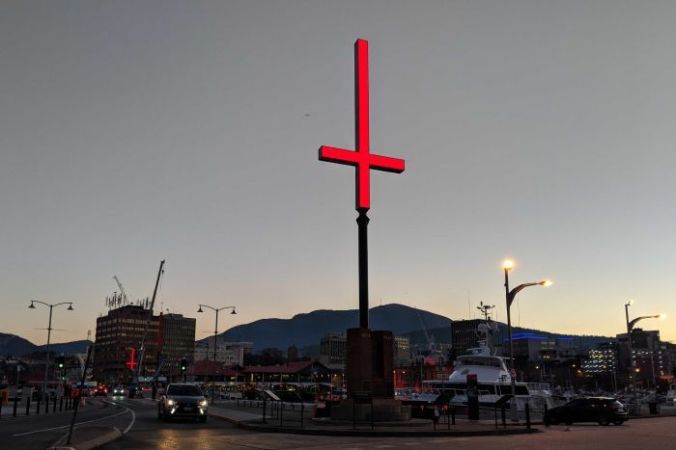
Last month a friend was about to visit Hobart and asked me whether it was worth visiting the Mona (Museum of Modern Art in Hobart). At first I thought he said MOMA, and so I proceeded to give a rapturous endorsement of this famous art gallery in New York City. He then clarified that he had said Mona and not Moma, at which point I was no longer able to help him. Perhaps there is a vibrant contemporary art scene in Tasmania, perhaps not. But then today, as I peered outside my Melbourne window and across Bass Strait, the distant feint red glow of upside down crosses didn’t succeed in turning around  my opinion about Tasmanian art.

9845166-3x2-700x467 (1).jpg

ABC

This is art? I realise that in Tasmania, the ministry of the Arts is combined with Justice, Correction, and the Environment. Was someone in the ministry confused when they opened the public purse? Or is Tasmania introducing a new form of justice and correction?

These so called ‘Crosses of Saint Peter’ look more like half assembled mood lights from Bunnings, rather than works of art. Then again, perhaps I’m being unfair to Bunnings!

Dark Mofo is a winter solstice festival, which aims to shock and to subvert. Last year, the Festival caused controversy in its ‘artistic’ use of slaughtered bulls, with blood and guts smeared all over people. This year, there is an anti-Christian theme, which would be innovative and interesting, except that it’s not. It’s kind of old and tried, about 2000 years so,  and sticking a few coloured LEDs onto  crosses is somewhat pedestrian.

Speaking of which, also appearing during the Dark Mofo Festival, is another artist, Mike Parr, who is going to bury himself under a road for three days. It’s unlikely though that his performance will have the same energy and excitement as the real resurrection, given that he’s not actually dead, and presumably he’ll need to eat and drink and poo and sleep. The more pressing question is this,  how is Mr Parr going to assess the critics reviews? Is trampling and driving over his ‘grave’ a sign of critical acclaim or of people expressing disinterest in the stupidity of the stunt?

Going back to these disco coloured inverted crosses, not only are they advertising an absence of artistic creativity, surely this project is a theological and social misfire.

The sight of these crosses is upsetting some Christians around Hobart, and I understand their reasons. Indeed, for millions of women and men around the world, they are being imprisoned and even killed because they love and believe the message of the cross, but why we would allow such facts to interrupt the creative processes. More so, I also think that once we’ve taken a step back, we can evaluate these cultural illuminatatis in a different way.

In his interview on the ABC, Mikey Lynch said it well,

“My immediate reaction was a bit of an eye roll — here we go, a shock jock statement that gets Christians grumpy.

“It’s a religious symbol and so for some people it is precious, so of course people are going to find that hurtful.

“For Christians, the cross is a symbol of shame and it’s about God taking on shame for the salvation of the world, so there’s a weird irony in getting offended by a symbol which in itself is offensive.”

These artists are taking what is the most offensive object of history, the cross, and are attempting to make some subversive statement about Christianity and to offend Christians in the process. Really? Let’s shame the symbol of shame? Perhaps the point has escaped the genius of these Dark Mofo artists, because surely their own subversive and unoriginal interpretations of the cross in fact reinforces the original point that was proven on the cross.

The Apostle Paul put it most aptly when he wrote,

“18 For the message of the cross is foolishness to those who are perishing, but to us who are being saved it is the power of God. 19 For it is written:

“I will destroy the wisdom of the wise;
    the intelligence of the intelligent I will frustrate.”

20 Where is the wise person? Where is the teacher of the law? Where is the philosopher of this age? Has not God made foolish the wisdom of the world?21 For since in the wisdom of God the world through its wisdom did not know him, God was pleased through the foolishness of what was preached to save those who believe. 22 Jews demand signs and Greeks look for wisdom, 23 but we preach Christ crucified: a stumbling block to Jews and foolishness to Gentiles, 24 but to those whom God has called, both Jews and Greeks, Christ the power of God and the wisdom of God. 25 For the foolishness of God is wiser than human wisdom, and the weakness of God is stronger than human strength.” (1 Corinthians 1)

Tasmania may be disconnected from the mainland by 500km of water, but apparently there also exists an ocean separating the Dark Mofo team from the world of art. Artists of Tasmania, please paint and sculpt, and resurrect what remains of your reputation.

They have may failed to set the art world alight, but these winter solstice revellers have given Tasmanians a new reason to ask questions about the cross. What a great conversation starter for Christians in Hobart this week.

Gehenna’s Dead

Screen Shot 2018-05-27 at 8.14.31 pm


Piled in unmarked graves,

Ashes to ashes, dust to dust.

Filling Gehenna with what remains,

Of flesh and blood and marrow.


Who are these nameless ones,

Whose time on earth so short?

What mountain of horror to see,

the scandalous unwanted dead.


No coffin or ceremony,

No words of solace spoken.

Though lingering in the deep,

Are perhaps doubts and disquiet,

Wonderings and hopes.


What cause,

What appeal,

What affliction has created this disturbance?

What necessity or hate has so consumed,

That life is deemed discretional?


Who would give their children to Molek,

Or present offerings to Eros and Aphrodite?

What god so insatiable must we appease,

To pull from womb ones so dear?


A public commotion shudders the earth,

Let us dance and celebrate;

Cheers reverberate through the streets;

We are free to kill.

We choose to kill.

Little ones, do not deny our liberty.


Jezebel, she is a jealous prophet;

Let us prove our dignity and worth.

For freedom sake,

Give us our rights.

We choose ourselves,

And we vote to forfeit others.


The altar of self is a bloody place.

The smell of burning corpses stiffens the air.

Winning is losing and the losers die.

Is this progress’ price,

Suffer the little children, and let them not come?


“Death has climbed in through our windows and has entered our fortresses;

it has removed the children.”

With approval we look on;

Humanity scorched, and losing soul.


Who will love these little ones, imago dei?

Who will remember them, their smiles and motions,

their cries and laughter,

that first word and step?

Who will celebrate their first birthday,

Hug them and say, ‘I love you’?


Who would give life to these unwanted,

to those disdained and sacrificed for Molek?

What name is given to these young lives,

Who are found amidst rubbish and refuse alike?


Greater Josiah has come.

He will love them.

He will welcome them home.

This greater Josiah;

A King upon a cross,

purify Gehenna,

redeem the dead,

forgive the transgressor.

Come Lord Jesus, come.

Indonesian Church attacks: some reflections

Surabaya

At approximately 10:30am, during the Sunday service at Mentone Baptist Church, three churches in Indonesia were attacked. While our children were heading out for Sunday School and the adults opening their Bibles for a second Scripture reading, suicide bombers entered 3 churches in the city of Surabaya. 11 people have died, with another 40 people injured.

As shocking as this news is, it is sadly not an unusual story for Christians in Indonesia. The persecution of Christians has been commonplace for many years in certain Indonesians provinces: in East Kalimantan, Aceh, and the city of Medan, just to name a few.

Not only in Indonesia, but similar horrific events are happening around the world on an almost weekly basis. Churches are attacked in Egypt, Nigeria, China, Pakistan, and many other parts of the world. The reality is, for millions of Christians in the world today, belonging to a Church and even attending a Church service, comes with an awareness that the cost may be great.

9756532-3x2-700x467.jpg

Source: ABC news

Abusing our religious freedom

As I’ve reflected upon the juxtaposition between Mentone and what happened inside those Indonesian Churches, I remembered one of the verses that I preached on today,

“Then the church throughout Judea, Galilee and Samaria enjoyed a time of peace and was strengthened. Living in the fear of the Lord and encouraged by the Holy Spirit, it increased in numbers.” (Acts 9:31)

This verse follows the conversion of the Apostle Paul. Previous to becoming a Christian, Paul was a renowned persecutor of Churches, killing Christians and imprisoning others. After a period of persecution, came a time of peace for these new church being planted across Judea and Samaria.

In the New Testament we learn that there can be seasons when there is relative societal peace and tolerance of Christianity, and there are also times of acute and dreadful opposition. In the book of Acts, we discover that Churches can grow and flourish in both situations.

Joining a Church in some parts of the world is potentially life threatening. On the other hand, attending Church in Australia is easy. We wake up on Sunday mornings, perhaps following a sleep in. We eat breakfast, get dressed, and drive down the road to a local church. There’s a good chance that we’re running late, and have already missed the first 10 minutes, but the temptation to spend those extra minutes at home is hard to fight against.

Making it to Sunday Church is easy in Australia, and yet how many of us find it hard, if not a burden? No one is going to enter our buildings and blow themselves up. The Government isn’t going to arrest congregation. And yet, so many of us Aussie Christians struggle to attend Church weekly. The situation has become so dire that once a month is now considered regular attendance! Imagine only eating one meal a month with your family and arguing that it is ‘regular family time’! Picture an employee informing their colleagues that turning up for 1 in 4 meetings was suffice and a demonstration of real commitment!

Of course belonging to a local church can’t be reduced to Sunday attendance, but it is the primary and central gathering of God’s people to whom you have covenanted. We meet to encourage others, just as they are meeting in order to love and grow us in Christ.

Making it to Church regularly should be easy. Unlike millions of Christians in other parts of globe, we have the freedom to meet, and we have the means: we can walk, we can drive, we can take public transport. And yet, we find it so hard. We don’t need the threat of bombs to keep us away from Church, the allure of the beach or of a coffee shop is more than equal to the task.

I once tried to calculate how many “ordinary” Sundays were in the calendar year. To begin with, there are summer holidays which take out about 6 Sundays, and then another 3 Sundays for each of the Autumn, Winter, and Spring school breaks. On top of that, in between there’s a highway of long weekends with public holidays attached to them, and we mustn’t forget Mothers Day and Fathers Day. I also assume, that like myself, other people catch winter colds and flues, and so that might mean we miss another 1-2 Sundays. If we have children, we can strike out a few more weeks with sore throats, head colds, and bouts of diarrhoea.

It is so easy to attend Church in Australia, and yet we find it so difficult. Australian society offers so much, promising our children every dream, offering us every heart desire. How hard it is to saying to our kids, we can’t play footy on Sundays because we have Church. We work so hard to climb ladders and create success and to pay extravagant mortgages, that we find ourselves with little energy for much else. We need the fishing trip and the late Sunday brunch, because we’ve exhausted ourselves in trying to drag heaven onto earth. I wonder, are we not worshiping God with his people on Sundays because we are no longer worshiping Him with our lives from Monday to Saturday?

Instead of using freedom of religion to minimise effort and commitment, should we not maximise the time we have? Are we so arrogant as to presume that freedom of religion will continue forever in Australia?

There are of course legitimate reasons for missing Church on a Sunday morning. Churches (and Pastors) should be understanding of members who are simple unable to attend every week, because of poor physical or mental health, because kids are sick or that long awaited annual vacation has come around. There are professions where workers are rostered for Sundays; after all, we can’t run hospitals or police or trains without people.

Make Church a habit

I was speaking with one of my church’s members recently. He and family are going through a difficult time, and so when they arrived late one Sunday, I said to him that I would understand if they couldn’t make it to Church on occasion. He responded with this gracious and rather memorable rebuke,

“Murray, of course we come to Church every week; it’s what we do.”

By this, he didn’t mean that Church attendance was a ritual or tired tradition. Rather, it was a helpful habit. Going to bed on Saturdays, they already knew what they were doing the next morning, because as a couple they had already settled in their hearts and decided made with their minds, Church matters. It wasn’t always easy, but they didn’t have to make the choice each Sunday because the decision was settled and the habit formed.

Consider Church a Joy

Tonight, as I pray for Indonesia and for Mentone, I want to cherish the local church and to make the most of the freedoms we have to meet each week, and even more.

May be I should be thinking, what temporary offerings can even begin to compare to the wonder of knowing God and to be part of the Church that Jesus has promised to build? Would I settle for playing football on the X-box if an AFL team called me to join their side? And yet we easily sacrifice Church, for small moments that will soon be forgotten.

According to Hebrews, a sign that our hope is directed in the right place, is that we are fight against the temptation to diminish Church. Those who draw near to God, are those who not give up on one another.

22 let us draw near to God with a sincere heart and with the full assurance that faith brings, having our hearts sprinkled to cleanse us from a guilty conscience and having our bodies washed with pure water. 23 Let us hold unswervingly to the hope we profess, for he who promised is faithful. 24 And let us consider how we may spur one another on toward love and good deeds, 25 not giving up meeting together, as some are in the habit of doing, but encouraging one another—and all the more as you see the Day approaching.” (Hebrews 10)