I love the footy. AFL is part of Melbourne’s DNA, and it’s one of our most successful exports to the rest of the country. But I don’t love AFL that much that I want to sell my soul. Our streets are awash with domestic abuse, where women (and children) live in fear and where indescribable things take place. As a society, we are meant to be learning and improving, even with the likes of Andrew Tate and Doug Wilson espousing their grotesque language and imagery. And then the AFL announces with pride,
‘I know what we need: let’s display our sport to the world and entertain the masses with a man who raps about demeaning women.’
Last month, the Carlton Football Club wore orange on their match-day jumper to promote gender equality and the prevention of violence against women. Well done, Navy Blues, our season may be a failure but this one was a win. Two weeks later, AFL CEO Andrew Dillon announced that Snoop Dogg would headline the AFL Grand Final entertainment.
How does the AFL square their stance on violence against women while inviting Snoop ‘let me find another vile word to say about women’ Dogg, to be the headline act on Grand Final day?
Bewildering is one word. If the rapper has genuinely repented and changed his life around, that’s one thing. We should and do believe in forgiveness. However, Snoop Dogg is on the record saying that while his attitudes towards women have changed, he doesn’t regret the songs he once wrote (and which continue to be played millions of times every month).
Calvin Cordozar Broadus Jr. is one of the biggest names in the music industry, and the sporting world seems to love him, from the Super Bowl to the Olympics, and to the world of Menulog!
He certainly has charisma and a thing for wearing sunglasses, but I doubt these are the reasons why the AFL is paying Snoop Dogg a truckload of cash to perform at this year’s Grand Final.
The dude is a singing misogynist, with lyrics so explicit in their sexism and degradation of women, if the AFL paid me what their paying the Dogg, I still wouldn’t share the words here. Those who know his songs know exactly what I mean, and those who don’t are better off. The issues don’t end with his songs, but with a litany of allegations and cases that have been brought against Snoop Dogg since the mid-1990s.
What kind of artist could we promote for families on Grand Final Day? What kind of music will help younger men think well of women? What kinds of songs tell us better stories? Is there no one available in our big big world who can sing, dance and perform? Even silent Snoopy the Dog would be a better choice.
Andrew Dillon, we’re not pooping on the party; we just don’t need Snoop Dogg, or a 100 other hip hop gold wearing, pyjama wearing artists who make Pablo Picasso look like a PG rated artist.
This is yet another example of our sex confused culture. It’s kiss cam all over again, with Coldplay singing, ‘I used to rule the world’. Condemn the CEO…but love is love…The poor wife…but he’s embracing his inner self…such betrayal….but this is a consensual relationship…
We don’t want to give up on the sex hype and yet it is leaving behind a very long trial of harm.
By the way, if you’re wondering how men should relate to women, it wouldn’t hurt to pay more attention to the old book. The old book isn’t so old. Its relevance is just what we need in our age of utter confusion about gender, sex and relationships. Take ,for instance, this advice that the Apostle Paul gave to a young bloke named Timothy, “Treat younger men as brothers, older women as mothers, and younger women as sisters, with absolute purity.”
Or these age words written to a man named Titus,
“encourage the young men to be self-controlled. In everything set them an example by doing what is good. In your teaching show integrity, seriousness and soundness of speech that cannot be condemned.”
I guess it’s not sexy enough, not enough risk and hormones letting fly.
Or take the story from the book of Judges, when Israel responded to the horrific incident of a woman being raped and murdered: they went to war against the offending tribe.
Will wise heads prevail? Will the allure of profit win the day? Or will we pay and praise a misognist in front of our daughters, mums and wives?
The reporter’s focus is on US Defence Secretary Peter Hegseth and his association with CREC (a new church association in the United States headed up by Doug Wilson). If it were not for Mr Hegseth reposting a video on X about Doug Wilson, Wilson and his Moscow movement might have remained in the cold, as far as Australian media is concerned.
The word is now out, and no doubt a large number of Australians are scratching their heads and wondering, what on earth is going on here? Is Doug Wilson a legit Christian voice? Do his views reflect what Australian Churches are teaching and practising?
Let me bring assurance and a note of caution. First up, no, Melbourne isn’t Moscow, but like a cold Russian winter, the chill can cross borders.
Doug Wilson and Christian Nationalism are not anonymous in the Aussie Christian scene. Thankfully, they are only a tiny voice, and yet it is more prominent than it was 5 years ago. There are now conferences and websites and some churches that regularly appeal to Wilson and Moscow, and invite speakers from their broad tribe to Australia.
As a quick aside, the Doug Wilson who was preaching and teaching some useful and valuable ideas a decade ago is quite different from the problematic man and his movement today. Whether he always held the positions he is now propagating and kept them quiet, or whether he’s shifted over the decade, I don’t know which is the case. Either way, the Moscow vibe, as I call it (Wilson lives in Moscow, Idaho) brings a chill that we do not need in our churches or country.
The presenting story that led to the AP piece is a view promoted by Wilson’s church, whereby women should lose the right to vote. I wasn’t shocked to read this, as it fits into their view of men and family life. In the last week, I have also heard the scenario where some (a tiny, tiny number) of Christians now advocate that women should not have voting privileges in a church! The idea is preposterous as it conflicts with one of the Bible’s wonderful teachings: the priesthood of all believers, and therefore the value of all members of the church and their contributions. And what of single women? In the world of Moscow, single women are frowned upon and offered and often derided. More of this in a moment.
It doesn’t need saying (although perhaps it does) that Christianity never fits neatly into any culture; for the Christian message is transcultural. This is one of the stunning truths of Christianity, that whether Korean or Ugandan or Bolivian, the Bible and the Christ of Scripture cross time and place and ethnicity. Part of that means, though, that there will always be some element of pushback, disagreement, and confusion as to how people understand and respond to Christianity. After all, if Christianity was nothing more than a mirror to Australia 2025, there would be little incentive and reason for anyone to become a follower of Jesus Christ and join a local church. And yet, not every idea preached by every religious leader is an accurate reflection of the Christian Gospel, and hence, when the unbelieving public are perplexed by and even finds a view repellent, they are right to do so.
There are evangelical leaders in the United States expressing concern over the normalisation of ‘Christian nationalism’ in some circles. Similarly, in Australia, there are voices raising concerns about Doug Wilson and his Moscow crowd.
Stephen McAlpine and myself are among a number of Australian pastors who have been sending up flares to warn Aussie Christians about the rise of Christian Nationalism. Again, while their influence is small, the Moscow flu is catching on in some more conservative churches in Australia, and it’s an ailment that inevitably makes people sick. Symptoms include public rage, thinking ‘normal’ evangelical churches and leaders have lost the gospel, one-sided politically, anti-authority, and demeaning toward various minority groups.
Let me observe 2 examples here, one in relation to how women are viewed and one that articulates concerns about Christian Nationalism.
Christian Nationalists love to talk tough love. Their men are vocal and grow long beards and know how to skin a beaver with their bare hands. These blokey males also have a way of using their strength to demean women.
A few years ago, Sydney theologian, Dani Treweek challenged Doug Wilson and another American pastor, Michael Foster, for how they speak about single women in churches.
Treweek said,
“Wilson and Foster embark on a shared lament about the impending crisis facing churches whose pews are soon to be filled with lonely, unlikeable, tubby spinsters who have nothing in their lives and so spend their days endlessly seeking the benevolent attention of their ever-patient but extremely busy and very important senior pastor.”
She sums up Foster and Wilson’s views on single women as:
the reason women are single is because “Baby […] You can do better than this. You’re not likeable” or because they are too “tubby” to be considered of marital value to the men around them (at least the ones they haven’t driven into the arms of Islam);
single women are derogatorily dismissed as a “bunch of old spinsters”
anyone not married by the time they are 40 are issued the dire warning that they ‘will be lonely’
elderly widowed women are depicted as a tiresome burden upon the senior pastor’s time and energy
the only valuable and valid expression of love in action is if it is directed towards someone’s own offspring and then their offspring
single women are the harbingers of “chaos”
unmarried women don’t “have anything” in their lives”
With the surprise of an AFL team beating the local u12 boys team, they responded with a tirade of personal attacks on Dani Treweek’s singleness and theological credentials!.
Then there is this issue with ‘Christian Nationalism’, which readers of The Age may be wondering about. At this point, allow me to repeat a few paragraphs from an article I wrote on the subject in 2023, following up a series of pieces written by Stephen McAlpine as he reviewed Stephen Wolfe’s ‘The Case For Christian Nationalism’. McAlpine eventually gave up reading Wolfe after several bouts of diarrhoea!
“The tectonic plates of belief and hope are moving and causing major disruptions to every sphere of life. One of the answers being proposed by Christians (in some circles) is one gaining some traction in some areas of American and European Christianity, and it’s finding its way onto Australian shores as well: Christian Nationalism.
It’s not as though Christian Nationalism is brand new; iterations have existed at different points in history, often with long-term disappointment, bloodshed, and Gospel compromise.
I understand why Christians across the United States are concerned and even angry at some of the values and views that have captured hearts. I appreciate why Aussie believers are troubled by various moral agendas that have been normalised in our political and educational institutions. However, frustration and concern with politicians and the political process is not a reason for reactionary theology and poor exegesis.
We don’t fix one problem by adding another one; that way, we end up with a bigger mess!
Christian Nationalism ends up making the State into the church and the church into a political party and turning the Gospel of grace into a weapon to beat down political opponents. Instead of being God’s message of reconciliation, it distorts the gospel into a message of social conservatism and one that sees political progressivism as the great Satan. Social and moral conservatism can be as dangerous to spiritual health in its intentions to create new forms of legalism and allegiances.
I’m not saying that Christians in Australia walk away from the public square and sit tight on uncomfortable pews behind stained glass windows. It’s not that Christians shouldn’t participate in the political process. It’s not that we should ignore social issues and cultural debates. Such things are part of common grace and ways we can love our neighbours. Christianity influencing the public square isn’t Christian Nationalism, it is a wonderful byproduct of the goodness and sensibility of Christianity.”
Australia is one of numerous countries where governments are getting bigger, and the people are looking increasingly to government to be the saviour of all their issues and hopes and fears. This has the unfortunate effect of giving more authority and responsibility to the State and, negatively, it diminishes the role of the community to take responsibility. That critique aside, in the eyes of Scripture, the State is not the main game, but it is the church. In this sense, Christian Nationalism makes a similar error to other heresies, like the prosperity gospel and social justice gospel. They all aim at changing society (and controlling society) through policy and behaviour.
The problem with that mindset is that it contradicts the nature of the Gospel and the purpose of the church (aka Ephesians ch.2). The halls of Parliament and legislative offices are not the places where God is working out his redemptive plans. It is in the church and by the Gospel of Christ that God is achieving his purposes.
Christian Nationalists may well identify some sins of America (or Australia), and yet the answer according to Scripture isn’t to make America great again or Australia, but to present the Gospel of Christ and make disciples of all nations. Christianity is international and multi ethnic, and any attempt to contract the gospel to a particular nation-state is enormously problematic.
Make Christianity weird again, not make Christianity skewed again! The message of Jesus Christ has this remarkable ability to weave and connect through every fabric of society. Christianity eventually revolutionised how the Roman Empire viewed women, babies, slaves, and more. Our modern equality sensibilities didn’t arrive by chance, but through Christianity. And yet it wasn’t through some militant takeover bid fueled with rage and demeaning the downtrodden, but with sacrifice and through persuasion, and the God of grace bringing forgiveness and newness of life.
If there is a ‘sin of empathy’ (yes, Moscow is also responsible for the ‘sin of empathy’ vibe), it is to show empathy with this movement blowing its cold weather in a westerly direction over the Pacific Ocean. My advice, avoid it like the plague. Instead, be captured by the Apostle Paul’s vision for the Christian Church in Ephesus. In that ancient metropolis of commercial and religious influence, Paul reminds the local church of God’s message of peace and being God’s people of peace. I’m convinced, we (churches) will do well to keep working hard at this:
He came and preached peace to you who were far away and peace to those who were near. 18 For through him we both have access to the Father by one Spirit.
19 Consequently, you are no longer foreigners and strangers, but fellow citizens with God’s people and also members of his household, 20 built on the foundation of the apostles and prophets, with Christ Jesus himself as the chief cornerstone. 21 In him the whole building is joined together and rises to become a holy temple in the Lord. 22 And in him you too are being built together to become a dwelling in which God lives by his Spirit. (Ephesians 2:17-22)
Mike Bird has written a series of helpful articles about Christian Nationalism, including reviewing Wiliam Wolfe’s book, ‘The Case for Christian Nationalism
As Zoomers try out church, many are looking toward older and more traditional churches. What is behind the growing interest in liturgical and classical churches? What are some helpful tips for choosing an authentic and legitimate church? In this episode, I explore 2 ways to assess the ‘real thing’: learning history and going back to first principles, namely the Bible.
A challenge if you live in Melbourne. A challenge no matter your age, and especially if you’re part of Generatoin Z
Be radical and read the Bible!
Check out the latest on ‘Tomorrow’s Melbourne’ and how an upsurge of Bible reading in the UK could help us take the Bible more seriously here in Melbourne
There seem to be 3 misnomers circulating regarding Baptist belief and practice, in light of the decision to remove 2 churches from the NSW/ACT Baptist Association:
Freedom of conscience
Freedom of association.
It’s a matter of interpretation
I have written about these topics at length on other occasions, so I won’t repeat everything here. Nonetheless, it is worthwhile pointing out that while these 3 points are being used to criticise the Baptists’ decision, these very points in fact support the decisions that were made.
Of course, freedom of conscience, and its cousin, freedom of association, are important Baptist principles. These are ideals for which I am thankful. They do not exist however without context, form or boundary.
Speaking to the ABC, Belinda Groves (Senior Minister Canberra Baptist), suggested,
‘Baptist churches are not like the Anglicans or the Catholics – it’s not very hierarchical. We have what’s called local, you know, congregational autonomy. And when we gather together as an association, it’s recognising that our real governance happens in our local churches and that that association is really just a recognition of connection between us and a common commitment to do things together that take a bit more than just a small individual church.’
That’s mostly true. Groves doesn’t explain what this Baptist connection is and means (I sense she’s downplaying it), which is fine given it’s a short television interview, but when we begin asking the question, what is the glue that makes us baptists together, the answer given is often that being Baptist is primarily about freedom: freedom of conscience and freedom of association. Again, while these are cherished ideals, they can’t exist without definition and boundaries, otherwise, they become meaningless terms.
When I hear some voices declare that Saturday’s decisions cut against our Baptist distinctive (some of these voices are by non baptists), I want to respond by saying, you’re being historically myopic and theologically incorrect.
Baptists can rightly defend a person’s right to believe and practice their religion freely AND believe that freedom of association requires common agreement among those desiring to associate together. The fact that we have doctrinal bases demonstrates that there are commonly aligned theological convictions: the Trinity, penal substitution, faith in Christ, the bodily resurrection of Jesus and more. When it comes to contemporary issues surrounding sexual practices, these were not disputed in former days, but now through what Carl Trueman describes as ‘expressive individualism’, matters like same-sex marriage have come about and therefore churches are required to form a view.
In 2009, theologian Hefin Jones wrote a paper for NSW Baptists where he offered an important historical survey of different strands of Baptist thought. While he is surveying NSW Baptists, the same groupings are found among Baptists worldwide. Jones demonstrates that when it comes to confessions and statements of association, there are broadly 3 Baptist groups: Anti-Creedalism, Non-Creedal Confessionalism, and Confessionalism.
That’s important for understanding those who are decrying the decision made by 2/3s of Baptist delegates last Saturday. When they argue that NSW is becoming anti-baptist and authoritarian, they are representing one line of historic Baptist thought, not the entirety.
Of NSW, Jones notes,
“Were Anti- or Non-Creedalism intrinsic to Baptist identity then NSW Baptists as a denomination have never been true to it…from the beginning of the NSW Baptist Union in 1868 it has been Confessional, the real question being, how Confessional? Unlike the associational rules of 1858 the 1868 constitution included a doctrinal basis.”
It’s interesting to discover that both freedom of conscience and freedom of association are linked historically to Baptists speaking against Governmental intrusion in religious matters or controlling the local church. More recently these have become an argument for Baptists to promote all kinds of ideas and practices. This, in my view, can lead to misrepresenting Baptist ideals.
It’s also the case that Baptists have always had mechanisms for removing pastors and churches. That our Unions have rarely resorted to these is a good thing but sadly sometimes it is necessary for the sake of Gospel clarity, unity and mission.
As much as some Baptists are crying ‘freedom’, we understand that the conscience isn’t infallible, nor is it the Lord of the Church. And Christian association, for it to be truly Christian, requires common ascent to the Gospel, and indeed to things like the Apostles Creed and Nicaea Creed. Baptists get along and disagree on many tertiary matters, but same-sex marriage isn’t one of them, and when we’re told that it is, I suspect progressives are ignoring their own clarion calls for justice and what they understand the gospel to be about.
This leads to the biggest misnomer of all, namely that same-sex marriage is merely a matter of interpretation and therefore not one that’s serious enough for breaking fellowship.
Bible interpretation is indeed a factor and there’s a whole discussion that can be had about hermeneutics, but is the Bible’s teaching on sexuality vague and contestable? The argument, ‘it’s just about interpretation’ serves more like a poor cover version of today’s sexual milieu. It’s an effective tool for muddying the waters, but little more. I suspect when progressive churches are transparent about their convictions (as I’ve heard some pastors argue behind the scenes), they believe sexuality issues are a love of God issue and a justice issue. Far from speaking about same-sex marriage as a second-tier belief, they often frame their position as crucial to understanding the Gospel and the character of Christ. If they are to be consistent, surely they appreciate and agree that the issue at hand isn’t one where we can all agree to disagree. It’s either a primary justice and love of God matter or it isn’t.
Same-sex marriage is a primary Baptist issue for 2 clear reasons: Jesus says sex outside heterosexual marriage is a sin and the Apostle Paul refers to exclusion from God’s Kingdom and what contradicts sound doctrine and the gospel. How can we embrace that which God says excludes? That’s not God’s hate language, this is God’s loving word who desires people to have life in His name.
The ABC presenter noted the banner that was positioned behind where Belinda Groves was speaking. It says, ‘Everyone’s welcome here’.
Yes, we want our churches to be welcoming and loving and kind. Please God, may they be a community where people from any background can come and be welcomed and hear the gospel. For the most part, our churches are. However, welcoming everyone into our churches, as Baptists do, does not mean embracing every belief and practice that walks in the door. No Christian Church can function that way; indeed no sporting club, school, or political party can function according to that principle. It’s the very fact that God’s love yet profoundly disagrees with us that shook the world and led to the cross and gives hope. I sinned, and yet he loved me. I rebuffed God’s ways, and yet he leads us to repentance and new life by his Son.
If Baptists choose to say no to the orthodox view of marriage, they are free to do so, but in doing so they have made a choice to tear themselves from this Baptist fabric. It’s not what anyone wishes, but God’s gospel of love and forgiveness and reconciliation matters so much that it’s incumbent upon churches to guard the faith once for all delivered.
The process undertaken by the New South Wales/ACT Association took longer than many of the key Church Councils throughout church history. I can’t think of how many meetings and conversations and Assemblies were held over the past 10 years that finally led to Saturday’s decision. People may or may not like the process, but one thing is certain, it was pretty exhaustive and exhausting, and rightly followed Baptist principles of the churches making decisions together for the sake of the gospel and gospel unity, health and mission.
I don’t know of anyone rejoicing over Saturday’s decision to remove the 2 churches. It was a sad day. It’s appropriate to grieve the loss of these churches and be thankful that a clear majority of churches chose to stick with Scripture and the good of future Christian witness. As the media take hold of the issue, it’s pretty obvious how the game will be played and who will be painted as the bad guys. So I reckon the Apostle Peter offers a timely word, ‘don’t be afraid’.
“Live such good lives among the pagans that, though they accuse you of doing wrong, they may see your good deeds and glorify God on the day he visits us…Who is going to harm you if you are eager to do good? But even if you should suffer for what is right, you are blessed. “Do not fear their threats; do not be frightened.” But in your hearts revere Christ as Lord. Always be prepared to give an answer to everyone who asks you to give the reason for the hope that you have. (1 Peter 2:12; 3:13-15)
This is the question posed by Bari Weiss. We can certainly ask the question of Australia. It’s not as though what happens in America will necessarily follow here in Australia, but their weather conditions often blow across the Pacific Ocean.
It comes to mind that there was the prophet from Crete quoted in Titus 1:12 and Epimenides gets a mention by the Apostle in his famed Areopagus speech. And let’s not to forget the Aussie band Crowded House who are getting a mention in this week’s sermon at church. There are moments when an unbeliever says something that is true either about God or about the world or Christianity, and their commentary is worth reflecting upon.
My mate Stephen McAlpine has been talking up Bari Weiss’ podcast, Honestly. Another friend drew my attention to one recent episode which I watched with interest yesterday.
For those who are unaware, Bari Weiss isn’t a Christian. She is a former New York Times journalist who famously resigned and now writes for other publications. Weiss is agnostic (former atheist?) and Jewish and a woman who’s married to another woman. There are obviously some things here out of sync with the message of Jesus Christ, especially the New York Times! (that’s a joke, sort of). Bari Weiss is among a growing throng of intellectuals who are dissatisfied with the cultural zeitgeist and who despite their unbelief, are warming to Christianity, or at least becoming positively disposed toward some of Christianity’s historical, ethical and sociological strengths. It’s as though they recognise that when a society dismantles Christianity, it’s like removing the steel frame from a building; it loses its sturdiness and begins to succumb to the environment and weather conditions surrounding it.
I have now listened to several of Weiss’ interviews, including a recent one with Jonathan Rauch. And it’s this interview that I wish to shine a light on.
Jonathan Rauch is an American journalist and Senior Fellow with the Brookings Institute. He has a pedigree from Yale University and writing for The Economist and The Atlantic. Like Weiss, Jonathan Rauch is not a Christian. He makes that clear in this podcast episode. Indeed, Weiss introduces him as an atheist Jewish gay man. As Rauch admits during the interview, he was no friend of Christianity and Christians and yet something is changing. He says,
“20 years ago I was in the camp that said America was secularising and isn’t that great. Religion is divisive and dogmatic and we’re going to have less of it and we’re going to be like Sweden or Denmark and Scandinavia, and we’ll be happier.
I was completely wrong about that. It has been the biggest mistake of my intellectual career.”
It is worth watching the full one-hour interview, both to hear Raunch’s interesting insights, and also just to hear how two thoughtful unbelievers are now engaging with Christianity.
During the conversation with Bari Weiss, Rauch wants to argue for Christianity in the sense that it provides the necessary pillars for liberal democracy. Rauch identifies 3 key pillars of Christianity and therefore of liberal democracy:
Don’t be afraid
Be like Jesus
Forgive each other.
He explains how these ideas were and remain radical and derive from the Christian faith. I would quibble about what are the pillars of Christianity and we can talk about this another time. But these 3 ideas are nonetheless revolutionary and were introduced into the world by Christianity. They have been so successful that we often take them for granted today without realising that dismantling Christianity will create significant problems for social and civil flourishing.
My interest in this interview centres on Rauch’s explanation of thin Christianity and sharp Christianity. It’s how Rauch attempts to call out and even plead with Christians to be more Christian, not less.
‘Thin Christianity’, as the adjective suggests, thins out Christian distinctive such that society finds the ideas palatable. It’s classic theological liberalism. Let’s thin out all those tricky Bible ideas that progressive society finds offensive. That kind of Christianity is still around in the United States and Australia, but it’s generally easy to spot as it’s lauded by social pundits and found in emptying churches.
Rauch also observes the rise of ‘sharp Christianity’. He looks back to the 1980s and the rise of the political evangelical but notes how this has escalated in the last 8-9 years. It is his view that among American Evangelicals there is a drift from the character of Jesus. To be clear, he’s not clumping all evangelicals under this ‘sharp’ umbrella and of course, as an unbeliever, Rauch isn’t defining these issues in a gospel and theological way. Nonetheless, his point has merit.
Rauch talks about sharp Christianity being ‘political and polarised’. He goes into some detail about how President Trump played for the conservative Christian vote and offered a seat at the White House. As Rauch notes, the promise of power is an ancient one. I’ve read enough over the years to see some evangelicals sacrificing gospel humility and clarity for an invitation to a White House prayer meeting or inside conversations with policymakers.
Interestingly Rauch differentiates between the older politicised evangelical, which was a top-down movement, and the more recent interaction which is bottom-up. I have certainly heard stories where people began attending and joining churches based on the church’s political stance.
Rauch goes on to make this rather chilling comment regarding young adults in America,
“They no longer believed that the church believed what it’s meant to believe.”
Where this is true, there’s a major problem.
The rhetoric Rauch is hearing among the ‘sharp Christians’ is,
’We don’t want to hear about turning the other cheek, we want to talk about taking back our country’.
Similar rhetoric is becoming more commonplace among some Australian Christian voices. It may not be the dominant voice, but it is certainly a noisy one and one vying for influence. Just yesterday one Christian pastor suggested I was the Devil for saying Christians should be more like Jesus instead of adding to the anger and fragmentation that’s perforating all around us.
This politicisation of Christianity has the habit of confusing the gospel, conflating Church and State, and misplacing eschatological hope by trying to drag the new creation into the present. I’ve been writing about this unseemly conjugality for several years now. It is not that Christians have nothing to say or contribute to civil society. A liberal democracy enables and needs people of faith to bring their ideas and convictions to the table. And as Jonathan Rauch recognises, a healthy liberal democracy is a fruitful branch born from Christian theism. And yet, as Jesus and the Apostles made clear distinctions between common grace and particular grace, and between the two ages in which we live, so must Christians today.
1 Peter is very much on my mind as we preach through the Petrine Epistle at church. Peter is pretty clear about where Christian hope lies, what Christian identity is, and therefore how we relate to different parts of society.
He says,
“ Dear friends, I urge you, as foreigners and exiles, to abstain from sinful desires, which wage war against your soul. 12 Live such good lives among the pagans that, though they accuse you of doing wrong, they may see your good deeds and glorify God on the day he visits us.
13 Submit yourselves for the Lord’s sake to every human authority: whether to the emperor, as the supreme authority, 14 or to governors, who are sent by him to punish those who do wrong and to commend those who do right. 15 For it is God’s will that by doing good you should silence the ignorant talk of foolish people. 16 Live as free people, but do not use your freedom as a cover-up for evil; live as God’s slaves. 17 Show proper respect to everyone, love the family of believers, fear God, honor the emperor.” (1 Peter 2:11-17)
If our language and speech toward others is frequently out of sync with the apostle’s instructions, there is a problem.
Both thin and sharp Christianity share a common goal even if their modus operandi differs. They both aim to win influence and people and to take the culture or country; the former does so by diluting Christian doctrine and life, and the other by using Christian ideas as a sledgehammer. Both may win approval in various quarters and even notch a few political wins, and we likely lose people’s souls and dishonour the Christ whom we claim to worship and follow.
I hope we can say that we want to avoid both thin Christianity and sharp Christianity. Instead, we need a Christianity that is both thick and grace-filled, deep and clear. And the only way to do that is to become more Gospel-centred, not less, more Bible not less, and more Spirit-filled not less. Christians can engage in the public square but don’t take your script from the culture. Public speech is to be conducted out of love for our neighbours, not about punching your opponents to the ground. Engagement in the culture should be about promoting the Gospel of Jesus Christ, not ensuring your favoured political party wins the next election. I’m not suggesting that public issues are unimportant to the Christian; but surely we have a bigger mandate and vision in mind.
Bari Weiss and Jonathan Rauch are not confessing the Lordship of Christ or believing in the atonement. But their tune has changed. Let’s pray that their appreciation of Christ becomes a genuine trust in Him. If Nicodemus the scholar could approach Jesus at night to ask questions and realise there is something true and good about Jesus, then those asking serious questions in the light of day may also find what Jesus alone can give.
Christianity isn’t a commodity, it’s about a person. Christianity is more than a political theory or ethical system, but is knowing the God of the cosmos, and being reconciled to Him because of the brutality God’s Son embraced for us. As Peter explained to the early churches,
“For Christ also suffered once for sins, the righteous for the unrighteous, to bring you to God”.
There is my Gospel call for today. Let’s return to Christians. The temptation to be a thin or sharp Christian isn’t new. How many times have I now heard someone wanting to be John Knox!
There is warrant to Rauch’s complaint, even if he falls short of where we need to be in following Jesus. Don’t be a thin Christian or a sharp Christian. Instead, be a Jesus Christian (as if there’s another kind!). For one final time, press closely to what Peter the Apostle instructs. Take a couple of minutes to read what Peter says and reflect upon our public voice in light of these verses. Sure, it’s unlikely to win an election or change society overnight, but it is better and it is desperately what the world needs of Christians today,
“Finally, all of you, be like-minded, be sympathetic, love one another, be compassionate and humble. 9 Do not repay evil with evil or insult with insult. On the contrary, repay evil with blessing, because to this you were called so that you may inherit a blessing. 10 For,
“Whoever would love life and see good days must keep their tongue from evil and their lips from deceitful speech.
They must turn from evil and do good; they must seek peace and pursue it.
For the eyes of the Lord are on the righteous and his ears are attentive to their prayer, but the face of the Lord is against those who do evil.”
Who is going to harm you if you are eager to do good? But even if you should suffer for what is right, you are blessed. “Do not fear their threats; do not be frightened.” But in your hearts revere Christ as Lord. Always be prepared to give an answer to everyone who asks you to give the reason for the hope that you have. But do this with gentleness and respect, keeping a clear conscience, so that those who speak maliciously against your good behavior in Christ may be ashamed of their slander.’ (1 Peter 3:8-16)
If Peter’s exhortation grates on us, then take that as God’s alarm going off and seek his grace to work out how your heart might more align with His.
The NSW Parliament last week adopted a set of laws prohibiting the conversion of or suppression of peoples sexuality orientation and gender identity. The laws are not as extreme as those in the State of Victoria, nonetheless, there is clear government overreach.
Yes, these new laws in places are bad. They are bad because they introduce needless restrictions on normal Christian faith and practice. They are bad laws because they are defending against practices that are mostly mythical. The laws are bad because they take a smidgen of truth and a lot of illegitimate and aggressive sexology (to use Stephen Mcalpine’s word). The are bad laws because the give Government greater authority over religion (which is an odd position for anyone positing that we are a secular country).
Associate Professor Neil Foster has written a helpful explanation of what the laws do and do not mean and where is ambiguity. I would encourage people to read Foster’s article in light of some misinformation that is floating around and being circulated as fact.
However, Christians have begun to respond to these new laws. I’ve noticed more than a few turning to the Old Testament prophet, Daniel, and have begun quoting that famous incident that landed him in a lion’s den. I happen to think the story of Daniel is one of many helpful Bible places we can turn to as a guide and encouragement. But if we’re going to use Daniel ch.6 for our stump speech, there are a couple of details we need to first take into account.
Firstly, what kind of presence are we in society?
Notice how Babylon’s officials and powerbrokers describe Daniel,
“At this, the administrators and the satraps tried to find grounds for charges against Daniel in his conduct of government affairs, but they were unable to do so. They could find no corruption in him, because he was trustworthy and neither corrupt nor negligent. Finally these men said, “We will never find any basis for charges against this man Daniel unless it has something to do with the law of his God.” (Daniel 6:4-5)
Daniel is a wonderful example to Christians today. There is something that particularly resonates with us about the life and times of Daniel for he was an exile living away from his home, as are all Christians today. He is living and working in a context with foreign gods and ideas dominate the horizon and we’re worshipping God is part of a small minority. Part of the wisdom that we glean from the book of Daniel, and it is a book of wisdom, is how Daniel adapted to life in Babylon and worked hard and judiciously for the common good, and yes obeyed pagan Kings, yet without compromising faithfulness to the one true God.
There have been an inflation of open letters and public declarations of late, mostly from a particular quarter of the Christian faith. These are often highlighting genuine issues, but their content and tone often fall short of usefulness. As someone who has had moments in the past when I’ve employed too many strong adjectives, I’m more conscious these days about precision and not overblowing a situation. It is advisable to read and research before putting your name to a public statement.
As the enraged mood takes hold of so many quarters of society, a Christian voice should be different, but sometimes it is as angry and hyperbolic and therefore indistuishable from others. For example, if your public record is filled with distain for authorities and governments and making antiauthoritarian claims whenever you disagree with a policy or law, when a legitimate concern finally arises, why would those in positions of authority listen to you? It’s like the percussionist in a Symphony Orchestra who is always smashing the symbols as hard as she can strike and often out of time with the rest of the Orchestra. Soon enough the orchestra is going to send you down to the basement and lock you out!
Who wants to listen to the guy who is always shouting at everyone? Who takes seriously the voices who are decrying every issue as a threat to freedom and democracy and religion?
Defiance seems to be the default modus operandi for too many Christians today. However, this shouldn’t be our baseline approach to life in the world and it’s certainly not the way Daniel approached life in Babylon.
There will be some other Christians who have no issue with the new laws in NSW and who are trying to con us into thinking that anyone criticising the law is pulling a furphy. I suspect they’ll be among those who volunteer to be part of the firing squad.
Second, notice how Daniel responded to the unreasonable law.
“Now when Daniel learned that the decree had been published, he went home to his upstairs room where the windows opened toward Jerusalem. Three times a day he got down on his knees and prayed, giving thanks to his God, just as he had done before. Then these men went as a group and found Daniel praying and asking God for help. So they went to the king…”
Daniel continues with what was his normal practice. He didn’t make a song and dance out of it. He simply continued to faithfully pray to God three times a day.
Daniel’s praying wasn’t attention seeking, or brash, he wasn’t revving up the social temperature or resorting to hyperbolic claims or allegations. The window was always open and he carried on as he had always done, with humility and faithfulness.
The problem is, and I understand because I know the injustice of the Victorian laws, too many people are wanting to be David swinging a rock at Goliath’s head, rather than a humble Daniel who went about faithfully serving the Lord and serving the common good of the city where he lived.
In case we think, maybe Daniel is just a one off, I’m about to start a new sermon series at Mentone Baptist on 1 Peter. With little imagination required, I’ve given our series the title, ‘Living away from home’. Like Daniel, Christians are exiles and sojourners, and Peter helpfully explains how Christians ought to live as exiles. In one place he says this,
“Who is going to harm you if you are eager to do good? But even if you should suffer for what is right, you are blessed. “Do not fear their threats; do not be frightened.” But in your hearts revere Christ as Lord. Always be prepared to give an answer to everyone who asks you to give the reason for the hope that you have. But do this with gentleness and respect, keeping a clear conscience, so that those who speak maliciously against your good behavior in Christ may be ashamed of their slander.For it is better, if it is God’s will, to suffer for doing good than for doing evil. (1 Peter 3:13-17)
There is a sense in which we are to embrace suffering for the Lord’s sake. And the manner in which we do also matters according to Peter. Gentleness and respect…not resorting to malicious speech but with good behaviour. So like Daniel and Peter, choose faithfulness, and like Daniel and Peter (and Jesus), part of faithfulness is speaking and behaving with utmost integrity and with grace and refusing to be that clanging cymbal.
‘What good is it for someone to gain the whole world, yet forfeit their soul? ‘
“No one can serve two masters. Either you will hate the one and love the other, or you will be devoted to the one and despise the other. You cannot serve both God and money.”
Nah, ‘surely not’, says the entrepreneur hungry for another dollar. As long as there is commerce, trade, and ingenuity, people have contended Jesus is wrong. You can have riches and God. You can have wealth and religion.
Why choose between the two? Can’t we have both, Jesus and a growing portfolio? Perhaps not $4 billion; let’s drop it down to a more reasonable $4 million, enough to live comfortably but not so much that my face and portfolio are splashed in The Australian.
It’s an Aussie dream story: success, celebrity status, and a partnership with Ferrari. Wouldn’t we follow these steps given the chance?
The Gospel of Luke tells the occasion when a young influencer makes a pitstop in front of Jesus while on the way to the Grand Prix (yes, there’s a touch of creative licence in this storytelling, but the point remains the same). Careful not to step his $1200 sneakers in a puddle beside the road, he approached Jesus. He was impressed by the man of Nazareth. This Jesus had a way with words and what he touched turned into something amazing. Jesus is useful.
This young dude introduced himself and spoke respectfully to Jesus. He may be young, but he was already enjoying his prosperity. He was going places, but there was this nagging question lurking at the back of his head: did he have it all?
So he asked Jesus, ‘“Good teacher, what must I do to inherit eternal life?”
Jesus then went through a list, spelling out the requirements of God’s law: Don’t murder, don’t commit adultery, and so on.
This pleased the man because he felt pretty solid on those grounds. But then Jesus went where the man did not want to go: his heart.
“You still lack one thing. Sell everything you have and give to the poor, and you will have treasure in heaven. Then come, follow me.”
“When he heard this, he became very sad, because he was very wealthy. Jesus looked at him and said, “How hard it is for the rich to enter the kingdom of God! Indeed, it is easier for a camel to go through the eye of a needle than for someone who is rich to enter the kingdom of God.”
Wealth remains one of the world’s great con jobs. It promises happiness and success and adventure and respect, and yet it is among the worst of addictions. Wealth can be obtained through family and through hard work. Many creative geniuses have made discoveries or invented new technologies that benefit society and have made a fortune through the process. Others have made millions through theft or deceit. And then there is gambling.
Laurence Escalante is Australia’s 32nd wealthiest person, with a personal fortune of $4.37 Billion. There is a feature story in today’s The Australian, with Laurence Escalante sharing his rags-to-riches journey, and from religion to Los Vegas.
Laurence Escalante grew up in a religious family, first attending a Catholic Church and then joining a large Pentecostal Church in Perth. Speaking to John Stensholt, he said,
“At the time I was very much into faith and religion. I was an acolyte”.
Apparently, Escalante has previously served as a church treasurer and started a Christian gaming company. In the vein of typically cringey Christian products, Escalante made video games based on Timothy and Titus, where players venture not to shoot all the bad guys, but to share the good news.
He left this debt-inducing business and subsequently started a new and massively successful business: casino games.
I’m interested in the way John Stensholt writes. Even he, a journalist, can sense the clash of worlds between Escalante’s Christianity and his worldly lifestyle. The article begins,
“If things had gone according to plan, Laurence Escalante would have had a career developing Christian computer games based on the Apostle Paul’s disciples, Timothy and Titus.
It may have been a decent earner, but it’s unlikely to have brought the level of success the 43-year-old has quickly attained in a decidedly less pious way and allowed him to live what is – judging from his social media accounts – quite the hedonistic lifestyle.”
And notice the headline, Saint to sinner? Or just a migrant kid who can now afford a jet. Even the editors can spot the scam.
Instead of bringing the good news of Jesus to the cyber world, Escalante is now making billions from the credit of the greedy and the foolish and the vulnerable. Stensholt can spot the contradiction, as can many a reader, but what about Escalante?
It would be interesting to hear how Laurence Escalante squares this with Jesus.
The podcast episode accompanying the article is tagged, ‘Guided by God to an online gambling fortune’. I’m not sure whether this is Escalante’s personal view or it’s an editorial interpretation. Either way, it’s not true. Can you imagine, ‘Guided by God to commit adultery’ or Guided by God to steal from my neighbour’? Neither can I. But how often do we reconfigure God in order to justify the life decisions we are making, regardless of what God has actually said (take a look at the Bible).
He wants to assure readers,
“While admitting he isn’t as religious as he once was, Escalante insists he is no sinner. He reckons he doesn’t worry about his reputation, and says he is simply revelling in success earned from hard work and learning from previous business failures.
“I’m having fun, enjoying life,” he says in a rare interview. “Being in the moment. I’ve always been that sort of person, [wanting] to enjoy life.
“I was always into cars; I just didn’t have the means to enjoy them. Now I can afford a jet … You have to enjoy life. You never know when it could disappear.”
Nowhere does Jesus say we can’t have fun in life and enjoy ourselves. But chasing the good life without God is like investing in counterfeit money and pouring your life savings into a scam. Are you running on a high? Sure, until reality hits home.
‘Those who trust in their riches will fall, but the righteous will thrive like a green leaf.’ (Proverbs 11:28)
‘Cast but a glance at riches, and they are gone, for they will surely sprout wings and fly off to the sky like an eagle.’ (Proverbs 23:5)
It is one thing to have wealth and it is another thing to consider how to be good stewards of our wealth. And it is an altogether different moral category when exploring by what means we accumulate our wealth.
But why choose between the two? Can’t we have both, Jesus and a growing portfolio? It’s an Aussie dream story: success, celebrity status, and a partnership with Ferrari. Wouldn’t we follow in his steps given half the chance? Before we throw the first cricket ball at Escalante, we might do well to consider our own hearts.
That’s the thing, Laurence Escalante is a God to riches story, and the appeal is strong. It’s easy to throw stones at this billionaire but what if we share his spiritual DNA? He’s simply succeeded where many more Aussies dream. Human nature hasn’t changed over thousands of years, and Jesus’ words are as sharp and confronting today as they were 2 millennia ago. We all too easily sell the soul for a few years of splashed excess.
Gambling is one of Australia’s favourite evils. We gamble in greater numbers than nearly every other nation on earth. We know it’s harmful. We know it destroys lives and families, and yet from Government to Sport, we’ve created this entanglement where we require gambling to sustain community projects and our appetite for a high standard of living.
To be clear, Escalante’s online casino games are illegal in Australia (from what I gather); he makes his money mostly from customers in the United States and in smaller countries like Malta.
Gambling is about playing on your hope through chance. It’s playing the odds as a means to change your life circumstances. Like every good addiction, gambling promises much and lies like porn. It exploits vulnerable people and strips them of further dignity, security and relationships.
If Escalante believes Jesus is okay with his billions, I urge him to think again.
How different is Jesus’ approach? Jesus isn’t utilitarian. He counted the cost. He chose sacrifice, even atonement for the sins of many. Jesus didn’t exploit the poor, he gave his life as a ransom for many. Instead of mingling with Melbourne’s celebrity culture over caviar and champagne at the Grand Prix, Jesus picked up the pieces left behind and gave life. He welcomed the humble and repentant, whether rich or poor.
That’s part of the problem, isn’t it? We want everything. How often are we told that we deserve everything? We create a list of desires and expect God to contribute, as though he owes us. It may not be a $ amount or material possessions, but likability or recognition or career success. What kind of screwed-up view of God that is. The very premise is mistaken. We neither deserve everything nor can we. If we treat Jesus like the non-essential extra to life, then not only do we miss out on Jesus, but in the end we’ll lose the lot.
What does Jesus tell us,
‘For whoever wants to save their life will lose it, but whoever loses their life for me and for the gospel will save it. What good is it for someone to gain the whole world, yet forfeit their soul? Or what can anyone give in exchange for their soul? If anyone is ashamed of me and my words in this adulterous and sinful generation, the Son of Man will be ashamed of them when he comes in his Father’s glory with the holy angels.” (Mark 8:35-38)
‘after all, is Apollos? And what is Paul? Only servants, through whom you came to believe—as the Lord has assigned to each his task. I planted the seed, Apollos watered it, but God has been making it grow.’
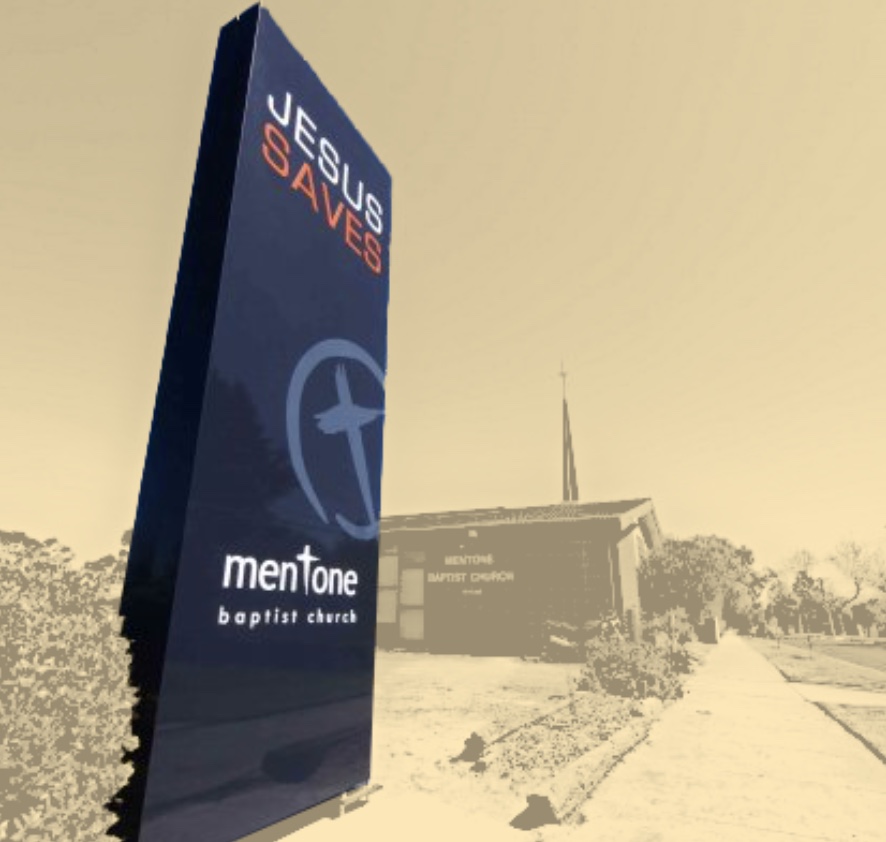
20 years ago today I was inducted as Pastor of Mentone Baptist Church. I won’t lie, it feels like 20 years! Our 3 children have literally grown up in the church. Prior to 2005, Susan and I had spent several years preparing for this scenario. I had always loved serving in my local church, although I had zero desire to move into pastoral ministry. It turned out that God had other plans. My pastor at Camberwell Baps was gracious enough to give me opportunities to teach the Bible; that idea of speaking and sharing God’s words with people got my heart pumping. But an immature 19 year old, is just that, an immature 19 year old! After finishing uni and getting married, Susan and I moved to London and then to Sydney, for training and gaining experience in churches, so that we could return to Melbourne and serve Christ here.
We returned to Melbourne from our place of exile and started at Mentone Baptist Church on February 6 2005.
I’ve wrestled with this for the past week, should I say something about the 20 years or not. I guess it is an anniversary of sorts. As some readers will be aware, I’m someone who writes more than a few words. Through this blog and writing for both Christian and secular publications, I enjoy talking about the gospel and trying to help others think through issues from the lens of scripture. I also love talking about music and cricket, and sharing with friends what my kids are up to and all their latest adventures. Talking about myself, isn’t something I generally do (leaving aside the compulsory self-effacing sermon jokes). I am conscious about not making Murray Campbell the topic of somethingness. It’s hard enough to see Jesus clearly, without my oddities standing in the way!
It was only this morning, as I read my Bible and read those verses in 1 Corinthians 3, that I decided, maybe I’ll put a few thoughts together. Maybe there is something I have learned from serving one church for 20 years that might be helpful to pastors elsewhere. Although, the last impression I want to suggest is that pastoral ministry is about the pastor. I’m not looking for praise (or the inverse!). And serving in the same church for 20 years doesn’t make the work any more or less important than pastors who only serve a few years. I’m also aware of how every church differs in some ways, and that means my particular experiences aren’t identical to a pastor who is serving in Mildura or Maroochydore. Then again, every minister of the Gospel shares the same Bible, the same mission and message, so perhaps similarities and parallels are not so few and far apart.
Here are 20 lessons that I have learned over 20 years of serving at Mentone Baptist Church. It’s not as though I didn’t believe or was unaware of many of these lessons prior to coming to Mentone. And it’s not as though I’ve reached the apex for these 20 themes. Most things in the Christian life are repetitive and a day by day process of sanctification. I’m not planning to provide detailed explanations and examples for these 20 lessons, but rather to note them in passing.
1. I still have much to learn.
I am often amazed at how little I know and how little I understand of the Scriptures and I’m excited at the prospect of continuing to dig deeper and discover more wonders of God in his word.
I’m still learning how to Shepherd a local church. Our Elders are currently reading Andrew Heard’s provocative book, Growth and Change, and am enjoying discussing penetrating questions about ministry and mission. It’s great. I love how the elders (and church) want to keep moving forward in the Gospel and to be more effective in seeing God’s Kingdom growing.
2. God answers prayer.
He really does. When the church has prayed, we have seen God work. Which begs the question, why do we pray so little?
3. God’s Gospel is powerful.
Just last year, our church heard testimonies and witnessed baptisms where the reality of Jesus Christ compelled and changed people’s lives. We have more planned in the early part of 2025. It is so strange to me to hear of churches smudging or avoiding clear and faithful presentation of the Gospel, as though that’s the best strategy for faithfulness and growth. So weird.
4. I’m still learning patience.
I like to run fast but there’s little point sprinting if the church isn’t ready. Sometimes though, I could probably encourage our leaders and members to walk a little faster!
5. God’s word really is beautiful and true and complete.
At Mentone, we use the Bible lots and we want to present God’s words in a way that reflects the treasure that it is. How amazing it is that God has given us a living word that speaks truth and grace today. That’s why we have 2 bible readings every Sunday morning and why we make sure our ministries, from Sunday school to youth group and 1-1 discipleship involve opening, reading and living out his word
6. People will hurt you (and at times you’re no saint either)
Learning to process hurt isn’t quick or easy. Having trusted and godly leaders is really important for working through these times.
7. I’m more convinced about the value of having a plurality of leaders.
The eldership hear me talking about this all the time. We want to grow the number of elders. A church needs a plurality of leaders: from pastors and elders, to deacons, and all kinds of lay ministry leaders. Paul didn’t lay out a paradigm in Ephesians 4 for us to ignore!
8. Make sure the eldership consists of godly men who share a broad breadth of personality, experience and skills.
A church requires greater wisdom than that of one pastor. However, we insist that there is profound and convinced agreement and unity on the church’s doctrine and direction.
9. Trying to set an example for others is hard.
The Bible says that pastors ought to set an example of life and godliness for the believers. It’s a balancing act, trying to share and show how I live outside the pulpit and yet doing so without handing out an autobiography each week.
10. Don’t do everything.
Set early and clear expectations and boundaries and be okay with saying ‘no’. Teach your congregation to be okay in hearing, ‘no’.
11. Membership really is important.
I believed this 20 years ago, and as the years have progressed I’ve become more convinced. Expressive individuals is a scourge on churches and hamstrings Gospel witness and effectiveness. Jesus meant every word when he said, “Love one another. As I have loved you, so you must love one another. By this everyone will know that you are my disciples, if you love one another.” Want to impact the world for Jesus? Then join a church and love the saints.
12. I will make mistakes and that’s ok.
13. The fear of losing people is common, but not dealing with problems generally makes the situation worse.
14. Technology is a curse.
Ok, not entirely. Tech is both good and bad, a useful servant and a terrible master. As technology changes, churches will often adopt and adapt and yet we also need to be wise in its use. Too often churches begin paying a cost without first thinking through behavioural changes that come about through smart phones or AI. Hey, even schools are now recognising these dangers!
I remember Carl Trueman suggesting once that the invention of the car changed people’s behaviours in ways that negatively impacted the local church. Cars are great, what a blessing it is to be able to move about easily and speedily. Cars give people more freedom and as Trueman explains, people started taking long weekends and pursuing more activities, and this turn impacted church attendance and participation. In other words, the car impacted the ministry and mission of the local church and does so even today.
15. We still need to cultivate a better culture of disciple making.
We talk about it and preach on it and we practice it in all kinds of ways, but I think we are yet to be convinced of how important discipleship is to the health and maturity of church.
16. Repetition is key to cultural change (thinking of point 14).
I’m learning that I need to say the same thing over and over again, and when I’ve done that, I need to repeat it again. I’m also trying to encourage our leaders to press repeat so that messages sink in and therefore lead to changed expectations or behaviours or whatever it is we’re trying to move forward.
Part of the issue isn’t reluctance from people, but leaders remembering that people live busy lives and their heads aren’t in the church 24//7 as mine is.
17. Church history is amazing and it matters.
I don’t need to be sold on history. I’ve always enjoyed reading history books and watching documentaries, even as a 3-year-old kid. I studied history at Melbourne University.
Many years later, I am more persuaded that churches should appreciate and understand that who we are today is the result of the sacrifices, thinking, preaching and lives of the saints from old. Churches make mistakes, take wrong turns, and lean into theological mess because we haven’t learned the lessons of church history.
We ran a course last year on Reformation history and this year we are talking about the Council of Nicaea.
18. Protecting my day off was a great idea.
Pastoral ministry isn’t just a job, it is a way of life. Family is family and church is also family. This makes setting boundaries often murky and imprecise. Susan and I have always wanted our children to view church as a family, and yet we never wanted to sacrifice them at the altar of ministry. I’m thankful for the clear and flexible boundaries that Susan and I set together and which the church embraced.
19. Theological liberalism is an easy gospel enemy to spot, but there is an emerging conservatism that we need to be aware of and keep away from the church.
Christian Nationalism which conflates common grace with the Gospel, and Church with State, is a growing concern not only in the United States but also in segments of Australian Churches.
This isn’t a biggy at Mentone Baps, but knowing this flavoured heresy is gaining popularity in some circles, I have already begun talking about these issues in sermons and discipleship (and of course on this blog). The Gospel is neither left nor right. Our mission isn’t defined by a side of politics, but by the Lordship of Christ and his Gospel that brings the forgiveness of sins.
20. There is so much work do to.
When all is said and done, the most pressing issue today remains the eternal state of people in light of the coming judgement of God. How many millions of people in Melbourne may know their left hand and right but are oblivious to Christ the judge and Christ the redeemer?
Pastoral ministry is the worst job in the world. Pastoral ministry is the best job in the world. I get to see and be part of people’s highest and lowest moments of life, to share their joys and sorrows. Pastors have the terrifying responsibility to preach the full counsel of God and dare suggest, see my life and follow my pattern of living. And we do, knowing that God will hold us to account for how we have shepherded his people. It really is a work that people should avoid and embrace.
I don’t spend a lot of time looking back over the years. To be honest, if you asked me for particular highlights in any given previous year, I may not be able to tell you with any precision. When I do reflect on the 20 years, I do so with some embarrassment and also much thankfulness: for Susan and my children, for a church that was patient and kind and who looks after the staff so well, and for God who never lets us down.
Mentone’s current associate pastor, Mike Veith has now been with us for 14 years in this role (and as a student pastor for 2 years before then), so that’s a milestone for which I am thankful.
I realise that 20 years in one church sounds a little bit unusual, but I know pastors who have served their churches for a great deal many more years. I think of Philip Calman from whom I learned so much during my 4 years at Chatswood Baptist as a student. He has been serving as their senior pastor for 28 years and counting. Praise God!
These are 20 of the lessons I’m learning from my 20 years at Mentone Baptist Church. There are many others, but perhaps among this this 20 there is something that might strike a note or encourage another pastor in their work for the Lord.