King Charles and Queen Camilla went to church in Australia last Sunday. They attended a regular service held at St Thomas’ North Sydney.
Kanishka Raffel, who is the Anglican Archbishop of Sydney, preached a sermon for all, whether they were Kings or kids, monarchs, musicians or mechanics.
What might an Archbishop preach about in the presence of the monarch? Of all the subject matter in the world, both large and small, what message is worth pressing home?
Kanishka spoke on Acts 8:26-40. Long before the Gospel ever reached the shores of England, and Europe, the good news of Jesus Christ came to an Ethiopian man who then took God’s message home with him.
‘The Good News of Jesus’. I can’t think of a better message for everyone to hear.
Last week, I enjoyed Xiao Long Bao with the family in a restaurant just behind Bourke Street in Melbourne City. On our way back to the car, we walked past two billboards casting their messages onto the famous Swanston and Flinders Street intersection.
The first billboard was hilarious; it advertised Melbourne’s Fringe Festival by emulating Paris’ Olympic Opening Ceremony with a Last Supper mock-up. Melbourne’s creatives apparently have the comedic and artistic flair of the inside of a vacuum: ‘Let stupidity repeat itself’! (no I’m not offended, except by the boorishness).
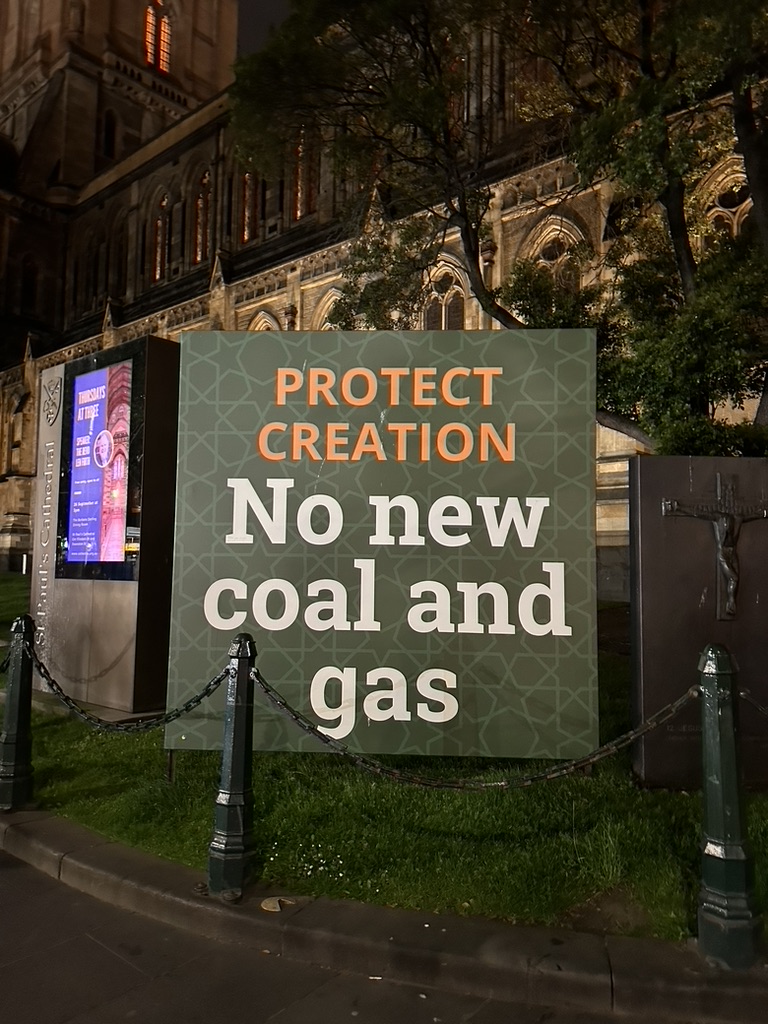
The second billboard stands outside St Paul’s Cathedral. This gothic lookalike sits on the busiest intersection in Melbourne’s CBD. It is a favourite spot for news reporters, city workers, protesters, and more. In every direction a tram is clicketing with passengers heading to the MCG or to theatre shows and the symphony.
With this kind of amazing frontage, which is probably unbeatable anywhere else in all of Melbourne, what message would you like to convey to the 100,000s people who pass by every day? Your Church has an opportunity to say something interesting, provocative, or encouraging to Melbournians on their way to work and home at the end of the day, what button should we press?
I’m not a climate sceptic, so don’t dump that label on me, but is it really the best message we can send to the city? St Paul’s isn’t alone in this. In fact, it has become the norm for churches to talk about and be known for social concerns. This isn’t new. The term ‘wowsers’ entered the Aussie vernacular because of Christian concerns over alcohol and related social problems. Of course, Churches since the earliest days have cared for the vulnerable. Praise God!
At the same time, Churches understood and prioritised Gospel proclamation, making disciples of Christ and growing churches. Today it sometimes feels that this task is either getting lost, or in too many cases, is no longer believed to be necessary
In other words, we are losing the vertical priority of the Gospel in favour of the horizontal. By vertical, I’m referring to the Bible’s idea that God is above all in holiness, authority and glory, and that sin is foremost a rejection of God’s rules and purposes. The primary issue facing people today is that we are separated from God on account of sin and are sitting under his rightful judgment. Hence, the greatest need we have is God’s forgiveness and reconciliation that is freely given through Jesus Christ.
By horizontal, I’m talking about relationships between people, hence social issues and creation care.
This shift from evangelism to social action didn’t happen overnight, but it has become a huge problem and one we need to talk about. The reasons for preferring the horizontal over the vertical are fairly obvious. Social issues are more tangible than talk about heaven. We can see family discord and poverty. We can hear about the terrible plight brought on by gambling and alcohol. We are regularly reminded of environmental issues facing the globe. The horizontal appears more pressing because in one sense it’s more obvious than talking about the wrath of God and needing God’s mercy and the cross of Jesus.
Social concerns are also more agreeable to the broader community. The city loves churches that provide foodbanks, clothing, and shelter. It’s a win!
People from all walks of life appreciate when churches do the heavy lifting for social needs. Such activities and messages are way less offensive than the bits of Christianity that involve preaching and talking about sin and hell and the cross and resurrection. Promoting the horizontal is palatable whereas focusing on the vertical is vulgar.
It’s not that the horizontal is unimportant. Loving our neighbours belongs to loving God. I think both the Mosaic Law and Jesus were pretty clear: we are not loving God if we are not loving our neighbours. There is something odd if we think that preaching a sermon is suffice and that somehow it’s okay to neglect my neighbour’s broken fence or ignore a child’s cries for help. The resurrection of Christ proves that the whole person matters. But let’s not fool ourselves into thinking we are faithful to God’s mission if we are not prioritising the proclamation of the Gospel to make disciples of Christ and grow his church. Indeed, we’re not fully loving people if we’re not speaking the Gospel into their lives. Don’t buy into delusional hubris that thinks we hit a 6 when the media praises a diocesan decision or the local council gives you another grant.
We don’t choose between the vertical and horizontal. Did Jesus? No. But neither did He allow pressing issues to hijack his mission in the world,
“Let us go somewhere else—to the nearby villages—so I can preach there also. That is why I have come.” (Mark 1:38)
“Now my soul is troubled, and what shall I say? ‘Father, save me from this hour’? No, it was for this very reason I came to this hour. Father, glorify your name!” (John 12:27-28)
In fact, by minimising the Gospel priority of the vertical, we distort the horizontal and the mission becomes less effective. It’s the Melbourne mirage; let’s do what the community wants so that we become more ‘successful’. We think we’re kicking goals. To state the obvious, why would people join your church or become a follower of Jesus if our offerings are little more than a cheap version of what the Government can give us?
Read statements from Archbishops and scan agendas for denominational meetings. Listen to Easter and Christmas sermons, what’s the message? How often does your Church talk about and encourage evangelism? How much of your church’s budget is given to spreading the Gospel and starting churches? When your denomination meets annually, is preaching Christ and calling people to repentance and saving faith in Jesus Christ on the top of the agenda? Does it even appear?
The recent Lausanne gathering in Seoul, South Korea is a case in point. I was invited to attend but due to other commitments was unable. This gathering of 5000 Christian sisters and brothers from around the world to discuss and pray about world evangelisation must have been an incredible experience. The privilege of listening to and learning from brothers and sisters from every corner of the earth would be a joy of a lifetime, a foretaste of heaven.
Each Lausanne Conference produces a paper to reflect, articulate, and explore the nature of reaching the nations with the gospel. For some time there have been some concerns, or at least questions raised, that evangelism and verbal proclamation of the gospel seem to be losing its central place amidst other important issues facing the world today.
There is much to commend in the Seoul Statement. I love the section calling on Christians to holiness. The Seoul Statement includes sections on technology and on human sexuality and gender. There is much to praise God for in these statements. The affirmation of biblical anthropology is a key issue in the 21st Century, where rejecting the Bible’s teaching about men and women leads to a rejection of the Gospel. These things are all really helpful and important. However…
Ed Stetzer is among notable voices who are, however, expressing mild concern that the vertical is being lost. Lost is perhaps too strong a word, but Gospel proclamation seems smaller because of the way horizontal issues are being framed and focused upon. He writes,
“Lausanne: The Need to Prioritize Evangelism…in a time of aggressive religious pluralism (when evangelism receives such significant pushback), evangelism (“declaring”) needs greater focus, particularly in a time of evangelistic decline….“The full name of the Lausanne Movement is the Lausanne Committee on World Evangelization. A stronger statement on the priority of evangelism would help the Seoul Statement. These statements will influence a generation, far more than the congress itself, so let’s make it stronger and not leave #L4Congress without the world knowing that we know mission drift happens—and is already happening in many places in evangelicalism. Let’s help an entire generation know that we are deeply committed to holding evangelism central to the mission.”
I share Ed’s concerns.
Again, Christians shouldn’t choose between the vertical and horizontal. This is not an either/or situation, but neither is it quite a both/and situation. There is an ontological and time priority to the vertical (preaching the gospel and making disciples). Think of it this way, when an oncologist diagnoses a patient, they will treat and care for presenting symptoms and tackle secondary causes, but they will also delve into the root cause. Sin is foremost against God. The Christian mission is about articulating the Gospel of what God has accomplished for us in Christ through his death and resurrection, which brings Divine forgiveness and reconciles us to the living God. This subsequently reconciles us to one another. This incredible coming together in peaceful relations then results in drawing further praise to God (cf Ephesians 2).
The problem is, that too many churches are either giving up on evangelism or no longer see evangelism as essential or it’s getting lost in the myriad of needs. I recall a missions seminar I attended in my denomination where the speaker focused solely on social action. When he was asked about evangelism, it was simply not on his radar.
When has evangelism ever been cool? When has explaining sin and salvation ever been popular on the community charts? When has evangelism ever been easy? And yet without evangelism, churches decline, Christians lose hope, and people go to hell.
Melbournians can be forgiven for thinking that our problems are primarily horizontal ones and God appears little more than in the shadows. Indeed, some churches explain away the vertical dimensions of sin with such Bultmann-like force that we are left wondering whether God is little more than a sociological or psychological category to justify human longings. Stripping God of his Divine power and denuding the Gospel of its vertical imperative is the ultimate humansplaining.
As Tom Holland recently suggested to Christians, “*Keep Christianity Weird… Don’t accommodate to the ideological mainstream, instead major on the supernatural…”
To be clear, I am not suggesting that St Paul’s Cathedral isn’t doing or not believing in evangelism, but their messaging is symptomatic of a disappearing Gospel confidence to provoke people in the best of ways, and to comfort them in eternal ways. The irony is, while the St Paul’s billboard communicates a positive image to one part of society, it’s saying something radically different for those who disagree with zero carbon. And will anyone who agrees with the billboard’s message be warmed to Christianity and think, you know what, I need to get with God? The message wasn’t necessarily wrong, but it’s not the church’s mission.
At the previous Lausanne meeting, held in South Africa, John Piper put it like this, “We care about all suffering now, especially eternal suffering”.
If your Church or denomination has a problem with that statement, then your church or denomination has a problem
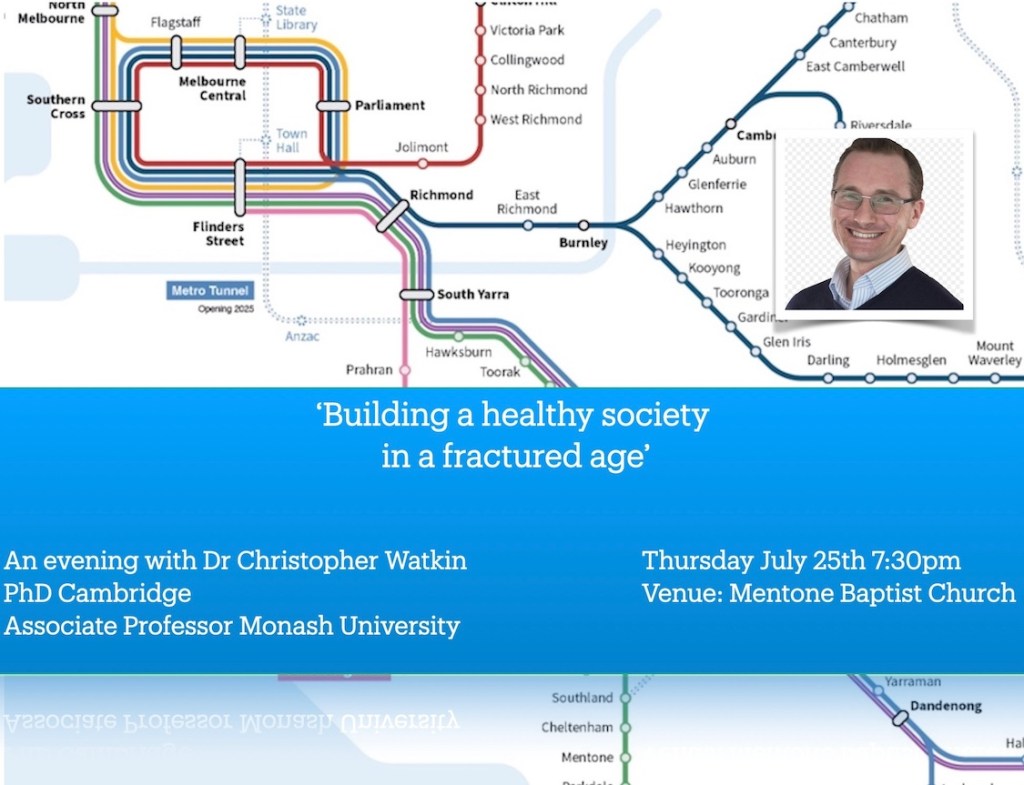
On July 25th at Mentone Baptist Church, Dr Christopher Watkin will be addressing one of the key social issues facing Australia in the 2020s:
‘How can we build a healthy society in a fractured age?’
Australia is wrestling with important issues surrounding religious and social freedoms and responsibilities. Dr Watkin will help us navigate a way forward.
In 2021, Chris addressed political and community leaders in Parliament House, Canberra, outlining a positive vision for civil society. It’s a great opportunity for Melbournians to engage with ideas that can shape tomorrow.
Dr Christopher Watkin is the ARC Future Fellow at Monash University. He is the author of the award-winning book, ‘Biblical Critical Theory’ and numerous other volumes including, ‘Difficult Atheism’.
Yesterday at church we enjoyed our biggest Good Friday service yet. That’s not a message for boasting, but rather one of thankfulness. Other churches are reporting similarly.
Over this Easter weekend, our friends at The Age newspaper decided on taking a different angle. They want readers to feel a disenchantment over Christianity and the merit of alternative faiths.
One of Australia’s worst-kept secrets is how nominal Christianity is declining. Naturally. Even the Bible speaks of the inevitable slow death of empty religion. The story is not new so why is it a feature story over the Easter weekend?
Society is at pains to honour and respect the sacred days of various world religions. Football Clubs produce special messages. Politicians offer the now obligatory salutations, often accompanied by a visit to the local Temple or Mosque, with a news camera or six! I’m knocking not them, but simply observing. We ought to respect our neighbours (even when we disagree with them) and be thankful for the religious toleration that still exists in our country.
The Agehas chosen to commemorate Christianity’s most ‘holy’ days with 2 articles speaking of the rise of world religions in Australia and of Christianity ‘plummeting’.
“Meanwhile, Christianity has plummeted by more than 26 per cent during the same period, and once grand houses of worship are battling a mass exodus and shrinking congregations.”
Whether this is designed to be a kick in the gut or they naively thought that this is a suitable way for the newspaper to celebrate Easter, I can’t help but see a parallel with the first Easter. Of course, the two are dissimilar in very big ways, but nonetheless, the jab in the side is noticeable.
Don’t get me wrong, sociological studies exploring the beliefs of Australians is an interesting and important task, and worthy of media reporting. I am simply noting that the data is not new, the research isn’t recent. I have engaged in conferences and conversations about the waves and currents of religion in Australia for many years. The timing for The Age’s expose is ironic to say the least. Like a Pharisaical jibe at Jesus as he hung on the cross, it’s open season for slamming Christianity.
In our reading at church yesterday,
“they began to call out to him, “Hail, king of the Jews!” Again and again they struck him on the head with a staff and spit on him. Falling on their knees, they paid homage to him. And when they had mocked him, they took off the purple robe and put his own clothes on him. Then they led him out to crucify him.”
And this,
“Those who passed by hurled insults at him, shaking their heads and saying, “So! You who are going to destroy the temple and build it in three days, come down from the cross and save yourself!” In the same way the chief priests and the teachers of the law mocked him among themselves. “He saved others,” they said, “but he can’t save himself! Let this Messiah, this king of Israel, come down now from the cross, that we may see and believe.” Those crucified with him also heaped insults on him.
Like a gambling addict, these sceptics were far too quick to claim Jesus had failed. Two days later, the earth erupted when Jesus physically rose from the dead. The world has never been the same. And even if Western nations like Australia convince ourselves that Christianity is on the way out, Christianity worldwide has never been bigger. Praise God! It is we who are missing out.
Unlike Jesus, Christians sometimes react to social movements with the angry rant of an American President or the rage of the latest mob blocking traffic in the city. Christians respond to negativity with hateful words need to be called out.
Like Jesus, Christians can respond to critics with kindness and grace. He didn’t retaliate. He didn’t hate on them. He absorbed the wrath of God in their place.
The Age expose includes this observation about the chessboard of Australian religious affiliation,
“Andrew Singleton, associate professor of sociology and social research at Deakin University, says the growth of religious minorities is tied to migration trends in Australia.”
I am a big supporter of migration. Our nation is largely built on the blood and sweat of millions of migrants. Come along to Mentone Baptist one day and you see the nations represented in just one small Church; it’s fantastic.
This is one major difference between Christianity and world religions. Christianity grows by conversion. Yes, I know ‘conversion’ is an ugly word in Victoria, even an illegal one, but if Jesus and the Apostles preached for conversion, so do we.
Conversion isn’t our society’s great sin; it is the great moment of liberation: God in Christ brings forgiveness. He justifies and reconciles. The Good news of Easter isn’t religions offer of enlightenment to those who work hard enough and who acquire sufficient levels of holiness, far from it. The good news of Easter is a gift; God’s loving gift of redemption. Jesus isn’t about merit, he is mercy.
We are seeing a plethora of reports tabled by Government and legislations produced, designed to further limit religious freedom. Hardline secularism opposes healthy pluralism, which values freedom to preach and persuade and engage. Christianity grows via conversion and conversion is about reasoning and persuading and people coming to believe the gospel for themselves. How different is the approach of authoritarian secularists who create laws to force-convert what Christians may and may not teach and practice. It is as though they googled Emperor Domitian or Communist China’s Sinicization program and concluded, that’s what we need here.
Of course, such opposition to the Christian faith is doing little more than reinforcing the Bible’s anthropology and the significance of the cross. Those who mock the cross are not undoing Christianity but simply exposing the human condition and thus our desperate need for divine mercy.
Unfortunately, I don’t think Australia has yet reached peak secularism; the reigns of power are rarely loosened without struggle. We are however beginning to see cracks appear and falling through these holes are real people whose lives have been promised much by life without God, and the results are often catastrophic: Not peace, but narcissism. Not freedom but bondage to self-realisation.
The one fact that The Age hasn’t explored is why and how classical evangelical churches are growing. I’m not referring to the super cool tribe who have the resources to stage a concert every Sunday, but churches who believe, open and teach the Bible, who preach about Christ crucified, who love to sing and praise God, and who are actively loving and serving the other.
It is important to differentiate between churches that hold to orthodox Christian beliefs, and those who don’t. I suspect the major fault line between churches that decline and those that grow is this one. Yes, there are other factors, changing demographics and sociological phenomena, and individual preferences that play into service styles. But there are too many ordinary churches where music is possible and the preaching okay, but who experience a work of God and more people becoming Christians.
Whereas, the churches that face most decline are those that move away from classical Christianity. Churches that embrace each latest iteration of sexology, who erase the Bible’s tricky bits, who explain away the resurrection, who argue against the penal aspect of the atonement, these are churches who race their congregations off a precipice and into a spiritual grave.
As Tom Holland famously quipped,
“I see no point in bishops or preachers or Christian evangelists just recycling the kind of stuff you can get from any kind of soft left liberal because everyone is giving that…if they’ve got views on original sin I would be very interested to hear that”.”
So thank you to The Age for interesting and poorly timed articles. And next time, dig a little deeper and you’ll notice the stronger currents that are at work in Christianity around Australia today.
I appreciate that the title may sound a little presumptuous, but hear me out.
Cate Blanchett is one of the world’s finest actors…and she hails from Melbourne!
The first movie I recall watching that starred Cate Blanchett was Elizabeth. My wife and I were living in London at the time, the very city where Queen Elizabeth 1 had lived, reigned and died. I already loved historical movies, but watching the film while immersed in Elizabeth’s city brought about a visceral connection. It’s a great movie.
As we enjoyed Elizabeth, Susan commented, ‘Murray, I went to school with Cate.’
I looked at Susan, and with my eyes pressed for more information.
Susan, typically downplaying such things, added only a few words,
“We weren’t friends. Cate was a few years ahead of me.”
That was it. That’s all Susan said. I suspect there was a little more to it, after all, Susan had clear memories of Cate being at the same school with her. But today I learnt something new about Cate Blanchett, albeit from the newspaper and it’s about those school years.
At the age of 10, Cate’s father suffered a heart attack and died. To lose a parent at any age is difficult, but at such a young age, one can only imagine the pain, grief, and disorientation created by such a sudden loss.
Speaking with a journalist while filming a new movie near her old suburban home and school, Cate reflected on how her Dad’s death caused her to turn away from both Church and God.
“As a child I wanted a religion. I wanted the strong hand of God to put a hand on my childish shoulders to say, ‘Your father is with me. He’s having fun. You’ll see him in 60 years.
“But that didn’t happen. And so as a ten-year-old I fled from the church and moved down to the river and spent my childhood propelled into nature”.
“If I’d stayed inside the Methodist church I’d have a lot of bad guitar playing, but instead I rode my bike, thinking I was Nancy Drew, down by the Yarra River. I remember that as profoundly as I remember the hymns”.
She was asked whether she left religion because it didn’t give her what she wanted,
“It was not so much about what I wanted…more what I was hoping for. Also, I was ten.
“But religion contains a sense of hope and also a sense of community. And, in a way, that desire for something greater than myself never left me”.
First of all, I agree with Blanchett’s fears of bad guitar playing. As a former classical musician, many a time have I cringed and groaned at the sounds wafting over a congregation. But fear not, it is also possible to find excellent guitar playing in churches today.
Music aside, I am reminded of something Timothy Keller wrote years ago as he borrowed from C.S Lewis,
“Horrendous, inexplicable suffering, though it cannot disprove God, is nonetheless a problem for the believer in the Bible. However, it is perhaps an even greater problem for nonbelievers. C. S. Lewis described how he had originally rejected the idea of God because of the cruelty of life. Then he came to realize that evil was even more problematic for his new atheism. In the end, he realized that suffering provided a better argument for God’s existence than one against it…
My argument against God was that the universe seemed so cruel and unjust. But how had I got this idea of “just” and “unjust”?… What was I comparing this universe with when I called it unjust?… Of course I could have given up my idea of justice by saying it was nothing but a private idea of my own. But if I did that, then my argument against God collapsed too— for the argument depended on saying that the world was really unjust, not simply that it did not happen to please my private fancies…. Consequently atheism turns out to be too simple.”
Let’s take as an example, John Lennon’s ‘Imagine’. Imagine doesn’t articulate the highest intellectual efforts to sustain unbelief in God but it does represent popular sentiment. Indeed, Imagine has become something of an international anthem in recent years. For a moment, let’s play out the song’s logic of imagining a world without God, without religion, and without heaven and hell:
Imagine there is no ultimate meaning or goal toward which our lives are headed.
Imagine there is no overarching design and no inherent significance.
Imagine if our lives were reduced to the potluck outcome of billions of years of impersonal atoms and molecules running around hitting and missing, making and destroying.
Imagine a world where the reality of conscience and moral choice has no grounding in a purpose beyond that of group survival in the evolutionary race to the top.
Imagine human affections are ultimately an illusion, a cruel joke orchestrated by the impersonal rules of physics.
Imagine all the people living for today, for tomorrow is the end.
This view offers no consolation to a gravely ill person. Nothing to help grieving families who have just witnessed a loved one being ripped from their lives.
It offers no hope to someone who is a victim of injustice, for there is no judgment and vindication to come.
In fact, the song collapses in on its own irrationality, like a sandcastle overrun by the incoming tide. Lennon imagines ‘living life in peace’, and there being no “greed or hunger”. We affirm this sentiment but peace requires a common purpose between people and demands reason and design in the world beyond us. A universe without God does not allow for the idea of universal peace.
As Cate Blanchett shares her personal testimony from God to nonGod, she admits,
“desire for something greater than myself never left me”.
It is as though a Divinely given conscience keeps poking and prodding at us despite our cognitive and emotional rescripting of life.
None of us comprehend all of the events we experience or see in this life. To have that kind of knowledge is to be omniscient, and not the brightest or most prophetic have the kind of understanding. But Easter reminds us that there is One who has gone before us and for us. Hope is not defined by my ability to create or sustain it, but by trusting the one who can gift it. Even faith, fragile and compounded by tragic loss, is given assurance through the Easter event.
As a father, I appreciate the limited capacity of my children to grasp concepts both significant and small. It’s not that a child is necessarily wrong, but like adults, our beliefs and commitments are trialled and formed by many kinds of circumstances, inquiries and tests. This is one reason why the message of Easter is so compelling and continues to offer consolation. The death and resurrection of Jesus Christ took place inside history and is thus subject to our scrutiny, but it also punches through time and into eternity and therefore offer timeless hope and assurance.
Last Sunday I preached on Hebrews 5:1-10. The text provides one of the wonderful explanations of why and how Jesus today serves as our faithful representative before God in heaven. There is a tangible and sustainable connection point between our world and heaven, between humanity and God; the God Man Jesus Christ.
The text explains,
“During the days of Jesus’ life on earth, he offered up prayers and petitions with fervent cries and tears to the one who could save him from death, and he was heard because of his reverent submission. Son though he was, he learned obedience from what he suffered and, once made perfect, he became the source of eternal salvation for all who obey him”.
Never think the cross was easy for Jesus. We should never conclude that suffering didn’t impact Jesus. He is utter love and light and goodness. He did not deserve to suffer even a scratch. And yet he committed himself to his father’s will to endure the greatest evil ever perpetrated.
No story ends before it begins. No movie is shown at the cinema before it is first written, shot, and produced. In the moment by moment, God is valuing the world and each person who lives. More than that, God didn’t press fast forward to the end of the story, but his Son pressed in every moment and every day, for it is through his suffering and atoning death that God brings about forgiveness and life. Not only does Easter declare an ultimate hope over tragedy but Easter proves that we have an empathetic High Priest in Jesus.
Cate Blanchett’s impulse as a 10-year-old is relatable for many, and so is her constant companion who reminds her that there must be something more, something better. Several members of my church have suffered loss in recent months, the death of a parent or child. Death is horrible. Death is, to quote the Bible, the last enemy.
Easter is for the unbeliever, it is for the doubter and for the lifelong transgressor. Easter is for those who know death and suffering. This confidence lies outside ourselves in the only one who can claim to outdo death. As these beautiful words from Hebrews 4 tell us,
“Therefore, since we have a great high priest who has ascended into heaven, Jesus the Son of God, let us hold firmly to the faith we profess. 15 For we do not have a high priest who is unable to empathize with our weaknesses, but we have one who has been tempted in every way, just as we are—yet he did not sin. 16 Let us then approach God’s throne of grace with confidence, so that we may receive mercy and find grace to help us in our time of need.”
As an Aussie, I’m bound to knock and mock the English, but just occasionally we should pay attention. During the same week as England banned puberty blockers on minors, the NSW Government introduced legislation to ban ‘conversion practices’. The irony isn’t lost.
England’s National Health Service (NHS) has banned prescribing puberty blockers for children and teenagers. A report states,
“We have concluded that there is not enough evidence to support the safety or clinical effectiveness of [puberty blockers] to make the treatment routinely available at this time.”
This report came about a pressure mounts from past patients at the Tavistock Clinic. Most notable is the High Court Case of Bell vs Tavistock.
In 2020, Keira Bell won a landmark High Court ruling against Tavistock and Portman NHS Trust, for its dangerous treatment of children who have gender dysphoria. Ms Bell was prescribed puberty blockers at age 16. As an adult Ms Bell sued Tavistock, alleging that young people do not have sufficient awareness to make an informed decision to undergo invasive treatments that will have long-term effects on their physical and mental state. Three judges ruled in her favour
Notice the clear language quoted by the The Times,
“under-18s in gender clinics need “far better mental health services to help them to reconcile themselves to their (sex) — not life-changing physical interventions that might alleviate short-term distress at the price of long-term trauma”.
Tavistock Clinic has since been shut down, and this week the NHS announced that such treatment for children suffering from gender dysphoria is banned. England is following other European countries who’ve recognised the same dangers. This is but the latest red flag signalling a fundamental problem with the way our society views gender and sex and the way we care for the vulnerable.
Evidence is mounting; the real and dangerous conversion therapy involves pumping children with hormones and chemicals that stall or prevent puberty, alter the physical appearance, that may bring about infertility and often lead to the surgical removal of healthy body parts. While England and Europe begin to move away from these experimental treatments, Australia is doubling down.
Enter NSW. The NSW Government this week released its conversion therapy Bill. The NSW proposal is not as extreme as the Victorian Laws that were introduced in 2021, but they prove that there is both political pressure and capital by submitting to groups of gender theory activists. No one disputes that among a few marginal religious groups, there were some weird and harmful practices. These practices do not have their origins in the Bible but were influenced by secular education taught to psychiatry students in the 1960s. Origins aside, Victorians were led to believe that there was a major and evil problem going on in Churches around Victoria, but when reports were published and evidence presented, it was clear that almost no one knew of let alone practised these so-called therapies. The real target was mainstream and normal religious activities such as talking and praying.
What is going on is that the latest self-appointed preachers representing ‘expressive individualism’ have a clear agenda to destroy what it is to be male and what it is to be female, and therefore what it is to be human. Hence, in part, when the Victorian laws were being debated, groups behind the legislation and some of the most vocal proponents, targeted Christian churches, and in effect created laws to prohibit 2000 years of orthodox and classical Christian teaching and practice about gender and human sexuality. Remember, that it is illegal in Victoria to discuss with an individual the Bible’s presentation of gender and sex, lest the individual is somewhere influenced.
Abigail Shear (who is not a Christian), has highlighted the sociological phenomenon that is fuelling the extraordinary rapid rise of gender dysphoria in Western societies. In her book, Irreversible Damage, she shows that before the 2010s, the number of people with gender dysphoria was incredibly small. The percentage amounted to roughly 0.01% and that group consisted almost entirely of boys. Today, transgenderism has become commonplace, with somewhere between 4-10% of children now identifying with the opposite gender (or identifying with one of the now 70 possible gender identities that apparently exist), and girls, in particular, are being affected by this. Shier notes,
“Between 2016 and 2017, a number of gender surgeries for natal females in the U.S. quadrupled with biological women suddenly accounting for, as we have seen, 70% of all gender surgeries. In 2018, the UK reported 4400% rise over the previous decade in teenage girls seeking gender treatment. In Canada, Sweden, Finland, and the UK, clinicians and gender therapists began reporting a sudden and dramatic shift in the demographics of those presenting with gender dysphoria from predominantly school-aged boys to predominantly adolescent girls.”
This new trend has become trendy. A uni student shared with me how they feel socially lesser and out of touch because they are not experimenting with their sexuality and identity. That is not to say gender incongruence isn’t a real and very difficult thing for some individuals, but there is more going on.
At the time of the ‘conversion practices’ debate, clinics in Melbourne saw a drastic rise in the number of children undergoing the very kinds of treatment that took place at Tavistock. Instead of reasoned debate and reasonable laws, the Victorian Government under then Premier Daniel Andrews shouted down concerns as belonging to bigots of the worst kind,
“Cruel and bigoted practices that seek to change or suppress a person’s sexual orientation or gender identity will soon be stamped out across Victoria, thanks to new laws introduced to Parliament today.
The Bill denounces such practices as deceptive and harmful, reinforces that the ideology behind these practices is flawed and wrong.”
Here lies a major obstacle in Australia. We are not permitted to have the necessary conversations and inquiries to examine what is going on in the clinics and what kinds of long-term impact treatments are having on our children. Last year, a senior staff psychiatrist was stood down in Queensland after raising concerns about ‘best practice’ for caring with gender dysphoric children.
In Victoria, anyone challenging the new orthodoxy faces threats of re-education programs and even criminal charges. Even reluctance can be deemed ‘suppression’ and see children taken from the home. Any conversation or prayer with an individual about these issues can result in allegations and a visit to court.
Progressive activists and politicians have effectively stifled conversation and today the law is a live weapon that’s held over anyone who dares present an alternative. Instead of caution, it’s full steam ahead in Victoria, with school programs designed to encourage children to question their bodies and doubt their biology. We’re yet not witnessing the end of this tragic chapter; in the meantime, real people and children are being used.
What cost are we willing to pay before we end this horrific abuse of vulnerable children? There have been recent attempts made in both the Victorian and South Australian Parliaments to open an inquiry into the medical treatment of children suffering from gender incongruence; both were blocked. Shouldn’t England’s decision at the very least validate a real and thorough investigation into the process, practices, and ethics behind what is going on?
In the meantime, The Victorian Premier has backed a public ‘performance’ coming to a Melbourne theatre where a female actor will ingest a cocktail of tranquillisers to fall unconscious and is then sexually assaulted by fellow performers, live on stage. Yes, this a criminal act, but because it’s a performance somehow it is morally acceptable.
May I suggest, that when it comes to sexual ethics, we have a problem.
It’s another reason why I am so convinced by the person and promises of Jesus. He doesn’t manipulate or abuse. He can love without affirming. He can empathise and help. He doesn’t diminish the individual, but came ’to seek and save the lost’.
This week I have the privilege to explore these amazing words from the book of Hebrews. When we fail to understand each other whether deliberately or ignorance, even parents or friends or teachers or Governments, there is one who does get us,
“Therefore, since we have a great high priest who has ascended into heaven, Jesus the Son of God, let us hold firmly to the faith we profess. For we do not have a high priest who is unable to empathize with our weaknesses, but we have one who has been tempted in every way, just as we are—yet he did not sin. Let us then approach God’s throne of grace with confidence, so that we may receive mercy and find grace to help us in our time of need”. (Hebrews 4:14-16)
The NSW Parliament adopted the conversion practices legislation on March 22
It’s the season for reflecting on the year that has been. People are compiling lists of the biggest or most momentous events of 2023. While these lists can be interesting, I want to do something a little different here. Rather than taking the usual perspective, I want to remind us that the Scriptures give us another view of reality and it’s one that we can easily miss or forget in the midst of everyday life.
Enjoy and be encouraged and a little bit challenged as well.
Two angels are in heaven. They are enjoying sipping ‘heaven’s nectar’ (single origin bean 2023; naturally) when they strike up a conversation. These 2 angels, let’s call them George and Sally, have seen much in 2023. The date (on earth) is December 14.
The universe may be cut off from heaven, but heaven knows what happens on earth. George and Sally read the New Jerusalem Gazette and learn of decisions and events as they go about serving God.
Amidst the clamour being made by 8 billion people in every corner of the world, the annual sound of Christmas Carols crescendos. Although most carolling fails to hit the heights of heaven, such is the powerless nature of lips singing truth from hearts that don’t believe.
George takes another sip and thinks to himself, ‘if only Melbourne knew what the greatest coffee tastes like!’
As the sweet aroma fills their angelic nostrils and swims around the palate, Sally says to George, what do think are the 7 biggest stories of 2023?
Where do the angels begin? The year has brought about eternal cheer and also much grief. On earth conversations and debates rage over a million stories and events that have influenced and shaped, bringing happiness and sadness. Which of these do angels choose?
Sally began compiling an initial list in her mind. She thought, “The Ashes were certainly memorable…maybe we won’t mention the Commonwealth Games or Rail link…And of course, there have been more than a few political elections this year but none of them make the cut…”
George observes that the 7 biggest stories in 2023 are in fact the same headlines from 2022, and pretty much every year. It’s not that each incident and event is glossed over and ignored. The angels have been around long enough to realise that the human condition remains unchanged and God’s eternal decree continues to work over and through every page of history. Sally agrees, which isn’t surprising given there is no unction for disagreement around God’s eternal home.
So here are the 7 biggest events from 2023 according to George and Sally:
7. Every act of injustice and evil in 2023.
The angels agree that number 7 isn’t on the list because of any virtue or value, but because of Divine outrage that continues against God’s world. Sally and George understand how God grieves every sin and transgression. They appreciate how much more than they, God grasps the gravity of these events that harm and offend and destroy.
Whether the acts are carried out by terrorists in the ancient land or Governments promoting injustice, greedy corporations or the hidden sins of a billion people, God grieves. God angers. His anger thunders with a ferocity that shakes the very foundations of the cosmos. The angels witness that while the most judicious of man-made courts cannot capture every offence, in the heavenly court every perpetrator of evil will face God’s wrath and eternal judgment.
Sally points out to George, how blinded by hubris, human beings readily believe they can circumvent Divine justice. At our worst, we even redefine righteousness and call evil good, but God isn’t fooled by our calculations. Whether it is the slaughter of civilians in Israel, the abusive parent in a suburban street in Melbourne, the academic legitimising the dehumanisation project, or the employer cheating his staff out of fair pay; God sees and condemns and guarantees justice.
Some events make the news in Sydney, New York and Colombo, while a billion go unnoticed or are wilfully ignored by friend and neighbour. There is no such overlooking by the King of Kings.
As the angels consider all the headline news, they ponder that God persists with the world; what a staggering thought. Sally then reminds, George, remember what God has said,
“But do not forget this one thing, dear friends: With the Lord a day is like a thousand years, and a thousand years are like a day. 9 The Lord is not slow in keeping his promise, as some understand slowness. Instead he is patient with you, not wanting anyone to perish, but everyone to come to repentance.
10 But the day of the Lord will come like a thief. The heavens will disappear with a roar; the elements will be destroyed by fire, and the earth and everything done in it will be laid bare” (2 Peter 3:9-10)
6. Christians chasing lesser things that distract from ultimate things.
George remarks, “God has given the most precious gift of all and to people who did not want or ask, his Son. And yet look at all these Christians filling up life with lesser things.
George scratches his head, “God gave himself in Christ but these Christians still aren’t satisfied. They are working harder and earning more and playing more, and yet sacrificing the very thing that can gives them life. And see how they’re teaching their children to chase after the wind. Why are they feeding them junk food when God offers living water? Sure, who doesn’t enjoy a party and decent education or long weekends at the beach. But do they have no sense of discipline and seeking first God’s Kingdom? No wonder millennials don’t take God seriously, when their elders are teaching like this.”
5. Grief over churches abandoning the Gospel and Christians deconstructing the faith
It is another year of sadness as more churches give up Jesus for a seat at the table of respectability, success and ease.
Sally notes a conversation she had with Thomas Cranmer and Hugh Latimer on November 16. She saw them weeping over the Church of England. To give up Divine love for the sake of a moment’s likability staggers the mind. Cranmer reflected on his own moment of weakness and then the grace that caused his repentance. Latimer remarked, that if the bishops of England snuff out the candle, then God will light it again among others.
Spurgeon still can’t get over the joy that his old days of melancholy are over forever. He remains overjoyed knowing that all the superlatives he used in his sermons to convey the wonders of Christ, were barely a tiny impression of the true glory that is being with Christ and seeing him face to face.
As he overhears Latimer talking with Sally, he interjects with Shakespearean flourish, to describe the ongoing downgrade among Baptists as being like the melting polar ice caps. Spiritual climate change is eroding church faithfulness and vitality. Instead of displaying the glory of God in the face of Christ, churches convince themselves that they need to become more like the world to reach the world. The Gospel is melted down and replaced with mirrors to reflect the culture, thus confirming unbelievers’ assumptions about the irrelevance and idiocy of the Christian faith in 2023.
George observed the unusual number of Bibles that are never opened or read.
“It’s like churches don’t ever open the Bible and read what God has to say to them. Don’t churches believe the Lord of the Church? Why do they pretend that the lamb’s 7 letters to the churches are always about someone else and not for them?
Mary and Martha walk past and add, “Churches who choose between love and truth end up losing both.”
Both angels are pleased to announce that the top stories of 2023 include more encouragement and thankfulness than sadness and grief. At number 4 is…
4. Growing holiness in the face of suffering
Sally is convinced that one of the highlights for 2023 is seeing so many people becoming more like Jesus. George gives an emphatic nod of agreement.
It’s amazing to observe the breadth of places and conditions in which people are living and the countless challenges many are facing. Instead of becoming bitter or turning to jealousy or despair, Christ’s light is shining. LED lighting might be seen from space, but the Spirit’s light in people’s lives reaches heaven.
The encouragement and comfort of God’s words produce the perseverance of the saints,
“Let us not become weary in doing good, for at the proper time we will reap a harvest if we do not give up.” (Gal 6:9)
“Since everything will be destroyed in this way, what kind of people ought you to be? You ought to live holy and godly lives 12 as you look forward to the day of God and speed its coming…14 So then, dear friends, since you are looking forward to this, make every effort to be found spotless, blameless and at peace with him.” (2 Peter 3:11-12; 14)
“For this very reason, make every effort to add to your faith goodness; and to goodness, knowledge; 6 and to knowledge, self-control; and to self-control, perseverance; and to perseverance, godliness; 7 and to godliness, mutual affection; and to mutual affection, love. 8 For if you possess these qualities in increasing measure, they will keep you from being ineffective and unproductive in your knowledge of our Lord Jesus Christ.” (1 Peter 1:5-8)
3. Thousands of churches are planted
Sally and George praise God for his faithfulness in 2023. God’s big project in the world is reconciliation and the church is the people of reconciliation. After all, Jesus shed his blood for the church and gave his word, ‘I will build my church’. The Lordship of Christ and the promises of God in the Gospel are intimately tied to God saving a people,
“And God placed all things under his feet and appointed him to be head over everything for the church, 23 which is his body, the fullness of him who fills everything in every way.” (Ephesians 1:22-23)
you are no longer foreigners and strangers, but fellow citizens with God’s people and also members of his household, 20 built on the foundation of the apostles and prophets, with Christ Jesus himself as the chief cornerstone. 21 In him the whole building is joined together and rises to become a holy temple in the Lord. 22 And in him you too are being built together to become a dwelling in which God lives by his Spirit.” (Ephesians 2:19-21)
God is pleased and heaven is enthralled to see churches of all shapes and sizes given birth in Kenya and Cameroon, in Iran and India, in China and Argentina, and even in the great lost nations of England and Australia. People may turn their backs on God, but His Gospel is compelling and he will finish what he has started building.
2. The salvation of millions of people
George and Sally agree that integrally tied to story no.3 is story no.2. Indeed, stories 2 and 3 are easily interchangeable, and really the same story, just from being reported from different angles.
The Church is God’s masterpiece and churches are made up of countless names and faces of the imago dei, sinful, forgiven and redeemed. Conversion may be considered a dirty and immoral word in parts of the world, but heaven rejoices.
2023 is another year of explosive Gospel growth around the world. A few of these names are recognised by society and media and their conversion stories go viral. In heaven the new birth and adoption of every person goes viral among heaven’s choir.
What a massive year for heaven’s choirs! It’s been non-stop singing with all the millions and millions of people from every language, ethnicity and city turning to Christ and coming to know new life in his name. George exclaims, “Every time I finish the chorus we sing it again. In heaven, Taylor Swift never gets a nod, not even Bach is back. It’s constant no.1”
“Salvation belongs to our God,
who sits on the throne,
and to the Lamb.”
1. Welcoming home all who finish the race
Heaven loves a home coming.
George confessed to Sally that while they enjoy a vantage point that those on earth don’t possess, God authored a word for people. It wasn’t to the angels that Scripture was given, but to people.
Sally recalls the words of Jesus,
“My sheep listen to my voice; I know them, and they follow me. 28 I give them eternal life, and they shall never perish; no one will snatch them out of my hand. 29 My Father, who has given them to me, is greater than all; no one can snatch them out of my Father’s hand
George adds the Apostolic voice,
“We know that the whole creation has been groaning as in the pains of childbirth right up to the present time. 23 Not only so, but we ourselves, who have the firstfruits of the Spirit, groan inwardly as we wait eagerly for our adoption to sonship, the redemption of our bodies”
Heaven longs that people daily correct our myopic gaze. It’s not that we have lenses to see through all time and space; naturally, we are not omniscient as is God (and neither are George and Sally). We do have, because of the God of wisdom and grace, His word which reveals more to us than we deserve and can imagine. The Scriptures provide more than a detailed account of human affairs and moral statutes. God opens his Divine foreknowledge to us so that we can see beyond the immanent frame and know a tiny snapshot of what was and what will be. These words from God give great assurance and encouragement to keep going.
A great crowd this year have finished the race and received those words from God, ‘Well done good and faithful servant”.
Sally is fascinated by the commitment people make to winning gold medals, trophies and awards. “See how they pour their lives into attaining a piece of tin or gold or something with a $ sign attached. The number 1 story of 2023 isn’t a World Cup or Grand Slam, but the crown of righteousness given to all who finish the race. In 2023 millions of people have made it home.
Thanks be to God.
“I have fought the good fight, I have finished the race, I have kept the faith. 8 Now there is in store for me the crown of righteousness, which the Lord, the righteous Judge, will award to me on that day—and not only to me, but also to all who have longed for his appearing.” (2 Timothy 4:7-8)
I am truly shocked. A local council in Melbourne yesterday adopted a motion about the conflict in Israel and Gaza. To describe it as an anti-Israel manifesto is probably a dilution of the actual words and intent.
The Merri-Bek City Council has passed a resolution with 11 separate points (which I’ve included below). In summary, Israel is to blame for all the events of the past month, including the slaughter of 1400 Israelis and the 200 hostages taken. And because Israel is responsible, the people of Melbourne (and they call on the Prime Minister) need to take sides with Palestine against Israel.
There is no word affirming Israel’s responsibility to defend its people against terrorism. If anything, the document would have us believe Israel is the evil perpetrator of genocide.
You may ask, but what about Hamas? The Council doesn’t attribute culpability to Hamas. Not once does the Council condemn Hamas; they don’t even mention the terrorist organisation. Why not? Is Hamas not responsible for the attack on Israel? Are they not responsible for the ongoing suffering of people in Gaza and are they not responsible for the continued fighting in Gaza today? It seems that admitting these facts doesn’t fit the narrative that the Merri-Bek Council wants to spin.
We are not obliged to agree with every policy and decision made by Israel over the decades. No nation is immune from legitimate criticism and concern. But these Councillors are either ignorant of what is taking place in the Middle East and ignorant of the religious and cultural history of the region or something far more sinister is going on. No wonder Jews in Melbourne are nervous and feeling a heightened sense of insecurity.
What is staggering about the Council’s resolve is that they are not even trying to hide the undertones. They are playing the discord openly and without hesitation.
The Merri-Bek Council wants to step further and introduce both symbolic and practical support of Gaza and against Israel. The motion includes a call to boycott businesses connected with Israel and the Council will be “raising the Palestinian flag on the fourth flag pole at Council’s Coburg Civic Centre for six months in recognition of the specific situation of a genocide being carried out against the Palestinians in Gaza.” Notice, that there will be no Israeli flag.
I’m not a supporter of flying flags of other nations (and causes) on our Government buildings. So don’t hear me saying that the Star of David should be flying in Coburg. But, flagrant distortion of what is happening and the gaslighting toward Jewish people beggars belief. And it gets worse, the Council then has the gall to insinuate that Israel is akin to Nazi Germany! Are they so ignorant of history?
The Herald Sun is reporting that one Councillor who voter against the motion has subsequently received death threats*. I guess those calls for peace don’t include those people who wish to stand up for Jews.
No one wants to see civilians in Gaza suffering and dying. It is a horrific state of affairs. It is however sheer ignorance and arrogance for this Council to lay all responsibility at Israel’s feet and none with the very people who perpetrated the evil on October 7, and who, by the way, have subsequently told the world that they will do it again and again until from the river to sea until Israel is no more.
We can weep and grieve for innocent Palestinians. We pray for peace. But will Merri-Bek Council not grieve for the countless Jews who have experienced the most horrific day since the Holocaust? Will Merri-Bek Council not offer one word of solace to Jews and word of assurance that they will stand by them?
Who will weep with Rachel and for her children?
We said never again, but today those words are sounding increasingly hollow.
May I propose a new motion and Merri-Bek Council takes a break from pontificating and instead read Jeremiah ch.31. If we are genuine about seeking peace, not only in the Middle East but here in Melbourne as schisms grow, then this is a word we need to take to heart.
———-
* I originally said that only one counsellor voted against the motion. Correction, there were four objections, with one of those for receiving death threats
—————————————–
That Council,
1. Mourns the tragic and horrific loss of civilian lives in the current conflict and condemns all attacks that target civilians.
2. Recognises that the constant bombing and the total siege of Gaza is traumatising for many Merri-bek residents who have relatives in the region or have come from war-torn countries. We express our solidarity with these communities.
3. Notes that the current conflict did not begin on 7 October 2023 – it began with the Occupation of Palestine, and the forced displacement of millions of Palestinians from their homelands as a result.
4. Condemns the words of senior Israeli politicians and military officials that seek to dehumanise Palestinians in Gaza to justify their war crimes. For example,
On 8 October 2023, Nissim Vaturi, member of the Knesset for the far right and governing coalition party, Likud, called for “erasing the Gaza Strip from the face of the earth. Those who are unable will be replaced.”
On 9 October 2023, Israeli Defence Minister, Yoav Gallant, stated: “We are imposing a complete siege on [Gaza]. No electricity, no food, no water, no fuel – everything is closed. We are fighting human animals, and we act accordingly”.
5. Notes that many global organisations and institutions, including Amnesty International, United Nations Special Rapporteurs, and the UN’s Independent International Commission of Inquiry on Occupied Palestinian Territory, have documented systematic evidence of war crimes committed by Israel and its army against Palestinians, including:
a) sustained bombing of residential neighbourhoods
b) the bombing of schools, health facilities, mosques and churches where civilians are sheltering
c) the use of white phosphorous (a chemical weapon which burns the skin)
d) the denial of food, water, fuel, electricity, internet, and medical supplies to the people of Gaza.
6. Notes that 800 scholars of international law, conflict studies, Holocaust and Genocide Studies declared in a public statement on 15 October:
“We are compelled to sound the alarm about the possibility of the crime of genocide being perpetrated by Israeli forces against Palestinians in the Gaza Strip.”
7. Writes to the Prime Minister and Foreign Minister calling on the Australian government to:
a) Strongly condemn the war crimes being carried out by Israel against the Palestinians in Gaza.
b) Call for an immediate ceasefire and end to Israel’s indiscriminate bombing.
c) Call for the immediate lifting of the siege on Gaza to allow Palestinians in Gaza to have unlimited access to food, water, fuel, electricity, medical supplies and construction materials to repair damaged homes and civilian infrastructure.
d) Advocate for all Palestinian and Israeli hostages to be released.
e) Advocate for a political resolution to the decades-long conflict which includes an end to Israel’s illegal Occupation of Palestine in order for there to be a just and sustainable peace.
f) End all military, economic, political and diplomatic ties with the state of Israel until it complies with its obligations under international law.
8. Notes that boycotts, divestment and sanctions are legitimate, non-violent tactics used by individuals and organisations to pressure foreign governments over human rights abuses and war crimes, including Israel’s brutal and illegal colonisation of Palestine.
9. Receives a report to explore options for council to cancel contracts with companies that support Israel’s illegal occupation of Palestine or profit from it, especially companies which supply equipment to the Israeli Defence Force.
10. Amends the Community Flag Schedule outlined in Council’s Flags Policy by raising the Palestinian flag on the fourth flag pole at Council’s Coburg Civic Centre for six months in recognition of the specific situation of a genocide being carried out against the Palestinians in Gaza. That this decision be communicated to the communities who were expecting their flags to be flown on other dates after six months the decision will be reviewed by Council.
11. As a diverse, multi-cultural, and multi-faith community, Merri-bek City Council deplores and actively stands against all forms of racism, including Islamophobia and Anti-semitism.
We live in an odd society here in Australia. Part of us thinks that growing up means ridding ourselves of God and all those Bible verses that we find so constraining. And yet we haven’t found an alternative to provide the necessary robust foundations for moral living and a sharper and more stunning hope for ultimate peace and righteousness.
Yesterday afternoon (October 30), six former Prime Ministers of Australia released a statement. John Howard, Kevin Rudd, Julia Gillard, Tony Abbot, Malcolm Turnbull, and Scott Morrison. These former national leaders represent different sides of the political spectrum. Through the years, they have expressed strong and opposing words to undermine each other and their respective Government positions. However, today, they are standing with one voice.
I do not recall another occasion where this significant number of former national leaders of Australia signed a letter with such force, unity and concern. This is a rare and historic moment and ought to cause Australians to consider the very real and dangerous and ugly antisemitism that is spilling onto streets and social media around the world, including here in Australia. 75 years ago the world declared, ‘Never again’, and yet from university campuses to political representatives and crowds, we are hearing cries for Jewish people to be destroyed.
In the midst of an Australia that is becoming more divided and fractured, these former Prime Ministers have laid aside differences and produced a timely and vital declaration that I urge Australians to read and take with the seriousness they are conveying. They express deep concern at the antisemitism on display around the world and at home. They offer clear and unapologetic condemnation of Hamas and their evil, both upon Israel and their own people in Gaza. They also call on Israel to abide by international conventions as they exercise their right to destroy the terror network.
Returning to my opening reflection, as our former Prime Ministers seek to lead by example, they turn to the Bible for example and help. They quote Psalm 34, which forms part of the Scriptures for both Jewish people and Christians.
“Seek peace and pursue it”
I find it odd and somewhat shallow when inner suburbanites yell at Christians and tell them to keep their Bible out of public issues. They make an exemption when Christian words seem to support their progressive (or conservative) agendas, but as soon as dissonance returns, the demands for silence come back with pugnacious certainty. Of course, sometimes Christians say unhelpful things and misuse the very Scriptures that shape us. There are times when the Christian perspective is neither left or right, progressive or conservative; indeed, this is most often the case. There are times when Christian wisdom displays a properly diagonalised view, which avoids false binaries and compromises. This is why a Christian perspective is sometimes misunderstood and or unwanted. There are also occasions when not speaking is the right thing to do. I do not, however, see how we can remain silent as the noise of antisemitism grows in Melbourne, Sydney and elsewhere (the same is true when our Muslim neighbours are targeted and abused).
It is worth noting that in October 2023, as the world witnesses horrific evil and growing unrest, six former Prime Ministers lean upon the Bible for guidance and moral impulse. I am encouraged and would encourage others to also lean in.
As we do, the Scriptures push us even deeper, not letting us settle for a consolation built on myth or vapor-like hopefulness. Words are just words if they are not conveying concrete truthfulness and goodness. Like a Shakespearean Sonnet with sonorous beauty or a Hallmark Card, they form a heart without a pulse. As the Apostle Paul dares to insist, if Christ has not been raised, we are to be pitied by all men, and our faith is an exposé of ignorance.
The phrase borrowed by our former Prime Ministers, Psalm 34, has more to say that is worthy of consideration and which provides reason and guts to the search for peace. For example, the full sentence of verse 24 says this,
“Turn from evil and do good;
seek peace and pursue it.”
Immediately following this statement, the Psalmist provides a framework for substantiating peace,
“The eyes of the Lord are on the righteous, and his ears are attentive to their cry;
but the face of the Lord is against those who do evil, to blot out their name from the earth.
The righteous cry out, and the Lord hears them; he delivers them from all their troubles.
The Lord is close to the brokenhearted and saves those who are crushed in spirit.”
There is evil in the world. There is also sin in each one of us. Modern Australia often tries to wipe away moral absolutes and considers categories like sin and evil as the language of oppressive Christians. Yet, time and time again we fall back into biblical language and concepts to articulate what we see and feel and know intuitively. Lean more attentively.
“Seek the LORD while he may be found; call on him while he is near” (Isaiah 55:6)
The world said, ‘Never again’. Following the Holocaust, where 6 million Jews were slaughtered, guilt, conviction and repentance led much of the world to exclaim, ‘Never again’. Most people believed the words, and yet today, in the year 2023, that promise is losing confidence and support.
Two weeks have passed since the terror attack on Israel killed 1400 people and left thousands injured, and more than 200 as hostages. It is not the condemnation of Hamas that surprises, but the support for Hamas that is rallying voices in cities worldwide, including Australian cities.
A friend of mine, as she tries to make sense of what is happening, made this remark,
“Over the last week or so it’s dawned on me how much I’ve domesticated Satan in my own thinking. Yes he is the subtle tempter. But he is also the blatant protagonist of violence, clamour, hatred, cruelty & death. And he’s currently having an absolute field day. God have mercy.”
Indeed, Lord have mercy.
What we are witnessing around the globe, from Melbourne to New York, Sydney to London, are scenes that harken back to the darkest moments in 1930s Germany. Of course, the geopolitical situation is not analogous, and yet a deep and vile hatred toward the Jews is manifesting. These are not quiet murmurs but public and vocal, and at times the anti-semistim is lauded by crowds and even by political and so called ‘erudite’ groups.
We can try and explain away some anti-semitism by suggesting it’s just the fringe. When the forecourts of the Sydney Opera House witnessed a mob shouting, ‘Gas the Jews’, and when young Jewish men were threatened on the streets of Melbourne with ‘I’ll kill you’, our minds calculated that these are the words of the tiny few.
The world has seen footage of children in American schools chanting, ‘“From the River to the Sea, Palestine Will Be Free”, a saying that means eradicating Jewish people from the land of Israel.
Bari Weiss’ office was defaced over the weekend with ‘F#ck the Jews’.
There is story after story.
Lest we think that the awful language is limited to a few thugs, there are politicians and academic institutions supporting Hamas against Israel. Many Universities and Colleges in the United States have produced statements in support of the Gaza ‘uprising’ and condemning Israel.
Harvard University, for instance, is considered one of the world’s leading institutions of education. Yesterday, the halls of Harvard were filled with students supporting Palestine against Israel. This followed a letter that was signed by 30 student groups at Harvard blaming Israel for the atrocities on October 7. They didn’t even wait for the dead to be counted before asserting,
We “hold the Israeli regime entirely responsible for all unfolding violence”.
So, Hamas terrorists are not responsible for raping, kidnapping, and murdering innocent civilians but somehow they are justified or simply victims being swept up in a moral fight against their oppressors? Apparently, a few of these student groups have since rescinded their support of their letter, saying that they hadn’t read the letter carefully.
Sydney’s Town Hall plays to all manner of social causes and lights up to display solidarity, and yet the Mayor of Sydney has blocked the attempt to show the blue and white of Israel. These are not examples of antisemitism, but this is not a time to play the argument of moral equivalence and to sidestep what took place in Israel. But to make clear, ‘never again’.
It isn’t helpful to exaggerate how wide or deep the anti-Jewish sentiment runs through our cities, for large portions of our populations see how vile such dehumanising is. It is becoming clear, however, that antisemitism exists and it is perhaps more commonplace than we realised, and it is event present in our elitist institutions with noise and clanging. We didn’t believe it. Perhaps we still refused to accept it. But for all our sophistry and hubristic self-belief, we are not immune from profound ugliness and distaste.
Contrary to the wistless historical positivism about history’s arc turning toward justice, the 20th century blew that idea out of the water.* The early decades of the 21st century have further reinforced that the saying is vapour. History is more like a Wagnerian cycle; prolonged agony with an audience gasping for resolution amidst near-eternal dissonance. Yes, we see progress and good in many spheres and yet none removes that basic instinct to sin.
My friend is right to attribute the evil of recent weeks to Satan. Satan is a cunning foe, and he is also a powerful ally in the ambition of hatred and death. It is not as though people are helpless victims in his hands, but rather he exploits our pre-existing heart condition. Lurking in all our hearts is far more sin than we are prepared to admit. It was Jesus who made the diagnosis,
“For it is from within, out of a person’s heart, that evil thoughts come—sexual immorality, theft, murder, adultery, greed, malice, deceit, lewdness, envy, slander, arrogance and folly. All these evils come from inside and defile a person.”
That is what we are seeing spillover around the world. Deep-seated views and convictions are sensing opportunity to come out and be expressed. Anti-semitism is but one example of many blots on the human heart, but it is a fearful one.
I still cannot fathom how a Melbourne Anglican Minister went on Twitter (X) in support of Hamas’ violent and bloody attack on Israelis. It is beyond belief.
Never again.
It is difficult to overstate the seriousness of the unfolding situation in Israel and Gaza. It is impossible to fathom the anxiety and fear overwhelming people in Israel and Gaza. National leaders and diplomats are pressing to control the situation and to find ways to release the pressure valve while at the same time acknowledging Israel’s right to destroy Hamas. For 3,000 years, Jerusalem has magnetised world history, and it remains so today. What happens in Israel doesn’t remain in Israel. We live in a global community, and when a stone is thrown in one part of the world, the ripples spread wide.
Surely we are gripped with sadness, grief and diminishing trust in man’s ability to overcome.
Never again.
Among the stories that gripped attention for more than a week is the speed to doubt and disbelieve. As reports were given to journalists and to the public of atrocities in Israeli homes, towns, and fields, many said, no. This isn’t true. We don’t believe you. Show us the bodies. Yesterday Israeli Defence Force representatives invited journalists into a room and played video footage of the dead. Films taken by Hamas show their members torturing, killing, burning and yes even beheading Israelis. The media are now reporting what ears refused to believe but eyes have now seen and witnessed now through flood of tears.
Andrew Neil retells,
“Journalists in tears as IDF shows them body cam footage of massacres by Hamas terrorists on Oct 7 with civilians and soldiers being shot, stabbed, tortured and burned merely because they were Jewish.
Their corpses were bound, gagged and riddled with bullet holes and knife wounds.
In one clip, a Hamas terrorist throws a grenade at a father and his son. The blast kills the father, while the young boy is covered in his blood. The child is dragged inside and forced to sit next to his brother, whose eye is a bloody mess after being subjected to horrific torture. One of the boys sobs: ‘Why am I alive?’
Other footage shows IDF soldiers beheaded with their headless corpses left splayed in the streets, while a contingent of female soldiers were injured by a grenade then shot at point blank range.
A Hamas gunman brags on the the phone to his parents about ‘killing 10 Jews’. He is using phone of a Jewish woman who has just been murdered and boasts that he ‘is a hero’ after killing Israelis with his ‘own hands’.”
Never again?
Unlike the waves of self-appointed Middle Eastern experts offering their opinions, I am not an expert. It does not, however, require a PhD in political science to understand that Hamas’ attack on Israel was evil and that Israel has the right to defend herself and her people and to agree that Hamas must never again have the ability to repeat these atrocities.
We can also and ought to affirm the protection of civilians across borders and people groups, regardless of their religion and ethnicity. How damnable are Hamas for preventing their own people from fleeing south. That Israel’s Defence Force gives prior warning and urge people to move away from targets, is demonstrably more than what a nation at war would normally do.
We pray and call for the protection of innocent Palestinians and Israelis. Speak up and stand against anti-semitism. We pray for justice. We pray for peace. Surely, we can give up our godless pretensions and take God at his word,
The Lord is angry with all nations;
his wrath is on all their armies.
He will totally destroy them,
he will give them over to slaughter.
Their slain will be thrown out,
their dead bodies will stink;
the mountains will be soaked with their blood.
All the stars in the sky will be dissolved
and the heavens rolled up like a scroll;
all the starry host will fall
like withered leaves from the vine,
like shriveled figs from the fig tree. (Isaiah 34)
Never again.
As it happens, I don’t believe that the modern state of Israel is the fulfilment of Biblical promise. I think that view misses the point about how the person of Jesus Christ fulfils all of God’s ancient promises. And yet one cannot ignore the Apostles’ teaching in the New Testament about how God loves Israel (the people); therefore we must also. This is a part of the Bible that Christians have sometimes ignored or abused. Sadly, the history of Christianity in Europe is marked by chapters of persecuting Jews. There are also positive moments, whether Oliver Cromwell welcoming Jews to return to England or the posture of preachers like Charles Spurgeon who insisted, ‘a Christian must be the last person who ought ever to speak disrespectfully or unkindly to the Jews’.
Never again.
Political and military courses have a place and imperative. However, the ultimate answer to justice and mercy, peace and reconciliation is the Christ whom we in the West are trying to remove from the story. Indeed, the world has tried that approach before. The world once famously rejected the Messiah. They arrested him under false pretences. They accused him of all manner of wrongdoing. The soldiers then had him tortured and forced him to carry the implement of his own execution. They crucified him, hands and feet until dead. And yet as Peter explained to the crowd in Jerusalem at Pentecost, it is through that very cross God was winning redemption for us. To confirm this ultimate victory, God raised Jesus from the dead.
Many of us remain sceptical today and others quietly go about thinking, maybe. In Gaza today and scattered around Israel too, are small groups of Christians, believing the world’s only hope is this Jesus.
In my previous and initial reflections on what happened on October 7th, I quoted an Old Testament Bible passage, and I do so again, because of how fitting it is. These words were written by a Jewish man who rested his hope on the promise of God. As he spoke of looming disaster and chaos and suffering, because of sin, Isaiah also gave words of comfort and hope. How the world today needs this kind of concrete hope.
“Nevertheless, there will be no more gloom for those who were in distress. In the past he humbled the land of Zebulun and the land of Naphtali, but in the future he will honor Galilee of the nations, by the Way of the Sea, beyond the Jordan—
2
The people walking in darkness have seen a great light; on those living in the land of deep darkness a light has dawned.
3
You have enlarged the nation and increased their joy; they rejoice before you as people rejoice at the harvest, as warriors rejoice when dividing the plunder.
4
For as in the day of Midian’s defeat, you have shattered the yoke that burdens them, the bar across their shoulders, the rod of their oppressor.
5
Every warrior’s boot used in battle and every garment rolled in blood will be destined for burning, will be fuel for the fire.
6
For to us a child is born, to us a son is given, and the government will be on his shoulders. And he will be called Wonderful Counselor, Mighty God, Everlasting Father, Prince of Peace.
7
Of the greatness of his government and peace there will be no end. He will reign on David’s throne and over his kingdom, establishing and upholding it with justice and righteousness from that time on and forever. The zeal of the Lord Almighty will accomplish this.
A friend pointed out the origins of the ‘arc of history’ quote, which is from Martin Luther King and posits a faith in God who will make all things news. This differs from how the phrase is commonly used today, unfortunately