Dr Michael Bird breathes some common sense into what is fast becoming a ludicrous situation in Tasmania.
This is an important read for every Australian who believes in freedom of speech.
http://www.onlineopinion.com.au/view.asp?article=17832
Dr Michael Bird breathes some common sense into what is fast becoming a ludicrous situation in Tasmania.
This is an important read for every Australian who believes in freedom of speech.
http://www.onlineopinion.com.au/view.asp?article=17832
Australians (and the West at large) don’t know what to do with religion. We don’t want to say that one religion is better or worse than another, but how do we deal with aspects of religion that are unacceptable? While ISIL are not supported by most Muslims, adherents are nonetheless practicing a devotion to Islam that finds support in the Koran. However because their ideology does not conform to the accepted pluralist world-view that all religions are valid, we hear political and religious leaders being forced to explain them away.
I don’t claim to speak for everyone and I don’t want to suggest that what I’ve written isn’t without bias. What I have written is a list of criteria that I try to practice when I’m talking with people about my Christian beliefs.

1. Show grace. Pride is not a Christian virtue. The very nature of Christian faith is that knowing God is a gift from God through Jesus Christ. Therefore, as we engage in conversation with people from different religions we avoid arrogance and pride, both in what we say and in the manner we speak.
2. Be gentle and respectful. When we talk to men and women we are speaking with people who are God’s image-bearers. That imago Dei, like in ourselves, is broken, but we maintain that they have value and ought to be treated with dignity. Therefore we don’t support graffiti on Mosques or other buildings, and we don’t support verbal or physical abuse toward people of other religions
3. Be honest about differences, and recognise that some contrarieties really do matter. One of the great weaknesses in current religious discourse is the unwillingness to call a spade a spade. Where there is commonality and agreement it should be recognised, but the pretend game of sameness is intellectually dishonest and shows disrespect to the many who hold to those points of difference.
There is no value in diminishing, ignoring or lying about differences in theology, ethics, or politics. For example, Christians and Muslims must not pretend that they share the same view of Jesus: Muslims do not believe that Jesus is fully and eternally God, Christians do. Muslims do not believe that Jesus was crucified and died on the cross, Christians do. Muslims do not accept that the Bible is God’s authoritative, sufficient and final word, Christians do. In the same way Christians don’t accept the Koran as a holy book, whereas Muslims do.
There exists an epistemological crisis in the world right now. The current crisis is not merely a moral one, but it is about how we understand truth. September 11 2001 shocked the world, not only because of the scale of evil perpetrated, but because it exposed the foolishness of our deference to the philosophical liberalism in the West; we were reminded that not every world-view is equally good or valid. Despite the warning, 14 years have now past and most of us in the West continue to walk the line of relativism. Will the recent and appalling rise of ISIL rouse us from the age of the post-critical conscience or will we keep popping our everyone-is-right pills?
4. Don’t excuse or protect the sins of your family. Sin is sin, whether it is perpetrated by someone else or by me. Christians can be guilty of wrongdoing: sometimes they break the law, other times they act lawfully but in ways that are unloving and therefore spurious. In the name of Christ, men and women have committed acts of cruelty and hate, not because of the Christian Bible but because they have abused the Bible in the pursuit of personal agendas. Where and when we are wrong we need to confess and repent, and repentance includes accepting the cost of restitution.
5. Aim to persuade. Coercion, threats, insults, violence – such things don’t help anyone. Beating someone down with a string of rapid rhetorical assaults does little more than create more distance between people, making genuine communication even more difficult. Persuasion, however, is healthy because it gives due weight to the subject at hand and it shows respect for the person with whom you are dialoguing. Persuasion says that people matter and the topic of dispute is too important for flippant dismissal or violent suppression. Persuasion includes using considered argument, showing coherence in your reasoning and providing evidence, using story and testimony, appealing to peoples hopes and desires, pointing out the weaknesses and untruths in alternative beliefs, and speaking with clarity and conviction.
6. Don’t caricature people or their beliefs. Not all atheists are like Richard Dawkins. Not all Muslims support ISIL. Not all Arabs are Muslim. Not all politicians are self-seeking egomaniacs. Not all Baptists are tee-totalling anti-fun facebook club members!
7. Seek to understand. Too often we assume what other people think and believe. Let’s not ignore the power of attentive listening, and of asking questions and taking time to research what other religions believe, teach and practice.
8. Live what you believe. Christianity doesn’t begin or end on the blog or at the public meeting, it continues through every encounter in all of life. If what Christians believe is true and good then it will influence every aspect of our interactions, both private and public.
When was the last time we smiled at and said hello to someone who was Muslim or Hindu? When was the last time we invited into our home for a meal someone who practices another religion? When was the last time we shared the good news of Jesus with someone from another religion? Why not put these things on our agenda?
9. The State and not the Church has the role to exercise civil and military authority. Unlike Muslim Scriptures, the Christian Bible recognises a distinction between the Church and the State. Throughout history not everyone has properly practiced this, but that has been due to a rejection of the Bible’s teaching, not adherence. However, in Islam there is no such distinction between religious and civil law and Government, hence Saudi Arabia and some of nations, as well as the theology underpinning ISIL. Having said that, other Muslim majority nations such as Turkey, have managed to move away from this orthodox Islamic worldview. (This article in The Atlantic about “What ISIL Really Wants” is worth reading)
“For the one in authority is God’s servant for your good. But if you do wrong, be afraid, for rulers do not bear the sword for no reason. They are God’s servants, agents of wrath to bring punishment on the wrongdoer. 5 Therefore, it is necessary to submit to the authorities, not only because of possible punishment but also as a matter of conscience.” (Romans 13:3-5)
My point here, is that Governments have responsibility to protect its citizens and to punish those who harm its people. It is not wrong for the French people to desire justice, and we must recognise that issues surrounding a response are complex. Doing nothing is hardly going to stop ISIL and engaging militarily seems to play into their agenda. Recognising them as a legitimate state is out of the question, given their propensity to abuse and kill thousands under their the control, and they are clearly not content to limit their borders at their current places. What we can do is pray for our Governments.
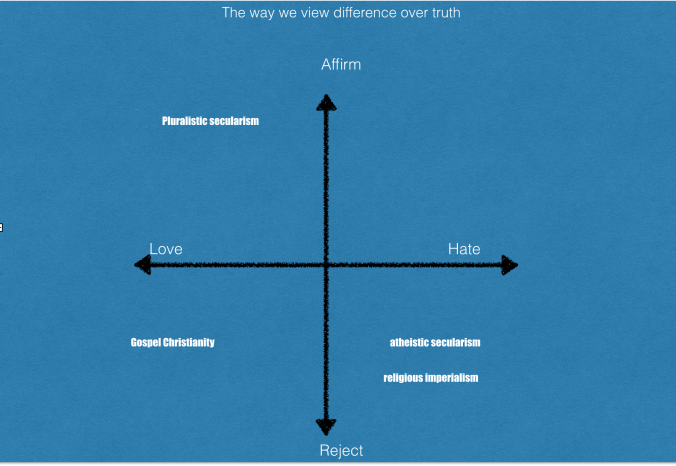
Below is a diagram that represents various approaches to viewing difference:

I agree.
Like sharks smelling a drop of blood, the media is swarming around the latest ‘religion is bad’ news story. This time, it comes in the form of a report that has been published in the journal Current Biology, by a group of researchers at Chicago University.
Research leader, Dr Jean Decety, has said, “Together, these results reveal the similarity across countries in how religion negatively influences children’s altruism. They challenge the view that religiosity facilitates prosocial behavior, and call into question whether religion is vital for moral development—suggesting the secularization of moral discourse does not reduce human kindness. In fact, it does just the opposite,”¹
That is one gargantuan call to make, and with significant implications should the assertion be true.
The Australian newspaper offered this helpful summary of the study (Nov 6):
“In the study, more than 1100 kids aged between five and 12 were asked to share stickers with anonymous schoolmates. The subjects lived in North America, the Middle East, South Africa and China, and included Christians, Muslims, Jews, Buddhists and Hindus.
Those from agnostic and atheist households consistently proved less likely to keep the best stickers to themselves. “The more religious the parents, the less altruistic the children, irrespective of the religion,” Dr Decety told The Australian.
He attributed the findings to a phenomenon dubbed “moral licensing”, where people’s perceptions that they were doing good — in this case, practising religion — exempted them from the obligation to perform other worthy deeds. “Apparently, doing something that helps strengthen our positive self-image also makes us less worried about the consequences of immoral behaviour,” he said.
The study also found that when the children were shown videos of “mundane” affronts, such as people bumping and pushing each other, religious kids were more inclined to decide harsh punishment was warranted. Dr Decety said this supported previous findings that organised religion promoted intolerance and punitiveness.”
I agree…in part.
I affirm the idea that religion can make people meaner and more selfish. This idea is hardly new, Christians have understood this since its earliest days, and it conforms to what the Bible has been saying since it was first written, millennia ago.
As Tim Keller put it in The Reason for God, “Those who believe they have pleased God by the quality of their devotion and moral goodness naturally feel that they and their group deserve deference and power over others. The God of Jesus and the prophets, however, saves completely by grace. He cannot be manipulated by religious and moral performance–he can only be reached through repentance, through the giving up of power. If we are saved by sheer grace we can only become grateful, willing servants of God and of everyone around us.”
According to Roman ch.1 religion stems from suppressing what is true, and creating and then depending upon things that are not true for meaning and salvation.
Subsequently, it is unsurprising to learn that religion is largely about self-justification; it is the human attempt to persuade God and others of one’s worthiness and goodness. Religion is about doing things and saying things in order to win God’s favour. Even acts of kindness can be a cover for gaining approval and for feeling better or happier about oneself. In other words, we shouldn’t be surprised to find that religion can make people, even children, mean.
The study doesn’t only suggest that religion makes children mean, it would have us believe that atheism makes children kind. Does unbelief enhance out potential for true altruism? A survey of non Government welfare agencies and charities will be hard pressed to find more than a handful that don’t have their foundations and funding in organised religion, especially Christianity. How many atheistic organisations can you think of that are working in our local communities and across the world to care for the poor and needy?
The average Australian gives away less than $200 each year, whereas Christians give on average, 5-9% of their annual income, and many give considerably more².
While I know some very friendly atheists, atheists are also among the most intolerant people in our society; listen to how many journalists, politicians, and social commentators now address Christians. For not subscribing to the secular agenda, Christians are labelled stupid and bigots, and Christian programs are being shutdown across the country.
History and contemporary society demonstrate that both religion and atheism are a problem. Should we debate who is worse, ISIS or Stalin? Surely evil is evil, whether it is perpetrated by the religious or irreligious.
How then, do we explain the findings of this outcome?
While I’m not dismissing the research, there are problems. For example,
1. In my opinion the study does not adequately differentiate between nominal religious believers and those who actually practice their religion. In particular, I am thinking of the distinction between Gospel (or Evangelical) Christianity and cultural Christianity. The use of the Duke Religiosity Questionaire may be useful as a sociology calculator but it is a poor theological and spiritual one.
2. The findings don’t properly differentiate between various religions. Islam and Christianity are at times lumped together, while other religions didn’t receive a large enough sample size to warrant analysis.
3. The research is making strong claims based upon limited research. Children completed a game and parents filled out a questionnaire, and from this we can now confirm that non religious families exude greater kindness than religious families? I think we call that, overreach.
4. “Children from religious households favored stronger punishments for anti-social behavior and judged such behavior more harshly than non-religious children”. Why is this deemed a negative? It is quite possible that children from religious families have a stronger moral compass and therefore a greater sense of justice.
5. The study involved children from 6 countries: Canada, China, Jordan, South Africa, Turkey and the United States. To what extent have the researchers accounted for cultural differences, and how these affect the way children behave? The way that culture and religion relate in Jordan is different from China and indeed the USA.
In my view, there are simply too many questions for people to be jumping on the bandwagon. Remember, this is one study, and it is worth noting that its findings conflict with other research that has been conducted in recent times, which have found that belief in God makes people happier and more community oriented (https://murraycampbell.net/2015/09/24/new-evidence-suggests-that-the-closure-of-sri-was-a-mistake/).
Dr Decety and the team from Chicago University have driven us to an all to familiar dead end street: we want to maintain that religion and irreligion are our only options, but there is a third way. That is why the message of Christianity is so subversive and why it does not fit with the dimensions of human expectations.
Christianity teaches that everyone is sinful, yes, even children. Isn’t it ironic that when Christians make this suggestion it is called ‘child abuse’, and when secular academics make the same observation it is called science! We shouldn’t be surprised to learn that young children exhibit selfish and judgemental traits; it is human nature. Sometimes we clothe it in God-speech and promises of eternal reward, and other times we simply call upon humanitarianism.
Altruism is unattainable because we simply cannot do it. Both religious and non religious people are capable of love and acts of kindness, but inconsistently, partially, and often for self-seeking reasons. The history of the world is our autobiography, and we are seriously kidding ourselves if we think that we have climbed up the evolutionary tree: domestic violence in 1 in 3 Australian homes, over 80,000 unborn children killed each year, the revelations on Ashley Madison, cruel Asylum Seeker policies, ka-ching and the masterminds behind the pokies industry, and on and on.
But in Jesus Christ we see perfect love, selfless service and sacrifice for the good of others; he is uncompromising in holiness and generous in mercy:
“This is love: not that we loved God, but that he loved us and sent his Son as an atoning sacrifice for our sins”. (1 John 4:10)
This is the essence of Christianity:
“The gospel is this: We are more sinful and flawed in ourselves than we ever dared believe, yet at the very same time we are more loved and accepted in Jesus Christ than we ever dared hope.” (Tim Keller)
When a person comes to know this declaration of God’s love, they are changed, forgiven and liberated to truly love God with our whole being and to love our neighbour. It changes us to give without expectation of return, and to sacrifice for the good of those who despite us. Religion and irreligion are proven dead ends, but the Gospel of Jesus Christ promises a light that changes how we see everything.
——————
See NCLS research for information regarding giving habits of Australian Christians. A summary of broader Australian giving can be found here – http://www.businessinsider.com.au/here-are-the-top-20-most-generous-suburbs-in-australia-2014-5
Last night on QandA, guest panelist, Dr Paul Ehrlich (Professor of Biological studies at Stanford University), made an astonishing allegation regarding religious instruction in schools.
“We did, but we didn’t have child abuse required in those days. We didn’t have any religious instructions in the schools,” Dr Ehrlich said.
“Did you just say religious instruction is child abuse,” Jones asked the outspoken panellist.
“That’s what Richard Dawkins and lots of other people have said; that you teach people details about non-existent supernatural monsters and then behave in reaction to what you think they are telling you.”
“That’s child abuse. You don’t raise your kids that way,” Dr Ehrlich said.
Audience members then responded with applause.
I have heard similar comments before, made by angry and uninformed persons, but not by an intellectual and person of public standing. We have come to expect these types of accusations by supporters of FIRIS and others, but do the allegations have warrant? If this is a case of name calling, it is truly bad taste and Dr Ehrlich should apologise. If, however, the allegation is serious, action must be taken by both Government and police, for child abuse is rightly deemed appalling and never acceptable.
According to the Department of Human Services (DHS) child abuse is defined in the following ways:
“Child abuse is an act by parents or caregivers which endangers a child or young person’s physical or emotional health or development. Child abuse can be a single incident, but usually takes place over time.
In Victoria, under the Children Youth and Families Act 2005 a child or young person is a person under eighteen years of age.
Physical abuse
Physical abuse occurs when a child suffers or is likely to suffer significant harm from an injury inflicted by a child’s parent or caregiver. The injury may be inflicted intentionally or may be the inadvertent consequence of physical punishment or physically aggressive treatment of a child. The injury may take the form of bruises, cuts, burns or fractures.
Sexual abuse
Sexual abuse occurs when a person uses power or authority over a child to involve the child in sexual activity and the child’s parent or caregiver has not protected the child. Physical force is sometimes involved. Child sexual abuse involves a wide range of sexual activity. It includes fondling of the child’s genitals, masturbation, oral sex, vaginal or anal penetration by a penis, finger or other object, or exposure of the child to pornography.
Emotional abuse
Emotional Abuse occurs when a child’s parent or caregiver repeatedly rejects the child or uses threats to frighten the child. This may involve name calling, put downs or continual coldness from the parent or caregiver, to the extent that it significantly damages the child’s physical, social, intellectual or emotional development.
Neglect
Neglect is the failure to provide the child with the basic necessities of life such as food, clothing, shelter, medical attention or supervision, to the extent that the child’s health and development is, or is likely to be, significantly harmed.”
Do Scripture classes fall into any of these categories? What are the facts?
-Scripture classes are voluntary, with parents having the choice to opt-in their children or not.
-In the case of Christian SRI, these classes teach students basic Christian beliefs by reading and thinking about the Bible.
-Students are free to explore and ask questions.
-No one is compelled or forced to believe the ideas that are communicated, although students are encouraged to use their minds and hearts as they consider the big questions of life.
– The worldview taught in SRI is about truth, love, hope and kindness. Everything that child abuse is, is opposed by these programs.
The reality is, there is no substance to Dr Ehrlich’s allegations; certainly not in the case of Christian instruction classes. I cannot speak on behalf of other religions as I don’t have experience there, but no doubt they will respond for themselves.
Such a misuse of language may garner rapturous cheers from anti-religious supporters, but it contributes nothing to wise and constructive discourse. In fact, Dr Ehrlich’s comments are incredibly irresponsible, and no doubt victims of child abuse would be justified for being hurt and outraged by them.
Imagine the public outcry if a Christian panelist on QandA said that refusing children the opportunity to explore theism was akin to child abuse? What would Dr Ehrlich think if a person on national television accused him of child abuse? My point is, his comments are not mere rhetoric, they are allegations of utmost seriousness, and Dr Ehrlich, if he has any intellectual and moral integrity, should withdraw them.
“You think freedom means doing what you like. Well, you’re wrong. That isn’t true freedom. True freedom means doing what I tell you.” (Shift, in The Last Battle)
I can’t remember many times when I have found myself agreeing with Germaine Greer, but on this occasion I am at least sympathetic with her situation. A petition with over 800 signatories is pushing to ban Germaine Greer from giving a lecture at Cardiff University, on account of her views about sexuality. That’s right, one the world’s most outspoken voices on women’s rights and sexual liberties is apparently too orthodox for these students.
The author of the petition commented, ”Greer has demonstrated time and time again her misogynistic views towards trans women, including continually misgendering trans women and denying the existence of transphobia altogether.”
“While debate in a university should be encouraged, hosting a speaker with such problematic and hateful views towards marginalised and vulnerable groups is dangerous. Allowing Greer a platform endorses her views, and by extension, the transmisogyny which she continues to perpetuate.” (quoted in The Age October 25, Petition calls for university to ban Germaine Greer from event over ‘hateful’ transgender views)
Based on this explanation it sounds as though Germaine Greer must hold some very distasteful views about transgender people. However, when I listened to Greer’s views, it appears that the accusations are false. The point that so riled these Welsh students is that Greer believes that surgical and hormonal treatment does not make a man into a woman. In fact, Greer does little more than state a biological fact. Listen to this interview by the BBC (language warning):
The allegations are so ridiculous; I feel like I need to rub my eyes to make sure that I’m not living in some fantasy land. But no, this isn’t Narnia or Animal Farm.
The allegation of transmisogyny maybe unfounded, but that doesn’t matter because the accusation itself is an effective way to silence opposing views. It may not have worked in the case of Germain Greer, not but not everyone is boisterous and thick skinned.
These students from Cardiff University have used a tool of debate that is becoming all to common:
No one is doubting that homosexual and transgender people have suffered abuses, and speaking out about such treatment is only right. The issue here, however, is not about protecting transgender people from hate and abuse, it is about denying people the freedom to discuss and disagree with the current sexual milieu. What makes this whole approach particularly ugly is that it is using people’s vulnerabilities and fears as a smoke screen for social engineering.
Germaine Greer is not the first victim of these Calormene-like speech police, this is the growing experience for many groups in the UK, Canada, Germany and the USA; especially Christian groups.
Sadly, this change of climate is also moving over Australian society, and a cold winter is gradually freezing out free speech. Take for example, Bill Shorten’s op-ed piece for Fairfax on the issue of the plebiscite for same-sex marriage:
“But I don’t think enough attention has been paid to the biggest risk a plebiscite brings – the danger and the damage of unleashing a divisive, drawn-out debate.
A plebiscite could act as a lightning rod for the very worst of the prejudice so many LGBTI Australians endure. A platform for people to attack, abuse and demean Australians on the basis of who they love.”
In other words, we should by-pass public opinion because public views may not necessarily conform to the progressive agenda.
“You thought! As if anyone could call what goes on in your head thinking.” Just as Shift challenged the Bear who dared question him, we seem to be moving toward a democratic totalitarianism, where society permits us to support same-sex marriage and sexual fluidity, but we are no longer free to offer a dissenting voice. Nowhere is this more evident than perhaps in Victoria where the Daniel Andrews’ Government is introducing policies that deliberately target the removal of Christian ideas and values from the public arena.
Deitrich Bonheoffer observed how the Reichstag Fire Decree of 1933 changed the public space in Germany. He wrote,
“Restrictions on personal liberty, on the right of free expression of opinion, including freedom of the press, on the rights of the assembly and association, and violations of the privacy of postal, telegraphic and telephonic communications, and warrants for house searches, orders for confiscations as well as restrictions on property, are also permissible beyond the legal limits otherwise prescribed.”
We have begun down this insane path, and if the media and certain political parties are anything to go by, the journey is just beginning.
In light of this, I offer these 3 suggestions:
1. Don’t accept the premise behind the case for marriage change. Disagreement and disapproval does not equal hate. The Bill Shorten’s and Cardiff students of this world would have us believe that there are only two roads to travel, either total acceptance or hate and fear. Both options are untenable. Christians know that the Gospel of Jesus Christ offers us a third way, that of loving and reasonable disagreement.
2. Don’t yield to the pressure and remain silent. It is important for the plurality of Australian voices to be heard in the public space.
3. Speaking up is no longer free; it will come at a cost. Our situation is unusual in light of world history; we have enjoyed social freedoms that people in many other parts of the world have never experienced. It has been possible to speak openly without any genuine sacrifice, perhaps a few crude comments thrown our way but nothing more. We need to wake up to the fact that Australia has changed, and for Christians, Jesus’ words about taking up our cross may become more than just words.
A donkey dressed up as a lion is still a donkey, no matter how much a monkey tells you otherwise. That old Narnian like Bear, Germaine Greer, has spotted a fraud in public discourse and we Aussies’ would be wise to also question the course that national conversation is now taking.
Scientists have discovered that babies in the womb, as young as 16 weeks, respond to music by ‘dancing’.
“The foetuses responded to the music by moving their mouths or their tongues as if they wanted to speak or sing,” said one of the researchers, Marisa Lopez-Teijon. The research has been published in journal of the British Medical Ultrasound Society, Ultrasound.
What this means is that babies’ cognitive faculties, creative faculties, and listening and communication skills are more highly developed at 16 weeks than previously thought.
The more scientists study human beings in the womb, the more wonder, beauty and complexity we discover. As scientific research advances, the findings increasingly demonstrate that embryos are not less human but fully human, and from the very earliest stages.
I am reminded of the words spoken by one excited mum, ‘As soon as the sound of your greeting reached my ears, the baby in my womb leaped for joy’ (Luke 1:44).
It was interesting to note that the article in The Australian, while sometimes referring to embryos, also addresses them as babies. The days when scientists and proabortionists justified abortion by claiming embryos were not human has long gone.
This latest research makes the reality of abortions even more appalling. It is a dreadful paradox of our society, that a child who enjoys listening to music in the womb can, on the same day, be killed in the womb.
How can we justify killing a child who in their first weeks of life is being moved by the sounds of Mozart and Bach? Not that responding to music defines their humanity but it further proves their humanity. He or she is not potential life, but is life with a mind and body that is active and alert.
Science is showing us the ignominy of our attitudes toward the unborn, but will we listen? We have longed turned deaf to the Bible’s pleas about the sanctity of life, and I suspect that we will also turn a blind eye to these amazing revelations that are being proven through empirical research.
Through music, science is affirming an ancient theological truth, embryos are people like us. But will we listen?
If you are reading this post as someone who struggles with a past decision to undergo an abortion, I want you to know that the good news of Jesus Christ means that real forgiveness and healing is promised through him. Abortion is wrong, but it is not the unforgivable sin. Again, please contact our church counsellor. If you don’t live near Mentone but are keen to find out more, please contact us and we’ll try to find a suitable church near where you live.
ABC Religion & Ethics have published this helpful article by Michael Bird (Ridley College). It is a constructive contribution to the current debate over ‘secularism’.
http://www.abc.net.au/religion/articles/2015/09/23/4318349.htm
Dear Adam Goodes,
We met briefly a few years ago and you graciously allowed me to take a photo of yourself with my two young boys. They were only aged 7 and 6 at the time, but they remember the occasion still.
Like many other Australians, I would like to see you participating on Grand Final day at the MCG. As a footballer, you have achieved success at a level that very few players will ever reach, and for that reason alone it is fitting for you to be recognised on that day.
Whether you decide to participate or not, I will not judge you. I believe it is too easy for non Aboriginal people (like myself) to arrive at conclusions as to how Indigenous Australians should or should not think and feel about their roles in Australia today.
I am sorry that you have been treated with such disdain on account of your race. I am offended for you. It must surely concern Australians that issues of race persist in 2015. While many prejudices and stereotypes have been taken away, it is clear that we have not yet arrived at where we need to be.
As a Christian I accept the Bible’s picture of what heaven will be like, and as part of its canvass the Bible describes how the nations will be present. The word that is used for nations has less to do with geo-political boundaries and is more about people groups. Race is not diminished, and no race is exalted over another, but on account on Jesus Christ peoples from every language and tribe are welcomed and received. While I am confident of where history will end, it is right to pursue this heavenly vision in our present time. To this end, we need to hear the stories of Aboriginal people, to learn, and for Australians to repent of past and present sins against the First Australians.
I wish to extend my congratulations to you on a great football career, and should you decide to take part on Grand Final day, I would hope that you receive a worthy applause.
Yours Sincerely,
Murray Campbell
…apparently not.
Five Prime Ministers in seven years.
Last night’s shenanigans in Canberra was a eureka moment for Australian media, and I confess that I was stuck to my television and to twitter like that final strand of spaghetti that you can never scrape off the bottom of the saucepan.
The second by second drama being played out on the ABC was dripping with more bolognese sauce than you can find in all Italy. We have officially lost all rights to mock the Italian political system, as comic as it has been for many years. We used to laugh at them, but now we are laughing at ourselves, and we must because otherwise we would hear our groans as we grow increasingly exasperated at our national leaders.
I share the view of many Australians, and that removing a sitting Prime Minister is imprudent and unsavoury; it may be within the rules of political warfare but as history has shown us, it is counter-productive.
Our recent history of political hits may belong to the script of a Spaghetti Western, and it also reflects our society’s heart more closely than is comfortable. Yes, we want our leaders to stop following opinion polls and instead lead, and yet we demand them to do our bidding. We want a vision for our nation’s future, but we are too greedy to wait or to sacrifice for the good of our children. A society that demands solutions now and without personal cost has not learned the meaning of community. And so it should not surprise us to see that our Governments turn to expediency in both policy and people. That leaves me wanting to urge our Governments to govern well, and it also leaves me with a greater anticipation for the perfect Government that is God’s.
Government is an expression of God’s grace and provision for the common good of society; it is a God given means to create order, peace and justice (Romans ch.13). But even the best functioning Government is only a tiny impression of what God promises us in Christ:
“For to us a child is born, to us a son is given, and the government will be on his shoulders.
And he will be called Wonderful Counselor, Mighty God, Everlasting Father, Prince of Peace.
Of the greatness of his government and peace there will be no end. He will reign on David’s throne and over his kingdom, establishing and upholding it with justice and righteousness from that time on and forever. The zeal of the Lord Almighty will accomplish this.” (Isaiah 7)
One day our political system will become redundant, but in the mean time we Christians want to take seriously both Romans ch.13 and 1 Timothy ch. 2. This morning I have begun by putting into practice these words written by the Apostle Paul,
‘I urge, then, first of all, that petitions, prayers, intercession and thanksgiving be made for all people— for kings and all those in authority, that we may live peaceful and quiet lives in all godliness and holiness. This is good, and pleases God our Savior…’