I love the footy. AFL is part of Melbourne’s DNA, and it’s one of our most successful exports to the rest of the country. But I don’t love AFL that much that I want to sell my soul. Our streets are awash with domestic abuse, where women (and children) live in fear and where indescribable things take place. As a society, we are meant to be learning and improving, even with the likes of Andrew Tate and Doug Wilson espousing their grotesque language and imagery. And then the AFL announces with pride,
‘I know what we need: let’s display our sport to the world and entertain the masses with a man who raps about demeaning women.’
Last month, the Carlton Football Club wore orange on their match-day jumper to promote gender equality and the prevention of violence against women. Well done, Navy Blues, our season may be a failure but this one was a win. Two weeks later, AFL CEO Andrew Dillon announced that Snoop Dogg would headline the AFL Grand Final entertainment.
How does the AFL square their stance on violence against women while inviting Snoop ‘let me find another vile word to say about women’ Dogg, to be the headline act on Grand Final day?
Bewildering is one word. If the rapper has genuinely repented and changed his life around, that’s one thing. We should and do believe in forgiveness. However, Snoop Dogg is on the record saying that while his attitudes towards women have changed, he doesn’t regret the songs he once wrote (and which continue to be played millions of times every month).
Calvin Cordozar Broadus Jr. is one of the biggest names in the music industry, and the sporting world seems to love him, from the Super Bowl to the Olympics, and to the world of Menulog!
He certainly has charisma and a thing for wearing sunglasses, but I doubt these are the reasons why the AFL is paying Snoop Dogg a truckload of cash to perform at this year’s Grand Final.
The dude is a singing misogynist, with lyrics so explicit in their sexism and degradation of women, if the AFL paid me what their paying the Dogg, I still wouldn’t share the words here. Those who know his songs know exactly what I mean, and those who don’t are better off. The issues don’t end with his songs, but with a litany of allegations and cases that have been brought against Snoop Dogg since the mid-1990s.
What kind of artist could we promote for families on Grand Final Day? What kind of music will help younger men think well of women? What kinds of songs tell us better stories? Is there no one available in our big big world who can sing, dance and perform? Even silent Snoopy the Dog would be a better choice.
Andrew Dillon, we’re not pooping on the party; we just don’t need Snoop Dogg, or a 100 other hip hop gold wearing, pyjama wearing artists who make Pablo Picasso look like a PG rated artist.
This is yet another example of our sex confused culture. It’s kiss cam all over again, with Coldplay singing, ‘I used to rule the world’. Condemn the CEO…but love is love…The poor wife…but he’s embracing his inner self…such betrayal….but this is a consensual relationship…
We don’t want to give up on the sex hype and yet it is leaving behind a very long trial of harm.
By the way, if you’re wondering how men should relate to women, it wouldn’t hurt to pay more attention to the old book. The old book isn’t so old. Its relevance is just what we need in our age of utter confusion about gender, sex and relationships. Take ,for instance, this advice that the Apostle Paul gave to a young bloke named Timothy, “Treat younger men as brothers, older women as mothers, and younger women as sisters, with absolute purity.”
Or these age words written to a man named Titus,
“encourage the young men to be self-controlled. In everything set them an example by doing what is good. In your teaching show integrity, seriousness and soundness of speech that cannot be condemned.”
I guess it’s not sexy enough, not enough risk and hormones letting fly.
Or take the story from the book of Judges, when Israel responded to the horrific incident of a woman being raped and murdered: they went to war against the offending tribe.
Will wise heads prevail? Will the allure of profit win the day? Or will we pay and praise a misognist in front of our daughters, mums and wives?
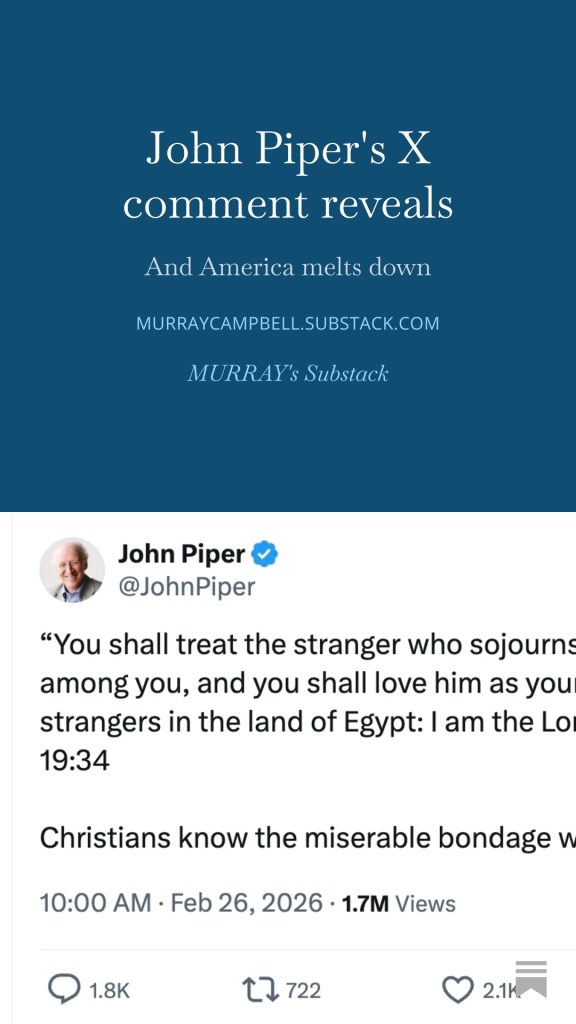
The reporter’s focus is on US Defence Secretary Peter Hegseth and his association with CREC (a new church association in the United States headed up by Doug Wilson). If it were not for Mr Hegseth reposting a video on X about Doug Wilson, Wilson and his Moscow movement might have remained in the cold, as far as Australian media is concerned.
The word is now out, and no doubt a large number of Australians are scratching their heads and wondering, what on earth is going on here? Is Doug Wilson a legit Christian voice? Do his views reflect what Australian Churches are teaching and practising?
Let me bring assurance and a note of caution. First up, no, Melbourne isn’t Moscow, but like a cold Russian winter, the chill can cross borders.
Doug Wilson and Christian Nationalism are not anonymous in the Aussie Christian scene. Thankfully, they are only a tiny voice, and yet it is more prominent than it was 5 years ago. There are now conferences and websites and some churches that regularly appeal to Wilson and Moscow, and invite speakers from their broad tribe to Australia.
As a quick aside, the Doug Wilson who was preaching and teaching some useful and valuable ideas a decade ago is quite different from the problematic man and his movement today. Whether he always held the positions he is now propagating and kept them quiet, or whether he’s shifted over the decade, I don’t know which is the case. Either way, the Moscow vibe, as I call it (Wilson lives in Moscow, Idaho) brings a chill that we do not need in our churches or country.
The presenting story that led to the AP piece is a view promoted by Wilson’s church, whereby women should lose the right to vote. I wasn’t shocked to read this, as it fits into their view of men and family life. In the last week, I have also heard the scenario where some (a tiny, tiny number) of Christians now advocate that women should not have voting privileges in a church! The idea is preposterous as it conflicts with one of the Bible’s wonderful teachings: the priesthood of all believers, and therefore the value of all members of the church and their contributions. And what of single women? In the world of Moscow, single women are frowned upon and offered and often derided. More of this in a moment.
It doesn’t need saying (although perhaps it does) that Christianity never fits neatly into any culture; for the Christian message is transcultural. This is one of the stunning truths of Christianity, that whether Korean or Ugandan or Bolivian, the Bible and the Christ of Scripture cross time and place and ethnicity. Part of that means, though, that there will always be some element of pushback, disagreement, and confusion as to how people understand and respond to Christianity. After all, if Christianity was nothing more than a mirror to Australia 2025, there would be little incentive and reason for anyone to become a follower of Jesus Christ and join a local church. And yet, not every idea preached by every religious leader is an accurate reflection of the Christian Gospel, and hence, when the unbelieving public are perplexed by and even finds a view repellent, they are right to do so.
There are evangelical leaders in the United States expressing concern over the normalisation of ‘Christian nationalism’ in some circles. Similarly, in Australia, there are voices raising concerns about Doug Wilson and his Moscow crowd.
Stephen McAlpine and myself are among a number of Australian pastors who have been sending up flares to warn Aussie Christians about the rise of Christian Nationalism. Again, while their influence is small, the Moscow flu is catching on in some more conservative churches in Australia, and it’s an ailment that inevitably makes people sick. Symptoms include public rage, thinking ‘normal’ evangelical churches and leaders have lost the gospel, one-sided politically, anti-authority, and demeaning toward various minority groups.
Let me observe 2 examples here, one in relation to how women are viewed and one that articulates concerns about Christian Nationalism.
Christian Nationalists love to talk tough love. Their men are vocal and grow long beards and know how to skin a beaver with their bare hands. These blokey males also have a way of using their strength to demean women.
A few years ago, Sydney theologian, Dani Treweek challenged Doug Wilson and another American pastor, Michael Foster, for how they speak about single women in churches.
Treweek said,
“Wilson and Foster embark on a shared lament about the impending crisis facing churches whose pews are soon to be filled with lonely, unlikeable, tubby spinsters who have nothing in their lives and so spend their days endlessly seeking the benevolent attention of their ever-patient but extremely busy and very important senior pastor.”
She sums up Foster and Wilson’s views on single women as:
the reason women are single is because “Baby […] You can do better than this. You’re not likeable” or because they are too “tubby” to be considered of marital value to the men around them (at least the ones they haven’t driven into the arms of Islam);
single women are derogatorily dismissed as a “bunch of old spinsters”
anyone not married by the time they are 40 are issued the dire warning that they ‘will be lonely’
elderly widowed women are depicted as a tiresome burden upon the senior pastor’s time and energy
the only valuable and valid expression of love in action is if it is directed towards someone’s own offspring and then their offspring
single women are the harbingers of “chaos”
unmarried women don’t “have anything” in their lives”
With the surprise of an AFL team beating the local u12 boys team, they responded with a tirade of personal attacks on Dani Treweek’s singleness and theological credentials!.
Then there is this issue with ‘Christian Nationalism’, which readers of The Age may be wondering about. At this point, allow me to repeat a few paragraphs from an article I wrote on the subject in 2023, following up a series of pieces written by Stephen McAlpine as he reviewed Stephen Wolfe’s ‘The Case For Christian Nationalism’. McAlpine eventually gave up reading Wolfe after several bouts of diarrhoea!
“The tectonic plates of belief and hope are moving and causing major disruptions to every sphere of life. One of the answers being proposed by Christians (in some circles) is one gaining some traction in some areas of American and European Christianity, and it’s finding its way onto Australian shores as well: Christian Nationalism.
It’s not as though Christian Nationalism is brand new; iterations have existed at different points in history, often with long-term disappointment, bloodshed, and Gospel compromise.
I understand why Christians across the United States are concerned and even angry at some of the values and views that have captured hearts. I appreciate why Aussie believers are troubled by various moral agendas that have been normalised in our political and educational institutions. However, frustration and concern with politicians and the political process is not a reason for reactionary theology and poor exegesis.
We don’t fix one problem by adding another one; that way, we end up with a bigger mess!
Christian Nationalism ends up making the State into the church and the church into a political party and turning the Gospel of grace into a weapon to beat down political opponents. Instead of being God’s message of reconciliation, it distorts the gospel into a message of social conservatism and one that sees political progressivism as the great Satan. Social and moral conservatism can be as dangerous to spiritual health in its intentions to create new forms of legalism and allegiances.
I’m not saying that Christians in Australia walk away from the public square and sit tight on uncomfortable pews behind stained glass windows. It’s not that Christians shouldn’t participate in the political process. It’s not that we should ignore social issues and cultural debates. Such things are part of common grace and ways we can love our neighbours. Christianity influencing the public square isn’t Christian Nationalism, it is a wonderful byproduct of the goodness and sensibility of Christianity.”
Australia is one of numerous countries where governments are getting bigger, and the people are looking increasingly to government to be the saviour of all their issues and hopes and fears. This has the unfortunate effect of giving more authority and responsibility to the State and, negatively, it diminishes the role of the community to take responsibility. That critique aside, in the eyes of Scripture, the State is not the main game, but it is the church. In this sense, Christian Nationalism makes a similar error to other heresies, like the prosperity gospel and social justice gospel. They all aim at changing society (and controlling society) through policy and behaviour.
The problem with that mindset is that it contradicts the nature of the Gospel and the purpose of the church (aka Ephesians ch.2). The halls of Parliament and legislative offices are not the places where God is working out his redemptive plans. It is in the church and by the Gospel of Christ that God is achieving his purposes.
Christian Nationalists may well identify some sins of America (or Australia), and yet the answer according to Scripture isn’t to make America great again or Australia, but to present the Gospel of Christ and make disciples of all nations. Christianity is international and multi ethnic, and any attempt to contract the gospel to a particular nation-state is enormously problematic.
Make Christianity weird again, not make Christianity skewed again! The message of Jesus Christ has this remarkable ability to weave and connect through every fabric of society. Christianity eventually revolutionised how the Roman Empire viewed women, babies, slaves, and more. Our modern equality sensibilities didn’t arrive by chance, but through Christianity. And yet it wasn’t through some militant takeover bid fueled with rage and demeaning the downtrodden, but with sacrifice and through persuasion, and the God of grace bringing forgiveness and newness of life.
If there is a ‘sin of empathy’ (yes, Moscow is also responsible for the ‘sin of empathy’ vibe), it is to show empathy with this movement blowing its cold weather in a westerly direction over the Pacific Ocean. My advice, avoid it like the plague. Instead, be captured by the Apostle Paul’s vision for the Christian Church in Ephesus. In that ancient metropolis of commercial and religious influence, Paul reminds the local church of God’s message of peace and being God’s people of peace. I’m convinced, we (churches) will do well to keep working hard at this:
He came and preached peace to you who were far away and peace to those who were near. 18 For through him we both have access to the Father by one Spirit.
19 Consequently, you are no longer foreigners and strangers, but fellow citizens with God’s people and also members of his household, 20 built on the foundation of the apostles and prophets, with Christ Jesus himself as the chief cornerstone. 21 In him the whole building is joined together and rises to become a holy temple in the Lord. 22 And in him you too are being built together to become a dwelling in which God lives by his Spirit. (Ephesians 2:17-22)
Mike Bird has written a series of helpful articles about Christian Nationalism, including reviewing Wiliam Wolfe’s book, ‘The Case for Christian Nationalism
Melbourne and footy are synonymous, so it’s only fitting to dedicate a whole episode to footy and faith! Geelong AFL player, Ollie Dempsey, has recently shared his story about faith and footy. He is one of many professional athletes in Australia who believe in and follow Jesus. Maybe it sounds strange, but why are more young people investigating Jesus? His story might serve as a quiet encouragement to many young people
I really enjoyed reading two recent interviews with Ollie Dempsey. His openness about the challenges of believing in Jesus is normal to the Christian experience and an encouragement.
You can watch my latest episode in ‘Tomorrow’s Melbourne’ below on youtube or on your preferred podcast platform.
As Zoomers try out church, many are looking toward older and more traditional churches. What is behind the growing interest in liturgical and classical churches? What are some helpful tips for choosing an authentic and legitimate church? In this episode, I explore 2 ways to assess the ‘real thing’: learning history and going back to first principles, namely the Bible.
A challenge if you live in Melbourne. A challenge no matter your age, and especially if you’re part of Generatoin Z
Be radical and read the Bible!
Check out the latest on ‘Tomorrow’s Melbourne’ and how an upsurge of Bible reading in the UK could help us take the Bible more seriously here in Melbourne
Melbourne has been rocked this week with 2 men charged with abusing little children. 1200 children are now required to be checked for STDs. Imagine the horror for these families? How do people begin to process what has happened?
In this episode of my new podcast, I want to address the question of evil, and needing a God who judges and who hates evil even more than us.
The ABC recently held a poll to discover the top 100 piano works. Thousands of music lovers, listeners, the bourgeois of Launceston, voted to see their most loved piano tunes strikes a chord near the top of the repertoire. I didn’t participate in voting but as someone who spent much of life with my fingers exercising on the keys, I took a tiny interest.
The ABC’s ‘Countdown’ list included many wonderful works for the piano, as well as the rather dull and uninspired, and then there’s piano music written for the movies! Like all pianists, I’m confident that my preferences are the genuine article and other opinions can swim around in the murky pond of lesser opinions! (this is also known as musician’s hubris!). So to redeem the piano from the Hungry Jacks of music, I’ve decided to put together the definitive list of the 10 greatest compositions for solo piano and the 10 finest piano concerti. Chamber works written for piano are a third category and one is left for another time.
Where there’s an *, it indicates that I’ve played or performed the work (or at least part of what belongs to a book or suite).
10 Greatest Works for Solo Piano
Well Tempered Clavier – J.S Bach*
Without Das wohltemperierte Klavier there would be no piano music, no Mozart or Chopin. Both books are the ultimate keyboard music, from which all the great composers look bad for education and inspiration.
2. Ballades – Chopin*
The high point of 19th Century Romanticism. Listen to Philippe Entremont’s recording; possibly my favourite music recording.
3. Piano Sonata No.29, ‘Hammerklavier’ – Beethoven.
The ultimate sonata. Turmoil on the keys!
4. Piano Sonata No. 8 in A minor, K. 310 – Mozart.
The sound of Mozart is pure and perfect.
5. Preludes – Debussy*
The soundtrack of nature with all its aromas and visuals played out on the piano
6. Goldberg Variations – J.S Bach
Simplicity and complexity weaved into perfect harmony
7. Etudes – Chopin*
Ferocious, brilliant, and sonorous
8. Sonata no.14 in C# Minor (“Moonlight”) – Beethoven *
A predictable choice but there is something about the opening movement
9. Années de pèlerinage II (Italie) S. 161: V Sonnette 104 del Petrarch – Liszt
Sparkling virtuosity
10 Preludes – Rachmaninoff *
The anti-revolutionary Russian longing for home (excluding Op23. No 5 which my teacher at the Con rightly thinks is pompous)
10 Greatest Piano Concertos
Piano Concerto no.3 in D minor, Op. 30 – Rachmaninoff
This is the ultimate pianist’s challenge.
2. Piano Concerto no.2 in C Minor, Opus 18 – Rachmaninoff
3. Piano Concerto no.20 in D Minor, KV 466 – Mozart
4. Piano Concerto No. 2 in F major, Op. 102 – Shostakovich
5. Piano Concerto no.5 Op.73 – Beethoven
it may not be the King of Concertos but it is the Emperor!
6. Piano Concerto no.3 in C major, Op. 26 – Prokofiev
A Kaleidoscope
7. Rhapsody on a Theme of Paganini, Op.43 – Rachmaninoff
Technically not a concerto, but who cares!
8. The Piano Concerto No. 1 in B♭ minor, Op. 23 – Tchaikovsky
Glorious opening minutes which become somewhat convoluted and meandering, but you never forget the power of those first pages. I remember being 4 or 5 and stopping a game of backyard cricket because the Tchaikovsky came on the radio.
9. Piano Concerto no.1 in Eb Major – Liszt
10. Piano Concerto no.1 in E Minor – Chopin
The lyricism outweighs Chopin’s inability to write orchestral parts!
There is an astonishing offering of piano music on these two lists. But perhaps I should confess, the definitive list doesn’t exist, not even for me. How does one choose between Bach, Mozart and Debussy? How is compiling a list even possible? They each bring genius of sound and thought to the mightiest of instruments. Nonetheless, on this wintery Melbourne day, this is my offering, and I suspect there would little change on a different day. The Mozart Sonata might change to another, and another 20th Century Concerto might squeeze out Liszt’s, but that’s about it.
If you’re keen to get a taste of the piano, these are my recommendations. Enjoy!