Baptists, Creeds and Confessions

It’s time to set the record straight. Baptists are not anti-creedal. Or at least, they shouldn’t be. 

Perhaps you have heard Christians (most likely a baptist) assert, ‘no creed but Christ’ or ‘no creed but the Bible’. 

Both of these sayings sound appealing. Which Baptist is going to set up an authority on par with the Lord Jesus Christ? Who would argue that the Church has an authority equal to or greater than Holy Scripture? A desire to preserve the authority of Jesus Christ and the authority of Scripture is noble and right. The rightful Lord of the church is Jesus Christ and the Bible is God’s final, full and sufficient word. Unfortunately, despite their appeal, these creedal mantras present a false equivalence not intended by Creeds and Confessions, they fail to recognise that all Christians are creedal by definition, and they ignore the fact that historically many Baptists wrote and affirmed confessions of faith.

To begin with, throughout our 400 years Baptists have written and given ascent to many Confessions of faith. It is true that many have opposed written and formalised statements of faith, and many others welcomed such agreed formulations.

Even today some baptists are strident in their rejection of Creeds and Confessions. My understanding is that in Australia only one State Baptist Union includes a reference to the rejection of creeds or confessions. They do so, despite requiring all constituents to affirm a doctrinal basis. 
One of the earliest figures associated with the birth of baptists is John Smyth. In 1609, Smyth wrote a confession of faith, although he never published it. Some of Smyth’s ideas though became untenable for many Englishmen who had moved to Amsterdam with him. Smyth became a Mennonite and many of his followers eventually split with him and returned to England where they (under Thomas Helwys) established the first Baptist Church. Smyth was so concerned to avoid liturgy (which he believed stifled the work of the Spirit) that he did not permit the Bible to be read in the gathering. Either way, Smyth is hardly the baptist example par excellence

In 1611 Thomas Helwys wrote a declaration of faith for English Baptists living in Amsterdam. Since then,  no fewer than 50 Baptist Confessions of faith have been written, published and affirmed by various baptists across the centuries. Both the Second London Baptist Confession of Faith (1689) and the New Hampshire Confession of Faith (1833/1853) remain in use today across many baptist networks. In other words, any blanket statement about baptists being anti-creedal cannot be sustained. The historical record demonstrates that Baptists are among the most prolific writers of confessions among all Christian denominations. And these do not include all the statements of faith and doctrinal bases that are in use today across baptist fellowships.

When baptists speak of creeds and confessions, the correct description ought to be, many baptists adhere to confessions and creeds while others do not, and at times, both groups live and serve together.

We have answered the question, are baptists anti-creedal. The next question is, should baptists be anti-creedal?

In 2004, Russell Moore made the observation,

“all Christians are, by definition, “creedalists.” After all, the Spirit tells us that the regenerate person must “confess with your mouth that Jesus is Lord and believe in your heart that God has raised him from the dead” (Rom 10:9 ESV). All Baptists are, by definition, “creedalists” since our name signifies that we share a belief about the meaning of baptism in identification with Christ. This is where the shell game hypocrisy of the “anti-creedal” Baptists is so disingenuous.”

Since the earliest days of the Church there has been a standard of belief, a statement of foundational truths required by churches. Even the New Testament gives us evidence of such statements. For example, 1 Corinthians 15:3-5

 “For what I received I passed on to you as of first importance: that Christ died for our sins according to the Scriptures, that he was buried, that he was raised on the third day according to the Scriptures, and that he appeared to Cephas, and then to the Twelve.”

Laying behind the anti-creedal movement may be a concern to preserve the authority and sufficiency of Scripture and to uphold Christ’s authority. Far from undermining these, Creed and Confessions, if they’re doing their job, will articulate and support these fundamental elements of the Christian Church. More often, or at least in contemporary situations, the issue is admitting that there are crucial points of doctrine where baptists no longer agree and then having to face the question of what to do next. Confessions and Creeds require agreement and commonality, whereas ‘no creed by Christ or the Bible’ is sufficiently vague so as to include all manner of weird, wonderful and downright heterodox positions. Whereas Creeds and Confessions require settled teaching, there is another “baptist” value that pushes against this, namely that the Spirit of God has new truths to enlighten us. This particular “baptist” distinction is one that I’ll respond to on another occasion for it is as historically controversial as is the question of creeds. Hence the use of inverted commas.

Creeds and Confessions of faith have long played a significant role for churches in articulating faith and doctrine, and in the formation of partnerships and unions. They are not infallible documents as is Scripture, but they can serve as faithful witnesses to and summaries of the Apostolic faith and of teachings crucial to the Church. A church that disconnects itself from historic Christianity is likely to move away from the faith once for all delivered. Is it any wonder that baptists can reject the bodily resurrection of Christ and still remain in union? Should it surprise anyone that penal substitutionary atonement, while formally declared in the ABM doctrinal basis, can be thrown out by some as an abhorrent teaching and yet happily fellowship together?

Creeds and Confessions alike can serve churches in these 4 helpful ways:

First, they ground our churches in the historic faith. They remind us that we are not separate from or distinct from faithful churches who have gone before us over the millennia; we share the same apostolic faith.

Second, they serve as a buttress, helping to preserve a church’s theological convictions. They give churches a reference point for summarising foundational beliefs and distinctives. Somewhat ironic, for all the talk about not relying on confessions, many Baptists are right now rushing about drafting statements of belief in relation to sex, gender, and marriage.

Third, such statements serve to aid the memory and function as useful catechizing tools.

Fourth, they serve to unify the church. For example, when we recite the Apostles Creed at church, with one voice we are affirming the faith that we hold together.

The next time a baptist looks you in the eye and with confidence tells you, baptists have no creed but Christ, perhaps ask them, which baptists? And then, if conversation permits, explore with them the reasons behind their objections. 

Do I watch the Beijing Winter Olympics or not?

I’ll be honest, when it comes to the Beijing Winter Olympic Games I feel torn. In light of recent human abuses in China and the growing tensions over her intentions with Taiwan, and the wellbeing of tennis star Peng Shuai, several nations including Australia refused to send Government representatives to the games. I also have friends who have decided not to watch the Games as a form of protest. 

Politics has never been far from the Olympic Games. In 1968, two American sprinters took a stand against racism on the dais. The 1972 Games was marred by a terrorist attack against Jewish athletes. Nations boycotted the 1980 and 1984 Games due to the Cold War. Games in the 21st Century have been increasingly influenced by cultural movements. And of course, there is the infamous 1936 Berlin Games.


I saw a few ‘highlights’ from the Opening Ceremony and was floored by the reuse of John Lennon’s insipid song, Imagine. Leaving aside the fact that one must have very little imagination for trotting out this dribble again, but did others notice the palpable hypocrisy of having those words resound around the Bird’s Nest?

“You may say I’m a dreamer

But I’m not the only one

I hope someday you’ll join us

And the world will be as one

Imagine no possessions

I wonder if you can

No need for greed or hunger

A brotherhood of man

Imagine all the people

Sharing all the world”

One might ask, but what of the Uyghur people? What of the treatment of Christians? What of the military threats facing Taiwan? Hong Kong? Perhaps the CCP read ‘join us’ and ‘the world will be as one,’ and assumed Lennon was talking about the Communist utopian dream!

After all,  Imagine is a fitting anthem for the Chinese Communist Party. The song is explicitly anti-religion, anti-pluralism, anti-God, and near nihilist in its agenda. 

Leaving aside the bizarrely befitting opening ceremony song, I’ve been trying to figure out whether I watch the games or not. To be honest, I’ve been feeling pretty blah about a number of the recent Olympic Games. Indeed, what is one to do about the Soccer World Cup hosted by Qatar later in the year?

I understand why a lot of people aren’t turning on the television to watch the Games. Why do we want to encourage in any way, a regime that stands in opposition to the values of liberal democracy? Why we would we wish to promote in any way, a Government that is actively stifling social and religious freedoms. No doubt, some in the CCP might turn and ask, well what about your own backyard Australia? Yes, indeed. 

While part of me wants to protest the Games by not watching, another part of me enjoys sport and I like watching the Olympic Games, both Summer of Winter. After all, some of these winter sports are pretty specular, from downhill skiing to bobsledding and aerial snowboarding. And don’t I want to support the Aussies competing? I suspect I’m not the only one facing the dilemma, do I do what I enjoy doing or do I hold to my principles? Do I stand by the belief that the CCP is a dangerous Government who should not be given support and praise (as these Winter Olympics are most assuredly doing) or do I cave in and submit to the Aussie primal urge for sport?

Maybe can I do both?  I can voice my objections with a swift statement on Twitter and then quietly turn on the tv in the background! Who would ever know?

In the case of the Winter Olympics, as with many sporting events, the answer isn’t always straightforward; there is some grey. For example, the Olympics isn’t solely about China: we want to see our fellow Australians compete and succeed, there is something noble in admiring human athletic brilliance. Again, in this conversation we may reflect and ask, is our own Aussie backyard pure as snow? 

The dilemma isn’t new. This Beijing impasse reminds me of that most ancient of battles, where we acknowledge God who is right and yet we decide to go our own way. Even today, we look at the life of Jesus and read his words, and yet the power of doing our own thing most often wins the day. We may be convinced by the moral norms presented in the Bible, but then the pull to satisfy personal desires and preferences leads us to explain away such Christian principles. We are proficient compromisers; revising, excusing, and justifying all manner of behaviours despite what we might ascend to formally.

Such paradoxes, tensions and even hypocrisies are noted in the Bible. For example, in the book of Roans the Apostle Paul notes this spiritual and moral disjunction that we all suffer. The assessment is fair as it is bleak. For him, it is autobiographical.

“You, therefore, have no excuse, you who pass judgment on someone else, for at whatever point you judge another, you are condemning yourself, because you who pass judgment do the same things. Now we know that God’s judgment against those who do such things is based on truth. So when you, a mere human being, pass judgment on them and yet do the same things, do you think you will escape God’s judgment? Or do you show contempt for the riches of his kindness, forbearance and patience, not realizing that God’s kindness is intended to lead you to repentance?

The prospects of surviving this hypocritical life are zero. The way to resolve the problem isn’t today’s ‘gospel’: just be true to ourselves. After all, is not the Chinese leadership being true to their own values and desires? Is Putin not being faithful to an old Russian dream?

In the same letter, Paul furthers the discord that many of us are subconsciously aware of. 

“We know that the law is spiritual; but I am unspiritual, sold as a slave to sin. 15 I do not understand what I do. For what I want to do I do not do, but what I hate I do. 16 And if I do what I do not want to do, I agree that the law is good. 17 As it is, it is no longer I myself who do it, but it is sin living in me. 18 For I know that good itself does not dwell in me, that is, in my sinful nature. For I have the desire to do what is good, but I cannot carry it out. 19 For I do not do the good I want to do, but the evil I do not want to do—this I keep on doing. 20 Now if I do what I do not want to do, it is no longer I who do it, but it is sin living in me that does it.

So I find this law at work: Although I want to do good, evil is right there with me. 22 For in my inner being I delight in God’s law; 23 but I see another law at work in me, waging war against the law of my mind and making me a prisoner of the law of sin at work within me. 24 What a wretched man I am! Who will rescue me from this body that is subject to death? “

The story could end like this, in a spectacular fall that makes downhill skiing look like a novice’s act. But it doesn’t. Paul, who authored these words, was both a legal and religious expert. He was a fervent advocate for his national identity and he openly opposed a new minority group that had appeared on the scene; Christians. This same man later admitted that the greater conflict wasn’t the one taking place externally in the geopolitical scene, but the one facing his own heart.  The sun may be out, but what can warm this heart of ice? I suspect that as readers soak in his reflection, we may well recognise the anx and conflict that we also experience inside our own consciences. 

Then comes this life giving, relieving and redeeming word,

“Thanks be to God, who delivers me through Jesus Christ our Lord!”

If you happen to be like me and feel conflicted over watching the Olympic Games, why not dig a little deeper. Sitting behind the world stage of ideological clashes are human lives whose hearts are in conflict with someone far greater than ourselves.  Why do we do what we ought not do?  

One of the greatest movements in the last 50 years took place in China. I don’t mean Communism and I’m not referring to China’s massive economic growth. I am speaking of 10s of millions of Chinese men and women who, despite the CCP’s active opposition, have found the answer to the conflict human heart. The solution is God’s gift of his Son, Jesus Christ. 

Maybe Australia does need to take a look at China, a deeper look behind geopolitics and into the way in which a people who lost all freedoms have in fact found the greatest freedom, namely Christ.

Men and Women in Romans 16: a portrait for today

Over the past 10 years, I have noticed a significant and growing volume of books, articles and posts talking about men and women. The broader culture is not only debating questions that relate to the equality of the sexes but even the most basic of questions: what is a man and what is a woman? Sadly, many people no longer know the answer, or at least, out of fear they no longer feel safe to give an answer. 

Churches have something positive and wonderful to contribute to this conversation. For example, the book of Genesis takes us back to the very beginning and to humanity’s essential nature.

“So God created mankind in his own image,

    in the image of God he created them;

    male and female he created them”.

While Genesis sets the foundations, it is Jesus Christ who redeems sinful men and women and does so not by eradicating sex and gender but through restoration. This redemption does more than return us to Eden, but points us to the ultimate realisation of humanity, to be known by Christ and found in him. For the Christian, our truest and deepest identity lies in our adoption to sonship, 

“In love he predestined us for adoption to sonship through Jesus Christ, in accordance with his pleasure and will— to the praise of his glorious grace, which he has freely given us in the One he loves” (Ephesians 1:4-6).

These concepts are unique to Christianity and for centuries they have provided essential ingredients for societal understanding of and valuing people. It is no wonder that as our culture distances itself from these truths we find growing confusion about the nature of manhood and womanhood. We have not only removed the theological underpinning for human nature but also biology and scientific fact. Trying to speak of men and women is becoming like a game of pin the tail of the donkey, except that not only are we disallowed from using our eyes, they’ve taken away the donkey altogether!

As much as passages like Genesis ch.1 and Ephesians ch.5 deserve repeated study, in this post I want to draw attention to Romans ch.16. My purpose isn’t to dig in and exegete every detail and name mentioned in this grand kaleidoscope, but hopefully, I can present a portrait that is faithful to the Apostle’s telling that is helpful for churches as we consider the roles of men and women in our churches, and therefore how our churches can faithfully execute God’s intention for the church to be “a pillar and foundation of the truth”.

As with all Christian doctrine, we are required to take in all of the Bible and to observe the Bible’s internal story line and logic ( ie, creation, fall, redemption, and consummation).  I’m preaching through 1 Timothy this term at church, and so there will be a few weeks where we look at men and women and their roles in the church and home. As I prepare I have also revisited Romans chapter 16 and it is on this passage of Scripture, that I wish to make a few observations here.

Romans chapter 16 provides us with a different sort of explanation to what we find in some other parts of the New Testament. It’s not different in that it contradicts other NT passages, but rather, the contrast is one of style. Romans ch.16 is not one of the didactic passages which directly outline a theology of men and women.  It is not a narrative like John’s retelling of Jesus engaging with the Samaritan woman. Romans chapter 16 is a list of names. It is a series of greetings that form the closing part of Paul’s letter to the church in Rome. This isn’t the only occasion where Paul’s letters contain such lists, it is however the longest.

Romans 16 isn’t foremost about men and women, it’s about the Apostle Paul commending his ministry team to the church in Rome. It is a team that consists of many people from all kinds of walks of life. Among the number are many men and many women. In other words, the inclusion of women is a beautiful albeit secondary consideration in Paul’s mind. Perhaps for that reason, this natural spilling out of affection for his coworkers reveals the internal workings of the Apostle’s team dynamics. 

Romans 16 does a stunning job in describing the rich layers of contributors in Gospel work that was headed up by Paul. It is a snapshot taken in time that depicts the dynamic advance of the Gospel across the Mediterranean.

There is Phoebe, 

“a deacon of the church in Cenchreae. I ask you to receive her in the Lord in a way worthy of his people and to give her any help she may need from you, for she has been the benefactor of many people, including me.”

Priscilla and Aquila are a married couple who’ve partnered with Paul for years and in various places.

There is Epenetus, a close friend of Paul’s and the first Christian convert in Asia.

Some people are named without any mention of what their ministry role is, but they are known to Paul with affection.

One of the lessons this surely presses home for churches (and for para-church organisations) is an Apostolic appreciation for the breadth of Christian service and which involves men and women. It is however a misstep to conclude from this chapter that there is no delineation in the church between how men and women serve. To be sure, there is much overlap and there is also some distinction.

My friend and brother in Christ, Mike Bird, recently posted some thoughts on Romans 16. Michael is a considered theologian armed with a writing style akin to a firecracker ignited indoors. Mike created a little stir when he commented on how Romans 16 led him to an egalitarian view of men and women in the church.

“For me, it was reading Romans 16, noting all the women that Paul mentions, seeing what he describes them doing, that brought me to the egalitarian position’. 

I remain unconvinced. Romans 16 is an exciting and encouraging passage that shows us the size of Paul’s ministry team and the affection he has for each of them. Far from contravening instructions regarding Pastor/Elders and the task of preaching/teaching to the Sunday assembly, it fit perfectly within those boundaries.

Phoebe is a Deacon. in the New Testament, Deacons are faithful servants set aside by the local church to oversee the practical administration of needs. Deacons are distinct from Elders/Pastors (cf Philippians 1:1l 1 Timothy 3), the latter who are set aside to oversee the local church, primarily through the task of preaching and teaching.

Priscilla and Aquila are a couple renowned for their hospitality. They opened their home to Paul when he visited Corinth. They later accompanied Paul on his missionary journey to Ephesus. While living in Ephesus they welcomed Apollos to stay with them and they “explained to him the way of God more adequately”.  In Romans 16 they are again mentioned for their hospitality, they are hosting a church in their home. 

Junia (who is coupled with Andronicus in v.7) is a somewhat enigmatic figure. There is some debate as to whether the name represents a man or a woman for it can refer to either. Most scholars lean toward the view that Junia is a woman (for various reasons that I won’t delve into here, but I concur). The next question is whether the Greek phrase should be read as ‘known by the Apostles” or “known among the Apostles”. The grammar works both ways. In other words, are Andronicus and Junia two people with a good reputation among the Apostles or are they two Apostles? New Testament scholars are divided and where they land often depends on what prior commitment they hold regarding gender roles in the church. There is one further piece of information that is important in Junia’s profile: the word Apostle has more than one meaning in the New Testament. There are the 12 Apostles, who hold a unique office in the early church. Their authority is unique and non replicable, and so it is only right to discount that possibility from Junia. Sometimes apostle is used as a small ‘a’ apostle and denotes a messenger (2 Cor. 8:23; Phil. 2:25), and this is a plausible reading of Andronicus and Junia. Messengers are vital players in advancing the Gospel but to assume compatibility with the office of Apostle and or with Church Elders is requiring more than the text provides. 

 Romans 16 is a tapestry that sits comfortably within a classical understanding of men and women in the church. One might even say, Romans 16 is precisely what an authentic complementarian should expect to find: men and women serving alongside each other in a variety of ways, and none of which overturn patterns of leadership and gender roles that are taught throughout the New Testament. 

Returning to a bigger picture. Here are some takeaways from reading Roman 16:

  1. Paul is thankful for his ministry team. How can we express thanksgiving for many people who serve in the multitude of ways that together glorify God and see the Gospel advancing?
  2. Gospel coworkers are doing many different works. Let’s honour not only public and formal ministry, but also the informal and personal that occurs in homes and lives every day.
  3. Paul‘s team consists of many men and women. Solo leadership is a disaster area. If Paul needed a big team, so do we all. We are working together and every member of the church is an essential worker.
  4. Romans 16 fits precisely with what we expect to find with a classical understanding of men and women and their roles.
  5. A challenge for complementarian churches is to see that women, and men, are being encouraged and equipped for ministry. Invite men and women to training programs. At Mentone, we have had and are open to women doing a full-time apprenticeships. At our lay leader training events about 50% of attendees are women. 
  6. If women are not pastors or doing the Sunday preaching, ensure they are fully immersed into other areas of church life and are rightly visible and honoured in the Sunday gathering. 
  7. Pastors need to find ways for listening to and engaging with the ideas and concerns of those who are not part of the Eldership (women, other men, youth, elderly, etc).

We live at a time where the world at large is struggling to know how to identify and relate to one another and to understand the most basic of existential and ontological questions. By no means am I saying this is the final answer, I am simply offering a small contribution here by pointing to a great Bible text. I do believe the Bible gives us the answer. The Bible paints a magnificent picture and it is one that is to be displayed in and by the local church. That’s why we mustn’t give up on difficult conversations about men and women and it’s why we must also pursue these conversations with grace and kindness. Too often churches have fallen and failed, either by understating gender or by overstating gender. It is not only gender confusion that is creating issues in every sphere of life, but the wicked issue of abuse has all too readily appeared among the people of God. It must not be. If your church is harbouring misogyny then it needs to be repented of before Christ snuffs out the candle. 

We all can and must learn from the example given to us throughout Scripture including the exciting and attractive panorama that is Romans 16. As Tom Schreiner reminded us recently, 

“Every argument for every perspective should send us back to the biblical witness. The word of God still pierces our darkness and can reshape how we think and live. The Bible can and should still be heard, believed, and followed—even though we are all fallible and culturally situated.”

A thought provoking lecture by Dr Chris Watkin

‘Developing a biblical critical theory’, a lecture by Dr Chris Watkin, given for the Reformed Theological Seminary New York City campus Spring 2021.

Have a listen and engage with Chris’ careful presentation of what it might look like to develop a biblical critical theory.

Boxing Day: the hardest Sunday of the year?

The hardest Sunday of the year for organising church is the first Sunday following Christmas Day. As it happens, this year the Sunday falls only one day after Christmas,  Boxing Day.

Boxing day in Melbourne is huge.  For Melbourne Boxing Day means cricket at the MCG and shopping sales at Chadstone and eating lots of delicious post-Christmas food. I love all those things and later on our family will be participating in each of those activities today. But as Melbourne awakes from its Christmas slumber and drinks enough coffee to get the body going, something else is happening around Melbourne today. Gathering in small groups across hundreds of locations there is something taking place that is of even greater significance and will do more to accomplish the direction of 2022 than everything else Melbournians will be doing and enjoying this Boxing Day.

For most of us at Mentone Baptist, holidays have started and the majority of our congregation are already away interstate visiting family whom we have not been able to see for almost 2 years; that’s important. Others at Mentone have returned for church, only 24 hours since we last met.

Despite meeting in smaller numbers than usual (and yet counting many thousands across Melbourne), men and women are praising God and remembering God’s good news about his son and we are committing to God in prayer the year that has been and the year that is about to start.

Such praise,  we are told in the Bible is like a pleasing aroma to God and which reaches heaven and is accepted by him. The voracious sounds of the MCG cricket crowd today is nothing compared to the praises of God‘s people.

And the prayers we pray to our Father in heaven may be of such consequence that lives will be changed and the very fabric of society can move. After all, God heard the pleas of his people in the Old Testament and answered them by sending the saviour of the world. The kaleidoscope of history is pitted with God answering prayer and fulfilling all his promises. There is nothing in all the world, no event, no pandemic,  no government that can outbid or outlast what God will accomplish through his Son.

To the many and the few who are this morning meeting as church, be encouraged. We are probably feeling tired this morning and we’re looking forward to Melbourne’s Boxing Day allures (as am I).  Also be encouraged, that as you meet for those precious minutes as a church today, this praise and prayer is of infinite worth and pleases God. And we can trust that God will use these petitions to accomplish his purposes in 2022.

A Christmas Acrostic

What is Christmas about? What does Jesus have to do with Christmas? How relevant today is the story of Jesus’ birth? Here’s a brief explanation via a short acrostic.

C

Christ came into the world: Christ means God’s anointed ruler. He is given authority by God to reign over a Kingdom that will never end, and he rules with justice and righteousness. He can always be counted on for doing what is right and good. 

H

Holy Spirit: Mary’s pregnancy was miraculous. While the circumstances of Jesus’ birth demonstrate his humanity, other particulars observe how this child is also God the Son. There are unique features surrounding Jesus which point to God’s special involvement. “His mother Mary was pledged to be married to Joseph, but before they came together, she was found to be pregnant through the Holy Spirit” (Matthew 1:18).

R

Redeemer: God’s Son came into the world on a rescue mission. Jesus wasn’t born because everything is okay, but because everything is not okay. And yet God loves us despite our multitude of failings and sins. That’s an idea worth thinking about it!  “You are to give him the name Jesus, because he will save his people from their sins.” (Matthew 1:21)

I

Incarnation: God didn’t ignore the human condition. Jesus didn’t pretend to be a person. The one who enjoyed eternal communion with the Father took on human flesh. “The Word became flesh and made his dwelling among us. We have seen his glory, the glory of the one and only Son, who came from the Father, full of grace and truth” (John 1:14).

It is because Jesus is God that he has the character necessary and power required to overcome sin and death. It is because Jesus is man, he could serve as our substitute and saviour. Today, this same Jesus lives embodied in his resurrection body, acting as our mediator in heaven and guaranteeing our resurrection from the dead. It is not putting it too lightly when the Bible says that Jesus is the hope of the world.

S

Scripture: The events of Jesus’ birth are more than history. They were promised by God in the Scriptures (Bible) over many centuries. Christ’s coming into the world was the long awaited event God’s people yearned to see. 

T

Travel: Jesus’ journey didn’t begin or end with the manger in Bethlehem. Jesus didn’t remain a forever baby, stuck inside Christmas cards or in portraits hanging in art galleries. Christmas is necessary preparation for Easter. The Son journeyed from heaven to earth, from Bethlehem to Nazareth, then to Jerusalem and the cross, the tomb and to life, ascension and heaven.

M

Manger: Jesus was born in the most humble of circumstances. His first bed was an animal’s feeding trough. God doesn’t ignore the baseline,  the poor or suffering. When he entered the world, he identified with those who have little. 

“Who, being in very nature God,

    did not consider equality with God something to be used to his own advantage;

rather, he made himself nothing

    by taking the very nature[b] of a servant,

    being made in human likeness.

And being found in appearance as a man,

    he humbled himself

    by becoming obedient to death—

        even death on a cross! (Philippians 2:5-8)

A

Adoration: The angels praised God, the Shepherds worshipped the infant, and the Magi brought him precious gifts.  This same Jesus is deserving of all honour and glory because of who he is and because of what he has accomplished for us. It’s right to sing songs about and to this Jesus, and it is proper for us to live all of life for him. Who else died for sin? Who else can forgive sins? Who else can gift us eternal life? 

S

Shepherds. Among the first to hear the good news of Jesus’ birth were ordinary people, even social outcasts. This reminds us how God’s good news isn’t for society’s elite but for those without a voice. Christianity is not a gospel validating self-sufficiency but revealing human anx and God’s efficacy. To quote Jesus, ‘I’ve not come for the healthy but for the sick’.

Photo by Somchai Kongkamsri on Pexels.com

If these facts about Jesus’ birth intrigue you, perhaps you’d like to open a Bible and read the Bible for yourself. Might I suggest starting in Luke’s Gospel, as it jumps straight into the story of Jesus, including the famous Christmas narrative. You may also like to visit a church over Christmas or in the new year. If you live around Mentone or Cheltenham (or in the Bayside area of Melbourne), you’re very welcome to visit us at Mentone Baptist Church.

UK Pastors write letter to the Government explaining they will choose God

Victoria is not the only jurisdiction in the world to introduce laws prohibiting conversion practices. While Victoria’s The Change or Suppression (Conversion) Practices Prohibition Act remains the most extreme, both in the breadth of what is banned and in the criminal sanctions that are threatened,  other Australian State and several countries have or are in the process of banning elements of Christian practice and belief. 

The United Kingdom is introducing legislation to ban so-called conversion practices.  More than 2500 pastors have signed a letter to the Government, explaining their position,

“It should not be a criminal offence for us to instruct our children that God made them male and female, in his image, and has reserved sex for the marriage of one man and one woman. Yet this seems to be the likely outcome of the proposed legislation,” they write.

“We therefore very much hope (and pray) that these proposals will be dropped in their current form. We have no desire to become criminals and place a high value on submitting to and supporting our government.

“Yet we think it important you are aware that if it were to come about that the loving, compassionate exercise of orthodox Christian ministry, including the teaching of the Christian understanding of sex and marriage, is effectively made a criminal offence, we would with deep sadness continue to do our duty to God in this matter.”

These are not words of bigotry. These are not malevolent attitudes toward fellow human beings who don’t identify with their biological sex or as heterosexual. These are reasonable convictions accompanied by love of neighbour. Indeed, the views articulated in the letter remain normal and orthodox in Christian churches around the world today (including Melbourne). The classical view of sex and marriage was even broadly held in civil society until just a few short years ago. But of course, the socio-political landscape has changed dramatically and it will continue to do so.

No doubt there are many faithful pastors who haven’t signed the letter. While others are weighing up the right course of action. I cannot of course speak for many who have signed. Among the signatories though are friends of mine. Indeed, some signatories are same-sex attracted. These are men and women who love God and are convinced by God’s good Gospel about his Son. 

They are not malicious troublemakers or intolerant social miscreants. These are thoughtful people who are convinced by the teaching of Scripture, the very same Scriptures from which our society gleans the belief that all men and women are equal and that all life has value. 

Perhaps I should clarify for those who are reading and are unsure about Christian motives behind objecting to these laws;. Christians seek good laws to govern society. Christians desire good for all citizens, and not just for those who agree with us. But introducing bad legislation for the sake of keeping up with today’s cultural controllers isn’t beneficial for anyone. Where people are mistreated on account of their gender and sexuality, we all call it out. The problem with these laws however isn’t just that they are an affront to religious freedom, but that they will also harm the very people the laws are designed to protect. 

I’m sure there are more than a few Church leaders in the United Kingdom who are happily following Demas and have no issue with this Governmental intrusion and oversight. But that kind of fallacious living is myopic in the extreme. For those who choose Christ and care for their congregations by teaching the full counsel of God, Christian ministry will become more difficult in the United Kingdom as it is here in Victoria, Australia. There may be short term pain and trouble (and let’s not pretend,  this pain and trouble will impact lives in significant ways), but to those who persist in faithfulness, there is eternal gain.

I am encouraged by the stand these Christian ministers are taking. No doubt, the decision to sign their names wasn’t done lightly. It takes courage to take this kind of public stand, knowing that signing your name may well cause attention and trouble for you and knowing it may indeed lead to accusations and slander, and even criminal charges. 

To my brothers and sisters in the United Kingdom,  may you be encouraged and strengthened. As Paul writes to Timothy, “For the Spirit God gave us does not make us timid, but gives us power, love and self-discipline. So do not be ashamed of the testimony about our Lord or of me his prisoner. Rather, join with me in suffering for the gospel, by the power of God.”

Governments and societies are important but they are not infallible. Sometimes popular ethics makes huge mistakes. Remember, Jesus found himself on the wrong side of popular opinion and on the wrong side of the courts. The Apostle Paul often found himself on the wrong side of the dominant culture, whether it was Jerusalem or Ephesus or Philadelphia. Christianity has often played this unwanted role in the last 2,000 years of history. It’s just that our cultural moment is unusual. In parts of the world like Australia and the UK we have reaped the rich gains of the Christian message, but we are now slowly turning our backs in pursuit of a life without God. 

During one of the many occasions when Paul was imprisoned he wrote a letter to a young Timothy and encouraged him not to give up. Paul didn’t suggest altering the message, he didn’t argue for cultural domination or appropriation, nor did he resort to embittered speech toward those who had him put away.  Paul did confront judges and legal counsel when he thought it wise, but he could not betray the God who saved him nor the people around him. After all, he had experienced Divine mercy, he who self-identified as the worst of sinners. How could he not seek good for others too?

From his prison cell, Paul wrote a letter to encourage Timothy. He said to Timothy, join me in being enthralled by what lays in store, 

“In the presence of God and of Christ Jesus, who will judge the living and the dead, and in view of his appearing and his kingdom, I give you this charge: Preach the word; be prepared in season and out of season; correct, rebuke and encourage—with great patience and careful instruction. For the time will come when people will not put up with sound doctrine. Instead, to suit their own desires, they will gather around them a great number of teachers to say what their itching ears want to hear. They will turn their ears away from the truth and turn aside to myths. But you, keep your head in all situations, endure hardship, do the work of an evangelist, discharge all the duties of your ministry.

For I am already being poured out like a drink offering, and the time for my departure is near. I have fought the good fight, I have finished the race, I have kept the faith. Now there is in store for me the crown of righteousness, which the Lord, the righteous Judge, will award to me on that day—and not only to me, but also to all who have longed for his appearing.”

Let us not give up trusting and obeying God. Let us not give up loving others.

Devonport: a word offered when no words can be found

A devastating tragedy struck the Tasmanian town of Devonport yesterday. On what should have been a fun filled celebration for Grade 6 children who were finishing their final day of primary school, became the worst of nightmares. Children were playing on a jumping castle when a sudden gust of wind swept it high into the air, before plummeting 10m to the earth. Five children have died and another four remain in critical condition. 

One dares not speak a word, for what can one say? Even as a parent with 3 children, what words can I utter? One cannot understand what these families are going through unless one has already experienced such loss ourselves. How do we make sense of the senseless? The death of any child is beyond words, but five lost to such circumstances? The reporter on the news last night added the note that this accident has happened so close to Christmas.

I don’t think the proximity to Christmas makes this awfulness any more harrowing than it already is. But perhaps there is something in the Christmas story that touches and empathises with the inexplicable. 

Soon after Jesus’ birth, a tragic incident occurred in Bethlehem, and it forms part of the Christmas story. It is part of the original Christmas although we don’t often read it. And fair enough, it was a terrible event that involved the deaths of many little children.

“A voice is heard in Ramah,

    weeping and great mourning,

Rachel weeping for her children

    and refusing to be comforted,

    because they are no more.”

There are words in Scripture that speak the word of unspeakable grief in losing a child. The circumstances and time and place are different but they nonetheless echo the human heart. Indeed, those words from the prophet Jeremiah are all poignant and jarring for the loss of those little ones in Bethlehem following the birth of another child, the Christ.

This Son of God, whose name is Jesus,  would one day preach a sermon which today echoes through the generations and still pierces light and life into the darkness. In the address, Jesus spoke these words,

“Blessed are those who mourn, for they will be comforted.”

He is willing to comfort those who cannot be comforted.

On another occasion, in Jesus’ inaugural public address, he chose for his Bible text, verses from the book of Isaiah,

“the people living in darkness

    have seen a great light;

on those living in the land of the shadow of death

    a light has dawned.”

What an astonishing announcement, the darkness will not win. The shadow of death is long and thick, but its hold will not last forever. For you see, this same Jesus doesn’t only offer comfort, he has walked the path none of us wishes to undergo and yet will do so one day. He accepted the cross and descended to the dead so that he might punch through the darkness and bring the light of life that can never be dimmed.

We may struggle and grasp to find words to express our sorrow for these families in Devonport today, and that’s ok. For what can one say?  Sometimes all one can do is sit and quietly grieve. 

The one thing I can say to my fellow Aussies as we look on is this: the message of Christmas has a word to offer in every situation, even the darkest grief and unknown. Strip away Christmas from all the presents and food and decorations, and we uncover in the biblical story a God who hates death. He is appalled by it. He opposes it.  His only Son experienced the harrowing of that darkness, for us, that one day death may be defeated forever and all who call on him will know his resurrection power.

We cannot answer the ‘why’ of much that happens in life. The unfathomable can sit like an incurable pain. The Jesus of Christmas tells us there is one who knows and we can go to him, not because we can explain everything, but because he has already taken that journey through death and he has broken through to life again. 

Let us rediscover the power of forgiveness

As  I watched one of my boys play a cricket match over the weekend, I chatted with one of the dads for much of the time. As we talked about how our kids are growing up and the challenges they face in the big mean world of Melbourne, the conversation turned to the topic of forgiveness. This cricketing aficionado said to me with a tone of sadness, we live in a time where people no longer know how to forgive. 

I agreed. One of the key ingredients for human living is forgiveness, and it’s now lost. Our societal impulse is no longer to forgive (let alone understand the other). In today’s Australia, the first to throw the stone is the victor, regardless of whether the offence is real or just perceived. Anger is the mood of today. Controlling the story line and asserting individual rights is the power play at work.

It is interesting to observe that as our self-appointed cultural adjudicators assess the merits of Christianity and move from defining her teaching as half-baked to harmful, we should not be surprised to see our society also shifting away from forgiveness. 

Expressive individualism is god and politics, education, and social media are the priesthood. People and society exist to serve my interests, rather than I have a duty to love my neighbour as myself. But what good is a power play like this if we lose our soul in the process? In ditching the message of Jesus Christ, we are not gaining, we are losing.  If you don’t believe me, spend a few moments on Twitter today.

I’m not suggesting that only Christians know how to forgive (and yes, some Christians need to relearn this basic good), but I am saying that it is because of this Christian message our world learned how to forgive. As we turn away we leave behind key ingredients that keep society together.

There is a distinctive element in this Jesus framed understanding of forgiveness, one that is inescapably powerful in its goodness. Forgiveness isn’t something we practice because of self interest (although forgiveness brings benefits to the person doing the forgiving in important ways). Forgiveness isn’t a decision we bring to the table when we believe the offender is deserving of those words, ‘I forgive you.’ The very nature of forgiveness is that the offending party has wronged you and shouldn’t expect a semblance of peace making. 

Forgiveness is acting in mercy toward an individual in light of their transgressions toward you. In what is one of the greatest words ever spoken, on the cross Jesus sees those responsible for his public execution and prays, “Jesus said, “Father, forgive them, for they do not know what they are doing.”

All this is to preface a word of grace and forgiveness that was spoken recently by a young woman at the funeral of her father. It is a word she shared about what she now wants for the man who murdered her dad.

Police Officer Richard Houston, of Mesquite, Texas, was killed in the line of duty by 37-year-old Jaime Jaramillo during a domestic disturbance.

At Mr Houston’s funeral, she said, 

“I remember having conversations with my dad about him losing friends and officers in the line of duty.

I have heard all the stories you can think of, but I’ve always had such a hard time with how the suspect is dealt with.

Not that I didn’t think there should be justice served, but my heart always ached for those who don’t know Jesus—their actions being a reflection of that.

I was always told that I would feel differently if it happened to me. But as it’s happened to my own father, I think I still feel the same.

There has been anger, sadness, grief, and confusion. And part of me wishes I could despise the man who did this to my father.

But I can’t get any part of my heart to hate him.

All that I can find is myself hoping and praying for this man to truly know Jesus.

I thought this might change if the man continued to live, but when I heard the news that he was in stable condition, part of me was relieved.

My prayer is that someday down the road, I get to spend some time with the man who shot my father—not to scream at him, not to yell at him, not to scold him—simply to tell him about Jesus.”

Do you find in her intent something hideous or something beautiful? Are we repelled by her attitude or intrigued?

The enacting and receiving of forgiveness is fast becoming a social memory. We all know how important it is, but the identity games that control social media and politics is creeping into our homes and every aspect of living. And it’s not only forgiveness that is being lost, we are also losing our grip on patience and gentleness and kindness; all virtues that are necessary for maintaining healthy relationships and a civil society. 

So long as we’re the one holding the stone or the dislike button, and everyone’s retweeting our version of justice, we can get by for a while. However, sooner or later we are the ones needing forgiveness. Indeed, one day the toll will toll for thee!

Jesus once taught his disciples to pray this,

“And forgive us our debts,
    as we also have forgiven our debtors.

And lead us not into temptation,
    but deliver us from the evil one.’

For if you forgive other people when they sin against you, your heavenly Father will also forgive you. But if you do not forgive others their sins, your Father will not forgive your sins.”

Is this Jesus so dangerous that a young woman finds in Him the power to want good for her father’s killer? Even that she might one day be able to tell him about Jesus? No one is ignoring the fact of the heinous crime or pretending justice should not be acquired. Just as we cannot live in a world without justice, we cannot live without forgiveness and neither will we survive for long without knowing the One who purchased for us Divine forgiveness.

May I suggest, don’t listen to our cultural overloads, avoid getting swept up by the tides of rage and intolerance that’s drowning our souls and dividing our society. Instead, let’s reconsider the powerful story of the Christ whose forgiveness so reconfigures the human heart, that we can be moved to desire good for those so undeserving. If we restart our own story with the definitive story of forgiveness, I can guarantee it will move our lives forward in ways that will surprise and surpass everything else.

John, one of Jesus’ disciples put it this way,

“This is the message we have heard from him and declare to you: God is light; in him there is no darkness at all. If we claim to have fellowship with him and yet walk in the darkness, we lie and do not live out the truth. But if we walk in the light, as he is in the light, we have fellowship with one another, and the blood of Jesus, his Son, purifies us from all sin.

If we claim to be without sin, we deceive ourselves and the truth is not in us. If we confess our sins, he is faithful and just and will forgive us our sins and purify us from all unrighteousness. 10 If we claim we have not sinned, we make him out to be a liar and his word is not in us.”

Private prayers in Victoria a legal ‘grey area’

I’ve written about The Change or Suppression (Conversion) Practices Prohibition Act numerous times given the extraordinary nature of this Government intrusion into the lives of religious Victorians.  In this post, I want to inform people of one further way these laws will encroach on religious and civil freedoms and commonsense.

The laws will come into effect in February 2022. Churches are supportive of some measures contained in these laws, but the Act goes well beyond what is reasonable or right.

Among the more extraordinary measures found in the Act is banning people from having conversations with individuals about sexuality and gender, and prohibiting praying with them in line with a Christian view of sexuality (even with their express consent). 

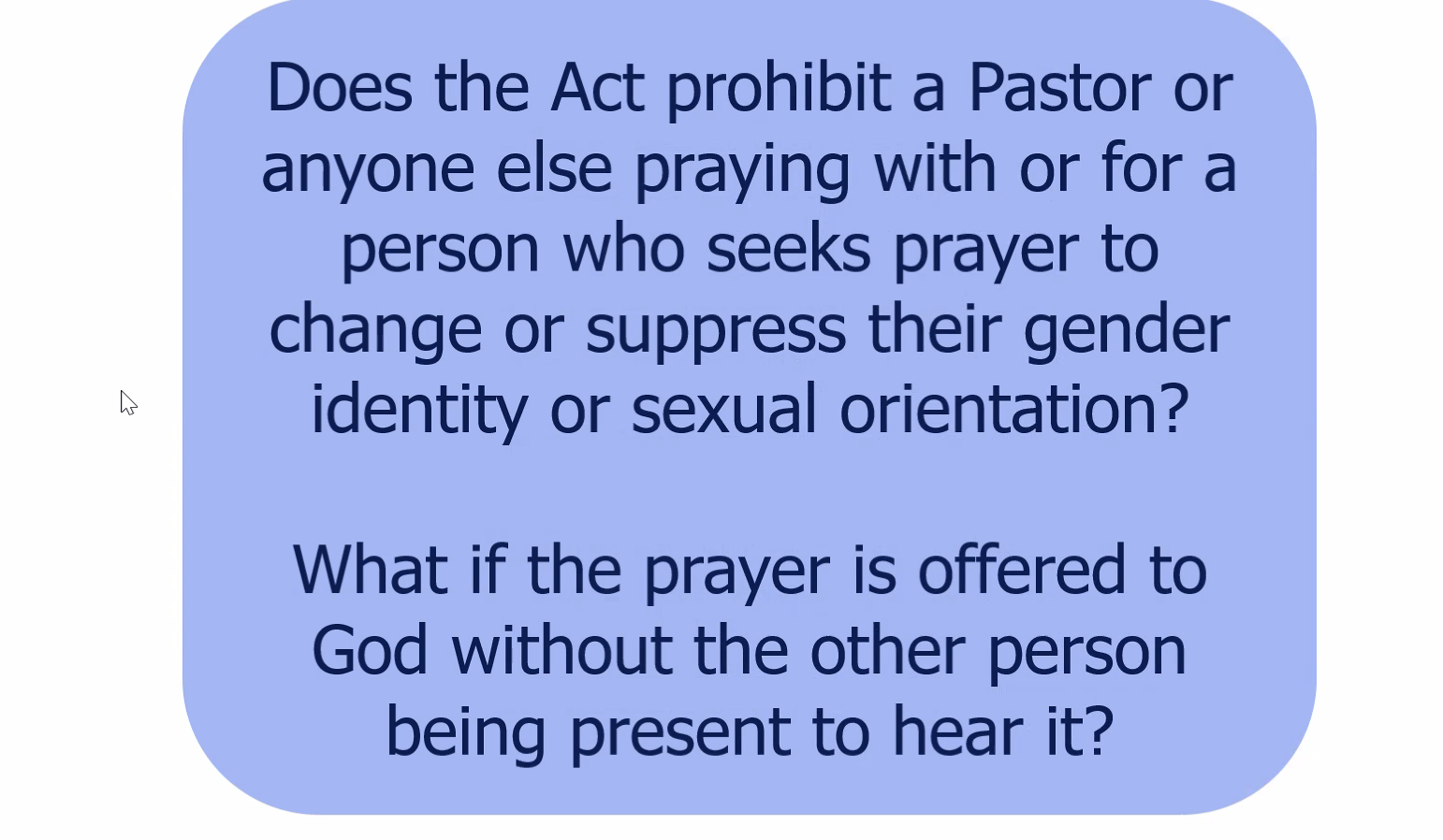
Slide is from a VEOHRC forum

The new laws may well extend even beyond consensual prayer.  In a letter sent to church leaders from my own denomination we read, 

“There is some uncertainty about the application of the Act to praying for or with people regarding their sexual orientation or gender identity. The Act specifically includes “a prayer based practice, a deliverance practice or an exorcism” in the unlawful practices, even if the person seeks or consents to such prayer. However, the VEOHRC has advised that it is a “grey area” if the person is not present when they are being prayed for. It may be unlawful if the person is aware of such prayer, in that this would be understood to be directed at them with the intention of change or suppression.”

Private prayers are considered a ‘grey area’ by the VEOHRC (Victoria Equal Opportunity Human Rights Commission). If that doesn’t make your eyes pop out of your head and roll down the hallway, what will?

For example, a believer prays for a friend, it’s just them and God. Or perhaps  2 or 3 friends pray together, as Christians do all the time, and they bring a request to God about another friend for whom they are concerned. This prayer, even if the person never knows about it, is potentially a breaking of the law. And depending on how police treat the crime, it could potentially lead to a term of imprisonment. More likely, the guilty prayers will be investigated by a civil tribunal and have their lives turned upside down and be forced to attend a reeducation camp where they must learn how to pray and believe in line with the religious views acceptable to the government.

Part of the problem with the VEOHRC coming out with what they call a ‘grey area’ is that it likely means a test case. Some poor woman or man will have their life dragged through the mud, legal system and courts, to see if a vexatious complaint can push the limits of the law.

What business is it of the Government to interfere with my prayers to God, or the prayers offered by anyone? 

For those who are not already convinced, can we not see the massive overreach and the insanity that a Christian’s personal prayers are treated as a violation of State law? 

What is it about prayer that the Government is so concerned about? Are they worried that God might answer prayer? As a Christian, I follow the Bible’s exhortation to regularly pray for our Governments, regardless of who is in power. I pray they might have wisdom and discernment, to act rightly, fairly, and mercifully. 

What is it about prayer that is so egregious? The answer is, activists are not content to ban what were a few rare and abhorrent practices. The intention is to delete any belief and practice that does not fully embrace their own worldview.

One group behind the laws explained,

“A similarly insidious development in conservative religious communities is the ‘welcoming but not affirming’ pastoral posture.”

Ro Allen (the VEOHRC Commissioner) said in an interview,

“The proposed law is quite clear in countering any teaching that says that homosexual sex is wrong, so this may well be part of their education”

I thank God that Jesus welcomes us while not affirming every attitude and behaviour I might have. The very crux of Christianity is that God mercifully welcomes those who contravene his good design in many different ways. I will say again, for those who haven’t read before, the Gospel aim isn’t to change a person’s orientation but it is that they might live a godly life (the distinction is important). There are many same sex attracted Christians who uphold and want to live in light of the Bible’s sexual ethic. The very nature of Christianity is that it welcomes and includes everyone who doesn’t belong by nature and choice. That’s good news worth thinking about. 

 But understanding the very notion of sin and conversion, transgression and forgiveness cuts against what some groups will tolerate in our society. They are not prepared to live in a civil society where a plurality of thought is encouraged or permissible. Banning certain behaviours isn’t sufficient; the aim is to change and control what we believe and even think. Yes, even our prayers.

Orwell’s 1984 has been done to death in recent years. The next latest 1984 analogy is getting rather tiresome and predictable, but sometimes Mr Orwell had a knack of looking into the hearts of men and seeing something disturbing, 

The aim of the Party in 1984 was power and they would orchestrate mind games in order to gain control over even the thoughts of the citizens,

“The thought police would get him just the same. He had committed–would have committed, even if he had never set pen to paper–the essential crime that contained all others in itself. Thoughtcrime, they called it. Thoughtcrime was not a thing that could be concealed forever. You might dodge successfully for a while, even for years, but sooner or later they were bound to get you.”

There is one who understands the mind and who hears our prayers, and it is beyond the purview of any Government.

“Search me, God, and know my heart; test me and know my anxious thoughts.”  (Psalm 139:23)

“For the word of God is alive and active. Sharper than any double-edged sword, it penetrates even to dividing soul and spirit, joints and marrow; it judges the thoughts and attitudes of the heart.”(Hebrews 4:12)

Let God judge our prayers and our minds. And perhaps with time, reasonable minds will appreciate the misstep taken by the Victorian Government and seek to amend this set of laws.