For most people, 8th May 2025, will be little more than another ordinary day like yesterday and tomorrow. However, there was nothing normal about 8th May 1945.
8th May 1945 was VE Day: Victory in Europe. On that day, the Second World War in Europe came to an end. Hitler had killed himself several days earlier, and Nazism had fallen. The reign of terror that was the Third Reich had been smashed, as will all evil either in this life or at the Judgment.
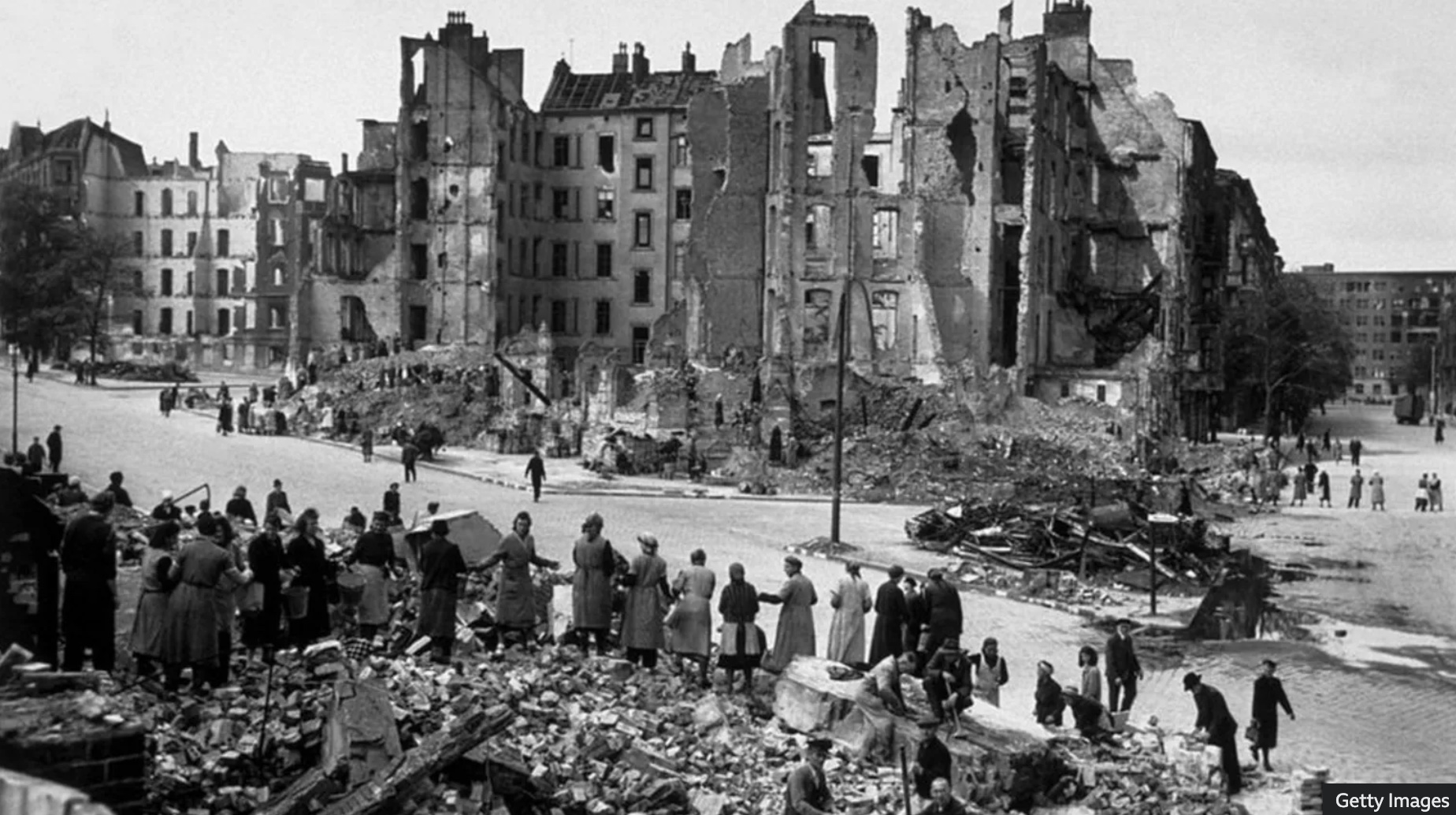
The streets of Berlin were covered in rubble and the blood had not yet time to congealed. In London, Paris, and New York and in towns and villages across Europe millions experienced euphoria as the six of the most violent years in history came to a close. 60 million human beings dead; in fact, no one knows the final count. As the biggest party burst into life, many other civilians and soldiers sighed with exhausted relief. Others were caught in a state of numbness, for how can we cheer when news of the dead continued to be announced. And what of the war in the East? Japan was fighting the most bloody of retreats, island by island, and with the most costly battle yet to be fought. And no one yet knew of the atomic bomb that would dropped, not once but twice on Japanese cities. Even as the champagne flowed at Trafalgar Square and the dust settled on the road to Berlin, there was anxiety and uncertainty as Soviet Forces met their Allies.
Dr Sarah Irving-Stonebraker argues in her 2024 book, ‘Priests Of History: Stewarding The Past In An Ahistoric Age, we are unclear about tomorrow because we don’t read history. Few people are reading history and interested in the past, and few look to history in order to understand where we are today. This is to our detriment because mistakes forgotten are ones we are likely to repeat.
This week as the news reports on elections, youth crime and the footy results, the 80th anniversary of VE Day barely makes a passing remark. In parts of the United Kingdom, Europe, and elsewhere, commemoration services are being held. It is a day worth marking. No doubt speeches will be delivered and words uttered, praying that we will never see such days ever again. Few are alive today to remind us of those years and most of us already have enough stresses and dreams in life without giving recourse to what sent the world hurtling into global war. And why stare down human nature when popping another ‘soma’ does the trick!
Oppenheimer is just a movie; isn’t it?
There is once again war in Europe. Nations like Poland and Finland moving quickly to protect themselves. Peace in South East and East Asia is fragile. India and Pakistan are exchanging missiles at the moment, and Gaza remains a hellscape. The new administration in the United States is pushing buttons and creating geological earth tremors as though Dr Strange Love is decent foreign policy. Nazism is no longer silent.
Remember Thucydides.
History classes should be filling up, and schools and universities eager to learn. Read Thucydides, Caesar and Churchill. More essential, read what remains the world’s most important history book, namely the Bible. This book of history and theology and psychology and sociology provides us with a solid framework for understanding both conflict and peace, the human condition and where ultimately hope for peace is located. Perhaps the Bible is too raw in its truth-telling and too humbling for us to take it seriously.
C.S Lewis was a student. Take this quotation, for example. It shocks. It doesn’t fit the storyline we so often feed on, and yet he is closer to the truth,
“War creates no absolutely new situation: it simply aggravates the permanent human situation so that we can no longer ignore it. Human life has always been lived on the edge of a precipice.”
Rather than spilling new words to get my point across, allow me to repeat this reflection from 2021. The words are about the First World War and of my Great GrandFather who fought in France, but I suggest there are salient for what took place in 1939-45 and toward the future.
“The paradox of the human condition bewilders such inexplicable worth and wonder and yet constant and repeated reproach. The height of creative prodigy with the ability to love and show kindness, and yet in our DNA are traits that stick like the mud of Flanders, and which no degree of education or scientific treatment can excise. At the best of times, we contain and suppress such things, and in others, they explode into a public and violent confrontation. The First World War wasn’t human madness, it was calculated depravity. It was genius used in the employment of destruction. This was a betrayal of Divine duty. I am not suggesting that this war was fought without any degree of moral integrity, for should we not defend the vulnerable?
When an emerging global war sends signals of intent to its neighbours, to what point must we remain on the sideline and permit bullying and harassment? At what juncture do allies speak up as a buttress for justice but do not support words with deeds? How much politicising is mere virtual signalling?
As I consider the events surrounding William Campbell’s war, the temptation is to conclude that lessons have been learned and today we move forward with inevitable evolution. While the superficial has progressed enormously, that is with scientific, medical, and technological breakthroughs, and with cultures building bridges and better understanding differences. And yet, we mustn’t make the error in thinking that today we are somehow better suited to the task of humanity. This is an anthropological fallacy of cosmic repercussions. The bloodletting has not subsided, it’s just that we exercise our barbarity with clinical precision or behind closed doors. We continue to postulate and protect all manner of ignominious attitudes and actions, but these are often sanctioned by popular demand and therefore excused.
The world sees the doctrine of total depravity but cannot accept the veracity of this diagnosis because doing so would be leaving our children destitute, without hope for a better tomorrow. Surely wisdom causes us to look outside ourselves and beyond our institutions and authorities to find a cure that ails every past and future generation?
It does not take a prophet to understand that the world will once again serve as the canvas for a gigantic bloodstain. There will be wars and rumours of war. There will be small localised conflicts and globalisation will inevitably produce further large scale violence, perhaps outweighing the experiences of the first two world wars. We may see and even learn from the past, but we project a fools’ paradise when we envision the human capacity to finally overcome evil. Religion is often no better a repose than the honest diatribes of Nietzsche and his philosophical descendants. Religion, “in the name of God”, is often complicit with death making and at times it missing from the task of peacemaking, while other efforts are much like stacking sandbags against a flash flood.
Theologian Oliver O’ Donovan refers to the “nascent warrior culture” in the days of Israel, some fourteen Centuries before the coming of the Christ. This culture is no longer emerging but is now long tried and tested among the nations. Does war intrude upon peace? Perhaps it is more accurate to say that war is interrupted by periods of relative peace and at times by ugly appeasement. Soon enough another ideologue and another authority tests the socio-political temperature and attempts to scale the ethereal stairs of Babel.
The human predicament is perhaps a grotesque complement to the rising philosophical concerns of the late 19th Century. Karl Marx and Friedrich Nietzsche began dismantling the imago dei with new and devastating honesty. Far from discovering superior freedoms, they justified authoritarian systems of Government and the mass sterilisation of ‘lesser’ human beings. To strip humanity of its origins is to leave us destitute and blind, but admitting this truth demands an epistemic and moral humility that few are willing to accept. Nietzsche was right, at least as far as his logic is concerned, that “the masses blink and say ‘We are all equal – Man is but man, before God – we are equal.’ Before God! But now this God has died.” A contemporary of Nietsche, Anatole France retorted without regret,
“It is almost impossible systematically to constitute a natural moral law. Nature has no principles. She furnishes us with no reason to believe that human life is to be respected. Nature, in her indifference, makes no distinction between good and evil.”
If optimism seems out of place and if pessimism is a crushing and untenable alternative, where does the future lie? The lush green cemeteries of the Western Front with their gleaming white headstones convey a respectful and yet somewhat misleading definition of war. This halcyon scene covers over a land that was torn open and exposed the capacity of man to destroy. Perhaps, as a concession, the dead have received a quiet bed until the end of time, but the serenity of this sight mustn’t be misconstrued in any way to deify war or to minimise the sheer horror that befell so many. In part, we want to learn and so avoid repeating history, and yet history shouts to us a message that we don’t wish to accept.
There is an ancient wisdom that stands tall amid time. These words demand closer inspection by those seeking to exegete the past and consider an alternate tomorrow. Every step removed signals further hubris that we can ill afford, but epistemic humility and confession may well reorient toward the compass that offers peace instead of war, life instead of death, and love instead of hate.”
“Why do the nations conspire
and the peoples plot in vain?
The kings of the earth rise up
and the rulers band together
against the Lord and against his anointed, saying,
“Let us break their chains
and throw off their shackles.”
The One enthroned in heaven laughs;
the Lord scoffs at them.
He rebukes them in his anger
and terrifies them in his wrath, saying,
“I have installed my king
on Zion, my holy mountain.”
I will proclaim the Lord’s decree:
He said to me, “You are my son;
today I have become your father.
Ask me,
and I will make the nations your inheritance,
the ends of the earth your possession.
You will break them with a rod of iron;
you will dash them to pieces like pottery.”
Therefore, you kings, be wise;
be warned, you rulers of the earth.
Serve the Lord with fear
and celebrate his rule with trembling.
Kiss his son, or he will be angry
and your way will lead to your destruction,
for his wrath can flare up in a moment.
Blessed are all who take refuge in him.” (Psalm 2)
 MurrayCampbell.net