‘It’s biblical’. The disaster is of ‘biblical proportions.’
The Age newspaper ran this headline to describe the terrifying fires in Los Angeles: ‘It was biblical.’
It’s fascinating to see how quick we are to turn to and lean upon biblical language and imagery when trying to make sense of events in front of us. This isn’t specifically a Christian trait, it is a cultural one. In fact, it is a near-universal tone for people grasping for description and explanation of what has befallen them.
The fires in and around Los Angeles are truly epic and terrible. As a Melbournian, I am familiar with fire. Every summer breeds conditions that can be whipped into a firestorm across our hills and outer suburbs within a very short period of time. Though we live across the Pacific Ocean, we are watching with understanding and trepidation for our American cousins.
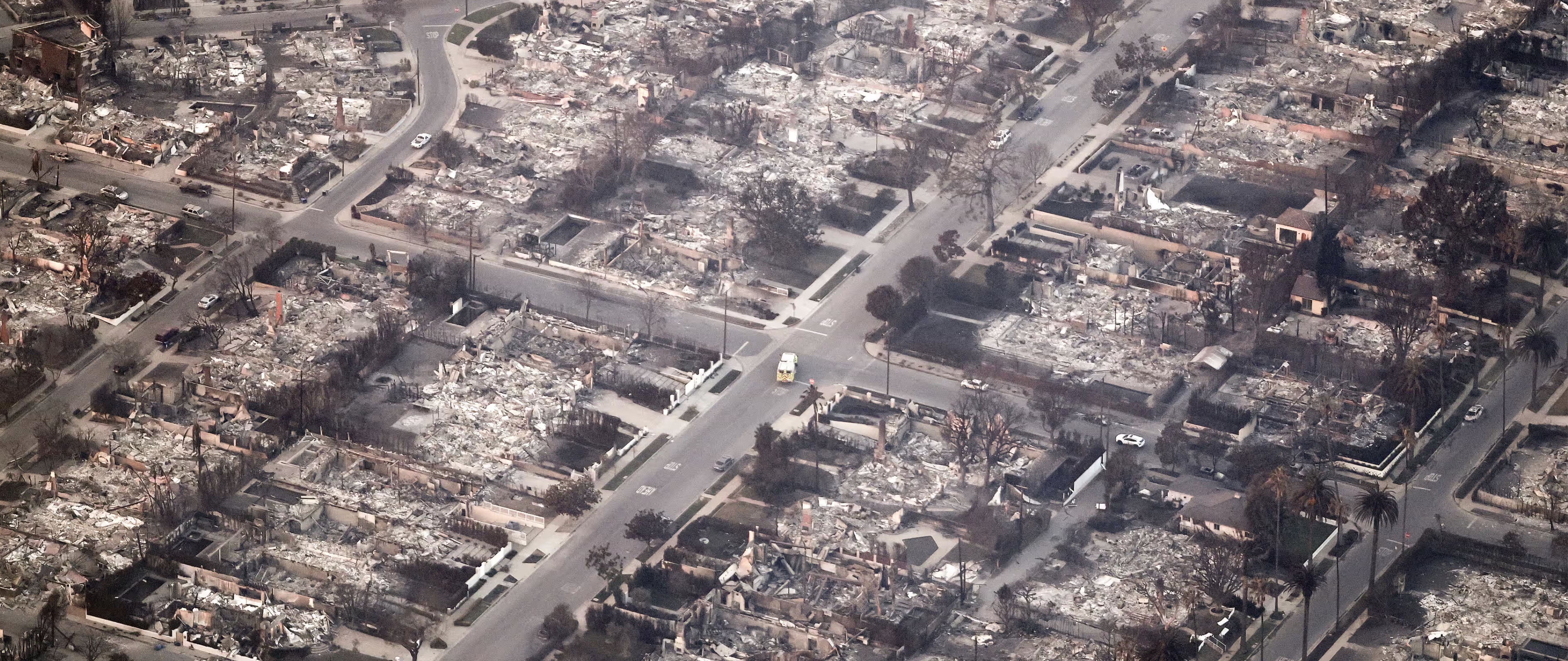
The observation that I wish to explore for a few moments here is the regularity in which the idiom, ‘biblical’ is used to describe events of monumental significance, and most commonly, those that are tragic in nature. It’s not only the use of ‘biblical’ in the vernacular but our almost subconscious reliance upon the Bible in order to make sense of life’s events. The Bible has so influenced our epistemology and morality and spirituality, that we defer to its words and ideas, often without realising or without belief.
What does it mean to be ‘biblical’?
On one level, it makes sense that we use the word, ‘biblical’ to describe overwhelming tragic events. After all, the Bible contains a large volume of events with awesome power and of cosmic consequence. Whether it is the Noahic Flood, the Plagues on Egypt, or the destruction of nations and humbling of kingdoms, the Bible depicts massive occasions and crises.
However, one of the mistakes we can fall into is assuming the Bible’s presentation of disaster as simplistic. This is far from the case. Comprehending the whys and what’s of grim events isn’t as easy as dividing the world into good and bad people, or equating blessing with moral people and suffering with sinful people. This is one reason for engaging seriously with the Bible text rather than relying on easy sloganeering. Learn our theology less from Dante and more from the Bible, and when we do we discover that the Holy Scriptures presentation is far more fearful and freeing, awesome, overwhelming and also consoling.
Let me show you. Take, for example, these five elements that are traced throughout the Bible’s storyline and which intersect and develop as we move from Genesis to Malachi and from Matthew to Revelation. Rather than picking and choosing or making a bland pot of tea, there is more to this ‘biblical’ than we may first realise.
First, disasters, whether ‘natural’ or manmade, signal to us that the world is not okay. The world in which we live, work, and play is amazing and replete with good things, and yet hardship and suffering meet us at every intersection. This is not a utopian world. The greatest minds and technologies still cannot control the forces of nature. We cannot ever curb human instincts toward evil, let alone human error. Indeed, we often use our imaginations and advancements to continue ill, rather than to cure. In this, the Bible is an honest story. The Bible is real to life. The Scriptures don’t ignore the heights of human joy and love and life, nor the greatest ignominy and ignorance.
The Bible isn’t a fictitious fable where everything ends well and the Princess rides off with the pony. The Bible exposes the cruelty of loss, the horror of death, and the thousand ways life is upended.
Second, today’s disasters are prelude to a day of Divine judgment. The presence of floods, fires, and disease are not moot experiences, simply to be endured.
As C.S Lewis famously wrote, “God whispers to us in our pleasures, speaks in our conscience, but shouts in our pains: it is his megaphone to rouse a deaf world”
In his famous ‘apocalyptic’ sermon, Jesus likens both natural and human-made disasters to a pregnant woman entering labour,
“Such things must happen, but the end is still to come. Nation will rise against nation, and kingdom against kingdom. There will be famines and earthquakes in various places. All these are the beginning of birth pains.” (Matthew 24:5-8)
In other words, not only is tragedy and pain signalling a world that is in turmoil, but these preempt, like a siren or rolling thunder, that a cataclysmic event is approaching. Jesus is saying, that as awful as these things are, they are reminders that we will all one day meet the God who is a consuming fire, holy and awesome.
Third, tragedy strikes everyone. We ought to step with extreme caution as we try to understand events in our lives and in those of other people. It is too easy, and erroneous, to suppose the tragedy only strikes the ‘sinner’ and blessing for the ‘righteous. Don’t be like Job’s friends!
In Los Angeles this week, the poor and wealthy alike, Hollywood stars and house cleaners, have shared the same loss. I know of Christians who have lost homes and Church buildings that become ruin and ash.
There are occasions in the Bible narrative where disaster falls on particular people as Divine judgment for specific sins. Many of the most serious words and actions are directed by God on his own people because of their continued evil and unrepentance. Moreover, the biblical testimony describes the world in which we live as fallen and corrupted, and all experience the moment. On one occasion Jesus gave an explanation of tragedy which should caution all before attributing specific Divine judgment for particular events in our time.
On one occasion when Jesus pushed back on the view that tragedy is necessarily linked to some specific horrible deed lurking in your past. Jesus mentions to local events, one was a massacre and the other a building collapse, and he used both incidents to rebuff the idea that suffering equals guilt,
Jesus answered, “Do you think that these Galileans were worse sinners than all the other Galileans because they suffered this way? I tell you, no! But unless you repent, you too will all perish. Or those eighteen who died when the tower in Siloam fell on them—do you think they were more guilty than all the others living in Jerusalem? 5 I tell you, no! But unless you repent, you too will all perish.” (Luke 13:2-5)
Fourth, we long for Divine intervention and grace. Why do we pray? When we lose control and when hope dissipates why is prayer the near universal default?
Jesus won’t have us believe that this is some evolutionary residue or chromosomal leftover from less developed times. Jesus (and therefore the Bible), won’t let us think that God is in any way less Sovereign today than in any moment of history. Rather, it is because God is God, and because he is a good God, that we can cry out to him, ‘Abba Father’.
Fifth, and perhaps most important of all, ‘biblical’ does not only denote terrible events, but also the wonderful and life giving.
Not all the ‘biblical’ is bad and disastrous – the truly biblical includes exquisite and extraordinary, grace and goodness. The pages of the Bible are filled with stories of immense love and of extravagant mercy and forgiveness. Even judgment is often met with redemption, and grief finds consolation. Above all, the most horrifying event of all history, the cross of Jesus Christ, also turns out to be the defining event that produces forgiveness, peace and new life.
The incarnation is big time ‘biblical’. That God the Son should come into our space and share our humanity and experience every gamut of human suffering. Jesus went further and grabbed hold of human sin and guilt and bore Divine punishment for us by his death on the cross.
This event of ‘biblical’ proportion is matched by his resurrection. The God Man who died and was laid in the tomb, was raised to real life on the third day: breathing, walking, physical and cognitive functioning life.
Within hours of the fires erupting in Los Angeles, people were looking for explanations and for people to blame. Indeed, investigations and enquiries will no doubt take place. Such things are important. Lessons need learning.
My point here is a simple one, equating events to ‘biblical’ isn’t a bad starting place. Most of us will do this, and do so without knowing what is ‘biblical’. In 2025, believers, sceptics and investigators will each turn to the Bible to image, explain and interrupt the events in our world, both great and small. As we do, let’s not mythologise the Bible or reduce the Scriptures to monolithic meaning, but embrace the whole.
We won’t grasp the ‘why’ of every tragedy in this life and world; such wisdom is beyond our pay grade. What is remarkably Biblical is to realise that God entered human suffering in the most personal of ways. Jesus’ life was marked by suffering. He walked alongside the sick and the destitute. He loved the poor and the outcast. His crucifixion entailed every manner of pain and violence, such that he satisfied the right wrath of God. He has even extinguished the power of death so that we might share ultimately in his life forever.
 MurrayCampbell.net